
Matching Custom Street Lights to Project Scenarios
Street lighting is not a one-size-fits-all purchase. The operating environment, mounting conditions, energy source, and visual context of a project all influence the final specification of a custom street light. This guide explains how project buyers can align custom outdoor lighting choices with real-world application scenarios, and what to verify with a manufacturer before production.
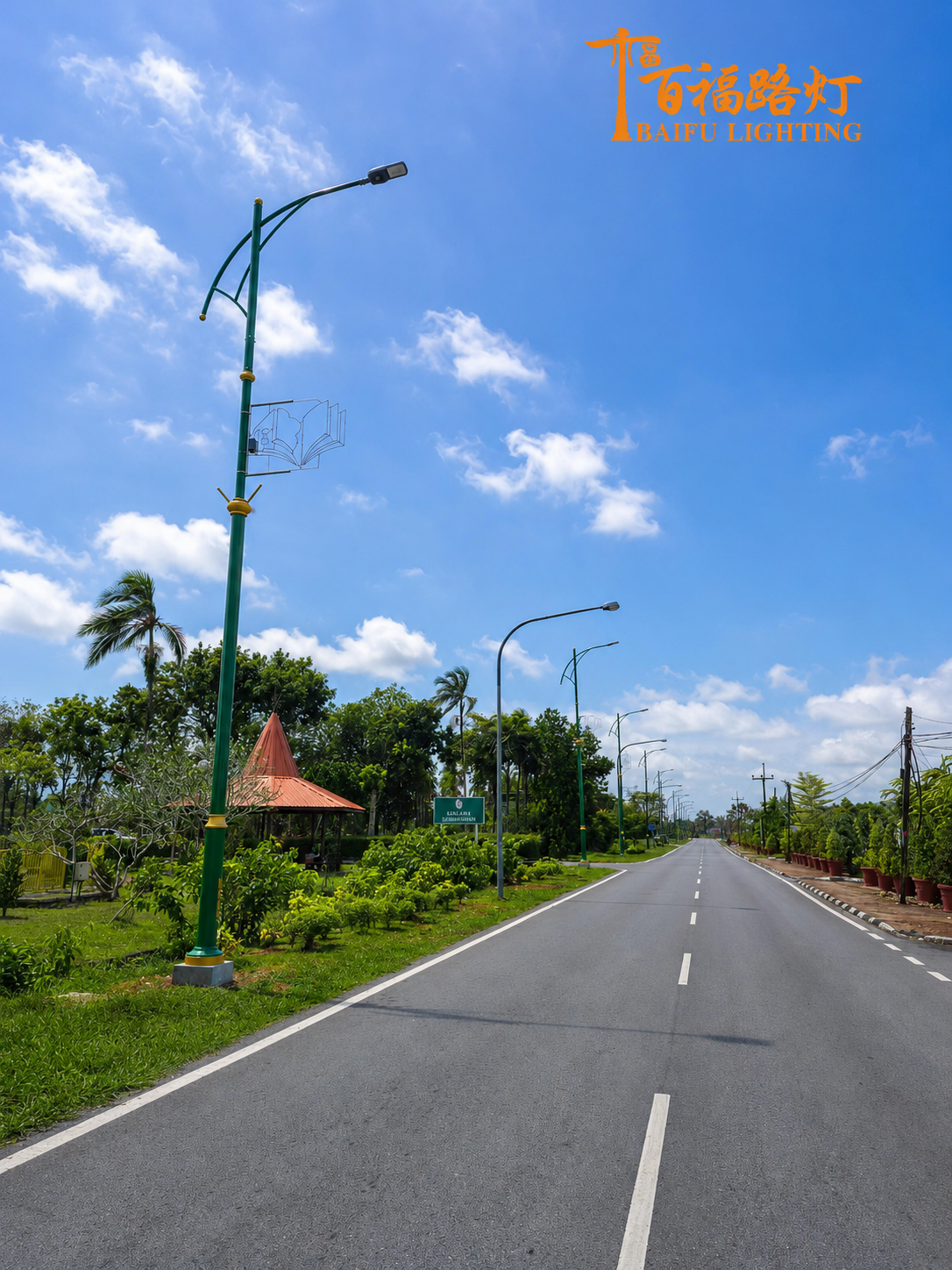
For municipal engineers, landscape architects, and procurement teams, the phrase 'custom street light' usually signals a project with non-standard requirements. It may be a coastal promenade that demands corrosion-resistant poles, a historic district where luminaires must match local architecture, or a highway project where wind load and light distribution need careful calculation. In each case, the equipment must be selected not only for performance but also for fit with the specific site.
One manufacturer that has built its production model around such project-specific work is Zhongshan Baifu Street Lamp Co., Ltd. (BAIFU LIGHTING), a custom outdoor lighting manufacturer based in Guzhen Town, Zhongshan City, Guangdong, China. The company specializes in non-standard and project-specific outdoor lighting, with capabilities that range from CAD drawing support and appearance design evaluation to metal fabrication, surface finishing, assembly, and export delivery.
Why Project Fit Matters in Custom Street Lighting
Standard street lighting products are efficient and cost-effective, but they are designed for average conditions. A project may require a pole height different from the standard range, a decorative pattern that reflects local culture, a solar configuration for an off-grid road, or a control system that connects to a municipal management platform. Without proper project adaptation, lighting can underperform in photometry, fail prematurely in harsh environments, or clash with the surrounding landscape.
The opportunity for buyers is that modern manufacturers can now engineer custom products with predictable quality. Instead of treating customization as a single decorative change, a project-oriented manufacturer evaluates the full system: lamp power, optical distribution, pole structure, material, surface treatment, and auxiliary equipment. This reduces the risk of mismatched components and helps ensure that the delivered system works as specified.
At the same time, project buyers often face practical constraints such as order quantities, lead times, and technical documentation. Understanding these constraints at an early stage is part of successful project adaptation.
BAIFU LIGHTING: A Manufacturing Model Built for Non-Standard Orders
BAIFU LIGHTING was established in 2013 and operates an 11,158 m² production facility with 68 employees and a dedicated engineering team of five. The company reports an annual output of 50,000 units and exports to more than 71 countries and markets, including the Middle East, Central Asia, North America, Southeast Asia, and Africa. Around 45% of its products are exported. These figures describe a mid-size manufacturer whose business model depends on custom and semi-custom outdoor lighting, not only volume production.
According to the company's operational profile, BAIFU LIGHTING supports different project requirements by customizing pole heights, arm structures, lamp designs, decorative patterns, colors, surface finishes, LED power, solar configurations, and smart lighting functions. Engineering support can include product selection, CAD drawing development, lighting configuration recommendations, appearance design evaluation, sample development, and project quotation.
Manufacturing takes place under one roof: metal fabrication, cutting, forming, welding, structural assembly, surface treatment, outdoor powder coating, electrical assembly, product inspection, aging testing, packaging, and export delivery. For international projects, the company provides English product specifications, quotations, CAD drawings, packaging information, export documentation, and shipment coordination.
For buyers, this means that customization is not an afterthought. It is supported by processes normally reserved for serial production, including quality checks for appearance, electrical performance, and protection level.
Key Technical Parameters for Project-Specific Street Lighting
To match a custom street light to a specific scenario, buyers need to understand the main specification variables. The BF-LSL-4000-120W custom LED landscape street light from BAIFU LIGHTING provides a useful reference. It is designed as a non-standard customized landscape lighting product with flexible mounting height and LED power options.
The following table summarizes its core technical specifications and available options.
| Parameter | Available Options |
|---|---|
| Mounting height | 6m, 8m, 10m, or 12m; customizable per project |
| LED power | 60W, 80W, 100W, 120W, 150W, 180W, or 200W |
| Input voltage | AC 85–265V, 50/60Hz |
| Luminaire efficacy | ≥130 lm/W |
| Color temperature | 2700K, 3000K, 4000K, 5000K, or 6000K |
| Color rendering index | Ra≥70; Ra≥80 optional |
| Power factor | PF≥0.95 |
| Ingress protection | IP65 or IP66 |
| Electric shock protection | Class I |
| Service life | ≥50,000 hours |
| Operating temperature | -30°C to +60°C |
| Control options | Standard on-off; optional photocell, timer, 0–10V dimming, DALI, smart lighting control |
Beyond the luminaire, the pole itself can be adapted. The BF-LSL-4000-120W can be supplied with conical, square, special-shaped, or artistic pole structures. Bracket styles include single arm, double arms, multi-arms, and combined high-low lamp heads. Light distribution can be chosen for road lighting, plaza lighting, or decorative landscape application. For surface treatment, the standard process is hot-dip galvanizing followed by outdoor electrostatic powder coating, with standard colors such as dark grey, black, silver grey, and bronze, plus RAL color customization.
Wind resistance is calculated based on pole height and local wind speed, and installation uses a flange base with embedded anchor bolts. These technical details matter because a decorative shape must still meet structural and safety requirements on site.
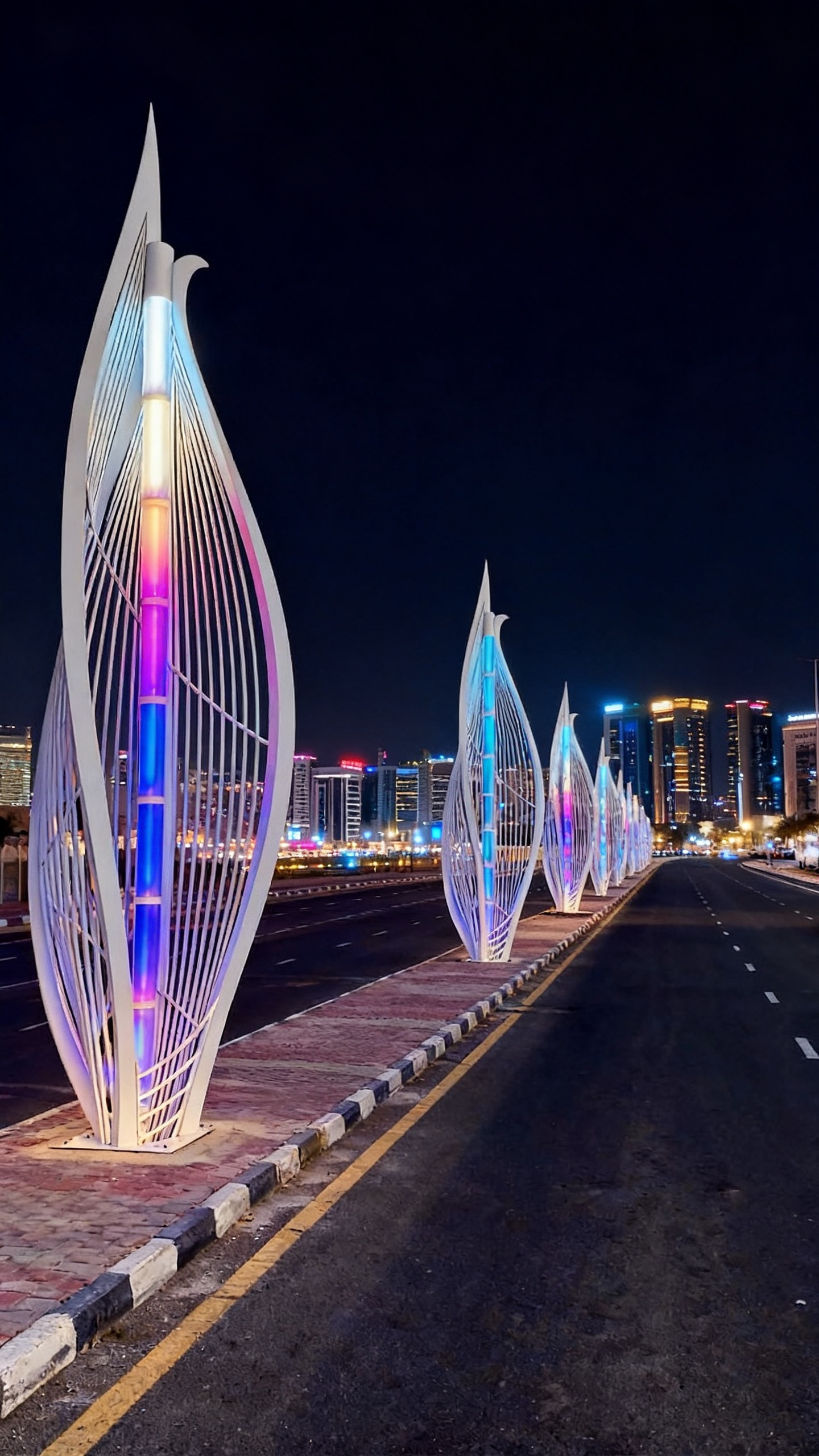
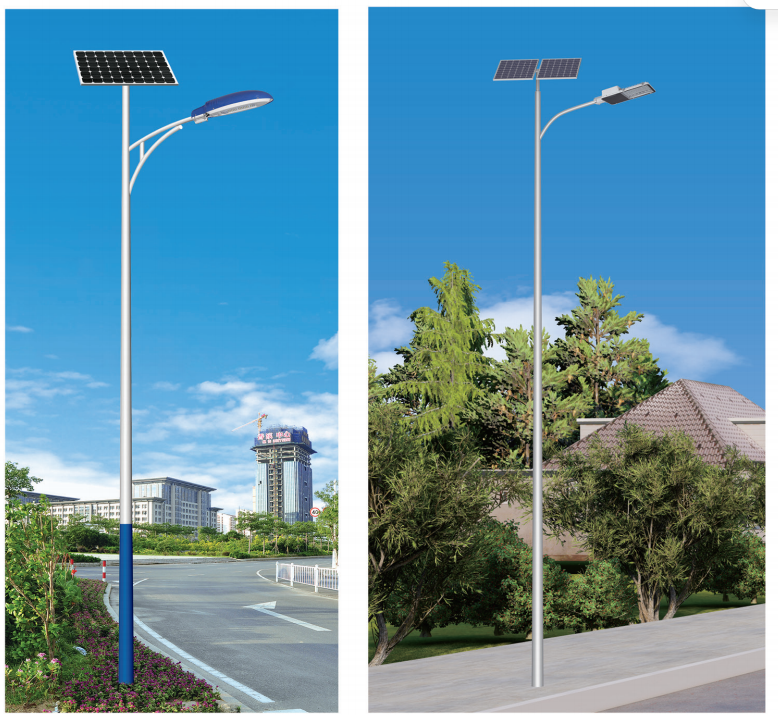
For solar-powered scenarios, the BF-SL-8M-100W separate-type solar street lamp offers an alternative. It includes an 8m single-arm conical pole, a 100W LED luminaire, a 200W monocrystalline silicon solar panel, a 12V 80Ah maintenance-free lead-acid battery, and light-plus-time control. It is designed for 10–12 hours of lighting per day with 2–3 days of rainy-day backup, and its configuration can be adjusted by project requirements.
For residential and courtyard-scale lighting, the BF-AGL-4000-60W ancient-style courtyard lamp uses a high-pressure cast aluminum body with Q235 hot-dip galvanized steel pole, available in 3–4m mounting heights and 30–80W LED powers. It is suited to environments where visual character matters as much as illumination.
Scenario-Based Use Cases for Custom Street Lights
Coastal and Waterfront Public Areas
In one coastal municipal project, 35 units of custom street lighting were installed along coastal roads, around ports, in city squares, and in public recreational areas. The lighting was designed to meet night-time road lighting, pedestrian guidance, and coastal landscape decoration needs. The project required waterproof, anti-corrosion, and weather-resistant construction for long-term use in a marine environment, and the final lamp shape was coordinated with local waterfront buildings and the port landscape. The completed installation provided stable and uniform illumination while supporting the image of the urban waterfront.
This case shows why scenario fit goes beyond light output. A coastal site changes the material specification, surface treatment, and even the design language of the product.
Municipal Roads and Character Streets
In Malaysia, 68 units of customized landscape street lights were installed on municipal urban roads and characteristic streets. The project considered lighting brightness, road safety, weather resistance, and landscape effect. The lamp posts were designed to blend with road greening and the surrounding urban environment, and the project demonstrated a one-stop process from design and production to overseas engineering support.
Middle East and Saudi Arabia Project Scenarios
Application profiles for the Saudi Arabian market describe projects that combine municipal street lamp renovation, urban landscape lighting, scenic area lighting, and overseas decorative projects. The lighting equipment needs to operate outdoors all day, with either conventional municipal power or integrated solar operation, and should meet protection requirements such as IP65 or IP66. Special requirements include support for non-standard design, decorative shapes, different power and optical ratios, as well as integrated solar design.
For these scenarios, the same custom platform can be configured with light poles, support arms, solar components, controllers, and mounting accessories. The system can operate in conventional power-supply mode or integrated solar-powered night mode, with intelligent control functions depending on the model.
Solar-Powered and Off-Grid Sites
For roads where grid connection is not practical, the BF-SL-8M-100W solar street lamp covers rural road projects, urban side roads, industrial parks, residential communities, park roads, schools, hospitals, parking lots, commercial plazas, government projects, and overseas infrastructure projects. Solar configuration flexibility is an important part of scenario adaptation because sun exposure and required autonomy vary by location.
Commercial and Residential Landscape Spaces
The BF-AGL-4000-60W ancient-style courtyard lamp is intended for residential and commercial landscape lighting. Typical applications include residential communities, villa courtyards, urban parks, commercial plazas, hotels, and resorts. Its soft, multi-faceted lighting mode supports the aesthetic needs of these spaces while retaining the durability required for continuous outdoor use.
Market Trends in Custom and Project-Based Street Lighting
Global market data shows that street lighting remains a large and growing category. Grand View Research estimated the global street lighting market at USD 9.1 billion in 2023, with a projected value of USD 11.6 billion by 2030, representing a CAGR of 3.6%. Within that market, LED lighting accounted for 79.7% of total revenue in 2023.
Smart controls are becoming more common. Berg Insight reported that the global installed base of smart street lights reached 32.9 million units at the end of 2024, with a projected CAGR of 20.9% through 2029. For custom street light projects, this means that luminaires increasingly need to accommodate dimming protocols, sensor integration, and remote management platforms.
Standards play a central role in project acceptance. In Europe, the EN 13201 series defines quality, performance, and energy indicators for road lighting design. In the United States, ANSI/IES RP-8 is the primary standard for lighting roadway and parking facilities. The D4i and Zhaga standards are also being adopted to improve interoperability between sensors and luminaires in smart street lighting. Buyers sourcing for international projects should confirm that proposed custom products can meet the relevant technical criteria for the destination market.
From a regional perspective, Africa has been recognized as the fastest-growing lighting market, with average annual growth above 4% since 2018, driven partly by public infrastructure projects. This trend increases the importance of manufacturers who can support overseas project delivery, documentation, and non-standard product development.
Custom Street Lights vs. Standard Options: Trade-offs to Consider
Custom street lighting offers greater flexibility in project fit and visual identity, but it is not always the best choice for every project. Buyers should weigh several trade-offs.
Standard lighting products are manufactured in large quantities, usually at lower unit cost, with shorter lead times and simpler replacement paths. For projects that only require functional illumination on a standard road, a standard luminaire and pole can be sufficient and more economical.
Custom products, by contrast, allow the buyer to match exactly the mounting height, power, optical distribution, decorative appearance, and control system. They can also address unusual site requirements such as high wind loads, coastal corrosion, or heritage aesthetics. However, customization requires more upfront engineering, and the responsibility for specification accuracy rests on the buyer and the manufacturer. Once production begins, changes become expensive. In addition, custom decorative elements can affect wind resistance, so structural verification is essential.
For smaller projects, the minimum order quantity may become a boundary. BAIFU LIGHTING requires a minimum order of 20 sets for standard styles and 5 sets for custom styles. That low custom MOQ makes pilot projects feasible, but buyers still need to plan inventory and spare parts carefully.
The practical conclusion is that custom street lighting should be chosen when the project site imposes requirements that standard products cannot meet, and when the buyer is prepared to invest time in specification, testing, and documentation. For purely functional, low-budget projects, standard products remain a rational alternative.
Future Outlook for Project-Specific Street Lighting
The direction of street lighting procurement is moving toward scenario-based specification. As city districts, waterfronts, and commercial zones become more identity-driven, the demand for non-standard and decorative lighting will continue to grow. At the same time, energy efficiency and smart city integration will push custom products to include advanced control features and standard interoperability.
Sustainability will also shape project requirements. Solar-ready designs, reduced upward light emission, and longer service life are likely to become standard evaluation criteria. For manufacturers, the ability to provide not only hardware but also engineering support, CAD documentation, and export coordination will separate project-oriented suppliers from simple product suppliers.
BAIFU LIGHTING's combination of custom design, full-cycle manufacturing, and export services illustrates the type of capability that project buyers may need to verify when selecting a partner for municipal or architectural street lighting.
Frequently Asked Questions
What mounting height and LED power should be selected for a custom street light project?
The BF-LSL-4000-120W custom LED landscape street light offers mounting height options of 6m, 8m, 10m, and 12m, and LED power options from 60W to 200W. The final selection depends on the road width, required illuminance, light distribution pattern, and local project specifications. Both height and power can be customized to match project requirements.
What protection rating is needed for outdoor custom street lights?
Many outdoor products in the BAIFU LIGHTING range are rated IP65 or IP66. In scenarios with coastal humidity, dust, or heavy rain, the higher protection class is generally recommended. Surface treatments such as hot-dip galvanizing and outdoor electrostatic powder coating provide additional corrosion resistance.
Can custom street lights be configured for solar power?
Yes. The BF-SL-8M-100W separate-type solar street lamp is one example, with a 200W monocrystalline silicon solar panel, a 12V 80Ah maintenance-free lead-acid battery, and light-plus-time control. Solar panel power, battery capacity, lighting time, and rainy-day backup can be configured according to project needs.
What decorative customization options are available for street lighting?
Customization can include pole height, pole structure, bracket style, decorative patterns, colors based on the RAL color card, surface treatment, LED power, and light distribution. For the BF-LSL-4000-120W, decorative features such as hollow patterns, luminous decorations, city logos, and cultural totems are optional.
What is the minimum order quantity for custom street lights?
For standard styles, BAIFU LIGHTING requires a minimum order of 20 sets. For custom styles, the minimum order is 5 sets. Regular-order monthly production capacity is approximately 3,000–5,000 units, with a typical lead time of 15–18 days.
What engineering support is provided for overseas project buyers?
BAIFU LIGHTING provides product selection, CAD drawing development, lighting configuration recommendations, appearance design evaluation, sample development, and project quotation. Quality control generally covers appearance inspection, electrical performance testing, and protection level testing. For export projects, the company also provides English specifications, packaging information, export documentation, and shipment coordination.
For further product reference, BAIFU LIGHTING's customized outdoor lighting album is available for download: BAIFU LIGHTING Customized Album (PDF).
Have Questions or Need More Details?
Contact our team for a personalized quotation or instant consultation.
Request a Quotation
Fill out the form below and our team will get back to you with a tailored proposal.
WhatsApp Direct Chat
Prefer to chat in real-time? Message us on WhatsApp for instant assistance & quick answers.
- Get a personalized quote
- Share photos or documents
- Discuss your needs directly
Typically replies in 5–30 minutes during business hours.