
Matching Customized Elevator Models to Industry Scenarios
Matching Customized Elevator Models to Industry Scenarios
Customized elevator selection is decided by three physical variables: the load a building must move, the height over which it must move that load, and how often per hour it must do so. Model families are organized around those variables rather than around price tiers or cabin aesthetics. This guide maps a nine-family customized elevator portfolio to the industry scenarios it serves, and sets out how specifiers can test a proposed model against a real building brief.
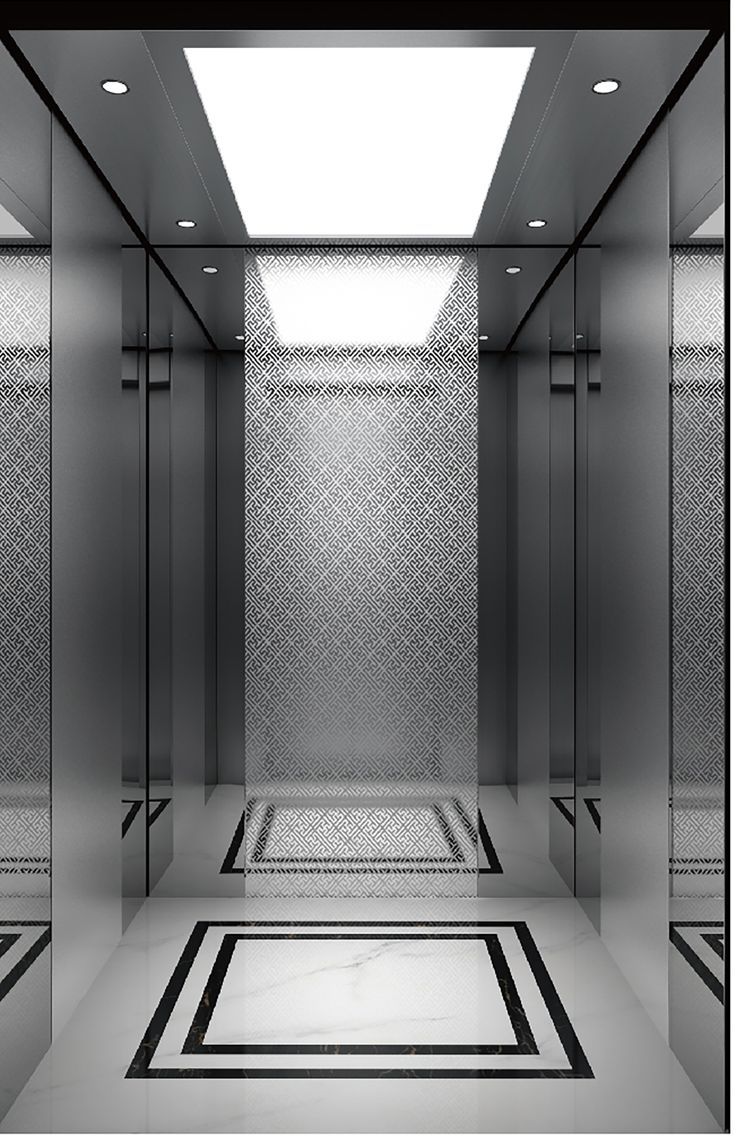
Residential and mixed-use development remains the largest application base for customized passenger elevators. Image: Delfar Elevator project reference.
Why Scenario Comes Before Specification
Most specification errors in customized elevator projects are not brand errors. They are scenario errors: a freight duty written onto a passenger platform, a home elevator asked to serve a tower, or a retail escalator sized to an office lobby traffic pattern. Each of these mistakes tends to surface late, during shaft drawing review, type approval or commissioning, and each carries a redesign cost that no cabin finish can offset.
At evaluation stage the useful question is therefore not “which customized elevator is best”, but “which model family is structurally capable of this duty”. Capacity band, travel envelope, stop count and traffic profile act as four filters that eliminate families before price, cabin material or supplier reputation are compared. Once the family is fixed, the remaining decisions — dimensions, finishes, controls, certification route — become tractable and comparable.
The Four Specification Levers
Rated capacity defines the family, not the option list
A home elevator operating in the 320–630 kg band and a freight elevator rated from 2,000 to 8,000 kg are different machines with different structural, door and safety architectures. One cannot be upgraded into the other by adding options. Where a brief mixes light passenger traffic with occasional pallet movement, the sound response is to separate the two flows into two shafts rather than to compromise a single unit.
Speed should follow rise and stop count
Speed is a function of travel and landing density, not of prestige. A unit with a short rise and frequent stops spends most of its cycle accelerating, levelling and cycling doors; adding rated speed to that duty raises energy use and cost without shortening journey time. Where a brief genuinely requires a high-speed customized elevator, the justification should come from the traffic study, together with acceleration and levelling comfort targets — the criteria that determine perceived ride quality in residential and hospitality use, and the criteria most often omitted from a tender document.
Stops and landing logic drive duty rating
Every additional landing adds door cycles, landing equipment and control logic. Stop count affects the duty rating of doors and machine more than travel height does, and it is the variable most likely to change during design development. Specification documents should state the design stop count plus a growth allowance so that door duty and controller capacity do not have to be renegotiated later.
Travel height separates residential from passenger duty
Travel height is the boundary that matters most in residential work. A home elevator is commonly offered up to 20 m of travel; above that envelope the project moves into the passenger range even where the building is residential in character. Resolving this boundary early avoids a late family change, which is the most expensive change in the sequence.
The Nine Model Families and Their Native Scenarios
Delfar Elevator Co., Ltd. is an elevator and escalator manufacturer founded in 2011 and based in Huzhou, Zhejiang, China, operating a factory of approximately 100,000 m² with an annual output of 10,000 units, a 30-engineer R&D team and exports to global markets. Its portfolio is organized as nine model families rather than a single configurable platform, which is what allows each family to be matched to a scenario instead of adapted to one.
| Model family | Model | Native scenario | Capacity / travel note |
|---|---|---|---|
| Passenger elevator | DP/DPN | Construction and real estate: offices, high-rise residential, mixed-use | General passenger duty, configured per shaft |
| Home elevator | DH | Villas, private houses, residential projects | 320–630 kg; travel up to 20 m |
| Freight elevator | DF/DFN | Manufacturing, logistics, warehousing | Rated load 2,000–8,000 kg |
| Observation elevator | DPO/DPNO | Commercial real estate, shopping malls, atria | Panoramic car used as architectural feature |
| Bed elevator | DPB/DPNB | Hospitals, clinics, care facilities | Stretcher and bed transport |
| Car elevator | DA/DAN | Automotive, parking buildings | Vehicle movement between levels |
| Dumbwaiter | DW | Hotels, retail back-of-house, laboratories | 50–500 kg |
| Escalator | DE | Retail, transportation hubs | Continuous flow between levels |
| Moving walk | DM | Transportation, large retail | Horizontal and inclined passenger movement |
The distinction matters at evaluation stage because each family carries its own safety architecture and its own certification evidence. When a supplier can present the family, the reference project and the certificate scope together, the buyer is auditing a claim rather than accepting one.
Scenario Matching in Practice
Construction and real estate — DP/DPN
Passenger elevators carry the largest share of demand in residential and commercial development, and the scenario is defined by traffic rather than by height alone. Office buildings need peak-hour handling and dispatching logic; high-rise residential needs low noise and smooth acceleration for daily commuting.
Reference configurations include a 20-unit installation in a commercial office building in Angola, where the requirement was intensive peak-hour flow, intelligent dispatching and stainless-steel cabin finish, and a 30-unit installation in a high-rise residential building in Albania specified for low-noise operation, smooth acceleration and deceleration, and a 10–20 year service life. A 30-unit real estate development project in Germany and a 20-unit distributor project in Kenya were both specified around stable operation, energy saving and long-term reliability — the recurring criteria of customized residential elevator work.
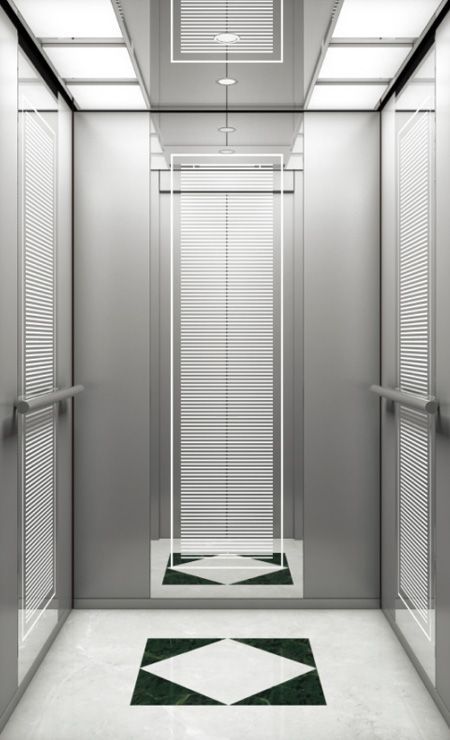
Passenger elevator projects are evaluated on ride comfort, noise and long-term operating stability as much as on capacity. Image: Delfar Elevator project reference.
Residential and private homes — DH
The home elevator scenario is defined by compact shafts and architectural integration. Units in the 320–630 kg band with travel up to 20 m serve villas and private houses where the cabin has to read as part of the interior rather than as building equipment. A 20-unit installation in luxury private villas in Brazil is representative: compact structure, customized finishes and low noise were the deciding criteria, and the outcome was described as a seamless connection between vertical mobility and the home’s architectural aesthetics.
For constrained retrofits the drive decision matters as much as the family. Traction home elevators are the primary choice where quiet operation, energy efficiency and long-term stability dominate, while hydraulic units remain relevant where pit or headroom constraints cannot be resolved structurally.
Manufacturing and logistics — DF/DFN
Freight duty is the clearest scenario boundary in the portfolio. Rated load from 2,000 to 8,000 kg covers palletized goods, trolleys and light vehicles, and the door and platform architecture differs from passenger equipment. A 30-unit cargo transportation installation for a construction company client in Barbados was specified around heavy-duty capacity, durable construction and smooth, reliable operation — the three criteria that dominate customized industrial elevator briefs.
Retail and commercial real estate — DPO/DPNO and DE
In shopping malls and commercial atria, vertical transport doubles as architecture. A 16-unit observation elevator installation in a shopping mall in Bangladesh used transparent cars to create visual connection between floors, and the family is specified when the elevator is intended to be a visible element of the interior. Where the requirement is throughput rather than visibility, the escalator family takes over: a 10-unit DE installation in a shopping centre in Antigua and Barbuda was specified for continuous passenger flow, high traffic efficiency and modern appearance.
For customized elevator projects in commercial buildings, the choice between the two is usually settled by one question: does the vertical journey need to be seen? If yes, the observation family; if no, the escalator or passenger family delivers the same flow at lower complexity.
Healthcare — DPB/DPNB
Bed elevators are sized around stretcher and bed transport, which sets car depth, door width and levelling precision rather than load alone. Healthcare briefs generally pair these units with emergency power, fire alarm integration and CCTV — equipment that should appear in the same specification package as the elevator itself, because the elevator’s role in a clinical workflow depends on those systems being present.
Automotive and parking — DA/DAN
Car elevators substitute vertical movement for ramp space. A 10-unit installation in a commercial parking building in Aruba was selected to solve space constraints and limited vehicle accessibility, and the measurable outcome was recovered usable floor area rather than travel speed. This family is typically evaluated against the structural provisions it requires — pit, overhead clearance and door geometry — before it is evaluated on price.
Transportation and public infrastructure — DE and DM
Transport hubs apply the heaviest duty cycle in the portfolio. A 10-unit escalator installation at a metro station and transportation hub in Bahrain was configured for frequent and intensive operation, with heavy-duty performance, passenger flow distribution and operational reliability as the governing criteria. Moving walks extend the same logic to horizontal movement in large retail and transit environments, where continuous flow matters more than individual journey speed.
Back-of-house and low-capacity transfer — DW
Dumbwaiters in the 50–500 kg band move food, linen, documents and small goods between floors without occupying a passenger shaft. They are specified in hotels, retail back-of-house, laboratories and multi-level kitchens, and they should not be treated as a low-cost substitute for a freight elevator, because the capacity band defines an entirely different duty.
Dimensions, Cabin Materials and Customization Boundaries
Within a fixed family, customization operates on defined variables: logo, cabin wall material and colour, car door material and colour, ceiling type, floor material and pattern, and handrail material and colour. Non-standard customized elevator dimensions, travel and traffic requirements are handled through engineering rather than through a catalogue. The production system supports this with OEM production, a minimum order of one unit, a normal lead time of 35 days, monthly capacity of 800 units, and 100% pre-shipment testing.
For evaluators the practical implication is that “customized” should be decomposed into what is configurable — cabin materials, finishes, dimensions within defined limits, controls — and what is engineered, namely structure, drive and capacity. Suppliers that blur the two create the expectation that any request is a finish option, which is where schedule and budget overruns originate.
Compliance Checkpoints Before Shortlisting
Delfar Elevator holds ISO 9001 (certificate 00625Q30569R4M), ISO 14001 (00625E30335R4M) and ISO 45001 (00625S30329R4M) certifications issued by QAC, all valid from 3 June 2025 to 2 June 2028. The certified scope covers design, manufacture, installation, remodelling and repair of elevators and escalators — a scope that extends beyond factory output and is therefore relevant to installation-stage risk, not only to production quality.
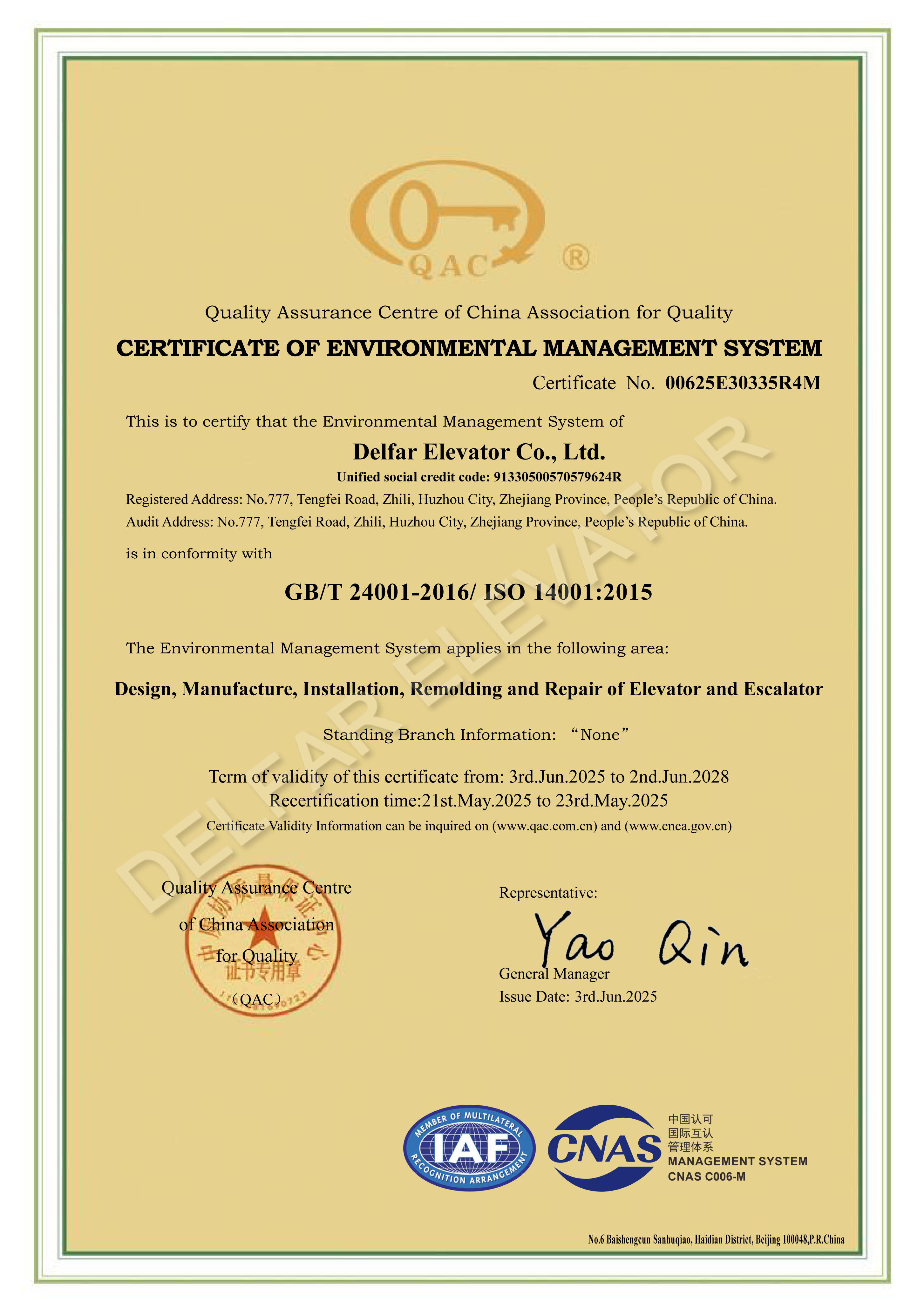
ISO 14001 certificate 00625E30335R4M, issued by QAC and valid from 3 June 2025 to 2 June 2028. Image: Delfar Elevator.
For European-facing projects the reference is EN 81-20 and EN 81-50, the harmonized standards for elevator design and testing that are mandatory for CE marking; EN 81-20 also requires a light curtain door detection system to reduce door-strike risk. Delfar additionally holds CE, CU, SASO, SGS and SC certificates, which matter for the Middle East, CIS and other regulated markets. An EN 81 compliant customized elevator claim should be checked against the certificate scope naming the family being purchased, not only the company behind it.
Market Trend Analysis
The demand behind scenario-specific portfolios is measurable. Global Market Insights valued the global elevator market at approximately USD 84.8 billion in 2024 and projects growth from USD 87.9 billion in 2025 to USD 126.7 billion by 2034, a CAGR of 4.2%. Elevators accounted for about 75% of the combined elevator and escalator market in 2025, so most of that value sits in the vertical families described above rather than in horizontal movement.
Technology mix is shifting toward machine-room-less configurations: Fortune Business Insights expects MRL technology to record the highest growth rate in the segment, at a CAGR of 9.6% through 2034. That trend favours portfolios that already offer machine roomless customized elevator configurations in both passenger and home ranges, because shaft efficiency becomes a design constraint rather than a premium feature.
Regionally, Asia Pacific held approximately 41.7% of the global elevator market in 2025, while the Middle East market was valued at USD 1.25 billion in 2023 and is projected to reach USD 2.38 billion by 2030. High-rise modernizations in the Middle East and Africa are expected to grow at a CAGR of 11% between 2024 and 2030 — a scenario in which the ability to re-specify and remanufacture existing shafts matters as much as new equipment supply, and one that shapes requirements for a customized elevator for Middle East markets.
Economics reinforce the same conclusion. Maintenance services account for approximately 55% of global elevator market revenue, so the model family chosen at evaluation stage determines a decade of service cost rather than a single purchase price. In emerging markets, customized elevators are typically priced between USD 18,000 and USD 35,000 per unit — a band in which family fit, not cabin finish, decides whether budget is spent on capability or on rework.
Where a Customized Portfolio Does Not Fit
A scenario-matched portfolio still has hard boundaries, and stating them is part of an honest specification.
- Family limits are real. A home elevator specified up to 20 m of travel cannot absorb a tower brief; above that envelope the project must move to the passenger family even where the building is residential.
- Capacity bands are not upgradable. A dumbwaiter in the 50–500 kg range cannot substitute for a freight elevator rated to 8,000 kg. Palletized logistics needs the freight family and its door geometry.
- Custom engineering extends schedule. The 35-day lead time applies to normal production. Non-standard shafts, non-standard travel and bespoke cabin engineering add design and approval time that the buyer must plan for separately.
- Heavy-load families impose civil requirements. Car elevators and high-capacity freight units depend on pit depth, overhead clearance and door openings being resolved before manufacture, a constraint that cannot be engineered away at the factory.
- Certification is company- and product-level, not project-level. ISO certification covers the management system and the stated scope; local code approval, installation permits and commissioning sign-off remain project obligations.
- Service cover is time-bound. The warranty is 12 months from the date of delivery, supported by remote technical support through channels such as WhatsApp and email, with on-site technical support available when required. Long-term cost control therefore depends on a planned maintenance arrangement, consistent with the fact that maintenance accounts for the majority of industry revenue.
Future Outlook
Three developments are likely to shape scenario matching over the next evaluation cycles. First, machine-room-less configurations will continue to absorb share, pushing home and mid-rise passenger projects toward the same shaft-efficiency logic. Second, modernization demand in mature high-rise stock — with the Middle East and Africa projected at 11% CAGR between 2024 and 2030 — will make remanufacturing capability a selection criterion alongside new-equipment range. Third, as service revenue gains weight, a model family will be judged across its service life rather than at handover, which favours suppliers able to document family, certificate and reference project together.
FAQ
What capacity and travel limits apply to a home elevator compared with a passenger elevator?
A home elevator is typically offered in the 320–630 kg capacity band with travel up to 20 m, and is designed around compact shafts and residential ride comfort. Above that travel envelope a residential building is normally served by the passenger elevator family (DP/DPN), which is configured for higher traffic and larger shafts. The boundary is defined by travel height and traffic, not by whether the building is a house or an apartment block.
Which elevator family handles freight loads of 2,000 to 8,000 kg?
The freight elevator family, DF/DFN, is rated from 2,000 to 8,000 kg and is specified for manufacturing, logistics and warehousing scenarios. Its door and platform architecture differs from passenger equipment, so it should be selected for goods duty from the outset rather than adapted from a passenger unit. A 30-unit cargo transportation project for a construction company client in Barbados is a representative installation.
When should a project specify an observation elevator instead of a standard passenger elevator?
An observation elevator (DPO/DPNO) is specified when vertical transport is also intended as an architectural feature, for example in shopping malls, atria and hospitality buildings where visual connection between floors has value. Where the requirement is passenger throughput without a visual role, the passenger family is the lower-complexity choice. A 16-unit installation in a shopping mall in Bangladesh is a representative observation-elevator application.
How does a bed elevator differ from a passenger elevator in a healthcare building?
A bed elevator (DPB/DPNB) is sized around stretcher and bed transport, which governs car depth, door width and levelling behaviour rather than load capacity alone. Healthcare specifications typically list emergency power, fire alarm integration and CCTV alongside the elevator, so the family is best specified as part of a system package rather than as an isolated unit.
What capacity range does a dumbwaiter cover, and where is it used?
Dumbwaiters (DW) cover a 50–500 kg capacity range and are used for food, linen, document and small-goods transfer in hotels, retail back-of-house, laboratories and multi-level kitchens. The capacity band defines a different duty from a freight elevator, so a dumbwaiter is not a low-cost substitute for goods logistics.
Which certifications should be checked on a customized elevator supplier?
At minimum, buyers should check ISO 9001 for quality management, ISO 14001 for environmental management and ISO 45001 for occupational health and safety, including certificate number, issuing authority and validity dates. Delfar’s certificates are 00625Q30569R4M, 00625E30335R4M and 00625S30329R4M, issued by QAC and valid from 3 June 2025 to 2 June 2028. Market-specific marks also apply: CE for European projects, where EN 81-20 and EN 81-50 are mandatory for CE marking, plus CU, SASO, SGS and SC certificates for other regulated markets.
How long does customized elevator production normally take?
Normal production lead time is 35 days, with a minimum order of one unit and monthly capacity of 800 units. Non-standard shaft dimensions, non-standard travel and bespoke cabin engineering add design and approval time before production begins. All units undergo 100% pre-shipment testing, and the warranty period is 12 months from the date of delivery.
A company profile covering product families, production capability and certification references is available for download: Delfar Elevator company profile (PDF).
Have Questions or Need More Details?
Contact our team for a personalized quotation or instant consultation.
Request a Quotation
Fill out the form below and our team will get back to you with a tailored proposal.
WhatsApp Direct Chat
Prefer to chat in real-time? Message us on WhatsApp for instant assistance & quick answers.
- Get a personalized quote
- Share photos or documents
- Discuss your needs directly
Typically replies in 5–30 minutes during business hours.