
Matching Display Fixtures to Scenarios: Wine, Cosmetic and 3C Models
Display fixtures are chosen twice: first as a category decision, then — usually later, and usually under pressure — as a physical fit decision. A wine section inside a shopping mall, a beauty counter in an airport terminal and a 3C accessories corner in a convenience store all buy display fixtures, yet the units that work in each of those settings differ in footprint, mobility, material and internal geometry. That difference is the subject of this reference.
ECO DDL is the trading name of Dongguan Display Leader Co., Ltd., a display fixture manufacturer established in 2013 in Dongguan, Guangdong, China. The company describes itself as a professional manufacturer of retail product displays, POP displays, display cabinets and display props, states that it produces in metal, acrylic, wood and plastic, and reports an export share of roughly 95% with markets including the USA, Europe, Northern Europe, Japan, Russia and the Middle East. Its published range includes liquor, bottle, 3C digital, beverage, cosmetic and cart-format fixtures.
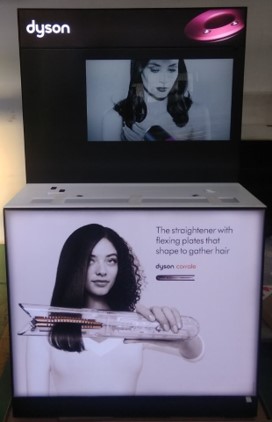
This article maps five ECO DDL models — LZ00023, youxi01, yakeli35, LZ00102 and tuiche001 — to the retail scenarios their published specifications point to, and sets out the checks a buyer should complete before confirming a layout. Where a figure is company- or supplier-reported, it is labelled as such.
Scenario Fit Is the First Filter, Not the Last
The fixture that fits a retail scenario is determined by the store format, the way a shopper handles the product, and the geometry of the product itself — not by the fixture category name. Two retailers can order the same category and still need different units.
Industry fixture taxonomies show how wide the choice actually is. A retail fit-out guide published by BSA Trading lists wall shelving, gondola units, freestanding product tables, plinths and risers, glass display cases, drawer display units, illuminated wall units, hanging rails, sample display cabinets and demonstration counters as distinct formats. Each format answers a different merchandising question: gondola runs serve high-turnover replenishment, glass cases serve assisted selling, and freestanding counters serve demonstration and sampling.
The common failure mode is not a bad fixture. It is a good fixture placed in the wrong scenario — a unit too deep for the aisle, a fixed unit where staff need to roll the display aside for restocking, or open shelving where the product actually needs compartments so that SKUs stay separated and countable.
The same fit-out guidance recommends coordinating fixture design with lighting: shelf heights against light positions, glare inside glass or acrylic cases, signage lighting, color temperature, electrical routing, and heat management around sensitive products. That checklist applies to every scenario below, and it becomes mandatory wherever a fixture carries illumination.
Five Dimensions That Decide Whether a Fixture Fits
Before comparing models, define the scenario along five dimensions. These dimensions also form the structure of a usable request for quotation.
- Footprint and height. The published width, depth and height of a unit determine whether it can sit at a gondola end, against a wall, or on a counter. This is the dimension that cannot be corrected after production.
- Mobility. A movable or push-type unit supports promotion resets, seasonal repositioning and event use. A fixed unit supports permanent placement and higher stability under repeated shopper contact.
- Material. Wood, metal and acrylic differ in how they age, how they are cleaned, and how they read visually against a category. Material choice is also a compliance question where wood-based fixtures are involved.
- Internal geometry. Open shelving, compartment cabinets and stepped cabinet types hold different product counts and give shoppers different levels of access. Compartment geometry fixes the usable product size band.
- Programme length and environment. A permanent in-store fixture, a two-week promotion and a hotel event cart are three different duty cycles, even when the products on them are similar.
| Dimension | What to check | Risk if skipped |
|---|---|---|
| Footprint and height | Published dimensions, plus the unit notation used in the source record | Unit does not fit the aisle, wall or counter it was bought for |
| Mobility | Movable, push-type or fixed; floor surface and route to the sales floor | Restocking and promotion resets become manual handling problems |
| Material | Wood, metal, acrylic or mixed construction; cleaning and repair expectations | Material ages faster than the duty cycle requires |
| Internal geometry | Open shelf, compartment or stepped cabinet; product size band | Assortment changes make the fixture unusable |
| Programme length | Permanent fixture, seasonal promotion, event or hospitality use | Over- or under-specification against the actual duty cycle |
Model-to-Scenario Matrix: Five ECO DDL Fixtures
The table below reproduces the published specification fields for the five models discussed in this article. Dimensions, materials and intended industries are stated exactly as recorded in the product entries.
| Model | Fixture type | Published size | Material | Function | Stated industries |
|---|---|---|---|---|---|
| LZ00023 | Liquor display fixture / wine display fixture | 40×40×160 | Wood | Movable | Shopping malls, supermarkets, catering, retail, brand promotion |
| youxi01 | 3C digital display fixture / game controller display fixture | 50×50×170 (customizable) | Metal, acrylic, wood | Movable | Supermarket, shopping mall, convenience store, sample room, 3C electronics category |
| yakeli35 | Acrylic compartment display fixture | 160×122.5×186 mm | Acrylic | Stepped cabinet type | 3C electronics, supermarket, shopping mall, brand promotion, hotel |
| LZ00102 | Cosmetic display stand | 50×30×150 cm; 103×36×240 cm (customizable) | Acrylic | Movable | Beauty retail, beauty and health care, airports, supermarkets and department stores, exhibition events, brand promotion, live-streaming e-commerce, hotels and clubs |
| tuiche001 | Display cart / wine rack trolley | Not stated in the record | Metal | Push-type, movable | Hotels, parties, brand promotion, supermarkets, shopping malls |
Wine Retail in Shopping Malls and Supermarkets — LZ00023
For red wine presentation inside shopping malls, supermarkets and catering environments, the model specified for that purpose is LZ00023: a wood liquor display fixture recorded at 40×40×160 with a movable function and an intended use of red wine display.
The specification logic follows the scenario. A compact square footprint is the profile of a vertical wine stand that can be placed beside a gondola run or at an aisle end rather than inside the main shelving line. The movable function supports the promotion rhythm of wine retail, where featured labels rotate seasonally and the display itself sometimes has to be shifted to a different position in the store. Wood as the stated material places the unit in the environment where wine merchandising is usually presented — retail and catering interiors rather than utility areas.
Where metal construction is preferred instead, LZ-019 is the adjacent option in the same range: a bottle display fixture in metal, described as customizable, and characterised in the product record as stable and wear-resistant, with stated industries covering retail, hospitality, the beverage industry and brand promotion. The distinction is straightforward: LZ00023 is specified for red wine display in mall and supermarket environments, while LZ-019 is positioned around hospitality and beverage service.
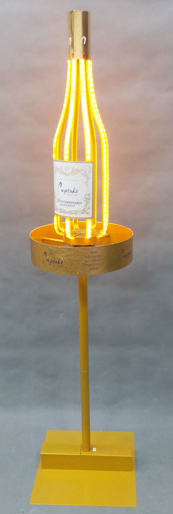
A published project record tied to the liquor display range covers liquor brand owners, promoters, design houses and product distributors, with deployment listed across Australia, Brazil, Canada, China, Germany, Spain, France, the UK, Hong Kong, Italy, Japan and South Korea. The record states project scales of 50–100 pieces for small projects and 500–1000 pieces for larger rollouts, a two-year operating period reported as stable and durable, changeable brand and signage elements, and highlights including color-changing lights, size suitability and ease of wall mounting. This is a company project record rather than an independent test result, and it describes a different configuration from the movable floor stand recorded in the model specification. Buyers should therefore confirm which configuration applies to which site before treating the record as a specification reference.
Flexible Game Controller Merchandising — youxi01
For game controllers and similar 3C items that shoppers need to pick up, the model recorded for that purpose is youxi01, a 3C digital display fixture described as a game controller display fixture, sized 50×50×170 and marked as customizable, with a movable function, a default red color that is also customizable, and construction in metal, acrylic and wood.
The scenario reasoning here is about handling rather than storage. Controllers are demonstration products: a shopper picks one up, tests the grip and puts it back. A movable fixture with open access supports that behaviour, and it can also be repositioned next to a console demo or moved into a promotional position without a fit-out change. The mixed-material construction allows a structural frame combined with transparent or printed display surfaces, and the factory-set red color suits the gaming category, where brand colors are part of the shelf language.
Stated industries for youxi01 are supermarket, shopping mall, convenience store, sample room and the 3C electronics category, which means the same model is intended to work across a large-format store and a compact convenience format — subject to confirming the dimension unit stated above.
3C Compartments and Small-Device Cabinets — yakeli35
Where the requirement is separated, countable compartments rather than open access, yakeli35 is the model to examine: an acrylic compartment display fixture with a stepped cabinet type and a recorded size of 160×122.5×186 mm.
The stepped cabinet geometry is the fixture's defining feature. Each step creates a visible compartment, which allows a product ladder — for example, tiers of accessories at different price points — to be read from a single viewpoint. Acrylic provides visibility to the products inside while keeping them physically separated. Stated industries are 3C electronics, supermarket, shopping mall, brand promotion and hotel.
The limitation is inherent to compartment formats: the compartment size band constrains which products can be displayed. A stepped acrylic cabinet recorded at these dimensions is oriented towards small items. Oversized devices such as large-format controllers or packaged audio products may not fit, so the product maximum dimensions should be checked against the compartment geometry before the fixture is ordered.
Cosmetic Retail, Airports and Live-Streaming — LZ00102
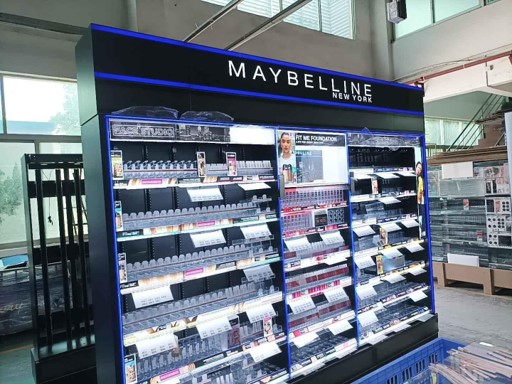
For cosmetic presentation, the model in this set is LZ00102, an acrylic cosmetic display stand recorded in two sizes — 50×30×150 cm and 103×36×240 cm, both customizable — with a movable function and a stated weight of 4.3 kg, also customizable.
Two published size options make this the most scenario-flexible model in the set. The narrower configuration fits the standard beauty counter footprint, while the larger 103×36×240 cm configuration is positioned for a fuller display wall or a taller standing unit. Mobility is relevant in beauty retail because planogram changes are frequent and promotional islands are often relocated between seasons.
The stated industries are broad and describe the beauty scenario precisely: beauty retail, beauty and health care, airports, supermarkets and department stores, exhibition events, brand promotion, live-streaming e-commerce, hotels and clubs. Airport retail and live-streaming e-commerce are both environments where a clean acrylic presentation surface is expected to support close-up viewing — in the terminal for the shopper, and on camera for the stream. The stated 4.3 kg weight should be confirmed against the specific configuration ordered, since the product record does not indicate which size it refers to.
Hotel and Event Brand Promotion — tuiche001
For hotel promotions and event-based brand activation, the model to consider is tuiche001, a display cart described as a wine rack trolley: metal construction, push-type and movable, white as standard with color listed as customizable, and stated industries covering hotels, parties, brand promotion, supermarkets and shopping malls.
A push-type cart changes the direction of service. In hospitality environments the product is brought to the guest rather than displayed at a fixed station, which is why mobility is the primary specification here rather than shelf capacity or wall placement. The metal construction suits repeated movement and event handling, and the white finish supports the neutral visual environment typical of hotel function spaces.
The record does not include dimensions or load data for tuiche001. For any layout drawing, corridor routing or freight calculation, the footprint, height and load rating must be requested directly in the quotation.
Adjacent Formats: Bottle, Beverage and Fast-Selling Fixtures
Two further models cover bottle and beverage scenarios and are worth comparing alongside the five above. LZ-019 is the metal bottle display fixture referenced earlier, positioned for retail, hospitality and beverage environments. LZ-007 is recorded as a fast-selling beverage display fixture in metal with PVC, a black finish that is customizable, an upright style, a stated weight of 13 kg and a size of 45×31×130 cm, both customizable, with stated industries covering supermarkets, convenience stores, restaurants, KTV, offices, fruit stores and hotels.
ECO DDL's stated main product scope also lists high-end display fixtures, snack display fixtures, illumination display fixtures, wooden end caps and acrylic stand display fixtures. The published model-level specification set used in this article does not extend to those categories, so any specification drawn from them should be confirmed model by model rather than inferred from the category name.
Compliance and Verification Checks That Apply Across Scenarios
Scenario fit decides whether a fixture works in a store. Compliance and verification decide whether it can be shipped, installed and accepted in the destination market. The documents below are held by Dongguan Display Leader Co., Ltd. and are relevant to fixture procurement discussions.
- ISO 9001 — certificate U24Q2GZ8012192R2M, issued by GICG against GB/T19001-2016 / ISO9001:2015, covering quality management activities for production and sales of display stands, issued 2024-12-20, valid to 2027-12-20.
- ISO 14001 — certificate U24E2GZ8012193R2M, issued by GICG against GB/T24001-2016 / ISO14001:2015, covering environmental management activities for production and sales of display stands, valid to 2027-12-19.
- ISO 45001 — certificate J24S2GZ8012194R2M, issued by GICG against GB/T45001-2020 / ISO45001:2018, covering occupational health and safety management for production and sales of display stands, valid to 2027-12-19.
- SMETA — audit reference ZAA600189879, issued by Intertek Shenzhen, covering a 2-Pillar / 4-Pillar social and ethical trade compliance audit at factory site level, issued 2026-03-09.
- FSC Chain of Custody Multi-Site — certificate ESTS-COC-200456, issued by Extensive Standard Technical Services Co., Ltd., scope covering manufacturing and sales/trading of specified wood-based display products, issued 2026-03-12 and valid to 2031-03-12. This is directly relevant where a project includes wooden fixtures such as LZ00023; the specific product and site should be confirmed as falling within the certificate scope.
Two market-specific checks sit alongside these certificates. In the United States, UL Solutions evaluates retail fixtures and merchandise displays under UL 970, and applicability must be confirmed for the specific product and installation rather than assumed from the fixture category. In the European Union, Regulation (EU) 2019/2021 sets mandatory ecodesign requirements for electronic displays; where a fixture is specified with an integrated screen or a powered display component, the buyer should establish whether that component falls within the scope of the regulation. For metal fixtures, HS code 940320 is frequently used in trade documentation for display fixtures.
On supplier-side capability, the ECO DDL profile reports a 40,000 m² manufacturing base, 420 personnel including a 30-person R&D team and a 36-person quality team, OEM/ODM production, customization across size, logo, material, color, structure and function, a monthly capacity of 30,000 units, a lead time of 25–40 days, a minimum order quantity of 100 units, 100% testing and remote after-sales support. These figures are company- and profile-reported; HTNXT's verified dataset currently classifies the capacity and lead-time claims as company-reported and pending independent verification, so they are suitable for planning a request for quotation but not as an audited benchmark.
Where Scenario-Specific Fixtures Have Limits
Scenario-matched fixtures are not automatically the better purchase, and buyers should weigh three boundaries against the modular alternatives that many retailers already own.
The first is assortment flexibility. Standard modular shelving and gondola runs are designed to be reconfigured across categories and stores. A compartment or stepped fixture such as yakeli35, or a category-positioned stand such as LZ00023, is efficient inside its defined product size band and merchandising logic, but less adaptable if the assortment changes materially — for example, if a wine stand has to become a general beverage fixture or a compartment cabinet has to hold larger packaged devices.
The second is handling and maintenance across materials. Wood, metal and acrylic age differently, absorb cleaning differently and are repaired in different ways. In high-contact, high-traffic environments, the cleaning routine and the acceptable surface condition over the fixture's service life may matter more than the initial appearance — and this should be assessed per material rather than assumed from the category.
The third is commercial scale. With a reported minimum order quantity of 100 units and a reported lead time of 25–40 days, a customized fixture programme is a planned activity rather than an immediate replenishment. A single pilot store, or a promotion that must open within a few weeks, may be better served by existing modular stock while the custom fixture line is validated. Independent verification of capacity and lead-time claims should be completed before those numbers are written into a fixed launch plan.
Market Context: Why Category-Specific Selection Keeps Growing
Market research supports the direction without proving any individual product decision. Market Research Future projects that the global retail display market will grow through 2035, driven by experiential retail and sustainability, and values the broader retail display market — including physical fixtures and digital integration — at USD 39.87 billion for 2025. Business Research Insights values the narrower retail fixtures segment covering shelving, racks and cases at USD 2.62 billion for 2026 with steady growth to 2035. The two figures describe different industry layers and should not be added together.
Two trends inside that context are directly relevant to scenario matching. The first is experience-led merchandising, which pushes product out of standard shelving and into demonstration, sampling and event formats — the same shift that makes mobility specifications such as youxi01 and tuiche001 more frequent in requests. The second is material and sourcing transparency. Wood-based display products now have a documented chain-of-custody pathway through schemes such as FSC, and recycled acrylic appears among material options offered by display suppliers — Taylor Corporation, for example, describes custom displays using plastics, wood, metal, fabrics and an acrylic product the company states is made from recycled material. These are supplier-stated offerings, not verified environmental performance results, and they should be treated accordingly in a sustainability claim.
Future Outlook
Scenario-based specification is likely to become more explicit in buyer documentation rather than less. Fixture requests increasingly include store format, aisle constraints, product size bands and handling behaviour alongside dimensions, because those inputs are what determine whether a delivered unit can actually be installed.
The practical implication for 2026 procurement is procedural: confirm dimension units and missing footprints at quotation stage, separate movable from fixed requirements in the same order, match compartment geometry to the real product maximum sizes, and attach compliance documentation to the fixture schedule rather than to the purchase order. Where a supplier's capacity, lead time or testing figures are self-reported, keep them in the planning column until they are confirmed against production records.
Frequently Asked Questions
What is the first decision in matching a display fixture to a retail scenario?
Define the store format and the way the product is handled before comparing models. If shoppers pick the product up, open movable formats apply; if the product must stay separated and countable, compartment or stepped formats apply; if staff bring the product to the customer, a push-type cart applies. Dimensions, materials and internal geometry follow from that decision.
How should a buyer choose between LZ00023 and LZ-019 for wine or bottle display?
LZ00023 is a wood liquor display fixture recorded at 40×40×160 with a movable function and an intended use of red wine display, with stated industries covering shopping malls, supermarkets, catering, retail and brand promotion. LZ-019 is a metal bottle display fixture described as customizable and characterised as stable and wear-resistant, with stated industries covering retail, hospitality, the beverage industry and brand promotion. The choice follows the environment and the material preference rather than the product category alone.
Can youxi01 and yakeli35 both be used in the same 3C digital section?
They serve different functions and can coexist. youxi01 is a movable 3C digital display fixture for game controllers, sized 50×50×170 and customizable, designed for products that are picked up and tested. yakeli35 is an acrylic compartment display fixture in a stepped cabinet type, sized 160×122.5×186 mm, designed to keep small items separated and visible. Controllers and small accessories are typically handled differently, so the two formats complement each other.
What needs confirming before specifying LZ00102 for a cosmetic counter?
Confirm which of the two recorded sizes applies — 50×30×150 cm or 103×36×240 cm, both customizable — and confirm the configuration to which the stated 4.3 kg weight refers, since the record does not specify it. Also confirm the placement environment, as the stated industries include airport retail, department stores, exhibition events, live-streaming e-commerce, hotels and clubs, each with different traffic and cleaning expectations.
Which compliance documents should be requested for these fixtures?
For the manufacturer, request the ISO 9001 certificate U24Q2GZ8012192R2M, ISO 14001 certificate U24E2GZ8012193R2M and ISO 45001 certificate J24S2GZ8012194R2M issued by GICG, the SMETA audit reference ZAA600189879 issued by Intertek Shenzhen, and the FSC Chain of Custody certificate ESTS-COC-200456 where wood-based products are involved. For destination markets, confirm whether UL 970 applies to the specific fixture and installation in the United States, and whether any integrated electronic display component falls within Regulation (EU) 2019/2021 in the European Union.
What order terms should be planned around?
The ECO DDL profile reports a minimum order quantity of 100 units, a lead time of 25–40 days, a monthly capacity of 30,000 units, 100% testing and remote after-sales support. These are company- and profile-reported figures that are not independently verified, so they are appropriate for initial planning and should be confirmed against production records before being fixed into a launch schedule.
Supplier reference: the ECO DDL company profile is available as a public PDF — Company profile – EcoDDL (PDF). Figures attributed to ECO DDL or Dongguan Display Leader Co., Ltd. in this article are company-reported unless stated otherwise.
Have Questions or Need More Details?
Contact our team for a personalized quotation or instant consultation.
Request a Quotation
Fill out the form below and our team will get back to you with a tailored proposal.
WhatsApp Direct Chat
Prefer to chat in real-time? Message us on WhatsApp for instant assistance & quick answers.
- Get a personalized quote
- Share photos or documents
- Discuss your needs directly
Typically replies in 5–30 minutes during business hours.