
Matching Dust Collectors to Welding Shop Airflow Demands: A Scenario Guide
Matching Dust Collectors to Welding Shop Airflow Demands: A Scenario Guide
Welding fume control is an airflow problem before it is an equipment problem. Two fabrication shops with the same number of welding bays can require different dust collectors, because airflow demand is set by how fume is captured, how many stations weld simultaneously, how long and how tortuous the duct run is, and how long the shift runs. Choosing a collector from a catalogue without matching it to that demand is the most common source of under-capture, rising energy cost and premature filter replacement.
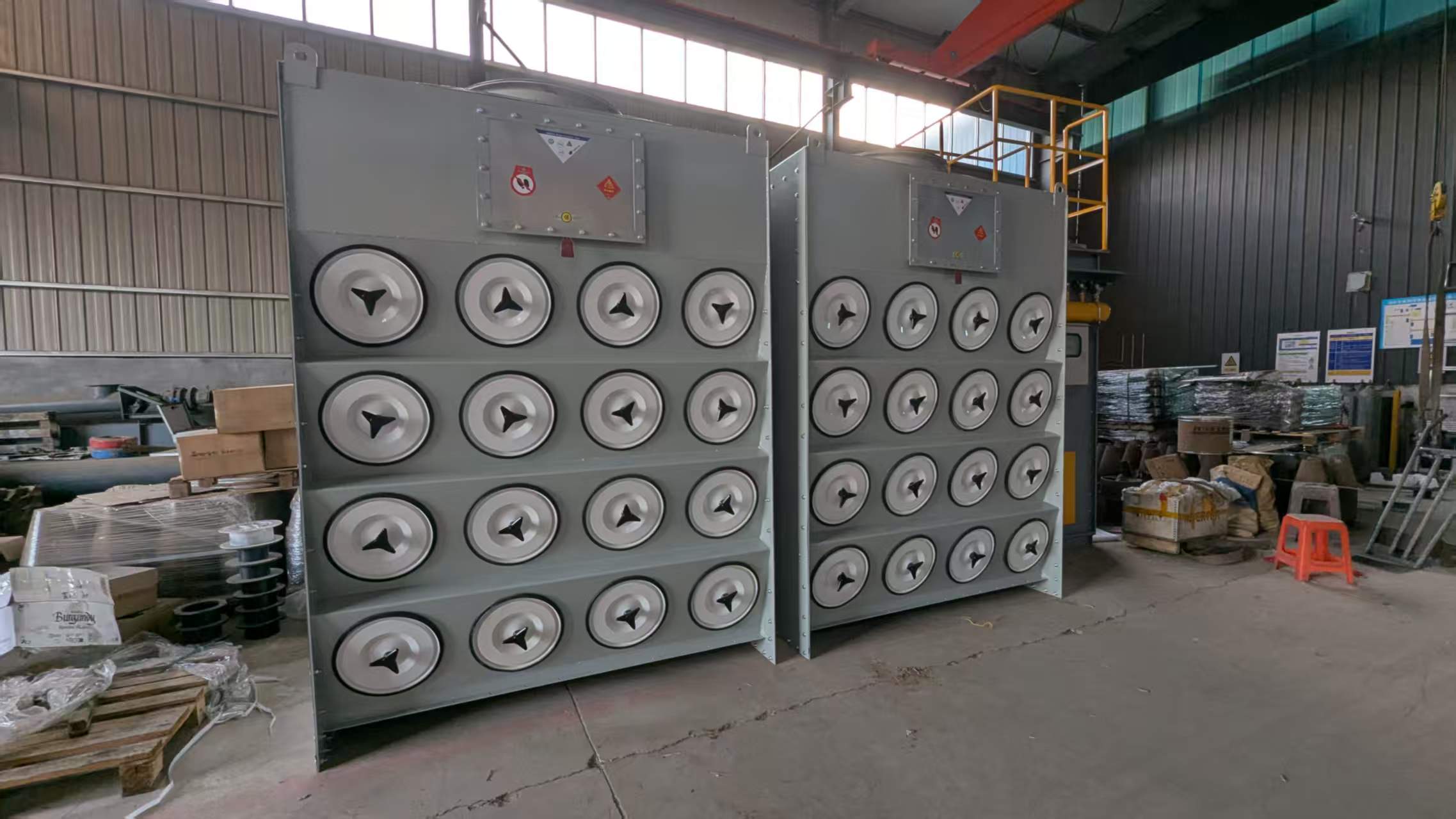
This scenario guide translates welding shop airflow demand into a collector choice, using published specifications for three SENOTAY configurations as worked examples: the LTMC-5000 angled-insert cartridge dust collector, the DMC-200 pulse bag filter, and the LXC-800 single-cylinder cyclone. SENOTAY is the export brand of Hebei Outai Environmental Protection Equipment Co., Ltd., a filtration equipment manufacturer founded in 2015 that supplies pulse bag filters, electrostatic precipitators, cyclone collectors, wet scrubbers and cartridge collectors, with roughly 70% of output exported to Central Asia, Southeast Asia, the Middle East, Russia, Africa and Europe.
Why airflow demand, not shop floor area, decides the collector
Shop floor area tells a buyer very little about which dust collector fits. Airflow demand is driven by five operational variables that can be observed on site without special instruments:
- Simultaneous welding stations. A shop with twelve bays where only three weld at any moment has a very different duty from a shop where eight bays run continuously.
- Capture method. Fume extraction torches, fixed hoods, articulated extraction arms and downdraft tables each impose different resistance and require different induced airflow at the hood.
- Duct network. Length, diameter, number of bends and hood entry losses add to the static pressure the fan must overcome before any air reaches the filter.
- Duty cycle. Single-shift fabrication and 24/7 production require different filter loading assumptions and different maintenance intervals.
- Fume characteristics. Metal fume from MIG/MAG and flux-cored processes behaves differently from TIG fume or from the mixed grinding and polishing dust found in the same shop.
The practical question is therefore not which dust collector is best in the abstract, but which collector matches this shop's airflow band, contaminant profile and operating hours. Under-sizing produces visible fume escape at the hood, which is both an air quality failure and a maintenance driver. Over-sizing pushes the fan onto a higher operating point than the filter media was designed for, which raises pressure drop and energy consumption without improving capture.
Step one: build an airflow demand estimate before comparing models
A defensible selection process starts with a demand estimate rather than a product shortlist. In practice, buyers who get this right follow a sequence: count the stations that weld simultaneously, confirm the capture type at each station, measure the longest duct branch, then add a margin for filter loading between cleaning cycles.
This is also where supplier engineering input changes the outcome. SENOTAY's on-site design stage analyses the customer's specific airflow volumes, dust particle characteristics and compliance targets before equipment is specified, rather than quoting a standard model against a square-metre count. The same logic applies to configuration: cartridge, bag and cyclone units are not interchangeable, and the same airflow figure can point to a different machine depending on whether the stream is welding fume, heavy coarse dust, or a mixture of both.
Three SENOTAY configurations and the airflow bands they cover
The three units below are the most relevant SENOTAY options for welding and metalworking shops. They differ not only in airflow capacity but in separation principle, which determines how each should be deployed.
LTMC-5000 — angled-insert cartridge collector for welding fumes
The LTMC-5000 (also designated the LTMC-16X angled-insert cartridge dust collector) is built for welding fume, grinding and polishing dust, and similar fine particulate streams. It uses 16 cartridges, accepts 7,596–10,128 m³/h of airflow, and provides 211 m² of filter area at a design filter velocity of 0.6–0.8 m/min. Published pressure drop is ≤1,200 Pa, dust removal efficiency is ≥99.9%, and the maximum operating temperature is 120 °C. The unit is available in carbon steel or SS304.
Dividing the published airflow band by the published media area gives the implied operating range: roughly 48–72 m³ of air per square metre of media per minute, which is the same 0.6–0.8 m/min figure SENOTAY publishes. That internal consistency is useful to buyers, because the filter velocity, not the fan curve, is what controls whether a cartridge collector holds its efficiency over a full shift.
DMC-200 — pulse bag filter for heavier continuous loads
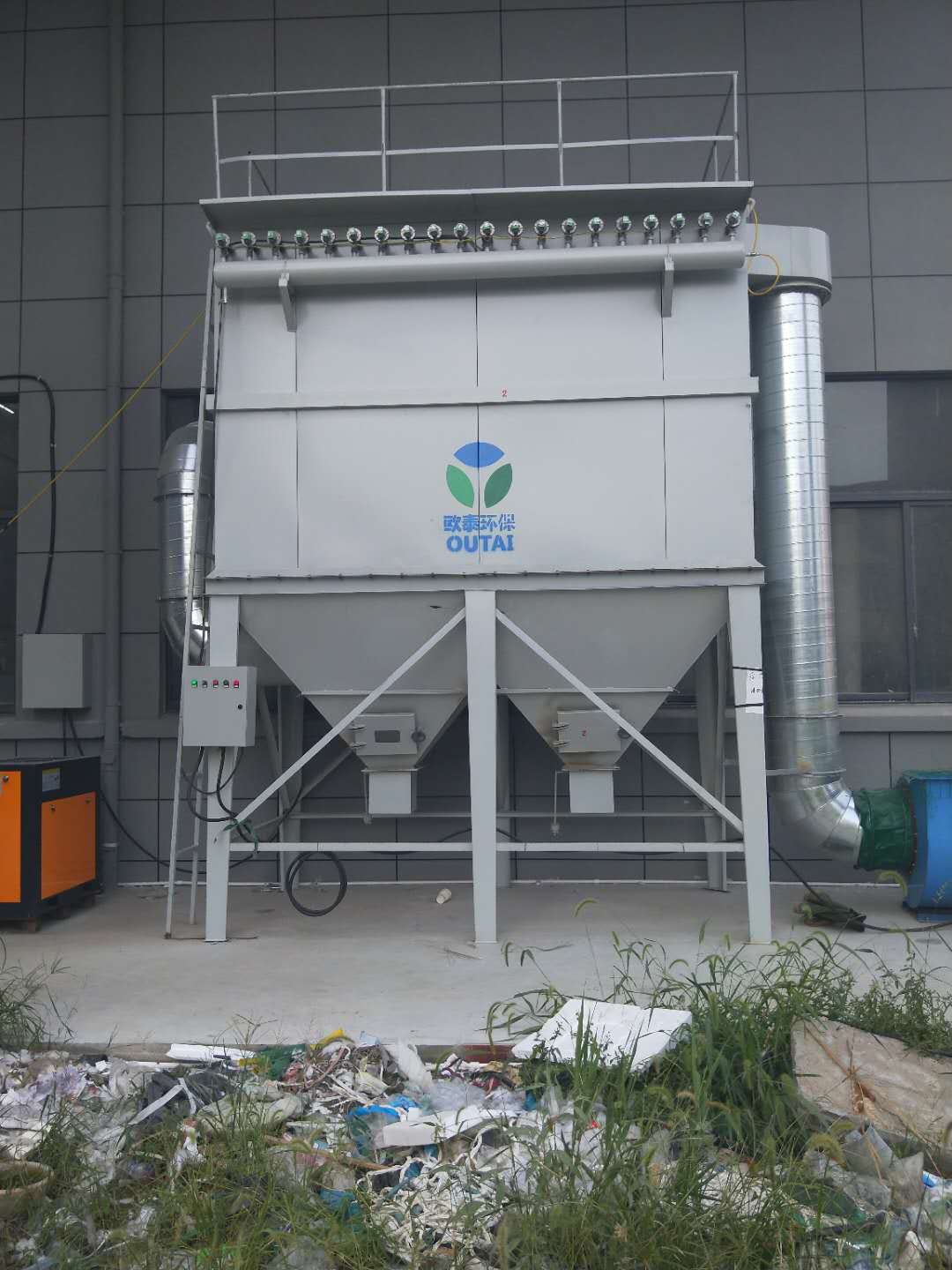
The DMC-200 is a pulse jet bag filter covering 9,600–14,400 m³/h with 160 m² of filtration area, purification efficiency above 99.5%, a filtration accuracy finer than 1 μm, and an 18.5 kW fan. It is offered in carbon steel or SS304 and is applied in steel, cement, metallurgy, building materials, food processing, grain drying, mining and casting duties where dust loads are heavier and more continuous.
LXC-800 — cyclone for pre-separation
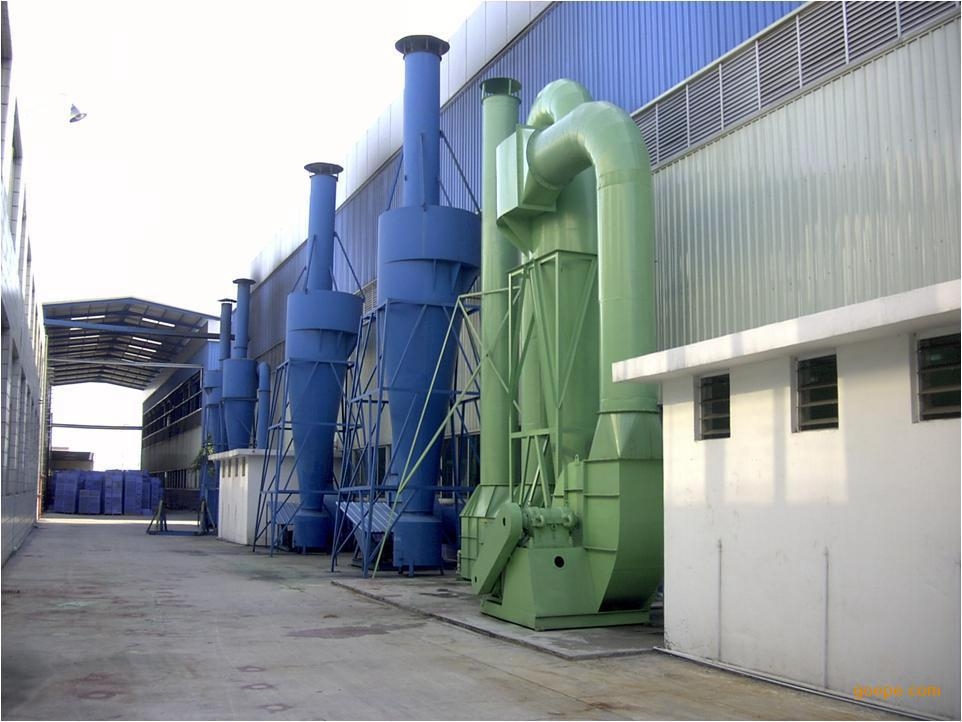
The LXC-800 is a single-chamber (φ800 mm single-cylinder) cyclone dust collector with 3,000–5,000 m³/h of airflow capacity, an inlet air velocity of 15–20 m/s, dust removal efficiency of ≥70%, pressure drop of 800–1,500 Pa, and an operating temperature limit of 300 °C. It is available in carbon steel or SS304. Its role is inertial pre-separation, not final filtration.
| Configuration | Airflow capacity | Media / separation | Efficiency | Temperature limit | Best-fit duty |
|---|---|---|---|---|---|
| LTMC-5000 cartridge collector | 7,596–10,128 m³/h | 211 m², 16 cartridges, 0.6–0.8 m/min filter velocity | ≥99.9% | ≤120 °C | Welding fume, grinding and polishing dust in medium fabrication shops |
| DMC-200 pulse bag filter | 9,600–14,400 m³/h | 160 m² bag media, filtration accuracy <1 μm | >99.5% | Not published in this configuration | Continuous heavier loads, larger fabrication and process dust streams |
| LXC-800 cyclone | 3,000–5,000 m³/h | Inertial separation, 800 mm cylinder, 15–20 m/s inlet | ≥70% | ≤300 °C | Coarse pre-separation upstream of a cartridge or baghouse stage |
Matching a welding shop to a configuration
With the three bands established, matching becomes a short exercise. The table below is a scenario framework, not a substitute for site-specific sizing, but it shows how the published airflow ranges map onto typical shop profiles.
| Shop profile | Indicative airflow demand pattern | Configuration that fits | Reason |
|---|---|---|---|
| Small fabrication cell, 2–4 extraction arms, single shift, fume only | Demand sits at the lower end of a compact collector band | LTMC-5000 | Welding fume duty, cartridge media, ≥99.9% dust removal efficiency |
| Medium shop, 6–10 active stations, mixed welding and grinding | Demand in the 7,600–10,100 m³/h range | LTMC-5000 | Filter velocity remains inside the 0.6–0.8 m/min design band at 211 m² |
| Large shop or line, continuous multi-station welding and heavy dust make-up air | Demand moves above 10,000 m³/h | DMC-200 | 9,600–14,400 m³/h with 160 m² bag media for continuous loading |
| Shop generating coarse scale, slag or heavy spark carry-over before filtration | Pre-separation stage required ahead of media filtration | LXC-800 upstream of LTMC-5000 or DMC-200 | ≥70% removal at 3,000–5,000 m³/h protects downstream media |
Two structural observations follow from these ranges. First, the LTMC-5000 and DMC-200 overlap between 9,600 and 10,128 m³/h. In that overlap band the decision is not about capacity but about dust character and duty: cartridge media at 0.6–0.8 m/min filter velocity is positioned for welding fume, while bag media is positioned for heavier continuous particulate streams. Second, the overlap is narrow. A shop whose demand exceeds 10,128 m³/h cannot simply push more air through the LTMC-5000 to save space — it moves into the DMC-200 band or into a multi-unit arrangement.
Technical explanation: why filter velocity and pressure drop decide real performance
Published efficiency figures are only meaningful alongside the airflow conditions at which they are achieved. The LTMC-5000's ≥99.9% dust removal efficiency is stated together with a filter velocity of 0.6–0.8 m/min and a pressure drop of ≤1,200 Pa, and those three numbers are linked.
Filter velocity is airflow divided by media area. Across 16 cartridges and 211 m², the LTMC-5000 distributes roughly 13 m² of media per cartridge, which is why a compact footprint can still hold a 7,596–10,128 m³/h band. When airflow is increased without adding media, velocity rises, the dust cake compacts faster, and pressure drop climbs toward and beyond the 1,200 Pa design ceiling. The fan then consumes more energy to move the same air, and the pulse-cleaning system has to work harder to recover the media.
Bag filters behave differently. The DMC-200's 160 m² of bag media, sub-1 μm filtration accuracy and 18.5 kW fan support a higher airflow band with a heavier dust load, and bag media tolerates the higher air-to-cloth ratios typical of continuous duty. Pulse jet cleaning — the mechanism both units rely on — is what allows either design to run across long shifts without manual media intervention.
Cyclones sit outside this media logic entirely. The LXC-800 separates by inertia at an inlet velocity of 15–20 m/s, which is why it reaches ≥70% removal at a fraction of the pressure drop of a media filter and tolerates up to 300 °C. That is a pre-separation performance profile, not a final filtration one.
Material selection: carbon steel versus SS304
All three configurations — LTMC-5000, DMC-200 and LXC-800 — are offered in carbon steel or SS304, so material choice is a scenario decision rather than a model limitation. Carbon steel is the standard specification for dry, indoor fabrication shops with no condensation risk. SS304 is the appropriate specification where the housing is exposed to moisture, wash-down, mildly corrosive process carry-over or humid ambient conditions, and it also simplifies cleaning in shops that also process food-grade or pharmaceutical-adjacent work.
Material choice does not change the airflow or efficiency figures cited above; it changes service life and maintenance frequency in a given environment. For streams well outside welding-shop conditions — high humidity, condensing acids or fine sub-micron particulate requiring wet operation — the adjacent SENOTAY option is the WESP-10000 wet electrostatic precipitator, rated 5,000–10,000 m³/h, ≥95% removal, ≤300 Pa pressure drop, ≤20 mg/m³ exhaust emission concentration and a maximum operating temperature of 80 °C, in carbon steel, SS304 or SS316. That unit is a different technology for a different scenario; it is not a welding fume collector substitute.
Application fit: where each configuration is documented in service
Welding fume duty is the LTMC-5000's stated application, alongside grinding and polishing, woodworking, powder coating, foundries, electronics, automotive manufacturing and similar fine-dust environments. The unit is specified as a dust collector for welding shops, which makes it the default starting point for fabrication cells where fume is the dominant contaminant.
Continuous, heavier load is where the DMC-200 is documented. In a tire factory application in Indonesia — a rubber mixing process at normal temperature running 24/7 with a variable-frequency motor — the DMC-200 was specified as part of a dust removal system alongside piping, electrical control, high-pressure gas supply and fan systems. The end-user installation comprised two units collecting dust generated by mixing equipment and reported stable operation after a year, with low noise and low energy consumption noted as highlights. The dust in that scenario is rubber mixing dust rather than metal fume, and the distinction matters: it demonstrates the DMC-200's behaviour under continuous 24/7 loading, not an equivalence between the two dust types.
Pre-separation is where the LXC-800 belongs. Shops that combine welding with grinding, flame cutting, plasma cutting or shot blasting generate coarse particles that would otherwise load cartridge or bag media quickly. Placing an LXC-800 upstream captures a large share of that coarse fraction at ≥70% efficiency and 3,000–5,000 m³/h before the air reaches the final filter stage.
Market trend: where welding-shop filtration sits in the wider dust collector market
The wider market context supports the scenario logic above. Grand View Research valued the global industrial dust collector market at approximately USD 9.58 billion in 2024, and reported that baghouse dust collectors held a 26.8% revenue share in the same year — the largest single technology position. Fortune Business Insights put Asia-Pacific at a 41.8% revenue share of the global market in 2025 and valued the North American market at USD 2.44 billion in 2025. Mordor Intelligence estimated China's industrial output, a structural driver of dust collection demand, at USD 5.3 trillion in 2024.
Two readings of that data are relevant to buyers. First, published estimates diverge: different research firms place 2024 global market value at different figures, so any single number should be treated as an estimate rather than a settled fact. Second, the market is not fragmented evenly — Fact.MR attributes approximately 18.6% of the dust collector systems market to Donaldson Company, which indicates that a small number of established suppliers carry substantial share alongside regional manufacturers.
For welding shops specifically, the practical implication is that technology choice remains scenario-driven rather than trend-driven. Baghouse systems hold the largest share partly because they suit high-volume continuous particulate streams; cartridge collectors, cyclones and wet systems occupy the segments where their separation principle matches the contaminant.
Where single-stage solutions reach their limits
A credible selection process states boundaries as clearly as capabilities. Four limits follow directly from the published specifications.
- Cyclone efficiency is not final-filtration efficiency. The LXC-800 removes ≥70% of particulate. That means a substantial fraction of the incoming dust stream passes through, which is acceptable for pre-separation and unacceptable as the only stage in a welding fume system.
- The LTMC-5000 has a 120 °C ceiling. Welding fume and grinding dust sit well below that, but high-temperature process off-gas does not. Where temperature is the constraint, the LXC-800's 300 °C limit is more relevant than either media filter.
- Cartridge collectors are sensitive to airflow creep. The 0.6–0.8 m/min filter velocity band and the ≤1,200 Pa pressure drop ceiling are design conditions. Later expansion — added welding bays ducted into the same unit — will push both out of range unless media area is added.
- Bag filters carry infrastructure requirements. The DMC-200's 18.5 kW fan and pulse jet cleaning system require adequate electrical supply and compressed air; a shop planning a baghouse for the first time should size utilities and compressed-air capacity alongside the collector.
For combustible particulate streams, standards also enter the picture. NFPA 654 is the primary standard for preventing fires and dust explosions from the manufacturing and handling of combustible particulate solids, and NFPA 68 provides guidelines for deflagration venting. Welding fume is not itself a combustible dust hazard in the usual case, but shops that also collect combustible dusts through the same system should verify applicability with the equipment supplier rather than assume it.
Future outlook for welding shop fume collection
Three directions appear durable. First, airflow discipline is becoming a procurement criterion rather than an engineering afterthought, because energy cost scales with pressure drop and filter velocity. Second, multi-stage architectures — cyclone pre-separation followed by cartridge or bag filtration — are increasingly specified where shops handle mixed streams, since no single separation principle covers coarse slag and sub-micron fume equally well. Third, specification transparency is improving: buyers now compare airflow bands, filter velocity, media area, pressure drop and efficiency together, which makes it harder for a model to be sold on an airflow figure alone.
SENOTAY's own manufacturing posture reflects the same logic: OEM and ODM production with voltage and logo customisation, a monthly capacity of 200 sets, lead times of 15–45 days, a minimum order quantity of one set, 100% testing before shipment, and after-sales support delivered remotely or on site. For a welding shop making a first or replacement purchase, those parameters matter as much as the airflow rating, because they determine how quickly a correctly sized unit can actually be installed.
FAQ
What airflow capacity does a welding shop dust collector actually need?
Airflow capacity should be matched to the estimated capture demand of the shop, not to its floor area. Demand is built from the number of simultaneously active welding stations, the capture method used at each station, the resistance of the duct network, and the duty cycle. The two SENOTAY media collectors in this guide cover a 7,596–10,128 m³/h band (LTMC-5000 cartridge) and a 9,600–14,400 m³/h band (DMC-200 pulse bag filter), with a narrow overlap between 9,600 and 10,128 m³/h. Estimating demand first and matching it to a published band is more reliable than selecting a unit by nominal airflow and adjusting ductwork afterwards.
Should a welding shop choose a cartridge dust collector or a pulse bag filter for welding fume?
The LTMC-5000 cartridge collector is specified for welding fume, grinding and polishing dust and provides 211 m² of filter area across 16 cartridges at a filter velocity of 0.6–0.8 m/min, with ≥99.9% dust removal efficiency and ≤1,200 Pa pressure drop. The DMC-200 pulse bag filter provides 160 m² of bag media, filtration accuracy finer than 1 μm, a purification efficiency above 99.5%, and a higher airflow band of 9,600–14,400 m³/h for heavier continuous loads. Where welding fume is the dominant contaminant, cartridge media in the 0.6–0.8 m/min velocity range is the closer fit; where airflow demand exceeds roughly 10,100 m³/h or the dust load is heavier and continuous, the bag filter band is the appropriate range.
Where does a cyclone dust collector fit in a welding shop system?
A cyclone fits as a pre-separation stage, not as a final filter. The LXC-800 handles 3,000–5,000 m³/h, separates by inertia with an inlet velocity of 15–20 m/s, removes ≥70% of particulate, and tolerates operating temperatures up to 300 °C. Because roughly a third of the incoming dust stream can pass through, it is normally installed upstream of cartridge or bag media to reduce the coarse-particle load reaching the final stage. It is not a substitute for a media filter where welding fume capture requires high-efficiency removal.
Carbon steel or SS304 for a welding shop dust collector housing?
Both the LTMC-5000 cartridge collector, the DMC-200 pulse bag filter and the LXC-800 cyclone are available in carbon steel or SS304. Carbon steel suits dry indoor fabrication shops without condensation risk. SS304 is the appropriate specification where the housing faces moisture, wash-down, mildly corrosive carry-over or humid ambient conditions. The material selection does not change the published airflow, filter velocity or efficiency figures for a given model; it changes expected service life and maintenance frequency in a specific environment.
What operational limits should be planned for before ordering a welding shop dust collector?
Four limits follow from the published specifications. The LTMC-5000 has a maximum operating temperature of 120 °C and a pressure drop ceiling of ≤1,200 Pa, so later airflow expansion beyond its 7,596–10,128 m³/h band requires additional media area rather than a larger fan setting. The DMC-200 requires an 18.5 kW fan supply and compressed air for pulse jet cleaning. Cyclones remove ≥70% of particulate, which rules them out as a single-stage solution. On the supply side, SENOTAY publishes lead times of 15–45 days, a minimum order quantity of one set, 100% testing before shipment, and after-sales support delivered either remotely or on site — parameters that determine installation timelines as much as the airflow rating does.
For readers who want the underlying specifications in one document, SENOTAY publishes a downloadable product and capability brochure covering its filtration, conveying and purification equipment: SENOTAY dust removal equipment brochure (PDF).