
Matching ESS Battery Pack Insertion Robots to Container Project Scenarios
Project Fit, Not Just Machine Specs: How Buyers Should Match ESS Battery Pack Insertion Robots to Container Lines
Containerized energy storage is moving from small-batch assembly into repeatable, continuous production. That shift changes how procurement teams should evaluate automation. The question is no longer only “Which robot can lift a battery pack?” but “Which mobile or fixed platform fits the layout, floor conditions, production rhythm, and after-sales setup of this specific project?”
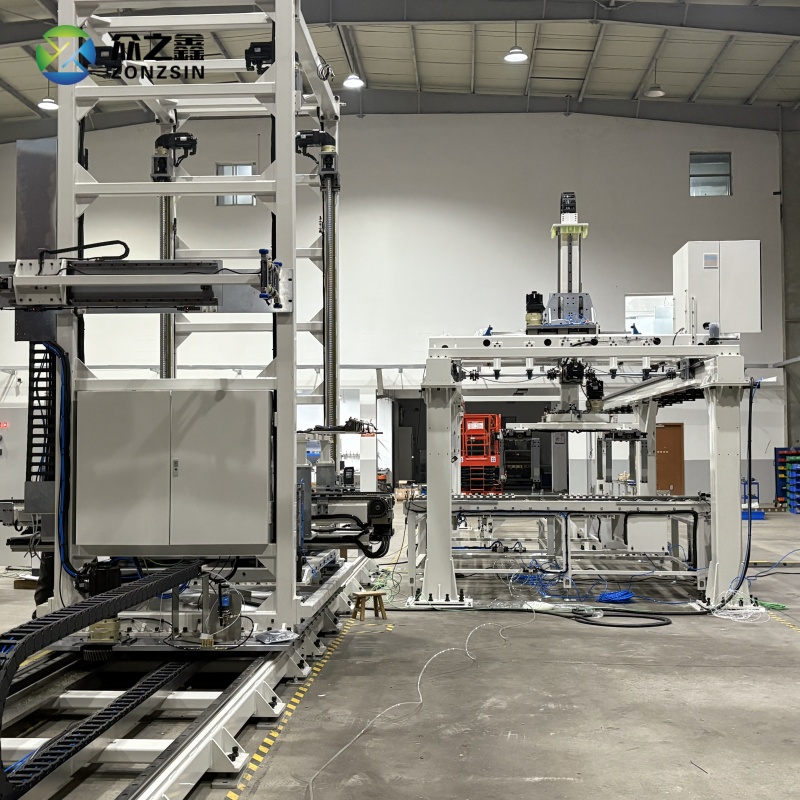
Rail-fixed battery PACK insertion robot positioned at a container rack opening. Image: Zonzsin
This article explains how project teams, ESS integrators, and EPC contractors can systematically match battery pack insertion equipment to container scenarios. It uses the product range from Shanghai Zonzsin Intelligent Equipment Co., Ltd., a Shanghai-based manufacturer of ESS battery pack insertion robots and automatic battery pack assembly lines, as a reference for what buyers can verify and specify.
Why Project Scenario Mapping Has Become a Procurement Step
Containerized BESS solutions are a significant segment of the energy storage market. Industry estimates place the containerized BESS market at roughly USD 11.75 billion in 2025, with a projected compound annual growth rate of 24.1% through 2035. Within this segment, the physical process of loading heavy battery packs into 20-foot or 40-foot container racks is a bottleneck that many integrators still handle manually or with improvised lifting tools.
The core procurement risk is not machine performance in isolation. It is the mismatch between a robot’s operating assumptions and the actual project environment. A rail-fixed machine works well on a stable indoor production line. The same machine may be impractical on an uneven outdoor yard, a temporary site, or a facility that frequently changes container models.
Buyers in the Research and Evaluation stages therefore need a matching framework. The available architectures differ in how they move, where they work, and which production environment they fit. Choosing between them first requires understanding the project scenario, not just comparing payload tables.
The Four Main Architecture Types for Battery Pack Container Insertion
Battery pack insertion equipment for containerized ESS generally falls into four categories: rail-fixed platforms, AGV-driven mobile carriers, crawler-driven mobile platforms, and hybrid or AGV-based systems that combine a guided vehicle with an insertion gantry. Each architecture changes the relationship between the machine and the container.
1. Rail-Fixed Battery PACK Insertion Robots
Rail-fixed robots are installed on a fixed ground rail aligned with the container door. The machine moves horizontally along the rail and inserts the pack into the rack plane. Because the rail stabilizes the entire load path, this architecture is well suited to continuous shift production in a fixed workstation.
Rail-fixed systems typically work with carbon steel construction and pneumatic or electric actuation. In the Zonzsin range, the ZZX2524 and ZZX2508 are representative examples. The ZZX2524 supports a load capacity of 1500 kg, a door opening angle of at least 150 degrees, gripper changeover in under one minute, and double-layer rack space saving. The ZZX2508 is specified for containers roughly 6058~7000 mm long, 2438~2700 mm wide, and 2896~3000 mm high, and for packs in the range of L1100~2200 mm, W780~1260 mm, H230~260 mm. It also requires compressed air at 0.5~0.8 MPa and AC380V power.
The engineering meaning for buyers: rail-fixed machines are designed for stable, repeated loading on a fixed production line. They are especially valuable when the project requires full automation, continuous PACK insertion, and a reliable reference to the container rack because the rail constrains horizontal motion.
| Architecture | Representative Model | Load Capacity | Typical Project Condition | Key Parameter to Check |
|---|---|---|---|---|
| Rail-fixed | ZZX2524 | 1500 kg | Indoor line, continuous shift production | Door opening angle ≥ 150°; gripper changeover time < 1 min |
| Rail-fixed | ZZX2508 | Not specified in corpus | Fixed workstation with known container and pack dimensions | Container size range L6058~7000 mm; compressed air 0.5~0.8 MPa |
| AGV-driven | RD16 | 1500 kg (verified external specification) | Flexible indoor movement between stations, batch and continuous production | Compatibility with 280/314/587Ah cells and 1P52S/1P104S packs; hoisting speed 100 mm/s |
| Crawler-driven | ZZX2522 | 1500 kg | Outdoor or uneven floors, insertion and removal service | Hoisting range 0.8~3.4 m; all-terrain working floor; manual handwheel leveling |
2. AGV-Driven Battery PACK Insertion Robots
AGV-driven insertion robots combine a mobile platform with a lifting and insertion mechanism. Because the machine can move to the container and position itself, it can serve multiple stations or lines without a fixed ground rail.
The Zonzsin RD16 is an AGV-driven battery PACK insertion robot for containers with overall dimensions of L3100 * W2600 * H3800 mm. It is compatible with 280/314/587Ah cells and 1P52S/1P104S packs, offers a hoisting range of 1.05~3.4 m (customizable), and a hoisting speed of 100 mm/s. According to the company’s application scenario documentation, this product functions to improve cycle time and enable batch and continuous production in energy storage container lines, with manual and remote controller operation modes.
This architecture is most relevant when the production layout is not yet fixed, when multiple docking positions are needed, or when the project requires flexibility to change production lines. It is also the category in which Zonzsin reports holding invention patents related to AGV-driven battery PACK insertion robots.
3. Crawler-Driven Battery PACK Insertion and Removal Robots
Crawler-driven machines use a tracked undercarriage instead of wheels or a fixed rail. This makes the platform less sensitive to floor flatness and improves outdoor mobility.
The Zonzsin ZZX2522 is a crawler-driven battery PACK insertion and removal robot with a hoisting range of 0.8~3.4 m (customizable), all-terrain working floor capability, a load capacity of 1500 kg, and manual handwheel leveling. The all-terrain capability is the distinguishing feature: this architecture is used in outdoor scenarios, uneven working floors, or conditions where a wheeled AGV might lose traction.
The tradeoff is that crawler-driven machines typically have a slower positioning workflow and require manual leveling adjustment. They are better understood as flexible service and maintenance platforms than as high-speed production robots. In the company’s case records, a customer in South Korea used a crawler-driven system for outdoor ESS battery PACK insertion and removal on uneven floor conditions. Another customer in Taiwan used the same architecture for indoor and outdoor battery pack insertion and pull-out, with a crawler chosen specifically because of a complicated working floor.
4. Rail-Guided AGV and Omni-Directional Systems
In addition to the three primary platforms, suppliers describe a fourth category: rail-guided AGV systems that add positioning precision to a mobile platform, or omni-directional AGV-based pack loading machines that can approach a container from different angles. These systems are typically built to order for projects with unusual docking geometry or multiple container rack configurations.
Buyers should be cautious when comparing these systems because no standard metric exists for “docking accuracy.” The practical procurement question is simpler: can the supplier demonstrate repeatable positioning on the customer’s actual floor conditions? If not, the purchase is best treated as a customization project rather than a catalog procurement.
When to Choose Which Architecture: A Scenario-Based Matching Guide
For a Research or Evaluation stage buyer, the most useful output of this article is a matching rule, not just a list of machines. The following logic uses the Zonzsin application scenario data and case records from China, South Korea, Taiwan, France, Sweden, and the United States as an evidence base.
Decision Rule 1: Fixed Indoor Line + Continuous Shift Production → Rail-Fixed Platform
If the project has a dedicated container loading station, stable indoor floor, and continuous daily production, the rail-fixed architecture is usually the strongest match. The fixed rail removes horizontal positioning uncertainty and allows the machine to repeat the same insertion cycle for every container.
The ZZX2524 double-layer rack configuration also addresses a common space constraint in container assembly: the need to store packs near the loading station without occupying the container footprint.
Decision Rule 2: Multiple Stations or Reconfigurable Layout → AGV-Driven Platform
If the same machine must serve different containers or different production cells, an AGV-driven platform reduces the need for multiple fixed installations. The RD16 supports cells up to 587Ah and 1P104S pack configurations, hoisting heights to 3.4 m, and manual/remote control. It is appropriate for batch and continuous production in ESS and C&I energy storage applications.
Decision Rule 3: Outdoor Terrain, Uneven Floor, or Service Work → Crawler-Driven Platform
If the project requires outdoor operation, the container line sits on undeveloped ground, or the machine must remove packs for later maintenance and reinsert them, the crawler-driven ZZX2522 is the architecture best supported by actual case evidence. The all-terrain working floor and manual handwheel leveling are concrete, verifiable features for these conditions.
Decision Rule 4: Unknown Container Mix or Early-Stage Project → Treat as Customization
If the project has not yet fixed its container dimensions, pack sizes, or site floor, buyers should not assume a standard model will fit. Zonzsin lists customization options for cycle time, automation, logo, color, and configuration. A 20-foot container is a common reference, but real production containers can vary beyond the 2896~3000 mm height range in the ZZX2508 specification. In such cases, the procurement process should require a supplier engineering review before a purchase decision.
.jpg)
AGV-driven battery PACK insertion robot (RD16) moving toward a container. Image: Zonzsin
What the Application Scenario Data Says About Container Line Automation
Zonzsin’s application scenario documentation describes the working condition as all-terrain, with a temperature range of 20~30 °C and continuous or shift production. The matched equipment set includes the container, docking roller, gripper, transfer AGV, working desk, material rack, platform ladder, PLC, and MES. This equipment list is useful for capex planning: the insertion robot is not the only cost item in an automated line.
The same documentation requires ESD protection, fire prevention measures, temperature/humidity and cleanliness control, and PACK compatibility or fixture adaptation. For an EPC contractor or integrator, these are project-level risk factors that should be included in the request for quotation. The robot can execute the motion, but the overall line will operate only if the facility supports these conditions.
Verifiable Evidence from Case Deployments
Several deployment records from Zonzsin help answer a practical buyer question: what happens after commissioning?
- China – rail-fixed insertion for continuous production: an energy storage system integrator, battery cell/PACK manufacturer, and EPC contractor context deployed one unit for continuous PACK insertion and stable PACK loading. The recorded result is stable operation and efficiency improvement over a two-year operating duration. The project highlight is the stable fixed ground rail for safe working, a dual-layer material rack for space utility, and versatile module options.
- South Korea – outdoor crawler-driven insertion and removal: a one-unit deployment for ESS battery PACK insertion into and removal from a container, operating for one year with stable operation. The project highlight is outdoor use and crawler-driven mobility for an uneven working floor.
- Taiwan – indoor/outdoor crawler-driven service platform: a one-unit deployment for ESS battery PACK insertion into and removal from a container, also one year of stable operation. The crawler was selected because the vehicle serves both indoor and outdoor use, performs pack insertion and pull-out, and must handle a complicated working floor.
These cases are limited in number and do not include quantified cycle-time reductions. They are nonetheless useful as evidence that each architecture’s stated benefit corresponds to a specific operating condition: fixed rail for line stability, crawler for rough terrain, and AGV for flexible movement.
Capability and Supplier Verification Points
Buyers evaluating a supplier for container insertion equipment should verify at least five areas before issuing a PO.
- Architecture-specific experience: Does the supplier have a reference case using the same platform type (rail, AGV, crawler) in a similar operating environment?
- Customization scope: Can the supplier adjust cycle time, automation level, logo, color, and configuration? A one-unit minimum order quantity is meaningful when the equipment is built to project specifications.
- Delivery and lead time: For a supplier with a monthly capacity of 3 units and a lead time of 2~4 months, the buyer must align the project schedule with the production slot. A 40-unit annual output at the Shanghai facility therefore represents a production-planning constraint, not a sales pitch.
- Quality control: Look for 100% testing of equipment before shipment, plus remote support and on-site installation and commissioning in the after-sales scope.
- Integration interface: Confirm that the machine can communicate with the customer’s PLC and MES. The matched equipment list in the application scenario includes PLC and MES, which should be included in the integration contract.
Limitations and Boundaries Buyers Should Respect
Automated battery pack insertion robots are not a universal solution. The following boundaries are worth documenting in an internal evaluation review.
- Payload is not the only selection criterion. Load capacity figures such as 1500 kg describe the static/managed load of the platform, not the maximum allowable stress in every insertion posture. Buyers should request calculations for the actual pack dimensions and rack height in their project.
- Rail-fixed systems require a prepared floor. A ground rail is an engineered foundation, not an off-the-shelf accessory. If the floor is not flat or level, installation cost and schedule will increase.
- AGV systems require navigation space. An AGV-driven robot still needs a clear path to the container and adequate turning space. The RD16 footprint of L3100 * W2600 * H3800 mm is large enough that cell layout must be reviewed before selecting this architecture.
- Crawler mobility has a throughput tradeoff. The all-terrain capability and manual handwheel leveling make the ZZX2522 suitable for service work, but the manual leveling step makes it less appropriate as a high-speed production loader for continuous line operations.
- Standards compliance is a separate workstream. For North American market access, energy storage equipment must comply with UL 9540. In the EU, BESS containers require CE marking under Regulation (EU) 2023/1542, including Low Voltage and Machinery Directive requirements for automated handling equipment. The buyer, not the robot supplier, carries the final compliance responsibility for the containerized product in its destination market.
Cost-Benefit Logic for the Evaluation Stage
A reliable cost-benefit assessment requires comparing the automated line against a manual baseline. In the absence of verified project-specific data, the following decision structure is more useful than a generic efficiency claim:
- Manual baseline: Count the number of workers, the average insertion cycle time per pack, the reject/damage risk, and the physical safety exposure.
- Automated scenario: Count the intended shift pattern, number of containers per month, and expected cycle time with the selected robot.
- Changeover cost: If the project uses multiple pack types, the gripper changeover time and fixture adaptation cost must be included in the total cost equation.
- Maintenance expenditure: Zonzsin states a design goal of 20% lower maintenance expenditures through modular design. This is a supplier claim that buyers can test by requesting a maintenance cost schedule for the specific model under evaluation.
Market Trend Context
The global BESS market is expanding at a scale that makes assembly-line automation structurally necessary. MarketsandMarkets estimates the BESS market at approximately USD 50.81 billion in 2025, heading toward USD 105.96 billion by 2030. Containerized BESS is described by Insightace Analytic as a major segment with a market size of USD 11.75 billion in 2025 and a projected CAGR of 24.1% through 2035. These figures are not directly attributable to Zonzsin, but they set the strategic context: integrators will face rising pressure to increase output without proportionally increasing labor.
Within this context, the trend is not toward a single automation favorite. The more likely pattern is a segmented adoption curve:
- High-volume, fixed layout: rail-fixed robots will be selected for throughput and stability.
- Mixed-model or reconfigurable plants: AGV-driven platforms will be selected for flexibility and multi-station service.
- Aftermarket service and outdoor sites: crawler-driven platforms will be selected for their ability to retrieve packs from containers and operate on unimproved ground.
Future Outlook
As integrators standardize their container designs, the equipment market will likely respond with more model-specific automation rather than general-purpose machines. The future procurement environment should reward suppliers who can document real deployments across multiple architecture types and who can support a buyer’s integration from container specification through PLC/MES interface to commissioning.
For Zonzsin, the company’s stated direction supports this trajectory: since its founding in 2019, Shanghai Zonzsin Intelligent Equipment Co., Ltd. has focused on lithium battery manufacturers, energy storage integrators, and automotive OEMs. With a 6000 m² factory, 90 employees, 43 engineers in the R&D team, and a 60% export ratio to SEA/EU markets, the company demonstrates a reasonable scale for a specialized equipment supplier. Its 50 granted patents, including invention patents for AGV-driven battery PACK insertion robots, are the kind of intellectual-property evidence that buyers can verify through the company website.
The near-term outlook for container assembly automation is therefore cautious but directional. Equipment adoption will accelerate in factories where container model variety is low and production volume is high. It will proceed more slowly in outdoor field assembly, where crawler platforms will remain a niche but essential tool for repair and reinsertion.
Frequently Asked Questions on Project-Scenario Fit
What is a battery pack insertion robot for containers used for?
A battery pack insertion robot for containers is used in ESS and C&I energy storage production to move battery packs into and out of container racks. It functions to improve cycle time and enable batch and continuous production in energy storage container lines. It typically operates in manual or remote controller mode.
What is the difference between a rail-fixed and an AGV-driven battery pack insertion robot?
A rail-fixed robot moves along a fixed ground rail and is best suited to a dedicated indoor workstation with continuous shift production. An AGV-driven robot is self-moving, performs the insertion from different docking positions, and enables batch and continuous production with greater layout flexibility. Rail-fixed models are more compact and repeatable; AGV-driven models are larger and more flexible.
When should a crawler-driven battery pack insertion robot be chosen?
A crawler-driven platform should be chosen when the working floor is uneven, the project requires outdoor operation, or the robot must perform both insertion and removal service work. The crawler architecture is designed for all-terrain conditions and is available with features such as manual handwheel leveling and a hoisting range of 0.8~3.4 m.
Which battery pack sizes are compatible with AGV-driven insertion robots?
A common compatibility profile for AGV-driven insertion robots is 280/314/587Ah cells with 1P52S or 1P104S pack configurations. Hoisting range is typically customizable and can be specified to match the container rack height. Buyers should request a fixture adaptation review for pack sizes outside the supplier’s current range.
What facility conditions are required for automated battery pack container insertion?
Automated battery pack container insertion requires a working area with ESD protection, fire prevention measures, temperature/humidity and cleanliness control, and adequate space for the robot and its matched equipment. The integration often involves a docking roller, gripper, transfer AGV, working desk, material rack, platform ladder, PLC, and MES.
How long does it take to deliver a customized battery pack insertion robot?
For a supplier with OEM/ODM capability, a monthly capacity of 3 units and a typical lead time of 2~4 months can be expected. The minimum order quantity is often 1 unit, which makes single-station projects feasible. Actual delivery time depends on the customization scope and the supplier’s production slot.
What standards apply to containerized BESS with automated handling equipment?
For North American market access, energy storage equipment must comply with UL 9540, which covers safety of enclosures and moving parts. For the EU, BESS containers require CE marking under Regulation (EU) 2023/1542, including compliance with the Low Voltage and Machinery Directives for automated handling equipment.
Can the same robot insert and remove battery packs?
Yes. Crawler-driven models such as the ZZX2522 are explicitly designed for insertion and removal work, and are used in outdoor and complicated floor conditions for ESS containers. Rail-fixed and AGV-driven models are primarily designed for insertion, but a project-specific gripper and control modification may extend them to removal tasks.
What should a buyer verify in a supplier capability review?
A buyer should verify the supplier’s relevant reference case, customization scope, lead time, quality control process, after-sales service, and integration interface. Quality control should include 100% testing before shipment, remote support, and on-site installation and commissioning. For AGV-driven robots, patent evidence is also available from the supplier as an engineering credibility signal.
Further reference: A downloadable product brochure with product specifications is available at https://cdn.socialarks.com/sbsp/24993/common/2026/0618/Product%20brochure.pdf.