
Matching Gaming Chair Models to Real Rooms: MC196-3-1, MC1034, MC1040
Matching Gaming Chair Models to Real Rooms: MC196-3-1, MC1034, MC1040
Gaming chair procurement is increasingly decided room by room rather than product by product. The global gaming chair market was estimated at USD 1.37 billion in 2024 and is projected to reach approximately USD 2.05 billion by 2030, while PC gaming chairs alone accounted for 52.6% of product-segment share in 2024. Those totals describe a growing category; they do not tell an importer which chair belongs in a dormitory desk, a 24/7 internet cafe, or a live-streaming studio.
Anji Maochang Furniture Co., Ltd. is a chair manufacturer located in Anji County, Zhejiang Province, China, established in 2016, producing gaming chairs, office chairs, and manicure chairs and exporting mainly to the EU, USA, Thailand, Brazil, and South Korea. Four models in its gaming line — MC196-3-1, MC1034, MC1040, and MC1039-1 — carry documented differences in recline mechanism, armrest adjustment, dimensions, and stated industries. Mapping those differences to actual rooms is the purpose of this article.
Why Use-Case Mapping Is a Constraint Problem, Not a Style Choice
Most gaming chair comparisons start with colour, silhouette, or price band. None of these determine whether a model works in a given room. The variables that do are more specific, and each one is documented on the specification sheet rather than inferred from a photo:
- Recline type. A locked multi-position tilt keeps the backrest at set angles; a full 180-degree recline opens to a near-flat position. The second option requires more clearance behind the seat.
- Armrest adjustment axes. A 2D armrest moving up/down and back/forth solves a different ergonomic problem than a 4D armrest.
- Product and carton dimensions. These determine floor-space fit and how many units move per container.
- Upholstery material. PU leather holds 57.3% of gaming chair material share, according to Mordor Intelligence; the trade-off is breathability in warm or poorly ventilated rooms.
- Certification scope and validity. Which document covers which exact model designation, and until when.
Two market signals support treating use case as the first filter. Hybrid work-and-game chairs represented 29.8% of the segment in 2024 (Expert Market Insights), which implies a large share of buyers are fitting one chair into a day that includes both work and play. Separately, high-density mold foam in the 50–65 kg/m³ range is widely used in premium gaming chair seating for long-term shape retention, which matters most in long-hour environments such as internet cafes and streaming studios.
The Four Models at a Glance
The specification data below is the basis for every mapping recommendation later in this article. Loading quantities are quoted as documented per model.
| Model | Type | Product size (W×D×H) | Carton size | Loading quantity | Materials | Documented industries |
|---|---|---|---|---|---|---|
| MC196-3-1 | Game type computer chair | 66.5×69×106–114 cm | 75×57×37 cm | 441 pcs | Fabric, PVC, PU, metal, plastic, foam | Home, office, internet cafe |
| MC1034 | Racing type game chair | 71.5×65×123–131 cm | 86.5×65×36 cm | 334 pcs / 1×40HQ | Metal, PU, plastic | Office, gaming, live streaming |
| MC1040 | Gaming sofa | 80×72×119 cm | 82×60×60 cm | 227 pcs | PU+PVC, metal frame | Home, office, live streaming |
| MC1039-1 | Heavy duty big size gaming chair | 74×80×126–132 cm | 82×60×53 cm | 260 pcs | PU, metal, plastic | Gaming, home, live streaming, internet cafe |
Read together, the four rows show a deliberate spread. MC196-3-1 is the compact entry: the lowest back height in the group and the smallest carton. MC1034 is the mid-size racing format with a taller back. MC1040 changes the product category entirely to a gaming sofa. MC1039-1 is the oversized chair for heavier users. They are not four versions of one product; they are four answers to four different room problems.
Model-by-Model: What Each Designation Is Built For
MC196-3-1 — Home PC Gaming, Office Work, and Internet Cafe Seating
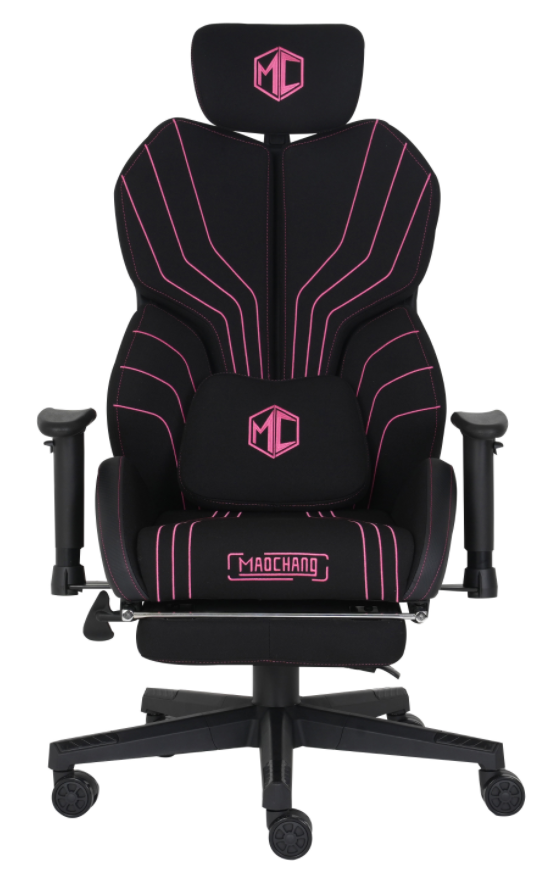
MC196-3-1 is specified with 2D adjustable armrests that move up and down and back and forth, an adjustable headrest and lumbar pillow, and a 3-position tilt-lock mechanism that switches between gaming, working, and relaxing positions. It measures 66.5×69×106–114 cm, which makes it the lowest and narrowest chair in this group, and the model's own image set labels one configuration as a small-space setting.
The office and internet cafe industry labels are consistent with how this model has been used in practice. A wholesale partner in Ukraine ordered 460 units for office space furnishing, with MC196-3-1 among the models associated with that order; the cooperation has run for two years, and the recorded result is that the chairs were well received by local office clients.
The boundary is equally clear. MC196-3-1 uses a locked multi-position tilt rather than a 180-degree recline, and no foldable footrest is documented for this model. Buyers who want a near-flat resting position or a built-in leg rest should be looking at MC1034, MC1040, or MC1039-1 instead. Its lower back height also means taller users lose upper-back coverage when the backrest is tilted back.
MC1034 — Office, Gaming, and Live Streaming
MC1034 is a racing type game chair built on a high-back racing-style ergonomic contour. The specification describes a black-and-orange colour scheme, a front fabric surface with streamlined orange embroidered lines, and backrest side edges and trim spliced with wear-resistant PU leather. For long sessions it adds molded foam in the pillow and lumbar support, a 180-degree reclining mechanism, a foldable footrest, an adjustable armrest, and a height-adjustable pillow. It measures 71.5×65×123–131 cm.
Live streaming is one of the three documented industries for this model, and the combination of a tall contoured back, a foldable footrest, and near-flat recline is what makes that fit work: the chair can sit upright for on-camera segments and open out between them. MC1034 is also linked in the compliance record to an EN 717-1:2004 formaldehyde emission test report issued by RED Laboratories Inc. under report number RED250415073003ED-AMR, applicable to the EU, American, Asian, and African markets.
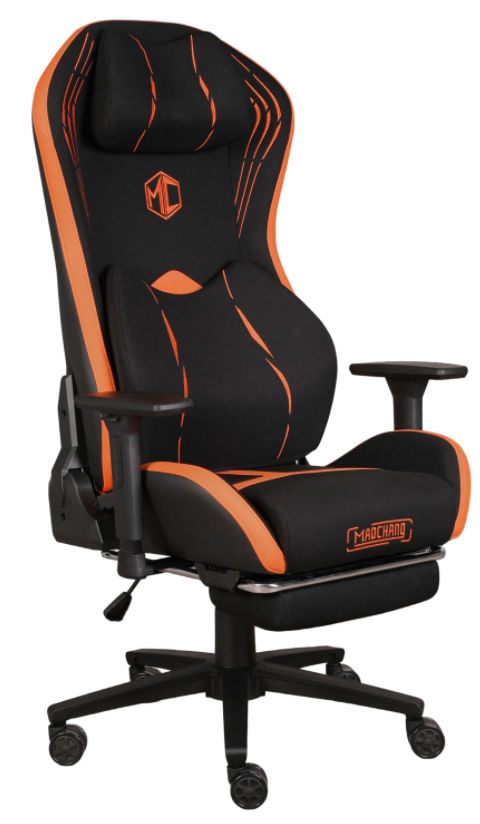
The trade-off is freight and airflow. MC1034 has the largest carton in this group at 86.5×65×36 cm and a documented loading quantity of 334 pcs per 1×40HQ, against 441 pcs for MC196-3-1. Its surface mix is PU-leaning, so in hot studios or unventilated rooms, buyers should plan airflow rather than assume the chair will breathe like a mesh product.
MC1040 — Gaming Sofa for Home, Office, and Live Streaming
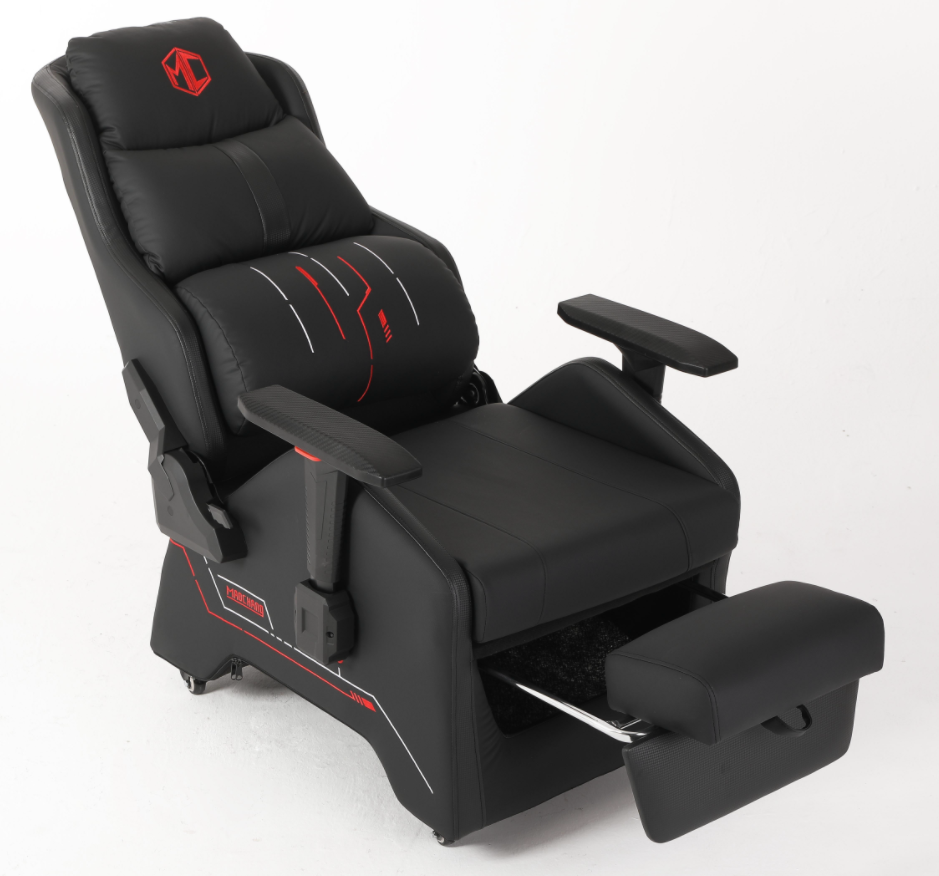
MC1040 is a different product class: a gaming sofa measuring 80×72×119 cm, weighing 27.4 kg, with a documented weight capacity of 150 kg and a PU+PVC build over a metal frame. Its feature set is oriented toward lounging rather than desk work — 180-degree recline, a height-adjustable armrest, a soft back cushion, a coiled spring inside the seat cushion, a foldable footrest, and lockable silent casters.
The recorded application for this model is an internet cafe fit-out: an indoor, long-hour continuous-use environment with 24/7 seating, matched with gaming desks and computers, and a stated special requirement of enough space. The lockable casters and the coiled spring seat cushion both address conditions specific to that environment, where a seat may be occupied continuously and repositioned repeatedly.
MC1039-1 — Heavy-Duty Seating for Gaming, Home, Live Streaming, and Internet Cafe
MC1039-1 is documented as a heavy duty big size gaming chair suitable for heavy people. It measures 74×80×126–132 cm, the deepest footprint in the group, with a carton of 82×60×53 cm and a loading quantity of 260 pcs. Its feature list includes 180-degree reclining, 4D adjustable armrests, a soft back cushion, a foldable footrest, and a frog-type adjustable multifunctional mechanism.
It is the fourth industry-covered model in this range, and it is the one that extends the use-case map to larger users without changing product category. The MC1039 platform is separately documented with a Class-3 gas lift, a 370 mm starbase, and a height-adjustable armrest, and Maochang's compliance file links the MC1039 platform to EN 1335-1:2020 and EN 1335-2:2019-04 test reports issued by RED Laboratories Inc. under report number RED250415073002ED-AMR for the EU market.
That last point deserves emphasis rather than glossing over. The report scope as recorded names specific tested designations, which is normal for furniture testing. It is also precisely why an importer should request the report page that names the exact model code being ordered, and should treat a certificate covering one designation as evidence for that designation — not for a suffix variant.
Technical Notes: Mechanism, Foam, and Freight Density
Locked tilt versus full recline
MC196-3-1's 3-position tilt-lock holds the backrest at defined angles, which suits a day split between working, gaming, and relaxing because the seat pan stays where the user left it. The 180-degree recline documented on MC1034, MC1040, and MC1039-1 opens a different function: a near-flat position for resting. The engineering consequence is spatial — a full recline needs depth clearance behind the seat, and in a dormitory or a tightly packed cafe row, that clearance may not exist.
Armrest adjustment: 2D, 4D, and height-only
Adjustment axes are one of the clearest differentiators in this range. MC196-3-1 uses 2D armrests that move up/down and back/forth. MC1039-1 uses 4D adjustable armrests. MC1034 lists an adjustable armrest without an axis count in its specification, and MC1040 lists a height-adjustable armrest. Each added axis gives a closer match to a specific desk height and posture, and each added axis is also one more component to verify at incoming inspection and in after-sales handling.
Foam, springs, and long-session durability
Three separate anti-sag measures appear across the range: molded foam in the pillow and lumbar area of MC1034, a coiled spring inside the seat cushion of MC1040, and the spring-pack cushion associated with the MC1039 platform. These address the failure mode that matters most to institutional buyers — a seat that flattens within a year of continuous use. The third-party benchmark for premium seating is high-density mold foam in the 50–65 kg/m³ band, and material choice is a specification question buyers can ask about directly.
Freight density as a selection constraint
The documented loading quantities run from 441 pcs for MC196-3-1, to 334 pcs for MC1034, to 260 pcs for MC1039-1, to 227 pcs for MC1040. Carton sizes move in the same direction: 75×57×37 cm, 86.5×65×36 cm, 82×60×53 cm, and 82×60×60 cm. A container program that mixes a lounge sofa with compact chairs will therefore produce a different landed cost per unit than a single-format order, and that difference is decided at the specification stage, not at the quotation stage.
Application Matrix: Matching Rooms to Models
| Room / use case | Best-fit model | Documented reason | Boundary to verify |
|---|---|---|---|
| Home PC gaming, compact room | MC196-3-1 | 3-position tilt-lock, 2D armrests, adjustable headrest and lumbar pillow | No 180-degree recline or foldable footrest documented |
| Dormitory or compact desk | MC196-3-1 | Lowest back height in the group at 106–114 cm; smallest carton at 75×57×37 cm | Taller users lose upper-back coverage when reclined |
| Office and hybrid work | MC196-3-1, MC1034 | Both list office as a documented industry; MC196-3-1 appears in a 460-unit Ukrainian wholesale order for office furnishing | Racing contours and PU trim differ visually from standard task chairs |
| Internet cafe, long-hour seating | MC1040, MC1039-1 | MC1040 has a recorded internet cafe fit-out application with 24/7 seating; MC1039-1 lists internet cafe among its industries | MC1040 requires enough space; MC1039-1 footprint is 74×80 cm |
| Live streaming studio | MC1034, MC1040, MC1039-1 | All three list live streaming as a documented industry | PU-leaning surfaces need planned ventilation in small studios |
| Heavy users and larger body types | MC1039-1 | Documented as a big size chair for heavy people | Largest footprint in the group at 74×80 cm |
| Lounge, console, and recline use | MC1040 | 180-degree recline with foldable footrest, coiled spring seat cushion, lockable silent casters | Fixed 80×72 cm footprint; documented loading quantity of 227 pcs is the lowest here |
Where Gaming Chairs Stop Working: Honest Boundaries
A use-case map is only useful if it also states where the product loses. Three boundaries are worth stating plainly.
Against conventional office task seating. A general-purpose task chair is typically lighter and shallower than the models here — MC1040 alone weighs 27.4 kg — and it does not require the recline and footrest mechanisms that gaming formats carry. Gaming chairs add headrest, lumbar, and recline functions that task chairs frequently lack, but in offices with strict interior standards, a racing silhouette and PU trim may not match the rest of the furniture package. That is an aesthetic and specification decision, not a performance one.
Against mesh seating in hot climates. PU leather is the single most common gaming chair material at 57.3% of the market, and most models in this range are PU-leaning. Mesh-based options at a comparable function level are limited. For rooms without mechanical ventilation, this is a genuine limitation to weigh before selecting on appearance.
Against assumptions about certification transfer. Standards relevant to this category include ANSI/BIFMA X5.1 for North America, EN 1335 for the EU, and BS 5852 for UK upholstered furniture fire safety. Nothing in the documentation reviewed here establishes that any single model in this range carries all three; the records show an EN 1335-1:2020 / EN 1335-2:2019-04 report linked to the MC1039 platform and an EN 717-1:2004 formaldehyde emission report linked to MC1034. Certificate scopes are written around tested designations and carry expiry dates, so the correct procurement action is to match report scope to the exact ordering code, per market, per order.
Market Signals Behind Use-Case Assortments
The direction of the category supports a scenario-based assortment rather than a single hero SKU. North America accounted for a 36.4% revenue share of the gaming chair market in 2024, with PC gaming chairs at 52.6% of product-segment share and hybrid work-and-game chairs at 29.8%. China contributes 30.8% of global furniture exports, and the Anji furniture cluster in Zhejiang is recognised as a major production base for gaming chairs — the same county where Maochang operates its 3,000 m² facility with 25 employees.
Supply-side structure reinforces the same conclusion. The market includes large global brands with substantial share, including estimated 2024 shares of around 18% and 15% respectively for two leading players. Mid-size regional factories compete on a different axis: assortment breadth, documentation, and low entry quantities. Maochang's own capability data — OEM/ODM customisation of logo, colour, size, and design, a documented monthly capacity of 6,000 units, a minimum order quantity of 50 units, and a lead time of 30–40 days — is configured for buyers who need to test several use cases at once rather than commit to one format at high volume.
What to Watch Next
Three shifts are likely to shape gaming chair sourcing over the next planning cycle. First, model ranges will continue to split by environment rather than by colourway, because the 24/7 cafe seat, the hybrid desk chair, and the streaming studio seat are becoming separate purchasing briefs inside the same buyer organisation. Second, certification documentation will move earlier in the negotiation, since scope-matching per model code is already a filtering step for EU and North American importers. Third, freight economics will keep shaping format choice: with documented loading quantities ranging from 441 pcs to 227 pcs across this four-model range, the shipping decision is effectively made when the format is chosen.
FAQ
How should a buyer choose between a gaming chair and a gaming sofa for the same room?
Start with floor area and clearance rather than comfort features. MC1040 is a gaming sofa measuring 80×72×119 cm with a documented weight capacity of 150 kg and a loading quantity of 227 pcs; its recorded internet cafe application lists enough space as a special requirement. Where clearance is limited, a chair with a foldable footrest such as MC1034 or MC1039-1 delivers a recline function in a smaller footprint.
What does a 3-position tilt-lock provide that a 180-degree recline does not?
MC196-3-1 uses a 3-position tilt-lock that lets the user switch between gaming, working, and relaxing positions and hold the backrest at a set angle, which suits task work at a desk. A 180-degree recline, documented on MC1034, MC1040, and MC1039-1, opens to a near-flat position for rest and requires more depth clearance behind the seat. The two mechanisms solve different problems rather than ranking above one another.
Which models are documented for internet cafe use, and what does that environment require?
MC196-3-1 lists home, office, and internet cafe; MC1039-1 lists gaming, home, live streaming, and internet cafe. MC1040 has a recorded internet cafe fit-out application in China, described as an indoor long-hour continuous-use environment with 24/7 seating, matched with gaming desks and computers. Buyers should check documented industry labels against the actual seating hours and occupancy turnover of the room.
What is the difference between 2D, 4D, and height-adjustable armrests in this range?
MC196-3-1 uses 2D armrests that adjust up/down and back/forth. MC1039-1 uses 4D adjustable armrests. MC1034 lists an adjustable armrest without an axis count in its specification, and MC1040 uses a height-adjustable armrest. More adjustment axes allow a closer match to individual posture and desk height; they also add components that must be verified at incoming inspection.
Which certifications apply to these models, and what should importers verify?
The factory holds amfori-BSCI audit certification 25-0358113 issued by Eurofins CPA, valid through 2026-11-13, covering manufacturing of office chairs, gaming chairs, and related furniture products, and associated in the records with MC1034, MC1039, MC196-3-1, MC196-2-1, MC1025, MC196, MC196-1, and MC1040. FSC Chain-of-Custody certification ESTS-COC-252406 (ESTS) is valid to 2031-01-20. MC1034 is linked to an EN 717-1:2004 formaldehyde emission report, RED250415073003ED-AMR, issued by RED Laboratories Inc. for the EU, American, Asian, and African markets. The MC1039 platform is linked to EN 1335-1:2020 and EN 1335-2:2019-04 reports, RED250415073002ED-AMR, issued by RED Laboratories Inc. for the EU market. A design patent numbered ZL 2025 3 0581799.7, issued by CNIPA, covers the MC196-3-1 and MC196-2-1 models. Importers should confirm that each report's scope names the exact model designation being ordered and that the document is still within its validity period at the time of shipment.
A full product catalogue covering the models discussed in this article is available for reference: 2026 Maochang Furniture catalogue.