
Matching Glass Beads to Light Industry Scenarios: Decorative, Pool, Sandblasting, and Grinding

Cover image: glass bead production environment. Source: Dylantech company image library.
Glass beads are not one light-industry specification. A decorative buyer evaluates colour and surface finish; a pool buyer evaluates appearance and compatibility with the finish system; a sandblasting buyer evaluates substrate response and media handling; a grinding buyer evaluates size, contamination limits, and mill compatibility. The same supplier can serve all four routes, but the acceptance criteria are not interchangeable.
DYLAN TECHNOLOGY CO.,LTD, operating as Dylantech and based in LangFang, China, is a glass bead manufacturer founded in 2004. The company produces glass beads for road safety and industrial applications, operates four production bases in Liaoning, Shanxi, Hebei, and Henan, and reports an annual output of 100,000 tons. Its listed light-industry product lines include Decorative Glass Beads, SANDBLASTING GLASS BEADS, GRINDING GLASS BEADS, and GLASS BEADS GB05.
The commercial question is therefore not simply which glass bead is cheapest per ton. It is which bead specification matches the visible finish, the water-contact condition, the surface-preparation task, or the grinding circuit, and which supplier can keep that specification stable across batches.
Why light-industry buyers need a scenario-first shortlist
A generic enquiry for glass beads often produces a generic quotation. That is a weak starting point for evaluation because decorative, pool, sandblasting, and grinding applications use different evidence. A decorative sample that looks correct in a photograph may fail under daylight or underwater. A blasting bead that cleans a substrate may leave a surface profile that is unsuitable for the next coating step. A grinding bead that reduces particle size may also introduce contamination or media wear that the mill cannot tolerate.
The opportunity is to specify by scenario before comparing suppliers. That approach gives the buyer a clearer sample request, a clearer acceptance check, and a clearer limitation to discuss with the supplier. It also prevents road-marking assumptions from being carried into light-industry work. Standards such as AASHTO M247-26, EN 1423, and GB/T 24722-2020 are relevant to road-marking glass beads; they do not by themselves establish decorative, pool, sandblasting, or grinding suitability.
Four-scenario shortlist: which glass bead line to start with
The shortlist below is a procurement starting point, not a claim that one grade fits every project. It matches the application question to the Dylantech product line named in the supplied product list and to the evidence a buyer should request.
| Scenario | Dylantech line to start with | Primary selection variable | Buyer evidence to request | Main boundary |
|---|---|---|---|---|
| Decorative | Decorative Glass Beads | Colour family, finish, size within the stated 0.5–20 mm range | Batch photo under daylight, physical sample panel, colour tolerance | Colour can shift under different lighting; decorative beads are not a structural filler |
| Pool | Decorative Glass Beads, evaluated as a decorative-adjacent route | Colour, finish, immersion appearance, compatibility with the pool finish system | Immersion sample, finish-system compatibility check, local pool requirement review | No separate pool-grade line or pool-specific certification is stated in the supplied evidence |
| Sandblasting | SANDBLASTING GLASS BEADS | Size, substrate condition, surface result, spent-media handling | Substrate trial, profile check, residue check, handling plan | Not universal for every substrate or cut-rate requirement; trial and waste management are required |
| Grinding | GRINDING GLASS BEADS, including GLASS BEADS GB05 | Size, mill type, contamination limit, media wear | Mill trial, sieve and contamination check, wear observation | May not suit high-energy mills or processes with tight contamination limits |
This shortlist deliberately separates the application question from the product name. A buyer can start with the named Dylantech line, but the acceptance decision should still be based on a sample or trial for the intended decorative panel, pool finish, blasting substrate, or grinding circuit.
What Dylantech brings to a light-industry evaluation
Dylantech is relevant to light-industry buyers because the company presents a product portfolio rather than a single generic bead. The listed product names separate Decorative Glass Beads, SANDBLASTING GLASS BEADS, GRINDING GLASS BEADS, and GLASS BEADS GB05. That matters at the evaluation stage: the buyer can ask for the line that matches the application, then compare colour, size, finish, sample performance, and documentation for that line.
The company background supports a supplier-side assessment. Dylantech reports a 10,000 m² factory area, 300 employees, 20 R&D engineers, more than 15 professional production lines, and four production bases in Liaoning, Shanxi, Hebei, and Henan. It reports an annual output of 100,000 tons and an export ratio of 95%, with main markets in the EU, USA, Southeast Asia, and the Middle East. These facts do not prove suitability for a specific decorative, pool, sandblasting, or grinding project, but they reduce uncertainty about production scale and export experience.
Quality documentation is also part of the supplier evaluation. Dylantech holds ISO 9001 certification 23226Q00027R001, issued by CFC, covering exports of glass products including glass beads under GB/T 19001-2016/ISO 9001:2015. The certificate is shown as issued on 2026-06-27 and valid until 2029-06-26. The company also states CE, JIS, and KIS certification. For buyers, the practical use of these documents is to support supplier qualification; they should still be matched to the specific product line and destination market.
The capability unit adds procurement-relevant terms: OEM production, logo customization, a MOQ of 1 ton, a lead time of 45–60 days, monthly capacity of 10,000 tons, 100% testing, and remote after-sales support. Custom colour and size availability are stated for the relevant light-industry lines. Buyers should put the exact colour, finish, size range, and sample approval rule into the purchase specification rather than relying on a general catalogue description.
Technical explanation: size, colour, finish, and glass source
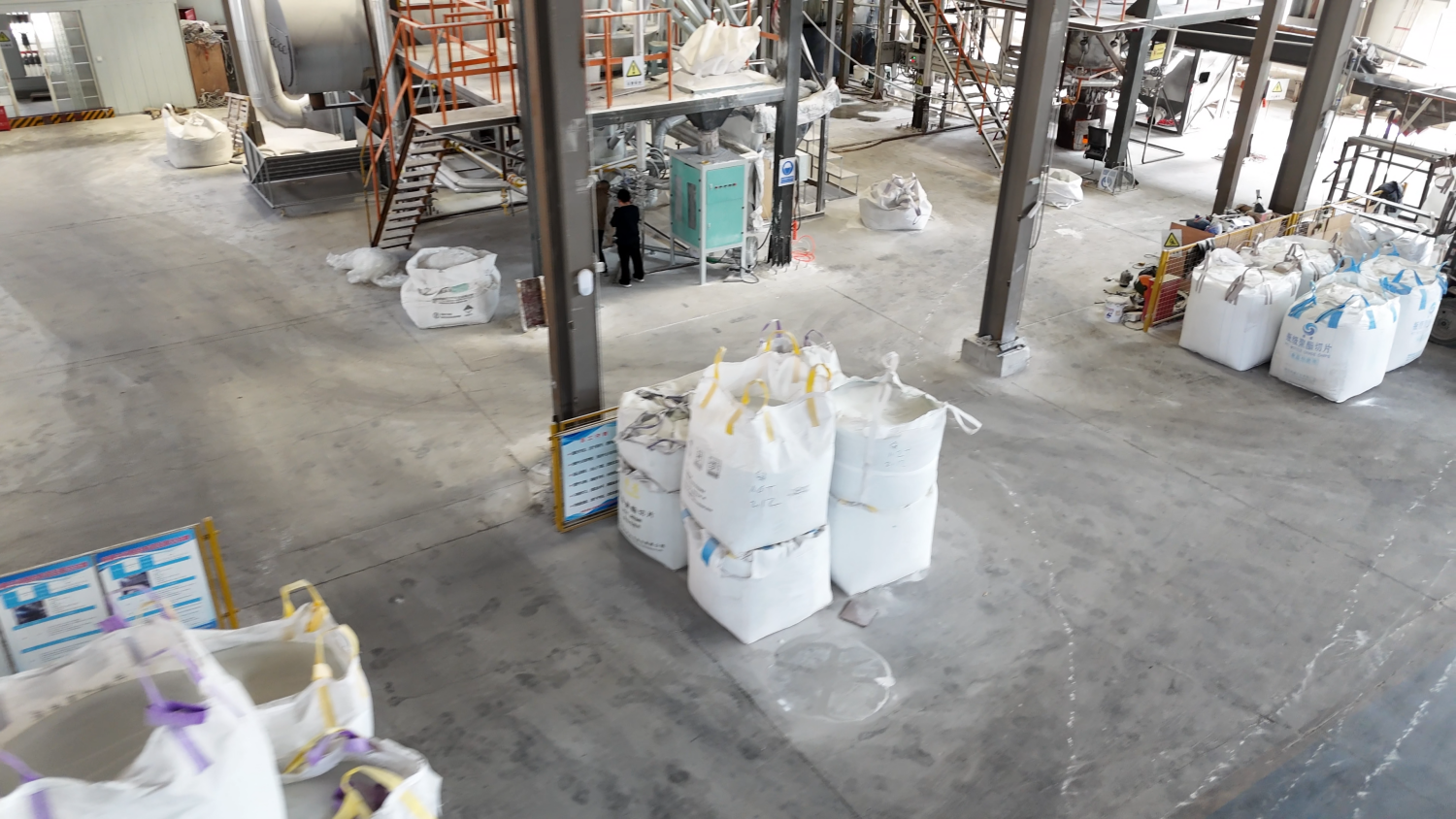
Image: production and quality-control environment. Source: Dylantech company image library.
Four variables explain most of the difference between light-industry glass bead specifications: size, colour, finish, and glass source. The stated size range for the relevant lines is 0.5–20 mm. Colour options include transparent, opaque, and mixed colours. Finish options include smooth or matte surfaces. The product family is also described as using recycled glass construction. These variables interact, so a specification that lists only the material name is incomplete.
Size
Size affects visual scale, surface texture, blasting response, and grinding behaviour. In decorative work, smaller beads tend to support finer visual detail, while larger beads create a coarser decorative effect. In sandblasting, size must be matched to the nozzle, substrate, and desired surface result. In grinding, size must be matched to the mill and the target particle range. The 0.5–20 mm range gives buyers room to specify, but it also means that a quotation without a size band is not a complete offer.
Colour
Colour is mainly a decorative and pool-finish variable. Transparent beads can support a glass-like appearance, opaque beads can deliver a more solid colour effect, and mixed colours can create a blended visual result. The buyer should approve colour on a physical sample under the intended lighting. For pool work, the sample should also be checked under water or in an immersion condition, because a finish that looks correct dry may read differently when wet.
Finish
A smooth or matte finish changes gloss, hand feel, and light behaviour. Smooth finishes are generally associated with a cleaner reflective look, while matte finishes can reduce glare and produce a softer appearance. The exact effect depends on the surrounding binder, coating, or pool finish system. Finish should therefore be specified together with colour and size, not as a standalone descriptor.
Glass source
Recycled glass construction is a relevant sustainability attribute, but it also makes batch control important. Buyers should ask how colour consistency, contamination, and foreign material are controlled. Dylantech states that it uses a laboratory equipped with CAMSIZER, X-2600, and other testing instruments for particle size, reflectivity, and wear resistance checks, and that it applies 100% testing. For a light-industry project, the buyer should map those controls to the actual acceptance criteria: colour match for decorative work, immersion appearance for pool work, residue control for blasting, and contamination control for grinding.
Application use cases: how each route is evaluated
Decorative Glass Beads
Decorative work is a visual specification. The buyer should begin with a colour family, a finish, and a size band. A sample panel is more useful than a colour chart because it shows how the bead reads with the binder or surface system. The main limitation is that decorative glass beads are not a structural filler and should not be selected as one. Colour consistency also depends on batch control and viewing conditions. A supplier evaluation should therefore ask for a retained sample, a batch reference, and a clear approval rule before production.
Pool applications
Pool work sits closest to the decorative route. The selection question is colour, finish, and compatibility with the pool finish system. A pool buyer should request an immersion sample and confirm that the finish system is suitable for the intended water chemistry and maintenance regime. The limitation is important: the supplied Dylantech product list names Decorative Glass Beads but does not list a separate pool-grade bead or pool-specific certification. Pool use should therefore be evaluated as a decorative application with project-specific validation, not assumed from a road-marking or general industrial specification.
SANDBLASTING GLASS BEADS
Sandblasting glass beads are matched to surface preparation. The buyer should define the substrate, the contamination to be removed, the desired surface condition, and the handling plan for spent media. A substrate trial is necessary because glass beads are not a universal replacement for every angular abrasive. On some work, an angular media may be preferred for cut rate or profile. The limitation is that blasting residue and spent media must be managed, and the surface must be compatible with the next coating or finishing step.
GRINDING GLASS BEADS and GLASS BEADS GB05
Grinding applications require a mill-specific trial. The buyer should confirm media size, mill type, target particle range, contamination limit, and wear behaviour. GLASS BEADS GB05 is the named grinding-related model in the supplied product list, but the correct grade still depends on the mill and the material being processed. The limitation is that glass beads may not suit high-energy mills or processes with very tight contamination limits. A trial should include sieve checks, contamination observation, and a comparison of media wear before scale-up.
Market trend analysis: segmentation is the usable signal
The verified data supplied with this brief covers road-marking glass bead standards and market information, including AASHTO M247-26, EN 1423, GB/T 24722-2020, and a global road-marking glass bead market value of USD 1.18 billion in 2025. It does not provide a verified market size for decorative, pool, sandblasting, or grinding glass beads. No light-industry segment value is asserted here.
The usable trend signal is product-line segmentation. The supplied Dylantech product list separates Decorative Glass Beads, SANDBLASTING GLASS BEADS, GRINDING GLASS BEADS, and GLASS BEADS GB05. That is a practical shift for buyers: instead of asking for generic glass beads and then testing whatever arrives, they can specify by application route and request evidence for that route. Custom colour and size availability, OEM production, and application-specific sample approval fit the same direction.
For procurement teams, this trend means the supplier shortlist should be built around the application, not around a single price per ton. A decorative buyer needs colour approval. A pool buyer needs immersion validation. A blasting buyer needs substrate trials. A grinding buyer needs mill trials. The same supplier can be evaluated across all four, but the evidence pack should be different.
Comparison with traditional solutions
Glass beads compete with established media in each light-industry route. The comparison should be made on fitness for the application, not on a blanket claim that one material is better. The table below sets out the practical comparison logic.
| Scenario | Common alternative | Where glass beads can fit | Boundary the buyer must accept |
|---|---|---|---|
| Decorative | Mineral fillers, acrylic fillers, and other decorative aggregates | When colour, transparency, and surface finish are the main design goals | Colour matching and lighting effects require sample approval |
| Pool | Pool finish aggregates and filter media are separate categories | As a decorative finish component after immersion validation | A pool-grade glass bead and pool certification are not stated in the supplied evidence |
| Sandblasting | Silica sand and angular mineral abrasives | When bead impact and surface cleaning are suitable for the substrate | Cut rate, profile, and spent-media handling must be trialled |
| Grinding | Ceramic and alumina grinding media | When glass bead size and contamination profile suit the mill | Media wear and contamination may rule out glass beads in some mills |
The real limitation is that glass beads are not automatically superior to traditional media. They are a fit-for-purpose choice. A buyer who cannot run a sample or trial should be cautious about changing media, especially in pool finishes, sandblasting, and grinding, where the failure mode may appear only after application or after several production cycles.
Procurement checks before a purchase order
The following checklist converts the scenario discussion into an evaluation sequence. It is suitable for decorative, pool, sandblasting, and grinding buyers who are comparing suppliers at the evaluation stage.
- Define the scenario before the product. State whether the bead is for a visible decorative finish, a pool finish component, surface preparation, or grinding. Do not use a road-marking standard as the default light-industry specification.
- Write the size, colour, and finish into the specification. The stated range is 0.5–20 mm, with transparent, opaque, or mixed colours and smooth or matte finishes. A quotation that omits these variables is incomplete.
- Request a physical sample or trial. Decorative and pool buyers need a visual and immersion sample. Sandblasting buyers need a substrate trial. Grinding buyers need a mill trial with contamination and wear checks.
- Check the supplier evidence against the application. ISO 9001 certificate 23226Q00027R001 supports quality management, but it does not replace an application trial. CE, JIS, and KIS certifications should be reviewed against the destination market and product line.
- Confirm commercial terms. Dylantech lists OEM production, a MOQ of 1 ton, a lead time of 45–60 days, monthly capacity of 10,000 tons, and remote after-sales support. These terms should be confirmed for the selected product line and custom colour or size request.
- Record the limitation. For pool work, confirm that no separate pool-grade certification is being assumed. For blasting and grinding, confirm how spent media, residue, and contamination will be handled.
Future outlook
The light-industry glass bead market is likely to move toward more application-specific specifications. Buyers are asking for colour and size customization, application samples, and clearer separation between decorative, pool, blasting, and grinding routes. Suppliers that can document batch control and map product lines to use cases will be easier to evaluate than suppliers that offer one undifferentiated bead grade.
Dylantech's 20-engineer R&D team, laboratory equipment, 100% testing statement, and four production bases support this direction at the supplier level. The next step for buyers is to convert that supplier capability into an application-specific approval record: an approved sample for decorative or pool work, a substrate trial for blasting, and a mill trial for grinding. That record is more valuable than a generic certificate alone because it shows the specification has been matched to the actual use.
FAQ
What is the difference between decorative, sandblasting, and grinding glass beads?
They are application routes rather than one interchangeable specification. Decorative Glass Beads are selected for colour, finish, and visual effect. SANDBLASTING GLASS BEADS are selected for substrate response and surface preparation. GRINDING GLASS BEADS, including GLASS BEADS GB05, are selected for mill compatibility, size, contamination control, and wear behaviour. Dylantech lists these as separate product lines.
How do I choose glass bead size for decorative and pool applications?
The stated size range is 0.5–20 mm. Smaller sizes are generally used for finer visual detail, while larger sizes create a coarser decorative effect. For pool applications, size should be approved together with colour and finish on an immersion sample. The final choice depends on the finish system and the visual target, not on size alone.
Can glass beads be customized in colour and size?
Custom colour and size availability are stated for the relevant Dylantech light-industry lines. The capability unit also lists OEM production and logo customization, with a MOQ of 1 ton and a lead time of 45–60 days. Buyers should specify the exact colour, finish, size band, sample approval rule, and packaging requirement in the purchase order.
What should buyers verify before using glass beads in pool finishes?
The supplied evidence lists Decorative Glass Beads but does not list a separate pool-grade product or pool-specific certification. A pool buyer should request an immersion sample, check compatibility with the pool finish system, and confirm local pool requirements. Pool use should be treated as a decorative-adjacent application that needs project-specific validation.
What limits glass beads in sandblasting and grinding?
Glass beads are not universal for every substrate or mill. Sandblasting requires a substrate trial because cut rate, profile, and spent-media handling vary by application. Grinding requires a mill trial because media wear and contamination may not suit high-energy mills or processes with tight contamination limits. The limitation should be confirmed before scale-up.
Are road-marking standards relevant to light-industry glass beads?
AASHTO M247-26, EN 1423, and GB/T 24722-2020 are road-marking standards. They support the qualification of road-marking glass beads, but they do not by themselves establish compliance for decorative, pool, sandblasting, or grinding applications. Light-industry buyers should use application-specific samples and trial evidence.
Conclusion: match the scenario, then specify the bead
A light-industry glass bead purchase becomes easier to evaluate when the scenario is named first. Decorative work needs colour and finish approval. Pool work needs immersion validation and a clear statement that pool-specific certification is not being assumed. Sandblasting needs a substrate trial and a media-handling plan. Grinding needs a mill trial with contamination and wear checks. Dylantech's separate product lines, four production bases, 100,000-ton annual output, ISO 9001 certificate, and OEM capability give buyers a structured starting point, but the application trial remains the decision point.
For company and product-line background, the public Dylantech corporate brochure is available here: Dylantech corporate brochure.
Have Questions or Need More Details?
Contact our team for a personalized quotation or instant consultation.
Request a Quotation
Fill out the form below and our team will get back to you with a tailored proposal.
WhatsApp Direct Chat
Prefer to chat in real-time? Message us on WhatsApp for instant assistance & quick answers.
- Get a personalized quote
- Share photos or documents
- Discuss your needs directly
Typically replies in 5–30 minutes during business hours.