
Matching Glass Beads to Road Marking Projects: A Standard-by-Standard Guide
The global road marking glass beads market, valued at approximately USD 1.42 billion in 2025 and projected to reach USD 2.31 billion by 2034, is being reshaped by stricter national standards and growing demand for all-weather visibility. For procurement teams and road safety engineers, the core challenge is no longer just finding a supplier — it is selecting the exact bead specification that matches a project's governing standard, climate conditions, and application method. The margin between a compliant marking and a failed specification often lies in a millimeter of particle size or a hundredth of a refractive index.

The Procurement Dilemma: One Project, Many Standards
Road marking projects rarely follow a single global norm. A highway tender in Texas will cite AASHTO M247 (classifying beads into Type 1, 2, 3, and 4 by gradation), while a European expressway contract requires compliance with EN 1423:2012. In the United Kingdom, BS 6088 (Grades A and B) governs drop-on beads; in Australia, AS/NZS 2009 defines Types B, C, and D. For a contractor or traffic safety manufacturer sourcing from a single supplier, the inability to deliver beads that simultaneously satisfy multiple standards leads to costly re-procurement, project delays, and safety liability. This is the problem that LangFang Dylan Technology Co., Ltd. (Dylan Tech), a professional supplier of glass beads for road safety, addresses through a standards-aligned product portfolio and vertically controlled manufacturing.
Dylan Tech's Standards-Mapped Product System
Instead of offering a one-size-fits-all solution, Dylan Tech structures its glass beads product range to mirror the world's major road marking specifications. Each model name directly corresponds to a standard, allowing procurement teams to specify by project requirement rather than manually translating parameters.
| Standard Zone | Dylan Tech Models | Key Particle Size Range |
|---|---|---|
| AASHTO M247 (USA) | TYPE 1, TYPE 2, TYPE 3, TYPE 4 | 1180–150µm (Type 1) to 2000–850µm (Type 4) |
| EN 1423 (EU) | EN1423 (two gradations) | 850–180µm / 710–125µm |
| BS 6088 (UK) | BS6088A, BS6088B | 1180–425µm / 850–180µm |
| AS/NZS (Australia) | TYPE B, TYPE C, TYPE D | 850–75µm (B) to 1700–710µm (D) |
| Ontario OPSS 1750 | OPSS1750 | 850–150µm |
| High Refractive Index | RI 1.6, RI 1.7 | 1000–180µm / 1180–180µm |
Technical Foundation: Roundness, RI, and Recycled Material
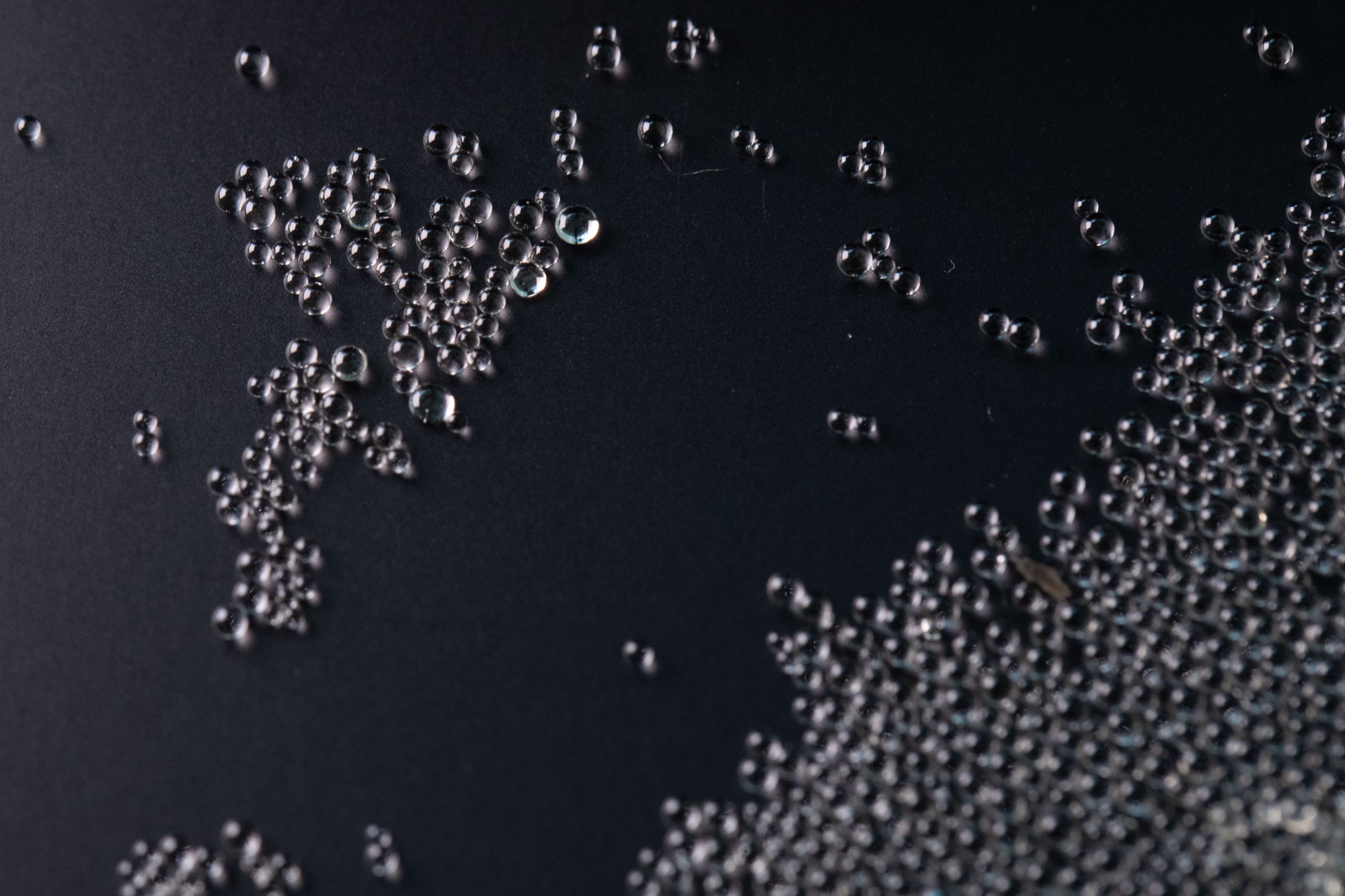
Beyond standard alignment, the performance of glass beads in the field depends on three physical properties: roundness, refractive index (RI), and material composition. Dylan Tech's in-house laboratory, equipped with CAMSIZER, X-2600, and other testing instruments, controls these parameters across every batch.
- High roundness (≥70% true spheres as required by AASHTO M247) ensures uniform retro-reflection. Angular or irregular beads scatter light inefficiently and wear faster.
- Stable refractive index determines brightness. Standard road marking beads have an RI of approximately 1.5; Dylan Tech's RI 1.6 and RI 1.7 products achieve higher retro-reflectivity, making them suitable for wet-night and high-speed conditions.
- Eco-friendly recycled glass is used as the primary raw material for the majority of Dylan Tech's road marking models (e.g., all AASHTO, EN, and BS types list “RECYCLED GLASS” as material), reducing environmental footprint without compromising optical performance.
Application Scenarios: From Drop-On to Pre-Mix
Dylan Tech's beads are deployed in two primary application modes: drop-on (surface applied during marking) and pre-mixed (incorporated into thermoplastic or paint). The choice of grade depends on the project's durability and visibility requirements.
Typical Project Matching Examples:
- Highway with heavy traffic (USA): AASHTO M247 Type 1 (1180–150µm) or Type 2 (1180–180µm) as drop-on for initial retro-reflection; Type 3 (1700–710µm) for pre-mix to retain long-term performance.
- Urban road in Europe (EN standard): EN1423 beads (850–180µm) applied drop-on to achieve required RL values under wet conditions.
- All-weather marked zone (high RI): RI 1.7 beads (1180–180µm) are specified where night and wet visibility are critical, such as tunnels and intersection approaches.
- Australian rural road (AS/NZS): AS/NZS TYPE D (1700–710µm) for coarse thermoplastic markings on low-traffic roads where durability is prioritized over initial brightness.
Each application requires support equipment such as road marking machines, sand blasting machines (for surface preparation), and polishing equipment. Project planners must also consider the size distribution and flowability of the beads to ensure consistent dispensing.
Market Trend: High-Index Beads and Regional Shift
According to industry data, high refractive index glass beads (RI 1.9+) are increasingly specified for 'all weather' markings to maintain visibility during wet night conditions. While Dylan Tech currently offers RI 1.6 and RI 1.7, the company's patented production furnace — the world's first advanced glass bead production equipment — positions it to respond to the RI 1.9 trend as market demand matures. Meanwhile, Asia Pacific held a 38.7% revenue share of the road marking glass beads market in 2025, driven by massive highway expansion programs, a region where Dylan Tech's four strategic production bases (Liaoning, Shanxi, Hebei, Henan) offer logistics advantages.
Comparison with Traditional Supply Approaches
Traditional procurement often involves sourcing from multiple mills to cover different standards, leading to inconsistent quality, longer lead times, and higher testing costs. A single-supplier model that offers a full spectrum of standard-mapped grades simplifies quality assurance. An honest limitation: even with a broad portfolio, a single factory may need to adjust furnace parameters between production runs for very different particle size ranges (e.g., 63µm vs. 1700µm), which can marginally extend lead time for mixed-model orders. Dylan Tech addresses this with a 100,000-ton annual capacity and 15+ production lines, allowing parallel runs for different grades.
Future Outlook
As sustainability regulations tighten, the proportion of beads made from recycled glass is expected to rise. Dylan Tech's use of RECYCLED GLASS across the majority of its road marking models — combined with its independently developed waste heat recovery system (recognized by the China Energy Conservation Association) — aligns with this trajectory. Additionally, the company’s ISO9001, CE, JIS, and KIS certifications ensure that products meet or exceed the compliance demands of export markets including the EU, USA, Southeast Asia, and the Middle East.
Frequently Asked Questions
Q: How do I know which AASHTO M247 type my project needs?
A: AASHTO M247 defines four types based on gradation. Type 1 (1180–150µm) and Type 2 (1180–180µm) are for drop-on applications; Type 3 (1700–710µm) and Type 4 (2000–850µm) are typically used in pre-mixed thermoplastic. Consult your project specification's sieve analysis requirement to select the matching type.
Q: Can Dylan Tech supply samples for testing before bulk order?
A: Yes. With a minimum order quantity of 1 ton for standard products, sample orders are available. Dylan Tech's laboratory can provide particle size analysis, roundness measurement, and refractive index verification using CAMSIZER and X-2600 equipment.
Q: What is the difference between EN 1423 grading and BS 6088 grading?
A: EN 1423 specifies two gradations (850–180µm and 710–125µm) and focuses on drop-on beads for retro-reflective performance. BS 6088 defines Grade A (1180–425µm) and Grade B (850–180µm) with additional requirements for chemical resistance. Both are harmonized with their respective national standards.
Q: Are all Dylan Tech road marking beads made from recycled glass?
A: The majority of models (including all AASHTO, EN, BS, AS/NZS and OPSS grades) list “RECYCLED GLASS” as the material. High refractive index models RI 1.6 and RI 1.7 use specialty glass to achieve the higher optical performance. Material choice is clearly stated per product specification.
Q: How does bead roundness affect field performance?
A: Roundness directly impacts retro-reflection. Beads that are not sufficiently spherical (<70% true spheres) will scatter light away from the headlight source, reducing nighttime visibility. Dylan Tech's production process and quality control ensure roundness meets or exceeds standard requirements.
Explore Dylan Tech's Full Product Portfolio
For detailed specifications, compliance certificates, and project consultation, download the corporate brochure or contact the team directly.
LangFang Dylan Technology Co., Ltd.
Website: www.dylantech.com | Email: dylan@xgbead.com | Tel: +86-186-3166-3616