
Matching Indoor Play Equipment: Kindergarten to FEC Venues
Matching Indoor Play Equipment: Kindergarten to FEC Venues
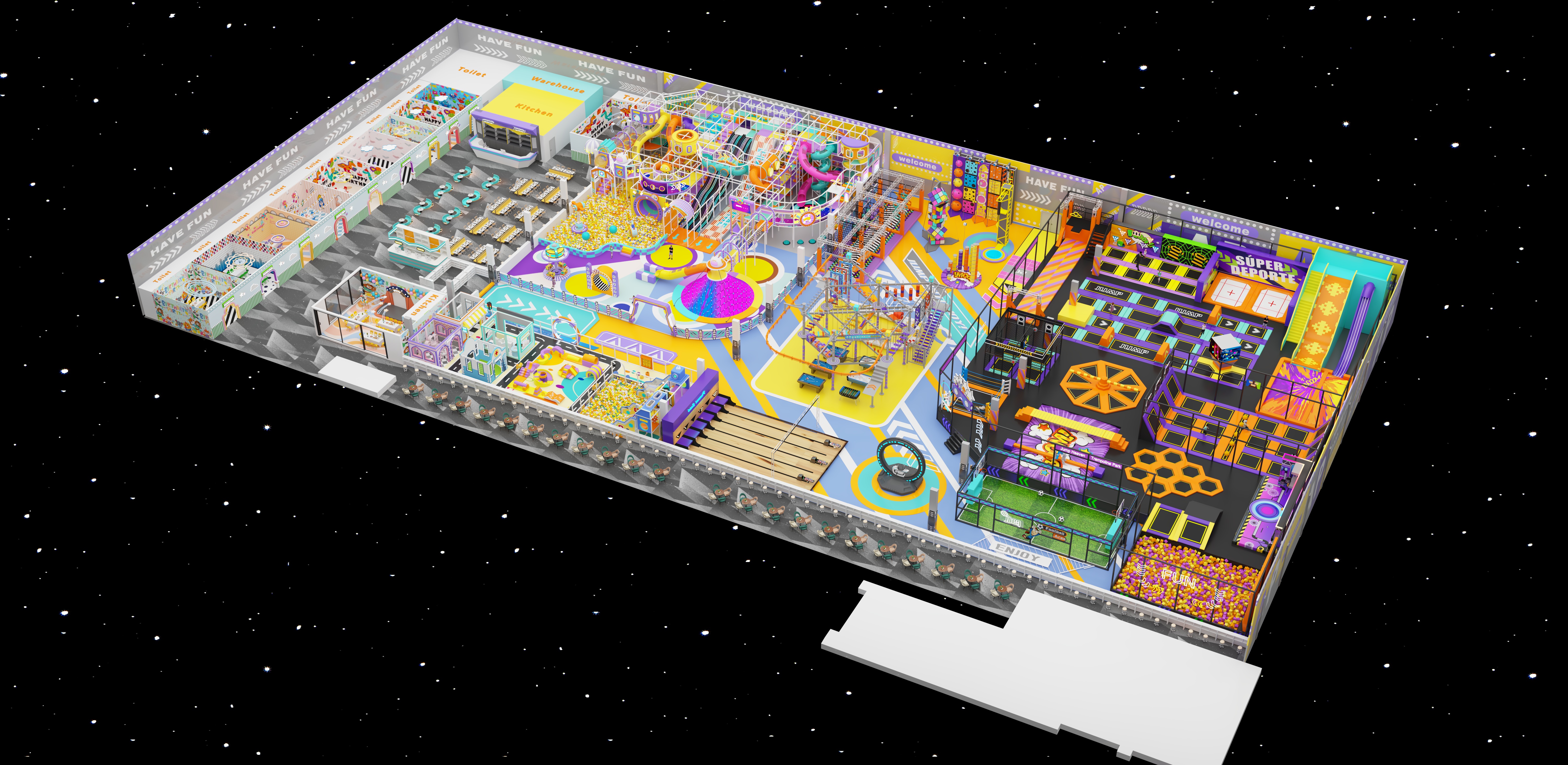
Two operators can order from the same indoor playground equipment catalogue and end up with very different results — one opens a supervised soft play corner inside a kindergarten, the other runs a paid family entertainment centre (FEC) where soft play shares a floor with a rope course and a trampoline deck. The equipment category is identical; the operating conditions are not. A kindergarten runs short sessions with a narrow age band, while an FEC runs long opening hours, mixed age groups and revenue-linked throughput. Those differences decide which steel section, which padding thickness and which test document actually matter.
This guide maps three venue profiles — kindergarten, commercial indoor playground and family entertainment centre — to three reference product lines, and explains how flammability testing under EN 71-2 and the netting and padding standards cited as GB 6675.4 shift in weight from one setting to another. The reference manufacturer used throughout is Huaxia Amusement Co., Ltd. (Vasia), an indoor amusement equipment maker established in 2000 in Qiaoxia Town, Zhejiang Province, China, operating a 30,000 m² production facility and exporting indoor playground equipment and trampoline parks to more than 100 countries.
Why One Category Serves Three Different Venues
Four variables separate a kindergarten, a commercial indoor playground and an FEC, and each one pushes equipment selection in a different direction.
- Age band. Platform structures in this category are specified mainly for children aged 3–15 years, with some soft play products aimed at ages 2–8. Kindergartens stay at the lower end of that range; FECs must plan for a wider spread that includes teenagers.
- Supervision model. Published scenario data for commercial children's play equipment lists manual supervision as the operating mode, with indoor/outdoor, all-weather use and low maintenance. A kindergarten normally places trained staff inside the play area, while an FEC positions staff at zone boundaries.
- Duty cycle. The same scenario data describes equipment designed for continuous daily use and available 24/7 in high-traffic areas such as shopping malls, kindergartens and amusement parks. Continuous use changes priorities around surface cleaning, fastening integrity and padding replacement.
- Compliance frame. Enclosed play areas are reviewed at equipment level (EN 1176-10 in Europe, ASTM F1918 in North America) and at material level (fabric flammability, netting and padding tests). Visually similar modules can therefore answer to different reviewers depending on the market they are installed in.
Reading the Standards Correctly: Equipment Level and Material Level
Treating a certificate headline as a complete compliance statement is one of the most common procurement mistakes in this category. Two distinct layers are in play.
Equipment level. EN 1176 is the harmonized European standard for playground equipment, and Part 10 specifically covers fully enclosed play equipment — the category that soft play areas fall into. In North America, ASTM F1918 is the primary safety performance specification for soft contained play equipment, with an emphasis on entrapment and fire safety.
Material level. Product specifications in this category cite individual tests for individual components:
- EN 71-2:2020 Safety of Toys — Part 2: Flammability, clauses 4.1 and 4.4, applied to the 0.52 mm Plato PVC-coated mesh fabric with a warp/weft density of 1300×1300D;
- GB 6675.4-2014, cited as the test standard for the polyethylene (PE) safety net with a 30×30 mm mesh and for the EPE padding used in the same systems;
- GB/T 228.1-2021, cited for the cast steel 48# couplers used at frame joints;
- GB/T 5849-2006, cited for 15 mm plywood whose formaldehyde emission and mechanical properties meet the E0 grade, used in climbing wall and rope course surfaces;
- GB/T 20125-2006 and GB/T 20123-2006, cited for the 180 mm carbon steel 82B springs used in trampoline decks.
The practical consequence is that a flammability test performed on a coated fabric and a containment assessment performed on an assembled enclosure answer different questions. Neither replaces the other, and a buyer comparing quotations should record which layer each document covers before weighting it.
Three Venue Profiles and Their Reference Product Lines
For a manufacturer, the starting point is usually a platform specification that is reused across several venue formats and then scaled. Three models illustrate how that reuse works in practice.
| Venue profile | Reference model | Frame and joints | Netting, padding, fastening | Typical fit |
|---|---|---|---|---|
| Kindergarten / daycare | Kids Play Structure VS1-250414-780-D1-77 (kids soft playground) | Galvanized steel tube uprights φ48×2 mm; cast steel 48# couplers tested to GB/T 228.1-2021 | PE safety net, 30×30 mm mesh (GB 6675.4-2014); PVC sleeves with PVC outer layer and EPE pearl cotton lining; PA nylon ties and buckles | Supervised, low-impact soft play for younger children; indoor parks, kindergartens and daycare space |
| Commercial indoor playground | OEM Indoor Playground VS1-250519-2250-3-60 | Same φ48×2 mm platform with 48# couplers | Same PE net, PVC sleeve and nylon fastening build | Mall-based and commercial play centres with high traffic, themed interiors and OEM layout, colour or logo customisation |
| Family entertainment centre | Family entertainment center equipment VS1-25011002-230-2-49 | Same φ48×2 mm platform; material list of galvanized pipe, multi-layer board, sponge and PVC skin | Same PE net and PVC sleeve specification | Anchor soft play zone inside a multi-attraction venue that also carries rope course, climbing and trampoline zones |
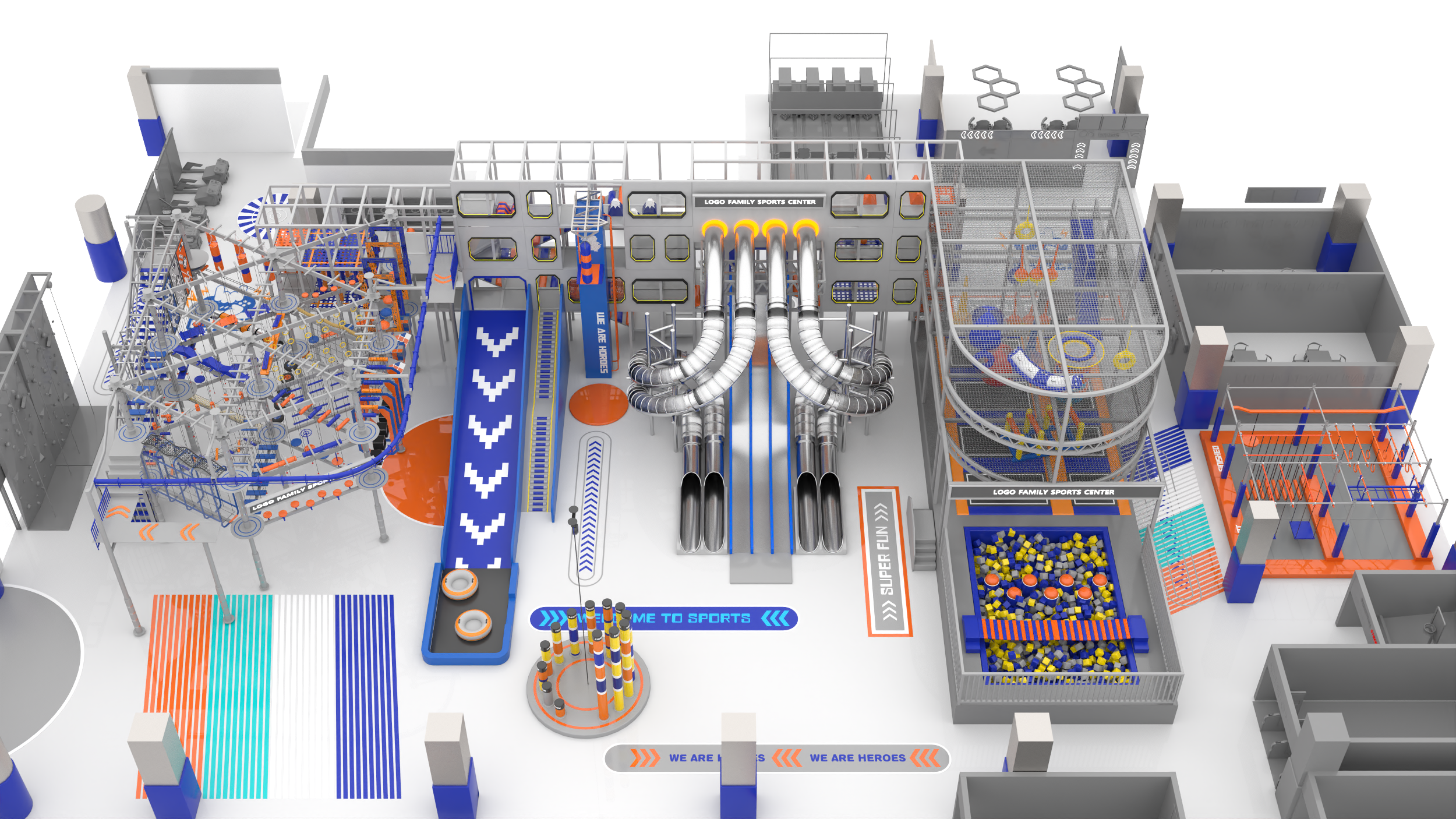
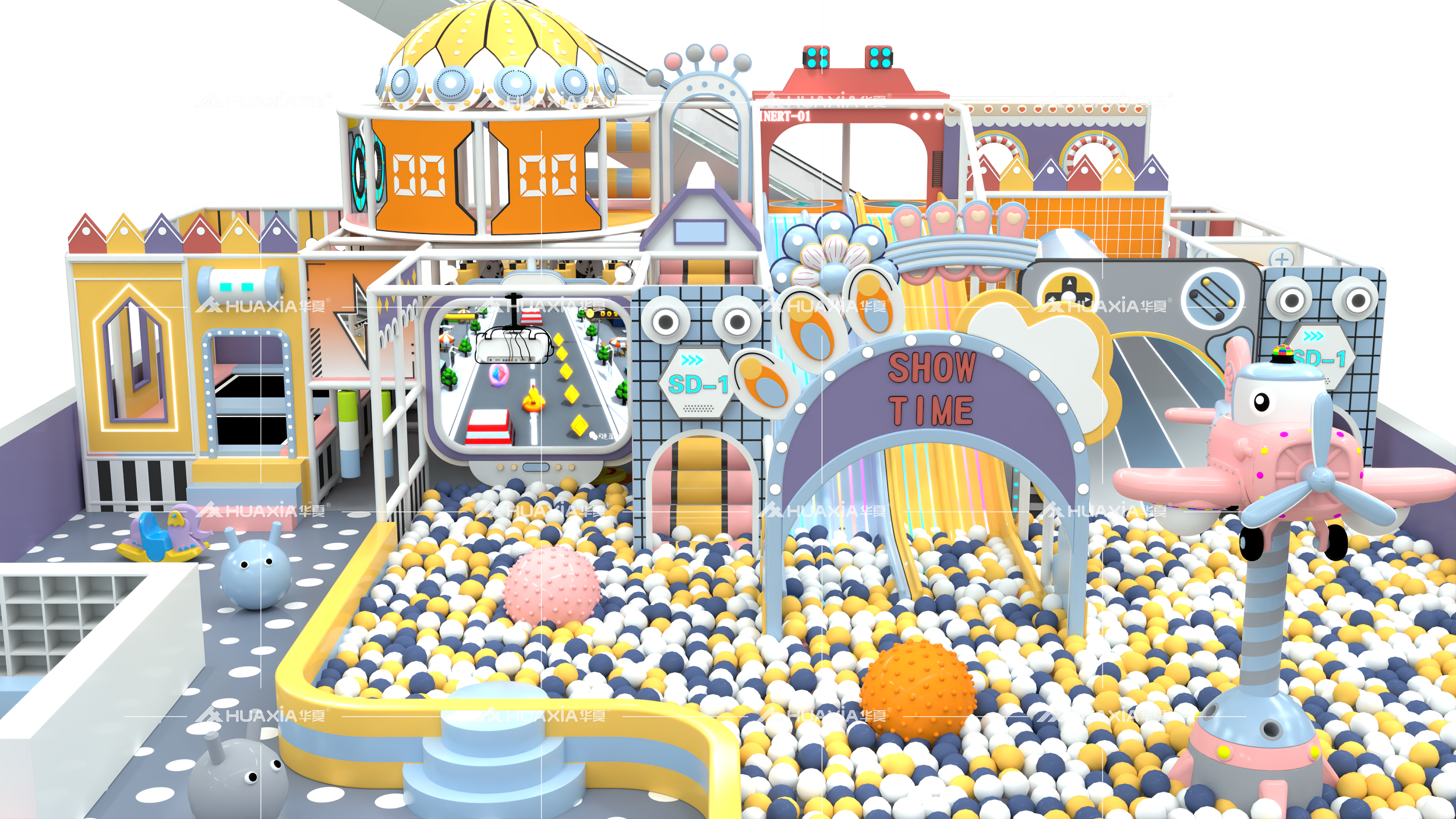
All three references share one platform specification: galvanized steel tube uprights of φ48×2 mm, cast steel 48# couplers tested to GB/T 228.1-2021, a polyethylene safety net with 30×30 mm mesh, polyamide (PA) nylon ties and buckles, and PVC protective sleeves made of a PVC outer layer with an EPE pearl cotton lining. What changes between venues is scale, layout, theming and the additional attractions mounted on or around the same platform.
How Material Choices Change Suitability
Sponge and EPE: thickness follows impact energy
Padding is the clearest example of a specification that cannot be copied from one zone to another. In the wider indoor playground equipment range, the soft play platform uses a composite of multilayer board (1.8 cm) + EPE foam (2 cm) + PVC leather (0.45 mm). A climbing wall section uses 15 mm plywood plus 10 mm high-density EPE pearl cotton. A trampoline deck uses high-density EPE pearl cotton at 70 mm. A rope course landing zone uses a 28 kg/m³ foam layer at 10 mm together with 140 mm thick EPE pearl cotton.
Read together, these numbers describe a system in which padding depth tracks the energy a falling body has to absorb. A kindergarten deck and a rope course landing mat are not interchangeable parts, and a procurement check should be done per zone rather than per project.
PVC: skins, sleeves and coated mesh
PVC appears in three roles: as the 0.45 mm leather skin on soft play platforms, as protective sleeves (PVC outer layer with EPE lining) around posts, and as the 0.52 mm PVC-coated mesh fabric with a 1300×1300D warp/weft density that is tested to EN 71-2:2020 clauses 4.1 and 4.4. The rope course range also uses 2.0 mm printed PVC flooring.
The flammability specification is the same across venue types, but enclosed indoor settings with young children tend to weight it more heavily, because coated mesh forms a large, continuous surface in direct contact with users.
Nylon and netting: fastening is part of the specification
Netting is specified as polyethylene safety net with a 30×30 mm mesh, cited against GB 6675.4-2014, and secured with polyamide (PA) nylon ties and buckles. Nylon also appears in load-bearing form: the professional trampoline mat of 2130×4260 mm uses stronger nylon webbing. In the wider platform range, fasteners are stainless steel, some supplied with protective plastic caps or anti-loosening washers so that children are not exposed to bare fixing hardware.
Aperture size and fixing method are the two variables a kindergarten or indoor playground buyer normally checks first, because they govern both containment and how quickly staff can inspect and re-tension a panel — a daily concern in a commercial setting.
Structural steel: section size signals intended use
Soft play platforms use φ48 mm galvanized steel pipes with a 2.0 mm wall and anti-collision sleeves of 15 mm outer diameter; where a larger expanded structure is required, the main frame moves to φ140 mm pipe with a 4.0 mm wall. Products built for dynamic load use heavier rectangular sections: trampoline frames are Q235 galvanized rectangular steel tube at 80×80×2.0 mm for uprights, 50×80×2.5 mm for connecting frames and 40×40×1.5 mm for reinforcement linkage, while the rope course frame uses 50×80×3.0 mm, 40×80×2.0 mm and 40×40×2.0 mm sections, and the climbing wall frame uses 40×40×1.5 mm.
The hierarchy is straightforward: soft play is the lightest structure in the family, and any venue that needs longer spans or carries dynamic load is specifying different steel.
Scenario Fit in Practice
Kindergarten: low impact, high contact
In a kindergarten or daycare setting, the equipment function set typically covers indoor playground, soft play area, kids obstacle course, themed playground and daycare play equipment. The scenario requirements attached to this use are compliance with ASTM safety standards, non-toxic materials, fire resistance, corrosion resistance, UV resistance, rounded corners, impact absorption, easy cleaning, child-safe design and customizable theming — a list weighted towards surfaces a small child touches and breathes near.
The Kids Play Structure VS1-250414-780-D1-77 fits this profile: PE safety net with 30×30 mm mesh, PVC sleeves with EPE lining on the posts, and the option of E0-grade 15 mm plywood components where plywood is used in the wider family. Because kindergartens supervise inside the structure rather than at its boundary, inspection access matters as much as the containment specification.
Commercial indoor playground: throughput, theming, cleaning
The commercial profile adds duty cycle to the equation. Scenario data for this equipment describes indoor/outdoor, all-weather operation safe for high-traffic areas, suitable for shopping malls and amusement parks, with 24/7 availability, manual supervision, low maintenance and design for continuous daily use. Typical matched equipment includes safety matting, protective padding, ball pit balls, slide components, climbing ropes, trampoline springs and pads, interactive play panels, themed decorations, anti-collision foam and non-slip flooring.
The OEM Indoor Playground model VS1-250519-2250-3-60 is built for this pattern: the standard φ48×2 mm platform, with OEM/ODM customisation available for indoor children's play equipment layouts, colour and logo, offered with a minimum order of one unit and a stated lead time of 15–45 days.
Family entertainment centre: one anchor zone, several independent attractions
An FEC is where the soft play platform stops being the whole project. The family entertainment center equipment model VS1-25011002-230-2-49 typically forms the anchor zone, and the venue then adds attractions with their own structural and material logic:
- Indoor rope course Equipment VS1-250522-1900B-30 — Q235 galvanized rectangular steel frame, 15 mm plywood surface meeting E0 grade under GB/T 5849-2006, 2.0 mm printed PVC flooring, climbing holds, an electronic timer and a safety mat built from 28 kg/m³ foam plus 140 mm EPE pearl cotton.
- Climbing Wall for Playground VS-2659 — 40×40×1.5 mm Q235 frame with 15 mm plywood and 10 mm high-density EPE padding.
- Indoor Trampoline Park VS6-180326-400a-2-40 and trampoline park equipment VS6-190301-1980A-13-29 — screw-fastened frames, PP jumping mat at 500D×500D, 70 mm high-density EPE mat, and 180 mm carbon steel 82B springs tested to GB/T 20125-2006 and GB/T 20123-2006.
The broader platform specification for this range lists a standard trampoline mat of 1800×1800 mm with a static load capacity of 600 kg and a dynamic load capacity of 130 kg, alongside a professional mat of 2130×4260 mm using stronger nylon webbing. A long-running reference point for this kind of mixed installation is a 3,000 m² end-customer site in Spain, in operation for five years with stable operation and stable income, where long lifespan and low maintenance were noted as the defining highlights.
Where the Market Is Moving
Market research on the supply side supports the idea that venue formats are broadening rather than converging. Dataintelo valued the global indoor playground equipment market at USD 4.8 billion in 2025 and projected USD 9.2 billion by 2034. Within that total, soft play equipment held the largest product type share at 31.4% in 2025, worth approximately USD 1.51 billion — a relevant figure because all three reference models discussed above are soft-play-type structures. Asia Pacific accounted for a 38.6% revenue share in 2025, ahead of North America and Europe.
The faster-growing segment sits next to soft play rather than replacing it: Dimension Market Research projects the global trampoline park market growing at a CAGR of 16.2% to reach USD 3.96 billion by 2032. One caution is in order when using any single figure. Business Research Insights values the related market at USD 7.3 billion for 2026, a difference that reflects scope — whether outdoor equipment or FEC operations are included. Buyers comparing market data should check the definition before treating two numbers as comparable.
Read together, the two signals describe the format that FECs already operate: a soft play anchor that holds the largest single product share, surrounded by attractions such as trampoline parks and rope courses that are expanding faster.
Comparison with Alternative Approaches — and Where Venue Matching Stops Working
The traditional approach to sourcing is a single-category import: one soft play kit, ordered to a budget, installed wherever floor space allows. The alternative described in this article is venue-mapped selection, in which the platform model, the padding stack and the documentation set are chosen per zone. The second approach costs more upfront on paper and requires more specification work, but it produces an installation whose performance claims can be traced back to named components.
It also has firm boundaries that buyers should understand before committing.
- A soft play platform is not a general-purpose structure. With φ48×2 mm uprights and a PE safety net, these modules are engineered around children's play. Trampolines and rope courses in the same catalogue use heavier sections (80×80×2.0 mm and 50×80×3.0 mm respectively) and their own mat, spring and padding specifications. An FEC that wants teenage traffic cannot substitute soft play for those attractions.
- Material certificates do not establish site conformity. EN 71-2:2020 clauses 4.1 and 4.4 relate to the coated fabric, and GB 6675.4-2014 is cited for the net and padding. Conformity of an assembled enclosure under EN 1176-10 or ASTM F1918 still depends on layout, fall heights, installation quality and supervision.
- Footprint and structure impose limits. Where a venue needs larger spans, the expanded φ140 mm × 4.0 mm frame members are required, which changes both structural cost and the range of workable layouts. Low-ceiling or irregular retail units may not accommodate every module in the range.
- Customisation has a calendar. OEM/ODM customisation is available with a minimum order of one unit and a stated lead time of 15–45 days. Projects tied to a fixed mall handover date must plan production plus international freight inside that window rather than treating it as float.
- Theming adds scope and review cycles. Partner support covering visual identity, IP and mascot creation, promotional materials, social media strategy and operational team training extends a project beyond hardware. Each added element lengthens approval chains and should be scheduled separately from production.
Procurement Checklist: Matching a Model to a Venue
The following checklist converts the specification details above into verification steps that can be applied per zone, before a purchase order is issued.
| Decision area | What to confirm | Why it matters by venue |
|---|---|---|
| Age band | Frame and mat specification against the intended user group (platform structures mainly for ages 3–15; some soft play for ages 2–8) | Kindergartens stay low; FECs must accommodate a wider spread |
| Netting and aperture | PE safety net at 30×30 mm mesh, cited against GB 6675.4-2014, secured with PA nylon ties and buckles | Containment and routine inspection access |
| Padding per zone | EPE thickness and foam density by attraction: 2 cm soft play deck, 10 mm climbing pad over 15 mm plywood, 70 mm trampoline mat, 140 mm rope course mat | Padding depth follows impact energy, not project budget lines |
| Fabric flammability | EN 71-2:2020 clauses 4.1 and 4.4 for the 0.52 mm PVC-coated mesh (1300×1300D) | Weighted more heavily in occupied indoor buildings |
| Structural steel | φ48×2 mm standard platform versus φ140 mm × 4.0 mm expanded structure; 80×80×2.0 mm trampoline uprights | Determines spans and load capability |
| Fasteners | Stainless steel, with protective plastic caps or anti-loosening washers where children can reach them | Removes exposed fixing hardware from child contact points |
| Indoor air quality | 15 mm plywood with E0-grade formaldehyde performance cited to GB/T 5849-2006 | Relevant for kindergartens and daycare interiors |
| Commercial terms | Minimum order of 1 unit; lead time 15–45 days; remote technical support; one-year warranty; lifetime service | Constrains project scheduling and post-opening support planning |
| Operating profile | 24/7 availability, manual supervision, low maintenance, easy-clean surfaces | Matches mall and FEC duty cycles |
Future Outlook
If the current split between product categories holds — soft play as the largest single segment and trampoline-linked attractions as the faster-growing one — the buyer question is likely to shift from “which equipment” to “which equipment for this zone”. That shift favours documentation over catalogue imagery: material-level evidence such as EN 71-2:2020 clauses 4.1 and 4.4 on coated mesh, GB 6675.4-2014 cited for netting and EPE padding, and E0-grade plywood performance under GB/T 5849-2006 will sit next to equipment-level conformity in tender packs rather than behind it.
On the supply side, the profile of a manufacturer capable of supporting venue-matched selection is fairly specific. Vasia operates a 30,000 m² production facility with more than 200 technical and management staff, a monthly capacity of 10,000 m² for trampoline parks and related play structures, and an R&D function that has produced more than 192 patents and copyrights. Its quality framework references ASTM and EN 1176, with testing by SGS and TÜV, certification including CE, UKCA, CPSIA and SASO, ISO 9001 quality management, and membership of IAAPA and RAAPA. For operators building a venue around zones rather than a single unit, that combination of capacity, documentation and channel engagement is the practical marker to look for.
FAQ
A soft play structure built on a light platform is the usual answer. The Kids Play Structure VS1-250414-780-D1-77 uses galvanized steel tube uprights of φ48×2 mm, cast steel 48# couplers tested to GB/T 228.1-2021, a polyethylene safety net with 30×30 mm mesh cited against GB 6675.4-2014, and PVC protective sleeves with an EPE pearl cotton lining. Platform structures of this type are specified mainly for children aged 3–15 years, with some soft play products aimed at ages 2–8, which places a kindergarten at the lower end of the intended range.
An indoor playground can be satisfied by a single soft play platform such as VS1-250519-2250-3-60. An FEC typically pairs a soft play anchor, such as the family entertainment center equipment model VS1-25011002-230-2-49, with attractions that carry heavier steel sections: 50×80×3.0 mm and 40×40×2.0 mm for the rope course frame, 40×40×1.5 mm for the climbing wall, and 80×80×2.0 mm uprights with 50×80×2.5 mm connecting frames for trampoline decks. Those attractions also bring their own mat, spring and padding specifications, including 180 mm carbon steel 82B springs and 70 mm high-density EPE mats.
Netting in these specifications is a polyethylene safety net with a 30×30 mm mesh, cited against GB 6675.4-2014, and the EPE padding in the same systems also cites GB 6675.4-2014 as its test standard. Fabric flammability is handled separately: the 0.52 mm PVC-coated mesh fabric with a 1300×1300D warp/weft density is stated as compliant with EN 71-2:2020, clauses 4.1 and 4.4. At enclosure level, EN 1176 Part 10 covers fully enclosed play equipment in Europe and ASTM F1918 covers soft contained play equipment in North America, with a focus on entrapment and fire safety.
Because the padding stack is matched to the impact energy of each zone. The soft play platform composite is multilayer board (1.8 cm) + EPE foam (2 cm) + PVC leather (0.45 mm). Climbing wall padding adds 10 mm of high-density EPE pearl cotton over 15 mm plywood. Trampoline decks use high-density EPE pearl cotton at 70 mm, and the rope course safety mat combines a 28 kg/m³ foam layer at 10 mm with 140 mm thick EPE pearl cotton. A single padding specification copied across all zones would not match those different conditions.
For the OEM Indoor Playground range, OEM/ODM customisation is offered with a minimum order of one unit and a stated lead time of 15–45 days. After-sales terms listed for the same manufacturer are remote technical support, a one-year warranty and lifetime service. Production context matters for scheduling: the facility is stated at 30,000 m² with a monthly capacity of 10,000 m² for trampoline parks and related play structures, and the company reports exports to more than 100 countries. Lead time, freight and any theming or brand-development work should be scheduled as separate, sequential stages.