
Matching Indoor Playground Equipment to Real-World Venues: A Scenario-Based Selection Guide
Selecting indoor playground equipment is rarely a single-product decision. A soft play center, a trampoline park, and a family entertainment center (FEC) operate under different traffic patterns, supervision models, and safety expectations, yet many buyers start with the same generic product search. This article explains how to match indoor playground equipment to specific venue scenarios, using Vasia as a practical reference for how manufacturers translate project needs into certified, built-to-purpose play systems.
Why Scenario Fit Determines Equipment Success
Indoor playground equipment serves a wide range of environments, including shopping malls, kindergartens, amusement parks, and dedicated trampoline parks. The global indoor playground equipment market was valued at USD 4.8 billion in 2025 and is projected to reach USD 9.2 billion by 2034. Soft play equipment alone held the largest product-type share at 31.4% in 2025. As the market expands, the risk is not a shortage of suppliers but a mismatch between what a venue needs and what a generic catalog offers.
A mall-based soft play area, for example, needs a design that fits a defined footprint and manages continuous daily use by young children. A trampoline park needs structural frames and jumping surfaces engineered for repeated impact and higher user turnover. A kindergarten needs smaller entry heights and simpler layouts. These are not merely aesthetic differences; they affect structural specifications, protective surfacing, supervision requirements, and compliance pathways.
Venue Profile: Shopping Malls and High-Traffic Indoor Spaces
Shopping malls and amusement parks typically require equipment that works in high-traffic areas under indoor or outdoor, all-weather conditions. Operators expect low-maintenance systems that can support continuous daily use, often with manual supervision rather than full-time structured programming.
For this scenario, a manufacturer should provide equipment that functions as indoor playground, soft play, trampoline park, kids’ obstacle course, themed playground, or daycare play equipment. The Vasia application scenario for children’s play equipment highlights this multi-function expectation: indoor playground, soft play, trampoline park, kids’ obstacle course, themed playground, and daycare play equipment can all be part of the same commercial proposal.
Buyers evaluating a mall installation should ask:
- Does the play structure fit the planned ceiling height and floor area?
- Can the supplier customize colors and theming to match the venue brand?
- Are materials and surfaces suitable for high-frequency cleaning?
- Will the equipment require constant maintenance, or is it designed for daily operation?
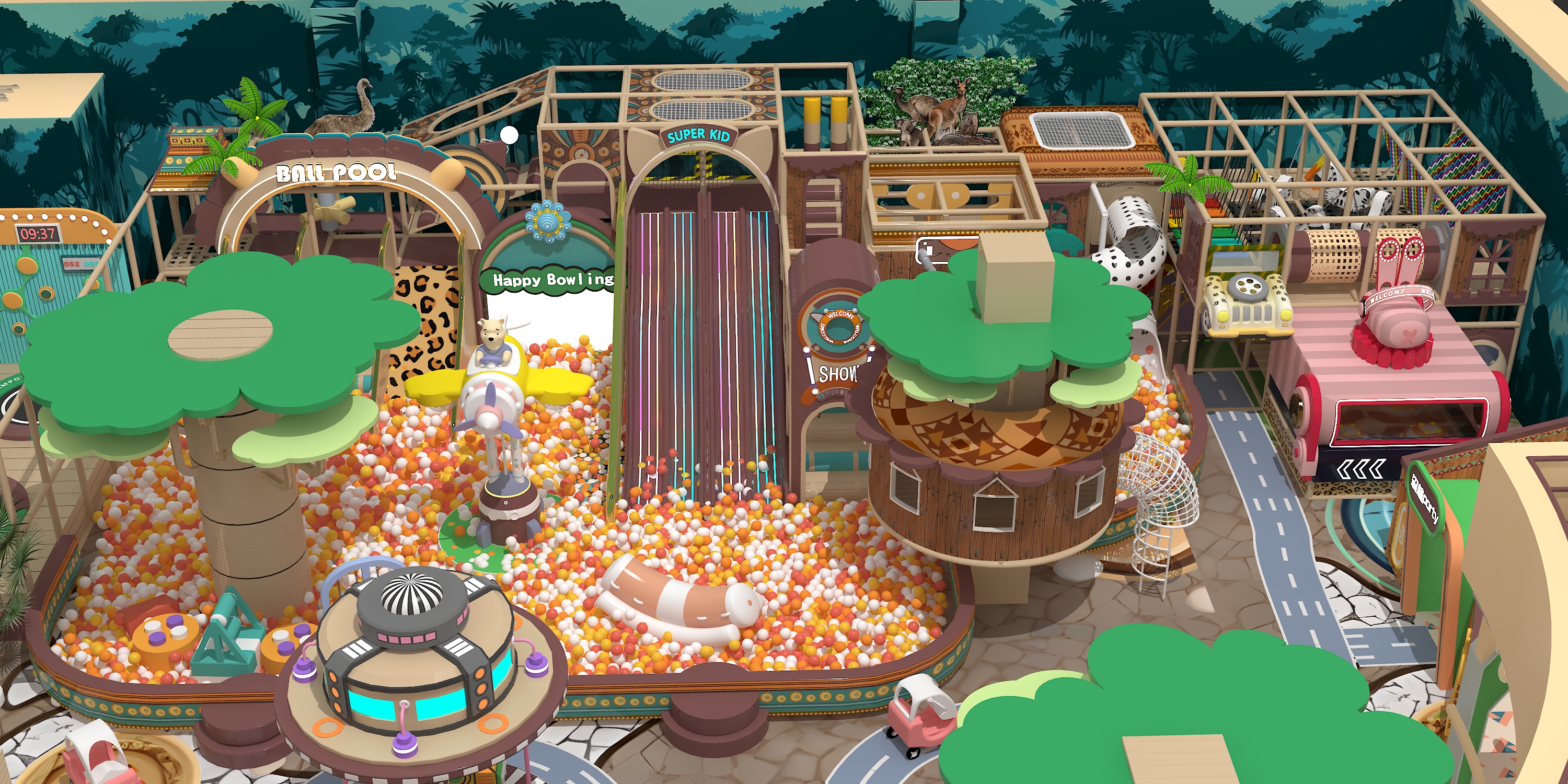
One way to assess these criteria is to review a specific product model. The Vasia Kids Play Structure VS1-250414-780-D1-77 is a soft play structure for trampoline parks, indoor parks, kindergartens, and indoor playgrounds. Its upright posts use galvanized steel tube φ48×2 mm, and its protective net is polyethylene (PE) safety net with 30×30 mm mesh. Cast steel 48# couplers are tested under GB/T 228.1-2021. For a mall environment, the steel frame provides structural stability, while the netting and protective sleeves address safety and impact absorption.
Venue Profile: Trampoline Park and Active Play Centers
Trampoline parks have become a distinct commercial format within the broader indoor entertainment industry. The global trampoline park market is expected to grow at a CAGR of 16.2%, reaching USD 3.96 billion by 2032. This growth creates demand for equipment that supports multiple active attractions, including trampoline zones, climbing walls, and rope courses.
Unlike soft play areas designed primarily for children aged 2–8, trampoline parks often serve a wider age range, including older children, teens, and adults. That changes the performance requirements: frames must handle repeated dynamic loads, jumping mats must retain elasticity, and safety padding must cover larger fall surfaces.
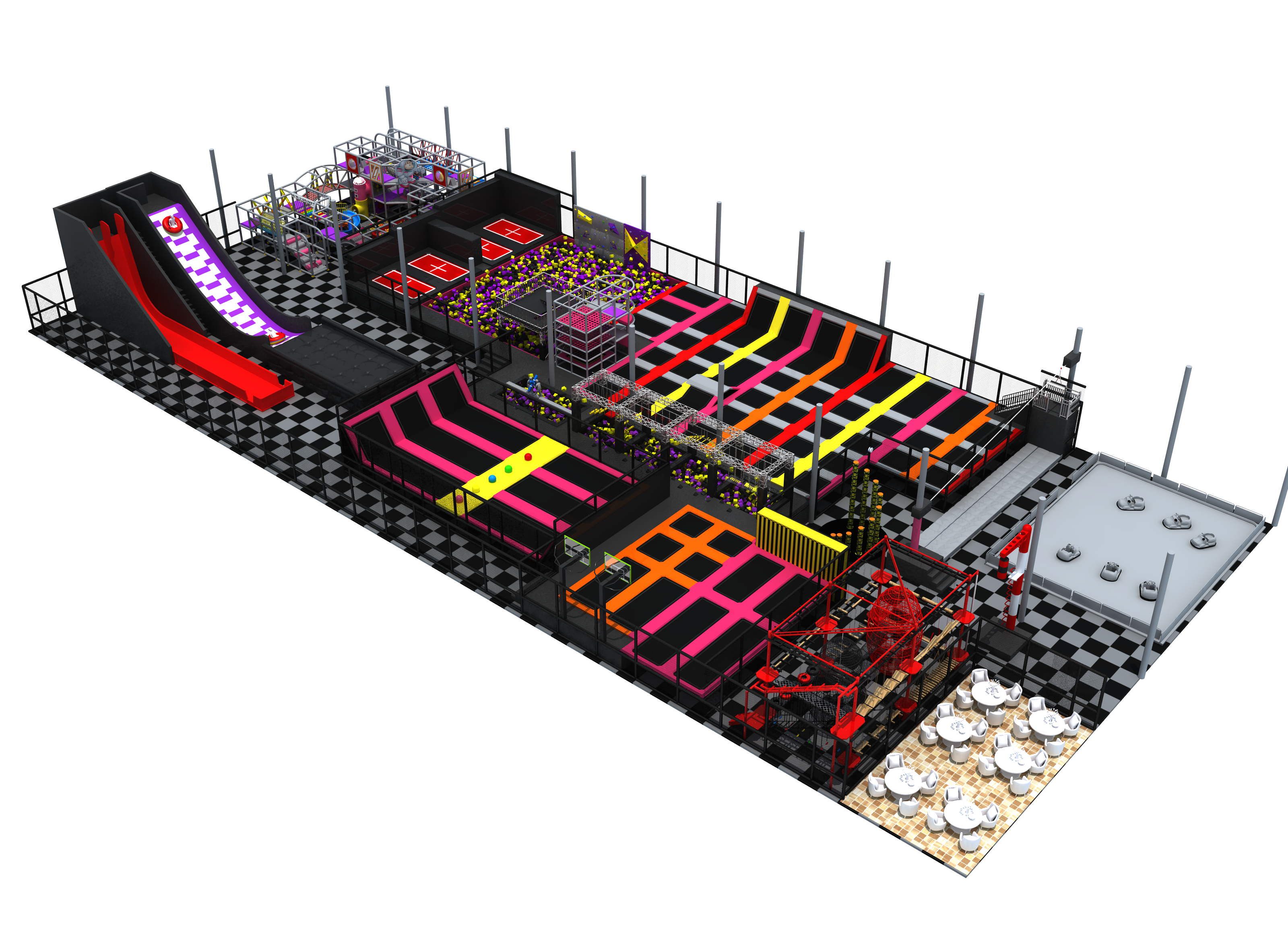
The Vasia trampoline park equipment model VS6-190301-1980A-13-29 uses Q235 galvanized rectangular steel tubes for upright posts and connecting frames. The jumping mat is made of PP material with a fiber count of 500D×500D, tested under GB 6675.4-2014. Springs are carbon steel wire 82B, 180 mm in length, tested under GB/T 20125-2006 and GB/T 20123-2006. The trampoline mat includes high-density EPE pearl cotton and Plato PVC-coated mesh fabric that complies with EU standard EN 71-2:2020 Toy Safety Part 2 Flammability, Clauses 4.1 and 4.4.
For a full trampoline park, the same supplier should be able to provide related equipment under one scope of supply. The Vasia product line includes the Indoor Trampoline Park VS6-180326-400a-2-40, the Climbing Wall for Playground VS-2659, and the Indoor rope course Equipment VS1-250522-1900B-30. Buyers can reduce coordination risk by sourcing these compatible systems from a single manufacturer.
Venue Profile: Kindergartens and Daycare Play Areas
Kindergartens and daycare centers require a different balance of safety, accessibility, and age-appropriate challenge. Equipment is typically lower to the ground, uses softer materials, and must be easy to supervise. The target age range is commonly 2–8 years for soft play products, although broader mixed-age solutions are available.
Vasia positions its equipment as applicable to trampoline parks, indoor parks, kindergartens, and indoor playgrounds. The Indoor Playground VS1-230518-4-60 is a kid’s soft playground model with galvanized steel tube upright posts, cast steel couplers, PE safety net, and PVC sleeves with EPE pearl cotton inner lining. These specifications address the key concerns of daycare operators: structural rigidity, containment, and soft impact surfaces.
A kindergarten buyer should also confirm that the equipment can be configured to the available space. Vasia’s production capabilities include OEM/ODM modes with customization of children’s play equipment, color, voltage, and logo. This is especially relevant for kindergartens that want to match their educational brand or interior design.
Venue Profile: Family Entertainment Centers
Family entertainment centers (FECs) combine multiple attractions under one roof: soft play, trampoline zones, climbing walls, rope courses, and sometimes party rooms. The equipment must carry high traffic volume, remain attractive to a broad visitor base, and support a business model that depends on repeat visits.
The Vasia family entertainment center equipment model VS1-25011002-230-2-49 is a kids’ soft playground product for trampoline parks, indoor parks, kindergartens, and indoor playgrounds. Its frame uses the same galvanized steel and cast steel coupler construction as other Vasia soft play systems, allowing an FEC operator to combine multiple models into a cohesive layout.
From a procurement perspective, FEC buyers should evaluate the supplier’s ability to deliver a complete package rather than a single unit. This includes trampoline park equipment, kids’ play structures, indoor rope course equipment, climbing walls, and soft play components. When one manufacturer produces and tests these systems under the same quality framework, the operator is less likely to take on compatibility or spare-part risk.
Compliance and Safety Requirements Across Scenarios
Safety compliance is not a single certificate; it is a set of requirements that must be matched to the destination market and the specific equipment type. For playground equipment, the most recognized frameworks include ASTM F1918 in North America and EN 1176 in Europe, with Part 10 covering fully enclosed play equipment.
In the Vasia application scenario for high-traffic areas, special requirements include compliance with ASTM safety standards, non-toxic materials, fire resistance, corrosion resistance, UV resistance, rounded corners, impact absorption, easy cleaning, and child-safe design. Customizable theming is also listed as a requirement, which reflects the reality that visual design and safety must be considered together.
For trampoline equipment, Vasia specifies compliance with EN 71-2:2020 for the flammability of trampoline mats and clothing, and GB 6675.4-2014 for testing materials such as jumping mats and EPE pearl cotton. This combination of destination-market standards and manufacturing test standards is the practical way buyers can verify compliance before placing an order.
Technical Specifications That Should Drive Selection
Beyond product category, buyers should compare technical parameters that affect long-term durability, maintenance cost, and safety performance. The table below summarizes typical Vasia specifications across soft play and trampoline product lines.
| Component | Soft Play Structure | Trampoline Park System | Climbing Wall / Rope Course |
|---|---|---|---|
| Main frame | Galvanized steel tube φ48×2 mm | Q235 galvanized rectangular tube 80×80×2.0 mm | Q235 galvanized tube 40×40×1.5 mm to 50×80×3.0 mm |
| Couplers / connections | Cast steel 48# couplers, GB/T 228.1-2021 | Screw fasteners | Tested under GB/T 228.1-2021 |
| Protective netting | PE safety net, 30×30 mm | — | — |
| Jumping / play surface | Multilayer board + EPE foam + PVC leather | PP mat 500D×500D; EPE pearl cotton 70 mm | 15 mm plywood with EPE padding |
| Flammability compliance | EN 71-2:2020 where applicable | EN 71-2:2020, Clauses 4.1 & 4.4 | EN 71-2:2020, Clauses 4.1 & 4.4 |
| Typical application | Indoor playgrounds, malls, daycare | Trampoline parks, FECs | Trampoline parks, FECs, indoor parks |
For soft play platforms, Vasia uses a composite structure of multilayer board (1.8 cm), EPE foam (2 cm), and PVC leather (0.45 mm), which provides both support and cushioning. Slides are made of imported engineering plastics or 196 resin. Carpet wear resistance reaches 80,000 rubs. Fasteners are made of stainless steel, and some include protective plastic caps or anti-loosening washers.
Trampoline systems, by contrast, emphasize load capacity and spring performance. Standard trampoline mats measure 1800×1800 mm with a static load capacity of 600 kg and dynamic load capacity of 130 kg. Professional trampoline mats can reach 2130×4260 mm and use stronger nylon webbing. These parameters matter because they are the difference between a structure that feels stable under heavy use and one that degrades quickly.
Comparing Project Needs: A Decision Framework
The following framework can help operators and investors translate a venue concept into a concrete equipment brief.
- Define the primary user group. Children aged 3–15 are the main users for most indoor playground systems; ages 2–8 are typical for soft play; newer trampoline parks cover all age groups.
- Estimate traffic and operating hours. Equipment that runs 24/7 or across long commercial hours must be designed for continuous daily use with manual supervision.
- Map the attraction mix. Decide whether the venue will include only soft play, or a combination of trampoline, climbing, and rope course zones.
- Review safety requirements for the destination market. Confirm which standards apply: ASTM F1918 for North America, EN 1176 for Europe, and additional flammability requirements such as EN 71-2.
- Check customization and OEM capability. For branded FECs, the ability to customize colors, logos, and layout is often as important as the equipment itself.
- Compare total cost of ownership. Lower maintenance, durable materials, and long lifespan affect profitability more than the initial purchase price.
Traditional vs. One-Stop Scenario-Based Procurement
The traditional approach to sourcing indoor playground equipment is often compartmentalized: a buyer selects a soft play supplier, then a trampoline supplier, then a climbing wall supplier, and coordinates installation separately. This can work, but it creates several practical challenges.
First, responsibility for the compatibility of different systems is split among multiple suppliers. If a climbing wall and a rope course share a structural zone, design conflicts are more likely to surface during installation. Second, after-sales service becomes more complex when multiple manufacturers are involved. Third, the buyer must manage different lead times, shipping schedules, and documentation sets.
A scenario-based approach treats the venue as a complete project and looks for a supplier that can deliver a coherent system under one quality framework. Vasia, for example, is a manufacturer with two production bases in Yongjia County, Wenzhou, a region recognized as China’s “Educational Toy Capital.” Its monthly capacity is 8,000 units, with a lead time of 15–45 days and an MOQ of 1 unit. The company provides remote technical support, a one-year warranty, and lifetime service.
This does not mean a one-stop supplier is always the right choice. For a very small single-themed area, a specialized supplier with deep expertise in one product type may be sufficient. Buyers should also recognize that not all manufacturers have equal capability across every category. A supplier that builds soft play well may not have the same engineering depth in trampoline systems. The practical approach is to verify the supplier’s certified production range, request model-specific specifications, and evaluate whether the proposed systems work together as a unified project.
Reference Case: Long-Term Operation in Europe
A relevant reference for scenario matching comes from an existing Vasia end-customer project in Spain. The project covers approximately 3,000 square meters and has been in operation for 5 years. The customer’s objective was to make a profit from business operations, and the reported result is stable operation with stable income. The highlight identified by the customer is long lifespan and low maintenance.
This case demonstrates what scenario-based selection should aim for: equipment that supports a commercial operation over the long term rather than a product that performs well only during the first months. Low maintenance and durability directly reduce operating cost, which is a critical factor for FEC operators that depend on repeat visits and continuous daily use.
Market Context and Why It Matters for Buyers
The indoor playground equipment market is growing across multiple regions. Asia Pacific dominated the market with a 38.6% revenue share in 2025, followed by North America and Europe. For importers and investors, this means that manufacturing capacity, export experience, and compliance documentation will become more important as competition intensifies.
Suppliers that export to multiple markets are more likely to maintain up-to-date certifications and efficient production processes. Vasia exports approximately 70% of its output, with main markets in the EU, USA, South America, Middle East, and Southeast Asia. This export ratio is not a ranking metric, but it is an indicator of practical experience in meeting cross-border requirements.
Limitations and Boundary Conditions
Every equipment selection involves trade-offs. Scenario-based matching improves alignment, but it cannot eliminate all supplier risk. Buyers should be aware of the following limitations:
- Floor and ceiling dimensions must be measured accurately before a manufacturer can propose a suitable layout. A generic product catalog cannot replace an on-site assessment.
- Safety certification is market-specific. A certificate that satisfies one destination market may not cover another. Buyers should request evidence for the specific standard that applies to their country.
- Lead times of 15–45 days depend on production scheduling and customization complexity. A heavily customized project may take longer than a standard order.
- One manufacturer’s warranty terms are not a substitute for local installation and maintenance support. Buyers should confirm the level of remote technical support available after handover.
- Market data such as the USD 4.8 billion global valuation is an estimate from a third-party research source. It is useful for context, not a guarantee of local demand or profitability.
Future Outlook
The next phase of indoor playground equipment development will likely favor manufacturers that can combine safety compliance with flexible production. Customizable theming has shifted from a premium extra to a standard expectation for FEC operators who want to differentiate their venue. At the same time, durable, low-maintenance materials are becoming more important as operators seek to improve lifetime value rather than only initial price.
For suppliers, the ability to offer multiple product categories under the same quality and safety framework will strengthen their position as project partners. Buyers, in turn, should move from asking “Which product is popular?” to asking “Which product configuration is correct for this venue, this audience, and this operating model?”
FAQ
What is indoor playground equipment used for?
Indoor playground equipment is designed for indoor playgrounds, shopping malls, kindergartens, and amusement parks to create safe and engaging children’s play environments. It can function as indoor playground, soft play, trampoline park, kids’ obstacle course, themed playground, and daycare play equipment.
What are the key safety requirements for indoor playground equipment?
Key requirements include compliance with ASTM safety standards, non-toxic materials, fire-resistant materials, anti-corrosion and UV-resistant surfaces, rounded corners, impact absorption, easy-to-clean design, and child-safe construction. Customizable theming is also commonly required for commercial venues.
What conditions are indoor playground systems designed to handle?
Indoor playground systems operate under indoor/outdoor, all-weather conditions and are safe for high-traffic areas. They are intended for continuous daily use, typically with manual supervision and low maintenance requirements.
What safety standards apply to indoor playground equipment?
ASTM F1918 is the primary safety performance specification for soft contained play equipment in North America. EN 1176 is the harmonized European standard for playground equipment, with Part 10 specifically covering fully enclosed play equipment. Additional flammability requirements may include EN 71-2:2020.
What should a buyer specify when ordering OEM indoor playground equipment?
A buyer should specify the target age group, venue dimensions, attraction mix, destination safety standards, maintenance expectations, and customization requirements such as color and theming. Vasia offers OEM/ODM production with customization of children’s play equipment, color, voltage, and logo, with a minimum order quantity of one unit.
Download the Vasia company brochure for detailed product specifications and production capabilities: Vasia Company Brochure (PDF)