
Matching JYF-05 Screen Partitions to Interior Scenarios
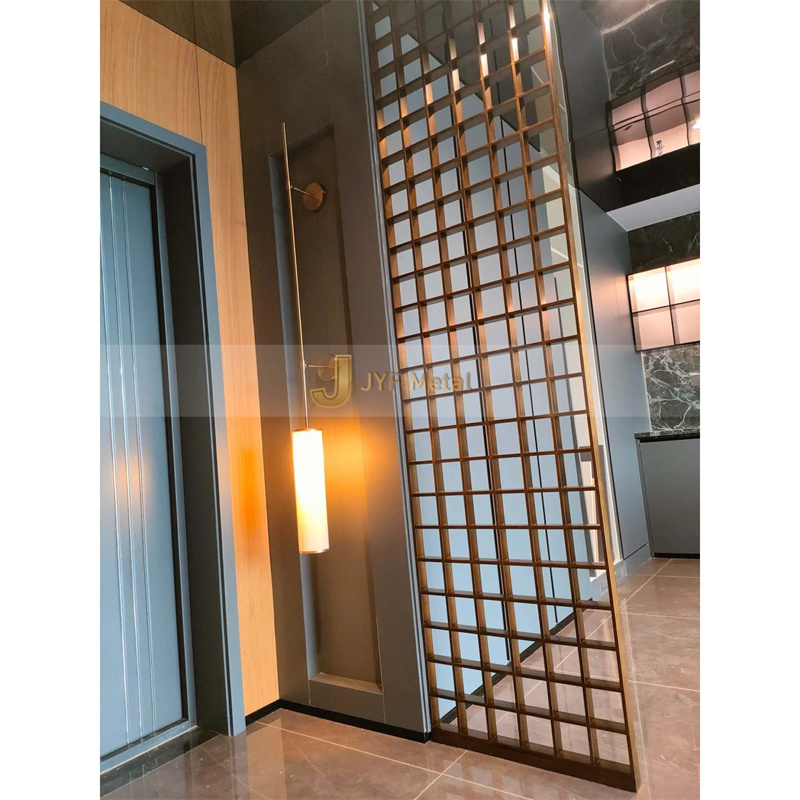
A welded stainless steel screen partition. In interior work, the fabrication detail rather than the marketing photograph usually decides whether a divider fits the project.
A stainless steel screen partition is a fabricated, non-structural divider that separates zones inside a building without fully closing off daylight, air movement or sightlines. In fit-out practice it behaves less like furniture and more like a measured building element: it is drawn, toleranced, fixed to the base build and inspected. Its performance depends on the match between three variables — the grade of steel, the finish applied to it, and the way it interfaces with adjacent materials such as glass, stone or lighting.
The JYF-05 stainless steel screen partition is a product built specifically for that role. It is manufactured by JYF Metal (Foshan Jinyifan Metal Products Co., Ltd., established 2013 in Foshan, Guangdong, China), a custom architectural metal fabricator whose products are exported to the Middle East, Asia, Europe and North America. The JYF-05 is a stainless steel room divider made from SS304 or SS316, supplied in a regular 1220 × 2440 mm size or in custom dimensions, with mirror, brushed or vibration finishes, and with the option to embed glass, marble, crystal, metal mesh or LED lighting.
This reference examines the application fit of that product for interior architects and buyers: where its material limits sit, how finish selection changes maintenance and perception, how embedded materials alter the engineering, and which interior scenarios it genuinely suits. It is written for designers, contractors and procurement teams evaluating a screen specification rather than browsing a product catalogue, and it separates what the product data confirms from what is simply design preference.
Product Definition and Specification Envelope
The JYF-05 is catalogued as a stainless steel screen partition, of the type stainless steel room divider, for architectural application. Its specification envelope is narrow and explicit, which is useful during evaluation: it can be checked line by line against a project requirement instead of being interpreted.
| Model | JYF-05 |
| Product type | Stainless steel screen partition (stainless steel room divider) |
| Material | SS304 / SS316 |
| Size | Regular 1220 × 2440 mm; custom sizes available |
| Colour | Silver, gold, rose gold, black, copper, bronze, custom |
| Finish | Mirror, brushed, vibration |
| Embedded material | Glass, marble, crystal, metal mesh, LED light |
| Fabrication processes | Spot welding, full welding, laser cutting, CNC cutting |
| Applicable industry | Architecture |
Two lines in that table drive most evaluation decisions. The first is the grade list: the JYF-05 is offered in SS304 and SS316 only. The second is the embedded-material list: the partition is designed to be fabricated around other materials, which means the interface — not the steel itself — is usually the hardest part of the drawing.
Material Limits: SS304, SS316 and the Grade the Screen Does Not Offer
Across JYF Metal's decorative sheet and trim families, SS201, SS304 and SS316 are all available. The JYF-05 screen partition is restricted to SS304 and SS316. This is a concrete procurement criterion rather than a technical footnote: a screen quotation built on SS201 is not a like-for-like alternative to a JYF-05 quotation, because the material class is different from the outset. Buyers comparing screen prices across suppliers should confirm the grade before comparing anything else.
The choice between SS304 and SS316 follows the exposure of the space. SS304 is the common architectural grade for controlled interior environments, including high-traffic interiors, and it covers the majority of hotel, office and residential interior screens. SS316 is generally specified where greater corrosion resistance is required — humid or coastal environments, or semi-external positions where the screen is exposed to weather. JYF Metal's application data for architectural metalwork lists indoor and outdoor use, high-traffic areas and humid or coastal environments as working conditions that call for corrosion-resistant material and custom surface finishes. That is the practical reason SS316 appears in specifications for coastal projects and for interiors with high humidity, and it is the reason grade selection should be tied to a stated exposure condition rather than to habit.
The related limit is structural. A stainless steel screen partition is a fixed, non-structural element. Where a divider is also required to brace a structure, carry load or resist building movement, that requirement belongs to the base build. The screen conceals or expresses structure; it does not replace it.
Finish Choice: Mirror, Brushed and Vibration
The JYF-05 is available with mirror, brushed or vibration finishes in silver, gold, rose gold, black, copper, bronze or a custom colour. Colour on architectural stainless steel is normally produced by PVD (physical vapour deposition) coating, which the International Stainless Steel Forum identifies as the industry standard for creating coloured stainless steel sheets for architectural use. In other words, the colour decision and the coating process are the same decision, and the process is what determines whether the colour survives cleaning, handling and sunlight.
The three finishes behave differently in a live interior, and the differences are practical rather than only aesthetic:
Mirror finish
Highest reflectivity, and the finish that most expands the perceived size of a tight interior. It can also function as a decorative surface in its own right. Its cost is maintenance: a mirror surface shows fingerprints, smudges and dust most readily, so it is usually positioned either out of reach or in locations that are cleaned frequently. Fingerprint resistance is a commonly specified requirement for stainless steel partitions in high-traffic interiors for exactly this reason.
Brushed finish
Lower reflectivity with a directional hairline appearance. It is the more forgiving option in daily use and the safer default where a screen will be touched, pushed against or walked past at close range — circulation routes, restaurant seating, reception counters and residential entryways.
Vibration finish
A patterned finish available across the same colour range, used where a large flat panel would otherwise read as uniform and where a lower-glare surface is preferred. JYF Metal's project records include PVD-coated vibration and patterned finishes in rose gold and bronze selected for residential dividers and ceiling and wall applications, where the intent was a rich metallic appearance rather than a mirrored one.
Colour is a procurement issue as well as a design issue, because a PVD colour must remain consistent across panels produced at different times and across different elements of the same scheme. Uniform coating appears among the special requirements recorded for stainless steel partitions in hotel, restaurant and club interiors, alongside high-precision laser cutting, seamless welding and fingerprint resistance. A specification should therefore state colour consistency, protective film and handling requirements, not only a colour name. JYF Metal offers custom size, custom colour, custom protective film and custom logo under its OEM/ODM service, which allows these requirements to be written into the order rather than left to site interpretation.
Embedded Materials: Where a Screen Becomes a Composite Element
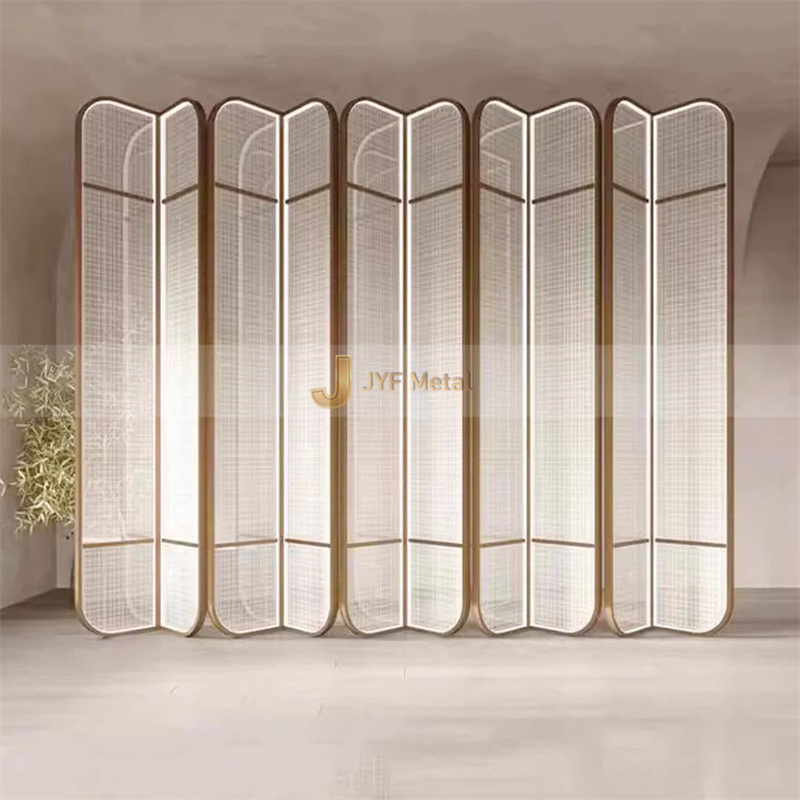
Embedded glass turns a metal screen into a composite assembly: steel supplies the frame and pattern, glass supplies translucency and enclosure.
The JYF-05 can embed glass, marble, crystal, metal mesh or LED lighting. In practice this changes what the product is. The partition stops being a metal element with openings in it and becomes a composite assembly in which steel provides the frame, the pattern and the fixing points, while another material provides opacity, translucency or light. Two consequences follow for specification.
First, the embedded material is a tolerance driver. Glass and stone inserts arrive with their own dimensional tolerances and their own movement characteristics. The metal frame is fabricated around an agreed panel size, so the insert dimensions and the frame dimensions must be coordinated before production rather than resolved on site. When the interface is designed late, the visible result is usually a shadow gap that varies along the screen — a detail that is very hard to correct after fabrication.
Second, the embedded material often sets the maintenance and acoustic behaviour of the assembly. A glass insert can be cleaned like glass; a metal mesh insert collects dust differently; an LED-lit screen introduces an electrical component into a decorative element, and the containment has to be designed into the frame from the start. Glass and lighting are the components most frequently coordinated with screen partitions in JYF Metal's application data for hotel, restaurant and club interiors, and the screens themselves are installed as fixed elements — which means the electrical and glass fixing details must be resolved at drawing stage, not during installation.
Fabrication: Why Welding and Cutting Choices Show Up in the Finished Screen
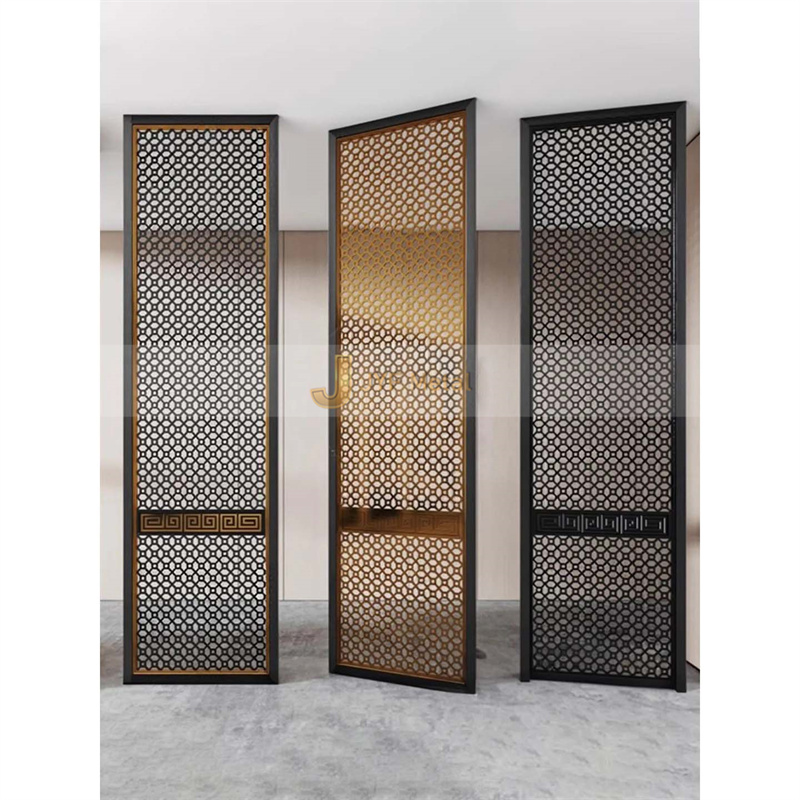
Laser cutting and CNC cutting determine whether fine pattern detail survives at full scale and repeats accurately across panels.
The JYF-05 is produced using spot welding, full welding, laser cutting and CNC cutting. Which process is used is not an internal manufacturing detail — it is legible in the finished screen at close range, and it is one of the few quality signals a buyer can inspect directly.
Full welding combined with polishing is the route to seamless joints, where panel edges and frame intersections visually disappear. JYF Metal's case records describe full welding and polishing used to achieve seamless joints on stainless steel room dividers, alongside a modular panel design intended to align joints and patterns across a multi-panel divider. Pattern alignment matters more than it sounds: on a screen that runs several metres, a misaligned perforation or laser-cut repeat is the first thing a visitor notices, and it cannot be corrected on site.
Laser cutting and CNC cutting determine edge quality, repeat accuracy and the smallest detail a pattern can hold at 1:1 scale. A drawing that looks precise at A3 size may lose its definition when cut at full size, particularly where a pattern repeats across standard 1220 × 2440 mm modules. This is a reason to request a physical sample of the actual pattern before mass production rather than approving a rendering.
On the commercial side, JYF Metal's operational data states a 20-day lead time for stainless steel screen partitions, extending to 25–30 days for custom products, with a minimum order quantity of 3 square metres for this product family. Quality control is described as 100% pre-shipment test with third-party inspection available, and after-sales support includes online installation guidance, sample provision and replacement parts. For programme planning, lead time and MOQ usually matter more than headline unit price, because a screen on the critical path can delay an entire fit-out sequence.
Scenario Fit 1 — Open-Plan Offices
The core problem of an open-plan office is that it needs zones without walls. A stainless steel screen addresses that requirement without the two side effects of a solid partition: loss of daylight and loss of air movement. JYF Metal's case record for a Canadian contractor project describes the design intent in exactly these terms — creating privacy while maintaining natural light and air circulation — and the same logic transfers directly to workplace interiors.
Within office fit-outs, the JYF-05 fits where a visual boundary is required and enclosure is not: separation between reception and waiting zones, screening between circulation routes and focus areas, a branded feature screen behind a reception desk, or cladding of a structural column using the same finish family. Custom sizing is what makes this work, since floor-to-ceiling screens are rarely a whole number of standard modules.
It does not fit where acoustic separation is the objective. Stainless steel is not an acoustic absorber, and open-plan noise problems are generally solved by absorption rather than by screening. In an office where speech privacy is a requirement, a metal screen should be specified as a visual and circulatory divider that is combined with acoustic treatment — not as a substitute for it. Treating the screen as an acoustic product is one of the most common specification errors in this category.
Scenario Fit 2 — Luxury Residential Interiors
At residential scale a screen usually solves an entrance or circulation problem: defining a foyer without building a wall, dividing a living area from a dining area, or screening a staircase. JYF Metal's Canada case record covers precisely this application — three units of stainless steel room dividers used to divide open areas and define functional zones without blocking layout flow, and to provide privacy at residential entryways and living rooms.
Two residential-specific factors matter. The first is fixing. The same case record notes a modular design with glue-free mechanical fixing, described as enabling immediate installation without adhesive, and a stainless steel frame intended for stability against warping. For a residential project, mechanical fixing removes adhesive cure time and removes the adhesive failure path behind a decorative wall — a practical advantage that is rarely visible in a photograph but frequently decisive in a completed home.
The second is finish. Rose gold and bronze PVD finishes appear in the residential case record, and in residential work colour is normally the first decision and grade the second, because interior humidity is typically low and SS304 is adequate unless the property is coastal or the screen sits in a humid zone.
Scenario Fit 3 — Hospitality and Commercial Interiors
Hotel lobbies, restaurant partitions and club interiors are the segment where screen partitions are most demanding, because the screen is both a decorative statement and a surface that thousands of people pass and touch. The recorded requirements for stainless steel partitions in this segment are high-precision laser cutting, seamless welding, uniform coating and fingerprint resistance, installed as fixed elements in indoor controlled environments with high traffic, with glass and lighting commonly coordinated alongside them.
The procurement consequence is that a hospitality specification should name the finish, the colour consistency requirement, the fingerprint resistance expectation and the interface with glass and lighting — and it should be validated with a physical sample, since none of these qualities can be judged reliably from a digital image. JYF Metal lists sample provision and online installation guidance among the after-sales support offered for exported projects, which allows this validation step to happen before the production order rather than after delivery.
Comparison with Traditional Partition Solutions
A metal screen is not automatically the right answer, and comparing it honestly with the alternatives is part of specifying it correctly. The table below compares qualitative characteristics of common interior partition approaches; it does not attempt to rank suppliers or assign prices, which vary by project.
| Criterion | Stainless steel screen (JYF-05 type) | Painted plasterboard / MDF panelling | Frameless glass |
|---|---|---|---|
| Structural role | Non-structural; fixed to base build | Non-structural; often self-supporting studwork | Non-structural; needs framing and glass fixings |
| Weight | Relatively heavy; fixing points need checking | Light; simple support | Heavy; engineered fixings required |
| Surface durability | PVD-coated stainless steel; resistant to fading and wear in normal interior use | Paint and veneer can chip or scuff at high-contact points | Glass surface is hard but can chip at edges |
| Daylight and air movement | Open patterns preserve both | Blocks both unless partially open | Preserves light; blocks air |
| Maintenance | Mirror finishes show marks; fingerprint resistance may be specified | Touch-up painting may be needed | Marking and cleaning visible on both faces |
| Acoustic behaviour | No absorption; visual divider only | Can incorporate absorption within the build-up | Reflective; limited absorption |
| Design flexibility | Laser-cut patterns, PVD colours, embedded glass, stone, mesh or LED | Flexible in form; limited in surface expression | Transparent and neutral |
| First cost position | Generally higher material cost than basic painted plasterboard | Usually the lowest first cost | Typically between the two, depending on thickness and fixing |
Where stainless steel loses, it loses clearly. A fabricated and coated metal screen generally carries a higher material cost per square metre than painted plasterboard or standard MDF panelling, and the justification is finish life, cleanability and design intent rather than first cost. It is heavier than timber or plasterboard partitions, so ceiling and floor fixing points must be verified and the substrate coordinated. Mirror finishes require cleaning discipline in high-contact positions. It provides no acoustic absorption. And because the JYF-05 is offered only in SS304 and SS316, there is no lower-cost grade option within this product family for buyers who are optimising purely on material price.
One further limit is programme-related rather than physical. Custom sizes must be confirmed against site dimensions before production begins, and a 20-day lead time for screen partitions — or 25–30 days for fully custom products — does not absorb late design changes. On projects where the screen dimension depends on a wall that is still being built, the specification should lock the interface design early and manage the site measurement as a scheduled milestone.
Specification and Procurement Checklist
| Item | What to state | Reference point |
|---|---|---|
| Material grade | SS304 or SS316 | The JYF-05 is offered in these two grades only |
| Exposure | Controlled interior, or humid and coastal | SS316 where greater corrosion resistance is required |
| Finish | Mirror, brushed or vibration | Mirror surfaces show marks; fingerprint resistance is a common requirement |
| Colour | Named colour or custom, with consistency requirement | PVD coating is the industry standard for coloured architectural stainless steel |
| Size | 1220 × 2440 mm standard or custom | Confirm site dimensions before production |
| Embedded materials | Glass, marble, crystal, metal mesh, LED light | Coordinate insert tolerances and electrical containment with the frame |
| Fixing | Fixed installation; mechanical fixing where applicable | Glue-free mechanical fixing recorded in project cases |
| Order quantity | Minimum 3 square metres for screen partitions | MOQ for this product family |
| Lead time | 20 days for screen partitions; 25–30 days for custom products | Plan against the fit-out programme |
| Quality evidence | Management system certificate and inspection records | ISO 9001:2015 certificate no. 120526Q00119R000, issued by Guangdong Jingwel International Certification Ltd., valid 15 May 2026 – 14 May 2029; 100% pre-shipment test and third-party inspection available |
| After-sales | Installation guidance, samples, replacement parts | Support listed for exported projects |
Market Trend Analysis
The wider market context supports the direction of this product category, and the available figures are specific. The global metal decorative panel market was valued at USD 3.5 billion in 2024 and is projected to reach USD 5.8 billion by 2032, according to SMR's metal decorative panel market outlook. Architectural cladding and facades are identified by Market Research Future as a primary driver of stainless steel demand in construction, specifically for 300-series grades — the grade family that contains both SS304 and SS316, and therefore the material basis of the JYF-05. Grand View Research places Asia-Pacific at approximately 69% of global stainless steel market revenue in 2025, driven by rapid urbanisation.
Two implications follow for buyers rather than for manufacturers. First, supply and finishing capacity for architectural stainless steel is concentrated, and the finishing step — not the base material — is where quality diverges most between suppliers. PVD coating is the established colouring process for architectural stainless steel, which means the coating line, its process control and its batch consistency are the variables worth auditing. Second, the demand growth sits in the same segments where screen partitions are used: commercial interiors, hospitality and high-end residential. Stainless Steel World Asia notes that water ripple stainless steel sheets, a closely related decorative product, are increasingly used in luxury retail and hospitality, with production hubs centred in Foshan, China — the city where JYF Metal manufactures.
Future Outlook
Three shifts are reasonable to expect on the basis of the material and specification evidence above. Screens will be specified earlier in the design sequence, because the interfaces — glass inserts, LED containment, frame fixing to the base build — are tolerance-critical and cannot be resolved after the base build is complete. Grade selection will increasingly be tied to a stated exposure condition, with SS316 written into specifications for humid and coastal interiors rather than treated as an upgrade. And verification will move further into the procurement document, because certification, pre-shipment testing and third-party inspection are already available as standard evidence in this category and are straightforward to request.
What is unlikely to change is the boundary of the product. A stainless steel screen partition remains a non-structural, non-acoustic decorative and spatial element. Projects that require acoustic performance or structural contribution need those requirements met by other systems, with the screen designed around them.
Further reference: JYF Metal publishes a Designer's Handbook and project case file for specifiers, available at Designer's Handbook and Project Cases. Company information is published at www.jyf-metal.com.
FAQ
Which stainless steel grades are used in the JYF-05 screen partition?
The JYF-05 is produced in SS304 and SS316. SS201, which is available elsewhere in JYF Metal's decorative sheet and trim ranges, is not part of this product family.
Which finish is suitable for a high-traffic interior partition — mirror, brushed or vibration?
Brushed and vibration finishes are generally more forgiving in high-contact positions because their reflectivity is lower and marks are less visible. Mirror finishes remain appropriate where the screen is out of reach or cleaned frequently. Fingerprint resistance is a commonly specified requirement for stainless steel partitions in high-traffic hotel, restaurant and club interiors, and it can be written into the specification regardless of the finish selected.
Can the JYF-05 partition incorporate glass, stone or LED lighting?
Yes. The JYF-05 can embed glass, marble, crystal, metal mesh or LED lighting. Because the frame is fabricated around an agreed insert size, the insert dimensions and the electrical details for LED options should be coordinated before production rather than resolved during installation.
What are the order quantity and lead time for a custom stainless steel screen partition?
The minimum order quantity for the screen partition family is 3 square metres. Standard screen partitions are quoted at a 20-day lead time, and fully custom products at 25–30 days. For comparison, JYF Metal quotes 7–10 days for decorative stainless steel sheets and 15–20 days for stainless steel trims.
How should a screen partition be specified for a humid or coastal project?
Grade selection is the first decision: SS316 is generally specified where greater corrosion resistance is required, which includes humid and coastal environments, while SS304 covers controlled interior conditions. JYF Metal's application data for architectural metalwork lists humid or coastal environments alongside indoor and outdoor use as conditions requiring corrosion-resistant material and custom surface finishes. Finish and coating consistency should also be stated, since uniform coating is a recorded requirement for stainless steel partitions in high-traffic interiors.