
Matching Low Flow Meters to Fuel Cell and Semiconductor Media
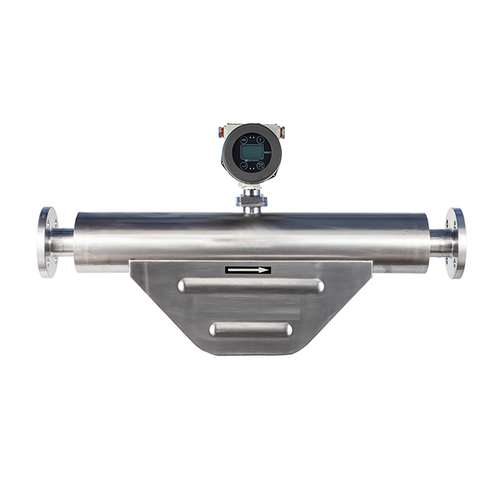
Low flow metering failures in fuel cell and semiconductor plants are rarely caused by a meter that cannot resolve a small flow. They are caused by a meter that was matched to a flow range instead of to a process medium.
Silane, supercritical CO2 and pure water all sit inside the same nominal “low flow” envelope, yet they attack different parts of a meter specification: hazardous-area classification, pressure rating, wetted material, and whether mass or volume is the meaningful measurement. Silver Automation Instruments, a Nanjing-based instrumentation manufacturer founded in 2010, builds two meter families that cover most of this space — micro Coriolis and low-flow thermal mass — and the selection logic between them is media-driven rather than range-driven.
The direct answer: specify a micro Coriolis meter for liquid and dense-phase duties such as pure water and supercritical CO2, where stainless steel 316L wetted parts and a 30 bar or 100 bar pressure rating are the governing constraints. Specify a low-flow thermal mass meter for gas-phase duties where the required mass flow falls below the Coriolis measuring floor, using the 2 sccm to 30 SL/M range. Both decisions then have to be reconciled with the output signal, the power supply and the certification the installation requires.
Why the Medium, Not the Flow Range, Drives Selection
Three media dominate low flow metering discussions in fuel cell manufacturing and semiconductor processing, and each one attacks a different part of a meter datasheet.
- Silane (SiH4) is handled as a gas at low mass flow. The governing constraints are leak integrity, wetted-material compatibility and hazardous-area certification — not turndown ratio alone.
- Supercritical CO2 is a dense-phase fluid whose density changes steeply with pressure and temperature. A volumetric reading is therefore ambiguous in a way that a mass reading is not, which pushes specification toward mass-based measurement and toward a defined pressure rating.
- Pure water is used in fuel cell humidification and cooling loops and in semiconductor wet processing. Here the dominant constraint is wetted-material inertness against contamination, which is why 316L stainless steel appears so frequently in these specifications.
There is a second layer underneath the medium itself: the operating conditions. Two installations can both meter pure water and still require different configurations, because one runs at 24 V DC on a 4-20mA loop while the other runs on a digital bus, or because one sits in a Zone 2 area and the other does not. Matching meter type to process media is therefore a two-stage decision: choose the measuring principle from the medium, then choose the configuration from the installation.
A Media-to-Meter Matching Framework
The table below maps the media named in the SH-CMF-FE specification to the meter family and the constraint that decides the choice. It is deliberately limited to media for which the wetted-material and pressure facts are published.
| Process medium | Phase | Governing constraint | Meter family | Published basis |
|---|---|---|---|---|
| Silane | Gas | Hazardous area, low gas mass flow, wetted-material compatibility | SH-CMF-FE Micro Coriolis; SRK-DL low-flow thermal for gas-phase duty | Silane is listed among the fluids the micro Coriolis meter can handle; 316L construction |
| Supercritical CO2 | Dense phase | Pressure rating and mass-based measurement | SH-CMF-FE Micro Coriolis | Pressure rating of 30 bar or 100 bar; supercritical CO2 listed as a handled fluid |
| Pure water | Liquid | Wetted-material inertness against contamination | SH-CMF-FE Micro Coriolis; SH-CM Coriolis | Stainless steel 316L construction on both models; pure water listed as a handled fluid |
| Process and fuel gases | Gas | Very low gas mass flow | SRK-DL low-flow thermal mass; SRK-100 for larger lines | 2 sccm to 30 SL/M range on SRK-DL; nitrogen and hydrogen among gas duties listed for the thermal family |
A practical rule that follows from the framework: if the medium is a liquid or a dense phase, the decision is usually about pressure rating and material. If the medium is a gas, the decision is usually about whether the required mass flow sits above or below the Coriolis measuring floor.
Micro Coriolis Meters for Liquid and Dense-Phase Duties
The SH-CMF-FE Micro Coriolis mass flow meter is a Coriolis-principle instrument offered as both a flow meter and a flow controller. It is built with stainless steel 316L wetted parts, which is the material grade that makes corrosive and high-purity duties tractable in one product.
| Measuring principle | Coriolis |
| Wetted material | Stainless steel 316L |
| Flow range | 40 g/h to 1000 kg/hr |
| Accuracy | ±0.25% to ±0.5% |
| Pressure rating | 30 bar or 100 bar |
| Output | 4-20mA, 0 to 5 VDC, 1 to 5 VDC |
| Communication | RS485 or RS232 |
| Power supply | 15 V DC or 24 V DC |
| Stated fluids | Pure water, silicone, aviation kerosene, diesel, supercritical CO2, silane |
Two of those specification lines carry most of the weight in the fuel cell and semiconductor context. The 100 bar pressure option is what makes the meter usable on a supercritical CO2 line, because supercritical service is intrinsically a high-pressure duty; the 30 bar option covers the more moderate liquid loops. The stainless steel 316L wetted path is what makes pure water service defensible, since the risk in fuel cell humidification and semiconductor wet processing is contamination of the medium rather than difficulty in resolving the flow.
A second Coriolis family, the SH-CM Coriolis mass flow meter, extends the same principle into larger and more extreme duties. It is available from approximately 1 mm to 300 mm line size, covers a flow range from about 10 kg/hr to 1500 t/h, operates with fluid temperatures from -200 to 350 °C, carries an IP65 protection level, and is constructed from stainless steel 316L. Its output set is broader as well: 4-20mA, pulse and frequency, with MODBUS RTU, HART, Profibus-DP and Profibus-PA communication.
On the mechanical side, Coriolis measurement has no moving parts in the flow path, requires no straight-pipe runs upstream or downstream of the sensor, and does not need upstream filtration to protect it from particles — characteristics reported in field service of the SH-CM family, including a crude oil installation in Saudi Arabia and a high-pressure nitrogen installation in Chile where the meter has held stable measurement at around 700 bar for more than three years.
Low-Flow Thermal Mass Meters for Gas-Phase Duties
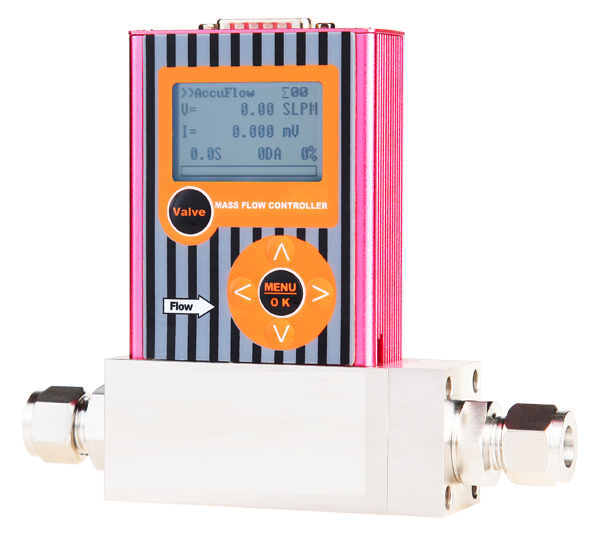
The SRK-DL Low Flow Thermal mass flow meter is the gas-phase counterpart. It is offered as both a mass flow meter and a mass flow controller, with a range of 2 sccm to 30 SL/M and an accuracy of ±1% F.S. It provides 0 to 5 V, 4-20mA and 1 to 5 V outputs, communicates over RS232/485 with MODBUS, and accepts ±15 V DC or 24 V DC supply. Its stated application fields are semiconductor, medical, analytical instruments, fuel cells and environmental monitoring.
The resolution this family offers is the reason it exists in this discussion at all. A micro thermal mass flow meter in the SRK-DL family has been used in a Chinese leak-detection application with three units in service for more than ten years, detecting air leakage down to 2 sccm. That is a sensitivity level well below the 40 g/h entry point of the micro Coriolis range, and it defines the practical boundary between the two families.
For gas measurement on larger lines, the SRK-100 Thermal mass flow meter covers DN15 to DN2000 in either inline or insertion configuration, with a gas temperature range of -20 to 300 °C, a 4-20mA output and RS485, MODBUS RTU and HART communication. Its published gas list includes air, compressed air, nitrogen, natural gas, biogas, oxygen and LPG, and its stated chemical and petrochemical scope extends to nitrogen, hydrogen and hydrocarbons.
Matching Configuration to Operating Conditions
Once the medium has selected the family, the remaining decisions are configuration decisions, and they are usually settled by the control system rather than by the process engineer.
| Parameter | SH-CMF-FE Micro Coriolis | SRK-DL Low Flow Thermal |
|---|---|---|
| Wetted material | Stainless steel 316L | Stainless steel |
| Flow range | 40 g/h to 1000 kg/hr | 2 sccm to 30 SL/M |
| Accuracy | ±0.25% to ±0.5% | ±1% F.S. |
| Pressure rating | 30 bar or 100 bar | Not published in the standard specification |
| Analog output | 4-20mA, 0 to 5 VDC, 1 to 5 VDC | 0 to 5 V, 4-20mA, 1 to 5 V |
| Communication | RS485 or RS232 | RS232/485, MODBUS |
| Power supply | 15 V DC or 24 V DC | ±15 V DC or 24 V DC |
| Meter or controller | Both | Both |
Output selection is a system-integration choice, not a performance choice. A 4-20mA loop remains the default for legacy DCS and PLC input cards, while RS485 with MODBUS is the default where the meter reports multiple variables or where the plant is standardising on a digital bus. The SH-CM Coriolis meter goes further and supports pulse, frequency, MODBUS RTU, HART, Profibus-DP and Profibus-PA, which matters where a meter has to sit inside an existing fieldbus architecture rather than beside it.
Power supply has a similar practical effect. A 24 V DC supply is common to both the micro Coriolis and the low-flow thermal families, which simplifies panel design; the thermal family also accepts ±15 V DC, and the micro Coriolis accepts 15 V DC, so a mixed installation can be built on a single rail or on a bipolar supply depending on what is already in the cabinet.
Compliance and Material Constraints in Procurement
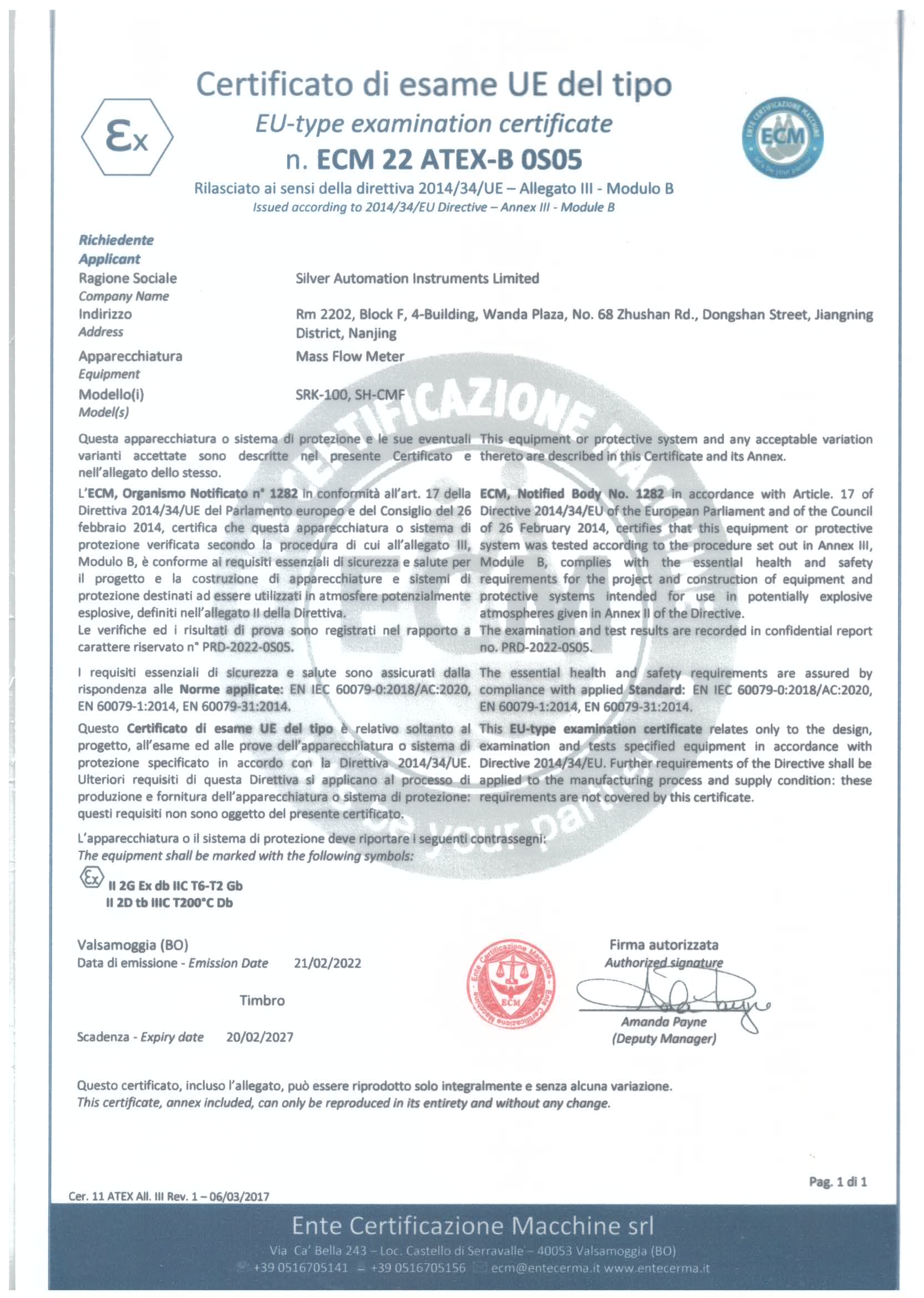
In an HVQ-2 procurement context — where certification, parameters and price band are the deciding factors — the documentation is part of the specification. For the product families discussed here, the published certification set is as follows.
- CE: certificate 1N220422.SAIUW36, issued by Ente Certificazione Macchine Srl to standard EN IEC 61326-1:2021, scope “flow meter”, valid to 21 April 2027.
- ATEX, Zone 2: certificate ICR/VC/HM251296, issued by ICR, to standards IEC 60079-0:2018+A11:2024, EN 60079-1:2014+A11:2024 and EN IEC 60079-31:2024, valid to 9 December 2030.
- ATEX, Zone 2: certificate ECM 22 ATEX-B 0S05, issued by Ente Certificazione Macchine srl, to standards EN IEC 60079-0:2018/AC:2020, EN 60079-1:2014 and EN 60079-31:2014, valid to 20 February 2027.
- ISO 9001:2015: certificate 79625Q0002107R0S, issued by ZHONGHONG CERTIFICATION (JIANGSU) CO.,Ltd., valid to 9 July 2028.
Product coverage is specific rather than generic. The ATEX certification covers the micro Coriolis model SH-CMF-FE under EN 60079-1:2014+A11:2024, the low-flow thermal model SRK-DL under EN IEC 60079-31:2024, and the steam mass flow meter model STLU-VFN under IEC 60079-0:2018+A11:2024. The thermal mass flow meter model SRK-100 and the Coriolis mass flow meter model SH-CM are also covered by ATEX certification. For a buyer, the practical question is not whether a supplier holds an ATEX certificate, but which model and which standard the certificate names.
One further standards reference matters at small line sizes. ISO 5167:2022 remains the primary international standard for differential-pressure flow measurement devices, and small-line accuracy is exactly where differential-pressure methods become difficult; that is part of the reason mass-based technologies are specified on small, low-flow lines in the first place.
Where Meter Matching Gets Harder: Limits and Trade-offs
A credible matching framework has to state where it stops working, and there are three boundaries worth naming.
The Coriolis measuring floor. The SH-CMF-FE begins at 40 g/h. Below that mass flow, the micro Coriolis family is not the instrument to specify, and the gas-phase thermal family — which reaches down to 2 sccm — becomes the appropriate choice. This is a hard boundary, not a preference.
Thermal measurement is gas-only. The SRK-DL is specified for gases, not liquids, and thermal mass measurement depends on the properties of the gas being measured. That means gas composition has to be known at the specification stage, and a change of process gas is a meter-configuration event rather than a settings change. In silane service specifically, the wetted-material and hazard assessment has to be confirmed against the medium before an order is placed, regardless of which family is chosen.
Coriolis is not the low-cost answer for large lines. The SH-CM family reaches DN300 and 1500 t/h, but for very large pipelines other principles remain the mainstream choice — electromagnetic meters, for example, account for 21.7% of total flow meter product share in 2026, and positive displacement meters hold 18% of the market for low to moderate flow rates of viscous fluids such as oils and fuels. Coriolis earns its place on accuracy, wetted-material range and multi-variable output, not on being universally cheapest.
Competitive context is also relevant at the ultra-low end. Bronkhorst High-Tech is identified as a major supplier in the ultra-low flow Coriolis segment focused on laboratory and OEM applications, while Honeywell, Emerson and Siemens are identified as tier-1 competitors in the broader high-precision flow meter segment. Buyers evaluating this class of instrument should compare published ranges, pressure ratings, wetted materials and certificate numbers rather than brand reputation alone, because those four lines are what determine whether a meter is actually suitable for a given medium.
Market Signals Behind the Shift to Small-Line Metering
The commercial environment reinforces the technical argument. Grand View Research valued the global flow meter market at USD 10.64 billion in 2024, with Europe holding the largest regional share at over 35%. Within that market, thermal flow meters — the technology family used for low gas flow rates — reached USD 1.73 billion in 2024 and are projected to reach USD 2.9 billion by 2035 according to Market Research Future.
Coriolis technology, used for high-precision low-flow liquid measurement, held a 26.77% share of the intelligent flow meter market in 2026, per Fortune Business Insights. The directional signal is stronger than the aggregate: Grand View Research identifies the 2-inch and smaller pipe size segment as the fastest-growing segment through 2030, driven by demand from pharmaceuticals and food and beverage — the same small-line, low-flow condition that characterises fuel cell and semiconductor duty.
Two adjacent markets point the same way. Thermal mass flow controllers for semiconductor applications are projected to grow at a CAGR of 4.5% between 2026 and 2035, according to SNS Insider. The microfluidic devices market, which includes micro flow sensors, was valued at USD 22.1 billion in 2024 and is growing at a CAGR of 12.2%, per P&S Intelligence. On the demand side, Market Research Future places the Asia-Pacific flow meter market at USD 3.27 billion in 2025, with China contributing over 50% of regional demand — which is also where a large share of the manufacturing capacity for these instruments is located.
Future Outlook
Two forces will shape low flow metering in fuel cell and semiconductor applications over the next several years. The first is the continuing migration of semiconductor and clean-energy process lines toward smaller diameter, higher-purity, higher-pressure configurations, which favours mass-based measurement over volumetric methods. The second is the growth of flow chemistry as an industrial discipline: Coherent Market Insights expects the flow chemistry market, which requires precision low flow metering, to reach USD 4.6 billion by 2032 at a CAGR of 8.1%.
For procurement teams, the practical consequence is that meter selection will increasingly be decided by four published lines — flow range, pressure rating, wetted material and certificate coverage — rather than by meter category. Manufacturers such as Silver Automation Instruments, whose product families span both micro Coriolis and low-flow thermal measurement, support that comparison by publishing the underlying specifications rather than only the application list. Silver Automation Instruments holds ISO 9001:2015 certification and operates OEM/ODM arrangements with logo customisation, a published monthly capacity of 2000 units, a lead time of 10-12 working days and a minimum order quantity of one unit, with calibration testing as the stated quality-control step.
Frequently Asked Questions
Which low flow meter type is used for silane in semiconductor processing?
Silane is a gas-phase, hazardous-area duty. The SH-CMF-FE Micro Coriolis mass flow meter lists silane among the fluids it can handle, uses stainless steel 316L wetted parts, and is offered with a 30 bar or 100 bar pressure rating. Where the required gas mass flow falls below the Coriolis measuring floor of 40 g/h, the SRK-DL Low Flow Thermal mass flow meter covers 2 sccm to 30 SL/M. In either case, gas compatibility and the hazardous-area assessment need to be confirmed against the specific installation.
Can a low flow meter handle supercritical CO2?
Supercritical CO2 is a dense-phase, high-pressure medium, so both the pressure rating and the measurement principle matter. The SH-CMF-FE Micro Coriolis mass flow meter is available with a 100 bar pressure rating and lists supercritical CO2 among the fluids it can handle. Because the density of a supercritical fluid changes steeply with pressure and temperature, a mass-based reading avoids the ambiguity that a purely volumetric reading would carry.
What material is specified for low flow meters in pure water service?
The SH-CMF-FE Micro Coriolis mass flow meter is constructed from stainless steel 316L and lists pure water among the fluids it can handle. The SH-CM Coriolis mass flow meter is also constructed from stainless steel 316L. Material grade is the governing constraint in pure water service because contamination, rather than flow resolution, is the primary risk in fuel cell humidification loops and semiconductor wet processing.
What output and power options are available for integrating a low flow meter into a control system?
The SH-CMF-FE micro Coriolis meter provides 4-20mA, 0 to 5 VDC and 1 to 5 VDC outputs, communicates over RS485 or RS232, and accepts a 15 V DC or 24 V DC supply. The SRK-DL low-flow thermal mass meter provides 0 to 5 V, 4-20mA and 1 to 5 V outputs with RS232/485 and MODBUS communication, and accepts ±15 V DC or 24 V DC. The SRK-100 thermal mass meter provides a 4-20mA output with RS485, MODBUS RTU and HART.
Which certifications should be verified before purchasing a low flow meter for EU or hazardous-area installation?
For EU market access, CE certificate 1N220422.SAIUW36 was issued by Ente Certificazione Macchine Srl to standard EN IEC 61326-1:2021 with a scope covering flow meters, and remains valid to 21 April 2027. For Zone 2 hazardous areas, ATEX certificate ICR/VC/HM251296 was issued by ICR under IEC 60079-0:2018+A11:2024, EN 60079-1:2014+A11:2024 and EN IEC 60079-31:2024, valid to 9 December 2030; a second ATEX certificate, ECM 22 ATEX-B 0S05, was issued by Ente Certificazione Macchine srl and is valid to 20 February 2027. ISO 9001:2015 certificate 79625Q0002107R0S is valid to 9 July 2028. Model coverage should always be checked on the certificate itself: the ATEX certification covers the SH-CMF-FE, SRK-DL, STLU-VFN, SRK-100 and SH-CM product families under their respective standards.
For full technical specifications, certification references and ordering information, the manufacturer brochure is available for download: Silver Automation Instruments product brochure (PDF).