
Matching Luminaires to Scenarios: Choosing Between Inground and Garden Bollard Lights
Matching Luminaires to Scenarios: Choosing Between Inground and Garden Bollard Lights
Exterior lighting design begins with the task, not the fixture. Inground luminaires and garden bollard lights share the same drawing layer — the ground plane — but they perform different jobs, tolerate different conditions and impose different costs on a project once the paving is laid.
Two families dominate the ground level of most architectural landscape schemes: inground luminaires, installed flush with paving or soil, and garden bollard lights, mounted above grade on a post. The choice between them determines how a space reads at night, how legible a route feels to a visitor, and how much maintenance the installation demands in its second year of operation.
The functional distinction is straightforward. Inground luminaires answer a surface question: how to graze a wall, wash a deck edge, mark a level change, or add depth to planting. Bollard lights answer a route question: how to make a path or perimeter legible while remaining visually quiet during daylight hours. Specifying one family for both roles is where many exterior schemes lose glare control, waterproofing margin or visual coherence.
This industry reference maps each family to concrete scenarios using documented product data from ALPHALUCE, an Italian architectural lighting brand that manufactures in Dongguan, Guangdong, China. The same scenario logic applies when evaluating comparable fixtures from other suppliers.
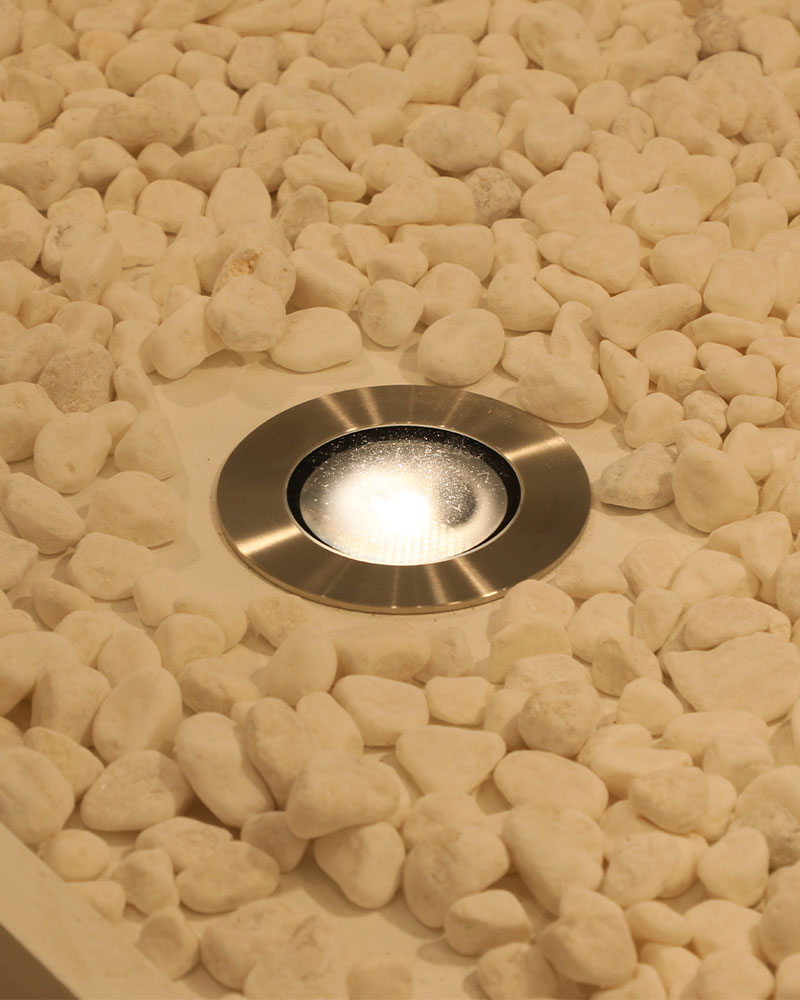
Inground luminaire ALDL1677: 5W, 126lm, CRI greater than or equal to 92, IP65, 15 degree adjustable, stainless steel / brush anodized finish. Image: ALPHALUCE
Why Exterior Fixture Selection Goes Wrong Before Installation Begins
Exterior zones are the harshest part of a building. Fixtures sit in rain, irrigation overspray, frost, salt-laden air and, at deck edges and pool surrounds, standing water. Documented scenario requirements for garden and landscape projects list IP67 protection, corrosion-resistant and UV-protected construction, and CRI of at least 90 as typical conditions, with timers, photocell sensors and low-voltage transformers as matched equipment.
Hospitality and public-area scenarios add a different set of demands: continuous 24/7 operation, IP65 protection for outdoor fixtures, anti-glare optics, warm colour temperatures in the 2700K to 3000K range, CRI of at least 92, and dimming systems such as DALI or KNX. A single fixture family rarely satisfies both sets of conditions without compromise, which is why scenario mapping is a specification decision rather than a styling decision.
Three recurring failure modes are worth naming:
- Wrong family for the task. Bollards used as accent lighting produce broad, diffuse light with limited directional control, while inground uplights used as path lighting create isolated pools of light and increase reflected glare on wet surfaces.
- Rating chosen by habit. An IP65 fixture placed where water accumulates, or a shallow cutout specified without planning drainage beneath it.
- Aiming decided on site. An adjustable fixture can be corrected after planting matures; a fixed one locks the design to an assumption made months earlier.
The Two Families, Documented
Inground luminaires sit flush with the finished surface, deliver relatively low luminous flux, and depend on cutout and drainage planning. Garden bollard lights stand above grade, illuminate the walking surface directly, and add a permanent vertical element to the daytime landscape. The table below summarises the documented differences across the exterior families.
| Dimension | Inground luminaires | Garden bollard lights |
|---|---|---|
| Mounting position | Flush with grade; cutouts from 21mm to 34mm | Above grade on a post; 400mm, 800mm or 1200mm body heights |
| Primary role | Grazing, surface accent, deck and pool surrounds, edge definition | Wayfinding, path and perimeter illumination |
| Documented models | ALDL1677, ALDL0192, ALDL1334 | ALSL0165, ALSL0152 |
| Documented output | 126lm (ALDL1677); 60/130lm (ALDL0192); 90lm (ALDL1334) | 560lm (ALSL0165); 422lm (ALSL0152) |
| CRI | At least 92 across the three referenced models | At least 90 across both referenced models |
| CCT options | 2700K / 3000K / 4000K | 2700K / 3000K / 4000K |
| IP rating | IP65 (ALDL1677); IP67 (ALDL0192, ALDL1334) | IP65 (ALSL0165, ALSL0152) |
| Adjustability | 15 degree adjustable (ALDL1677) | 0 to 135 degree tilt, 355 degree rotation (ALSL0165); fixed (ALSL0152) |
| Supply | DC24V (ALDL0192, ALDL1334) | DC24V (ALSL0165, ALSL0152) |
| Main constraint | Low flux ceiling; cutout, drainage and relocation limits | Daytime visual presence; aiming tied to body height; not a substitute for wide-area illumination |
Five Variables That Decide the Match
1. Mounting height and glare
Glare depends on where the light source sits relative to the eye and the direction of view. A 400mm bollard places the source below typical standing eye level and, on the adjustable model, can be aimed after installation: ALSL0165 offers 0 to 135 degree tilt and 355 degree rotation at a 400mm height. A fixed bollard such as ALSL0152 relies on the specified body height — 400mm, 800mm or 1200mm — to achieve the same result. Inground luminaires are below eye level by definition, but the risk shifts to reflected glare from wet or polished paving, which favours narrow beams and modest output at deck edges.
2. Water exposure and IP rating
The rating should follow the exposure, not the product category. In this portfolio the inground uplight ALDL1677 is rated IP65, while the exterior ground lighting ALDL0192 and the inground pool LED light ALDL1334 are rated IP67 and operate at DC24V. IP65 suits rain and irrigation exposure; IP67 is the appropriate specification where a fixture may sit in standing water or in a pool-deck zone with accumulation of splash. Wet-area zoning practice demonstrates the same principle in regulation: BS 7671 requires IP44 in Zone 2 and IP65 in Zone 1 for bathroom lighting, tying the rating to the water exposure of the location rather than to fixture styling.
3. Beam angle and colour consistency
Beam angle determines whether a fixture accents or illuminates. Documented options across the exterior families include 15, 24, 36 and 60 degrees (ALDL1677 and ALSL0165), 12, 24, 38 and 50 degrees (ALSL0086), 24 and 36 degrees (ALSL0024 and ALDL0192), and 15, 24, 36 and 60 degrees (ALDL1334). Narrow angles concentrate intensity for uplight and object accent; wider angles support path and ambient illumination. All of these exterior families are documented with 2700K, 3000K and 4000K options, which allows a single colour temperature strategy across the entire ground plane.
4. Aiming, adjustability and installation tolerance
Adjustability moves a decision from the specification stage to the installation stage. ALSL0024 offers 0 to 110 degrees of tilt, ALSL0086 offers 0 to 45 degrees, ALSL0029 offers 0 to 355 degrees of tilt with 360 degree rotation, ALSL0165 offers 0 to 135 degrees of tilt with 355 degree rotation, and ALDL1677 provides 15 degrees of adjustment. Fixed models such as ALSL0152 require height, spacing and orientation to be resolved inside the lighting design, because no on-site correction is available.
5. Material, finish and grade-level durability
Exterior fixtures in this portfolio are constructed in aluminium alloy, with finishes selected for exposure. ALDL1677 is offered in a stainless steel / brush anodized finish, and ALSL0152 is available with custom colour. Finish and material choices matter most in coastal schemes, where corrosion resistance is a stated project requirement in documented resort applications.
Scenario Mapping: Which Fixture Answers Which Question
| Scenario | Appropriate family | Documented reference |
|---|---|---|
| Garden path and border lighting | Bollard, adjustable or multi-height | ALSL0165, ALSL0152 |
| Specimen tree, shrub and facade accent | Spike or inground with narrow beam | ALSL0086, ALSL0024, ALDL1677 |
| Pool surround and deck edge | Inground, IP67, small cutout | ALDL1334 (21mm), ALDL0192 (34mm) |
| Step and level-change marking | Recessed step luminaire, IP65 to IP67 | ALDL2009, ALDL1956, ALDL1540 |
| Hotel terrace and 24/7 public realm | Bollard for wayfinding plus inground for accent | ALSL0165, ALDL1677 |
Path and border lighting. Bollards carry the wayfinding layer. Wider beams in the 36 to 60 degree range support continuous path illumination, while narrower 15 or 24 degree beams are better for marking individual features along the route. Adjustable models allow the aim to be corrected once planting has matured; multi-height models let one product family serve both low path lighting and taller perimeter marking. Fixed-height bollards require this decision to be locked in the lighting design.
Poolside safety and deck edges. Only the inground family can sit within the deck plane without adding a vertical obstacle. The IP67 models with 21mm and 34mm cutouts are documented for landscape and wet-area applications, and the inground pool LED light ALDL1334 offers 1W to 2W operation, 90lm, a 15 to 60 degree beam range and 2700K, 3000K or 4000K output. This is edge definition and safety illumination rather than area lighting. Level changes are handled by dedicated recessed step luminaires such as ALDL2009 and ALDL1956 (3W, 270lm, IP65) or the IP67 ALDL1540 (3W, 75lm, 2700K).
Accent lighting. Accent work rewards colour fidelity and aiming precision rather than raw output. Garden spike luminaires documented at CRI of at least 97 — ALSL0086 at 7W and 560lm with 0 to 45 degree tilt, and ALSL0024 at 3W and 240lm with 0 to 110 degree tilt — are suited to planting that changes height across seasons, while inground uplights with 15 degree adjustment suit fixed architectural surfaces and wall grazing.
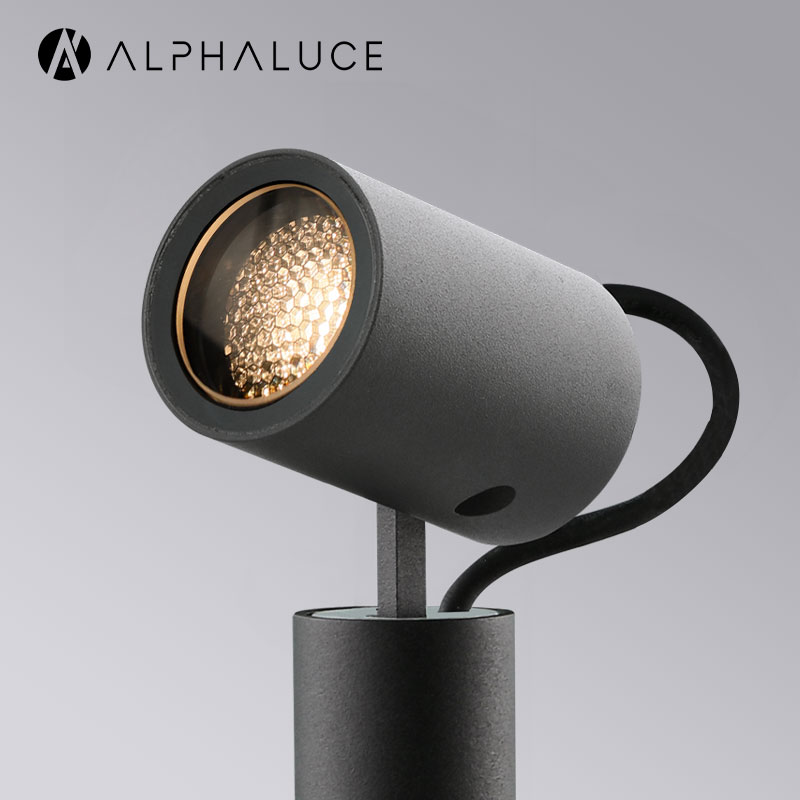
Bollard lights outdoor ALSL0165: 7W, 560lm, CRI greater than or equal to 90, IP65, 0 to 135 degree tilt, 355 degree rotatable, height 400mm. Image: ALPHALUCE
What ALPHALUCE Contributes to Scenario-Based Selection
ALPHALUCE is an Italian architectural lighting brand founded in Florence and operating as ALPHALUCE ARCHITECTURAL LIGHTING CO., with manufacturing based in Dongguan, Guangdong, China. The company supplies one-stop integrated lighting solutions for premium commercial and residential spaces, including luxury hotels, high-end residences, commercial offices, retail displays and restaurants, and it is structured as a four-in-one business covering design, research and development, manufacturing and sales.
The corporate entity was founded in 2010 and operates a 40,000 square metre factory with 150 employees, an annual output of 504,000 units and an R&D team of 20 engineers. Export accounts for 80 percent of sales, with main markets in Europe, the Middle East, North America and Australia, and long-term strategic partnerships with more than 300 clients across more than 100 countries and regions. Production is vertically integrated, with the company operating its own foundry, surface treatment facilities and assembly plants, which supports control over quality, customisation and lead times.
For scenario-based exterior selection, the relevant capability facts are documented as follows: OEM and ODM production with customisation of colour, CCT, beam angle, power, surface finish and logo; monthly capacity of 42,000 units; lead time of 20 to 30 days; minimum order quantity of 100 units; quality control comprising 100 percent inspection plus an aging test; certification to CE, ETL, RoHS, LVD and EMC with ISO-certified quality and environmental management systems; and a 5-year warranty. These figures define what a specifier can verify before specification, rather than what a rendering suggests.
Documented application evidence supports the indoor-outdoor continuity that scenario selection aims for. In an Alpine golf resort project in Austria, the company delivered combined architectural and landscape lighting intended to perform across four seasons. A coastal resort project in Sri Lanka specified corrosion-resistant materials as a project requirement. In residential work, a villa project in China connected indoor and outdoor living spaces through a consistent architectural lighting language — the same objective that pairing bollards with inground luminaires serves at ground level.
Market Signals Behind the Shift to Scenario-Based Specification
Scenario-based selection is gaining ground partly because the exterior lighting category itself is expanding and becoming more closely integrated with interior specification. Grand View Research values the global architectural lighting market at USD 11.1 billion in 2025 and projects USD 17.5 billion by 2033. Asia Pacific accounted for 43.2 percent of 2025 revenue share, with China the largest single country market, and the commercial segment represented 50.9 percent of market share in 2025. Human-centric lighting, tracked separately by Fortune Business Insights, reached USD 3.53 billion in 2024, reflecting demand for lighting specified around user wellbeing rather than raw output alone.
Three practical consequences follow for exterior projects. First, colour temperature and colour rendering are increasingly expected to hold across interior and exterior boundaries, which is why documented CCT sets of 2700K, 3000K and 4000K across a fixture family matter more than a single impressive model. Second, glare and light spill are specification topics rather than site corrections, which favours fixtures with documented tilt and rotation ranges. Third, compliance documentation is part of the selection process: recessed luminaires must comply with safety standard EN IEC 60598-2-2 for sale in the EU market, and IP zoning requirements such as BS 7671 tie ratings to water exposure levels.
The competitive landscape includes large international groups such as Acuity Brands, Signify (Philips), Zumtobel Group and ERCO, alongside regional specialists such as ALPHALUCE. For buyers, the practical question is not which list is longest but which supplier can document the specific rating, beam angle, adjustability and quality procedure that a given scenario requires.
Comparison With Traditional Exterior Lighting Practice
Traditional exterior specification often treated the ground plane as a single problem, resolved with one fixture type applied across paths, borders and facades. Documented practice differs in three ways. First, task separation: bollards for wayfinding and inground or spike luminaires for accent, rather than one family for both. Second, exposure-based rating selection, so IP65 is used for rain-exposed posts and IP67 for locations with standing water or splash accumulation. Third, aiming as a documented property: 0 to 135 degree tilt and 355 degree rotation on ALSL0165, 0 to 110 degree tilt on ALSL0024, 0 to 45 degree tilt on ALSL0086, 0 to 355 degree tilt with 360 degree rotation on ALSL0029, and 15 degree adjustment on ALDL1677.
The boundaries of this approach should be stated plainly, because scenario fit is as much about what a fixture cannot do as what it can:
- Inground luminaires have a low output ceiling. Documented figures of 90lm (ALDL1334), 126lm (ALDL1677) and 60/130lm (ALDL0192) position them as accent and wayfinding fixtures, not as area lighting for wide surfaces.
- Inground installation is a construction decision. Cutouts of 21mm and 34mm must be coordinated with paving, and relocating a buried fixture after hardscape completion is expensive. Drainage at low points is required, and the IP65 rating of ALDL1677 is not intended for standing water.
- Bollards add a daytime element and a fixed geometry. ALSL0152 is fixed at 400mm, 800mm or 1200mm, so the height must be resolved at specification stage; ALSL0165 offers tilt and rotation but in a 400mm body. Neither model is a substitute for pole-mounted or wall-mounted area lighting where uniform illuminance is required across a wide carriageway.
- Low-voltage distribution requires planning. The exterior fixtures documented here operate at DC24V, which means driver or transformer locations and matched equipment such as timers, photocell sensors and low-voltage transformers must be part of the design. Dimming architecture is defined at system level, with DALI and KNX listed as matched equipment for hospitality and commercial scenarios rather than as a property of every outdoor fixture.
Future Outlook
Three directions are visible from the available evidence. The first is material resilience: coastal and marine-adjacent projects increasingly treat corrosion resistance as a baseline requirement, as documented in resort applications where corrosion-resistant materials were specified alongside high CRI hospitality lighting. The second is continuity of colour between interior and exterior, which reduces the number of fixture families a project manages and simplifies long-term replacement. The third is earlier specification of aiming, adjustment and control, so that exterior lighting is designed with the same discipline as interior lighting rather than corrected on site.
For buyers, the practical implication is that scenario mapping should happen before the fixture schedule is fixed. Deciding whether a zone needs a route layer, an accent layer, or both determines the rating, the beam angle, the mounting height and the maintenance access required — and those decisions are far cheaper to make on paper than in finished paving.
Frequently Asked Questions
What is the practical difference between inground lights and garden bollard lights?
Inground lights are installed flush with the finished surface and are used for grazing, accent and edge definition. Documented examples include ALDL1677 (5W, 126lm, IP65, 15 degree adjustable), ALDL0192 (1W to 2W, 60/130lm, IP67, 34mm cutout) and ALDL1334 (1W to 2W, 90lm, IP67, 21mm cutout). Bollard lights stand above grade and illuminate paths and perimeters directly; ALSL0165 delivers 7W and 560lm at a 400mm height with 0 to 135 degree tilt and 355 degree rotation, and ALSL0152 delivers 7W and 422lm at fixed heights of 400mm, 800mm or 1200mm. Bollards typically provide more flux per fixture, while inground luminaires remain visually absent during the day.
Which IP rating should be specified for luminaires near a pool or in a garden?
The rating should follow water exposure rather than fixture type. Scenario requirements for garden projects list IP67 protection, corrosion resistance and UV protection, with CRI of at least 90. In this portfolio ALDL1334 and ALDL0192 are rated IP67, while ALDL1677, ALSL0165 and ALSL0152 are rated IP65. IP65 suits rain and irrigation exposure; IP67 is appropriate where a fixture may sit in standing water or in a pool-deck zone with splash accumulation. Regulatory practice for wet areas follows the same logic: BS 7671 requires IP44 in Zone 2 and IP65 in Zone 1 for bathroom lighting, tying the rating to the location rather than to the product family.
How do beam angle and mounting height affect the choice for a path?
Narrow beams of roughly 12 to 24 degrees concentrate light for accent and uplight work, while wider beams of roughly 36 to 60 degrees suit path and ambient illumination. Documented beam options include 15/24/36/60 degrees (ALDL1677 and ALSL0165), 12/24/38/50 degrees (ALSL0086), and 24/36 degrees (ALSL0024 and ALDL0192). Mounting height and adjustability determine how precisely that beam can be placed: a 400mm bollard with 0 to 135 degree tilt and 355 degree rotation can be corrected after installation, whereas a fixed bollard requires the height and spacing decision to be finalised at specification stage.
Can bollard lights and inground lights be used together in the same scheme?
Yes, and the two roles are complementary rather than competing. Bollards normally carry the wayfinding and path layer, while inground luminaires carry the accent, edge and poolside layer. Coherence depends on shared colour temperature and colour rendering: the exterior families documented here offer 2700K, 3000K and 4000K, with CRI of at least 92 on the referenced inground models and at least 90 on the referenced bollards. Both families operate at DC24V, which allows shared low-voltage infrastructure and matched equipment such as timers, photocell sensors and low-voltage transformers.
What should a buyer verify before ordering exterior landscape luminaires?
Verification typically covers the IP rating against the actual water exposure, the cutout dimensions for inground fixtures (21mm for ALDL1334, 34mm for ALDL0192), height and finish options (ALSL0152 is available at 400mm, 800mm or 1200mm with custom colour available), the CCT and beam angle options required by the lighting design, and the supplier quality procedure. ALPHALUCE documents 100 percent inspection plus an aging test, certification to CE, ETL, RoHS, LVD and EMC standards with ISO-certified quality and environmental management systems, OEM and ODM customisation of colour, CCT, beam angle, power, surface finish and logo, a monthly capacity of 42,000 units, a minimum order quantity of 100 units, a lead time of 20 to 30 days, and a 5-year warranty.