
Matching Non Woven Bag Making Machines to Production Scenarios
A non-woven bag making machine is not a single-purpose purchase. It is a production platform whose value depends on how well it matches the plant's product mix, shift pattern, power supply, operator level, and end-customer requirements. This article explains how buyers evaluating a non-woven bag making machine — from fully automatic and high speed models to ultrasonic, PLC-controlled, servo-driven, D-cut, W-cut, and 3D box bag configurations — can align machine choice with real production scenarios.
Why Scenario Fit Now Drives Machine Selection
Over 140 countries had enacted legislation restricting or banning single-use plastic bags by 2026. That policy shift has changed the packaging machinery market. The global bag making machine market was valued at USD 4.8 billion in 2025 and is projected to reach USD 8.1 billion by 2034, while the specialized global non-woven bag making machine market is predicted to grow from USD 179 million in 2025 to USD 733 million by 2032. Analysts expect the non-woven segment to record a CAGR of 22.5% from 2026 to 2032.
Automatic machines already hold a 52.4% share of the total product type market. For a buyer, the implication is practical: the bottleneck is rarely demand, but whether the selected equipment can operate reliably in the buyer's specific environment — the bag style required by customers, the daily output target, the available power supply, the floor layout, and the operator's skill level.
The Core Problem: One Machine Line Cannot Serve Every Scenario
A bag manufacturer serving a supermarket chain needs high-speed output, consistent dimensional accuracy, and multi-color print registration. A promotional products maker needs quick job changeover for short runs. A food takeaway packaging plant needs cleanroom-compatible operation, odorless ink, and automated stacking. A garment exporter needs wrinkle-free finished surfaces and a soft fabric-like handle feel.
Each production scenario changes the calculation. A first-time buyer producing standard D-cut shopping bags for local retail will not need a 12-ton 3D bag machine. A large-scale operation supplying multiple national retail chains will not be well served by an entry-level machine designed for 8–16 hour shifts. The risk of over-specification is as real as under-specification: buying too much machine inflates capital cost, spare parts inventory, and operator training; buying too little machine creates downtime, quality rejects, and capacity ceilings.
The Opportunity: Matching Machine Capability to Application Tiers
Zhejiang Zhengxin Machinery Co., Ltd. — a Wenzhou-based manufacturer established in 2014 with a 60,000 m² facility, 200 employees, and 30 engineers in its R&D team — organizes its non-woven bag making machine portfolio around application tiers. The company reports an annual output of 500 units and exports to over 120 countries, with 60% of production going to Africa, the Middle East, Southeast Asia, and Latin America. Its ISO 9001:2015 certified factory and CE-certified machines (Machinery, Low Voltage, and EMC Directives) provide a common compliance baseline. The product models can then be mapped directly to the buyer's production scenario.
Scenario Mapping at a Glance
| Production Scenario | Typical Bag Styles | Recommended Machine Orientation | Key Technical Requirement |
|---|---|---|---|
| Retail, supermarket & grocery chain supply | D-cut, W-cut, vest/T-shirt, shopping bags with printed logos | ZXL-A700, ZXL-A700Ultra, ZXL-E700, ZXL-E700Ultra | ≥100 pcs/min, defect rate <0.5%, registration accuracy for printed logos |
| Food delivery & takeaway packaging | Flat bags, D-cut, 3D/box bags for restaurant and bakery use | ZX-LT500, ZX-LT500Pro, ZX-LT500V | Cleanroom compatibility, odorless sealing, automated stacking and batch coding |
| Garment, fashion retail & apparel | Logo-printed garment bags, dust covers, suit covers | ZXL-A700, ZXL-A700Ultra | Anti-static material compatibility, wrinkle-free surface, soft handle feel |
| Advertising, promotional products, corporate gifts | Multi-color printed tote bags for events and trade shows | ZXL-A700Ultra + flexo printing unit | Quick job changeover, print registration accuracy ±0.3mm, premium surface finish |
| High-volume 3D/box bag production | Box bags, 3D standing bags, loop-handle shopping bags | ZX-LT500 series | One-time forming, side gusset control, handle welding in-line |
Brand Solution: A Portfolio Built Around Application Complexity
Zhengxin's non-woven bag making machines cover the full production chain — from entry-level D-cut machines to high-speed 3D box bag platforms. The company also supplies flexo printing machines (ZXH series), screen printing machines, 3D bag machines (ZX-LT500 series), and fabric slitting machines (ZXC series), which allows a buyer to build a complete production line from one supplier.
The technical backbone is consistent across the portfolio: genuine branded components such as Siemens, Delta, or Mitsubishi PLCs, Omron sensors, and NSK bearings; ultrasonic welding systems; servo-driven feeding and cutting on higher-tier models; and PLC control with touchscreen HMI. Third-party inspection by SGS, Bureau Veritas, or CCIC is available on request before shipment.
The Model Lines in Plain Terms
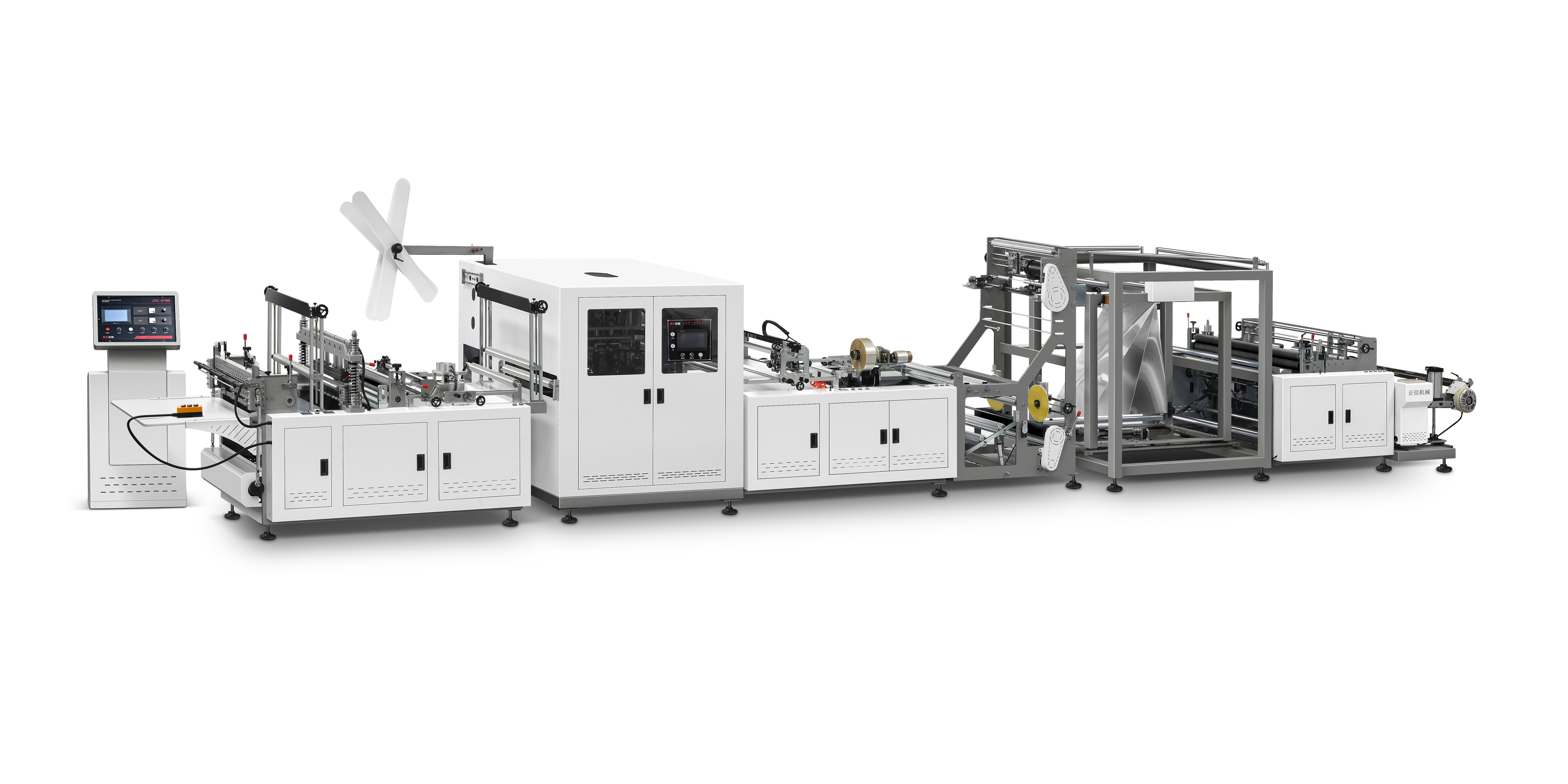
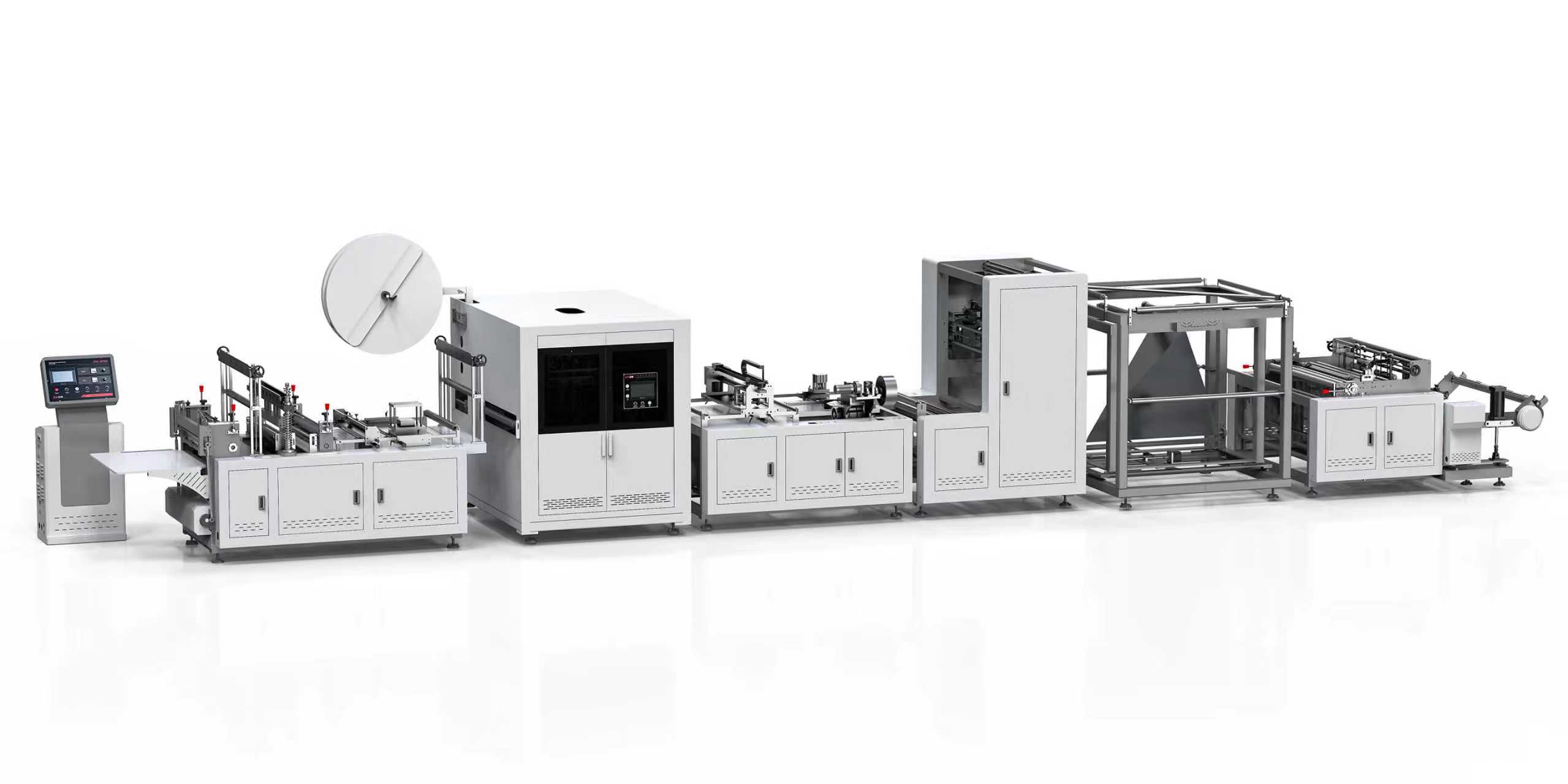
ZXL-A700 / ZXL-A700Ultra — vest, T-shirt and W-cut bags. The A700 produces non-woven T-shirt & W-cut bags and vest bags at 40–120 pcs/min, with fabric roll widths of 500–1300mm, bag heights of 300–700mm, and bag widths of 200–400mm. The Ultra version adds zero-waste-edge technology, which saves approximately 5% on raw material procurement costs by eliminating edge trim waste. This is the workhorse for retail and supermarket supply, and it is the model documented in global application scenarios requiring at least 100 pcs/min output and a defect rate below 0.5%.
ZXL-B700 — D-cut and drawstring bags. A stepping-motor and PLC-controlled machine producing 4,000–5,000 bags per hour, with auto-loading, magnetic powder tension control, automatic stop when material runs out, and color tracking for printed bags. It suits producers whose core product is the simple D-cut shopping bag sold in high volume.
ZXL-D700 / ZXL-E700 / ZXL-E700Ultra — flat bags and 4-in-1 / 5-in-1 configurable lines. The D700 is a 4-in-1 flat bag machine with online handle attachment; the E700 is a 5-in-1 non-woven box bag machine with online handle attachment, capable of producing over 20 bag types including drawstring bags, 3D bags, and zipper bags. The E700Ultra adds patented zero-trim technology. These models matter for buyers whose orders include multiple bag styles from the same line.
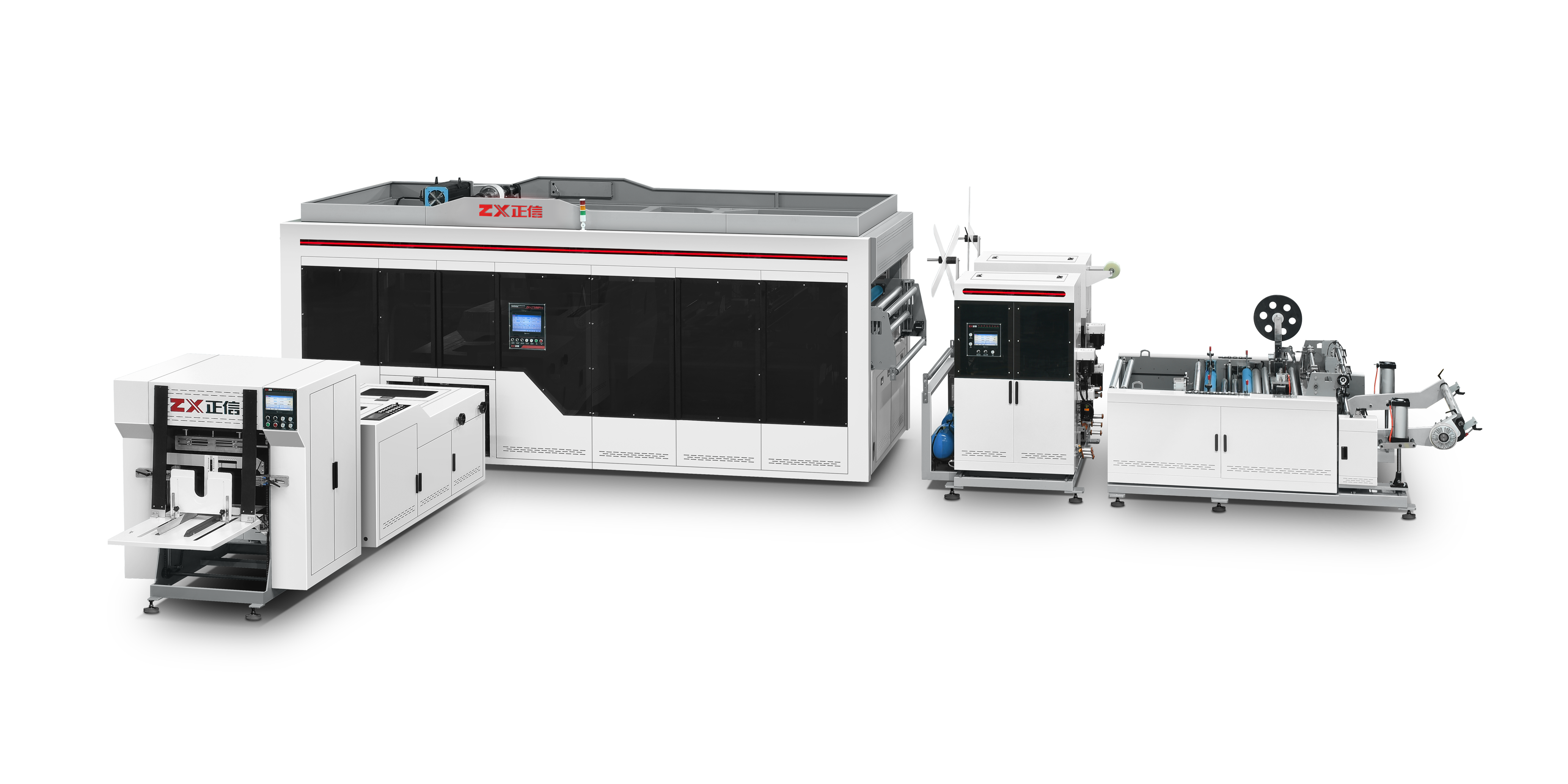
ZX-LT500 / ZX-LT500Pro / ZX-LT500V — 3D box bag platforms. These are heavyweight, specialized machines. The ZX-LT500 runs at 60–100 pcs/min with a 9500kg frame; the Pro version reaches 120 pcs/min with full servo control; the V version is a vertical-folding 3D bag machine optimized for RPET and PP non-woven fabrics. All are designed for soft-loop-handle box bags, shopping bags, and other 3D structures where the bag must stand upright.
ZXL-G700 — side gusset bags with online handle. A fully automatic gusset bag machine with a side gusset range of 60–200mm, producing shopping bags with 3D shaping for higher-end retail applications.
Technical Explanation: What Makes a Machine Scenario-Ready
Four technical capabilities determine whether a non-woven bag making machine can handle a given production scenario.
1. Bag-Forming Flexibility
A machine's bag-forming mechanism defines the product range. Ultrasonic welding — using 20kHz vibration to fuse polypropylene fibers — is the industry standard for clean, strong, odorless seals. Zhengxin's machines use ultrasonic welding for bag mouth folding, sealing, cutting, and handle attachment. Machines that combine ultrasonic sealing with die-cutting and gusseting can switch between flat bags, D-cut bags, vest bags, and 3D box bags. The G700's side gusset adjustment, for instance, allows a factory to serve both flat shopping bags and bulky-item packaging from one platform.
2. Registration and Cutting Precision
For printed bags, the machine must align cutting and sealing actions with pre-printed logos. Zhengxin machines use photoelectric eye tracking and color tracking sensors. In the promotional products scenario, where multi-color logos must sit in the same position on every bag, a print registration accuracy of ±0.3mm is required. Machines without this capability force the producer to buy pre-printed fabric with sacrificial margins, raising material cost.
3. Control Architecture and PLC Integration
PLC-controlled machines with HMI touchscreens allow operators to store recipes for different bag sizes and styles. The ZXL-B700, for example, integrates automatic deviation correction, automatic tension control, and automatic feeding. For a facility running multiple products per week — common in promotional bag production — recipe recall reduces changeover time. This is why PLC control is not a luxury; it directly affects how many orders a factory can execute per shift.
4. Power Supply and Environmental Adaptation
Zhengxin machines can be configured for 220V/380V/415V/440V, single-phase or three-phase, with material thickness ranges from 30 to 150 g/m². Factory environment matters just as much. A food takeaway bag plant requires a dust-free workshop with positive air pressure and temperature control; a garment packaging line needs clean workshop conditions and anti-static material compatibility. These are not machine options listed in a brochure — they determine whether a plant can pass audits from food chains or apparel brands.
Scenario Fit Checklist for Buyers
- Define the primary bag styles: D-cut, W-cut, vest, flat, drawstring, 3D box, or side gusset.
- Calculate daily output target using 80–85% of rated speed as a realistic baseline.
- Confirm the available voltage, phase, frequency, and whether a voltage stabilizer is installed.
- Identify printing requirements: 1–2 colors, 4+ colors, or no printing at the start.
- Check whether the end customer needs batch traceability, anti-static handling, or food-grade odorless sealing.
- Plan for supporting equipment: air compressor, fabric slitter, voltage stabilizer, and counting/bundling units.
Application / Use Cases: Four Scenarios, Four Configurations
Scenario 1: Retail, Supermarket & Grocery Chain Supply
The non-woven bag making machine (model ZXL-A700) is used in the retail, supermarket, and grocery chain industry for high-volume non-woven shopping bag production. It mass-produces customized non-woven shopping bags with single or multi-color printed logos, operating in fully automated 24/7 continuous mode from raw material feeding to finished bag stacking. The machine is specified for at least 100 pieces per minute with a defect rate below 0.5%.
The real-world reference: a shopping bag manufacturer in Kenya uses 3 units — two ZXL-A700 bag machines and one ZXH-C41200 4-color flexo printing machine — to supply more than 200 retail stores across the country. In this scenario, the machine line runs as a fully automatic printing-to-finished-bag workflow with a single operator managing the entire line.
Scenario 2: Food Delivery & Takeaway Service
In the food delivery and takeaway service industry, the machine produces non-woven bags for restaurant takeaway, food delivery platforms, and bakery packaging. The operating environment is a dust-free workshop with positive air pressure and temperature controlled at 20–28°C; supporting equipment includes automatic counting & bundling machines and inkjet date coders. Printing uses odorless and non-toxic water-based ink.
A food packaging and retail shopping bag manufacturer in Egypt has run Zhengxin equipment since 2017 — five units combining the ZXL-E700 bag machine, ZXH-C21200 2-color flexo printer, and ZXL-D700 bag machine. The same supplier supports three distinct product lines: food takeaway bags for restaurant chains, multi-color printed promotional shopping bags, and retail mall packaging. This is a direct example of how one vendor can power multiple revenue streams.
Scenario 3: Garment, Fashion Retail & Apparel Manufacturing
In this sector, the non-woven bag making machine produces logo-printed non-woven garment bags, dust covers, and suit covers for clothing brands and export packaging. The machine operates in a 16-hour double-shift mode with 1–2 operators per machine. Special requirements include anti-static treated material compatibility, a soft fabric-like handle feel, and a wrinkle-free finished bag surface.
The garment scenario demonstrates why material handling matters as much as machine speed. A line that scratches or wrinkles fabric during bag forming will fail a garment brand's quality audit even if output is high.
Scenario 4: Advertising, Promotional Products & Corporate Gifts
In the advertising & promotional products and corporate gifts & events industry, the machine is used in custom promotional bag production center projects. Its role is to produce small-to-medium batches of high-quality multi-color printed non-woven tote bags for corporate events, trade shows, brand promotions, and conference giveaways. The production mode is flexible batch-based, operating 8–16 hours with quick job changeover. Required supporting equipment includes a multi-color flexo printing station (4+ colors), die-cutting unit, handle attaching machine, and grommet punching unit. Special requirements include quick job changeover capability, print registration accuracy of ±0.3mm, and premium surface finish for luxury brand packaging.
A promotional bag producer in Mwanza, Tanzania, uses a ZXL-A700Ultra plus a ZXH-C21200 2-color flexo printer. The company expanded from one to two production lines within 18 months and now handles more than 10 custom orders per week, each with different artwork. The zero-waste-edge technology of the A700Ultra reduces raw material cost — a decisive advantage when job runs are short and fabric waste per design change can otherwise accumulate.
Large-Scale Deployment Evidence
At the high-volume end, Zhengxin has installed 42 units at one of Indonesia's largest non-woven bag manufacturing groups: 8 × ZX-LT500, 13 × ZXL-E700, 7 × ZXL-A700, 12 × ZXH-A1200, and 2 × ZXL-G700. The installation spans five machine models, producing shopping bags for retail chains, multi-color printed promotional bags, food-grade takeaway packaging, and garment dust covers. The client reports supplying more than one million bags monthly to major retail chains and food delivery platforms.
In Brazil, a mid-scale manufacturer deployed six units across four models — ZX-LT500, ZXL-B800, ZXL-D800, and ZXL-B700 — to produce shopping bags for supermarket chains and breathable produce packaging bags for fruit and coffee exporters. The single-supplier model unified after-sales support, made spare parts interchangeable across models, and allowed one training session to cover all four machine types.
These cases share a pattern: once a factory outgrows a single bag style, the ability to run multiple models from one supplier becomes an operational advantage. Interchangeable spare parts, unified training, and one point of contact reduce the complexity that typically multiplies when a factory sources machines from several manufacturers.
Market Trend Analysis: Plastic Bans Push Buyers Toward Flexible Automatic Lines
The growth of the non-woven bag making machine market is a policy-driven phenomenon, not just a packaging trend. As of 2026, over 140 countries have enacted legislation restricting or banning single-use plastic bags. Asia Pacific dominated the broader bag making machine market with a 43.6% revenue share in 2025, and automatic bag making machines held a 52.4% share of the product type market.
For buyers, the main trend is the shift from single-purpose machines to multi-format platforms. A factory that once produced only D-cut shopping bags now needs the ability to make vest bags, drawstring bags, box bags, and laminated bags as customer requirements evolve. The Zhengxin product line mirrors this: the E700 and E700Ultra support more than 20 bag types; the A700Ultra adds material savings; the ZX-LT500 series adds 3D forming capability. The direction is clear — flexibility is becoming a core requirement, not an option.
Comparison with Traditional Solutions: Faster, But With Defined Boundaries
Compared with traditional semi-automatic and manual bag making lines, fully automatic non-woven bag making machines offer a step-change in output. A fully automatic machine runs at 40–120 pcs/min with 1–2 operators, while a semi-automatic line typically produces 15–20 pcs/min and requires 3–4 workers. Zhengxin reports that its ultrasonic-based machines offer 5–6 times the efficiency of traditional equipment. The fully automatic platform also enables one-time forming — printing, bag forming, handle attachment, and stacking in a single continuous process.
However, the comparison has realistic limits. First, the capital cost is 3–5 times higher than semi-automatic equipment, and the payback period shortens only when daily output exceeds roughly 30,000 bags. Second, fully automatic machines demand stable three-phase power; in locations with grid fluctuation, a voltage stabilizer becomes a mandatory addition, not an optional accessory. Third, the maximum rated speed assumes consistent raw material quality — fabric with variable GSM will force the operator to slow down, which is why a machine such as the ZXL-A700 operates at 40–120 pcs/min rather than a single fixed speed. Fourth, high-speed platforms such as the ZX-LT500Pro are specialized: they do not replace the general-purpose A700 for standard shopping bags.
Another boundary is speed. Some competing high-end models are rated at 220 bags per minute, while Zhengxin's current general-purpose line peaks at 120 pcs/min. Buyers whose business model depends on ultra-high-speed production of a single bag style should compare the total cost per bag at full utilization — not the headline speed — before choosing a platform.
Future Outlook: Scenario Optimization Will Replace One-Size-Fits-All
As the non-woven bag market grows, the winning factories will be those that configure equipment around specific demand clusters. Three developments are likely:
1. Material-driven machine selection. With recycled PET (RPET) and lighter fabrics gaining share, machines will need to handle wider GSM ranges. Zhengxin's ZX-LT500 series already supports 60–150 g/m² and is optimized for RPET, suggesting that material compatibility will become a standard selection criterion.
2. Automation beyond the bag machine. Automatic counting, bundling, and batch coding are moving from optional to standard in food and retail supply. Buyers should plan for these auxiliary units at the initial layout stage.
3. Local service capacity. Zhengxin has established offices in Kenya, Morocco, Egypt, Vietnam, Tanzania, Dubai, Oman, Indonesia, and Ethiopia, and reports that remote support resolves more than 80% of issues via WhatsApp and video call. For buyers in Africa, the Middle East, Southeast Asia, and Latin America, the availability of local service is becoming as important as the machine specification.
FAQ
What machine configuration do you recommend for producing shopping bags for supermarket chains?
For supermarket chain supply, the recommended configuration is the ZXL-A700Ultra (fully automatic, 100–120 pcs/min, ultrasonic sealing) paired with a ZXH-C41200 inline 4-color flexo printing machine. This combination produces finished printed shopping bags in a single continuous line. At 100 pcs/min, daily output is approximately 45,000–55,000 bags in an 8-hour shift. Supermarket buyers typically require consistent bag quality, sharp print registration within ±0.3mm, dimensional consistency, and batch traceability, which can be added with an inkjet date coder.
What auxiliary equipment do I need besides the main bag making machine?
Four categories of auxiliary equipment are needed for a professional setup: a fabric slitting machine to cut wide master rolls into narrower bag-width rolls; an industrial screw-type air compressor with air dryer and tank (minimum 15–22 kW); a voltage stabilizer/AVR where grid power is unstable; and material handling equipment such as a hydraulic lift table for loading fabric rolls. For food and retail supply, automatic counting & bundling machines and inkjet date coders are recommended.
What is the difference between your machine models?
Zhengxin organizes its models into tiers. The ZXL-A700/B700/D700/E700 are entry-to-mid-range fully automatic machines producing D-cut, W-cut, drawstring, vest, flat, and box bags at 40–120 pcs/min. The ZXL-A700Ultra and E700Ultra add zero-waste-edge technology, saving about 5% on raw material costs. The ZX-LT500 series is the high-end 3D box bag platform, starting from an 9500kg heavy-duty frame and reaching 120 pcs/min on the Pro version. The ZXL-G700 is the dedicated side-gusset bag machine. Selection should start with the primary bag type and daily output target.
Should I buy a fully automatic or semi-automatic non-woven bag making machine?
Fully automatic machines are recommended when daily output exceeds 30,000 bags. They run at 100–120 pcs/min with 1 operator per 2 machines, achieve defect rates below 0.5%, and integrate printing, forming, sealing, counting, and stacking in one process. Semi-automatic machines run at 15–20 pcs/min, require 3–4 workers per line, and have a defect rate of 3–5%. Semi-automatic only makes sense when daily output is below 10,000 bags, capital is severely constrained, or production is dominated by highly varied small batches where frequent changeover is the main activity.
Is your factory ISO 9001 certified? Can you provide the certificate?
Yes, Zhengxin's manufacturing facility is ISO 9001:2015 certified. Its quality management covers incoming material inspection, in-process QC checkpoints, and continuous full-load production testing of every machine before shipment. A copy of the ISO 9001 certificate is provided with every shipment. Third-party factory audits by SGS, Bureau Veritas, TÜV, or the buyer's own inspection agent are welcome before shipment.
Have Questions or Need More Details?
Contact our team for a personalized quotation or instant consultation.
Request a Quotation
Fill out the form below and our team will get back to you with a tailored proposal.
WhatsApp Direct Chat
Prefer to chat in real-time? Message us on WhatsApp for instant assistance & quick answers.
- Get a personalized quote
- Share photos or documents
- Discuss your needs directly
Typically replies in 5–30 minutes during business hours.