
Matching Packaging Lines to Supplements, Sports Nutrition, and Beauty Formats
Packaging lines for supplements, sports nutrition, and beauty products are usually specified by category — a “supplement bottle”, a “protein jar”, a “beauty container”. The format inside the pack is treated as an assumption. In practice, the format decides most of what the packaging line has to do: how the container is filled, how the consumer doses, how the closure seals, and how the package performs on a shelf next to a dozen similar SKUs.
The formats themselves are already defined. RTCO’s plastic packaging products are used for commercial packaging and dosing of dietary supplements, sports nutrition powders, tablets, gummies, and liquids, and the company works with Health & Beauty, Sports Nutrition, and Supplement brands on innovative packaging. That scope covers the majority of what the supplement and beauty categories ship today.
This article maps packaging requirements to four format families — powder, tablets and capsules, gummies, and liquids — and explains what actually changes in a packaging line when the format changes. It is written for buyers and engineers who have moved past category selection and are now specifying components, tolerances, and supply terms.
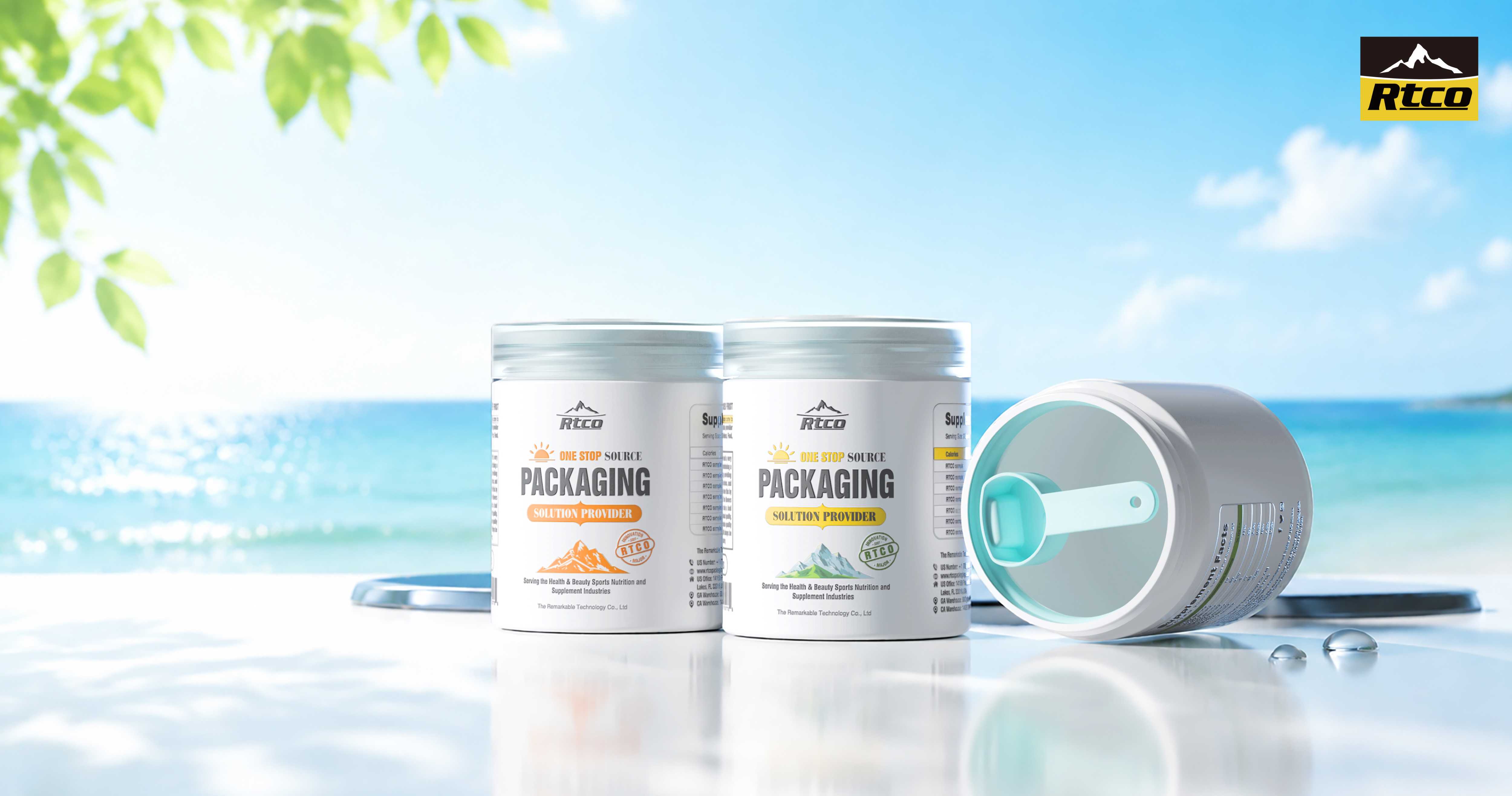
Rigid plastic packaging for supplement, sports nutrition, and health & beauty formats — the container, closure, scoop, and finish are specified together, not separately.
Format Precedes Category in Packaging Specification
Three variables drive almost every decision on a supplement packaging line: how the product is filled, how the consumer takes a dose, and how the package closes and re-closes. Category labels do not capture any of them. A 60 ml dropper bottle, a 300-count tablet bottle, a 5 lb protein jar, and a gummy flip-cap bottle are all “supplement packaging”, yet they share almost no mechanical requirements.
The practical consequence is a common failure mode. A container architecture that performs well for one product type gets carried over to another where the fill method or the dosing method is fundamentally different. The result is usually visible late — during filling trials, during stability checks, or on shelf when the pack does not communicate the format it holds.
Buyers who evaluate packaging as a capability rather than as a catalogue item tend to sequence the specification differently. They start from the format, derive dosing and closure requirements, and only then choose bottle geometry, material, and decoration. That sequence is what makes a line “one-stop” in any meaningful sense: the container, closure, scoop, liner, and surface finish are engineered as one system rather than assembled from unrelated suppliers.
Mapping Four Format Families to Packaging Requirements
The table below translates each format into the requirements it places on a packaging line. The right-hand column lists the container families RTCO produces that correspond to those requirements.
| Format | Consumer action | Packaging priorities | Corresponding container families |
|---|---|---|---|
| Powder (protein, pre-workout, greens, meal replacement) | Scoops a measured dose out of the container | Wide mouth opening, scoop fitment and storage, large fill volumes, controlled filling under dust-free conditions | Wide-Mouth Protein Powder Jar; Flip-Cap Scoop Bottle; Pre-Workout / BCAA Bottle |
| Tablets & capsules | Counts or pours a defined number of units | Compact neck, liner and seal integrity, printable label area, tamper and child-resistance considerations | Capsule & Tablet Bottle; Dual-Chamber Supplement Bottle |
| Gummies & gels | Reaches in, or shakes a few units out | Wide opening geometry, resealable flip closure, tactile and premium shelf presence | Flip-Cap Scoop Bottle; custom wide-mouth jar configurations |
| Liquids (liquid supplements, beauty serums and tonics) | Dispenses a small, precise amount | Dispensing closure architecture, container clarity, tight fill tolerances, leak integrity in transit | Dispensing bottle configurations; PET and HDPE bottle formats from 60 ml upward |
Powders: capacity, scoop access, and fill consistency
Powder is the most volume-sensitive format. Protein and pre-workout products are sold by weight, so the container has to carry a large fill volume while remaining comfortable for a consumer to open, scoop from, and close one-handed. That combination pushes the design toward a wide-mouth jar with a scoop that either sits on an internal ledge or hooks into the cap — the pattern behind the Flip-Cap Scoop Bottle and the Wide-Mouth Protein Powder Jar.
Powder also raises the first real engineering question in the project: scoop calibration. A scoop is not an accessory bolted onto a finished bottle; it is a measuring instrument with a defined capacity. RTCO’s scoop range covers measuring capacities from 0.3 cc to 8 oz, which allows the scoop to be matched to the label serving size rather than forced into an existing tool.
Tablets and capsules: count dosing and closure choice
Tablet and capsule packaging optimises for a different consumer behaviour — counting rather than scooping. The opening can be narrower, the label panel often becomes the dominant visual surface, and the closure decision splits between simple screw caps and child-resistant designs. In the United States, child-resistant packaging for supplements and nutraceuticals is governed by the Poison Prevention Packaging Act, with ASTM D3475 providing the standard framework for evaluating child resistance.
This is a format where a dual-chamber container earns its place. A Dual-Chamber Supplement Bottle allows two product components to ship in one pack without pre-mixing, which changes both the filling sequence and the label claims architecture.
Gummies: opening geometry and shelf presence
Gummies sit between the powder and tablet models. Consumers typically want a small number of units at a time, so the opening has to be wide enough to shake or reach into, and the closure has to reseal reliably across many open-close cycles. The flip-cap bottle is the natural architecture here.
The gummy format also carries the strongest premium-signalling burden. Because the product shape is uniform, differentiation has to come almost entirely from the package: colour, gloss, tactile feel, and the way the closure aligns with the body.
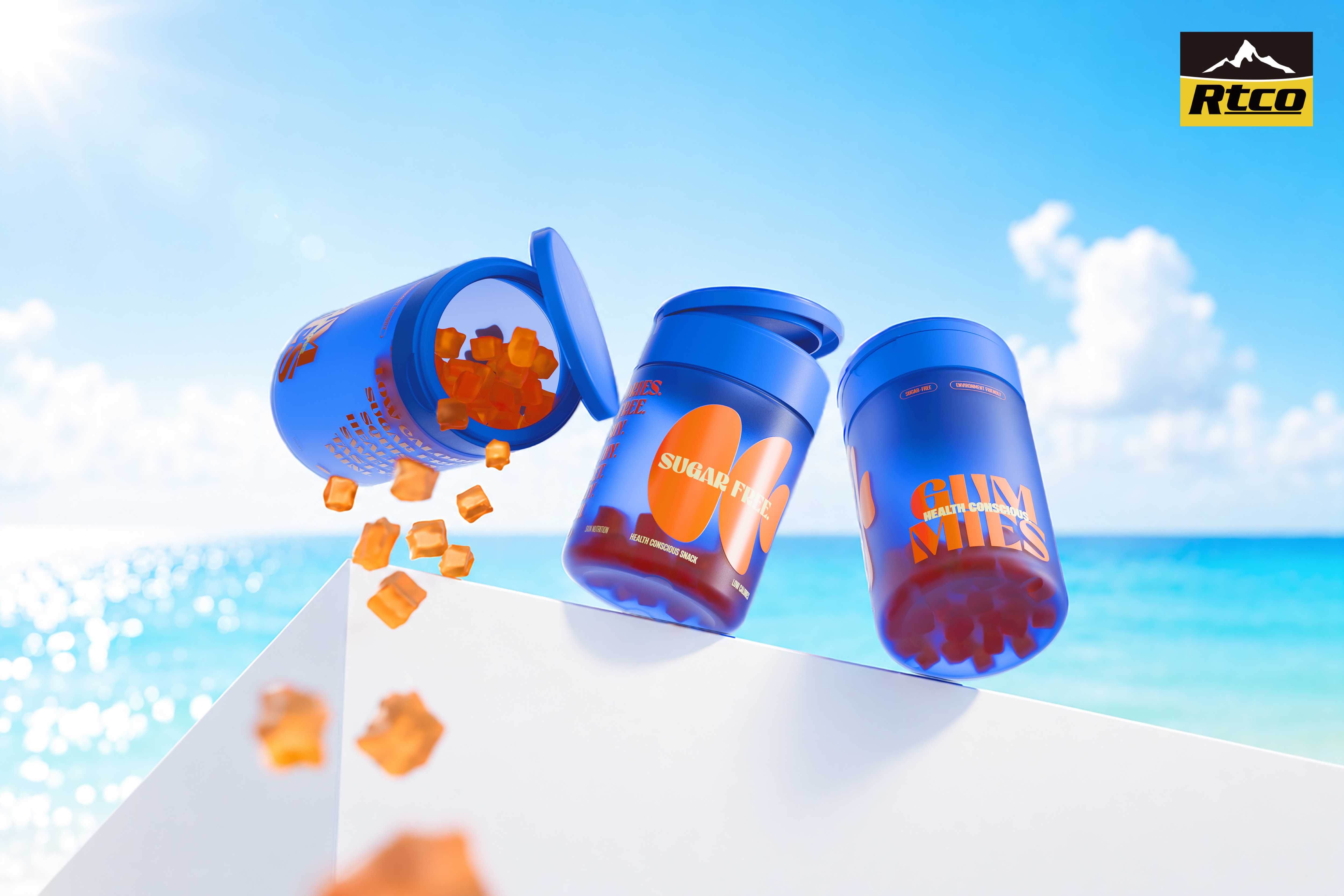
Flip-cap architecture suits gummy and gel formats, where the consumer needs a wide opening and a closure that reseals reliably across repeated use.
Liquids: dispensing and material clarity
Liquid supplements and beauty formats invert the powder logic. The fill volume is small, but the dose is precise and the delivery mechanism is the product experience. A dispensing bottle is a closure-led design: the bottle body is comparatively simple, while the dispensing path determines how the user measures, pours, or drops.
Material choice shifts as well. PET is used where container clarity supports the product story, while HDPE is used where opacity and a softer surface feel are preferred. Both are available in food-grade grades, with options for recycled PCR material where a brand’s sustainability positioning requires it.

Liquid and beauty formats place the engineering load on the dispensing closure rather than the container body.
What RTCO Supplies Across These Formats
The RTCO PAK PTE. LTD. (RTCO) is a packaging manufacturer founded in 2007 that produces plastic containers, scoops, caps and closures, liners, accessories, and surface finishes, operating a 68,000 m² manufacturing footprint with 200 employees and a 40-engineer R&D team, and reporting annual output of 1,000,000,000 units.
Its product line is organised around the format families described above and includes wide-mouth protein powder jars, pre-workout and BCAA bottles, dual-chamber supplement bottles, capsule & tablet bottles, and flip-cap scoop bottles. Containers are produced in food-grade HDPE, PET, and PP, with optional recycled and PCR materials.
Customisation is offered on an OEM, ODM, and fully customisable basis, and covers materials, bottle shape, capacity, colours, surface finishes, engraved logo design, closures, scoops, structural engineering, and rapid custom mould development. On the specification side, the documented ranges are:
- Bottle fill capacity: 60 ml to 6,000 ml
- Bottle body diameter: 40–200 mm
- Bottle height: 60–325 mm
- Cap diameter: 20–200 mm; cap height: 10–40 mm
- Scoop measuring capacity: 0.3 cc to 8 oz
- Monthly production capacity: 80,000,000 units
Surface technology is where format-specific packaging becomes brand-specific packaging. Available finishes include soft-touch coating, UV coating, silk screen, 3D printing, labelling, vacuum metallisation, and embossed logo treatment. A soft-touch finish on a gummy flip-cap bottle and a soft-touch finish on a beauty serum bottle serve different commercial purposes, but they draw on the same coating capability and the same process control.
Supply geography is part of the specification for North American buyers. RTCO operates integrated manufacturing capabilities across Asia and the United States, with a U.S. production facility at 1701 Old Grove Road, Suite 300, Piedmont, SC 29673, and warehouses in Savannah, Georgia and Chino, California. That structure supports US stock plastic bottle programmes as well as full custom runs.
How a Format-Specific Line Is Built and Validated
The engineering sequence matters as much as the component list. RTCO’s integrated design-tooling-production model — referred to internally as the Three-One Service — is structured as roughly one day of design, about one month of tooling, and about one week of production. Standard lead time is quoted at 30–45 days, with the explicit caveat that actual lead times depend on project complexity and available capacity.
Quality control runs through the same sequence. Production operates under dust-free manufacturing conditions, with pre-shipment inspections and food-grade testing processes, and third-party testing support available where a buyer’s own compliance framework requires independent verification. Compliance risk is managed through material compliance risk management and third-party testing, supported by qualified raw materials and standardised production control.
The compliance footprint that buyers typically request during evaluation includes ISO 9001:2015 for the manufacturing of food-grade plastic packaging containers (certificate 05126Q00928R153, issued by NOA Testing & Certification Group Ltd.), ISO 15378:2017 GMP for primary packaging materials for medicinal products covering HDPE and PP bottles (certificate HBPCER20260088, issued by Intertek Testing Services), and BRCGS Global Standard Packaging Materials Issue 7 for blow moulding and injection moulding of PE and PP containers, lids, spoons and hooks for food use (certificate C0860130-BRC2, issued by NSF Certification, LLC). Additional systems include a HACCP management system certification (331HACCP2600024, Ti Certification (Shanghai) Co., Ltd.), ISO 14001:2015 environmental management, ISO 45001:2018 occupational health and safety, SA8000:2014 social accountability, and a Global Recycled Standard certification covering the manufacturing, moulding and printing of recycled plastic products.
Application Scenarios Across the Three Categories
The value of format-based specification becomes concrete in real programmes. A documented RTCO project served brands in the United States, Canada, Australia, Mexico, the United Kingdom, France, Germany, and Singapore at a scale of 20,000,000 units. The project combined the integrated rapid design-tooling-production service with North American manufacturing support and surface technologies including vacuum metallisation and soft-touch, and reported faster time-to-market, improved shelf performance, and a simplified supply chain achieved through localised production.
Four scenarios illustrate how the format logic plays out commercially:
- Sports nutrition powder launch. A wide-mouth protein jar with a calibrated scoop, decorated with a soft-touch or metallised finish, and produced against a capacity plan sized to the launch forecast. The binding constraints are scoop calibration, fill volume, and tooling lead time.
- Gummy supplement line extension. A flip-cap bottle in a differentiated colour and finish, where the design work concentrates on opening geometry and tactile quality rather than on fill volume.
- Beauty and health supplement liquids. A dispensing bottle in PET or HDPE, where closure engineering and leak integrity dominate the specification.
- Private label and CMO programmes. Multi-SKU runs where the same bottle platform is re-decorated and re-closured across brands, which rewards suppliers that control container, closure, and finishing in one facility.
Across these scenarios, packaging products from the same line have been used for commercial packaging and dosing of dietary supplements, sports nutrition powders, tablets, gummies, and liquids, and have been used by health, nutrition and beauty brands, contract manufacturers, and private-label customers.
Market Signals Behind Format-Specific Packaging
Three published data points explain why format-specific packaging capability has become a procurement topic rather than a design detail.
First, the category is large and still growing. The global dietary supplement packaging market was valued at USD 12.7 billion in 2024 and is projected to reach USD 23.1 billion by 2034, a CAGR of 6.1% according to Precedence Research. The U.S. sports nutrition market alone was estimated at USD 29.42 billion in 2024, with Grand View Research projecting growth to USD 55.51 billion by 2033.
Second, the material mix is settled in the near term. Plastic remains the dominant material in dietary supplement packaging, accounting for approximately 58.3% of market share in 2024, per Precedence Research. That concentration means most format-specific engineering effort continues to happen inside rigid plastic platforms — bottle, closure, scoop, liner.
Third, buyers are increasingly evaluating packaging as a customised product rather than a commodity. Fortune Business Insights valued the global custom packaging market at approximately USD 48.17 billion in 2025, with North America holding a 40.09% share; Grand View Research publishes a lower estimate of USD 39.7 billion for the same market, and the divergence between the two figures is a reminder to treat any single market-size number as directional rather than definitive.
A related signal concerns traceability. Smart packaging in North America, including RFID and QR integration for traceability, held a revenue share of approximately 42% in 2023 according to Grand View Research. For format-specific lines, that pressure lands on decoration and data-carrying surfaces — printed panels, labels, and coded closures — rather than on the container body itself.
Comparing Approaches — and Where the Limits Sit
There are three common ways buyers assemble a format-specific packaging line, and each has a real boundary.
| Approach | What it optimises | Where it constrains the buyer |
|---|---|---|
| Single-format supplier per component (bottle from one vendor, closure from another, finishing from a third) | Lowest unit price per component; maximum choice at each step | Interface risk sits with the buyer; fit, seal and finish mismatches surface late in filling trials |
| Narrow specialist covering one format only | Deep expertise in a single container architecture | A multi-format portfolio requires multiple suppliers, multiple tooling investments and multiple compliance audits |
| Integrated multi-format producer covering container, closure, scoop and finishing | One accountability chain across design, tooling, production and fulfilment | Requires the buyer to commit to a formal project sequence and to a minimum volume per SKU |
The limits of the integrated model are worth stating plainly, because they determine whether it is the right fit. RTCO’s range is built on rigid plastic — HDPE, PET and PP containers with matching closures, scoops and liners. Glass, metal tins, and flexible pouch formats sit outside that scope, and buyers with those requirements need a different supplier set.
Minimum order quantity is another boundary. MOQ is typically 10,000–30,000 units per SKU depending on the product, with first trial orders below the standard MOQ supported for validation purposes. Programmes smaller than that floor are better served by stock formats than by fully custom tooling.
Timing is a third limit. The reference model compresses design into roughly one day and tooling into about a month, but a design change after tooling begins resets part of that timeline, and the 30–45 day lead-time figure is explicitly conditional on project complexity and capacity.
Finally, format logic is not transferable across all formats. A scoop-based dosing system is a powder and tablet solution; liquid formats require dispensing closures, a different engineering path with its own tooling. And because consumer packaging is single-use, it carries no long-term service-life requirement — durability specifications belong to the supply relationship, which is generally covered by a two-year warranty, not to the container itself.
What to Watch Next
Two developments are likely to reshape format-specific packaging specifications over the next several years.
The first is material. With recycled PCR options already available alongside food-grade HDPE, PET and PP, and with Global Recycled Standard coverage extending to the manufacturing, moulding and printing of recycled plastic products, the question for buyers is shifting from “can this be recycled?” to “what percentage of recycled content can this SKU carry without changing its performance?” That is a format-by-format question, because a gummy flip-cap bottle, a protein jar, and a liquid dispensing bottle each tolerate recycled content differently.
The second is traceability. If smart packaging continues to expand at the pace indicated by North American market-share data, coded closures and data-carrying decoration will move from premium features to baseline expectations in sports nutrition and beauty. Packaging lines that treat printing, labelling and finishing as integrated capabilities — rather than as outsourced after-steps — will be better positioned to absorb that shift.
For buyers, the practical implication is unchanged. Format determines function; function determines the packaging line; and the packaging line is only as reliable as the sequence that connects design, tooling, production, and fulfilment.
FAQ
- Which product formats can RTCO’s packaging support?
- RTCO’s plastic packaging products are designed for packaging and dosing of powder, capsule, tablet, gummy/gel and liquid products, and are used for commercial packaging and dosing of dietary supplements, sports nutrition powders, tablets, gummies, and liquids. The range includes wide-mouth protein powder jars, pre-workout and BCAA bottles, dual-chamber supplement bottles, capsule & tablet bottles, and flip-cap scoop bottles.
- What bottle and component size ranges are available?
- Bottle fill capacity ranges from 60 ml to 6,000 ml, with body diameters of 40–200 mm and heights of 60–325 mm. Caps range from 20 mm to 200 mm in diameter and 10–40 mm in height. Scoops are available with measuring capacities from 0.3 cc to 8 oz. Materials are food-grade HDPE, PET and PP, with options for recycled and PCR materials.
- What is the minimum order quantity for a custom packaging project?
- MOQ is typically 10,000–30,000 units per SKU, depending on the product. First trial orders below the standard MOQ are supported so that buyers can validate a new product before committing to volume. Monthly production capacity is 80,000,000 units, and annual output is reported at 1,000,000,000 units.
- What lead times and purchasing terms apply?
- Standard lead time is 30–45 days, with actual lead times dependent on project complexity and capacity. The reference model sequences roughly one day of design, about one month of tooling, and about one week of production. Supported delivery terms include EXW, FOB, CIF and DDU, by sea, air or international express. Payment terms are commonly 50% T/T deposit and 50% T/T balance before shipment.
- How are quality and compliance verified?
- Acceptance is built on sample approvals, pre-shipment inspection and contractual acceptance criteria, with third-party testing available on request. Compliance risk is managed through material compliance risk management and third-party testing, supported by qualified raw materials and standardised production control. The systems portfolio includes ISO 9001:2015 for food-grade plastic packaging container manufacturing, ISO 15378:2017 GMP covering HDPE and PP bottles for medicinal products, BRCGS Global Standard Packaging Materials Issue 7 covering blow moulding and injection moulding of PE and PP containers, lids, spoons and hooks for food use, and a HACCP management system certification, alongside ISO 14001:2015, ISO 45001:2018 and SA8000:2014.
- Can packaging be produced and stocked in the United States?
- RTCO’s U.S. production facility is operational at 1701 Old Grove Road, Suite 300, Piedmont, SC 29673, supported by warehouses in Savannah, Georgia and Chino, California. Localised production is designed to shorten delivery cycles and simplify supply chains; a 20,000,000-unit programme serving brands in the United States, Canada, Australia, Mexico, the United Kingdom, France, Germany and Singapore reported faster time-to-market, improved shelf performance and a simplified supply chain through localised production.
For buyers who need the full specification set across sports nutrition and supplement formats, the RTCO catalogue for sports nutrition packaging is available as a downloadable reference document.