
Matching Packaging to Product: Deodorant and Foundation
Industry Reference | Cosmetic Packaging
Matching Packaging to Product: Deodorant and Foundation
A stick product's packaging is not a container chosen after the formula is finalised. For anhydrous deodorant sticks and stick foundation, the package is part of the dispensing mechanism. Turn the dial and the product has to rise at a predictable rate. Cap it and the formula has to survive temperature swings without sweating, cracking, or leaking into the lid.
This guide explains how to match packaging to two common solid and semi-solid formats: deodorant sticks and stick foundation. It uses two COSFINITY reference articles — the 20ml deodorant stick container (TP01-1018-15) and the empty stick foundation tube (CP08-0053) — as worked examples of how a package's mechanical design has to follow the physics of the product it carries.
For product developers, procurement managers, and brands evaluating a new SKU, packaging mismatch is one of the most common sources of launch delay, first-batch complaint, and rework cost. It usually only becomes visible at the first stability test or the first filling trial.
Where packaging matching goes wrong
The most repeated mistake is assuming that two stick products with similar form factors can share one package. Deodorant sticks and stick foundations are both anhydrous solid formats, but their rheology, application method, and regulatory status differ, and the mechanical requirements follow.
In practice, packaging mismatch shows up in a few predictable ways:
- The product will not rise evenly. A formula that behaves well in controlled storage can shrink or swell after transport heat cycling, leaving the twist mechanism loose long before the stick is used up.
- The formula interacts with the package. Fragrance, esters, and actives migrate into some plastics, while some oils attack low-grade sealing materials.
- The fill volume is copied rather than derived. Brands lift a nominal capacity from a competitor without realising that number depends on stick diameter, screw pitch, and barrel wall thickness — not just barrel height.
- Mechanical durability is untested on the bench. A dispensing mechanism can work at filling and capping, then fail after twenty consumer cycles.
None of these problems is solved by stricter incoming material inspection. They are solved when the package, the formula, and the filling process are designed as one system.
Four physical factors that reshape the design
Four factors dominate when comparing one deodorant or foundation stick package against another.
1. Product consistency. A cream, a wax-based solid, and a pressed powder cake behave differently. Solids need a predictable yield strength under shear. If the formula softens at a mild temperature rise, the mechanical lift can slip back.
2. Dispensing mechanism. A twist-up lift, a piston system, a squeeze tube, and a applicator wand each handle tolerance differently. For a twist-up, the relationship between screw pitch and barrel seal is usually more critical than the outer diameter.
3. Thermal behaviour. Shipping conditions are the environment the package must survive, and they are often not fully reproduced in a stability lab. Wax and oil behave differently in a cargo hold than in a 20°C chamber.
4. Chemical compatibility. Fragrance, emollient esters, and actives interact with contact materials. Material grade, colorant, and seal elastomer choices all depend on the actual formula being filled.
These factors are not independent. Tightening a tolerance to stop back-slip can reduce glide; thickening a barrel wall to improve heat resistance changes the fill volume. In practice, a packaging project is a set of trade-offs.
Case one: the 20ml deodorant stick container (TP01-1018-15)
COSFINITY lists TP01-1018-15 as a 20ml deodorant stick container, designed for solid and semi-solid formulas. The stick format is the reason the package exists: it is built around an anhydrous, self-supporting mass that is pushed mechanically out of the container rather than poured, squeezed, or sprayed.
That format narrows the engineering to three specific points.
The barrel seal. In a twist-up deodorant stick, the interface between the formula and the barrel wall is what controls glide or drag. Too tight and every turn becomes a fight with the mechanism; too loose and the product falls back under its own vacuum.
The lift mechanism. In an anhydrous format, the screw and the elevator plate working together determine whether the product rises at a consistent rate from the first turn to the last. As the product is consumed, the remaining mass changes and the torque changes with it. A good mechanism keeps the feel consistent until the stick is finished.
The lid seal. A deodorant stick is opened and closed repeatedly between uses. The cap has to resist accidental opening in a bag while still forming a seal tight enough to stop fragrance diffusing into the inside of the lid.
This is why a deodorant stick cannot be specified on millilitres alone. The 20ml figure is the result of barrel geometry, elevator travel, and the practical fill volume together. The same nominal capacity in a different form factor can behave completely differently in the user's hand.
Case two: the empty stick foundation tube (CP08-0053)
A foundation stick tube carries a different brief. The application is skin-contact, and the product category is usually formulated with higher pigment loading, higher wax-to-ester ratios, and finely dispersed colourants.
COSFINITY lists CP08-0053 as an empty tube for foundation stick products. Its dimensions and construction respond to a product the user applies directly to the face, which makes hand feel and glide as important as capacity.
For a brand specifying a foundation stick, several factors are worth verifying:
- The contact surface finish. Because the product is applied directly to skin, any burr, seam line, or rough tube neck becomes a perceived defect rather than an internal reject.
- Heat stability. Foundation sticks are typically softer than deodorant sticks. A fill that works at an ideal room temperature may fail in summer transit.
- Colour and texture behaviour. High pigment load dispenses with a slightly different feel. If the internal mechanism drags, the stick can pull or drag across the skin.
CP08-0053 is a reference point for why the package format should be fixed before the formula is locked. Once a stick format's geometry is set, asking a stick foundation to chase a given dimension, fill, and glide is working in the wrong order.
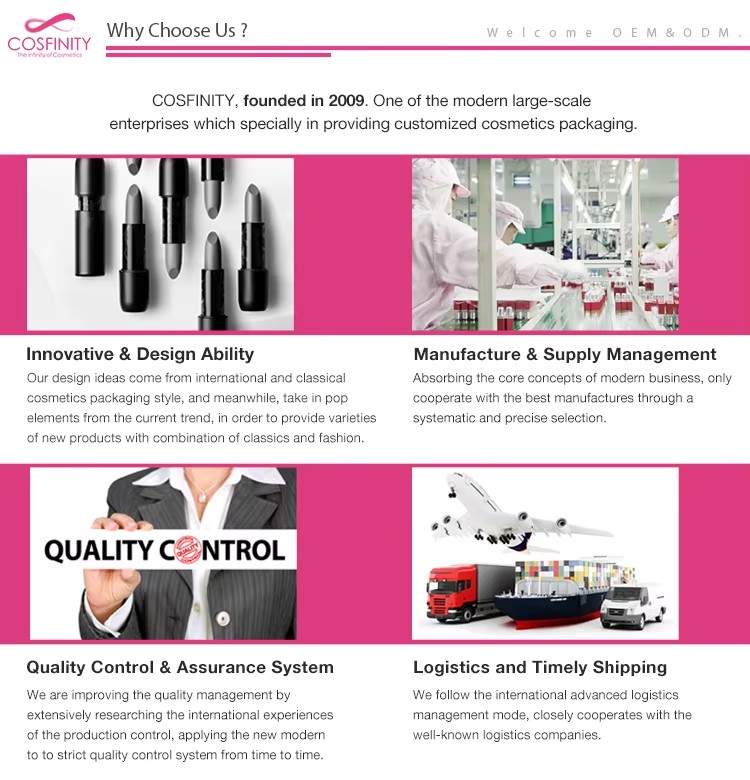
COSFINITY's custom packaging capability
COSFINITY is a custom cosmetic packaging manufacturer. Its company profile describes OEM and ODM production models, with customization options covering logo, colour, shape, material, volume, thickness, and packaging. The company states that it exports to global markets and provides after-sales service remotely online.
Production scale is the next item buyers typically verify during evaluation. COSFINITY publishes a monthly capacity of 10,000,000 pcs, a standard lead time of 15–25 days, and a quality control process that includes 100% testing.
On supplier qualification, the company holds an SGS Alibaba Verified Supplier Factory Audit certificate (cert number 485460650_T), issued by SGS, covering enterprise factory and trade qualification audit, valid from 2026-01-10 to 2027-01-10.
For a procurement team, that audit certificate matters in a specific way: it is a third-party document with a named body, an issue date, and a certificate number — not a self-declared compliance statement from the vendor.
From sample to bulk: the procurement sequence
Before a package is accepted, a procurement team needs a fixed set of items aligned. According to published COSFINITY purchasing terms:
| Item | Detail |
|---|---|
| Minimum order quantity | 12,000 pcs |
| Delivery terms | EXW / FOB / DAP / DDP |
| Acceptance criteria | Pre-shipment test |
| Payment terms | 50% advance payment, 50% balance payment |
| Standard lead time | 15–25 days |
| Quality control | 100% testing |
These terms shape the practical timeline of a project. The 12,000-piece MOQ means a custom deodorant or foundation stick package is planned as a bulk order rather than a pilot run. That fits a brand that has already locked its formula and is moving to scale. It does not fit an early-stage campaign that needs to test a product concept at a few thousand units.
A useful discipline for brands weighing that threshold: fix the MOQ, lead time, and payment structure first, before moulding or colour is committed, then build the launch plan around those constraints rather than the other way round.

Market signals: plastic still dominates cosmetic packaging
Three public data points help frame the market a deodorant or foundation stick package sits inside.
Market size. The global cosmetic packaging market was valued at approximately USD 34.17B to USD 47.3B in 2024, with expectations to reach up to USD 89.72B by 2034, depending on whether secondary packaging and industrial bulk containers are included (Fortune Business Insights / ResearchAndMarkets / Data Bridge).
Material share. Plastic remains the dominant material in cosmetic packaging with a 64.5% market share in 2024, followed by glass and metal (ResearchAndMarkets.com).
Regional weight. Asia Pacific led the global market in 2025 with a 42.36% share, driven by rising disposable incomes and e-commerce growth (Fortune Business Insights).
For stick formats, this means two things: the great majority of deodorant and foundation stick packages will start from plastic, and an increasing share of the projects that produce them will be sourced, sampled, and scaled in Asia while shipping into European or North American markets.
Regulation is tightening alongside. The EU Packaging and Packaging Waste Regulation (PPWR) 2025/40 introduces recyclability and labelling requirements for cosmetic packaging, while the U.S. Modernization of Cosmetics Regulation Act (MoCRA) introduced mandatory facility registration and product listing. For brands selling the same product into multiple markets, packaging specifications have to be designed against these constraints from the outset.
Comparison: custom cosmetic packaging vs. stock containers
Custom cosmetic packaging and off-the-shelf containers solve different problems, and the difference tends to appear later in the project than most brands expect.
| Dimension | Stock container | Custom cosmetic packaging |
|---|---|---|
| MOQ | Often lower; no tooling | 12,000 pcs (published COSFINITY MOQ) |
| Lead time | Usually shorter, depends on stock | 15–25 days (published COSFINITY lead time) |
| Dimensional fit | Limited to standard sizes; formula must adapt | Geometry matched to formula specification |
| Brand differentiation | Competitors may use the same container | Mould, finish, and decoration under brand control |
| Compatibility testing | Generic assumptions | Material, seal, and finish verified against the actual formula |
| Flexibility | Easy to reorder from stock | Capacity scheduled against the order |
Stock containers win on speed and a lower entry price. For a brand testing a niche SKU or covering a short seasonal window, that can be the deciding factor.
The limitation sits on the other side. Custom packaging locks in geometry, which means an already-cut mould is a real cost if the formula shifts after launch. The MOQ and the 15–25 day lead time also mean that smaller first orders or very short production windows are harder to accommodate on a custom path. That is not an unsolvable problem, but it is a genuine trade-off a brand has to weigh per SKU rather than once for the company.
Future outlook
Over the next few years, packaging for deodorant and foundation sticks is likely to move along three predictable lines.
Material pressure. As recyclability requirements under the EU PPWR move from guidance into enforcement, the all-plastic, multi-material stick container faces closer scrutiny. Recyclable alternatives, such as mono-material PP constructions or aluminium sleeves, are likely to regain attention.
Refill architecture. If the 2024 consumer survey finding that 63% of cosmetic consumers prioritise refillable or recyclable packaging continues to hold, replaceable inner cartridges will move from premium lines into mainstream SKUs — and the mechanical tolerance of a refill cartridge becomes as important as the primary container itself.
Compliance documentation as standard. Both MoCRA and the PPWR push brands to demand specific, accurate material and recyclability documentation from suppliers. For stick packaging projects, that means the compliance pack will increasingly be treated as an entry requirement rather than a nice-to-have.
The practical implication for a procurement team is simple. If the packaging specification is fixed after the formula is locked, any of these trends makes the adjustment more expensive. Matching packaging to product is, at heart, a sequencing discipline.
FAQ
What production services does COSFINITY provide?
COSFINITY provides OEM and ODM production services. Customization options include logo, colour, shape, material, volume, thickness, and packaging. The company exports to global markets and provides remote online after-sales service.
What is the minimum order quantity for custom cosmetic packaging?
COSFINITY publishes a minimum order quantity of 12,000 pcs. Quality control includes 100% testing.
What customization options are available?
Customization covers logo, colour, shape, material, volume, thickness, and packaging. Products in this line are classified as plastic tubes designed for cosmetic packaging applications.
How is quality control handled?
COSFINITY states that quality control includes 100% testing. Delivery terms include EXW, FOB, DAP, and DDP, with pre-shipment test as the acceptance criteria.
What is the standard lead time and payment structure?
COSFINITY publishes a standard lead time of 15–25 days. Payment terms are 50% advance payment and 50% balance payment.
Reference: COSFINITY company profile (PDF).