
Matching Rubber Seals and Mounts to Green Energy Production Scenarios
Sealing and vibration isolation are two different engineering problems that often get sourced under one keyword. Scenario matching is what separates a component that lasts from one that leaks, hardens, or transmits noise.
Green energy and new materials production runs on equipment judged by output, yield, and uptime — but much of that equipment is held together by rubber. Extruded seal profiles close enclosure doors, cabinet edges, and fluid paths. Cylindrical anti-vibration mounts sit between motors, compressors, and pumps and the frames that carry them. Neither component appears in a plant's specification sheet headline, and both cause disproportionate downtime when they are chosen by habit rather than by scenario.
The global gasket and seal materials market reached a valuation of USD 61.4 billion in 2024, according to Grand View Research, and rubber seals represent approximately 56% of the global gasket and seals market share because of their extensive use in dynamic sealing (Grand View Research, 2026 estimate). The O-ring sub-category alone was valued at USD 10.41 billion in 2025 (Vantage Market Research). Vibration isolation follows a similar pattern of concentrated supply: China accounts for roughly 23% of the global anti-vibration rubber mounts market (Cognitive Market Research, 2024).
This reference is written for buyers, engineers, and procurement teams in the green energy and new materials sector who need to connect two specific component families — LG-RX rubber extrusion seals and LGMM cylindrical anti-vibration mounts from Lingo Rubber Plastic — to the production situations they actually run.
Start With the Scenario, Not the Part Number
The most common sourcing error in this category is searching by generic description. A buyer asks for a "rubber seal" or a "rubber mount" and receives a quotation that technically matches the request but not the operating condition. A seal profile that performs well on an indoor electrical cabinet can fail within months on an outdoor skid exposed to UV, ozone, and temperature cycling. A mount selected purely by thread size can shift the resonance of a compressor frame into a range that amplifies noise instead of reducing it.
Scenario matching means answering four questions before a material or a geometry is chosen: what the part touches, what temperature it sees, whether the load is static or cyclic, and how the part is fixed in place. Those four answers narrow the specification far more effectively than a category keyword.
That discipline matters more in green energy and new materials than in many legacy sectors, because equipment is frequently deployed outdoors, in coastal or high-humidity environments, or inside enclosures where heat builds up. The same plant may need a weather-resistant extrusion profile on a skid, an oil-resistant seal on a hydraulic power unit, and a fatigue-rated mount under a rotating machine — three different rubber specifications on one site.
Four Variables That Decide Whether a Rubber Component Fits
| Variable | What It Changes | What the Buyer Should Be Able to Answer |
|---|---|---|
| Media and chemistry | Whether the elastomer swells, hardens, or cracks in contact with the fluid, grease, or cleaning agent present | Is the exposure oil and grease, water and weather, a solvent, or a food-contact surface? |
| Temperature range | Which elastomer family remains stable, and how much compression set accumulates over service life | What is the continuous operating temperature, and what is the peak temperature during startup or cleaning? |
| Static vs. dynamic duty | Whether the part is judged on sealing contact or on fatigue life under repeated compression and shear | Does the part sit still, or does it cycle — and how many cycles over the service interval? |
| Interface and tolerance | Whether the part seats correctly in a groove, channel, or bolt pattern, and whether units from different batches behave the same | What is the mating geometry, and what tolerance class does the assembly require? |
LG-RX Rubber Extrusion Seals: Matching Material to Exposure
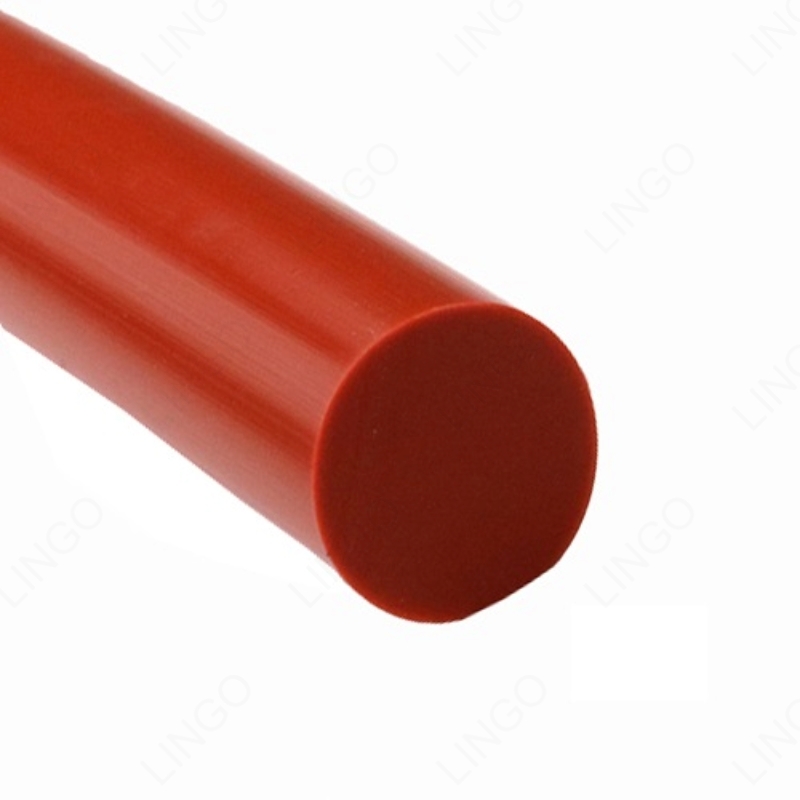
The LG-RX is a rubber extrusion seal available in EPDM, NBR, Silicone, FKM and other elastomers, with hardness specified per Shore A as required, customizable length, and color per Pantone or RAL, meeting industry standard tolerances. Within that family, Lingo Rubber Plastic produces silicone rubber extrusion seals, rubber extrusion seals with adhesive, rubber co-extrusion seals, FKM rubber extrusion seals, solid rubber extrusion seals, and sponge rubber extrusion seals.
The value of an extrusion format is continuity. Extruded profiles can be cut to the exact length a frame or enclosure requires, which makes them well suited to long straight runs — cabinet doors, container edges, panel joints, and equipment skids — where a molded gasket would require a large and expensive tool. The trade-off is that the joint, corner, or splice becomes part of the sealing design, and that responsibility sits with the buyer and the supplier together, not with the material alone.
The stated application range for LG-RX covers household appliances, marine and offshore, industrial manufacturing, HVAC and refrigeration, automotive and transportation, aerospace and aviation, medical and healthcare, and food and beverage industries. That breadth is precisely why material selection cannot be left implicit: the same profile geometry behaves very differently depending on which of those environments it enters.
| Elastomer | Generally Chosen When | Practical Boundary to Check |
|---|---|---|
| EPDM | Outdoor and weather-exposed sealing, water and steam contact, UV and ozone exposure | Generally not the first choice where petroleum-based oils or fuels are present |
| NBR | Oil, grease, and hydraulic fluid exposure at moderate temperatures | Generally less suited to sustained outdoor ozone and UV exposure |
| Silicone | Wide temperature service and applications where heat resistance and cleanliness matter | Mechanical tear and abrasion resistance is generally lower than that of other elastomers |
| FKM | Aggressive chemicals and elevated temperatures where standard elastomers degrade | Usually a higher material cost, so it should be justified by the exposure, not by default |
A related product family is worth noting for buyers whose scenarios involve round-section sealing rather than a profile. The LG-SRC silicone rubber cord is available in solid and sponge forms, is made of silicone rubber, is heat resistant and FDA qualified, and can be supplied in customizable length and color per Pantone or RAL. For applications that require a closed loop rather than a cut length, the LG-RS rubber sealing ring family covers rubber O-rings, X-rings, and oil seals in NBR, EPDM, silicone, FKM, or FFKM, with hardness normally between 50 and 95 Shore A, a heat range of -40°C to 250°C, resistance to ozone, water, and oil, and certifications including FDA, UL, ROHS, and REACH.
LGMM Cylindrical Anti-Vibration Mounts: Load, Deflection, and Tolerance
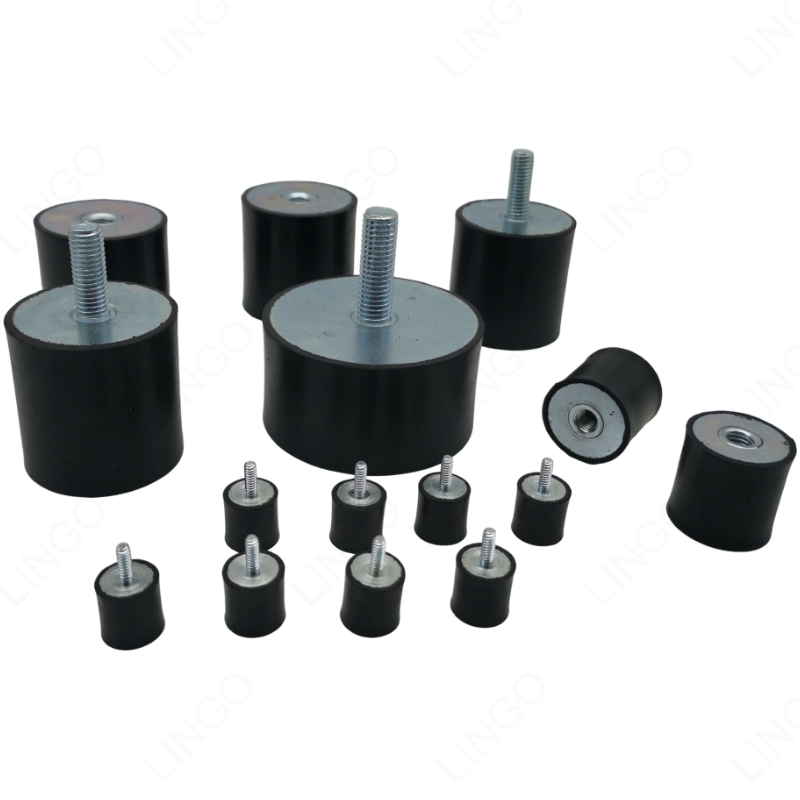
The LGMM is a cylindrical rubber mount designed for vibration isolation. It is made of natural rubber with carbon steel, with a diameter range of 8 to 150 mm and a height range of 8 to 90 mm, meeting RMA A2 tolerance standards. The product data sheet specifies natural rubber with zinc-coated steel, and the mount is classified within the cylindrical rubber mount and rubber stud mount category.
Two specification values matter more than the rest. The first is the dimensional envelope: 8 to 150 mm in diameter and 8 to 90 mm in height defines the practical range, and requests outside it generally require a different mount architecture rather than a scaled version of this one. The second is the RMA A2 tolerance class, which is what makes batch-to-batch predictability possible. When a frame uses sixteen identical mounts, the assembly's behaviour depends on all sixteen having similar stiffness and geometry — a tolerance class is the mechanism that makes that reasonable to expect.
Natural rubber is generally selected for dynamic service because of its fatigue and elastic behaviour under repeated loading. Where ozone, weathering, or non-polar oils dominate the exposure, EPDM or NBR-based sealing solutions are usually specified instead — a boundary worth checking before natural rubber mounts are placed in an outdoor or oil-contaminated environment.
For transportation-adjacent scenarios, the application data is specific: the mount is designed for vibration isolation in engine mounting, suspension, and seat systems across automotive, rail, and marine applications. It operates under continuous cyclic compression and shear in dynamic loading, absorbing engine vibration, reducing structure-borne noise, and improving ride comfort. That duty calls for low compression set and fatigue resistance in the range of 10⁶ to 10⁷ cycles, under high dynamic load, a temperature range of -40°C to +120°C, and exposure to oil, grease, road shock, and continuous vibration. Supporting equipment includes engine brackets, chassis frames, rail bogies, and ship engine beds. Typical markets for this work include the United States, United Kingdom, Germany, Italy, Russia, the United Arab Emirates, and Canada.
Scenario Matching: Six Production Situations and the Component Logic Behind Each
The following table translates common green energy and new materials production situations into the component logic that usually applies. It is a starting framework for a specification conversation, not a substitute for testing the actual exposure.
| Production Scenario | Sealing Consideration | Isolation Consideration |
|---|---|---|
| Outdoor equipment skids and containerised systems | Extruded EPDM or silicone profile, solid or sponge, cut to frame length; UV and water exposure dominates | Where pumps or compressors are skid-mounted, mounts should be evaluated for weather exposure as well as load |
| Electrical cabinets and control enclosures | Extruded profile with adhesive backing speeds assembly on door edges; compression set drives service life | Generally not an isolation application; cabinets should not be rigidly coupled to vibrating frames |
| Hydraulic and lubrication power units | NBR-based sealing where oil and grease contact is continuous | Cylindrical mounts reduce structure-borne transmission from pump bodies into base frames |
| Rotating machinery on structural frames | Sealing is secondary; shaft sealing belongs to the ring and oil seal family | LGMM cylindrical mounts sized by static load per mount and required deflection |
| Food, beverage, and laboratory-adjacent equipment | Silicone cord and silicone extrusion profiles, including FDA-qualified options | Mounts evaluated for cleanability and material compatibility with wash-down chemicals |
| Transport and mobile equipment | Weather and oil resistance combined; profile retention under vibration matters | Fatigue-rated cylindrical mounts with low compression set for cyclic dynamic duty |
A practical sizing sequence for mounts runs as follows. Establish the total static load carried by the assembly and divide it by the number of mounting points to get load per mount. Define the required deflection or the target isolation frequency. Then confirm that the resulting diameter and height fall inside the 8 to 150 mm and 8 to 90 mm envelope, and that the tolerance class matches what the frame can accept. Any request outside that envelope should be treated as a new design problem rather than a variation of an existing part.
Market Signals Buyers Should Read Carefully
Demand-side indicators in this category are reasonably strong but not uniform, and buyers should read them with the scope of each source in mind. The gasket and seal materials market reached USD 61.4 billion in 2024 (Grand View Research), while the more narrowly defined O-ring market stood at USD 10.41 billion in 2025 (Vantage Market Research). The difference between those two figures illustrates how much a category definition changes a market number.
On the supply side, China's approximately 23% share of the global anti-vibration rubber mounts market (Cognitive Market Research, 2024) means that for most international buyers, the realistic shortlist will include Chinese manufacturers, and competitive comparison will happen inside that base rather than around it.
A caution on market sizing. Published forecasts for the broader industrial rubber market do not agree. Persistence Market Research reports a global industrial rubber market expected to be valued at US$181.5 billion in 2026 and reaching US$299.2 billion by 2033, while Mordor Intelligence projects the same category growing from US$16.88 billion in 2026 to US$20.36 billion by 2031 at a CAGR of 3.81%. The two figures cannot be reconciled without a full methodology review, and they should not be averaged. Buyers using market data for investment or capacity planning should verify scope and methodology before relying on any single estimate.
Regulatory classification is another signal worth tracking. HS Code 4016.93 covers gaskets, washers, and other seals of vulcanized rubber other than hard rubber, specifically identifying O-rings and oil seals for automotive use. This applies to the sealing side of the category; buyers importing mounts should confirm their own classification separately with a customs broker rather than assuming a shared code across the two product families.
Extruded Seals and Rubber Mounts vs. Traditional Alternatives
Rubber is not the only answer, and a comparison against alternatives clarifies when it is the right one.
| Option | Where It Works | Where It Falls Short |
|---|---|---|
| Extruded rubber seal profile | Long, continuous sealing runs where tooling cost for a molded part is not justified; cut-to-length flexibility | Corners, joints, and splices become a design and assembly responsibility; precision dynamic sealing is not its role |
| Molded rubber gasket or O-ring | Closed-loop sealing, defined groove geometry, higher precision requirements | Requires a tool for each size; less economical for long linear runs |
| Liquid sealant or formed-in-place gasket | Irregular geometries; fast prototyping | Difficult to service and re-enter; cure time and dispensing consistency affect the assembly process |
| Rigid mounting | Simple, low cost, dimensionally stable | Transmits vibration directly into the structure; noise and fastener loosening become secondary problems |
| Metal spring or hydraulic isolators | Very low frequency isolation and high load capacity | Higher cost and complexity; often more than a skid-mounted pump or compressor requires |
Two boundaries deserve to be stated plainly. First, LG-RX extrusion seals are specified to industry standard tolerances and are not a precision dynamic sealing solution; where the application requires a defined squeeze in a machined groove under pressure, a molded sealing ring is the appropriate family, and the LG-RS range exists for that purpose. Second, the LGMM mount family is defined by its 8 to 150 mm diameter and 8 to 90 mm height envelope; applications requiring isolation outside that envelope, or requiring very low frequency isolation beyond what a natural rubber mount can deliver, need a different solution rather than a stretched specification.
What to Confirm Before Committing to a Repeat Supply Program
Once a component is matched to a scenario, the next risk is consistency. The specification that worked for a sample must hold for the ten-thousandth unit. The following checkpoints are standard practice in this category and worth confirming in writing.
- Batch consistency mechanism. Ask how material batches are tracked and how dimensional consistency is maintained across production runs. Full inspection of the initial sample and random inspection of bulk lots are common ways buyers and suppliers control this together, and the inspection method, sampling level, and acceptance criteria should be documented before the first order.
- Specification completeness. Hardness (Shore A), material grade, tolerance class, and color standard should all be written down. Where color is specified per Pantone or RAL, confirm the reference number and the acceptable visual deviation.
- Commercial terms. Minimum order quantity, payment terms such as T/T, L/C, or D/P, and delivery terms such as EXW, FOB, CIF, or DDP are negotiated variables that differ by product family, order history, and destination. Buyers should confirm each one explicitly rather than assume a default, since these terms materially change landed cost and cash flow.
- Lead time. Tooling and sampling lead time is generally longer than production lead time. The Lingo Rubber Plastic published profile indicates a standard lead time of 4 to 6 weeks for tooling and samples, and 3 to 4 weeks for production parts; buyers should confirm current lead times for their specific part at the time of enquiry.
- Capacity fit. Match the supplier's stated capacity against your annual volume. Lingo Rubber Plastic reports an annual production capacity of 1.58 million units from a 3,000-square-metre facility with approximately 40 staff, including a 10-person R&D team, with exports accounting for approximately 80% of total sales and major markets in the EU and USA. Those numbers describe scale, and buyers should verify that the scale fits the size of the program in question.
- Repeat-order behaviour. For production programs with recurring releases, ask how spare tooling, spare parts inventory, and replacement supply are handled. Continuity planning is a legitimate part of the commercial discussion and is usually cheaper to settle before the first order than after a line stoppage.
Where This Component Category Goes Next
Three directions look reasonably clear from the available evidence. First, material compliance requirements continue to move toward the sealing side of the category: FDA, UL, ROHS, and REACH already appear in published specifications for rubber sealing rings, and that documentation burden tends to spread rather than retreat as end markets tighten. Second, buyers increasingly treat seals and isolation mounts as one interface-reliability category rather than two separate purchases, which favours suppliers that can cover extrusion, molding, and assembly rather than a single process. Third, the supply base remains concentrated — with China holding roughly 23% of the global anti-vibration mounts market — so evaluation effort is better spent on capability and consistency evidence than on searching for a supplier base that does not exist.
For buyers in green energy and new materials, the practical implication is to write scenario-based specifications rather than category-based ones, and to verify batch behaviour before, not after, the second order.
Frequently Asked Questions
What is Lingo Rubber Plastic and what does it manufacture?
Lingo Rubber Plastic is the trading name of Hangzhou Lingo Rubber and Plastic Product Co., Ltd, established in 2022 in Hangzhou, China. It manufactures rubber compression molding parts, rubber extrusions, plastic injection parts, and plastic extrusion profiles, and states that its business focus is solving sealing problems and providing anti-vibration solutions. Its product classification covers rubber molded parts such as sealing rings, grommets, bonded-to-steel components, anti-vibration mounts, bellows, O-rings, bushings, diaphragms, and gaskets, alongside extruded rubber and plastic profile families.
What is the difference between a rubber extrusion seal and a molded rubber seal?
An extruded seal is pushed through a die and cut to length, so the same profile can serve long, continuous runs without a size-specific tool, and length is customizable. A molded seal is formed in a closed tool, which allows closed-loop geometry, defined cross-sections, and tighter control of squeeze in a machined groove. Extruded profiles are usually the more economical choice for cabinet doors, panel joints, and frame edges; molded parts such as O-rings, X-rings, and oil seals are used where sealing depends on precise compression in a fixed groove.
How does a buyer choose between EPDM, NBR, silicone, and FKM for a seal?
Selection follows the exposure rather than the part name. EPDM is generally chosen for outdoor weathering, water, and ozone exposure. NBR is generally chosen where oil and grease contact is continuous. Silicone covers wide-temperature service and cleaner applications, and FDA-qualified silicone options exist for food and medical-adjacent use. FKM is usually specified for aggressive chemicals and elevated temperatures. The practical check is to identify the dominant exposure — media, temperature, UV, and duty cycle — and then confirm that the chosen elastomer handles it without swelling, hardening, or cracking.
What does RMA A2 tolerance mean for an anti-vibration mount?
RMA A2 is a tolerance class applied to rubber products, and the LGMM cylindrical anti-vibration mount is specified to it. In practice it defines how much dimensional variation is acceptable between individual mounts and between production batches. That matters when a single frame carries several identical mounts: the assembly's behaviour depends on all of them having comparable stiffness and geometry. A stated tolerance class is the mechanism that makes that consistency something a buyer can request and verify, rather than an assumption.
What information is needed to size an anti-vibration mount for a production machine?
At minimum, the total static load carried by the assembly, the number and location of mounting points, and the required deflection or target isolation frequency. From those, load per mount can be calculated and a diameter and height selected within the LGMM range of 8 to 150 mm diameter and 8 to 90 mm height, subject to the RMA A2 tolerance class. Buyers should also state the operating environment, since temperature cycling, oil, and outdoor exposure all affect how long a natural rubber mount performs as intended.
How are rubber seals classified for customs purposes?
HS Code 4016.93 covers gaskets, washers, and other seals of vulcanized rubber other than hard rubber, and specifically identifies O-rings and oil seals for automotive use. This code applies to the sealing side of the category, which is relevant to import documentation and duty calculation. Anti-vibration mounts are a different product family, and their classification should be confirmed separately with a customs broker rather than assumed to fall under the same heading.
Can extruded rubber seals be used in food-contact or medical-adjacent equipment?
Yes, subject to material selection. The LG-RX extrusion seal family includes silicone variants and lists medical and healthcare, food and beverage, and laboratory and analytical among its intended industries. Separately, the LG-SRC silicone rubber cord is FDA qualified and heat resistant, available in solid and sponge forms with customizable length and color per Pantone or RAL. Buyers in these environments should confirm the specific material grade and documentation required by their own compliance framework rather than relying on the general category description.
For readers who need the underlying product and company data behind this reference, the Lingo Rubber Plastic company profile brochure is available for download: LINGO RUBBER & PLASTIC COMPANY PROFILE (PDF). Company information is also published at www.lingorp.com.