
Matching Sludge Dewatering Equipment to Agri-Food and Chemical Wastewater
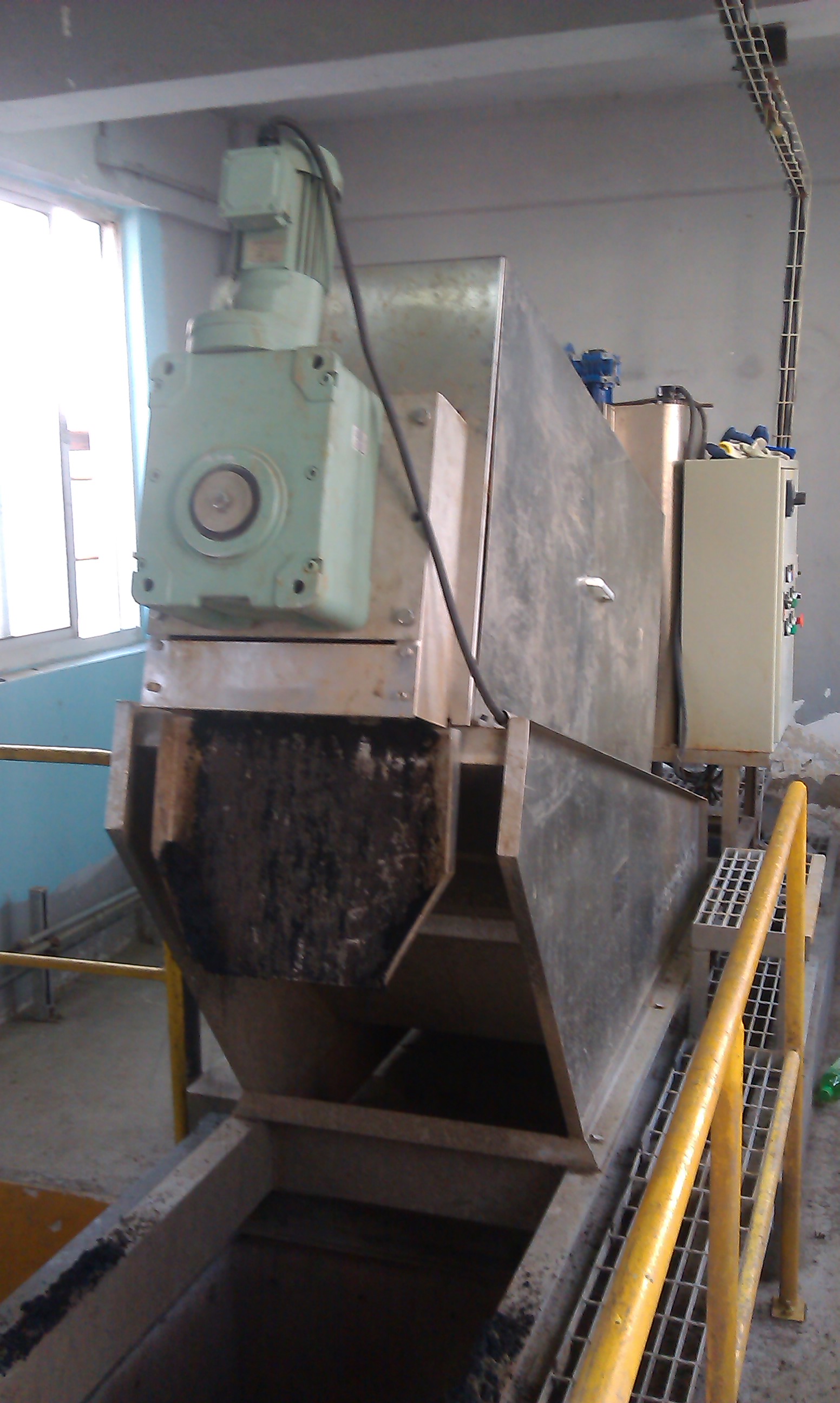
Sludge leaving a food-processing plant and sludge leaving a chemical plant can look identical on a process flow diagram, then behave completely differently inside the same machine. In agriculture and ecology projects, that gap is the most common cause of an under-performing dewatering line. Equipment selection therefore starts with the wastewater type, not with a machine category.
This reference sets out how sludge dewatering equipment is matched to wastewater types across agri-food and chemical applications, using published product specifications from Shanghai Fuchan Machinery Technology Co., Ltd. (SFC Machinery) alongside independent third-party benchmarks. It covers four recurring scenarios: oily food-processing sludge, chemical plant sludge that needs a second dewatering stage, low-solids feed that requires thickening first, and projects where drying is the only route to a disposal-ready product.
Why the water type decides the machine
Three feed characteristics decide more about equipment selection than throughput ever does.
- Inlet consistency. SFC's screw press families are specified for feed from S.S. 0.6% to 5.0%, while its high-pressure deep dewatering stage is specified for S.S. 15–20%. A machine designed for one window cannot be judged against a machine designed for the other; they sit at different points in the same treatment chain.
- Sludge character. Oily, sticky, high-inorganic and fibrous sludges behave differently during flocculation, conveying and cake release. SFC lists low-concentration, sticky, oily and high-inorganic-content sludge as the target sludge types for its wear-free multi-disc screw press series, which is a more specific statement than a general claim of suitability.
- Target output. Independent literature benchmarks place a mechanically dewatered cake at roughly 25–30% total solids, with deep dewatering reported at approximately 35–40% TS. A broader definitional range for dewatering as a process is 15–45% dry solids, which is what separates dewatering from thickening.
The practical consequence is straightforward: the target output determines how many stages a project needs, and the sludge character determines which equipment family can run reliably at each stage.
Where SFC Machinery sits in the sludge treatment chain
Shanghai Fuchan Machinery Technology Co., Ltd. (SFC Machinery) is a Shanghai-based environmental equipment manufacturer established in 2007 and located in Pudong New Area, adjacent to the China (Shanghai) Pilot Free Trade Zone. The company builds sludge reduction, thickening, dewatering, deep dewatering and drying equipment together with automatic polymer preparation and dosing systems, and integrates them into complete sludge treatment lines.
Its published company profile lists a 25,000 m² facility, an annual output of 500 sets, a five-person R&D team, and export activity accounting for 30% of sales, with equipment operating in Southeast Asia, Russia, South America and the Middle East. The same profile lists ISO 9001:2015, ISO 14001, ISO 45001:2018 and CE certification. The company's official site is www.sfceco.com.
For buyers researching OEM or ODM supply, the published capability statement covers equipment type and model selection based on sludge characteristics and treatment capacity, treatment capacity customization, equipment dimensions and footprint, PLC automation level, voltage and frequency configuration, modular dryer design for capacity expansion, and integration of conveying, dosing and storage auxiliaries. Minimum order quantity is stated as 1 unit, lead time as 30–60 days, and quality control as 100% testing.
That portfolio structure matters for this topic because scenario fit is rarely about a single machine. A food-processing site and a chemical plant may both order a sludge dewatering machine, but only one of them also needs a thickening stage ahead of it and a deep dewatering stage behind it. The difference is in the water.
A stage-by-stage matching framework
Reading the following table from left to right, inlet consistency rises and output water content falls. Reading it from top to bottom, the process moves from volume reduction toward disposal readiness. Most mis-specified projects have collapsed two rows into one purchase.
| Process stage | Representative series | Feed condition (as published) | Output condition (as published) | Typical fit |
|---|---|---|---|---|
| Thickening | FBT belt sludge thickener; FRDT rotary drum sludge thickener | S.S. 0.6–1.5% | Outlet consistency 2.5–8%; solid capture 98% (FBT) and 95% (FRDT) | Low-solids municipal and industrial feed; reducing hydraulic load before dewatering |
| Integrated thickening + dewatering | GDY; FTE; FTB | S.S. 0.6–2.5% | Cake water content 75–85% (GDY 75–80%) | High-flow continuous duty; sites that prefer one unit over two |
| Screw press dewatering | DL series; SRD wear-free series | S.S. 0.6–5.0% | Cake water content 75–85% | Oily, sticky, low-concentration and high-inorganic sludge |
| Deep dewatering | SD series, including product 5179 | S.S. 15–20% (already dewatered) | Cake water content 60–75% | Chemical plant sludge, drying pretreatment, incineration pretreatment |
| Drying | SFC-BSD belt dryer; SFC-TR batch dryer | S.S. 15–35% (BSD) | Final water content 10–50% (BSD); sludge reduction up to 70% (TR) | Disposal or reuse routes that need a dry, stable material |
Scenario one: oily and food-processing sludge
Food processing and vegetable oil extraction produce sludge that is oily, frequently low in solids, and difficult to convey. SFC lists oily sludge treatment and food processing wastewater among the application areas of both the DL screw press series and the SRD wear-free multi-disc screw press series.
The SRD series is specified for inlet consistency S.S. 0.6–5.0%, dried sludge output of 25–900 kg/h, cake water content of 75–85%, screw specification from Ø270×1 to Ø370×4, and driving motor power of 0.55–1.1 kW with multi-motor configurations by model. Construction is SS304. The wear-free designation refers to the multi-disc configuration, which is intended to reduce screw-to-ring wear risk in difficult sludge rather than to increase throughput.
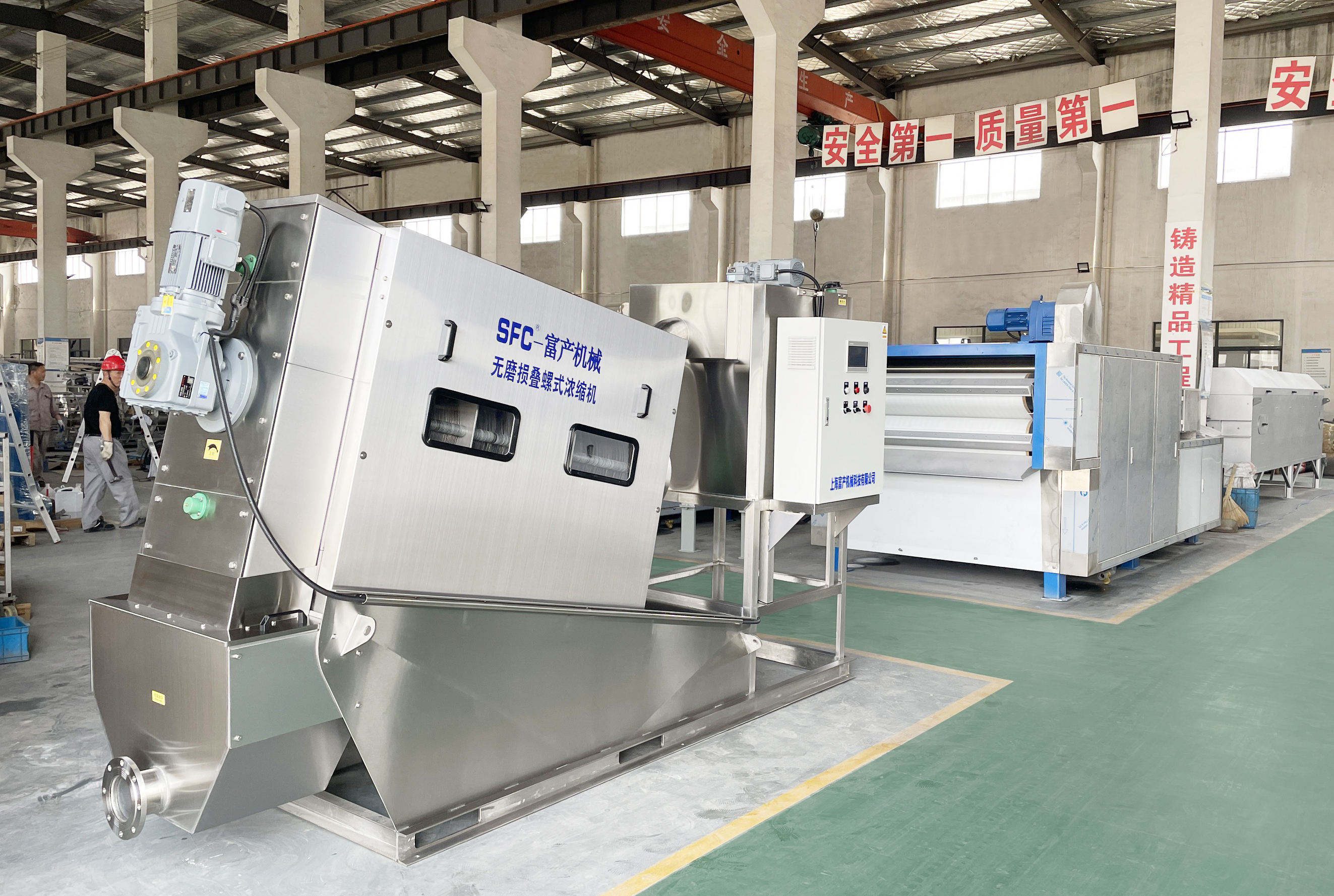
Documented service experience supports the fit. At a vegetable oil processing operation, a DL series screw press has been running for eight years, reducing sludge moisture from 97% to 77%, which corresponds to a sludge volume reduction of up to 98%. At a food processing wastewater site in Malaysia, an FTB-1000 rotary drum thickening and belt press dewatering machine has operated for eight years, taking sludge from 98.5% moisture to below 80%, with the operator reporting a 30% reduction in sludge handling costs.
Distillery and brewery sludge is a related but distinct case. SFC's application material describes high-organic-load distillery and brewery sludge with moisture typically between 95% and 99.8%, prone to fermentation and odor generation, and requiring enclosed, corrosion-resistant equipment because of organic acids and ethanol residues. The recommended process package is thickening, screw press dewatering and thermal drying, with the dried output suitable for co-incineration, land application or use as an alternative fuel.
Boundary condition. A screw press in this family produces a cake at 75–85% water content. That is a volume-reduction result, not necessarily a disposal-ready product. Where a site must meet a drier specification, the next stage — deep dewatering or drying — has to be planned, priced and operated separately.
Scenario two: chemical plant sludge and the deep dewatering stage
Product 5179 is used in chemical plant applications to reduce sludge moisture. Within SFC's product structure, product 5179 is the SD series high-pressure belt deep sludge dewatering machine, marketed as a secondary deep dewatering system rather than a first-stage unit.
Its published specifications are specific about where it belongs. Inlet consistency is S.S. 15–20%. Treating capacity is 0.3–5.0 t/h at 65–75% water content, and 0.35–6.1 t/h at 60–70% water content, with dried sludge output of 60–760 kg/h and 70–920 kg/h respectively. Driving motor power is 0.55–3.0 kW, the sludge mixer is 2.2–5.5 kW, the sludge distribution spiral is 0.25–1.5 kW, and the sludge crushing screw is 0.37–0.75 kW. Construction is SS304, and listed applications include municipal wastewater treatment plants, chemical plants, sludge deep treatment, sludge drying pretreatment and sludge incineration pretreatment.
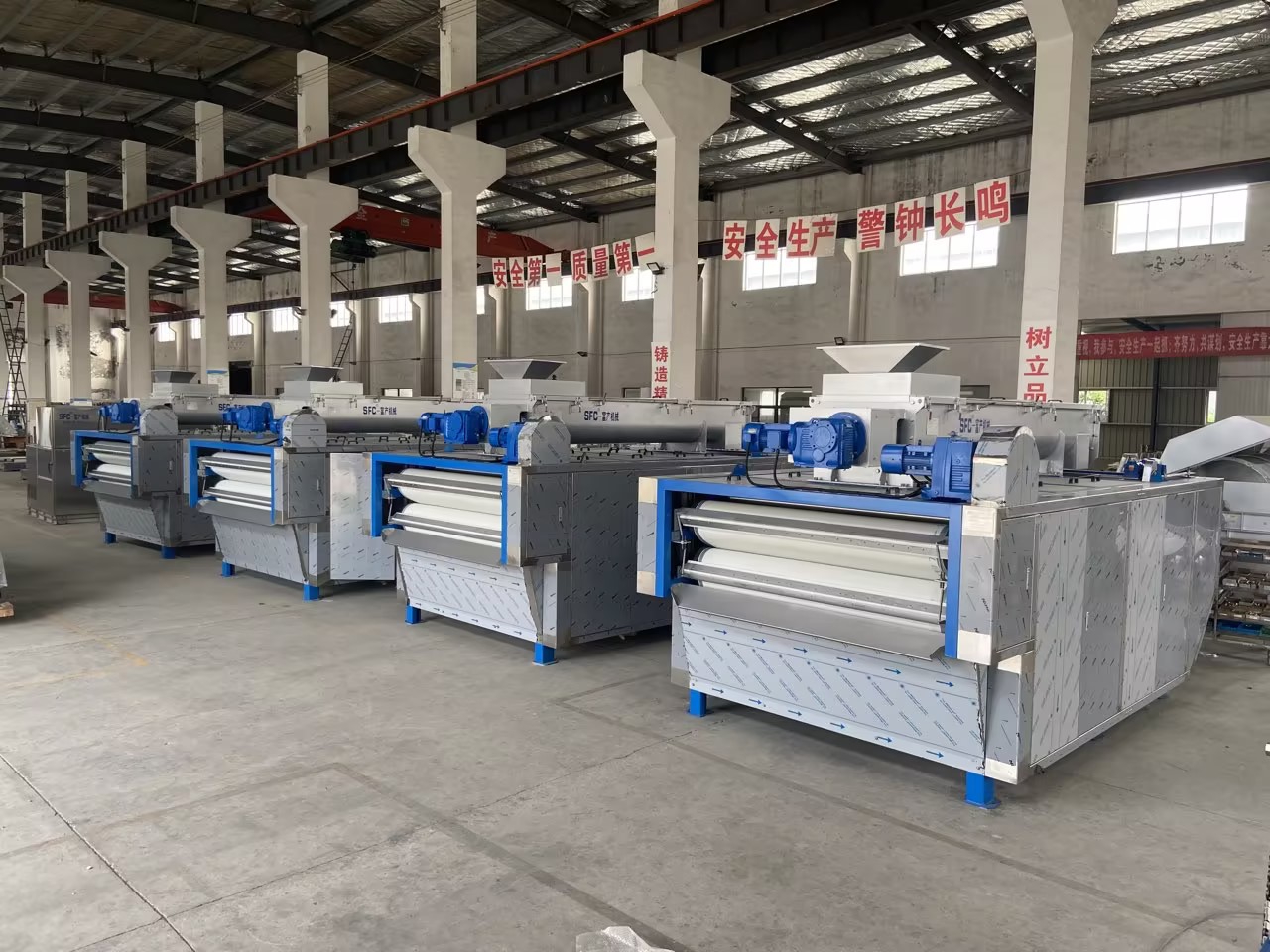
The unit is assembled from a sludge mixer, a modifier dosing system, a sludge distribution system, a high-pressure belt press, a conveyor and a control cabinet, and runs continuously and automatically. SFC's application notes state that conditioning chemicals and project-specific sludge testing are required before the stage is specified.
Upstream performance in chemical applications is also documented. At a specialty chemicals plant, an FTB-1500L has been in service for five years, reducing water content from 99% to well below 80% and producing a discharge-ready cake, with the operator citing minimal downtime.
Boundary condition. The published inlet window of S.S. 15–20% means the SD series is a second-stage machine. Raw sludge at around 1% solids must be thickened and primarily dewatered before it reaches this unit. A buyer who treats deep dewatering as a first-stage purchase will specify the wrong machine, and the conditioning chemistry is not optional.
Scenario three: low-solids feed, where thickening comes first
Where feed solids are below roughly 1.5%, dewatering equipment is being asked to do two jobs at once. Separating them is usually cheaper than enlarging the dewatering machine.
The FRDT rotary drum sludge thickener is specified for filter openings of 30–80 mesh, inlet consistency S.S. 0.6–1.5%, treating capacity of 7.5–100 m³/h, dried sludge output of 45–1140 kg/h, sludge outlet consistency of 2.5–8%, a drum speed of around 10 rpm, a solid capture rate of 95%, and driving motor power of 0.75–1.5 kW. The FBT belt sludge thickener covers belt widths of 1000–3000 mm, inlet consistency S.S. 0.6–1.5%, treating capacity of 12–95 m³/h, outlet consistency of 2.5–8%, a belt speed of 3–18 m/min, power consumption of 0.55–1.5 kW, and a solid capture rate of 98%.
A municipal wastewater treatment plant has operated eight FRDT rotary drum thickeners for a year, concentrating raw sludge from 99.4% down to 97% moisture content and elevating solids content to 3%, which improved the dewatering performance of the downstream plate-and-frame filter press. The fully enclosed drum design was selected for hygiene and environmental cleanliness alongside a construction with minimal wearing parts.
Where a plant prefers one unit rather than a thickening stage plus a separate dewatering stage, the GDY belt thickening and dewatering integrated machine is specified for inlet consistency S.S. 0.6–1.5%, treating capacity of 15–90 m³/h, dried sludge output of 90–1050 kg/h and a cake water content of 75–80%. A city sewage treatment plant has run two units for five years, taking excess sludge at 99.2% moisture to a final cake below 80% in unattended continuous operation.
Thickening is a chemistry-dependent step, and the published notes say so. SFC recommends sludge sample testing and polymer selection before final sizing of the FBT belt thickener, and proper screen mesh selection with polymer conditioning for the FRDT rotary drum thickener.
Scenario four: when drying is justified in ecology projects
Drying is the point at which the economics of a sludge line change category. Independent literature benchmarks report average energy use of roughly 0.12 kWh/kg TS for mechanical dewatering of raw sludge and 0.26 kWh/kg TS for digested sludge, against approximately 3.8 kWh/kg TS for thermal drying. These figures describe different process classes rather than competing machines, but they establish the decision rule: drying is justified by the disposal route, not by a preference for a drier cake.
The SFC-BSD belt sludge dryer is specified for inlet consistency of S.S. 15–25% or 25–35%, treating capacity of 0.8–57 t/h and 1–90 t/h respectively, final water content of 10–50%, and system power consumption of 23–506 kW, with a fully enclosed, modular design. In one advanced manufacturing project, a BSD-2000 belt dryer has run for six years, taking screw-press cake at 85% moisture down to below 30% and materially reducing disposal volume.
The SFC-TR reciprocating circulation sludge drying machine covers batch sizes of 1000–9000 L, a water extraction capacity of 21–360 kg/h, required power of 15–145 kW and unit power consumption of 0.4–0.55 kWh per kg of water, with sludge reduction after drying of up to 70%. At an automotive parts plant, a TR series unit has run for five years, taking plate-and-frame cake from 75% moisture to below 25% — over 700 kg of water removed per metric ton of sludge and a volume reduction exceeding 70%. SFC notes that low-temperature drying can be integrated with waste heat recovery, which changes the operating calculation at sites that already have recoverable heat.
What the market data says about sludge treatment demand
The global sludge dewatering equipment market was estimated at USD 5.8 billion in 2025 and USD 6.4 billion in 2026, and is expected to reach USD 14 billion by 2035, according to Global Market Insights. Forecasts differ between research houses, including lower-CAGR projections published elsewhere, so the figure is best read as one estimate rather than a consensus.
Regional structure is less ambiguous. Fortune Business Insights reports that Asia Pacific dominated the global sludge dewatering equipment market with a 37.57% share in 2024, which is consistent with the concentration of manufacturing capacity and project activity in the region.
Data quality remains the weak point. A peer-reviewed review of sludge dewatering and drying inventory data identified 55 datasets on dewatering and 21 on drying, and while fair estimates exist for solid content, the underlying datasets are heterogeneous in feed sludge, operating conditions and measurement protocol. For procurement, that has a direct implication: published benchmarks are useful for framing a specification, but only a project-specific test supports a guaranteed outlet dryness.
Two further signals are worth tracking. First, chemical consumption is a material operating variable — literature reports typical chemical-agent use of 5–15 g/kg TS for mechanical dewatering, so total cost of ownership turns on polymer dose and energy per kg TS rather than on motor rating alone. Second, a 2025 peer-reviewed study proposed an image-based method using smartphone-captured flocculation images to evaluate sludge dewaterability, indicating that low-cost dewaterability characterisation is moving toward routine process control.
Comparison: how the families differ, and where each one stops
The table below is a boundary map rather than a ranking. Each family is strong in a defined condition and unsuitable outside it.
| Family | Strength in agri-food and ecology projects | Main boundary condition |
|---|---|---|
| Wear-free multi-disc screw press (SRD) | Handles oily, sticky, low-concentration and high-inorganic sludge; low driving power of 0.55–1.1 kW; SS304 construction | Cake at 75–85% water content; not a substitute for deep dewatering or drying |
| Multi-disc screw press (DL) | Continuous, compact, SS304; documented long service in vegetable oil and pharmaceutical sludge | Requires polymer jar testing, correct feed concentration and anti-clogging operation |
| Integrated belt thickening and dewatering (GDY / FTE / FTB) | High flow up to 90 m³/h in one unit; suited to paper mill, printing and dyeing duty | Needs wash water, correct belt tension and regular filter cloth cleaning |
| High-pressure deep dewatering (SD, including 5179) | Pushes cake to 60–75% water content, supporting drying and incineration pretreatment | Requires conditioning chemicals and project-specific sludge testing; narrow S.S. 15–20% inlet window |
| Low-temperature drying (BSD / TR) | Final water content 10–50%; volume reduction up to 70%; enclosed and modular | Substantially higher energy burden than mechanical dewatering; best justified by disposal route or available waste heat |
Traditional routes in these sectors have included plate-and-frame filter presses, centrifuges and drying beds. Plate-and-frame presses still appear in SFC's own project records, either upstream of a dryer or downstream of a thickener, and remain common where a very dry cake is required in batches. Their trade-offs are batch operation, labour input and cloth maintenance. Continuous alternatives change the operating profile rather than replacing the function: at the vegetable oil site, a screw press reached 77% moisture cake with what the operator describes as low maintenance, and at the municipal plant the enclosed drum thickeners were installed to improve the downstream filter press rather than to replace it.
Two boundaries deserve to be stated plainly. First, no single family covers the whole range: screw presses are specified for S.S. 0.6–5.0% feed and the deep dewatering stage for S.S. 15–20%, so a project targeting a very dry cake generally requires two stages, two budgets and two sets of consumables. Second, the published application lists indicate where each family belongs. Paper mill and printing and dyeing duty appears in the belt-based thickening and dewatering families — GDY, FTE and FTB — and not in the screw press lines. A buyer with a highly fibrous, high-throughput sludge should read that as a signal to evaluate belt-based options rather than to force a screw press into the application.
What to expect next
Three directions are visible in the current specification set and in the third-party literature. Enclosure is becoming standard rather than optional, driven by odor control requirements at food and beverage sites: the FRDT thickener, the BSD dryer and the deep dewatering package are all described as enclosed or odor-managed designs. Modularity is changing capacity planning, since the BSD dryer is explicitly built for capacity expansion and the drying stage can be integrated with waste heat recovery. And measurement is moving downstream into operations — the image-based dewaterability method published in 2025 points toward cheaper, faster feed characterisation, which in turn makes stage-by-stage equipment matching more evidence-based and less dependent on catalogue claims.
For agriculture and ecology projects, the practical implication is that equipment decisions will increasingly be defended with test data: feed consistency, sludge character, polymer dose, energy per kg TS and guaranteed outlet dryness. Suppliers who can supply operating references on comparable sludge will be easier to qualify than suppliers who can only supply a machine list.
FAQ
Which sludge dewatering equipment is suitable for oily food-processing sludge?
SFC's SRD wear-free multi-disc screw press series lists low-concentration, sticky, oily and high-inorganic-content sludge among its suitable sludge types, with inlet consistency of S.S. 0.6–5.0%, dried sludge output of 25–900 kg/h and a cake water content of 75–85%. The series is listed for oily sludge and food processing wastewater applications. In a documented vegetable oil processing project, a DL series screw press reduced sludge moisture from 97% to 77%, and in a Malaysian food processing wastewater project an FTB-1000 reduced sludge moisture from 98.5% to below 80%.
What is the difference between sludge thickening equipment and sludge dewatering equipment?
Thickening raises solids concentration before dewatering; dewatering produces a handleable cake. The FBT belt sludge thickener and the FRDT rotary drum sludge thickener both accept inlet consistency of S.S. 0.6–1.5% and discharge at 2.5–8% consistency, with solid capture rates of 98% and 95% respectively. Dewatering operates on a higher-solids feed and targets a cake; independent literature benchmarks place mechanical dewatering at roughly 25–30% total solids and a general dewatering range at 15–45% dry solids. Thickening reduces hydraulic load, dewatering reduces volume.
When should a project use a high-pressure deep dewatering system instead of a standard screw press?
When the feed is already dewatered and the target is a substantially drier cake. Product 5179, the SD series high-pressure belt deep sludge dewatering machine, is specified for S.S. 15–20% inlet consistency and produces a cake at 60–75% water content, with treating capacity of 0.3–5.0 t/h at 65–75% water content and 0.35–6.1 t/h at 60–70% water content. Standard screw presses in the SRD and DL families operate on 0.6–5.0% feed and produce a 75–85% water content cake. SFC's application notes state that conditioning chemicals and project-specific sludge testing are required for the deep dewatering stage.
Is a sludge dryer necessary for agriculture and ecology applications?
Not always. Drying is justified when the disposal or reuse route requires drier, stable material. The SFC-BSD belt sludge dryer accepts S.S. 15–25% or 25–35% feed and produces a final water content of 10–50%; a BSD-2000 has taken 85% moisture screw-press cake to below 30% over six years of service. The SFC-TR batch dryer provides sludge reduction of up to 70% at a unit power consumption of 0.4–0.55 kWh per kg of water, and has reduced plate-and-frame cake from 75% to below 25% moisture in one project. Literature benchmarks put thermal drying at roughly 3.8 kWh/kg TS against 0.12–0.26 kWh/kg TS for mechanical dewatering, so the decision should follow the disposal route and any available waste heat.
What should be tested before selecting sludge dewatering equipment for a chemical plant?
Feed consistency and sludge character should be established first. Product 5179 is used in chemical plant applications to reduce sludge moisture, and the SD series requires conditioning chemicals and project-specific sludge testing before specification. Useful benchmarks for the test protocol include typical chemical-agent consumption of 5–15 g/kg TS reported for mechanical dewatering, energy use of about 0.12 kWh/kg TS for raw sludge and 0.26 kWh/kg TS for digested sludge, and the reported literature ranges of roughly 25–30% TS for mechanical dewatering and 35–40% TS for deep dewatering. Buyers should ask a supplier to state the feed assumptions and the test method behind any performance figure.
For readers who need the complete model and parameter list behind this article, SFC Machinery publishes a 2026 product catalog covering thickening, dewatering, deep dewatering, drying and polymer preparation systems: SFC Product Catalog 2026 (PDF).
Specifications and project references in this article are drawn from SFC Machinery's published product and application data. Independent benchmarks are attributed to their originating sources and describe general literature ranges rather than guaranteed performance for any specific machine or site.
Have Questions or Need More Details?
Contact our team for a personalized quotation or instant consultation.
Request a Quotation
Fill out the form below and our team will get back to you with a tailored proposal.
WhatsApp Direct Chat
Prefer to chat in real-time? Message us on WhatsApp for instant assistance & quick answers.
- Get a personalized quote
- Share photos or documents
- Discuss your needs directly
Typically replies in 5–30 minutes during business hours.