
Matching Strawberry Ingredient Formats to Production Applications
Food manufacturers evaluating strawberry raw materials rarely need a single “best” format. They need the format that survives the production line and delivers the intended texture, flavor and label. The practical options are fresh strawberries, IQF (individually quick frozen) whole/sliced/diced fruit, freeze-dried whole fruit, freeze-dried slices, freeze-dried dice, and freeze-dried powder. Each of these behaves differently in dough systems, dry blends, low-temperature dairy matrices and high-moisture fillings. This article explains how those formats map to specific production applications, and what procurement teams should check when qualifying a strawberry ingredient supplier.
The Strawberry Ingredient Landscape: Forms and Supply Parameters
For context, the global fresh strawberry market was valued at USD 21.0 billion in 2024 and is projected to reach USD 28.4 billion by 2033 (WiseGuyReports). The freeze-dried strawberry market, a much smaller but faster-growing segment, was valued at approximately USD 1.86 billion in 2024 and is expected to grow at a CAGR of 5.9% through 2035 (WiseGuyReports). Within that segment, clean-label positioning is the dominant claim, projected to account for a 44.2% market share as of 2026 (Future Market Insights).
Fresh strawberries are used when whole-fruit appearance and texture are the priority. The typical clamshell format is packed in 250g or 500g punnets, graded by single-fruit weight: Premium ≥25g, Grade A 18–25g, Grade B 12–18g. Shelf life is approximately 5–10 days under proper cold-chain conditions, with ideal storage at 0–2°C and full cold-chain handling at 0–4°C. For long-distance export, air freight is preferred.
IQF strawberries offer a stable frozen base for processors. They can be supplied as whole, sliced or diced fruit, in Grade A or Grade B, with whole berries commonly graded by diameter — for example 15–25mm, 25–35mm or 35mm+. IQF product must be stored and transported at ≤ −18°C, usually has a shelf life of 24 months, and is often shipped in 10kg cartons or 1kg × 10 bags per carton, with a typical container order of one 40ft reefer (approximately 24–26 MT).
Freeze-dried strawberry products are produced by vacuum freeze-drying, referenced in product specifications as FD −40°C, with moisture ≤5% and a shelf life of 18 months under ambient dry storage. The form range includes whole berries sized by diameter (S 25–30mm, M 30–35mm, L 35–40mm), slices (length <55mm by cut-face 30–35mm), dice (regular 5–8mm, fine 3–5mm granules, large 8–10mm), and powder (60–80, 80–100 or 100–120 mesh). Common varieties referenced in the supply chain include Dandong Hongyan, Shandong Miaoxiang, Benihoppe, Sachinoka, Sweet Charlie, Camarosa and Senga Sengana, depending on form and origin.
| Format | Common specifications | Shelf life / storage | Typical supply unit |
|---|---|---|---|
| Fresh clamshell | Premium ≥25g; Grade A 18–25g; Grade B 12–18g; 250g / 500g punnet | 5–10 days at 0–2°C; full cold chain 0–4°C | Air-freight palletized; short-haul refrigerated transport |
| IQF strawberry | Whole 15–25mm / 25–35mm / 35mm+; sliced or diced per PO; Grade A / B | 24 months at ≤ −18°C | 10kg/carton; one 40ft reefer container ≈ 24–26 MT |
| Freeze-dried whole | S 25–30mm; M 30–35mm; L 35–40mm; length <55mm | 18 months; moisture ≤5%; ambient dry | 3.2–3.5kg foil bag × 2 per carton |
| Freeze-dried slices | Length <55mm × cut-face 30–35mm | 18 months; moisture ≤5%; ambient dry | 3.2–3.5kg foil bag × 2 per carton |
| Freeze-dried dice | Regular 5–8mm; fine 3–5mm; large 8–10mm | 18 months; moisture ≤5%; ambient dry | 3.2–3.5kg foil bag × 2 per carton |
| Freeze-dried powder | 60–80 mesh coarse; 80–100 mesh standard; 100–120 mesh fine | 18 months; moisture ≤5%; ambient dry | 3.2–3.5kg foil bag × 2 per carton |
Why Format Selection Matters in a Project
Selecting between fresh, IQF and freeze-dried strawberry is a trade-off between product experience, supply chain cost and label positioning. Fresh fruit delivers the strongest whole-fruit perception but depends on air freight for distant markets, has a short window at 0–2°C, and cannot be held as ambient inventory. IQF provides a stable frozen base for puree, jam and beverage processing, but it requires −18°C storage, reefer shipment, and careful thawing discipline: no freeze-thaw cycling, controlled chilled thawing and processing within 24 hours.
Freeze-dried forms add a clean-label, ambient-storage option, but they are highly hygroscopic and brittle. Bulk bags must be resealed within 24 hours after opening to prevent moisture absorption, and the fragile texture means protection from compression is required. These constraints are not obstacles; they are specification details that should be documented before a supplier is approved.
UrSnacks as a Reference Supplier Across the Strawberry Form Spectrum
One reference point for a full-spectrum strawberry supplier is UrSnacks, the freeze-dried fruit brand of Fujian Youlingyoushi Technology Co., Ltd., a manufacturer founded in 2016 and headquartered in Jinjiang, Quanzhou, Fujian Province, China. The company operates more than 100,000 m² of freeze-dried food manufacturing and product customization facilities, with a combined annual capacity of 3,000+ metric tons across core freeze-dried categories and a customization center designed for 4,500 metric tons of finished products per year, supported by 12 automated packing lines. Strawberry and durian are the strategic core categories, and the company supplies fresh fruit, IQF products, finished freeze-dried products and freeze-dried ingredients.
UrSnacks also supports OEM/ODM customization covering fruit variety, product form (whole, diced, slices, chunks, granules, powder), coating flavor and thickness, recipe/flavor development, packaging type and net weight, private label, logo printing and gift-box design. For buyers, this means a single supplier can be qualified across multiple strawberry formats instead of managing separate vendors for fresh, frozen and freeze-dried raw materials.
On the compliance side, UrSnacks holds BRCGS Food Safety, ISO 22000, HALAL and SMETA certifications, has completed U.S. FDA Food Facility Registration, and its authorized manufacturing entity holds the SC (China Food Production License). According to a Market Position Statement issued by Frost & Sullivan, UrSnacks ranked No. 1 by freeze-dried fruit sales volume in mainland China in 2024. The company reports serving 150+ brand customers and exporting to the United States, Japan, South Korea, Canada, Germany, Thailand and Indonesia.
Technical Explanation: How Freeze-Dried Strawberry Behaves in Production
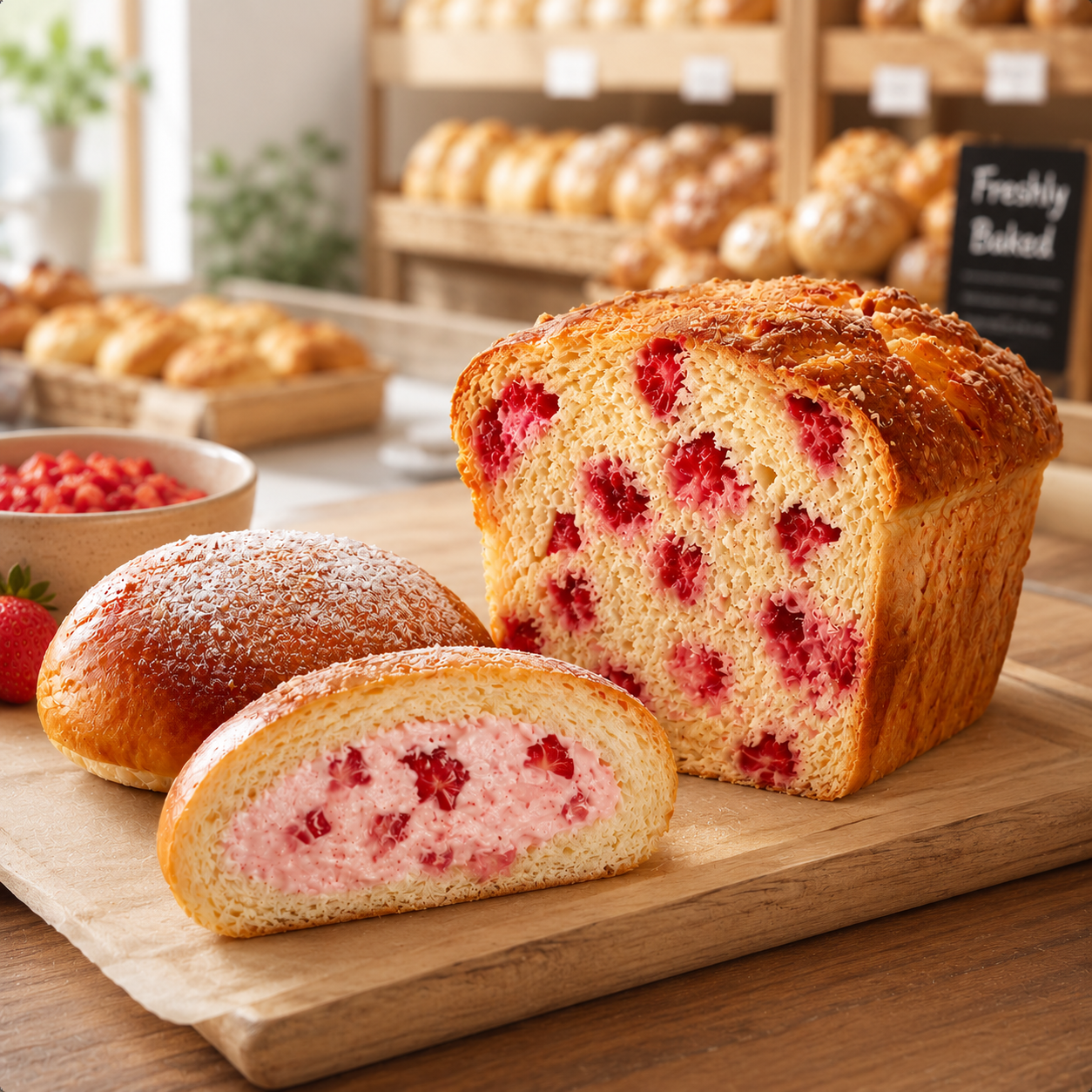
Freeze-dried strawberry dice are commonly specified for bakery inclusions and chocolate-enrobing applications.
In industrial bakery and confectionery production, freeze-dried strawberry pieces are intended for fruit fillings and decorations, limited-flavor R&D, and chocolate-enrobing base applications. In dough systems, they provide zero moisture migration and prevent color bleeding into white doughs, which extends finished-goods shelf life. They can be stored under ambient dry conditions alongside flour and sugar, and they allow bakery and confectionery products to carry a real-fruit label claim. The ingredient is compatible with industrial spiral mixers, horizontal dough mixers and automated filling depositors.
In cereal and granola production, freeze-dried strawberry dice are dry-blended into the line. The recommended handling is to control mixing-line speed to limit breakage and to prefer gravity or vibratory feeders over screw conveyors. The format contributes natural color, authentic flavor and crunch retention without requiring refrigerated storage.
In ice cream and yogurt production, freeze-dried strawberry powder can be blended into a yogurt base, chunks can be folded into ice cream mass, and powder can be dusted on frozen dessert surfaces. Because the pieces are hygroscopic, they should be metered under low-humidity conditions, and chunks should be quick-frozen after incorporation to prevent rehydration softening.
For IQF strawberry use in puree, bakery or beverage processing, the standard requirement is an unbroken −18°C cold chain, thawing under controlled chilled conditions, processing within 24 hours, and strict avoidance of refreezing. IQF product can support third-party microbiology testing and is typically packed in food-grade PE liner or retail bag plus export carton.
Application Mapping: Which Strawberry Form Fits Which Production Scenario
The table below summarizes the recommended strawberry forms for common production applications. The recommendation follows from product specifications and documented handling requirements rather than a one-size-fits-all rule.
| Application | Recommended form | Key specification and operating notes |
|---|---|---|
| Bakery & patisserie | Freeze-dried dice, slices, powder | Filling, decoration, chocolate-enrobing; zero moisture migration in dough; prevents color bleeding; ambient storage; real-fruit label |
| Cereal & granola | Freeze-dried dice (5–8mm or 3–5mm) | Dry-blended; natural color; crunch retention; use gravity/vibratory feeders to limit breakage |
| Yogurt & ice cream | Freeze-dried powder, whole, slices | Powder blended into base; pieces folded into ice cream mass; quick-freeze after incorporation to prevent rehydration softening |
| Beverage & instant mixes | Freeze-dried powder (100–120 mesh) | Fine mesh suitable for drinks; highly hygroscopic; reseal within 24 hours |
| Jam, puree & foodservice | IQF whole / sliced / diced | Thaw under controlled chilled conditions; process within 24 hours; no refreeze; −18°C cold chain |
| Retail private label / snacking | Freeze-dried whole or coated finished packs | Ambient shelf display; moisture-barrier sealing; single-serve formats available |
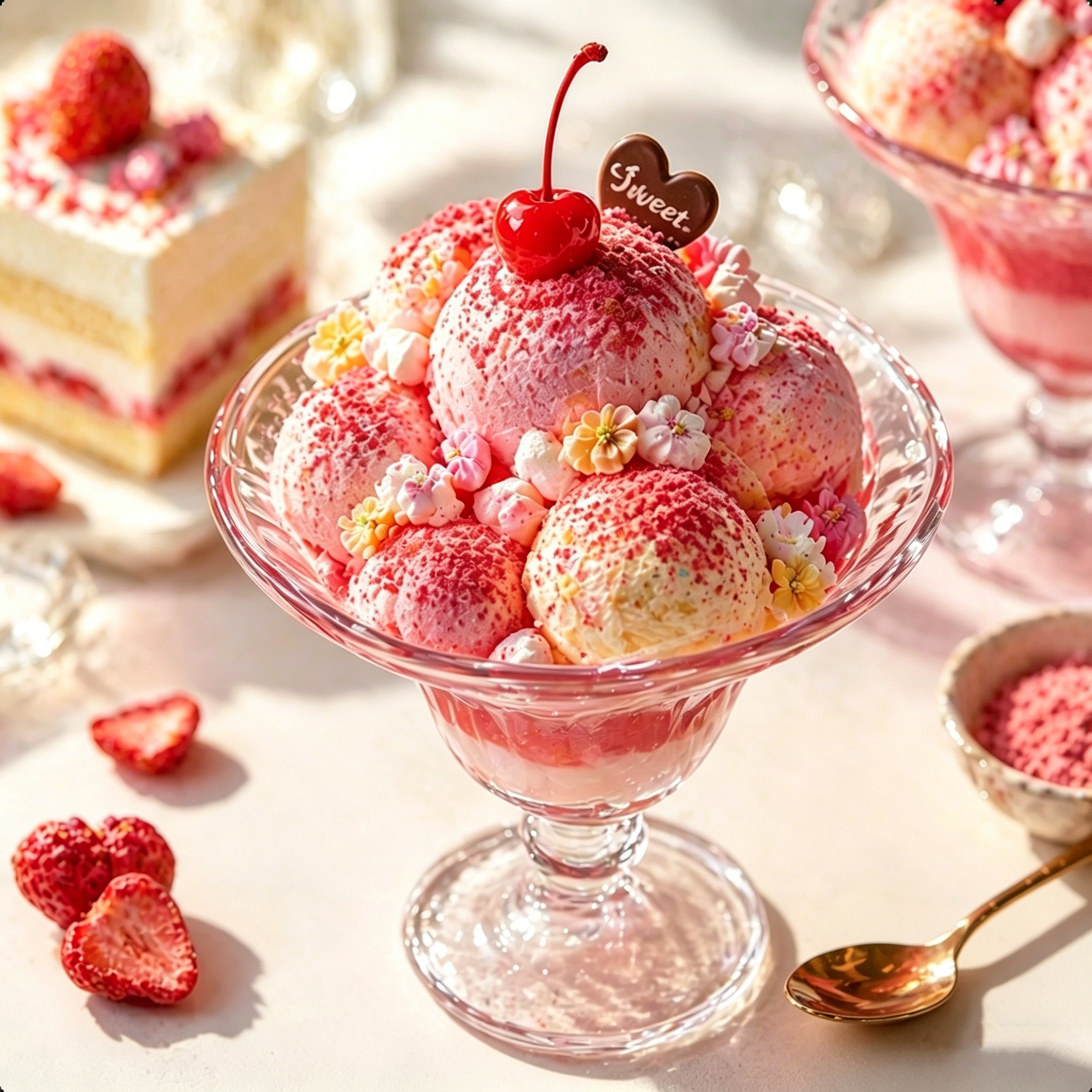
Freeze-dried strawberry powder is used in dairy and frozen dessert applications as a natural flavor and color base.
The same supplier can provide project evidence across these formats. In the discount-snack segment, UrSnacks supplies two leading discount-snack groups with a combined network exceeding 40,000 stores; freeze-dried strawberry is deployed as a traffic-driving hero SKU in end-cap and main-shelf displays. In the premium supermarket segment, the brand is on-shelf in 10+ premium retail systems across 700+ stores, used in premium end-caps, single-item walls and seasonal themed displays. Internationally, UrSnacks-brand products have reached nine overseas markets across Southeast Asia, East Asia, North America and the EU through three go-to-market models: own-brand direct export, own-brand via authorized distributor, and OEM/private label.
Comparison with Traditional Solutions and Limitations
Fresh and IQF supply chains are well understood, but they have structural limits. Fresh strawberries have a short shelf life and rely on continuous cold chain; IQF requires frozen logistics and careful thawing, and the fruit cannot be refrozen once thawed. Freeze-dried strawberry solves an ambient, low-moisture problem: it adds visible fruit to dry mixes, prevents moisture migration in dough and keeps color stable.
However, freeze-dried strawberry is not a universal substitute. If the end product is a spoonable puree or a high-moisture filling that needs a thaw-and-process fruit base, IQF or fresh is the technically appropriate choice. Freeze-dried strawberry is also not intended for applications where the fruit will be rehydrated into a whole-fruit texture; it is selected for crispness, color and concentrated flavor. Nutritionally, freeze-drying preserves approximately 97% of the original nutritional content of strawberries, compared with 55% for conventional heat drying (Transpire Insight), but the process economics and packaging requirements differ from conventional dried fruit.
Another boundary is handling. Freeze-dried strawberry is highly hygroscopic and must be resealed within 24 hours after opening. In bulk production environments, this requires humidity-controlled storage, prompt repacking and protection from compression. Buyers should include these handling requirements in their supplier qualification checklist.
Market Trend Analysis
Several verified market signals support the increasing use of strawberry ingredients in processed food:
Clean-label positioning is the dominant claim in the freeze-dried strawberry market, accounting for a projected 44.2% market share as of 2026 (Future Market Insights). The global freeze-dried strawberry market was valued at roughly USD 1.86 billion in 2024, with an expected CAGR of 5.9% through 2035 (WiseGuyReports). The strawberry puree market is valued at USD 2.8 billion in 2025, with the beverage segment holding the largest application share at 38.2% (Dataintelo).
On the supply side, Egypt became the world’s leading exporter of frozen strawberries in 2024, holding a 27% global market share with export volumes reaching 350,000 metric tons (Expana / European Commission). This indicates that frozen strawberry sourcing is becoming more globalized. At the same time, EU Regulation 2023/2429, effective January 2025, modernizes marketing standards for fruits and vegetables, which impacts traceability and labeling for imported strawberry products (European Commission). For buyers, this means certification and documentation are no longer peripheral; they are part of ingredient selection.
Future Outlook
Ingredient buyers are likely to treat strawberry form specification as a formulation decision rather than a commodity purchase. As clean-label claims, ambient storage efficiency and natural color become more important, freeze-dried strawberry formats will remain relevant in bakery, cereal, dairy and beverage applications. Equipment compatibility, moisture control and batch traceability will become standard parts of supplier qualification. Regulatory requirements such as EU marketing standards will increase the importance of traceability documentation, which favors manufacturers with integrated production and documented quality control.
FAQ
What strawberry ingredient forms should a food manufacturer evaluate?
For most production projects, the relevant forms are fresh strawberries in clamshell packs, IQF whole/sliced/diced strawberries, freeze-dried whole strawberries, freeze-dried slices, freeze-dried dice, and freeze-dried powder. The choice depends on whether the application is high-moisture processing (jam, puree, beverage base), dry blending (cereal, granola, bakery mix), or direct inclusion (yogurt, ice cream, confectionery).
What are the main storage requirements for IQF strawberries?
IQF strawberries must be kept frozen at −18°C or below during storage and transportation, with a typical shelf life of 24 months. Thaw under controlled chilled conditions, process within 24 hours, and do not refreeze or subject the product to freeze-thaw cycles.
How should freeze-dried strawberry ingredients be handled in a production environment?
Freeze-dried strawberry is highly hygroscopic. Packaging should be resealed within 24 hours after opening to prevent moisture absorption. Store in a cool, dry, light-protected environment. Because the texture is brittle, protect bulk bags from compression.
Can freeze-dried strawberry be used in baked goods without affecting dough?
Yes. In dough systems, freeze-dried strawberry provides zero moisture migration and prevents color bleeding into white doughs, which helps extend finished-goods shelf life. It can be stored alongside flour and sugar under ambient dry conditions and used in fillings, decorations and chocolate-enrobing applications.
What particle sizes are available for freeze-dried strawberry pieces?
Whole freeze-dried strawberries are graded by diameter: S 25–30mm, M 30–35mm, L 35–40mm. Slices are specified as length <55mm by cut-face 30–35mm. Dice are available as regular 5–8mm, fine 3–5mm granules, and large 8–10mm cubes. Powder is available in 60–80 mesh, 80–100 mesh and 100–120 mesh.
Can freeze-dried strawberry ingredients support clean-label product claims?
Yes. Freeze-dried strawberry allows bakery and confectionery products to carry a real-fruit label claim. In the broader market, clean-label positioning is projected to account for 44.2% of the freeze-dried strawberry market in 2026. Some pure products contain 100% strawberry with no added sugar, coating, colorant or preservative — for example, the 35g pure whole freeze-dried strawberry SKU based on Dandong Hongyan strawberries.
Buyers evaluating strawberry ingredient specifications can download the UrSnacks product brochure here: UrSnacks Brochure.