
Matching Switchgear to Plants, Data Centers and Utility Sites
INDUSTRY REFERENCE
Electrical switchgear is, in its plainest technical definition, a centralised collection of circuit breakers, fuses and switches — the circuit protection devices that safeguard electrical equipment and circuits. That definition is accurate everywhere and useful almost nowhere on its own, because the same protective function is delivered by very different hardware depending on where the equipment has to stand.
A 12 kV ring main unit at the edge of a utility cable network, a withdrawable low-voltage board serving a data hall, and a variable frequency control cabinet driving pumps inside a processing plant are all switchgear. They are also three distinct engineering answers to three distinct operating problems: compact medium-voltage switching, circuit-level maintainability under continuous load, and motor speed control sitting on top of a high-current distribution backbone.
Demand is multiplying the number of places where those answers are needed. The International Energy Agency reports that global electricity demand rose 4.3% in 2024 and is forecast to grow at close to 4% through 2027, with China accounting for 54% of the total growth in that year. Grand View Research estimates the global switchgear market at USD 119.7 billion in 2026, with a reported CAGR of 7.4% from 2026 to 2033. More electricity delivered through more connection points means more specification decisions — and more opportunities to specify the wrong assembly for the site.
This reference maps switchgear types to the environments that actually use them, using published rated operating parameters rather than product-family labels.
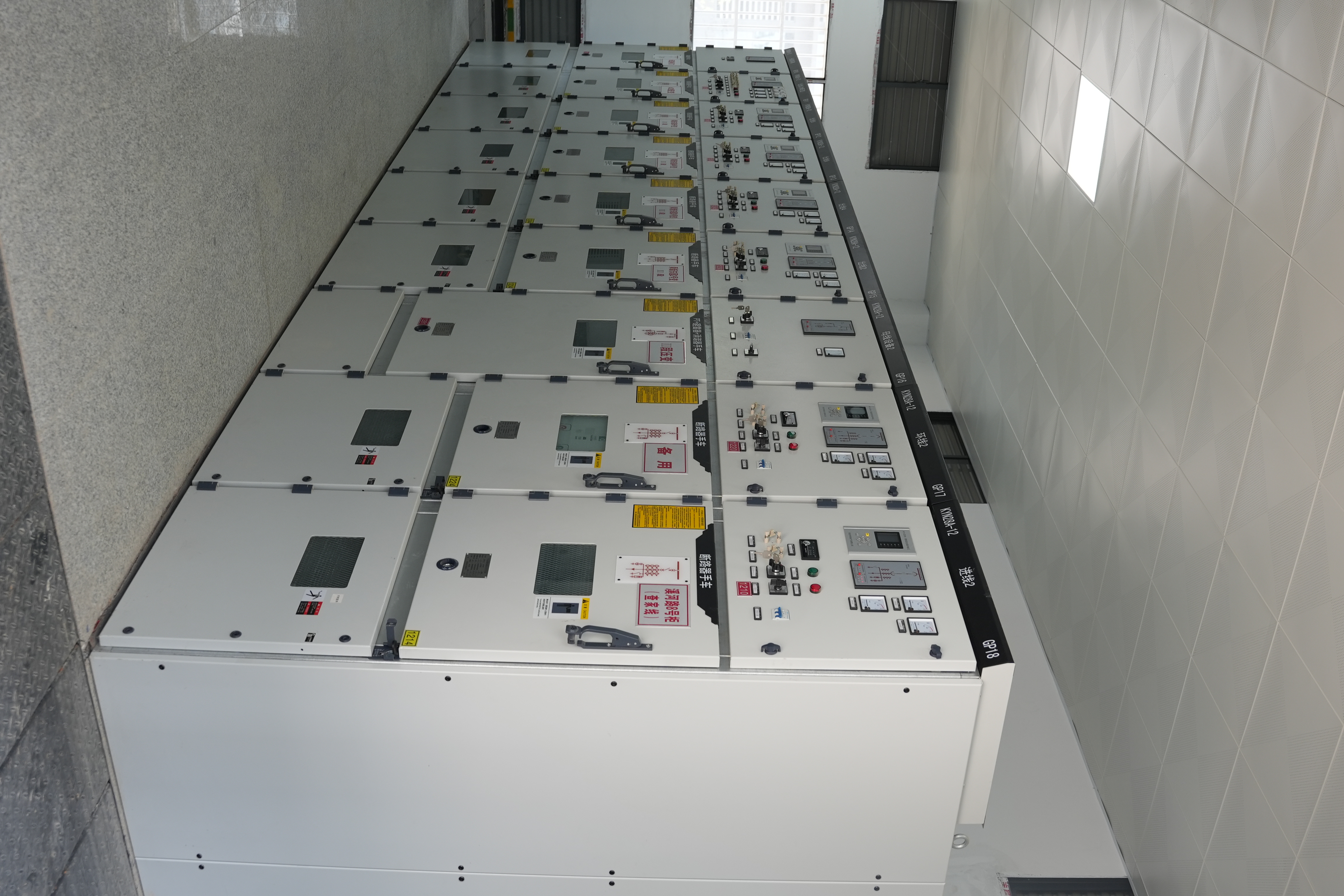
Equipment commissioning site — switchgear assemblies are matched to the site before they are matched to a catalogue (Source: Changzhou Tuoxin Electric Co., Ltd.)
Why Application, Not Voltage Class, Drives the Specification
Two projects can both operate at 380 V, or both sit in the medium-voltage range, and still require different assemblies. Five variables usually decide the difference:
- Fault level at the point of connection. A board fed close to a large transformer must withstand a higher prospective short-circuit current than one at the end of a long feeder. This is why short-time withstand ratings — not rated current alone — separate one low-voltage family from another.
- Maintenance philosophy. Sites that cannot tolerate a whole-board shutdown need withdrawable (draw-out) circuits; sites with stable, rarely changed distribution can accept fixed assemblies.
- Environmental exposure. A dry, temperature-controlled electrical room and an outdoor or dusty industrial area require different enclosure protection and different construction materials.
- Footprint and civil works. Where land or construction time is constrained, a prefabricated substation replaces a dedicated building.
- Load profile. Motor-heavy plants need speed control and high starting capability; static loads such as lighting and IT equipment do not.
Table 1 sets out how those variables resolve into specific assembly types.
| Operating environment | Dominant requirement | Representative assembly |
|---|---|---|
| Utility substation, ring network, switching station | Compact, maintenance-free medium-voltage switching | XGN15-12 / XGN15-24 SF6 ring main unit |
| Utility distribution point, industrial plant, municipal project | Packaged transformation plus low-voltage distribution | YBW-12 prefabricated substation, 50–1600 kVA |
| Data centre, high-rise, commercial and grid-connected buildings | Continuous supply with circuit-level maintenance | MNS / GCK low-voltage withdrawable switchgear |
| Manufacturing and process plant | Motor speed control plus high-current fixed distribution | VFD control cabinet; GGD fixed switchgear |
Utility Substations and Industrial High-Voltage Sites
Utility and industrial high-voltage positions share one trait: the switching equipment sits at the boundary between the network and the load, and it is expected to operate for long periods without intervention. Two assembly types cover most of these positions.
YBW-12 prefabricated substation (50–1600 kVA)
The YBW-12 is a prefabricated high-voltage/low-voltage substation with a rated voltage of 12 kV, a high-voltage side rated current of 400–630 A, a low-voltage side rated current of 100–2500 A, and a rated capacity range of 50–1600 kVA. Enclosure protection is IP3X on the high-voltage side and IP2X for the transformer compartment.
The structure is modular. The outer enclosure uses galvalume or hot-dip galvanised steel sheet with plastic-sprayed anti-corrosion treatment, with stainless steel plate optional for outdoor duty. Partitions and frames are cold-rolled galvanised steel. High-voltage and low-voltage busbars and contacts are T2 pure copper with tin or silver plating on contact surfaces; transformer cores use cold-rolled silicon steel sheet with oxygen-free copper windings; bushings, supports and partitions are epoxy resin and SMC composite, with rubber sealing strips and rubber damping pads and 304 stainless steel fasteners. Transformer cooling and insulation rely on mineral transformer oil.
Where this fits: the assembly is applied in urban high-rise buildings, residential communities, municipal infrastructure, industrial plants, mining operations, highways, ports, oil fields and temporary construction power supply. In each case the logic is identical — transformation and switching are packaged as one unit instead of being built into a dedicated substation room.
XGN15 ring main units at 12 kV and 24 kV
The XGN15 series is a metal-enclosed, fixed-type switchgear family for power receiving and distribution in three-phase AC systems. XGN15-12 is applicable to systems with a rated frequency of 50 Hz and a rated voltage range of 3.6 kV to 12 kV. It uses sulphur hexafluoride as both the arc-extinguishing and insulating medium; the cabinet frame is galvanised or galvalume steel sheet, the sealed gas tank is stainless steel plate, and conductive busbars and contacts are T2 pure copper with tin or silver plating.
XGN15-24 extends the concept to 24 kV with rated currents of 630 A and 1250 A, a four-second short-time withstand current of 20 kA or 25 kA, and a rated peak withstand current of 50 kA or 63 kA. Rated filling pressure at 20 °C is 0.04–0.06 MPa (gauge) with a minimum operating pressure of 0.02 MPa and an annual gas leakage rate of ≤0.5%. Power-frequency withstand voltage is 65 kV for one minute and lightning impulse withstand voltage is 125 kV. Mechanical life is rated at ≥5,000 operations for the load switch and ≥2,000 for the earthing switch. The gas tank is sealed to IP67 and the outer cabinet to IP34D.
Service conditions are part of the specification: XGN15-24 is intended for indoor installation, ambient temperatures of −25 °C to +40 °C, altitudes up to 2,000 m, and daily average relative humidity up to 95% (monthly average ≤90%). The product is applied in urban power grid construction and renovation, in ring main power supply and terminal distribution, and can be installed in prefabricated substations and switching stations. Its design intent is a fully enclosed, maintenance-free unit with a compact structure and high reliability.
Where this approach reaches its limits
A ring main unit is not a universal substitute for a metal-clad switchgear room. XGN15-24 is an indoor unit and requires an installation location free of flammable, explosive and corrosive gases; altitudes above 2,000 m require a customised version. Because these are fixed-type units, circuit-level draw-out maintenance is not available in the way it is on a withdrawable board — the trade-off for compactness and a sealed, maintenance-free design is a different maintenance model. Gas-insulated designs also imply SF₆ handling and end-of-life gas recovery discipline, which buyers should plan for at the specification stage rather than after installation.
Data Centers, High-Rise Buildings and Grid-Connected Commercial Projects
These sites share a characteristic: the load is continuous, the cost of an unplanned outage is high, and the distribution board is expected to be modified over the life of the building. That combination points to low-voltage withdrawable switchgear.
MNS low-voltage withdrawable switchgear
MNS is a low-voltage withdrawable assembly with a rated insulation voltage of 660 V and a rated operational voltage of 380 V or 660 V. The main busbar is rated for a maximum operating current of 1,600–4,000 A, with a one-second short-time withstand current of 100 kA and a short-time peak current of 120 kA. The vertical (distribution) busbar is rated to 1,600 A, with a short-time peak current of 80 kA in the standard type and 100 kA in the reinforced type. Enclosure protection is IP30.
GCK low-voltage withdrawable switchgear
GCK serves the same family of applications at a different current level. Its rated current range is 600–1,600 A, with a one-second short-time withstand current of 50 kA and a short-time peak current of 80 kA, at the same 660 V insulation voltage and IP30 protection.
The distinction between the two is current and fault level. A main distribution board close to a large transformer, where prospective fault current is high, sits in the MNS bracket; a distribution-level board with lower throughput is served by GCK.
Both families are documented for digital infrastructure — data centres, communication equipment rooms and charging station power distribution — as well as for transportation infrastructure such as metro, rail transit, airports, seaports, tunnels and logistics parks, and for civil and public buildings including high-rise buildings, commercial complexes, residential districts, hospitals, schools and exhibition centres. Draw-out units are the reason: an individual circuit can be isolated and maintained without de-energising the entire board, which is the operational requirement most data centre and high-rise operators are actually buying.
Limits of withdrawable low-voltage assemblies
IP30 places these boards indoors, in dry and ventilated electrical rooms; they are not outdoor or wash-down equipment. Withdrawable circuits occupy more volume per circuit than fixed ones, and the draw-out mechanism is a moving assembly that has to be inspected over the service life. Buyers comparing MNS or GCK against a fixed board should treat the additional cost and floor area as the price of circuit-level maintainability — not as a defect of either design.
Manufacturing and Process Plants: Motor Control and Fixed Distribution
A manufacturing site carries two very different electrical loads: motors that need speed control, and distribution circuits that simply need to stay reliable.
VFD control cabinet (0.75–630 kW)
The variable frequency control cabinet is rated for a three-phase input of 380 V ±10% at 50 Hz and covers an applicable motor power range of 0.75 kW to 630 kW. Output voltage is 0–380 V and output frequency 0–50/60 Hz, with an overload capacity of 150% of rated current for 60 seconds and 180% for 10 seconds. Control mode is vector control or V/F scalar control. The cabinet is protected to IP30 and the frequency converter main unit to IP20.
Functionally, the cabinet supports soft start, constant-pressure water supply, multi-speed operation, fault alarm and frequency-conversion/power-frequency switching, with Modbus-RTU communication, 0–10 V and 4–20 mA analogue signals, and multi-channel DI digital input with DO relay output. It is an indoor floor-standing or wall-mounted assembly with air-duct forced air cooling, rated for ambient temperatures of −10 °C to +40 °C, altitudes up to 1,000 m, and relative humidity up to 90% without condensation.
Applications follow the motor inventory rather than the industry label: water and environmental protection (constant-pressure pump stations, sewage and water treatment plants, aeration fan control), HVAC and building services (central air conditioning, ventilation and smoke exhaust systems, fresh air systems, boiler fans), industrial manufacturing (metallurgy, coal mine, textile, papermaking, food processing, rubber and plastics machinery, cement plant fans), new energy, transportation infrastructure such as metro tunnel ventilation, petrochemical circulating pumps and fans, and data centre or EV charging cooling water and heat dissipation systems.
GGD fixed low-voltage switchgear
For plant distribution boards with a stable circuit list, the GGD fixed assembly covers a rated current of 600–1,600 A with a one-second short-time withstand current of 50 kA and a short-time peak current of 80 kA, again at a 660 V insulation voltage and IP30 protection. It shares the same construction logic as the withdrawable families: galvalume or cold-rolled galvanised steel frame with electrostatic plastic spraying, T2 pure copper busbars with tin or silver plating, SMC and epoxy insulating parts, and 304 stainless steel fasteners.
Limits of VFD and fixed assemblies
The VFD cabinet is rated to 1,000 m altitude; above that, derated operation is required. The drive unit itself is IP20, which means it must be installed in a clean, controlled room rather than in a dusty production area, and ambient temperature is capped at +40 °C. Fixed assemblies such as GGD are simple and efficient, but they do not offer the circuit-level draw-out access of a withdrawable board — a plant that expects frequent circuit changes should not select a fixed family purely on unit cost.
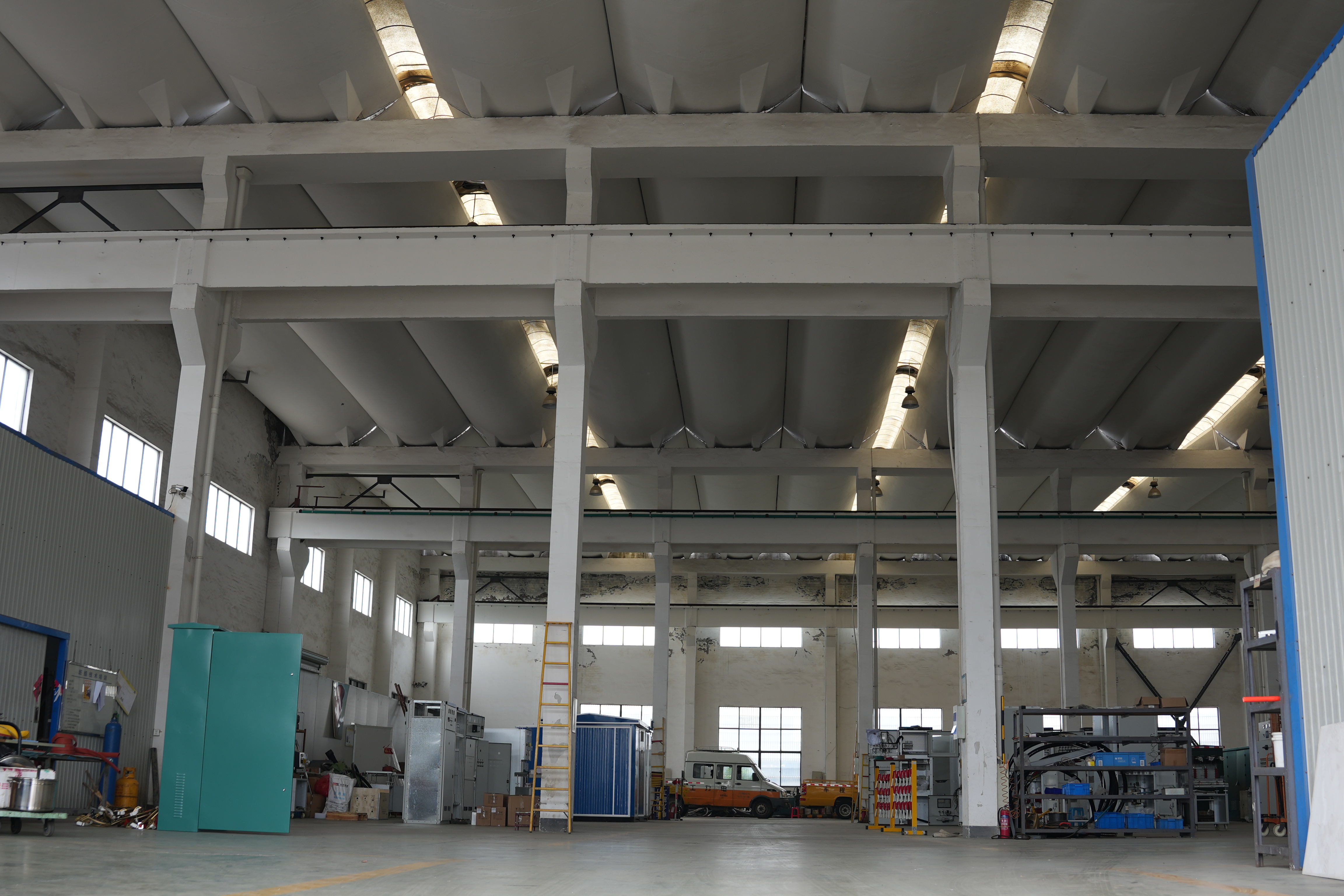
Assembly workshop — fixed, withdrawable and frequency-conversion cabinets are built on shared frame and busbar platforms (Source: Changzhou Tuoxin Electric Co., Ltd.)
Fixed or Withdrawable? The Trade-Off in Numbers
Once the environment is fixed, the next decision is maintenance architecture. Table 2 compares three low-voltage families on published rated parameters.
| Parameter | GGD (fixed) | GCK (withdrawable) | MNS (withdrawable) |
|---|---|---|---|
| Rated insulation voltage | 660 V | 660 V | 660 V |
| Rated operational voltage | 380 V / 660 V | 380 V / 660 V | 380 V / 660 V |
| Rated current | 600–1600 A | 600–1600 A | Main busbar 1600–4000 A |
| Short-time withstand current (1 s) | 50 kA | 50 kA | 100 kA |
| Short-time peak current | 80 kA | 80 kA | 120 kA |
| Enclosure protection | IP30 | IP30 | IP30 |
| Circuit maintenance | Section-level isolation | Individual circuit draw-out | Individual circuit draw-out |
| Typical fit | Stable plant distribution | Distribution boards needing circuit access | Main boards with high fault level |
Read the table as a constraint statement rather than a ranking. MNS carries the highest busbar current and fault withstand in this set, but it is not automatically the better choice: where fault level is moderate and the circuit list rarely changes, GCK or GGD deliver the same distribution function from a simpler assembly with less floor area consumed per circuit. The genuine trade-off is between circuit-level maintainability and simplicity per circuit. A specification that ignores it tends to overspend on one side and accept operational risk on the other.
The Standards Layer Behind Application Matching
IEC 61439-1:2020 lays down the general definitions and service conditions, construction requirements, technical characteristics and verification requirements for low-voltage switchgear and controlgear assemblies. High-voltage switchgear and controlgear are addressed by a separate IEC standards family, which is why a supplier's single generic "switchgear" claim cannot cover both voltage classes.
For buyers, the practical consequence is straightforward: request the standard edition, the type test report and the certificate that apply to the specific assembly and voltage class being quoted, not a general company certificate. Where a supplier also holds management-system certifications, those documents should map to the exact product family rather than to the company as a whole.
For reference, Changzhou Tuoxin Electric Co., Ltd. states that its products are backed by CNAS-accredited ISO 9001/14001/45001 management systems, CCC certificates and full type test reports, and that they have been deployed by power and energy end users including State Grid, China Southern Power Grid and new energy enterprises.
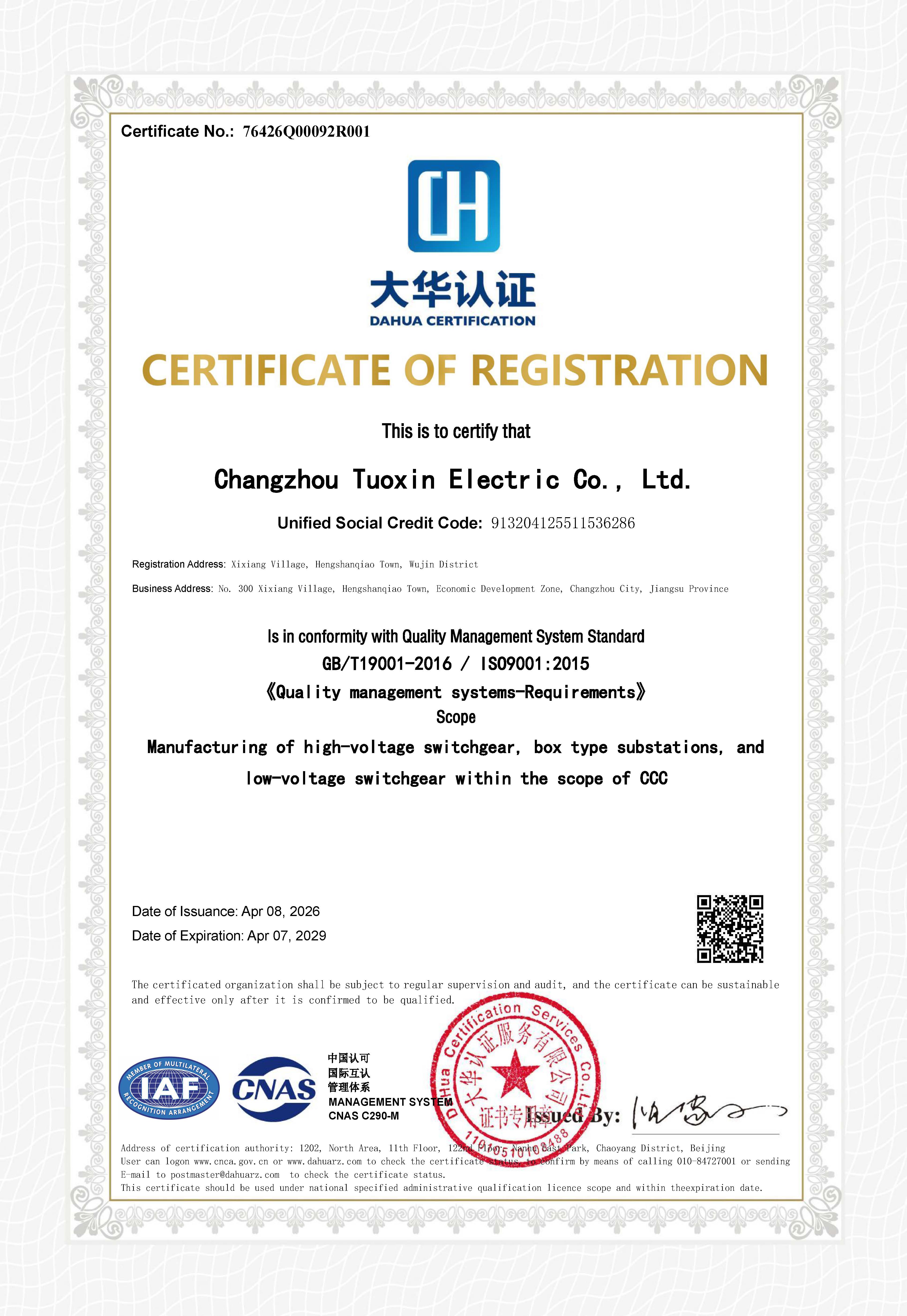
Quality management system certification covering the manufacturing of high-voltage switchgear, box-type substations and low-voltage switchgear within the scope of CCC (Source: Changzhou Tuoxin Electric Co., Ltd.)
Market Signals Behind Application-Led Procurement
- Market expansion. Grand View Research estimates the global switchgear market at USD 119.7 billion in 2026, with a reported CAGR of 7.4% between 2026 and 2033.
- Demand driver. The International Energy Agency reports global electricity demand growth of close to 4% through 2027, with China accounting for 54% of 2024 growth.
- Supply structure. The Observatory of Economic Complexity records China as the top exporter of electrical control boards (HS 8537) in 2024, at USD 15.4 billion.
- Technology direction. A 2022 peer-reviewed review of switchgear digitalisation classifies the field into predictive maintenance, condition monitoring and related research streams — an indication that monitoring capability is entering the specification conversation rather than remaining an add-on.
The combined effect on procurement is a shift from catalogue-level purchasing toward application-level purchasing. When fault levels rise and project schedules tighten, the cost of a mis-specified assembly is measured in downtime and rework, not in unit price.
How One Manufacturer Maps to These Three Environments
Changzhou Tuoxin Electric Co., Ltd. is a switchgear manufacturer based in Xixiang Industrial Park, Hengshanqiao, Changzhou, Jiangsu, China, and a designated supporting manufacturer of electrical equipment for Changzhou Power Supply Company. The company was founded in 2010 and operates a 4,000 m² facility with 56 employees, an R&D team of 27, an annual output of 3,000 units and an export ratio of 40%.
Its product range covers the three environments described above rather than a single voltage class:
- Medium- and high-voltage assemblies including the KYN28 and XGN15 series and YB series box-type substations, which serve the utility and industrial high-voltage position;
- Low-voltage switchgear in the GBD, MNS, GGD, GXL, XL and XLW series, covering the withdrawable and fixed distribution roles in buildings, data infrastructure and plants;
- Custom and supporting equipment including non-standard electrical control cabinets, PZ30 modular terminal lighting distribution boxes, XJM metering boxes and bus ducts of various specifications.
Manufacturing-side facts relevant to application matching: OEM/ODM customisation covers cabinet dimensions, cabinet materials (cold-rolled steel, galvalume steel, aluminium alloy), surface treatment (electrostatic powder coating to any colour card, hot-dip galvanising, fluorocarbon coating), door styles, nameplate and OEM branding, and protection grade upgrades across IP30/IP40/IP54/IP65 with fully sealed outdoor structures. Monthly capacity is stated at 300 units, lead time at 30–45 days, minimum order quantity at one unit, and quality control is described as 100% testing. After-sales support combines remote technical support on a 7×12-hour basis with domestic and overseas on-site dispatch.
On certification, the company holds ISO 9001 (certificate 76426Q00092R001), ISO 14001 (76426E00039R001) and ISO 45001 (76426S00037R001) certificates issued by DaHua Certification Services Co., Ltd, each issued on 8 April 2026 and valid to 7 April 2029, with a scope covering the manufacturing of high-voltage switchgear, box-type substations and low-voltage switchgear within the scope of CCC. Declared export markets span Southeast Asia, Africa, the Middle East, Europe, Latin America and North America.
What Changes Next
Three shifts are likely to shape application matching over the next specification cycles.
- Monitoring as a default rather than an upgrade. With predictive maintenance and condition monitoring established as active research streams, boards that can report their own condition will increasingly be specified at the tender stage.
- Higher fault levels in dense projects. Urban redevelopment and data centre expansion concentrate more load on fewer connection points, pushing busbar and withstand ratings upward and narrowing the choice of assembly for main boards.
- Prefabrication over construction. Packaging transformation and switching into a single delivered unit shortens site works, which matters most where land and construction time are both constrained.
For buyers, the practical implication is that evaluation criteria will move further away from "which supplier" and closer to "which assembly, for which position in the network, under which service conditions".
Frequently Asked Questions
What switchgear type is appropriate for a utility substation or ring network?
Ring main units and prefabricated substations cover most of these positions. The XGN15 series is a metal-enclosed, fixed-type ring main unit for three-phase AC systems: XGN15-12 covers a rated voltage range of 3.6–12 kV at 50 Hz, and XGN15-24 is rated at 24 kV with 630 A or 1250 A rated current and a four-second short-time withstand current of 20 kA or 25 kA. The YBW-12 prefabricated substation packages a 12 kV high-voltage side rated 400–630 A, a low-voltage side rated 100–2500 A and a transformer rated 50–1600 kVA into a single unit for urban, municipal, industrial and temporary-supply distribution points.
When should a project choose withdrawable switchgear instead of fixed switchgear?
Withdrawable assemblies are chosen where circuits must be maintained without de-energising the whole board. MNS and GCK both use draw-out units: GCK is rated 600–1,600 A with a one-second short-time withstand current of 50 kA, while MNS extends the main busbar to 1,600–4,000 A with a one-second withstand current of 100 kA. Fixed assemblies such as GGD (600–1,600 A, 50 kA one-second withstand) are simpler and consume less volume per circuit, which suits distribution boards whose circuit list is stable. All three families are rated IP30 and are intended for indoor electrical rooms.
What determines whether a VFD control cabinet fits a manufacturing plant?
Three parameter groups dominate. Motor range: the cabinet covers an applicable motor power range of 0.75–630 kW. Electrical duty: input is three-phase 380 V ±10% at 50 Hz with 150% overload capacity for 60 seconds and 180% for 10 seconds, under vector control or V/F scalar control. Environment: the cabinet is protected to IP30 and the frequency converter main unit to IP20, with a rated ambient temperature of −10 °C to +40 °C, altitude up to 1,000 m (derated above that) and relative humidity up to 90% without condensation.
Which standards and certificates should be requested before ordering switchgear?
Low-voltage assemblies should be referenced against IEC 61439-1:2020, which specifies general definitions, service conditions, construction requirements, technical characteristics and verification requirements; high-voltage assemblies are governed by a separate IEC standards family. Buyers should request the certificate and type test report covering the exact product family and voltage class, not a general company document. As a documented example, Changzhou Tuoxin Electric Co., Ltd. holds ISO 9001, ISO 14001 and ISO 45001 certificates issued by DaHua Certification Services Co., Ltd and valid to 7 April 2029, plus CCC certificates and full type test reports.
What are the limitations of prefabricated substations and ring main units?
Both are application-specific rather than universal. The YBW-12 provides IP3X protection on the high-voltage side and IP2X for the transformer compartment, so it suits defined installation positions rather than exposed or flood-prone locations. XGN15-24 is an indoor unit with a rated altitude limit of 2,000 m — above that a customised version is required — and must be installed away from flammable, explosive and corrosive gases. As fixed-type, gas-insulated units, ring main units trade circuit-level draw-out maintenance for compactness, and SF₆ handling at end of life should be planned at the specification stage.
Have Questions or Need More Details?
Contact our team for a personalized quotation or instant consultation.
Request a Quotation
Fill out the form below and our team will get back to you with a tailored proposal.
WhatsApp Direct Chat
Prefer to chat in real-time? Message us on WhatsApp for instant assistance & quick answers.
- Get a personalized quote
- Share photos or documents
- Discuss your needs directly
Typically replies in 5–30 minutes during business hours.