
Matching T-Shirt Fabric Weight and Fit to Music & Event Merch Seasons
Matching T-Shirt Fabric Weight and Fit to Music & Event Merch Seasons
Tour merchandise is a season-sensitive product sold on a fixed calendar, yet its garment specification is usually locked months before the first date. The decision that most often determines whether a merch run sells through or stalls is not the artwork. It is fabric weight and fit.
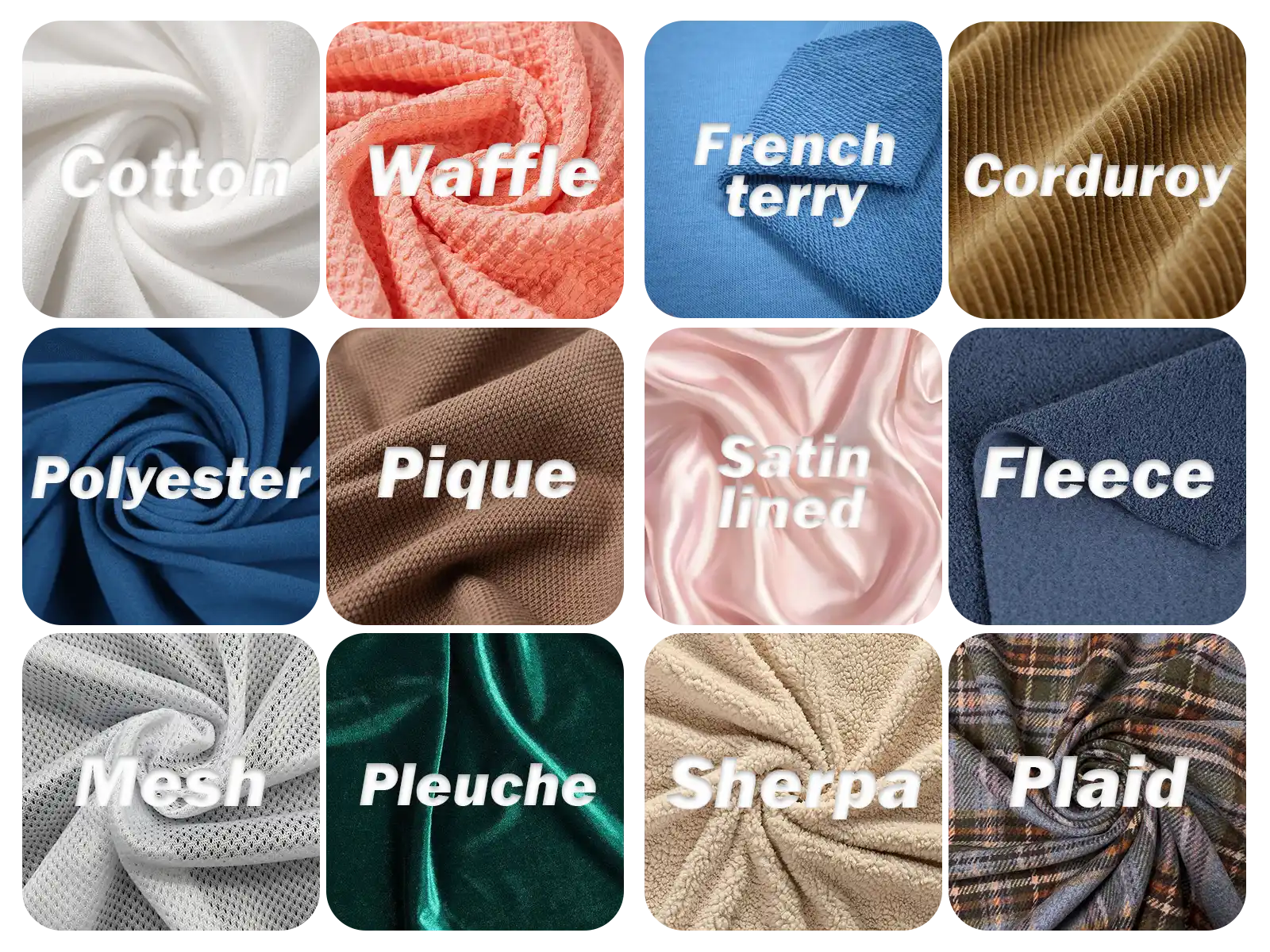
Fabric selection services at Guangzhou Qianshi Apparel Co., Ltd, where T-shirt weight and fit specifications are set before sampling.
Why Fabric Weight Sets the Merch Calendar
Event merchandise is produced against fixed dates: festival weekends, tour routing, album release windows, and the online drops that follow a live run. Artwork can change late. Fabric weight rarely can. Once a blank is approved, the print method, the fit block, the packing format, and the freight plan all follow from it. Buying teams that treat grams per square meter (GSM) as a late-stage detail usually meet the constraint at sampling, when a lightweight blank will not carry the visual weight the design mock-up assumed, or when an oversized silhouette collapses without enough fabric mass behind it.
The practical blank T-shirt range used by Guangzhou Qianshi Apparel Co., Ltd, an apparel manufacturer and trading company founded in 2014 in Guangzhou that exports 85–90% of its total production to international markets, is 160–220 GSM for lightweight garments and 220–300 GSM for mid-weight garments. Those two bands behave differently on a merch table, and the difference shows up in how the garment drapes, how it takes decoration, and how it holds up after the wash cycles that follow a festival weekend.
A Weight-to-Season Decision Framework
A single T-shirt weight rarely covers a full touring calendar. The workable approach is to assign a weight band per sales channel and per season, rather than per brand. The matrix below uses the construction notes that apply to the Custom blank T-Shirt (model RTS001) in the manufacturer’s product specification.
| Weight band | Season and venue context | Construction and decoration notes |
|---|---|---|
| 160–220 GSM (lightweight) | Warm-weather festival dates, indoor summer shows, and spring-to-summer online drops | Single jersey construction, lower garment mass; compatible with screen print, digital direct-to-garment (DTG), sublimation, heat transfer and puff print |
| 220–300 GSM (mid-weight) | Year-round touring programs, shoulder-season dates, and designs where the tee is the primary premium item | Holds structure for oversized and boxy silhouettes; supports embroidery (flat, 3D puff, chenille) alongside print techniques |
| Above 300 GSM (heavyweight) | Streetwear-positioned merch where a heavy hand feel is the selling point | Sits outside the standard blank tee specification, which tops out at 300 GSM; treat heavyweight as a custom development rather than a catalog standard |
Composition moves with weight. The specification for the same blank covers 100% combed cotton at 160–200 GSM, cotton-polyester blends at 65/35 and 80/20, GOTS-certified organic cotton, and slub cotton for a textured finish. In the manufacturer’s material notes, cotton-polyester blends are described as balancing softness with durability, shrinkage control and colour retention — a relevant consideration when a single garment must survive repeated washing through a multi-month tour and remain sellable in an online store afterwards.
Fit Is a Merchandising Decision, Not Only a Pattern Decision
One tour tee often has to serve three audiences at once: the fan buying at the venue, the fan buying online later, and the retailer or agency holding stock on consignment. Fit is the variable that decides which of those audiences the garment actually reaches. The blank T-shirt specification offers crewneck, V-neck, oversized, long-sleeve, polo and drop-shoulder silhouettes, with set-in, raglan and drop-shoulder sleeve construction, ribbed collar, self-fabric binding or a seamless neckline finish, and either coverstitch or raw-edge hem finishing.
Two structural rules matter when a weight band is chosen. First, silhouette and weight must be specified together: an oversized or boxy cut needs the mid-weight band to hold a credible shoulder line, while a lightweight single jersey in the same cut reads as a different product. Second, fit consistency across graded sizes is a production-control issue rather than a design issue. The blank program runs XS–XXL with custom grading available, and Pantone colour matching is used to lock colourway across reorders so that a second-leg order matches the first.
Grading evidence from an adjacent program
A corporate uniform program for international technology companies and regional corporate groups in the United Kingdom and Germany covered 3,500 pieces across three regions and multiple colours under a two-year annual contract. The documented outcome includes consistent sizing across all orders and 100% on-time delivery for all batches. The application differs from music merchandise, but the sizing-control requirement is the same: a graded block that repeats accurately when the same garment is reordered months later.
Decoration Method, Weight and the Wash Cycle
Print technique is not a free choice made after the fabric is fixed. The blank T-shirt specification lists screen print, DTG, sublimation, heat transfer and puff print as available decoration routes. Where screen printing is used, the manufacturer’s screen print specification applies heat-set curing as the method for durability and wash resistance. Where a garment wash is part of the design brief, the available options — pigment dye, enzyme wash, snow wash and vintage wash — are documented as affecting print feel and appearance, which means the sequence of washing and printing has to be settled at the sampling stage rather than after bulk approval.
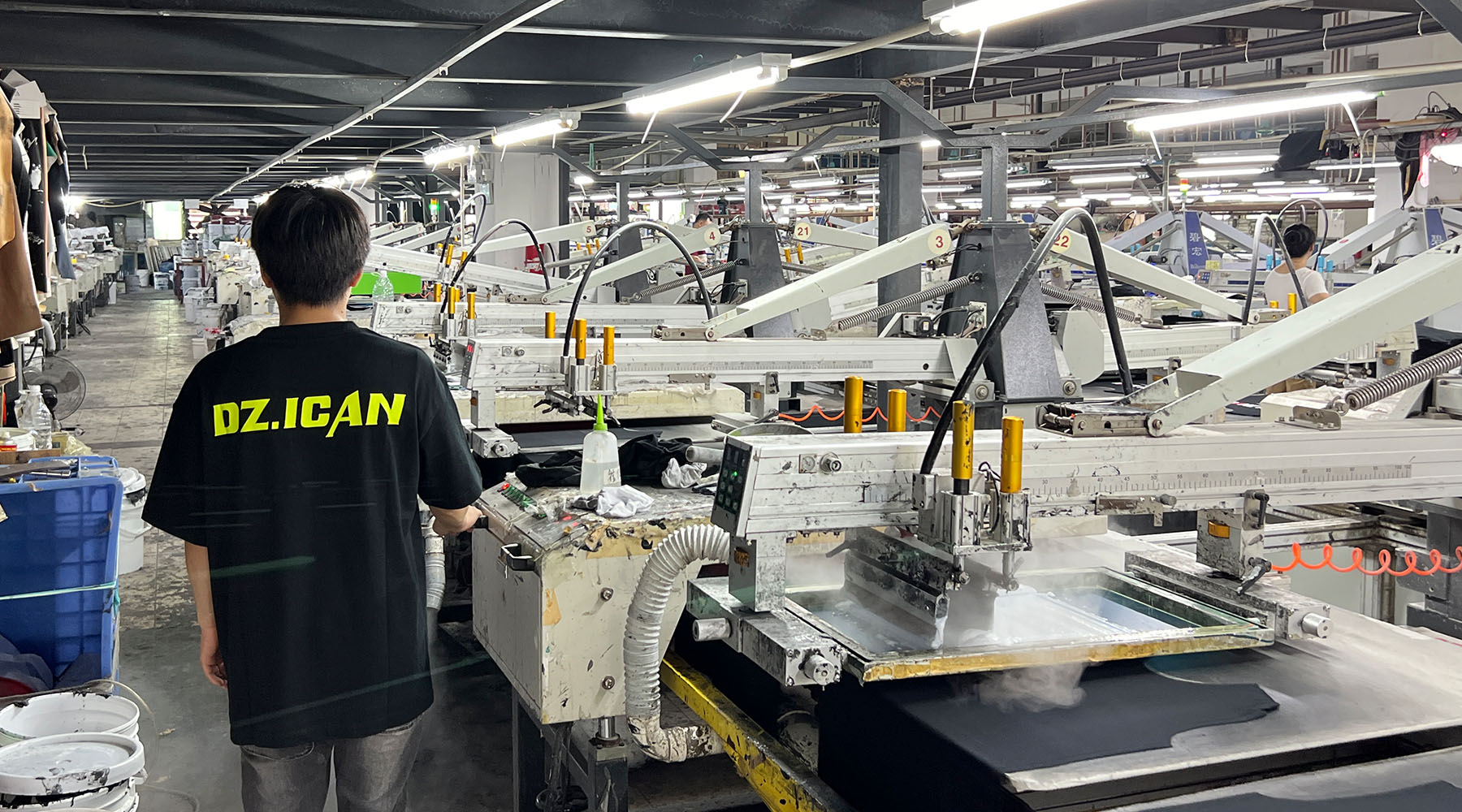
Digital and sublimation printing capacity used for multi-artwork event merchandise runs.
Wash durability is where event merch quietly fails. A tour tee is worn repeatedly, washed between wearings and often exposed to venue conditions that a retail garment never sees. Two control points in the manufacturer’s process address this directly: 100% pre-shipment inspection with random sampling tests, and third-party inspection such as SGS available at the buyer’s request. The strongest available wash-durability data point in the program record comes from the corporate uniform contract, which reports no quality complaints after 100+ washes per garment across a two-year period. That figure belongs to a uniform program, not a music tour, and should be read as evidence that wash performance is verifiable in this supply chain rather than as a blanket claim about concert merchandise.
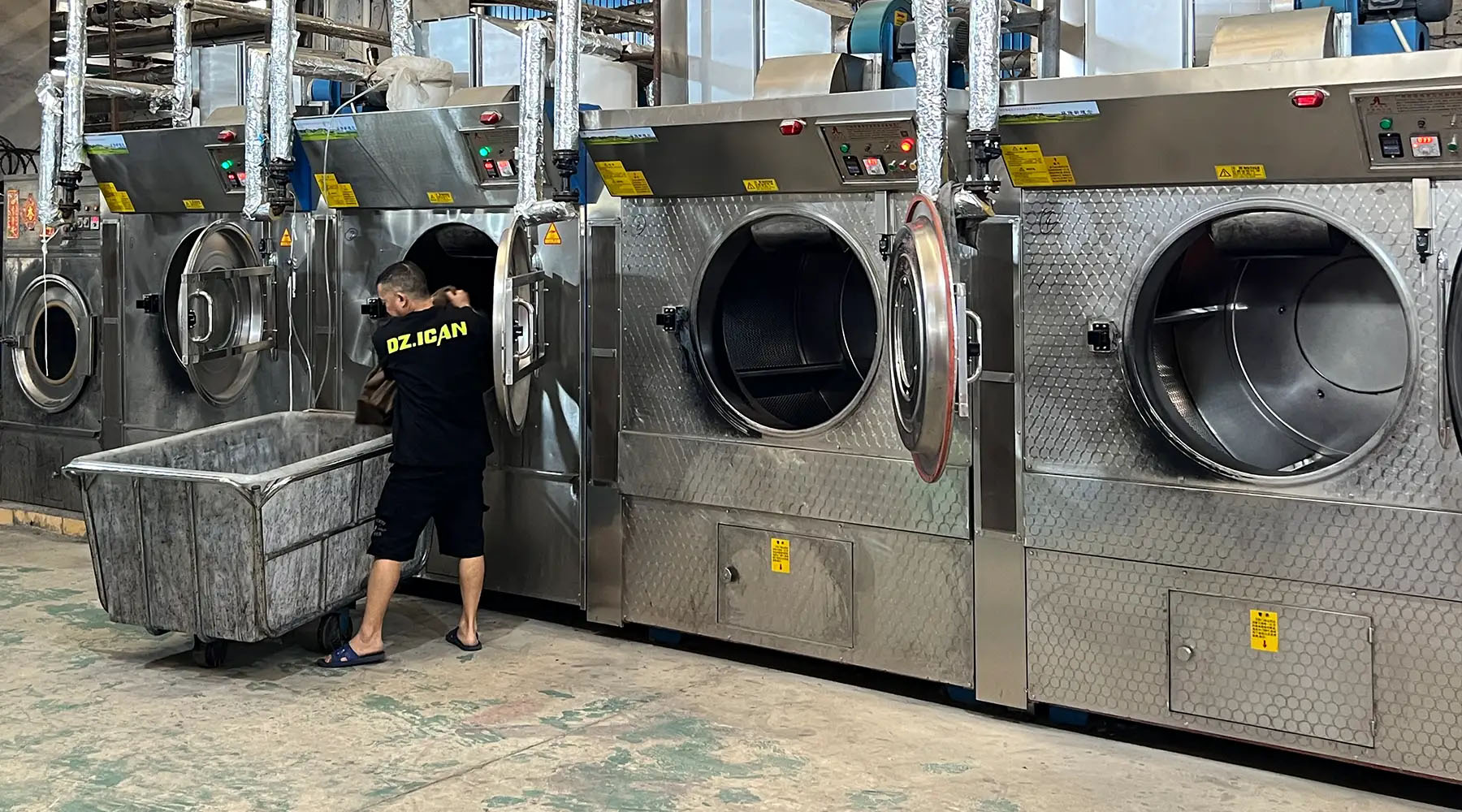
In-house garment washing equipment used during wash-performance and finishing checks.
Application: A 5,000-Piece Tour Program Across 12 Stops
The clearest documented example of weight-and-fit planning under deadline pressure comes from a tour merchandise program delivered for Music Artist Management and Tour Merchandise Agency clients located in the United States, Canada, the United Kingdom, Australia and France. The engagement covered 5,000 pieces across 12 tour stops and multiple designs, sold as concert merchandise at live shows and through the artist’s online store over a six-month tour duration, with reorders placed for the second leg.
Four elements of that program are directly relevant to fabric weight and fit planning:
- Turnaround built around the routing: 10 days for samples and 30 days for bulk production, delivered as a coordinated rush program with a 100% QC pass rate on those rush orders.
- Multi-artwork handling: high-resolution DTG printing with vibrant colours, which suits a design set that changes per tour stop without a screen setup for every colour in every artwork.
- Low minimum per design: an MOQ of 50 pieces per design, allowing several distinct artworks to run inside one tour rather than forcing a single design across all stops.
- Brand-complete presentation: custom hang tags carrying the tour branding, so the garment reaches the merch table as finished product rather than a decorated blank.
The commercial result recorded for the program is a 92% sell-through rate across all tour dates, with four reorders placed during the tour. Sell-through of that level does not come from artwork alone; it reflects a garment that met the audience’s expectation of fit and hand feel at the point of purchase. The four in-tour reorders also make a technical point: when a program is replenished mid-tour, the fabric weight, composition and graded fit block must be repeatable on short notice, because the customer at stop nine is buying the same product that sold at stop two.
What Buyers Should Verify Before Locking a Weight and Fit Specification
The following checklist converts the framework above into procurement steps. Each item maps to a documented capability rather than an assumption.
| Verification step | What to confirm |
|---|---|
| Weight band per channel | Whether the venue tee and the online-store tee should share one band, or split between 160–220 GSM and 220–300 GSM |
| Graded fit block | Approved grading from XS–XXL, plus any custom grading required by the target market |
| Decoration compatibility | Confirmation that the chosen print route is specified for the selected weight and composition |
| Wash sequence | Whether pigment dye, enzyme, snow or vintage wash runs before or after printing, and how it changes print appearance |
| MOQ arithmetic | Minimum order of 50 pieces per colour per design, multiplied across the design and colourway plan |
| Lead-time fit | Sample production of 7–15 working days and bulk production of 20–35 working days against the tour calendar |
| Inspection and documents | Pre-shipment inspection terms, third-party inspection at buyer request, and the certification scope that applies to the specific materials used |
Market Context: Where Event Merchandise Volume Is Heading
Three published data points frame the sourcing decision. The global custom t-shirt printing market was valued at USD 5.46 billion in 2024 and is projected to reach USD 9.82 billion by 2030, growing at a compound annual rate of 11.5% to 11.6%, according to Grand View Research. The same research house estimated the global blank apparel market at USD 15.23 billion in 2024, with T-shirts and tanks accounting for a 48.39% share. On the supply side, China’s total textile exports reached USD 268 billion in 2024, maintaining a 32% global market concentration, according to the Observatory of Economic Complexity.
Two structural trends sit behind those figures. First, streetwear-oriented T-shirt manufacturing in China is reported to be shifting toward heavyweight fabrics in the 300–500 GSM range along with complex finishes such as acid washes and puff printing, according to industry sourcing coverage. That matters for music merch because tour tees increasingly borrow streetwear conventions in cut and hand feel, even though the supplier’s standard blank specification is documented only up to 300 GSM. Second, chemical compliance is tightening: OEKO-TEX Standard 100 updated its 2024 regulations to include a new limit value for total fluorine (PFAS) at 100 mg/kg effective 1 January 2024, and the Global Organic Textile Standard requires that products labelled organic contain at least 95% certified organic fibres.
Comparison with Traditional Sourcing Paths, and Where Each One Breaks Down
Most event merchandise is bought through one of three routes: wholesale blanks decorated locally, a marketplace-sourced custom manufacturer, or a direct OEM and private-label manufacturer. Each route has a different failure mode when fabric weight and fit are the priority.
| Criterion | Wholesale blank plus local decorator | Marketplace-sourced custom supplier | Direct OEM / private-label manufacturer |
|---|---|---|---|
| Fabric weight control | Limited to what the blank distributor stocks in the target market | Variable; specification may change between orders | Specified per order, with composition and weight documented on the product sheet |
| Fit and grading | Fixed block from the blank supplier | Often unverified until the sample arrives | XS–XXL with custom grading available |
| MOQ per design | Depends on blank pack sizes | Frequently higher than advertised once colourways are counted | 50 pieces per colour per design |
| Decoration | Local print shop capability | Outsourced, less control | Screen print, DTG, sublimation, heat transfer, puff print in the same production chain |
| Delivery terms | Domestic only | Varies by intermediary | EXW Guangzhou, FOB Guangzhou or Shenzhen, CIF to major ports, DDP on request |
| Compliance documentation | Blank supplier’s own certificates | Rarely traceable to the actual production site | ISO 9001:2015 certificate 51825Q10787R0; AZO dye test TST20240903560-6EN aligned with EU REACH Annex XVII entry 43 and OEKO-TEX STANDARD 100; amfori BSCI social compliance audit 156-065504-000 |
Limits and boundaries buyers should plan around
- MOQ compounds across designs. The minimum of 50 pieces applies per colour per design. A 12-stop tour with 12 unique artworks in two colourways each creates 24 SKUs and therefore a floor of 1,200 pieces before any sizing curve is applied. Running several artworks inside one tour is feasible, but the arithmetic has to be planned up front.
- Standard lead times do not compress on request. Sample production is specified at 7–15 working days and bulk production at 20–35 working days. A tour that locks artwork late cannot use standard windows. The documented 10-day sample and 30-day bulk figures come from a specific coordinated rush program, not from the default schedule.
- The standard blank range ends at 300 GSM. Heavyweight streetwear-style tour tees in the 300–500 GSM band reported by industry sources sit above the catalog specification and require custom development, which affects both cost and timeline.
- One weight cannot serve every date. A single specification chosen to cover summer festival dates and cold-weather arena dates will compromise on one end. Splitting the buy across two weight bands is usually the more accurate solution, at the cost of a more complex order.
- Certificate scope is specific, not universal. The AZO dye testing scope covers textiles, apparel and accessories such as zippers, buttons and threads. Buyers should confirm that the certificate or test report in hand covers the actual fabric, trims and print inks used in their order.
Future Outlook
Three shifts are likely to shape how event merchandise is specified over the next planning cycles.
The first is the de-seasonalisation of merch. As online stores continue selling tour product after the final date, the garment has to work outside the climate of the original show. That pushes buyers toward the mid-weight band, which reads as a premium product in both a warm venue and a shoulder-season shipping window, and toward composition choices that protect colour retention through repeated washing.
The second is the pull toward heavier garments. Streetwear conventions are migrating into music merch, and the reported 300–500 GSM trend means more programs will require custom development rather than a catalog selection. Buyers who plan heavyweight as a standard option, rather than a special request, will have more realistic calendars.
The third is documentation. With OEKO-TEX tightening total fluorine limits and organic claims tied to a 95% certified fibre threshold, the weight-and-fit conversation is increasingly accompanied by a materials conversation. Programs that already operate on repeat orders — a documented 90% season-over-season reorder rate in one streetwear partnership, four in-tour reorders in the tour program, and two reorders within 12 months for a direct-to-consumer brand launch — are the ones best positioned to keep specifications stable while compliance requirements move.
The practical conclusion for a T-shirt manufacturer and its buyers is straightforward: approve two weight bands and one graded fit block before the tour calendar is finalised, not after the first drop. Weight and fit are the two variables that cannot be corrected once the truck leaves the factory.
FAQ
What fabric weight is appropriate for a summer festival T-shirt?
In the blank T-shirt specification for the Custom blank T-Shirt (model RTS001), lightweight garments are specified at 160–220 GSM and mid-weight garments at 220–300 GSM. The lightweight band uses single jersey construction and a lower garment mass, which is the band most often matched to warm-weather dates and spring-to-summer online drops. It accommodates screen print, DTG, sublimation, heat transfer and puff print. Weight selection is normally made together with composition, since the same specification covers 100% combed cotton, cotton-polyester blends, GOTS-certified organic cotton and slub cotton.
How is fit consistency maintained across graded sizes in a multi-stop program?
Fit consistency is handled through an approved grading block rather than through individual pattern adjustments. The blank program covers XS–XXL with custom grading available, and Pantone colour matching is used to keep colourways stable across reorders. A related program in a different category — 3,500 corporate uniform pieces across three regions under a two-year contract — recorded consistent sizing across all orders, which illustrates the same control requirement: once a graded block is approved, it has to repeat accurately when the item is reordered months later.
What is the minimum order quantity when a tour uses several different artwork designs?
The production minimum is 50 pieces per colour per design. Because that minimum applies to each design and each colourway, a program with 12 distinct designs in two colourways each creates 24 SKUs and a floor of 1,200 pieces before sizing distribution is added. The documented tour program for Music Artist Management and Tour Merchandise Agency clients ran a low MOQ of 50 pieces per design across 5,000 pieces and 12 tour stops, which shows that multiple artworks can be accommodated within a single tour when the minimum is planned at the design-and-colourway level.
How is a T-shirt verified for durability through repeated washing?
Three documented control points apply. Incoming and pre-shipment inspection is performed at 100% of production, with random sampling tests and third-party inspection such as SGS available at the buyer’s request. For screen-printed garments, the print specification applies heat-set curing for durability and wash resistance. Where a garment wash is specified — pigment dye, enzyme, snow or vintage wash — the wash is documented as affecting print feel and appearance, so the sequence must be fixed during sampling. The strongest wash data point in the program record is from the corporate uniform contract, which reports no quality complaints after 100+ washes per garment over a two-year period.
What lead times apply to sampling and bulk production for time-critical tour merchandise?
Standard sample production is listed at 7–15 working days and standard bulk production at 20–35 working days, with a monthly capacity of 250,000 units. For deadline-critical work, the documented tour program delivered samples in 10 days and bulk in 30 days for 5,000 pieces across 12 stops, with a 100% QC pass rate on rush orders. Those accelerated figures came from a specific coordinated program and should be confirmed order by order rather than assumed as the standard schedule.
Which compliance documents are relevant for merchandise sold in the US, EU, UK and Australian markets?
The documentation set includes ISO 9001:2015 quality management certification (certificate 51825Q10787R0) and AZO dye testing (report TST20240903560-6EN), which is aligned with EU REACH Regulation (EC) No 1907/2006, Annex XVII, Entry 43 and integrated into OEKO-TEX STANDARD 100. Social compliance is covered by an amfori BSCI audit record (156-065504-000), which reports against the amfori BSCI Code of Conduct aligned with ILO conventions. Two scope points matter for buyers: AZO testing covers textiles, apparel and accessories including zippers, buttons and threads, and OEKO-TEX Standard 100 updated its 2024 regulations with a total fluorine (PFAS) limit of 100 mg/kg effective 1 January 2024. Buyers should confirm that the certificate or report covers the specific fabric, trims and inks used in their order.