
Matching UHF RFID Reader Form Factors to Factory Workflows
An industry reference on how asset, tool and inventory workflows map to ceiling, fixed-port, handheld and embedded readers — and which specifications, certifications and supply constraints decide the choice.
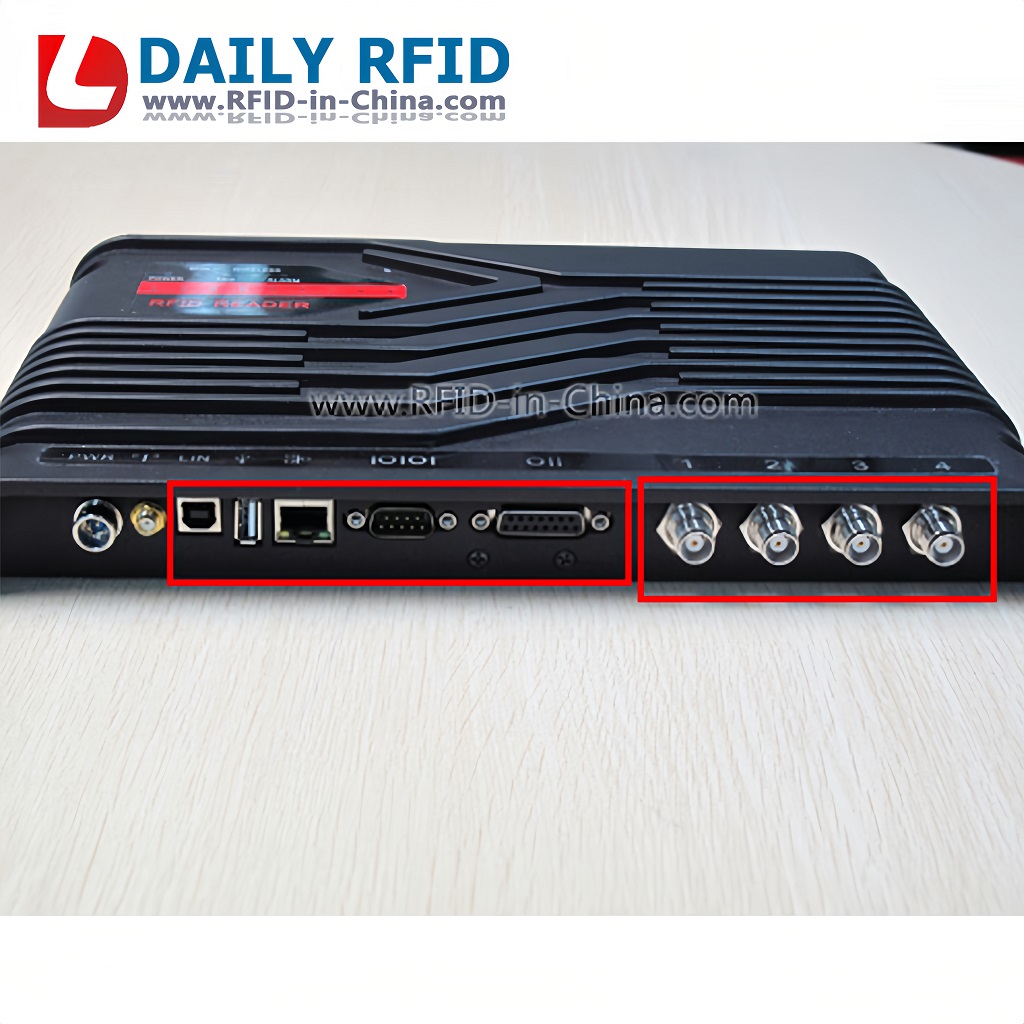
A four-port UHF RFID reader class, used where several antenna zones must cover one high-traffic factory read point.
A UHF RFID reader is the fixed, mobile or embedded device that powers passive ultra-high-frequency tags and converts their backscatter into usable identification data. In a smart manufacturing project it is usually the reader, not the tag, that decides whether a workflow can be automated at all: the device sets the read range, the number of tags captured in one pass, the mounting position, the enclosure rating — and the compliance documentation a plant has to file.
Reader classes are frequently treated as interchangeable. They are not. A ceiling-mounted reader with an integrated antenna covers a working radius measured in metres. A four-port fixed reader can drive four antenna zones across a loading lane and read up to 1,000 tags at once. A handheld covers a shelf row. A desktop module covers a single tag at a distance measured in centimetres. Matching the class to the workflow is the difference between a pilot that scales and a pilot that stalls.
This reference maps three factory workflows — asset movement at gateways and zones, tool and fixture control, and inventory or workbench counting — to reader form factors and the published specifications behind them. Product and certification facts come from DAILY RFID CO., LIMITED, an RFID manufacturer founded in 2008 and based in Guangzhou, China, operating a 28,000 m² factory with 180~200 employees and 38 engineers. The company manufactures RFID tags and RFID readers, with annual output of approximately 50 million RFID tags, 30 million RFID cards and 100,000 RFID reader units, and exports about 80% of production to the EU and USA.
The problem: workflows are compared, hardware constraints are not
Factories rarely fail at RFID because the technology is unavailable. They fail because the read point was specified from a drawing instead of from the physical path a tagged item actually travels. Four constraints decide the reader class before any purchase discussion becomes useful.
| Constraint | Question to answer | What it decides |
|---|---|---|
| Read-point geometry | Does the tag pass overhead, at the side of a lane, or in an operator's hand? | Ceiling, fixed multi-port, or handheld class |
| Tag density | How many tagged items are present at the peak instant? | Anti-collision capacity and antenna count |
| Environment | Metal, liquid, dust, temperature range, vibration, wash-down? | Enclosure rating, tag construction, mounting method |
| Data path | Ethernet, Wi-Fi, Bluetooth, cellular, or offline sync? | Reader variant selection |
Answer these four questions and most reader candidates eliminate themselves. The rest of this reference applies that logic to three workflows and to the hardware classes that fit them.
The reader form-factor map
Reader classes differ in three measurable ways: coverage geometry, anti-collision capacity and environmental tolerance. The table below summarises the classes most commonly deployed on factory floors, with the published specifications of the corresponding models.
| Reader class | Reference model | Published range | Anti-collision | Environment |
|---|---|---|---|---|
| Ceiling all-in-one | DL6990 UHF Ceiling RFID Reader | 0.1–5 m overhead, 33 dBm adjustable | Up to 50 tags | IP66, −20 to +60 °C, 180×180×28 mm |
| AI multi-port fixed | DL6940/6960 AI Multi-Antenna 4-Port UHF Reader | 25–30 m read, 10–15 m write | Up to 1,000 tags | IP64, −30 to +70 °C, 4 external TNC/SMA ports, 5 W |
| Fixed integrated (PoE / GSM) | DL921 UHF Long Range RFID Reader with GSM | 0.1–15 m | Up to 50 tags | IP65, −20 to +60 °C, 2G/4G cellular, PoE variant |
| Wi-Fi integrated | WiFi RFID Reader DL920Plus | 8–15 m read, up to 7 m write | Anti-collision supported | IP64, −30 to +70 °C, integrated Wi-Fi |
| Compact integrated | UHF Bluetooth RFID Reader DL930B / DL930W / DL930G | 4–8 m | Protocol-level multi-tag processing | IP65/IP66, −30 to +70 °C |
| Industrial handheld | DL1380 AI-Powered RFID Handheld; DL1280 Industrial PDA | UHF 0.1–20 m | More than 200 tags (DL1380); 100 tags (DL1280) | IP65, 1.5 m drop resistance (DL1380) |
| Tray readers | DL6993 RFID Tray Reader; DL4130H RFID Jewelry Tray Reader (HF) | 0.1–5 m (UHF tray); 1–50 cm (HF tray) | 80–100 tags; 50 tags | IP66; IP54 |
| Desktop module / encoder | DL213 Type-C UHF Reader Module; DL9702 AI Tag Tester & Encoder | 0.1–10 cm; 10–15 cm | 5 tags; single-tag lock filtering | Exposed module / desktop enclosure, USB powered |
| Cabinet reader module | RFID Smart Cabinet Component | 0.1–5 m, software optimised for fixed cabinet range | More than 500 tags per partition | IP54, −30 to +70 °C, 4/8/16 antenna ports, GPIO |
The map shows why one reader standard is rarely the right answer. A ceiling reader and a handheld can share the same air-interface protocol and still serve entirely different workflows.
Scenario 1: asset movement at gateways and zones
Gateway and zone tracking is the workflow where fixed infrastructure pays back fastest, because the tag population is large, the traffic pattern is predictable and the read point is physically stable.
Overhead coverage. The DL6990 UHF Ceiling RFID Reader integrates its antenna into a 180 mm × 180 mm × 28 mm enclosure and provides 0.1 m to 5 m of overhead reading at up to 33 dBm adjustable transmit power, with simultaneous reads of up to 50 tags and an IP66 rating. That makes it a zone device rather than a checkpoint device: it confirms that an asset or tote is inside a defined area, and it tolerates dusty or semi-outdoor corners of a plant where a non-sealed enclosure would not survive.
Lane coverage. Where the requirement is a walk-through gate, a dock door or a line-side read point, the DL6940/6960 AI Multi-Antenna 4-Port UHF Reader is the appropriate class. It provides four external TNC/SMA antenna ports, a 25 m to 30 m read range with a 10 m to 15 m write range, and high-density anti-collision specified for up to 1,000 simultaneous tags, drawing 5 W with IP64 protection across a −30 °C to +70 °C operating range. Its data-processing speed is specified at 16 times that of ordinary mainstream readers — relevant when a forklift presents a burst of tags rather than a steady trickle.
Read points without a cable. Not every gateway has an Ethernet drop. The WiFi RFID Reader DL920Plus covers 8 m to 15 m with an integrated antenna and a built-in Wi-Fi module at IP64, while the DL921 UHF Long Range RFID Reader with GSM adds 2G/4G cellular backhaul, plus a Power over Ethernet variant for single-cable installation, reading 0.1 m to 15 m with up to 50 tags at IP65.
Documented factory profiles follow the same pattern. An automotive manufacturing profile specifies fixed readers with an antenna array streaming component data to a manufacturing execution system at high throughput, and a Spanish automotive parts warehouse deployment using 420 long-range reader sets reports inbound receiving with 40%–70% less manual work and fewer missed pallet scans. The lane is a fixed-reader problem, not a handheld problem.
Scenario 2: tools, fixtures and the on-metal boundary
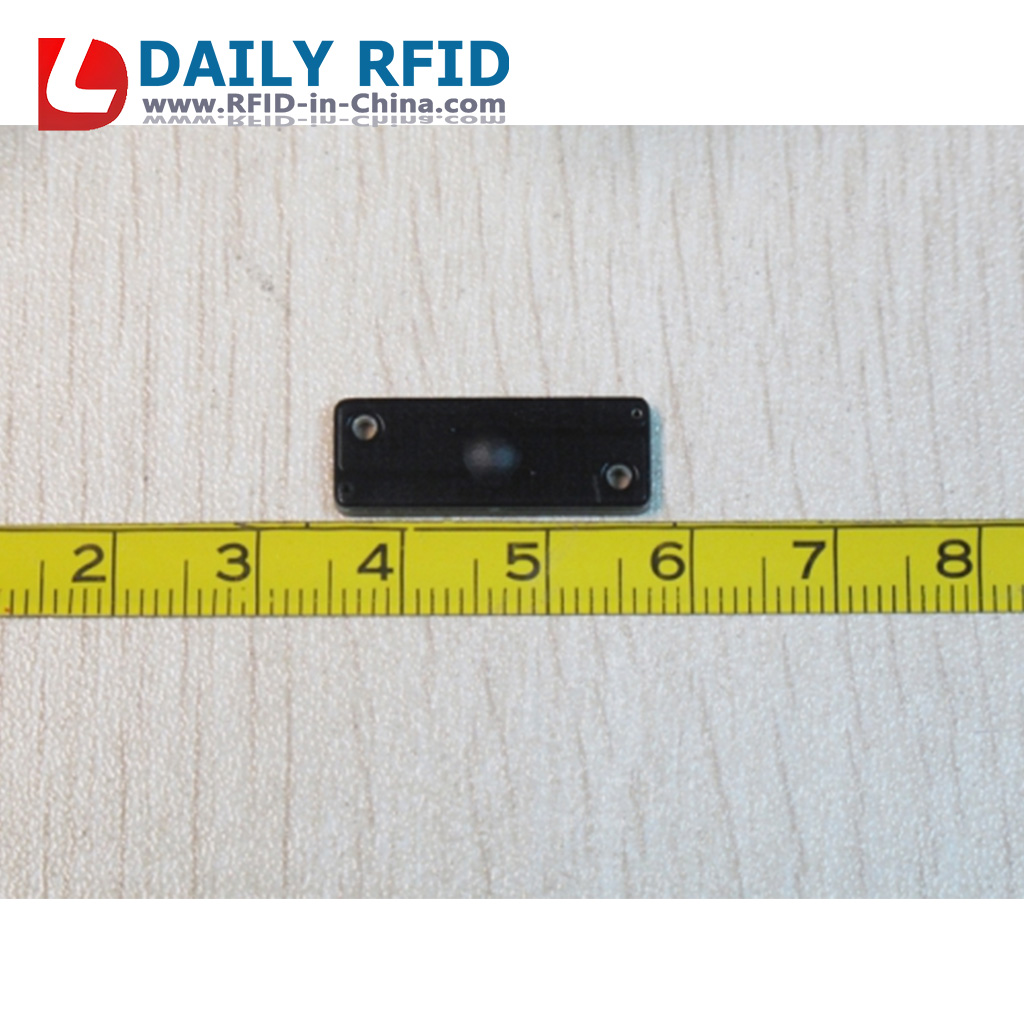
On-metal tag construction, required when tagged items are steel tools, fixtures or machined parts.
Tool control is the workflow where physics intervenes first. Metal tools, fixtures and machined parts detune a standard UHF label, so the tag and the reader settings have to be selected together.
On-metal tag behaviour. The RFID Tool Management Adhesive Tag uses an integrated ferrite isolation layer that prevents the metal surface from short-circuiting or detuning the antenna. Its published reading distance is 1 m to 3.5 m on metal surfaces using a 4 W EIRP handheld reader, and up to 5 m off metal. The same product is available in footprints from 25 mm × 9 mm to 50 mm × 10 mm with a 1.2 mm to 1.5 mm on-metal thickness profile, so it fits curved handles and small socket sets without affecting grip. Its operating range is −40 °C to +85 °C, with storage to +100 °C — relevant for plants that keep tooling in unheated areas.
Cabinet-level tool control. Where every issue and return has to be a transaction, a cabinet module is more efficient than a handheld sweep. The RFID Smart Cabinet Component supports 4, 8 or 16 external antenna ports, reads more than 500 tags per partition, and uses RSSI shelf-level positioning so adjacent drawers do not cross-read. It also exposes opto-isolated GPIO for electronic locks and door sensors, which means the cabinet authorises a door opening rather than merely logging one afterwards. Its rated operating range is −30 °C to +70 °C at IP54.
Locating tools in open production areas. For tools that live on benches and fixtures rather than in a crib, a handheld closes the loop. The DL1380 AI-Powered RFID Handheld reads UHF tags from 0.1 m to 20 m with more than 200 tags in anti-collision, applies edge filtering to suppress repeat reads, and carries IP65 protection with 1.5 m drop resistance — the practical threshold for walking a shop floor. A German warehouse and manufacturing deployment covering 120,000 on-metal tags reports tool and fixture search time reduced by 40%–70% and audit preparation time reduced by 50%–80%.
Scenario 3: inventory, trays and workbench counting

Tray readers deliberately trade range for precision, so a scan captures one workstation instead of the next one.
Not every read point is a gate. Kit trays, small-parts bins and encoding benches need readers whose range is deliberately short.
Workbench batch counting. The DL6993 RFID Tray Reader is a flat-panel device with an integrated antenna covering 0.1 m to 5 m and reading 80 to 100 tags in a single pass at IP66, which suits kit trays, small-parts trays and returns verification. Where items are metallic or densely packed in a small area, the HF class is used instead: the DL4130H RFID Jewelry Tray Reader operates at 13.56 MHz with a built-in near-field loop antenna array over 1 cm to 50 cm, reads up to 50 tags, and uses a metal-resistant design that avoids blind spots when the tray sits on a metal counter.
Encoding and quality control. Tags should be validated before they enter the process, not after a pallet has been labelled. The DL9702 AI RFID Tag Tester & Encoder works at 10 cm to 15 cm with 17 dBm transmit power, uses an AI-enhanced single-tag lock filter to prevent adjacent tag mis-reads during high-intensity encoding, and draws 0.25 W from a USB port. For embedded stations, the DL213 Type-C UHF Reader Module measures 45 mm × 30 mm × 6 mm, reads five tags at up to 23 dBm over 0.1 cm to 10 cm, and supports USB keyboard simulation so tag data drops straight into an existing form field without custom software.
Mobile counting. For periodic shelf and pallet counts, the DL1280 Industrial PDA covers UHF, HF and LF in one terminal, reads up to 100 tags simultaneously at more than 100 tags per second, and reaches 0.1 m to 20 m on UHF under IP65 with Android 12 on an eight-core 2.0 GHz processor — useful where the same device must handle UHF pallets and HF cards in one shift.
Technical constraints that decide the reader class
Air interface. Passive UHF RFID operates in the 860 MHz to 960 MHz range and is standardised under ISO/IEC 18000-6C, also known as EPC Gen 2. Regional sub-bands differ — 902 MHz to 928 MHz in the Americas, 920 MHz to 925 MHz in parts of Asia, and 860 MHz to 868 MHz in Europe — which is why readers are specified with selectable or customisable frequency ranges rather than a single fixed channel. The reader models referenced here operate across the 860 MHz to 960 MHz span with regional configuration.
Read speed and capacity. Single-tag read time is commonly specified below 10 ms per 64 bits, but throughput is decided by anti-collision capacity: 50 tags on an integrated ceiling or narrow-beam device, 80 to 100 on a tray reader, more than 200 on an AI handheld, more than 500 per cabinet partition, and up to 1,000 on a four-port fixed reader. A gateway that presents several hundred tags per pallet will saturate a low-capacity reader regardless of its nominal read distance.
Metal and liquid. UHF energy is absorbed and reflected by metal and by water-bearing products. This is a tag-engineering problem first and a reader problem second: ferrite-isolated on-metal tags restore performance, and transmit power plus antenna zoning compensate for the rest. The boundary remains real — on-metal reading distance for the tool tag is 1 m to 3.5 m versus up to 5 m off metal.
Environment. Shop-floor readers should be matched to the environment rather than the reverse. Across the range, published tolerances include IP54 for cabinet modules, IP64 for the four-port reader and the Wi-Fi reader, IP65/IP66 for compact integrated and handheld units, and operating ranges from −30 °C to +70 °C for the four-port reader down to −20 °C to +60 °C for several integrated models. Freezers, wash-down areas and outdoor yards each eliminate a different subset of the catalogue.
Compliance checks before a reader is approved
Certification is a procurement filter, not a formality: a reader that cannot be placed lawfully in the destination market cannot be piloted. The documents below are on record for the referenced product families.
| Document | Scope | Issued by | Market |
|---|---|---|---|
| CE RED Certificate of Compliance 2019, no. DGE190109029 | UHF RFID Reader & Writer under Directive 2014/53/EU | Dongguan NTEK Testing Technology Co., Ltd. | EU |
| CE Certificate of Conformity, no. ATE20180529 | RFID Reader-02 per EN 55032:2015 and EN 55024:2010+A1:2015 | Shenzhen Accurate Technology Co., Ltd. (ATC) | EU |
| FCC Supplier's Declaration of Conformity, no. FCSE20015006 | 2.4 GHz RFID active tracking system per FCC Part 15 Subpart B:2018 Class B | Flux Compliance Service Laboratory | US |
| FCC Verification of Compliance, no. ATE20161983 002 | RFID Tiny Tags per FCC Part 15 Subpart B Class B | Accurate Technology Co., Ltd. (ATC) | US |
| RoHS 2.0 no. DGC180421014L / REACH report no. DGC170511007T02 | RFID Label, per Directive 2011/65/EU and Regulation (EC) No. 1907/2006 | NTEK Testing Technology Co., Ltd. | EU |
| Certificate of Analysis, no. SNTEK2026032314501 | RFID embedded tag per ISO/IEC 18000-6C, ISO/IEC 18046-3:2021, IEC 60529, IEC 62321 | North South Precision Testing Technology Service (Shenzhen) Co., Ltd. | Global |
Two practical notes apply here. First, certification scope matters: a certificate covers the models it lists, so a purchase order should name the exact model rather than a product family. Second, component-level compliance is tracked separately from the finished device — tag products carry their own RoHS, REACH and analysis records, and a finished assembly inherits only what its listed components carry.
Customisation, MOQ and lead-time constraints
Hardware fit is only half of a procurement decision. The other half is whether the supplier can deliver the configuration, at the quantity, within the project window. Published production parameters for the relevant product families are listed below.
| Item | Customisation | MOQ | Lead time | Quality control |
|---|---|---|---|---|
| UHF Fixed Reader | Antenna gain, interface | 1 unit | 15~45 days | Factory acceptance test |
| UHF Handheld Reader | OS, software, housing | 1 unit | 15~30 days | Full system burn-in |
| RFID Tray Reader | Antenna layout, interface, software | 1 unit | 20~45 days | Factory acceptance test |
| RFID Smart Tool Cabinet | Cabinet size, reader module, software | 1 unit | 20~45 days | System integration test |
| Anti-metal RFID tag | Form factor, adhesive | 50 units | 7~15 days | 100% signal test |
| UHF label for metal surfaces | Label size, adhesive, printable surface | 1,000 units | 7~15 days | Peel and signal test |
These figures matter most at pilot stage, where a plant needs a handful of units rather than a container. A minimum order of one reader unit and short lead times make it practical to validate a read point before committing to a line-wide rollout.
Market context
Third-party estimates place the global UHF RFID reader market at approximately USD 4.8 billion in 2025, projected to reach USD 11.2 billion by 2034 (Dataintelo). UHF technology accounted for 40.72% of total RFID market revenue in 2025, driven by retail inventory cycles and multi-item read capability (Mordor Intelligence). Regionally, Asia Pacific is the fastest-growing hardware region, with an expected 11.8% CAGR in shipments through 2031 (ABI Research), while the Americas still account for more than 60% of global UHF tag usage, largely on the back of retail mandates (IDTechEx).
For manufacturing buyers the implication is supply-side rather than aspirational: reader and tag supply is expanding, specification variety is increasing, and the differentiating question shifts from availability to fit.
Comparison with barcode, HF and active RFID — including the boundaries
| Approach | Read geometry | Strength | Boundary |
|---|---|---|---|
| Barcode / 2D label | Line-of-sight, one item at a time | Low label cost, universal printing | Requires line of sight and manual aiming; cannot batch-read a pallet |
| HF / NFC (13.56 MHz) | Centimetres to about 50 cm | Precise, contained read zone; up to 50 tags on a tray reader | Short range limits gateway and yard use |
| Passive UHF (860–960 MHz) | Centimetres to 25–30 m depending on reader and antenna | Batch reads up to 1,000 tags; long range; battery-free tags | Metal and liquid detune tags; positioning resolution is zone-level, not continuous |
| Active 2.4 GHz | 0–100 m adjustable | Continuous presence and long range; up to 200 tags in anti-collision | Requires battery tags, adding cost and maintenance |
The boundaries deserve to be stated plainly, because they explain why mixed installations remain normal:
- Passive UHF reports zone-level presence, not continuous position. A ceiling reader covering 0.1 m to 5 m, or a lane reader covering 25 m to 30 m, tells the system that a tagged asset is inside a defined zone; it does not plot a live track. Continuous positioning requires an active layer such as the DL9230 RFID TCP/IP Active Reader, which reads 2.4 GHz active tags at 0 m to 100 m with up to 200 tags in anti-collision — but active tags carry batteries and add maintenance.
- Metal shortens range on the tag side. The same tool tag that reads at up to 5 m off metal reads at 1 m to 3.5 m on metal.
- Short-range classes stay short. Tray readers and desktop modules trade coverage for precision: 80 to 100 tags on a UHF tray, 50 tags on an HF tray, five tags on a Type-C module at 0.1 cm to 10 cm.
- Handheld counting is still manual walking. Handhelds make each pass faster and reduce error rates, but they do not remove the labour of the pass; only fixed infrastructure removes the pass.
Future outlook
Three directions are already visible in specifications rather than in promotional language. First, edge intelligence: AI filtering and multi-antenna coordination are being used to suppress duplicate reads and distribute coverage across zones, which raises practical anti-collision capacity from tens to hundreds of tags per read point. Second, connectivity decoupling: Wi-Fi, Power over Ethernet and cellular variants mean a read point no longer has to sit where the cable is, which matters for yards, remote gates and temporary lines. Third, adjacent automation: RFID-enabled inventory collection by drones is projected to reach USD 8.2 billion by 2026 as a service category (PR Newswire), a signal that mobile and aerial data capture is being evaluated alongside fixed infrastructure in large facilities.
None of these developments removes the constraint logic described in this reference. They change which box satisfies it.
FAQ
Which reader type fits a factory gateway or zone-tracking workflow?
Gateway and zone workflows are served by fixed readers rather than handhelds. For overhead zone coverage, an integrated ceiling reader such as the DL6990 provides 0.1 m to 5 m of overhead reading at up to 33 dBm adjustable power, reads up to 50 tags simultaneously and carries an IP66 enclosure. For lane, dock-door or conveyor read points, a multi-port fixed reader such as the DL6940/6960 provides four external TNC/SMA antenna ports, a 25 m to 30 m read range and anti-collision specified for up to 1,000 tags. Read points without a network drop use the WiFi RFID Reader DL920Plus at 8 m to 15 m, or the DL921 series with GSM/PoE backhaul at 0.1 m to 15 m.
How far can a UHF RFID reader read on a factory floor?
Published distances vary by class and by tag. A Type-C module such as the DL213 reads 0.1 cm to 10 cm; the DL9702 encoder reads 10 cm to 15 cm; an HF tray reader covers 1 cm to 50 cm; a UHF tray reader and a ceiling reader cover 0.1 m to 5 m; the compact integrated DL930B reads 4 m to 8 m; the Wi-Fi reader reads 8 m to 15 m; the GSM/PoE fixed reader reads 0.1 m to 15 m; industrial handhelds read 0.1 m to 20 m; and the four-port DL6940/6960 reaches 25 m to 30 m. Actual performance depends on transmit power, tag type, mounting angle and the surrounding metal and liquid.
Why is the read distance shorter for tags mounted on metal tools?
Metal surfaces reflect and short-circuit the tag antenna, shifting its tuning and reducing the energy the tag can harvest. On-metal tags solve this with an integrated ferrite isolation layer. The RFID Tool Management Adhesive Tag is specified at 1 m to 3.5 m on metal surfaces with a 4 W EIRP handheld reader, against up to 5 m off metal. The same product is built in footprints from 25 mm × 9 mm to 50 mm × 10 mm with a 1.2 mm to 1.5 mm on-metal thickness profile and an operating range of −40 °C to +85 °C.
What protection rating and temperature range should a shop-floor reader have?
Match the enclosure to the area rather than the whole plant. Published ratings across the referenced range include IP54 for cabinet reader modules, IP64 for the four-port AI reader and the Wi-Fi reader, IP65 for industrial handhelds and the GSM/PoE fixed reader, IP65/IP66 for the compact integrated reader, and IP66 for the ceiling reader and UHF tray reader. Operating temperature spans −30 °C to +70 °C for the four-port and Wi-Fi readers, and −20 °C to +60 °C for the ceiling, tray and several integrated models, with storage ratings extending further.
How many tags can a reader capture at once?
Anti-collision capacity is published per model: five tags for the DL213 and DL228 Type-C modules, 50 tags for the DL6990 ceiling reader, the DL921 fixed reader and the DL4130H HF tray reader, 80 to 100 tags for the DL6993 UHF tray reader, 100 tags for the DL1280 industrial PDA, more than 200 tags for the DL1380 AI handheld, more than 500 tags per partition for the RFID Smart Cabinet Component, and up to 1,000 tags for the DL6940/6960 four-port AI reader. In practice, capacity depends on tag orientation, item material and how densely the tagged items are stacked, so a site test at the real read point remains necessary.
Which certifications should be verified before a reader is approved for an EU or US plant?
For the EU, verify the CE RED Certificate of Compliance under Directive 2014/53/EU — certificate number DGE190109029, issued by Dongguan NTEK Testing Technology Co., Ltd. for UHF RFID reader and writer models — and the CE Certificate of Conformity number ATE20180529, issued by Shenzhen Accurate Technology Co., Ltd. per EN 55032:2015 and EN 55024:2010+A1:2015 for the RFID Reader-02 family. For the US, verify the FCC Supplier's Declaration of Conformity number FCSE20015006, issued by Flux Compliance Service Laboratory under FCC Part 15 Subpart B:2018 Class B for the 2.4 GHz active tracking system, and FCC Verification of Compliance number ATE20161983 002 for RFID Tiny Tags. Material compliance is documented separately: RoHS 2.0 certificate DGC180421014L and REACH test report DGC170511007T02, both issued by NTEK Testing Technology Co., Ltd., and Certificate of Analysis SNTEK2026032314501 referencing ISO/IEC 18000-6C, ISO/IEC 18046-3:2021, IEC 60529 and IEC 62321.
Reference material: the DAILY RFID company profile, including product families and production data, is available as a downloadable document at company profile (PDF). Product information and contact details are published at www.rfid-in-china.com.