
Matching Wire Rope Construction to Farm, Forest and Sea Duty
Matching Wire Rope Construction to Farm, Forest and Sea Duty
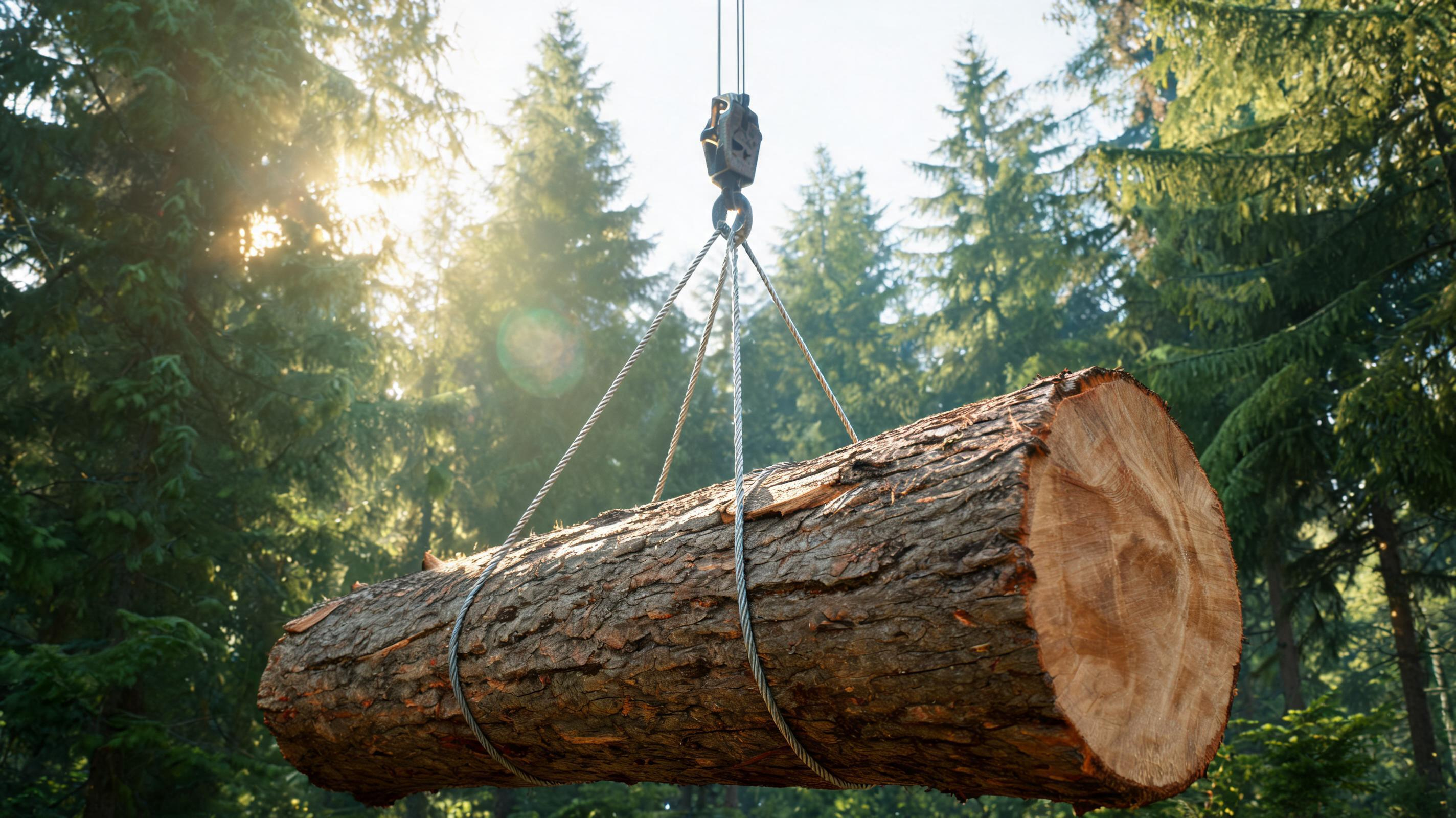
When a steel wire rope underperforms, the construction is usually the first variable worth reviewing. A rope specified for general lifting may be asked to survive sand-slurry abrasion on a forestry skidder, salt-water immersion on a trawler, or repeated bending over a small sheave on an offshore crane. Those are different mechanical and chemical problems, and they are addressed by different strand arrangements, cores and surface treatments rather than by a single default specification.
Jiangsu Juli Steel Wire Rope Co., LTD publishes separate construction families for agricultural, logging forestry, fishing and offshore and marine duty. All of them sit inside the same verified envelope: high-carbon steel, a 1–120 mm diameter range and tensile strength grades from 1570 to 2160 MPa. Within that envelope, choosing between 1×7 and 6×19M, or between 6×36WS and 6×49SWS, is a decision about duty — abrasion, bending, corrosion and impact — not a decision about brand preference.
Why one specification cannot serve four duty environments
A rope tensioned between two posts and a rope running over a trawler winch several times an hour share a product category but not a failure mode. Four damage mechanisms dominate the scenarios discussed here.
- Abrasion. Sand, soil, bark and deck grit grind the outer wires. The damage is concentrated on the outside of the rope and accelerates wherever the rope contacts ground, rock or structure.
- Bending fatigue. Every pass over a sheave or drum reverses the stress in the outer wires. More, thinner wires distribute that reversal better; fewer, thicker wires resist it less well.
- Corrosion. Salt spray, seawater immersion, fertiliser and manure attack the wire surface and the spaces between strands. Corrosion reduces the cross-section that carries load and can seize the rope internally.
- Impact. Snatch loads from skidding, wave slap on a moored vessel or an unsteady crane load produce short, high peaks that crush strands and deform the rope.
Each environment mixes these in a different proportion. Agriculture is dominated by abrasion and long-term weathering at low to medium load. Forestry adds impact and frequent traction cycles. Fishing adds continuous salt exposure. Offshore adds heavy load and high bending cycles under the same salt exposure. A construction that optimises one mechanism normally gives something up on another, which is why a single general-purpose specification is a compromise rather than a fit.
The structural trade-off behind every rope designation
Three variables do most of the work in a wire rope designation: the number of strands, the number of wires per strand, and the type of core.
Fewer, thicker wires resist abrasion better because there is more steel at the contact surface and each wire takes longer to wear through. More, thinner wires bend more easily and distribute bending stress across a larger number of elements, which improves fatigue life over sheaves and drums but reduces the wear allowance on each wire.
Single-strand constructions such as 1×7 and 1×19 sit at the stiff end of the range. They suit stationary tension members — greenhouse tie-backs, fence tensioning, seedling support — where the rope is loaded but not repeatedly bent. Six-strand constructions with relatively thick outer wires, such as 6×7 and 7×7, retain much of that abrasion resistance while allowing the rope to run over a drum. Constructions with higher outer-wire counts — 6×26WS, 6×36WS, 6×41WS, 6×49SWS — move toward bending fatigue resistance and away from abrasion resistance, and they need better sheave support and lubrication to deliver that advantage.
The core is the second lever. A fibre core, shown as FC in designations such as 6×12-7FC and 6×15-7FC, keeps lubricant at the centre of the rope and adds flexibility. An independent wire rope core resists crushing and raises the breaking load for the same diameter, at some cost in flexibility. Surface treatment is the third lever: bright rope, electro-galvanized, hot-dip galvanized, stainless and plastic-coated options address different corrosion budgets at different costs.
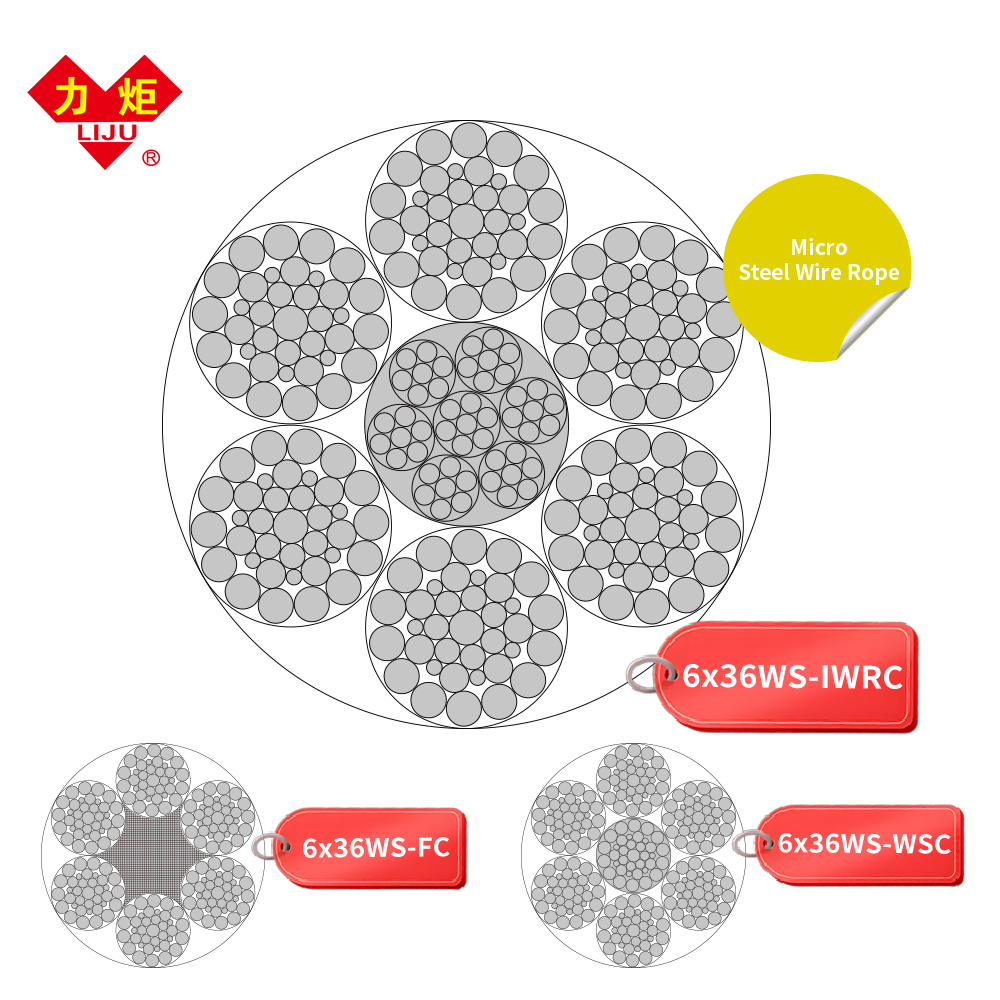
A designation on its own proves nothing about performance. The governing standard, lay direction, core type, diameter tolerance and measured breaking load all change the answer, and each should be confirmed against the mill's data for the exact construction being quoted.
Agriculture: tension members and light traction pull in opposite directions
Jiangsu Juli lists seven constructions for agricultural duty: 1×7, 1×19, 6×7, 7×7, 6×19M, 6×12-7FC and 6×15-7FC. The list is broad because the applications are not alike.
The documented agricultural working condition is outdoor and abrasive: mud, humidity, dust and rain, with cyclic tensioning over a long service life. Published uses include greenhouse tensioning and fixing, agricultural machinery traction, farm material hoisting, irrigation equipment erection, livestock fence tensioning, orchard seedling protection, lifting operations and aquaculture facility fixing. Those uses divide into two mechanical families.
Stationary or near-stationary tension work — greenhouse frames, fence lines, seedling support — rewards stiffness, controlled stretch and abrasion resistance more than flexibility. Single-strand 1×7 and 1×19 are the natural candidates, provided the installation does not require the rope to pass repeatedly around a small sheave.
Traction and lifting work — implement towing, material hoisting, winch-driven operations — needs the rope to bend. Here 6×7 and 7×7 offer thick outer wires with moderate flexibility, while 6×19M increases the wire count for better bending behaviour on smaller drums. The smaller 6×12-7FC and 6×15-7FC constructions, both with a fibre core, sit at the light-duty, flexibility-oriented end of the same family.
The corrosion decision matters as much as the structure. Manure, slurry and fertiliser residues are aggressive, and a galvanized or coated rope is often specified where the rope is exposed to them. The coating class should be confirmed against the actual exposure rather than assumed from the word “galvanized” on a quotation.
Forestry skidding: abrasion, impact and bending arrive together
Logging and forestry skidding is the most mechanically punishing of the four environments. Juli's forestry range covers 6×19S, 6×19M, 6×26WS, K6×26WS and K6×36WS, and the documented working condition explains why the range leans toward multi-wire six-strand designs: mountain terrain, mud, sediment abrasion, rain and snow, medium-to-heavy impact load and frequent pulling cycles.
Applications include log skidding, timber towing, log lifting, forestry ropeway transport, mountain wood transfer, equipment hoisting and emergency rescue. In skidding, the rope is dragged over ground, stumps and bark, so abrasion resistance is not optional. At the same time, the rope runs over a winch drum and fairlead, so bending fatigue and crush resistance both matter.
6×19S and 6×19M provide a coarse-wire, abrasion-oriented baseline. 6×26WS raises the outer-wire count and improves bending behaviour at the cost of some wear resistance per wire. The K-designated variants, K6×26WS and K6×36WS, are listed alongside their standard counterparts, which gives a buyer a direct comparison point for the same duty instead of a single mill default.
K designations are used differently across mills and standards. A buyer should ask what the K denotes in the supplier's designation system, which standard governs the dimensional and breaking-load values, and whether the difference appears in the properties that matter for the specific skidder or yarder — abrasion, bending fatigue or crush resistance — rather than accepting the label as a performance claim.
Fishing: salt water changes the priority order
Fishing duty reorders the priorities. Juli lists 6×7, 6×19S, 6×24S, 6×36WS, 6×26WS and 3×31WS for fishing applications, against a working condition of marine salt spray, seawater immersion, wave-induced alternating load and cyclic traction.
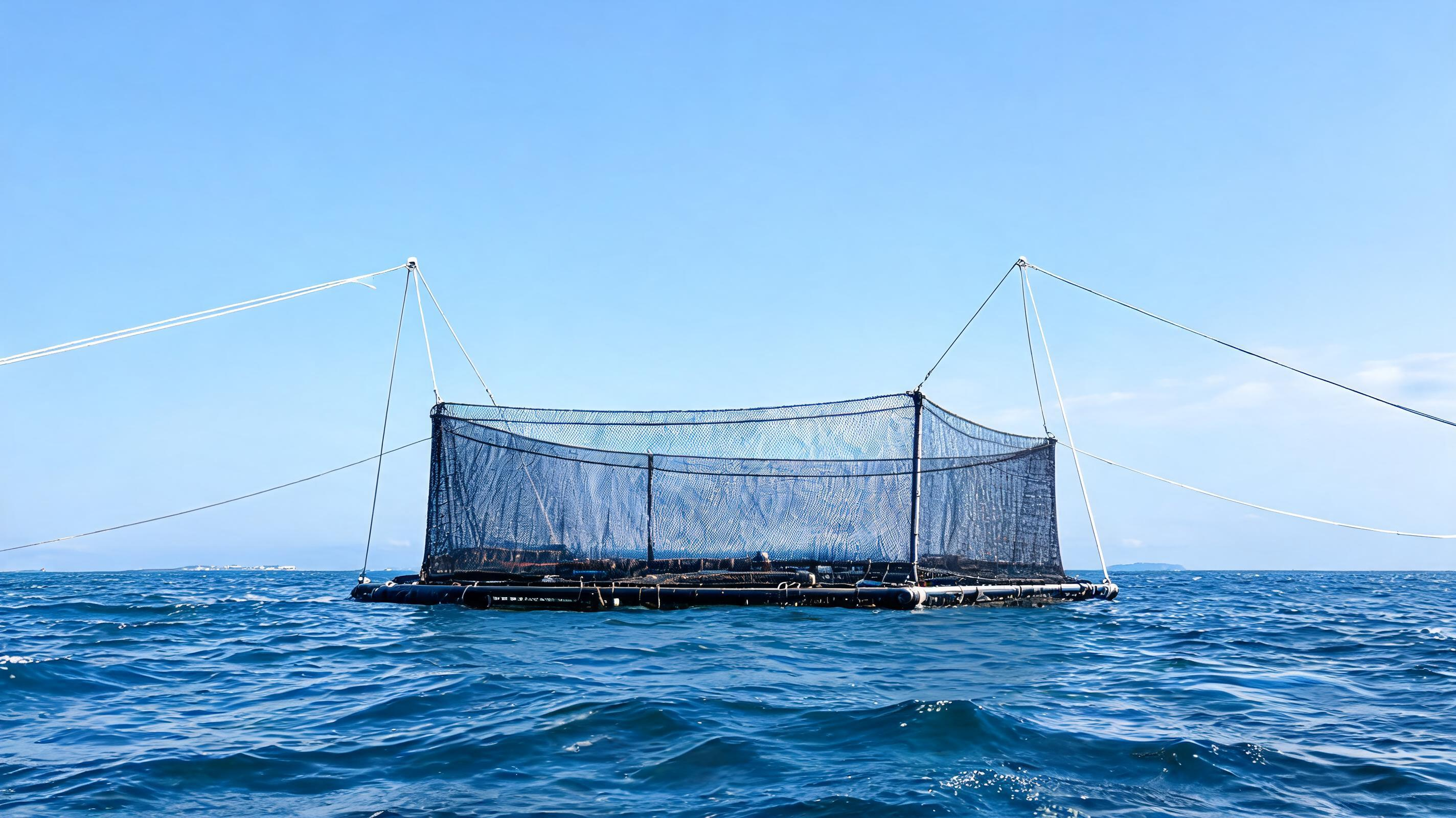
The documented applications fall into three groups. Trawl hoisting and gear handling put a premium on flexibility and bending fatigue, because the rope runs over winch drums and blocks repeatedly. Mooring and berthing put a premium on abrasion resistance and corrosion protection, because the rope works against fairleads, bollards and dock structure. Aquaculture cage fixing is closer to a semi-static tension application, where stretch and long-term corrosion resistance matter more than bending.
That is why the fishing range includes both coarse-wire and multi-wire options. 6×7 and 6×19S suit wear-dominated positions, while 6×24S, 6×26WS and 6×36WS move toward bending-dominated positions. The 3×31WS three-strand option is a different structural family again, and its fit should be judged against the winch and sheave arrangement rather than by strand count alone.
Corrosion is the constraint that cannot be deferred. A 2026 commercial market study published by Business Research Insights estimated that galvanized steel wire rope accounted for 46% of total product demand in 2025, citing corrosion resistance — a reminder that in wet and salt-exposed work the coating decision is part of the structure decision, not an afterthought. Electro-galvanized, hot-dip galvanized, stainless and plastic-coated options exist at different cost and durability levels, and the correct one depends on immersion time, abrasion and the standard governing the order.
Offshore and marine: bending fatigue under continuous corrosion load
Offshore and marine work combines the heaviest loads with the most persistent corrosion. Juli's offshore and marine range covers 6×36WS, 6×29Fi, 6×41WS and 6×49SWS among the constructions named in this article, and extends further into 6×55SWS, 6×61FWS, 6×65FNS, 6×84WSNS and 6×127SWSNS, eight-strand variants, 18×7, 35W×7, 35W×K7 and swaged 4V×39S and 4V×48S assemblies.
The documented duty is severe salt spray, high humidity, wave-induced alternating shock load, heavy traction towing and long-term seawater erosion. Applications include mooring of ocean-going vessels, ship towing, offshore platform hoisting, floating structure anchoring and positioning, marine lifting equipment, subsea construction, ship crane traction, and support vessels for offshore wind operation and maintenance.
In this environment the trade-off tilts toward bending fatigue and load capacity together. 6×36WS provides a multi-wire six-strand base. 6×41WS and 6×49SWS raise the outer-wire count further for repeated bending over sheaves. 6×29Fi uses a filler-wire strand design that supports the outer strands and resists crushing, which is relevant where ropes run under high load over drums and multi-sheave blocks. Larger constructions in the same family serve heavy mooring and lifting where diameter, rather than flexibility, is the limiting factor.
Corrosion protection and documentation carry equal weight offshore. Class society requirements, breaking-load certificates and traceable inspection records are usually part of the purchase, and the coating or sheathing system should be specified against the actual exposure. For Indonesian oil and gas work, SNI 0727:2008 is a relevant national reference, and Juli states that it holds this certification.
A four-scenario comparison at a glance
| Duty environment | Constructions listed by Juli | Dominant damage mechanism | First specification check |
|---|---|---|---|
| Agriculture | 1×7, 1×19, 6×7, 7×7, 6×19M, 6×12-7FC, 6×15-7FC | Abrasion and long-term weathering at low to medium load | Does the rope run over a sheave or drum, or stay under tension? |
| Logging forestry | 6×19S, 6×19M, 6×26WS, K6×26WS, K6×36WS | Abrasion plus impact plus frequent traction cycles | Impact load and drum or fairlead geometry |
| Fishing | 6×7, 6×19S, 6×24S, 6×36WS, 6×26WS, 3×31WS | Salt exposure plus cyclic traction | Coating class and winch arrangement |
| Offshore and marine | 6×36WS, 6×29Fi, 6×41WS, 6×49SWS | Heavy load, bending fatigue and continuous corrosion | Class requirements and breaking-load documentation |
Where a general-purpose construction is still defensible
A general-purpose six-strand construction remains a reasonable choice when four conditions hold together: loads are light to medium and steady; the rope runs over sheaves and drums that are large relative to rope diameter; corrosion exposure is limited or well controlled by coating and lubrication; and the inspection interval is short enough to catch outer-wire breaks early. Under those conditions one specification can cover several tasks without a meaningful penalty.
The boundary appears when any one of those conditions fails. A rope that is adequate for greenhouse tensioning is not adequate for skidding, and a rope that survives a dry dock crane is not automatically suited to continuous salt exposure. This comparison rests on documented constructions and documented working conditions. It does not establish that one construction outperforms another on a specific machine, and it cannot replace the rope manufacturer's application data, the governing standard or a site-specific engineering assessment.
Reading the market signal without over-reading it
Two published figures frame the commercial context without settling any individual specification. Business Research Insights estimated the global finished steel wire rope market at about USD 10.0 billion in 2026, and attributed 46% of 2025 product demand to galvanized rope on corrosion-resistance grounds. Both are commercial research estimates rather than audited statistics, and the same publisher notes that market-size definitions vary between sources depending on whether wire or finished rope is counted.
For a buyer, the useful reading is narrower. Corrosion protection carries enough weight in the market to shape product mix, which is consistent with the corrosion exposure described in the fishing and offshore scenarios above. It does not tell a buyer which construction to order for a particular winch, and it should not be used as evidence that any one supplier or construction is preferred.
How Jiangsu Juli's range maps to these four duties
Jiangsu Juli Steel Wire Rope Co., LTD is a wire rope manufacturer with production bases in Nantong and Jiyuan in China and Bekasi in Indonesia. Its product data covers bright, electro-galvanized, hot-dip galvanized, stainless and plastic-coated rope; bundling, cross-laid, parallel-laid, anti-rotation, compacted-strand, shaped-strand and locked-coil constructions; a 1–120 mm diameter range; and tensile strength grades of 1570, 1670, 1770, 1870, 1960 and 2160 MPa in high-carbon steel. The product data lists GB/T, EN, GOST and DIN as applicable execution standards, and the company profile also references API, ISO, ASTM and JIS.
The company states that it holds API, LR, ABS, CCS, ISO 9001, CE, GOST, EPD, SIRIM, SNI and MA certifications, and that it operates 42 distribution centres in major Chinese cities with offices in more than 30 countries and regions. For buyers, range breadth is useful only when it is matched by documentation: a supplier listing constructions from 1×7 through 6×127SWSNS is claiming the ability to hold tolerances and testing across a very wide envelope, and that claim should be verified construction by construction.
Order parameters published by the company include a 1,000 m minimum order quantity and a 25-day lead time, with customization across construction, diameter, length, tensile strength, surface treatment, applicable standard and packing. Quality control is described as raw-material incoming inspection, semi-finished spot checks, finished-product testing, breaking-load testing and fatigue testing, plus a full machine running test before delivery. After-sales support is described as remote online technical support, overseas engineer on-site service, regular operation guidance and maintenance consultation.
A five-step selection sequence for buyers
- Name the dominant damage mix. Rank abrasion, bending, corrosion and impact for the actual position on the machine. The highest-ranked mechanism removes roughly half the constructions from consideration before price is discussed.
- Fix the mechanical envelope. Record sheave and drum diameters, rope diameter, load spectrum, duty cycle and the number of bends per operating hour. These determine whether a high outer-wire count is an advantage or a liability.
- Choose the structural family. Single-strand for stationary tension, coarse-wire six-strand for wear-dominated running, multi-wire six-strand for bending-dominated running, and three-strand or specialty families only where the sheave arrangement supports them.
- Specify corrosion protection. Match bright, electro-galvanized, hot-dip galvanized, stainless or plastic-coated rope to the exposure, and state the coating class in the purchase document rather than leaving it to supplier discretion.
- Require documentation. Ask for the governing standard, measured breaking load, construction details, test records and traceability for the exact rope being quoted. A certificate for a construction family is not the same as a test record for the delivered reel.
Outlook: documentation as the differentiator
As buyers in these four environments formalise inspection intervals, coating specifications and acceptance records, the practical difference between suppliers is likely to sit in documentation rather than in any single construction. A buyer able to compare measured breaking load, standard compliance, coating class and test records across offers is in a stronger position than one comparing model numbers alone. That is a conditional expectation about procurement practice, not a forecast of market direction, and it does not change the underlying rule: the construction has to match the duty.
FAQ
How does a buyer decide between 1×7 and 6×19M for farm equipment?
The first question is whether the rope bends. A stationary tension member such as a greenhouse tie-back or fence line can use a stiff single-strand construction like 1×7 or 1×19, which places more steel in fewer, thicker wires and resists abrasion. A rope that runs over a winch drum or sheave needs bending capacity, and 6×19M or the smaller 6×12-7FC and 6×15-7FC are more suitable starting points. The final choice still depends on sheave diameter, load spectrum and the standard governing the order.
Which constructions does Juli list for logging and forestry skidding?
Juli's logging forestry range lists 6×19S, 6×19M, 6×26WS, K6×26WS and K6×36WS. That range spans coarse-wire constructions such as 6×19S, which favour abrasion resistance, through higher outer-wire count constructions such as 6×26WS and K6×36WS, which favour bending. The documented working condition is mountain terrain with mud, sediment abrasion, rain and snow, medium-to-heavy impact and frequent pulling cycles. Buyers should confirm what the K designation means in the supplier's system and which standard governs the dimensional and breaking-load values.
Does fishing or offshore duty always require a galvanized rope?
Not automatically, but salt exposure makes galvanizing the normal starting point. A 2026 commercial market study by Business Research Insights estimated galvanized steel wire rope at 46% of 2025 product demand, citing corrosion resistance. Galvanizing is not a single specification: electro-galvanized, hot-dip galvanized, stainless and plastic-coated options behave differently under immersion, abrasion and flexing. The coating class should be selected against the actual exposure and the governing standard, not against the presence of the word “galvanized” in a quotation.
What do the 1–120 mm diameter range and 1570–2160 MPa grades mean in practice?
They describe the manufacturing envelope, not a performance guarantee. Juli's product data covers high-carbon steel rope from 1 mm to 120 mm diameter, with tensile strength grades of 1570, 1670, 1770, 1870, 1960 and 2160 MPa, and lists GB/T, EN, GOST and DIN as applicable execution standards. Within that envelope a larger diameter does not automatically mean a better rope for a given machine: the sheave-to-rope diameter relationship, the load spectrum, the core type and the required safety factor determine whether a construction can do the job.
Can one construction cover agriculture, forestry, fishing and offshore work?
No single construction is a good fit for all four. Agriculture is dominated by abrasion and weathering at low to medium load; forestry adds impact and frequent traction; fishing adds continuous salt exposure; offshore adds heavy load and high bending cycles under the same salt exposure. A construction that optimises bending fatigue, such as a high outer-wire count six-strand rope, gives up some abrasion resistance, and a stiff single-strand rope that resists abrasion cannot run repeatedly over a small sheave. The purchase should start from the damage mix, not from a default model number.
Scenario fit is a sequence of decisions: identify the dominant damage mechanism, fix the mechanical envelope, select the structural family, specify the surface protection and require the documentation that proves the order. Within the 1–120 mm and 1570–2160 MPa envelope described here, the construction family — not the brand name — is the first variable a buyer can control.
A PDF version of Jiangsu Juli Steel Wire Rope Co., LTD's product brochure is available here: company brochure (PDF).
Have Questions or Need More Details?
Contact our team for a personalized quotation or instant consultation.
Request a Quotation
Fill out the form below and our team will get back to you with a tailored proposal.
WhatsApp Direct Chat
Prefer to chat in real-time? Message us on WhatsApp for instant assistance & quick answers.
- Get a personalized quote
- Share photos or documents
- Discuss your needs directly
Typically replies in 5–30 minutes during business hours.