
Matching Your Mission: Cordless Tools for Construction vs. Auto Repair
Industry Application Guide · Cordless Power Tools
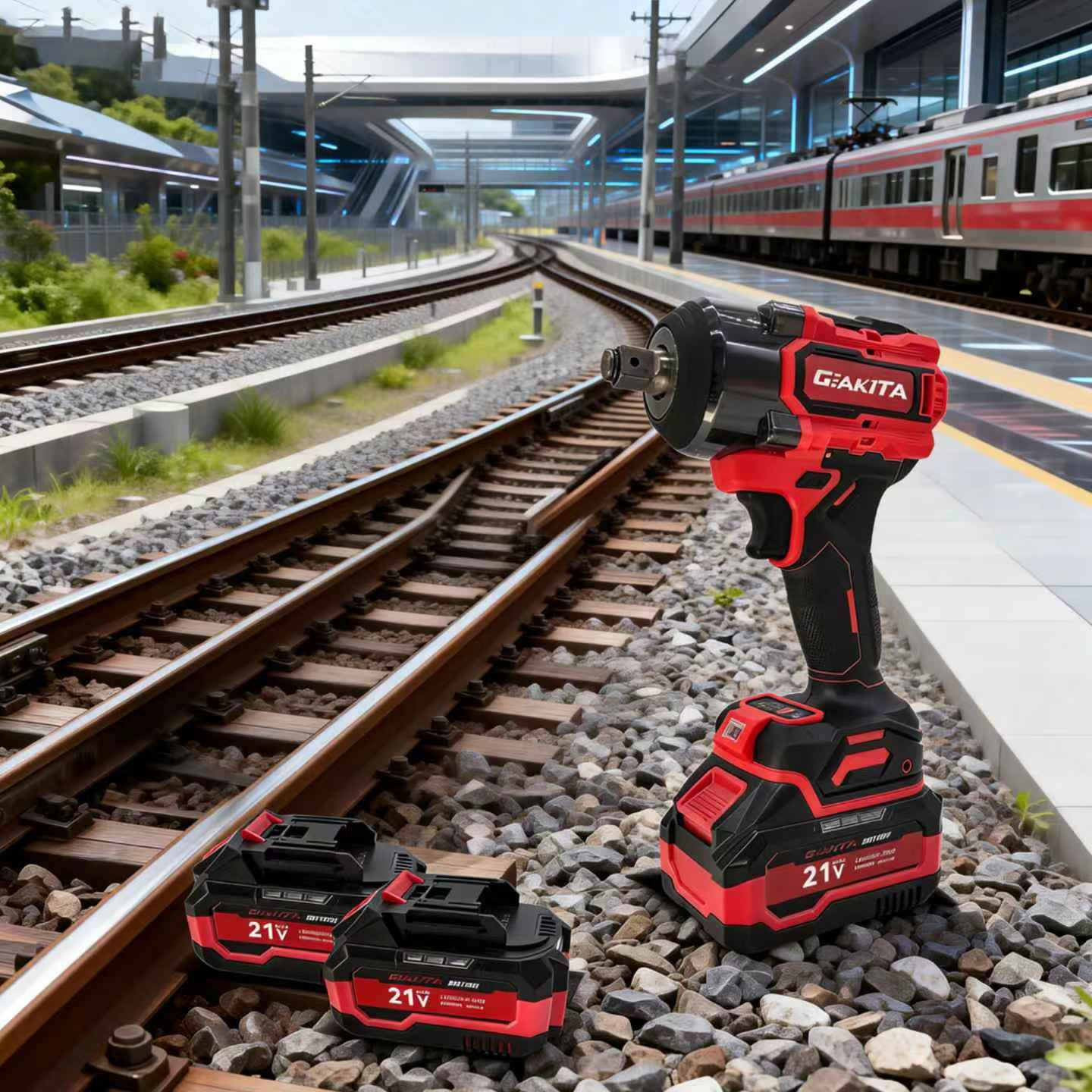
Heavy infrastructure and construction work sits at the continuous-duty end of cordless tool use, where specification choices have long-term consequences.
Cordless power tools are sold by category but bought by mission. A high-temperature construction site and an automotive repair bay both depend on impact wrenches, drills and grinders, yet the two operations impose different constraints on torque, duty cycle, battery configuration and compliance evidence. Getting that mapping right is what separates a tool that still performs in year three from one that is merely on the approved list.
Why category-first buying breaks down
Procurement lists usually begin with a product category: impact wrenches, angle grinders, cordless drills, rotary hammers. The category is often the last thing that should be decided. Voltage class, cell count, torque band, chuck and disc interface, and ambient temperature tolerance are all downstream of the mission. Once a purchaser fixes those variables against the wrong mission, correcting the decision means replacing a fleet rather than a single SKU.
Two variables do most of the separating work. The first is duty cycle: how long the tool runs per shift, and at what ambient temperature. The second is torque band: what the fastener, material or cut actually requires, and how much control the operator needs around it.
Construction and automotive repair diverge on both. A contractor on a high-temperature site is buying against continuous operation, dust and structural bolt loads. A workshop technician is buying against repeatable torque delivery in a confined bay, where over-tightening a component can cost more than under-tightening it.
| Selection variable | High-temperature construction & infrastructure | Automotive repair & maintenance |
|---|---|---|
| Primary operations | Concrete drilling, metal cutting and grinding, bolt fastening, chiseling | Impact tightening and loosening, tire replacement, engine disassembly, daily workshop repair |
| Duty cycle | Continuous operation, commonly 8–12 h/day on heavy-duty projects | Intermittent high-torque bursts between inspection and assembly steps |
| Environment | Outdoor, dust, elevated ambient temperature | Indoor bay, lubricants, restricted clearances |
| Critical tool class | 21V rotary hammer, 21V angle grinder, 1000 N·m impact wrench class | 21V impact wrench, 21V brushless impact drill, compact impact screwdriver |
| Accessory interface | Rotary hammer bits, 100 mm cutting and grinding discs, impact sockets | Impact sockets, hex bits, extensions, drill bits up to 13 mm |
| Evidence buyers ask for | Heat tolerance, duty-cycle stability, EMC and safety documentation | Torque repeatability, tool weight and control, battery turnaround |
Construction and infrastructure: heat, dust and continuous duty
Construction and infrastructure work is recorded in Geakita's application data as professional-grade, industrial heavy-duty operation, with continuous operation of 8–12 hours per day on heavy projects and typical functions spanning drilling, fastening, cutting, grinding and chiseling.
That combination pushes the specification toward the 21V tier rather than compact 16.8V tools, because the mission is defined by how long the tool runs and how much load it carries rather than by how many tasks it can theoretically perform.
Concrete work sets the drilling requirement. The RH01 and RH02 cordless rotary hammers run on 21V brushless pure copper motors with 2000 mAh × 10 cell batteries and deliver a no-load speed of 0–2000 r/min, with a drilling capacity of Φ26 mm in concrete, Φ13 mm in steel and Φ26 mm in wood. Those figures define the practical ceiling of the class: a hole specification above them is not a battery problem, it is a tool-class problem.
Cutting and grinding on site are handled by the 21V angle grinder family. The JM01-02 brushless angle grinder and the JM03 angle grinder both use a 100 mm cutting disc with a 16 mm inner diameter and run at a no-load speed of 12,000 RPM, with a net weight of 1.6 kg including one battery. The JM05 sits on the same 21V, 1300 mAh × 10 cell platform.
Structural fastening is where torque band decides the purchase. The GKR06 heavy-duty wrench delivers an actual torque of 1000 N·m at a no-load speed of 0–3200 r/min on a 21V brushless pure copper motor, and the 21V Brushless Impact Wrench 1000NM is built on a 1500–2000 mAh × 10–15 cell configuration. These models are positioned for construction and steel structures, heavy machinery, railway engineering and maintenance, and shipbuilding.
Field evidence carries more weight than a specification sheet. A programme running more than two years and covering over 5,000 units across construction, retail and distribution channels reported 99.8% on-time delivery, a 0.3% defect rate, and stable performance in environments above 45 °C. The same programme lists concrete drilling, metal cutting and bolt fastening as its primary construction applications.
Automotive repair and maintenance: torque control in a confined bay
Automotive work runs on the same cordless architecture but a different torque logic. Application records list vehicle maintenance, tire replacement, engine disassembly and daily workshop repair as the core tasks, and the tool that fits best in that context is usually the mid-range impact wrench rather than the heaviest model available.
The GKR05 21V pure copper brushless impact wrench delivers 650 N·m at a no-load speed of 0–4000 r/min, with a 2000 mAh lithium-ion pack on a Makita 10-cell configuration. Geakita positions it for automotive and transportation, railway engineering and maintenance, and light industry work. The higher no-load speed relative to the 1000 N·m GKR06 is a meaningful distinction in a bay: faster rundown matters when a technician is moving between many fasteners per hour, while the heavier wrench is reserved for structural and heavy machinery loads.
Around the impact wrench, the workshop set is completed by tools that trade maximum torque for control. The PT24 21V brushless impact drill produces 150 N·m with a 2000 mAh × 15 cell battery, a 13 mm three-jaw metal ratchet chuck and 24+3 torque settings. The QZ01 and QZ02 16.8V impact screwdrivers offer three torque levels of 35/100/120 N·m with stepless speed change and forward and reverse rotation — the range that covers interior trim, panel fasteners and engine-bay reassembly without over-driving small fasteners.
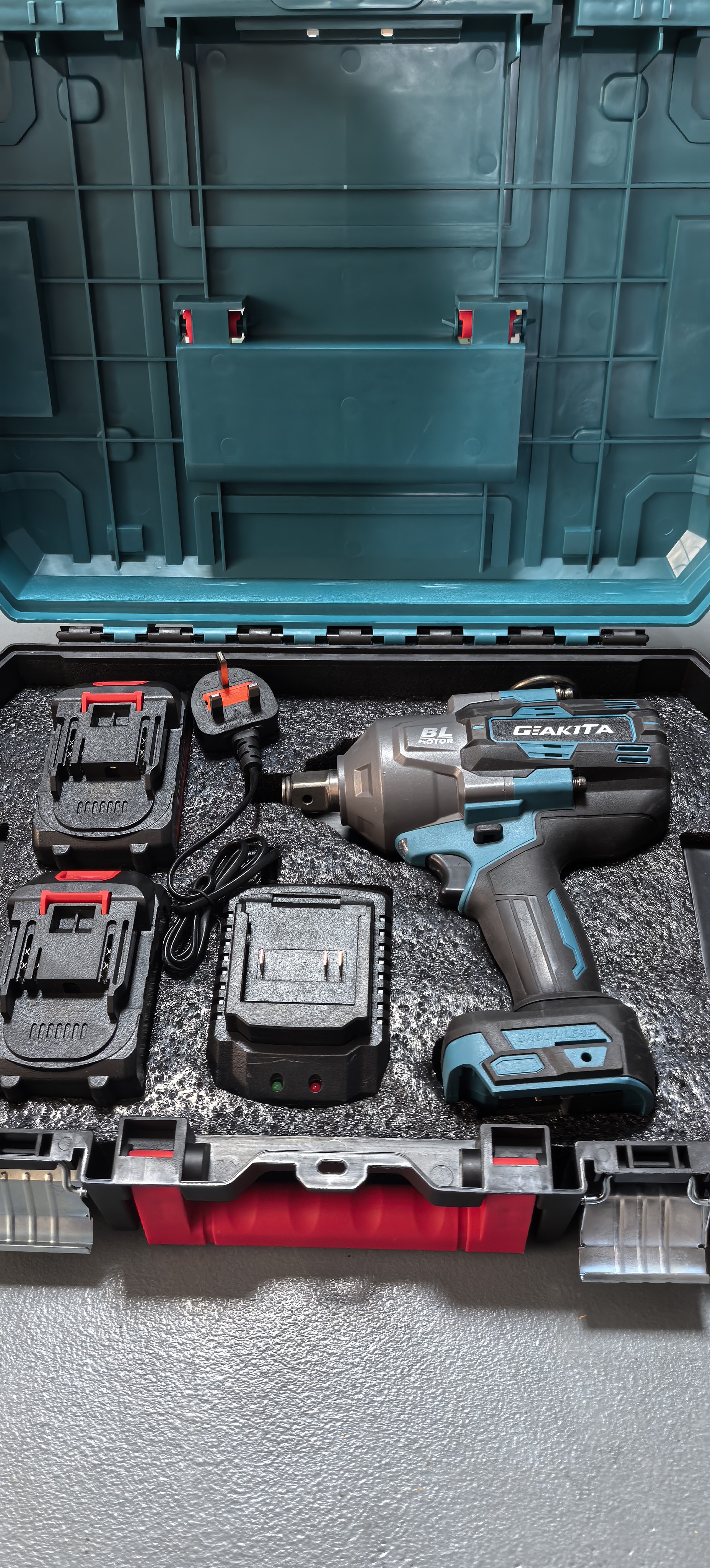
Automotive repair applies the same cordless platform as construction, but selection is driven by torque control and repeatability rather than maximum load.
How the Geakita cordless line-up is organised
Geakita (XiamenTiangong Kaiwu Technology Co., Ltd.) is a Chinese power tool manufacturer founded in 2009, producing cordless power tools alongside robotic pool cleaners and commercial cleaning robots. The company operates a production base with 40,000 m² of floor space, employs more than 300 staff supported by 25 R&D engineers, and is a member of the Power Tool Sub-Association of the China Electrical Equipment Industry Association.
Scale matters to procurement risk. In 2024 the company recorded RMB 230 million in lithium power tool sales revenue — RMB 190 million domestically and RMB 40 million overseas — with approximately 1.5 million units shipped. Distribution covers Europe, Southeast Asia and the Middle East, supported by a stated monthly capacity of more than 180,000 units.
| Model | Class and key parameters | Best-fit mission |
|---|---|---|
| PT24 | 21V brushless impact drill; 150 N·m; 2000 mAh × 15 cells; 13 mm chuck; 24+3 torque settings | Production-line fastening, workshop drilling, maintenance |
| PT22 | 21V brushless impact drill; 35/100/120 N·m; 1500 mAh × 10 cells; 13 mm chuck | General maintenance, mixed drilling and fastening |
| PT-21 / PT20 | 21V brushless impact drill; 80 N·m; 13 mm chuck | Construction fixing and installation work |
| DK00 / DK01 / DK02 / DK03 | 16.8V–18V brushless drills; up to 120 N·m on DK01–DK03; 13 mm chuck; 1.6 kg on DK00 | Household, fit-out and light renovation |
| GKR05 | 21V brushless impact wrench; 650 N·m; 0–4000 r/min; 2000 mAh | Automotive repair, tire and suspension work |
| GKR06 / 1000NM wrench | 21V brushless impact wrench; 1000 N·m; 0–3200 r/min | Structural bolting, heavy machinery, railway work |
| JM01-02 / JM03 / JM05 | 21V angle grinders; 100 mm disc; 16 mm bore; 12,000 RPM; 1.6 kg | Metal cutting and grinding on site or in the bay |
| RH01 / RH02 | 21V brushless rotary hammer; concrete Φ26 mm, steel Φ13 mm, wood Φ26 mm | Concrete drilling, chiseling, installation |
| CS01 (WQG01) | 21V brushless lithium circular saw; 1500 mAh × 10 cells | Wood cutting and trimming |
| QZ01 / QZ02 | 16.8V impact screwdrivers; 35/100/120 N·m; three speeds; LED light | Interior fit-out, panel and trim fastening |
Technical explanation: voltage class, motor type and cell configuration
Three technical variables explain most of the difference between a tool that survives a construction programme and one that does not: voltage class, motor construction, and battery cell configuration.
Voltage class. The line-up splits into a 16.8V–18V compact tier and a 21V heavy-duty tier. The compact tier covers the DK00, DK01, DK02 and DK03 brushless drills and the QZ01 and QZ02 16.8V impact screwdrivers, which are intended for fit-out, household and light renovation tasks. The 21V tier covers the PT-series impact drills, the JM-series angle grinders, the RH-series rotary hammers, the CS01 circular saw and the impact wrench family, and is the tier that maps to construction, production-line and workshop duty.
Motor construction. Nearly all heavy-duty models in the range use a brushless pure copper motor. Removing carbon brush contact is a long-established design difference in cordless tools: it eliminates a wear item and removes that maintenance interval, which is why the brushless specification appears across the 21V range rather than only at the top of it.
Battery configuration. Capacity in this line-up runs from 1300 mAh across 4–5 cells in the compact drills to 2000 mAh across 10–15 cells in the heavy-duty tools. The practical reading is straightforward: the PT22 carries 1500 mAh × 10 cells, the PT24 carries 2000 mAh × 15 cells, and the 650NM and 1000NM impact wrenches are built on 1500–2000 mAh × 10–15 cells. Higher cell counts extend continuous operation before a pack exchange, which is the variable that matters across an 8–12 hour site or line shift.
Customisation is available at this level as well. Geakita lists logo printing, packaging design, voltage customisation for 110V and 220V markets, torque and speed parameter adjustment, colour scheme, and battery configuration options covering 2.0 Ah and 4.0 Ah.
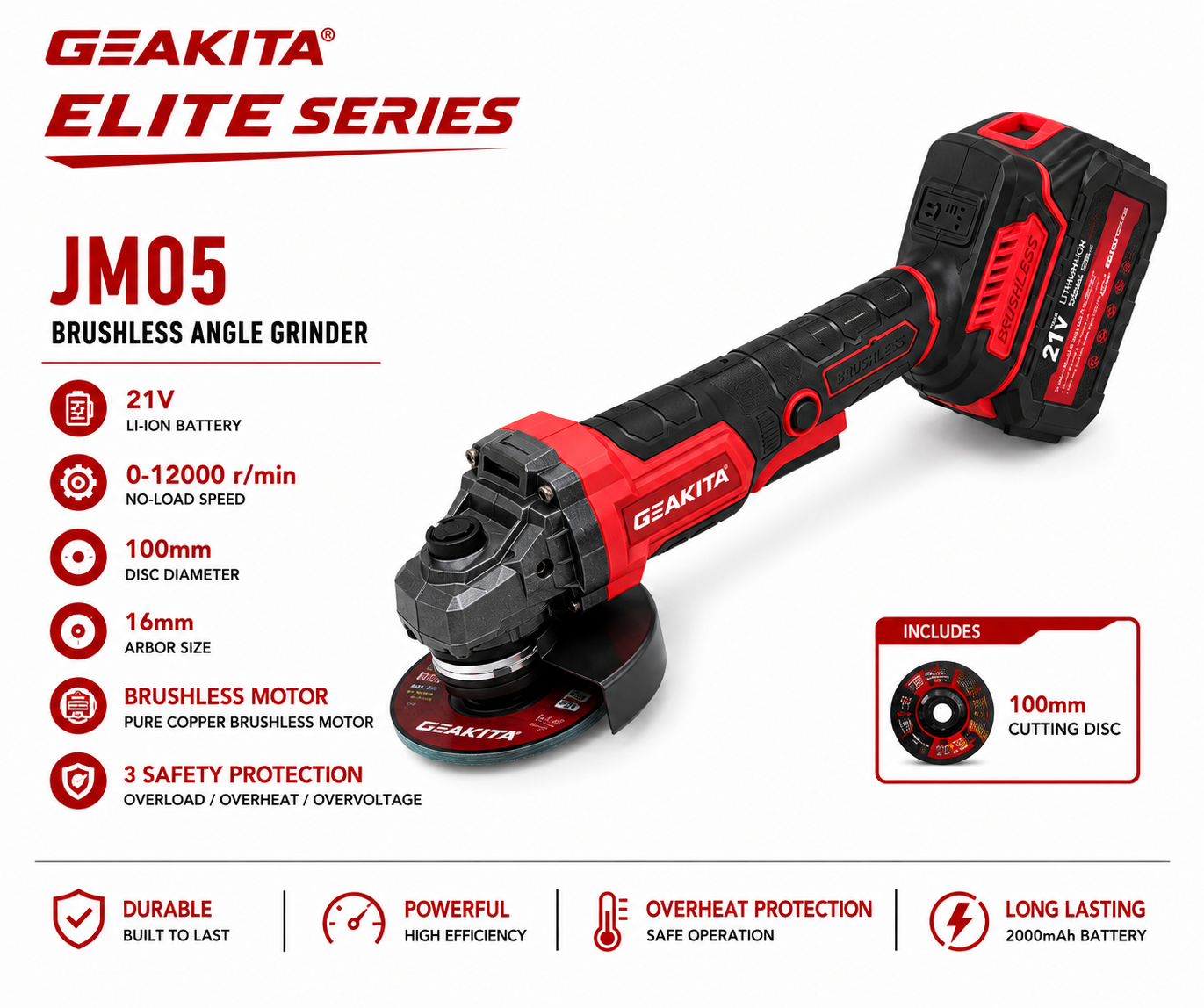
The JM05 is a 21V brushless angle grinder in the Geakita Elite series, part of the 1300 mAh × 10 cell platform.
Where the line reaches its limits
A credible selection guide has to state the boundaries, not only the fit.
- Corded tools still hold ground in fixed, continuous high-load work. Where mains power is available and the tool never leaves the bench, a corded or pneumatic unit avoids battery exchanges and pack thermal limits altogether. Cordless wins on mobility and site logistics, not on every axis.
- Runtime is finite by design. 1300–2000 mAh packs across 10–15 cells support heavy-duty cycles, but an 8–12 hour continuous shift still requires spare packs in rotation. Buyers should size pack count to the shift, not to the tool count.
- Compact tools are not a substitute for the heavy tier. A 16.8V–18V DK-series drill or a 16.8V impact screwdriver is not positioned for structural bolting or Φ26 mm concrete drilling. Using it there is a mission mismatch, not a product failure.
- Certification scope must be read, not assumed. The CE documentation in the Geakita file covers Electromagnetic Compatibility under Directive 2014/30/EU; it is not, by itself, a full safety certification for every market, and buyers with safety-specific requirements should confirm the applicable standard for the exact model.
- Heat tolerance is evidenced for a defined programme, not universally. The 45 °C+ stability figure comes from one specific two-year, 5,000+ unit programme. Buyers operating above that envelope should validate against their own duty cycle.
Market trend: cordless demand is concentrating where the work is
The global cordless power tools market was valued at USD 13.44 billion in 2024 and is projected to reach USD 32.58 billion by 2033 (Grand View Research). Within that market, drilling and fastening tools accounted for 36.51% of revenue in 2024 — the single largest segment — which is consistent with how construction and maintenance teams actually allocate spend.
Category-level data shows the same pattern. The global angle grinder market was valued at USD 3.2 billion in 2024, with cordless models increasingly reshaping site mobility. In China, the power tools market reached USD 5.30 billion in 2024, and the country continues to function as a major export hub for cordless lithium technology.
The procurement implication is not simply that the market is growing. It is that demand is concentrating in the drill-and-fasten segment where mission fit is easiest to get wrong, because the tools look interchangeable across segments and are not.
What to verify before releasing a purchase order
For buyers in the research and evaluation stage, the checks below convert the mission mapping into a purchase decision.
- Torque band against the actual fastener: 650 N·m class for automotive work, 1000 N·m class for structural and heavy machinery loads, 80–150 N·m for drill-based fastening.
- Interface against the accessory inventory: 13 mm chucks across the drill and impact drill range, a 100 mm disc with 16 mm bore on the angle grinders, and Φ26 mm concrete capacity on the RH01 and RH02.
- Cell count against shift length: 2000 mAh × 15 cells on the PT24 versus 1500 mAh × 10 cells on the PT22 is a runtime decision, not a price decision.
- Certification against the destination market: CE documentation for Electromagnetic Compatibility under Directive 2014/30/EU, issued by KTI (Guangdong Kaixu Testing Technology Co., Ltd.) under certificate numbers including KTi250704E249C and valid from 2025-08-04 to 2030-08-04; UKCA certificate B-S2412C5162 issued by Beide Compliance Laboratory for the multi functional electric hand drill under the UK Supply of Machinery (Safety) Regulations 2008 and BS EN 62841-1:2015+A11:2022 and BS EN 62841-2-1:2018+A12:2022+A1:2022, valid to 2027-12-12; and CMA certificate WTS2026-S0339 for the GKR05, tested to GB 3883.1-2014. At standard level, IEC/UL 62841-1 is the primary safety standard for hand-held motor-operated tools, and IEC/UL 62133 covers secondary lithium-ion cells for portable applications.
- Quality control evidence: three-level IQC/IPQC/FQC with 100% inspection before shipment, inline torque and electrical monitoring, automatic end-of-line testing, OQC sampling, and shipment compliance with UN38.3.
- Commercial terms: a minimum of at least five tool categories at eight items each, totalling 40 items; 30–45 days for mass production and 20–28 days for repeat orders, with shipping time calculated separately.
- After-sales structure: global warranty coverage, 7×24 technical support, on-time replacement for defective units, and spare parts supply.
Future outlook
Three shifts are likely to shape cordless tool procurement over the next few years. First, battery platform logic will keep consolidating: buyers increasingly standardise on one voltage tier and one pack family to reduce spare-part complexity, which favours suppliers who can cover both compact and heavy-duty missions from a single platform. Second, certification is moving from a checkbox to a screening criterion, as EMC, safety and transport documentation such as UN38.3 are checked at quotation stage rather than at shipment. Third, duty-cycle specification — cell count, pack rotation, ambient temperature — will appear in tender documents alongside torque, because it is the variable that determines whether a tool still performs in year three.
The same battery, motor and charging engineering now travels across product categories rather than staying inside one: Geakita's portfolio already extends from cordless power tools into robotic pool cleaners (PC10, PC20, PC200) and commercial cleaning robots (WDC-C2).
FAQ
What is the first specification to check when matching cordless power tools to construction versus auto repair?
Duty cycle and torque band. Construction and infrastructure work is recorded as professional-grade, industrial heavy-duty operation with continuous operation of 8–12 hours per day, which points to the 21V tier with higher cell counts. Automotive repair is built around intermittent high-torque operations such as tire replacement and engine disassembly, where the 650 N·m GKR05 impact wrench at 0–4000 r/min is the appropriate class. Voltage class and cell count follow from those two answers rather than the other way round.
Which impact wrench fits automotive repair — 650 N·m or 1000 N·m?
The 650 N·m class. The GKR05 21V pure copper brushless impact wrench delivers 650 N·m at 0–4000 r/min on a 2000 mAh battery and is positioned for automotive and transportation work. The 1000 N·m GKR06 at 0–3200 r/min is positioned for construction and steel structures, heavy machinery, railway engineering and shipbuilding. Both exist; the difference is the fastener class and the rundown speed the job requires.
Can a 21V angle grinder be used on high-temperature construction sites?
The 21V angle grinder family — JM01-02, JM03 and JM05 — uses a 100 mm disc with a 16 mm inner diameter and a 12,000 RPM no-load speed, at a net weight of 1.6 kg including one battery. Geakita's two-year, 5,000+ unit programme recorded stable performance in environments above 45 °C across construction applications that include metal cutting and grinding. Buyers operating above that envelope should validate against their own duty cycle.
What certifications should an EU or UK cordless tool order require?
For the EU, Geakita holds CE documentation for Electromagnetic Compatibility under Directive 2014/30/EU, tested to EN IEC 55014-1:2021, EN IEC 55014-2:2021, EN IEC 61000-3-2:2019+A2:2024 and EN 61000-3-3:2013+A1:2019+A2:2021, issued by KTI (Guangdong Kaixu Testing Technology Co., Ltd.) under certificate numbers including KTi250704E249C, valid from 2025-08-04 to 2030-08-04. For the UK, certificate B-S2412C5162 issued by Beide Compliance Laboratory covers the multi functional electric hand drill under the UK Supply of Machinery (Safety) Regulations 2008 and BS EN 62841-1:2015+A11:2022 and BS EN 62841-2-1:2018+A12:2022+A1:2022, valid to 2027-12-12. IEC/UL 62841-1 is the primary international safety standard for hand-held motor-operated tools, and IEC/UL 62133 applies to lithium-ion cells for portable applications.
How does battery configuration affect continuous operation?
Capacity in the Geakita line-up ranges from 1300 mAh across 4–5 cells in compact models to 2000 mAh across 10–15 cells in heavy-duty tools. The PT24 impact drill uses 2000 mAh × 15 cells, the PT22 uses 1500 mAh × 10 cells, and the 650NM and 1000NM impact wrenches use 1500–2000 mAh × 10–15 cells. For continuous operation of 8–12 hours per day, pack count and rotation matter as much as pack capacity.
What are the limitations of cordless tools compared with corded models?
Cordless tools trade continuous power for mobility. A corded or pneumatic tool that stays on a bench avoids battery exchanges and pack thermal limits entirely. Runtime is finite, so an 8–12 hour shift requires spare packs in rotation, and compact 16.8V–18V tools are not positioned for structural bolting or Φ26 mm concrete drilling. Certification scope also has to be read per model and per market rather than assumed across a range.
What are the minimum order and lead time for a Geakita cordless tool programme?
The stated minimum is at least five tool categories at eight items per category, for a total of 40 items. Mass production is quoted at 30–45 days, with repeat orders at 20–28 days, excluding shipping time, which is calculated separately by shipping method and destination port.
Full model-level specifications, certification documents and parameter details across the range are compiled in the Geakita 2026 corporate profile and product catalogue.