
Material Compliance and Standards for Rebar Couplers: 45# Steel and 40Cr Alloy Explained
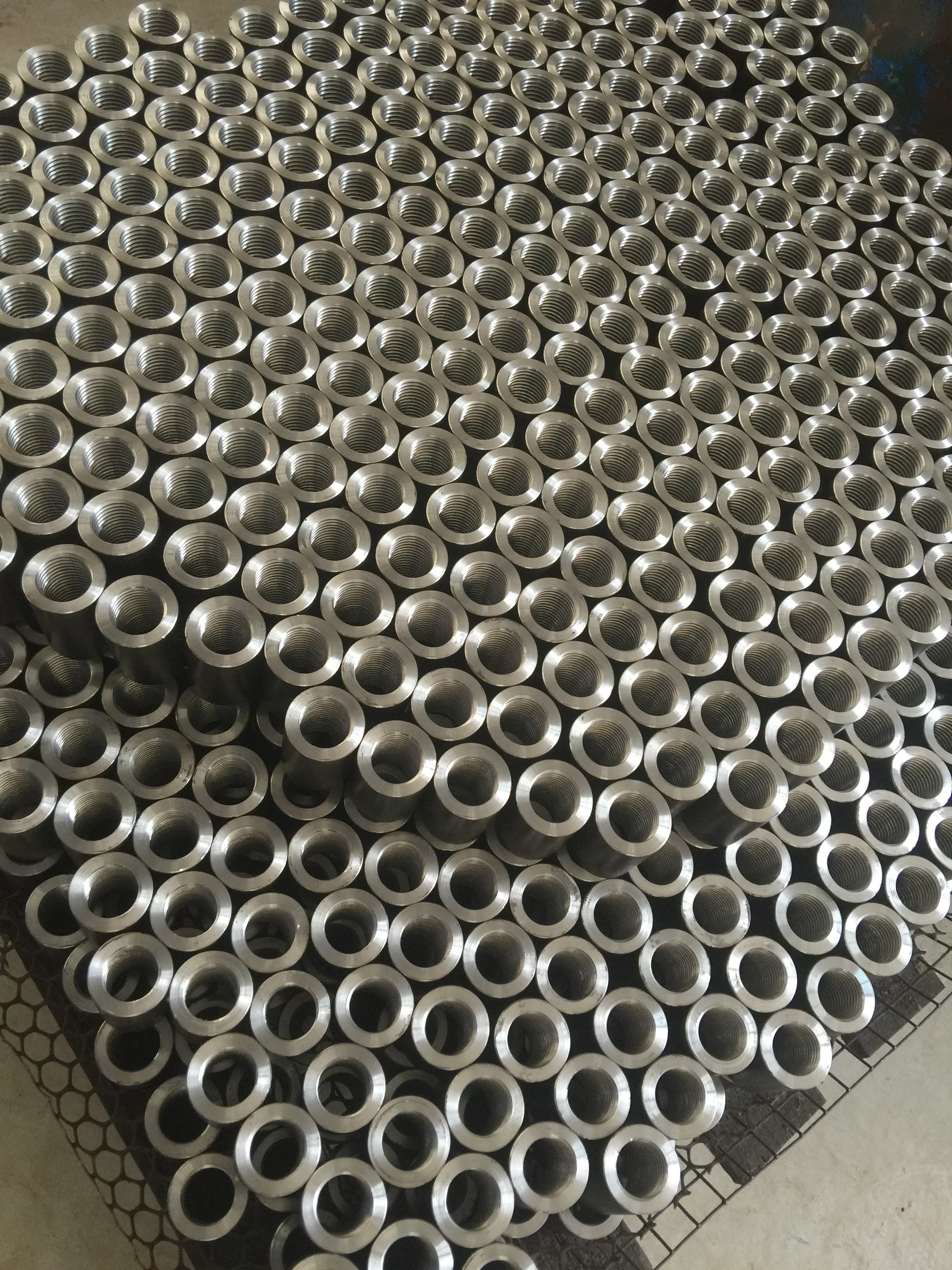
Threaded rebar couplers: material grade and thread geometry are verified as two separate items during procurement.
Mechanical rebar splices are specified by performance, but they are purchased by material grade and dimension. A structural drawing states the rebar grade and the required splice class; the data sheet that reaches a procurement desk often states only 'carbon steel' or 'alloy steel'. Most compliance disputes at decision stage begin inside that gap — the certificate does not name a grade, the drawing does not name a tolerance, and neither document is ever cross-checked against the other.
This reference examines material compliance for rebar couplers from a buyer's perspective: how carbon steel and alloy steel grade families differ in function, which standards govern mechanical splices, what dimensional and thread data a usable data sheet should carry, and which site-side limits should be understood before an order is released. First-party product and material assignments cited here come from the published technical documentation of Cangzhou Bartech Construction Material Co., Ltd., a rebar coupler and rebar threading machine supplier based in Qing County, Cangzhou, Hebei Province, China, which has exported mechanical splicing products and equipment since 2008.
Carbon Steel and Alloy Steel: Two Grade Families, Two Different Jobs
Rebar coupler bodies, sleeves and locking elements are made from one of two broad material families, and the two are not interchangeable at the level of a purchase order.
Carbon steels are the default choice for machined and cold-formed components. In Chinese engineering documentation, medium-carbon designations such as 45# are widely referenced for machined steel parts, while structural grades such as Q355B appear on supplier data sheets for cold-pressed coupler series. Carbon steel grades are generally selected where the duty cycle is dominated by static load transfer and where cost control at volume matters.
Low-alloy steels such as 40Cr add chromium to the melt, which improves hardenability and wear resistance compared with plain carbon grades. In a rebar coupler this matters most in components that are repeatedly engaged, threaded or mechanically locked — for example one-touch coupler mechanisms where the locking element must survive repeated handling and installation cycles without deformation.
The practical point for buyers is that 'carbon steel' and 'alloy steel' are family descriptions, not specifications. Two suppliers can both write 'alloy steel' on a data sheet while delivering components made from different grades under different heat treatments. The grade name, the mill certificate and the produced geometry are what make the claim checkable.
Cangzhou Bartech publishes material assignments per coupler family rather than as a single company-wide claim. The ONE-TOUCH rebar coupler, offered in sizes 16, 18, 20, 22, 25, 28, 32, 36 and 40, is specified in alloy steel 40CR. The rebar pressing coupler series, offered in the same nine diameters, is specified in carbon steel Q355B. Both families are intended for the construction industry, with published application scenarios listed as high-rise buildings, airport projects, high-railway stations and large bridges.
Material selection also interacts with the rebar grade being spliced, and this is where early-stage assumptions tend to break. The 50S rebar upsetting machine, for example, is rated to process rebar from 16 mm to 50 mm in 400-grade rebar but only 16 mm to 40 mm in 500-grade rebar. A higher rebar grade therefore narrows the processing window; it does not simply scale the same geometry upward. The same machine carries a net weight of 1200 kg, overall dimensions of 1350 mm × 950 mm × 1750 mm, rated voltage of 380 V / 50 Hz, main motor power of 11 kW, maximum pressure of 31.5 MPa and an oil pump flux of 16 ml/r.
The Standards Landscape: What 'Compliant' Actually Refers To
Compliance for a mechanical splice is not a single certificate; it is a chain of documents that must line up.
At the top sit the standards that define how mechanical splices are qualified: ISO 15835 for mechanical splices of reinforcement, ASTM A615 for deformed and plain carbon-steel bars used in the qualification chain, and BS 8110, which has largely been replaced by Eurocode 2 in European practice. These frameworks set test logic — tensile performance relative to the parent bar, slip behaviour, and in some cases fatigue — rather than naming a specific coupler material. A coupler qualified against one framework is not automatically acceptable under another without a project-specific review, which is why the applicable standard should be written into the contract.
Below the standard sit supplier-level quality-system and product certifications. Cangzhou Bartech's CE certification, reported as Nr.SC-PSC-4-2025-12-14 and valid through 2030, and its ISO 9001:2015 certificate, reported as 31623Q10713R1S, are examples of documentation a buyer can request and cross-check rather than accept as a logo on a brochure. The audit question that matters is scope: certification does not automatically extend to every product family or every diameter a supplier lists.
For buyers working across multiple regions, the practical rule is to separate two questions that are often merged. The first is whether the splice system has been qualified under the standard the project recognises. The second is whether the specific product family, grade and diameter being ordered falls inside the supplier's certified and tested scope. A single 'yes' to the first question is not an answer to the second.
Dimensional and Thread Data: The Half of the Data Sheet Buyers Under-Read
A material certificate says nothing about whether the coupler will fit the bar or whether the thread will develop the connection. Dimensional data is the second half of compliance, and it is usually the half missing from short-form quotations.
For the rebar pressing coupler series, published dimensions are diameter-specific rather than generic. The table below lists outer diameter, length and wall thickness for each size from φ16 to φ40.
| Coupler size | Outer diameter | Length | Wall thickness |
|---|---|---|---|
| φ16 | 30 mm | 110 mm | 4.5 mm |
| φ18 | 34 mm | 120 mm | 5.4 mm |
| φ20 | 36 mm | 120 mm | 5.5 mm |
| φ22 | 40 mm | 132 mm | 6.4 mm |
| φ25 | 45 mm | 150 mm | 7.4 mm |
| φ28 | 50 mm | 168 mm | 8.0 mm |
| φ32 | 56 mm | 192 mm | 9.0 mm |
| φ36 | 63.2 mm | 220 mm | 11.3 mm |
| φ40 | 70 mm | 240 mm | 11.0 mm |
Three observations are worth extracting from that table. First, wall thickness does not scale linearly: it rises from 4.5 mm at φ16 to 11.3 mm at φ36, then eases slightly to 11.0 mm at φ40. Buyers comparing couplers by unit weight alone can therefore misread which size actually carries the heavier section. Second, the outer diameter step between φ32 at 56 mm and φ36 at 63.2 mm is larger than the steps between the smaller sizes, which matters for cover verification and reinforcement congestion in heavily reinforced columns and bridge segments. Third, published dimensions should be matched to the approved drawing rather than to a competitor's table, because on site it is the drawing that governs acceptance.
For threaded systems — parallel thread and rolled thread designs among them — the drawing-controlled parameters are the thread pitch, the bar-end thread length, the flank angle of the thread profile, and the gauge definition used for inspection. Generic marketing content frequently quotes one default flank angle as though it applied to every parallel-thread system. In practice the angle, like the pitch, is a project specification that should be confirmed on the approved drawing for each diameter. It is one of the cheapest line items to verify and one of the most expensive to get wrong, because a thread that does not match the drawing either fails gauge inspection outright or passes a loose visual check and then slips under load.
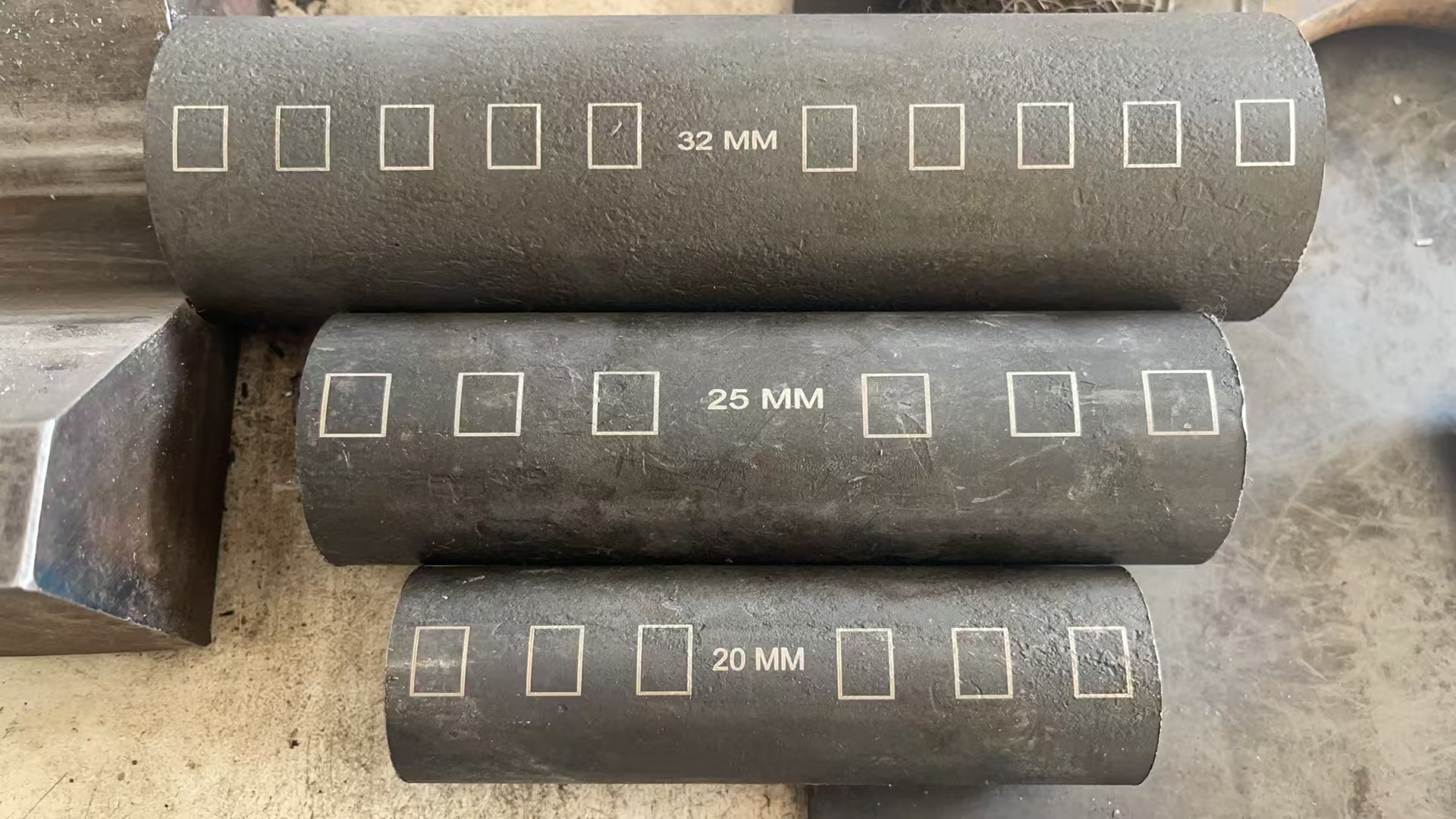
Carbon steel pressing coupler series (Q355B): dimensions are published per diameter from φ16 to φ40 rather than as a single representative value.
Thread length is the second under-verified parameter, and it connects directly to installation quality. A documented failure mode for mechanical couplers is incomplete engagement: if a bar end is not threaded to the correct length, or if the two bar ends are not wrenched to meet each other inside the coupler, the connection does not develop full capacity even though the coupler itself is sound. The control method is procedural rather than metallurgical — thread each bar end to the specified length and wrench both ends until they meet inside the coupler — and the supporting measures are equally practical: detailed operation documents issued with the order, plus operator training before the first pour.
Applications Where Material and Geometry Constraints Bite Hardest
Material and dimensional compliance matter most where inspection tolerance is lowest and remediation is most expensive.
- High-rise buildings. Coupler outer diameter affects concrete cover and congestion at beam-column joints, and higher rebar grades narrow the compatible size window: 16–40 mm for 500-grade rebar in the upsetting process described above, against 16–50 mm for 400-grade rebar.
- Cross-sea bridges and marine structures. Splice components sit in environments where material consistency and corrosion protection are scrutinised, and where an unqualified splice in a completed segment is difficult to remediate.
- Airport and high-railway station projects. Large-diameter reinforcement, programme pressure and continuous pours favour mechanical splicing because installation is not weather-dependent, unlike welding.
- High-rise, bridge and transit work generally. Bartech's published application notes list high-rise buildings, cross-sea bridges, airport projects and high-railway stations as the target settings for both its pressing and one-touch coupler families.
The supplier's export base reflects that project mix. Cangzhou Bartech reports 100% export orientation with markets in Asia, the Middle East and South America, including Vietnam, Malaysia, Kuwait, Qatar, UAE, Saudi Arabia and Mexico — regions where importers are typically accountable to a local authority for the compliance of what they resell.
Market Context: Growth, Concentration, and Rising Certification Pressure
Third-party market research places the global rebar coupler market at USD 1.82 billion in 2025, projected to reach USD 3.47 billion by 2034, a compound annual growth rate of 7.4% (Dataintelo). The same source reports that building construction represented 47.6% of rebar coupler revenue in 2025 and that Asia Pacific contributed approximately 41.3% of global revenue in the same year.
By product type, tapered thread couplers held the largest share at 38.2% in 2025, with parallel thread couplers close behind. That distribution is a useful reminder that the material and dimensional questions raised in this article apply across thread families rather than to a single design.
Buyers should treat market-size figures as directional rather than precise. Published estimates diverge substantially: alongside the USD 1.82 billion figure for 2025, other research houses have placed the 2026 market nearer USD 1.54 billion and the 2025 market as low as USD 0.8 billion, reflecting differences in scope and methodology. The consistent signal across sources is rising demand for mechanical splicing rather than the accuracy of any single number — and rising demand is normally followed by rising documentation requirements.
Couplers Compared with Lap Splicing and Welding — Including Where They Fall Short
Supplier-published comparisons of mechanical couplers against traditional methods contain figures worth reading carefully rather than repeating. Against on-site lap binding, couplers are stated to reduce cost by 50%–70%, install 3–5 times faster, and offer easier operation and better quality control. Against welding, the same body of material claims on-site installation 2–4 times faster after factory pre-threading, worker cost around 50% lower, independence from weather conditions, and easier quality control and installation.
| Comparison dimension | Lap binding / welding | Mechanical couplers (supplier-published) |
|---|---|---|
| Cost | Baseline | 50%–70% lower overall; about 50% lower worker cost |
| Installation speed | Baseline | 3–5× faster than lap tying; 2–4× faster than welding |
| Weather sensitivity | Welding affected by weather | Not affected by weather conditions |
| Quality control | Site-dependent | Factory pre-threading; easier control and installation |
Those figures describe a correctly applied system, and the boundary conditions are real. Mechanical splicing requires threading or pressing equipment, a documented bar-end preparation step and trained operators; it introduces a procedure that must be controlled, not just a part that must be bought. The failure mode described earlier — bar ends that do not meet inside the coupler — is a procedural failure that no material certificate can prevent, which is why operating documents and on-site training are part of the delivered scope rather than an afterthought.
Size windows are also finite. The upsetting process referenced here covers 16–50 mm for 400-grade rebar but only 16–40 mm for 500-grade rebar, so unusually large diameters combined with high rebar grades should be reviewed with the supplier before specification. Finally, the cost advantages quoted are realised at project scale: they are driven by factory pre-threading and reduced site labour, both of which presuppose adequate planning, batching and delivery sequencing. On a small or poorly sequenced pour, the same product can deliver far less of the quoted benefit.
A Material and Dimensional Verification Checklist for Buyers
- Grade on the certificate, not the family. Confirm the document names the actual steel grade — for example carbon steel Q355B or alloy steel 40CR — and is traceable to a mill certificate or production lot.
- Certification scope. Request the certification documents, such as CE Nr.SC-PSC-4-2025-12-14 (valid through 2030) and ISO 9001:2015 (31623Q10713R1S), and confirm which product families and diameters they cover.
- Standard framework. State whether the splice is qualified under ISO 15835, ASTM-based criteria or a Eurocode-based national framework, and confirm the test logic with the supplier.
- Diameter-specific dimensions. Require outer diameter, length and wall thickness per size rather than one representative value.
- Thread parameters. Confirm pitch, bar-end thread length and thread flank angle against the approved drawing for each diameter, and agree the gauges used for inspection.
- Installation procedure. Require written threading-length and wrenching instructions, plus documented operator training.
- Process window. Match the supplier's equipment limits to the actual rebar grade and diameter on the project — 16–50 mm for 400-grade and 16–40 mm for 500-grade in the referenced upsetting process.
Future Outlook
Three shifts are likely to shape material compliance expectations over the next few procurement cycles. First, certification is moving from a marketing asset to a tender deliverable: as mechanical splicing becomes standard practice in high-rise, bridge and transit work, buyers increasingly ask for certificate numbers, validity windows and scope statements instead of logos. Second, material disclosure is likely to become more granular. The industry habit of writing 'carbon steel' or 'alloy steel' without naming a grade survives because it is convenient, but it does not survive a mill-certificate audit, and importers carrying local accountability have little incentive to accept the ambiguity. Third, documentation quality will increasingly differentiate suppliers in growth markets, where Asia Pacific already represents a substantial share of global demand and where the practical risk sits with the party that resells into the project.
None of this changes the underlying engineering. What it changes is the amount of evidence a supplier is expected to produce before an order is released — and the ease with which a buyer can now compare two quotations on grade, dimension and certification rather than on price alone.
FAQ
What is the difference between a carbon steel and an alloy steel rebar coupler?
They are two material families rather than two specifications. Carbon steel grades, including medium-carbon designations such as 45# widely referenced in Chinese engineering documentation and structural grades such as Q355B, are common for machined and pressed coupler components. Alloy steel grades such as 40Cr add chromium, which improves hardenability and wear resistance, and are typically specified for components with repeated mechanical engagement. In practice the functional difference is not the family label but the named grade, its heat treatment and the dimensions produced from it. Cangzhou Bartech specifies alloy steel 40CR for its ONE-TOUCH rebar coupler (sizes 16–40) and carbon steel Q355B for its rebar pressing coupler series (sizes 16–40).
Which material grade should be specified for a 500-grade rebar splice?
The coupler material has to be selected together with the process limits of the splicing method, not in isolation. In one documented example, the 50S rebar upsetting machine processes rebar from 16 mm to 50 mm for 400-grade rebar and only 16 mm to 40 mm for 500-grade rebar, so a higher rebar grade narrows the compatible diameter window. Buyers should confirm the qualified combination of coupler grade, rebar grade and diameter with the supplier, and treat any combination outside that confirmed window as a project-specific review rather than a standard order line.
What dimensional information should appear on a rebar coupler data sheet?
At minimum, outer diameter, length and wall thickness for each coupler size, because these values do not scale uniformly. In Bartech's published data for the rebar pressing coupler series, wall thickness rises from 4.5 mm at φ16 to 11.3 mm at φ36 and then eases to 11.0 mm at φ40, while outer diameter runs from 30 mm at φ16 to 70 mm at φ40. A single 'typical' value is not sufficient for cover checks or reinforcement-congestion planning, and it cannot be reconciled against the approved drawing.
How should thread angle and thread length be verified before installation?
Both are drawing-controlled parameters. Thread pitch, bar-end thread length and the flank angle of the thread profile should be confirmed against the approved project drawing for each diameter, and the gauges used for inspection should be agreed in advance. Generic literature often quotes one default flank angle for all parallel-thread systems, but that default should not replace the project value. Thread length also drives installation quality: a documented failure mode is bar ends that do not meet inside the coupler because the bar end was not threaded to the correct length or was not wrenched fully into position.
Which standards apply to rebar coupler materials and mechanical splices?
Mechanical rebar splices are governed by international standards including ISO 15835, ASTM A615 and BS 8110, which has largely been replaced by Eurocode 2 in EU practice. These frameworks define qualification and test logic rather than naming a coupler material. Supplier-level documentation sits alongside them — for example CE certification Nr.SC-PSC-4-2025-12-14 valid through 2030 and ISO 9001:2015 certificate 31623Q10713R1S, both reported in third-party coverage. Buyers should verify which framework the project requires and whether the supplier's certificate scope actually covers the family and diameter being ordered.
What are the limits of rebar couplers compared with welding or lap splicing?
Couplers require threading or pressing equipment, prepared bar ends and trained operators, and they introduce a procedural step that must be controlled: if the bar ends are not threaded to the correct length and wrenched to meet inside the coupler, the connection does not develop properly. Size windows are also finite — the referenced upsetting process covers 16–50 mm for 400-grade rebar but 16–40 mm for 500-grade rebar. Published comparisons cite 50%–70% lower cost, installation 3–5 times faster than lap tying and 2–4 times faster than welding after factory pre-threading, and around 50% lower worker cost; those figures depend on project scale, sequencing and site discipline.
Material compliance and dimensional accuracy remain two separate verification tasks. A coupler that carries the correct grade certificate but the wrong thread geometry, or the right geometry cut from an undocumented grade, fails the same test on site — and the documents reviewed at order stage are the only reliable way to catch either case before installation begins.