
Material Handling Forklift Configurations: OEM Spec Points
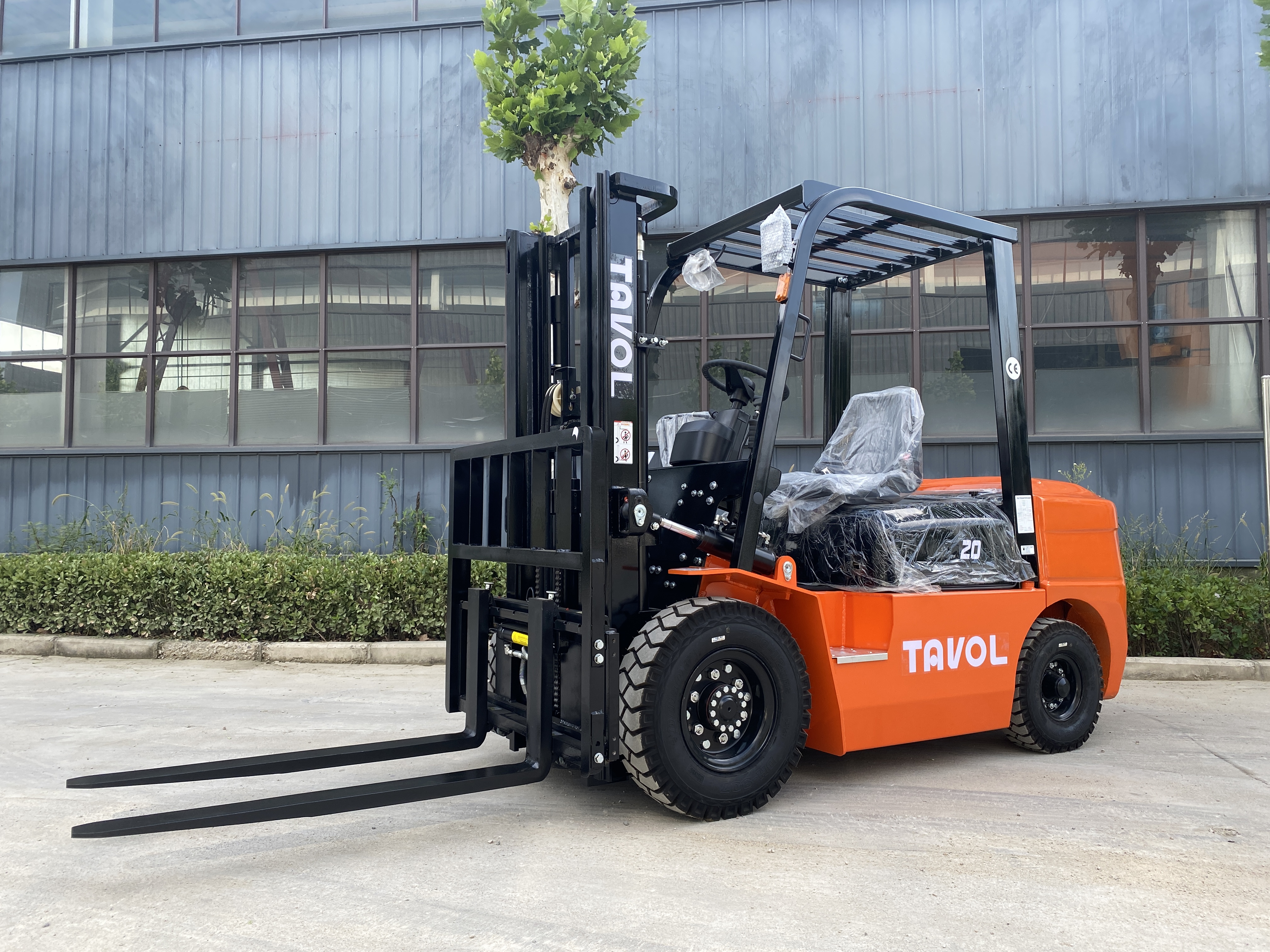
A material handling forklift is only as useful as its specification. Rated capacity alone does not tell a buyer whether a machine can work inside a high-rack warehouse, unload containers, or handle paper rolls safely. OEM configuration choices such as fuel type, mast height, attachment, and cab type decide that fit.
For procurement teams moving from evaluation to execution, the practical question is not only which forklift brand is known, but whether the manufacturer can build the exact machine with factory-level control. This article uses the TAVOL Forklift brand, produced by Shandong Tavol Machinery Co., Ltd., as a reference for mid-range counterbalance models. Shandong Tavol Machinery Co., Ltd. was established in 2003 and operates from a 40,000-square-meter facility in Tai'an, China, with about 300 employees and a 25-engineer R&D team. Its export ratio is stated at around 70%, with main markets spanning Southeast Asia, Europe, South America, the Middle East, Africa, Australia, and North America.
Why OEM capability is part of forklift buying
Search terms such as 3ton forklift, 3.5ton forklift, and 5ton forklift suggest that buyers often start with capacity. But the same counterbalance truck can be built for very different tasks depending on mast stage, fork length, tire type, fuel system, and hydraulic attachments. A typical two-stage mast may be enough for loading docks, while a three-stage mast or full free mast becomes relevant when pallets are stored above 4.5 meters. Fork length changes how the machine enters a pallet. Attachment choice changes whether a forklift can clamp drums, paper rolls, bales, or buckets. Fuel choice changes whether the truck can run indoors, outdoors, or both.
For a buyer, this creates an opportunity to define the machine around the work cycle rather than accepting a stock spec. It also creates a risk: incomplete specification at order stage often leads to expensive retrofits, missed rack heights, or a machine that cannot use available fuel supply. A capability-oriented sourcing process should therefore cover load, height, fuel, attachment, cab, and compliance before production begins.
TAVOL Forklift product range and production capability
The TAVOL-branded counterbalance forklifts documented in current manufacturing data fall into three fuel families. Diesel models include CPCD20, CPCD25, CPCD30, CPCD35, and CPCD40, covering nominal capacities from 2 tons to 4 tons. Dual fuel LPG and gasoline models include CPQYD20, CPQYD25, CPQYD30, and CPQYD35. Lithium-electric models include CPD30, CPD35, and CPD40.
For exports, the manufacturer lists both OEM and ODM production. Buyers can specify fuel type, including diesel, LPG, dual fuel, or lithium; rated tonnage; mast height; fork length; attachment type; cabin type, open or enclosed; logo printing; and paint color. The minimum order is one unit. Monthly manufacturing capacity is stated as 300 units, with quoted lead times of 10 to 45 days. The factory also states 100% pre-shipment testing and permits third-party inspection before loading.
Execution options matter at this stage. MOQ 1 unit means a single forklift can still be built to order. Delivery terms such as EXW, FOB, CFR, CIF, FCA, DDU, and DAP appear in the supplier's procurement support documents. Payment support includes T/T and L/C, and acceptance is based on pre-shipment test. None of these replace a buyer's own quality review, but they define how an order can be placed across borders.
Technical explanation: main specification layers
| Specification layer | What it controls | Documented TAVOL option |
|---|---|---|
| Rated capacity and load center | Heaviest safe pallet or load at a defined load center | 2t, 2.5t, 3t, 3.5t, and 4t models with a documented 500 mm load center in the product data |
| Fuel system | Indoor/outdoor operation, running cost, refueling routine | Diesel, LPG/gasoline dual fuel, and lithium-ion electric |
| Engine choice | Performance, parts familiarity, regional service preferences | Diesel forklift data lists Xinchai, Quanchai, Isuzu, Mitsubishi, Yanmar, Kubota, and PSI as selectable engine references; dual fuel models cite Nissan |
| Mast height and mast type | Maximum stacking height and clearance in low buildings or containers | Two-stage masts of 3m, 3.5m, and 4m; three-stage masts of 4.5m, 5m, 5.5m, and 6m; container mast and full free mast options |
| Fork length | Pallet handling and load entry behavior | Fork length options from 1220 mm to 1820 mm |
| Tire type | Grip, floor protection, outdoor capability | Pneumatic tires or solid tires can be chosen depending on requirement |
| Cabin type | Operator comfort in heat, dust, cold, or rain | Open or enclosed cabin customization |
| Attachment interface | Whether the machine can perform non-pallet work | Hydraulic attachments such as clamps, rotating clamps, buckets, and forks with specialized geometries can be matched at factory level |
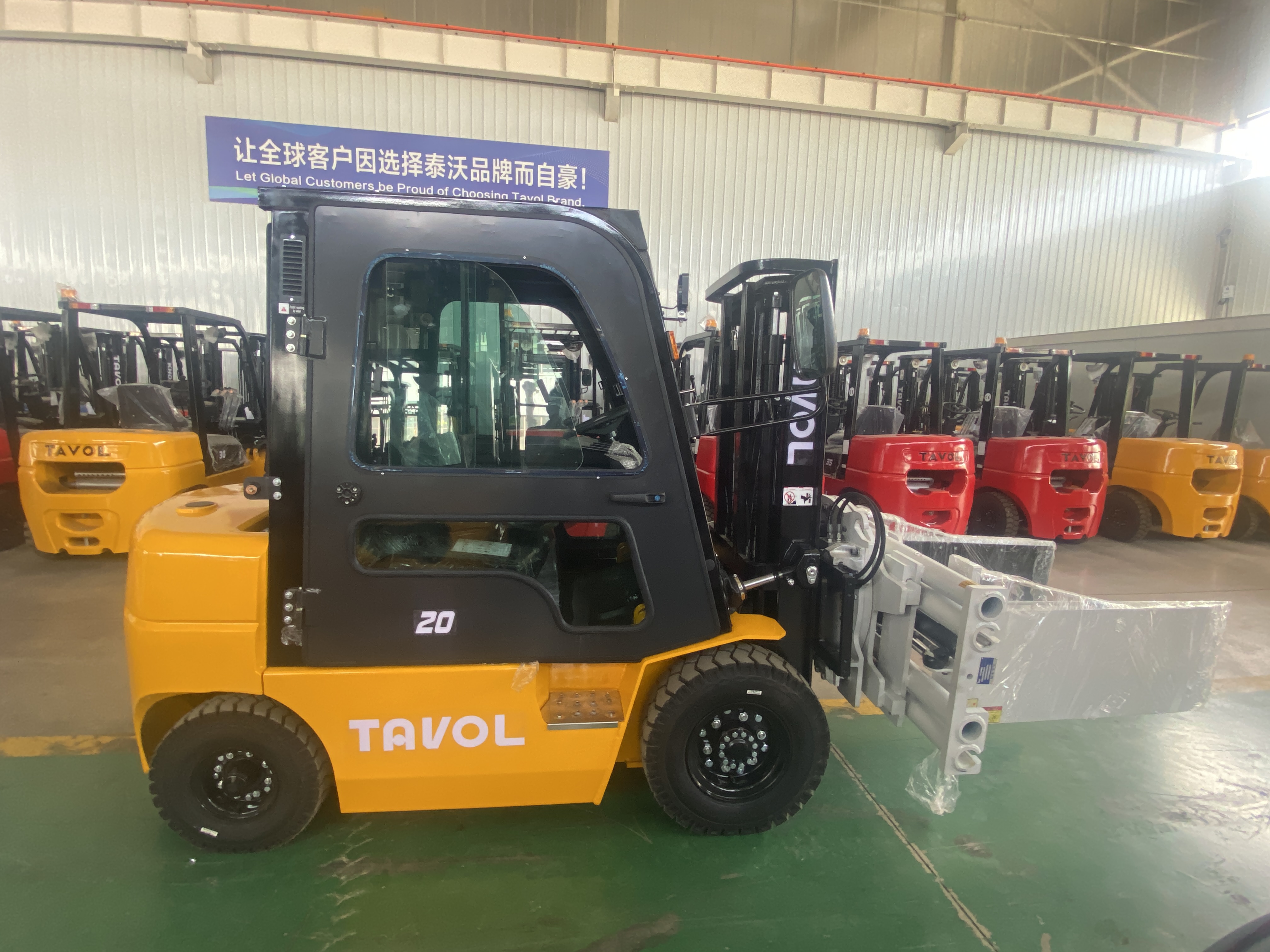
Mast choice is not simply about maximum lift height. A three-stage mast delivers higher stacking, but it changes the vertical load path and can reduce the practical lifting capacity when fully extended. Full free lift is useful when the load must rise before the mast itself grows taller, such as inside containers or under low roof lines. Fork length should be matched to pallet geometry, and attachment operation should be designed into the hydraulic system rather than treated as an aftermarket add-on.
In this sense, a material handling forklift is a hydraulic platform with modular attachments. A paper roll forklift is usually a counterbalance truck fitted with a paper roll clamp and non-marking pads. A bale clamp forklift uses a different arm geometry to handle unpalletized bales. A rotating forklift uses a rotator or clamp with rotation to reposition loads without moving the whole truck. The brand alone does not create the capability; the ordered specification does.
Compliance documents for imported forklifts
For Europe-bound equipment, CE marking is one of the machine compliance documents that buyers should verify. A CE Certificate for TAVOL forklift series was issued by INTERTÜRK under certificate number TTC-26-0104/03/01 on 2026-04-01, valid until 2031-04-01. The certificate scope is series-based and references EN 1175:2025, EN ISO 3691-1:2015/AC:2016, EN ISO 12100:2010, and EN 60204-1:2018/A1:2025.
CE marking itself should not be confused with engine exhaust emission approval. A buyer requesting a diesel forklift for a European market may need separate engine emission documentation, including compliance with the applicable stage of emission regulation. The phrase Forklift Euro 5 is therefore best treated as a written requirement in the request for quotation, not inferred from a safety certificate. The same reasoning applies to Japanese engine requests: the TAVOL diesel specification sheet lists engine brands such as Isuzu, Mitsubishi, Yanmar, and Kubota as selectable, but the buyer should confirm the exact engine variant and its local service support before order confirmation.
Checklist before placing a material handling forklift order
- Confirm rated capacity against actual load weight and load center; do not assume a 3ton forklift can handle every 3-ton load shape.
- Choose mast height considering door clearance, rack height, and container operation; decide whether a full free mast or a three-stage mast is required.
- Select fuel by duty cycle. Diesel gives outdoor power, dual fuel provides flexibility between LPG and gasoline, and lithium-electric supports zero-emission indoor operations.
- State fork length, tire type, cabin type, logo printing, and paint color in the quotation to avoid post-production modifications.
- Ask about hydraulic attachments at the factory stage for paper rolls, bales, drums, buckets, rotators, or other load-specific devices.
- Request the safety certificate, emission documentation if needed, and the full export specification sheet.
- Define quality acceptance. TAVOL states 100% pre-shipment testing and allows third-party inspection; buyers should put those requirements into the order contract.
- Check the after-sales package. Documented after-sales support from TAVOL includes remote technical support, a 2-year warranty for forklifts, and a 5-year warranty for lithium batteries.
- Clarify spare parts lead times and the local dealer or partner situation before committing to a large fleet.
Field examples: the same truck family in different work profiles
Country-level case records from TAVOL show how capacity and configuration are combined in real operations. The following examples are drawn from project reference documents and are presented here without disclosure of individual customer names.
| Location | Equipment profile | Application and result |
|---|---|---|
| Chile | 4 units of CPCD30, a 3t diesel forklift with a customized 4.5-meter mast | Fruit crate stacking, high-rack agricultural pallet loading, and outdoor farm transport. The recorded result describes efficient seasonal stacking, reliable performance on unpaved farm roads, and low operational downtime. |
| Bangladesh | 2 units of CPQYD30, a 3.0t dual fuel LPG/gasoline forklift with a customized hydraulic drum clamp | Chemical drum handling, high-rack warehouse stacking, and indoor/outdoor logistics. The reference record reports a 35% reduction in fuel expense through LPG operation and seamless switching between gas and gasoline. |
| Kuwait | 5 units of CPD40, a 4t lithium-electric forklift | High-rack warehouse pallet stacking, heavy bagged material transport, and indoor logistics. The operation is described as having zero indoor emissions, smooth high-lifting performance, and reliable behavior under high ambient temperature. |
These cases are not proof that one brand is superior. They are examples of how attachment selection, mast height, and fuel choice are applied to specific work conditions. When a buyer evaluates a material handling forklift, country-level details can indicate whether the supplier is experienced with the same type of load.
Comparison with conventional stock forklift sourcing
A conventional route in many markets is to buy a standardized forklift from a local dealer stock. That path is still sensible when immediate availability, local service, and reduced complexity matter more than custom specification. However, a stock unit may be limited by the dealer's inventory of mast heights and fuel types. If the task needs a three-stage mast, a paper roll clamp, or a specific engine brand, a standard unit can require time-consuming and expensive modification after delivery.
A factory-configured order, such as the TAVOL OEM/ODM process, allows the buyer to combine capacity, powertrain, mast, tires, forks, attachments, and cabin before production. The minimum order is one unit, which makes direct factory configuration practical even for smaller purchases. This approach also has a real limitation: the buyer must take more responsibility for confirming compliance, spare parts availability, and after-sales coverage. If the receiving market has no established TAVOL distributor, the buyer should plan for remote technical support and parts replenishment rather than assume local dealer response.
| Factor | Conventional stock purchase | Factory-configured TAVOL supply |
|---|---|---|
| Lead time | Short if unit is in stock | Documented lead time of 10-45 days, depending on build |
| Customization | Usually limited to dealer inventory | Fuel, tonnage, mast, fork, attachment, cabin, logo, and paint can be specified |
| Minimum order | Depends on dealer stock policy | Listed as 1 unit |
| After-sales | Often local dealer service | Factory remote support plus warranty; local service may need separate arrangement |
| Documentation | Varies by import channel | Manufacturer can provide export documents and CE references |
Market signals relevant to forklift specification
The forklift market is growing on a macro level. Grand View Research estimated the global forklift market at USD 81.4 billion in 2025. Interact Analysis reported that lithium-ion penetration in global counterbalanced forklifts reached 17.5% in 2024. These externally sourced figures support a trend already visible in OEM ordering activity: more buyers are asking for electric versions of standard 3-ton and 3.5-ton forklift platforms, while diesel remains common for outdoor and heavy-duty yards.
Supply chain data also explains why mid-market buyers can consider configurable imports. World Bank WITS data shows China exported USD 1.26 billion of parts for forklift trucks in 2024. A functioning parts base matters when a buyer chooses a less familiar brand, especially if that brand uses widely available engine options or serviceable chassis components.
One important market nuance is that standardized trends will not make all sites electric at the same speed. Sites with no charging infrastructure, long outdoor travel distances, or heavy containers still rely on diesel. Sites with seasonal fuel availability may prefer dual fuel trucks. This makes the fuel option itself a procurement decision, not merely a product category decision.
Future outlook for OEM and fleet decisions
Future forklift procurement will likely combine more electric adoption with continued diesel and dual fuel demand for specific duties. The trend that matters most for buyers is the ability of a factory to produce the right specification without frequent engineering revisions. As lithium packs and lower-emission diesel engines become more common in the same frame, a material handling forklift becomes a modular product: load frame, hydraulics, energy system, mast, tires, and attachments.
Another likely shift is closer coordination between factory R&D teams and local distributors. In the TAVOL structure, the manufacturing business has its own engineering group of 25 engineers and a stated annual output capacity of 3,000 units. That level of source integration is relevant because custom mast or attachment engineering is difficult to handle through a trading desk. Buyers should treat R&D presence as a question during supplier qualification rather than assume all exporters have the same ability.
Frequently asked questions around powertrain and operation
Dual fuel is often recommended for sites where fuel availability is unstable or seasonal, such as ports and outdoor construction sites, because the operator can switch between fuel sources and avoid downtime. Single fuel equipment is a good fit when one fuel source is reliable, storage is simple, and the buyer prefers less fuel system complexity.
Bring the forklift to a stop and let the engine idle. Use the fuel mode selector switch on the dashboard, switch to gasoline or LPG, wait a few seconds for the fuel system to stabilize, then resume normal operation. Do not switch while the truck is under heavy load or on a slope, and confirm the LPG cylinder is mounted securely before work starts.
Lithium-powered forklifts are usually the better fit for multi-shift or fast-paced warehouses because they support opportunity charging and require no watering or acid checks. Lead-acid may fit lighter single-shift operations or stricter upfront budgets, but it adds longer charging time and more maintenance work.
Before every shift, check engine oil, hydraulic fluid, and coolant levels; inspect tires for wear and inflation; test brakes, horn, lights, and backup alarm; check forks and mast for cracks, bending, or hydraulic leaks; start the engine and confirm there is no unusual noise, smoke, or warning light. Never operate a forklift with a brake fault or hydraulic leak, and wear the seatbelt during operation.
Yes. OEM and ODM production means the manufacturer can build the product for the buyer's own brand or with buyer-specific design input. TAVOL states that both OEM and ODM services are available, which supports private-label distributors and regional buyers who need a machine tailored to local conditions.
For buyers who need a facility-level reference, the public company profile is available for download: Shandong Tavol Machinery Company Profile PDF.
Have Questions or Need More Details?
Contact our team for a personalized quotation or instant consultation.
Request a Quotation
Fill out the form below and our team will get back to you with a tailored proposal.
WhatsApp Direct Chat
Prefer to chat in real-time? Message us on WhatsApp for instant assistance & quick answers.
- Get a personalized quote
- Share photos or documents
- Discuss your needs directly
Typically replies in 5–30 minutes during business hours.