
Mechanical vs Airbag 3D Massage Chairs: Key Decision Factors
When a purchase decision moves from “is 3D worth it” to “which 3D mechanism suits my buyers,” suppliers often compare two design families: mechanical 3D roller systems and airbag 3D systems. Both appear in product listings as “3D massage chairs,” but they deliver different massage depth, pressure sensation, maintenance needs and price points. This article compares the two approaches using data points that buyers can verify when sourcing from manufacturers such as Ningbo Zhouqi Health Technology Co., Ltd (ZHOUQI).
The global massage chair market is projected to grow from USD 4.28 billion in 2026 to USD 8.78 billion by 2035 at a CAGR of 8.3%, according to Business Research Insights. As product lines expand, the distinction between mechanical 3D and airbag 3D massage chairs has become one of the most common decision points in procurement conversations.
Problem / Opportunity: matching massage type to end-user expectations
Retailers, distributors and importers need to forecast which 3D model will satisfy their local customers. A family user looking for relaxation may prefer a soft, wrapping massage, while a customer with chronic back tightness may expect a firmer, deeper treatment. Choosing the wrong mechanism can lead to returns, low satisfaction or a narrower addressable market.
For manufacturers, the economic decision is also important. Mechanical 3D systems and airbag 3D systems are not interchangeable at the same cost. The difference in initial cost — around USD 40 higher for a mechanical 3D chair compared to an airbag 3D model, based on ZHOUQI’s product comparison — is small enough to absorb in a premium line but may affect price-sensitive markets.
Brand reference: ZHOUQI as a measurable supplier reference point
Ningbo Zhouqi Health Technology Co., Ltd (ZHOUQI) is a professional massage chair manufacturer based in Cixi, Zhejiang Province, China. Its operations cover R&D, production and sales of massage chairs. According to the company’s corporate profile, ZHOUQI operates a 130,000 m² factory, employs about 450 people, and has a stated annual output of 200,000 units. Its engineering team includes 34 engineers, and exports go to the USA, the EU, Southeast Asia and the Middle East. These details provide a baseline for evaluating supplier capacity before OEM/ODM discussions.
ZHOUQI’s mechanical 3D massage chair is one example of the mechanical roller approach. The company also markets an airbag 3D massage chair line, making it possible to compare the two configurations within the same supplier portfolio.
Technical explanation: mechanical 3D rollers vs airbag-based compression
The core difference is in how pressure is applied to the body.
Mechanical 3D roller system
A mechanical 3D massage chair uses motor-driven metal rollers that move along the back, providing direct hard contact for deep-tissue massage. The rollers can protrude toward the body, allowing variable pressure during the massage. In ZHOUQI’s mechanical 3D chair, the maximum massage penetration depth is 8 cm for back muscle release. That depth is a key specification for buyers who target customers with muscle stiffness or a preference for firm pressure.
Airbag 3D massage system
An airbag 3D massage chair also uses 3D rollers but combines them with full-body airbags that inflate and deflate to create a squeezing and wrapping sensation. The result is a softer, more diffused pressure. According to the same comparison data, an airbag 3D model provides a maximum massage penetration depth of 4.5 cm, which is approximately 44% lower than the mechanical 3D chair’s 8 cm depth. The lower depth makes the massage gentler, but it also means the airbag system is less effective for users who want a strong, deep back massage.
The difference in sensation is often described as direct hard contact versus airbag-based compression. Buyers should treat this as a product-positioning factor, not only a technical specification.
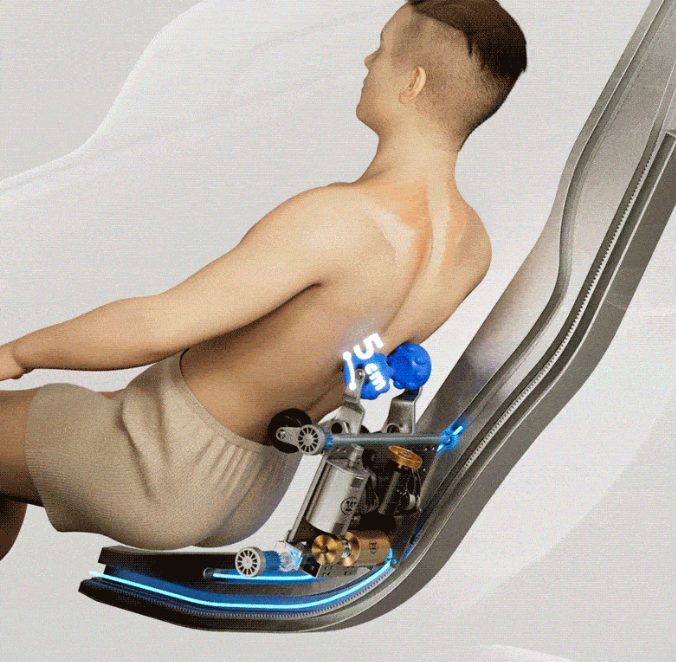
Image: Mechanical 3D massage on the back. Source: ZHOUQI product visual library.
Side-by-side comparison for procurement
The table below summarises the main factors used in supplier comparisons.
| Factor | Mechanical 3D Massage Chair | Airbag 3D Massage Chair |
|---|---|---|
| Massage mechanism | Motor-driven metal rollers with direct hard contact | 3D rollers plus full-body airbags for a wrapping massage |
| Maximum penetration depth | 8 cm for back muscle release | 4.5 cm, about 44% lower |
| Sensation | Strong, firm, deep | Soft, squeezing, wrapping |
| Initial cost difference | About USD 40 higher than airbag | Base reference for this comparison |
| Best-fit users | Home and office users who prefer strong and deep back massage | Seniors, slim-build users, and people who prefer a gentle, wrap-around massage |
| Maintenance considerations | Metal roller components need periodic inspection; higher wear and tear risk | Fewer moving mechanical parts in airbag components; lower maintenance workload |
Application and use cases
The intended use case should drive the mechanism choice.
Home and office settings with firm massage needs
Mechanical 3D chairs are positioned for users who want a noticeable, deep tissue effect. The 8 cm penetration depth is designed for back muscle release, making it suitable for home and office environments where users have regular access and can adjust the intensity themselves.
Gentle massage for seniors and lightweight users
Airbag 3D chairs output a softer diffused pressure. With a 4.5 cm penetration depth and full-body airbags, they are often a better match for seniors, slim-build users and customers who prefer a gentle, wrap-around massage rather than firm roller pressure.
Family safety consideration
When children or pets are present, the gap between the massage chair and the mechanism can become a risk point. ZHOUQI addresses this with an anti-pinch design integrated into the chair, reducing the risk of children or pets getting stuck in gaps. Buyers sourcing for home markets should ask suppliers whether such a safety feature is standard or optional.
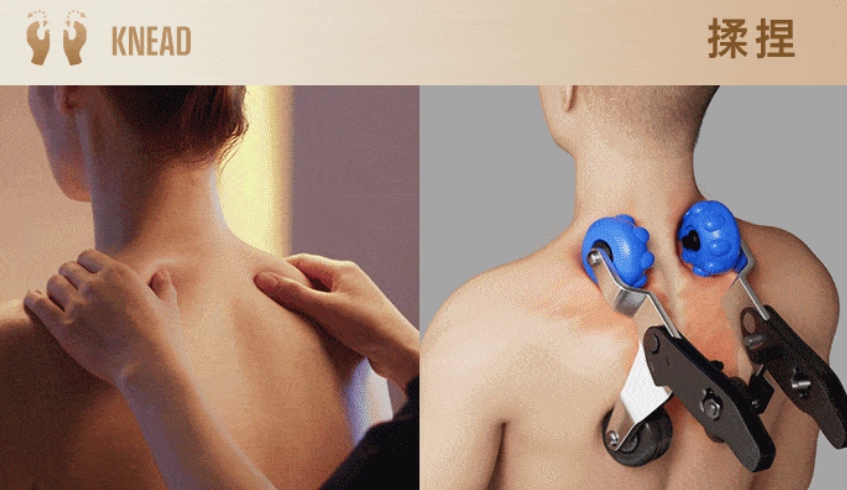
Image: 3D massage chair kneading motion. Source: ZHOUQI product visual library.
Market trends shaping buyer preference
Several market-level data points help frame the mechanical-versus-airbag decision.
- The global massage chair market is projected to grow from USD 4.28 billion in 2026 to USD 8.78 billion by 2035 at a CAGR of 8.3% (Business Research Insights).
- Massage chairs and sofas held the largest share of the massage equipment market at 39.5% in 2024 (Grand View Research).
- North America dominated the massage equipment market in 2024 with a 36.9% revenue share (Grand View Research).
- Asia Pacific is the fastest-growing market for massage chairs, holding a 34.8% share of the luxury segment in 2024 (Credence Research).
- The smart massage chair market is expected to reach USD 14.2 billion by 2033, driven by AI-powered body scanning and smart connectivity (Dataintelo).
- About 41% of new massage chair models in 2026 are expected to integrate AI-based sensors for body scanning (Business Research Insights).
For a sourcing manager, these trends indicate that 3D massage chairs are moving beyond basic roller movement into software-enabled personalisation. The mechanical-versus-airbag choice will increasingly be combined with questions about body scanning accuracy, app control and custom massage programs.
Comparison with traditional solutions and practical limits
Compared with a traditional fixed-roller massage chair, both mechanical 3D and airbag 3D systems offer variable pressure, but they come with their own trade-offs.
Mechanical 3D: The strongest advantage is depth. An 8 cm roller protrusion provides a level of pressure that many deep-tissue users expect. The boundary is equally clear: direct metal-roller contact can feel too intense for sensitive users, and the moving parts require periodic inspection. For a distributor entering a market with mostly older consumers, this may be a practical constraint.
Airbag 3D: The airbag system is gentler and easier to accept across a wider age range. However, its maximum depth of 4.5 cm is roughly 44% lower than the mechanical version, so customers who want a firm, structural massage may consider it insufficient. The cost profile is lower by about USD 40, but that saving may be lost in return or replacement costs if the product does not match the target user.
Buyers should therefore avoid assuming that all “3D massage chairs” serve the same customer. The mechanism is a strategic product attribute, not a minor spec.
Future outlook
As the smart massage chair segment expands, the mechanical-versus-airbag decision will become part of a larger conversation about AI-powered body scanning and connectivity. The 41% adoption rate forecast for AI sensors in 2026 indicates that chair intelligence will differentiate models more visibly than the roller mechanism alone. For sourcing teams, the durable criteria remain: depth, sensation, price, safety and service support.
Manufacturers with dedicated R&D teams and flexible production lines are better positioned for evolving requests. ZHOUQI’s stated capacity — 200,000 units per year, 34 engineers and a 130,000 m² facility — is one example of the scale required for OEM programs that must balance mechanical performance and cost.
Further reference
For buyers preparing supplier conversations, the current ZHOUQI e-catalogue provides additional product details: ZHOUQI 2026 E-catalogue.
FAQ
What is the main difference between a mechanical 3D massage chair and an airbag 3D massage chair?
A mechanical 3D massage chair uses motor-driven metal rollers that provide direct hard contact for deep-tissue massage. An airbag 3D massage chair combines 3D rollers with full-body airbags to create a soft squeezing and wrapping massage. The mechanical version reaches about 8 cm deep, while the airbag version reaches about 4.5 cm.
Which type of 3D massage chair is better for deep-tissue massage?
Mechanical 3D massage chairs are better suited for users seeking strong and deep back massage. With a maximum penetration depth of 8 cm for back muscle release, they provide a firmer pressure than airbag 3D chairs, which offer a maximum depth of 4.5 cm and a gentler, more diffused compression.
Is a mechanical 3D massage chair more expensive than an airbag 3D massage chair?
According to the product comparison data, a mechanical 3D massage chair has an initial cost about USD 40 higher than an airbag 3D massage chair. The price difference is relatively small but can be relevant at scale.
Which massage chair type is more suitable for elderly or lightweight users?
Airbag 3D massage chairs are generally a better fit for seniors, slim-build users and people who prefer a gentle, wrap-around massage. The lower penetration depth and airbag-based squeezing sensation reduce pressure intensity compared with the direct hard contact of mechanical 3D rollers.
What safety feature should buyers look for when sourcing 3D massage chairs?
One important feature is anti-pinch design. This measure addresses the risk of children or pets getting stuck in the gap of a massage chair. Buyers should confirm whether the manufacturer integrates anti-pinch protection as a standard part of the product.
How much maintenance do mechanical 3D massage chairs require?
Mechanical 3D massage chairs use metal roller components that require periodic inspection and have a higher wear-and-tear risk. Airbag 3D systems have fewer moving mechanical parts in the airbag components, which can mean lower maintenance workload. The selected mechanism affects the after-sales service plan.