
Medical Device Housing Injection Molding: A Buyer's Guide
Medical Device Housing Injection Molding: A Buyer's Guide
Medical device housing injection molding is the production of the outer shells, enclosures and internal structural housings of medical and healthcare products from engineering-grade plastic, using tooling and process controls that are stricter than those applied to general consumer molding. What separates the two is not the molding machine. It is the discipline around the machine: dimensional consistency, surface cleanliness, material batch stability and documented inspection.
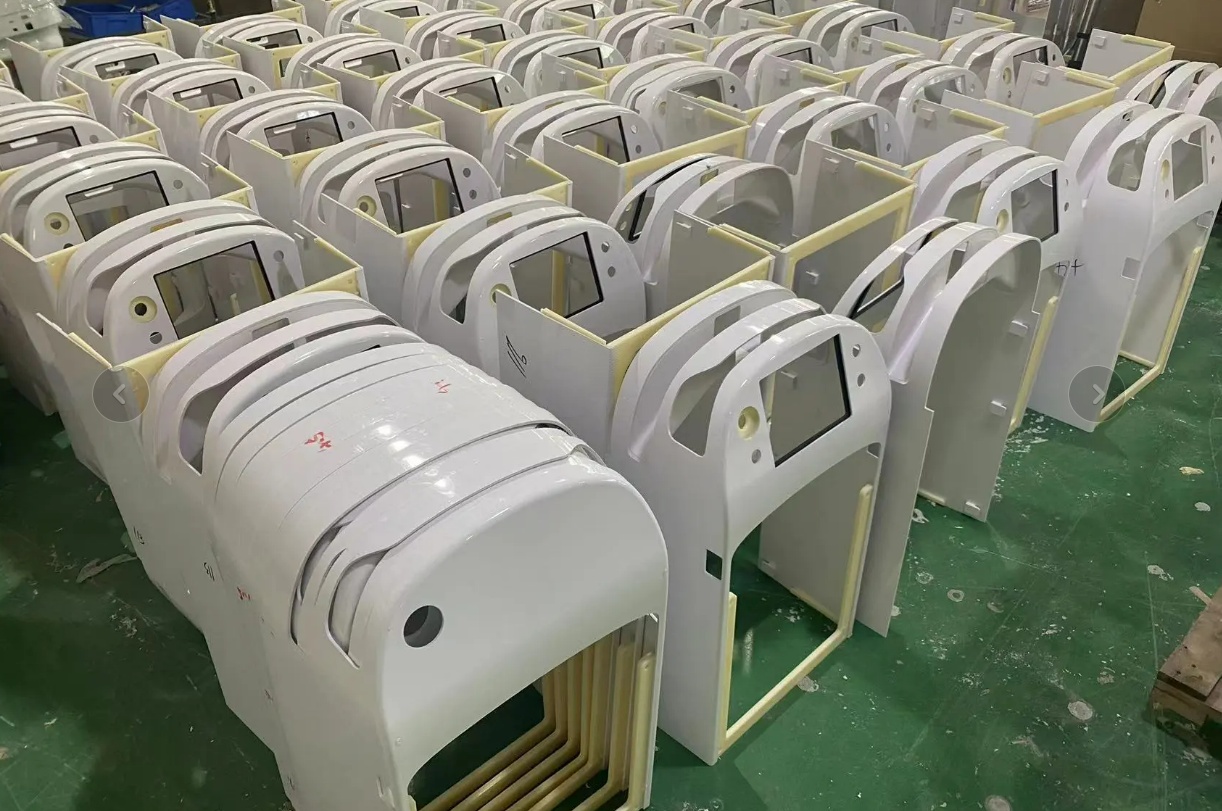
Medical and healthcare product components molded for clean-use environments with strict appearance and dimensional requirements.
For buyers at the awareness and research stage, the useful question is rarely what injection molding is. It is which properties actually matter when the molded part becomes the housing of a medical device, how those properties are controlled, and where the process stops being the right answer.
Why Medical Device Housings Are Judged Differently
A medical device housing is not a decorative cover. In the medical and healthcare product segment, the molded component supports the device structure, protects internal electronic modules and sensors, and contributes directly to product usability. These parts are permanently assembled inside the device and operate through continuous intermittent use: multiple on and off cycles per day, routine cleaning and sterilization, and a mix of long-term static mounting and frequent actuation.
That operating profile produces a requirement set that is tighter than a typical enclosure specification. The segment typically demands:
- High-precision molding with tight tolerances;
- Clean, defect-free surfaces;
- Stable material batch-to-batch consistency;
- Rigorous 100% quality inspection, covering both dimensional measurement and visual check.
Each of these maps to a failure mode that is expensive to correct later. Tight tolerances protect assembly alignment. Defect-free surfaces protect appearance and contact surfaces. Batch-to-batch material consistency protects the behavior of a part that will not be re-evaluated after release. And 100% inspection converts those controls into evidence rather than assumption.
The Problem: Where Medical Housings Fail in Practice
Housing defects rarely appear as dramatic failures. They surface as drift and inconsistency. Dimensional variation accumulates against the internal modules, sensors, tubes and buttons the housing must locate, so a part that measured acceptably in the first sample may still cause difficulties at assembly. Surface issues such as flow lines, sink marks or cosmetic blemishes become visible on a device that a clinician or patient will handle daily. Appearance and color variation between production batches is noticed immediately on a finished product, even when every measurement is in specification.
Material behavior is the least visible risk and often the most consequential. A medical housing is expected to endure cleaning and sterilization routines over the product lifecycle without degrading, warping or loosening. Where material batches are not consistent, this expectation becomes difficult to sustain even with a well-controlled molding process.
The opportunity sits on the other side of these problems. Engineering plastics give device makers lighter housings, more freedom over geometry and interfaces, and the ability to integrate mounting features directly into the part. Precision injection molding, combined with first article inspection and full inspection on medical components, is how that design freedom is converted into something repeatable.
How DTG TECH Approaches Medical Device Housing Injection Molding
DTG TECH CO., LTD. is a custom injection molding manufacturer based in Xiamen, Fujian, China, founded in 2002 and ISO-certified, operating from a 2,500 m2 facility with 80 employees, a 25-engineer R&D team and an annual output of 47,881 units. The company exports 100% of its production and serves customers in the USA, Europe and India. Its stated model is a one-stop service spanning precision mold design, tool manufacturing, prototype development, plastic injection molding and mass production, supported by product analysis and mold testing.
For medical and healthcare product housings, four product families are relevant. They differ mainly in process route, material set and the level of dimensional control applied.
| Product | Model | Process | Materials | Relevant capability |
|---|---|---|---|---|
| Plastic Injection Molded Housings | DTG-PIH-002 | Injection molding | ABS, PC+ABS, PP | Size, structure, color and surface texture customizable; polishing, painting, printing and assembly support |
| Precision Injection Molded Components | DTG-PIM-003 | Precision injection molding | ABS, PC, POM, Nylon, engineering plastics | Dimensional control according to engineering drawings; dimensional inspection and first article inspection |
| Custom Injection Molded Plastic Parts | DTG-CIMP-001 | Plastic injection molding | ABS, PP, PC, PC+ABS, TPE, Acrylic and other engineering plastics | Prototype to mass production; texture, polishing, painting and printing finishes |
| Insert Injection Molded Parts | DTG-IIM-005 | Insert injection molding | ABS, PC, PP combined with metal inserts | Insert position, material combination and structure design customizable; functional and structural components |
Read together, these four families cover the practical requirements of a medical housing program: the housing itself, the tight-tolerance functional geometry inside it, the custom part route from prototype through volume, and a metal insert option for attachment points that will be assembled and disassembled repeatedly.
Technical Explanation: What High-Precision Means in Practice
In precision injection molding, accuracy is not a general claim. It is dimensional control according to engineering drawings, verified by dimensional inspection and first article inspection. First article inspection matters because it fixes the reference: once the initial part is measured against the drawing, later production can be compared against a known baseline rather than against an assumption.
Surface condition is treated as a specification rather than an outcome. Housings can be customized in size, structure, color and surface texture, with polishing, painting, printing and assembly support available at the finishing stage. For medical parts, the stated requirement is clean and defect-free surfaces, which also means the process window must be stable enough to avoid flow lines and similar cosmetic defects on a repeatable basis.
Material selection follows the same logic. Medical-grade ABS and medical-grade PC both sit inside the material sets used for these parts, alongside PC+ABS, PP, POM, Nylon, TPE and other engineering plastics depending on the product family. Because stable batch-to-batch consistency is a stated requirement for medical and healthcare components, the material grade should be locked before tooling is released. Changing resin after the tool exists forces re-validation of both the tool and the process.
Where the housing needs threaded or reinforced attachment points, insert injection molding combines plastic with metal inserts. Insert position, material combination and structure design are customizable, which allows metal load-bearing features to be integrated into an otherwise plastic part instead of added as separate components.
Process control applies across the whole chain rather than at a single station. DTG's stated workflow runs from precision mold design and tool manufacturing through prototype development, molding and mass production, with product analysis and mold testing in the loop. Custom parts are produced from prototype to mass production, so the same process is scaled rather than replaced when volumes rise. The final control layer for medical and healthcare parts is rigorous 100% inspection, combining dimensional measurement with visual check.

Precision inspection of medical device components: dimensional measurement plus visual check on every part.
Application: Where These Housings Are Used
The medical and healthcare product application covered here concerns medical device plastic parts and healthcare product components. Their working environment is a clean-use setting with high consistency requirements and strict appearance and dimensional demands. Functionally, they support device structure, protect internal electronic modules and sensors, and improve product usability.
The matched internal equipment is what makes the geometry demanding. These housings are assembled with electronic modules, sensors, tubes, buttons and assembly fixtures. That means the plastic part sits at the intersection of mechanical, electrical and user-interface requirements simultaneously: it must locate the modules and sensors it carries, provide the geometry through which tubes and buttons interface with the device, and remain stable enough that these interfaces do not shift over time.
Operating conditions reinforce this. The components are permanently assembled inside the device and are subjected to continuous intermittent use under cleanroom conditions, including daily on and off cycles and routine cleaning and sterilization. They are designed for both long-term static mounting and frequent actuation, with the expectation of reliable performance and no degradation over the product lifecycle. For a housing that combines structural support with sensor protection, that combination of static and moving duty is the defining constraint.
Market Trend Analysis
Three broad movements are shaping how buyers evaluate medical device housing injection molding suppliers, and all three push toward earlier and more documented supplier involvement.
First, enclosure design continues to consolidate on engineering plastics. Designers increasingly treat the housing as a structural and functional element rather than a shell, which brings requirements such as sensor alignment, button actuation and tube routing into the molding conversation. That change raises the cost of late-stage tooling changes and favors buyers who involve the molder during design.
Second, buyers are asking about evidence earlier. Inspection practice, first article inspection, dimensional control against drawings and batch consistency are increasingly discussed at the research stage rather than after tooling is committed. This is a shift in the procurement conversation more than a change in the technology itself.
Third, regional requirements differ, and buyers are increasingly explicit about which market they are designing for. A supplier serving the USA, Europe and India simultaneously, as DTG does, works across several expectation sets at once, which makes it practical to raise regional documentation questions during the research stage rather than at the point of purchase.
Comparison with Traditional Solutions
Buyers researching medical device housings usually compare three routes: a metal enclosure, general-purpose plastic molding without medical-oriented controls, and medical-oriented plastic molding. The differences are not absolute advantages. Each route has a profile.
| Consideration | Metal enclosure | General-purpose plastic molding | Medical-oriented plastic molding |
|---|---|---|---|
| Design freedom and weight | Limited geometry; heavier | Flexible geometry | Flexible geometry; integrates mounting features |
| Dimensional repeatability | Stable but constrained in complex shapes | Depends on supplier process control | Dimensional control against engineering drawings |
| Surface condition | Requires secondary finishing | Cosmetic defects more likely without a locked process window | Clean, defect-free surfaces specified |
| Material consistency | Not applicable | Varies by supplier | Batch-to-batch consistency specified |
| Inspection evidence | Dependent on supplier | Often sampled | 100% dimensional measurement and visual check on medical parts |
| Upfront investment | Tooling and fabrication costs | Tooling cost | Tooling plus validation effort |
The limits deserve equal attention. Injection molding is a tooling-dependent process, which means the tooling investment and the validation effort are incurred before production begins. That model is efficient when a design is stable and repeat volumes are real. For a design still under significant change, or for very low unit volumes, the economics are weaker than for other forming methods, and buyers should treat tooling release as the point of commitment rather than an early administrative step.
Capacity is the second practical boundary. DTG operates a 2,500 m2 facility with 80 employees. That is a workable scale for the project profiles described here, but buyers running large concurrent programs or multiple product lines should plan tooling and production scheduling with the supplier instead of assuming unlimited parallel capacity.
The third boundary is regulatory, and it applies to every supplier. The specific cleanroom classification and the documentation package required by a buyer's regulatory pathway vary by market. Because those requirements differ, the right approach is to confirm the supplier's scope of qualification and documentation against the target market before tooling release, rather than after. A supplier's inspection data supports a regulatory submission; it does not by itself define the submission.

Production environment at DTG TECH CO., LTD., Xiamen, China, where molded components move from tooling and validation into volume production.
Future Outlook
The direction of travel in medical device housing injection molding follows the direction of device design. As devices become smaller, more sensor-dense and more frequently handled by users, the housing carries more functional load, and the tolerance and cleanliness requirements attached to it tighten accordingly.
Two practical consequences follow for buyers. The first is that the molding supplier moves earlier in the development sequence. Where a molder was once engaged at the production stage, engagement during mold design and prototype development reduces the risk that functional requirements discovered late force tooling revisions. A workflow that already spans mold design, tool manufacturing, prototype development and mass production supports that earlier involvement.
The second is that evidence becomes part of the product. Dimensional inspection, first article inspection, visual checks and batch consistency records increasingly travel with the part rather than sitting in a supplier file. Suppliers whose process controls are already documented are better positioned for this shift than suppliers whose quality claims are verbal.
Frequently Asked Questions
What is medical device housing injection molding?
It is the injection molding of the outer shells, enclosures and structural housings used in medical devices and healthcare products. In this application, molded components are permanently assembled inside the device, supporting device structure and protecting internal electronic modules and sensors while improving product usability. Because the parts remain in place for the product lifecycle, they are produced with tight tolerances, clean and defect-free surfaces and stable batch-to-batch material consistency, and they receive rigorous 100% inspection covering dimensional measurement and visual check.
Which plastic materials are used for medical device housings?
Material sets vary by product family. Plastic Injection Molded Housings (DTG-PIH-002) specify ABS, PC+ABS and PP. Precision Injection Molded Components (DTG-PIM-003) specify ABS, PC, POM, Nylon and engineering plastics. Custom Injection Molded Plastic Parts (DTG-CIMP-001) cover ABS, PP, PC, PC+ABS, TPE, Acrylic and other engineering plastics. Insert Injection Molded Parts (DTG-IIM-005) combine ABS, PC or PP with metal inserts. Because stable batch-to-batch consistency is a stated requirement for medical and healthcare components, the material grade should be fixed before tooling is released.
Why is high-precision molding important for medical device housings?
Because the housing locates the parts around it. Electronic modules, sensors, tubes and buttons are assembled inside or onto the component, so dimensional drift affects assembly alignment, fit and user-interface function. The medical and healthcare product segment requires high-precision molding with tight tolerances, clean and defect-free surfaces and stable material consistency, and the components are designed for both long-term static mounting and frequent actuation with no degradation over the product lifecycle.
How is quality verified on medical injection molded components?
For precision components, dimensional control follows engineering drawings and is verified through dimensional inspection and first article inspection. For medical and healthcare products, the stated requirement is rigorous 100% quality inspection covering dimensional measurement and visual check. Prototype validation and mold testing are also part of the production workflow before mass production, and custom parts are produced from prototype through volume on the same process route.
What are the limits of injection molding for medical device housings?
Injection molding depends on tooling, so tooling cost and validation effort are committed before production begins; the model is most efficient when the design is stable and repeat volumes are meaningful. Designs still undergoing significant change, or very low unit volumes, may not justify that upfront investment compared with other forming methods. Capacity is a second variable: DTG operates a 2,500 m2 facility with 80 employees, so buyers running large or multi-line programs should confirm scheduling. Third, cleanroom classification and documentation requirements differ by market, so the scope of qualification relevant to a buyer's regulatory pathway should be confirmed with the supplier before tooling release.
Facility, capability and product details for DTG TECH CO., LTD. are compiled in the company presentation, available here: Xiamen DTG Tech Co., Ltd. Presentation.
Have Questions or Need More Details?
Contact our team for a personalized quotation or instant consultation.
Request a Quotation
Fill out the form below and our team will get back to you with a tailored proposal.
WhatsApp Direct Chat
Prefer to chat in real-time? Message us on WhatsApp for instant assistance & quick answers.
- Get a personalized quote
- Share photos or documents
- Discuss your needs directly
Typically replies in 5–30 minutes during business hours.