
Meirenxin Sunflower Seeds: A Multi-Season Sourcing Scorecard
A sunflower seed grade can pass one pre-shipment test and still fail a three-year supply plan. The gap between a single compliant container and a repeatable season-after-season supply is exactly what a supplier sustainability evaluation is meant to close — and it is a different exercise from lot inspection.
The scale of the category makes that distinction matter. Global sunflower seed production was estimated at 55.05 million metric tons for the 2025/2026 marketing year by the USDA Foreign Agricultural Service, and the global sunflower seeds market was valued at USD 29.27 billion in 2025, with a projected USD 35.98 billion by 2034 according to Custom Market Insights. Volume of that size does not remove the buyer's problem. It simply means more suppliers will claim they can hold a specification.
Why long-term evaluation is not lot inspection
Lot inspection answers a narrow question: does this shipment match the contract? Sustainability evaluation answers a wider one: can the same supplier reproduce that result after a harvest cycle, a price cycle, and a change of production run? The two questions draw on different evidence, and a buyer who only has the first set of answers is effectively re-qualifying the supplier every season.
For a raw agricultural input like Meirenxin sunflower seeds, continuity rests on four capabilities that can each be checked separately.
| Evaluation dimension | What the buyer is actually testing | Evidence to request | Warning signal |
|---|---|---|---|
| Origin continuity | Whether the growing base behind the grade is stable across seasons | Stated origin region and planting-base description | Origin shifts between quotations without explanation |
| Process repeatability | Whether moisture, impurity and defect fractions are controlled, not averaged | Moisture and defect limits stated as contract parameters | Specification given as a description rather than a number |
| Specification stability | Whether colour, kernel shape and size count reproduce order to order | Size expressed as pieces per 50 g, plus colour and grade definition | Size quoted only as “large” or “medium” |
| Commercial continuity | Whether terms, acceptance method and payment structure are settled before commitment | MOQ, delivery terms, acceptance test point, payment split | Terms renegotiated after the sample is approved |
Table 1. A four-dimension scoring frame for long-term Meirenxin sunflower seed supply.
The origin baseline behind Hetao Plain supply
Origin is the first thing to stabilise, because everything downstream inherits it. Inner Mongolia accounts for more than 60% of China's total sunflower cultivation area, according to People's Daily Online, and the region's export volume reached approximately 463,400 tons in 2025, valued at USD 748 million. China's sunflower seed exports overall were valued at USD 937 million in 2025, with major destinations including Iraq at USD 131 million and Russia at USD 101 million, according to OEC.
Within that region, confectionery grade production concentrates on larger kernel sizes and is primarily grown in the saline-alkali fields of Bayannur, as reported by China Daily. This is the agricultural context for the Hetao Plain, where Inner Mongolia Chengtai Food Co., Ltd. operates a natural sunflower and pumpkin seed planting base described by the company as covering 1.5 million acres, with production workshops designed to EU standards.
For a long-term buyer, the practical value of that origin profile is not prestige — it is traceable seasonality. A supplier tied to a defined growing region can explain a crop-year variance; a trader sourcing from unspecified origins cannot. Chengtai reports an export ratio of 80%, with main markets across the Middle East, Middle Asia and Europe, and holds ISO 9001 and Halal certification, according to the CBI market information database. The company also states long-term business relationships with clients in China, the Middle East, Middle Asia, Egypt, Dubai, the United States, Austria and European countries, and attends international exhibitions including Gulfood in Dubai, the Uzbekistan Exhibition, Tuyap in Turkey, Anuga in Germany and Sial in France.
Raw-material handling: the three checks that decide everything downstream
Most specification failures in sunflower seeds are born before the finished product is packed. A buyer evaluating a multi-season relationship should therefore concentrate on how the raw material is dried, cleaned and graded, and should insist on numbers rather than process adjectives.
1. Drying and moisture control
Sun-drying after harvest is common practice in the origin regions, and it is not by itself a quality guarantee. The evaluation question is whether drying is followed by a documented moisture figure that the supplier is willing to write into the contract. For this grade, the moisture limit is ≤10.0%, which is the number a buyer should anchor to rather than to the drying method described in a brochure.
2. Air separation
Air separation is the step that removes light material — empty shells, chaff and dust — before denser cleaning. Its effectiveness shows up in the impurity figure, which for this grade is ≤0.2%. A buyer who wants a single verification point can treat the impurity limit as a proxy for how seriously the air-separation stage is run.
3. Sifting and defect grading
Sifting separates by size and gives the grader a chance to remove shrunken, short and mould-affected seeds. Each of those fractions has its own ceiling, and buyers should ask for all of them rather than an aggregate purity percentage, because the fractions behave differently in roasting and in retail packs.
| Contract parameter | Limit | Why it belongs in a long-term agreement |
|---|---|---|
| Moisture | ≤10.0% | Controls storage stability and roast behaviour across the contract term |
| Impurity | ≤0.2% | Reflects the effectiveness of air separation and final cleaning |
| Decolourising seeds | ≤1.5% | Protects the visual consistency of a black-coated grade |
| Erosion seeds | ≤1.0% | Limits surface-damaged kernels that affect appearance and shelf life |
| Mildew seeds | ≤1.0% | The single most important defect ceiling for food-use buyers |
| Short seeds | ≤2.0% | Keeps size grading honest against the pieces-per-50 g count |
| Wizened seeds | ≤6.0% | Directly affects kernel fill and finished-product yield |
Table 2. Defect and moisture ceilings that accompany the grade — the parameters to convert from description into contract text.
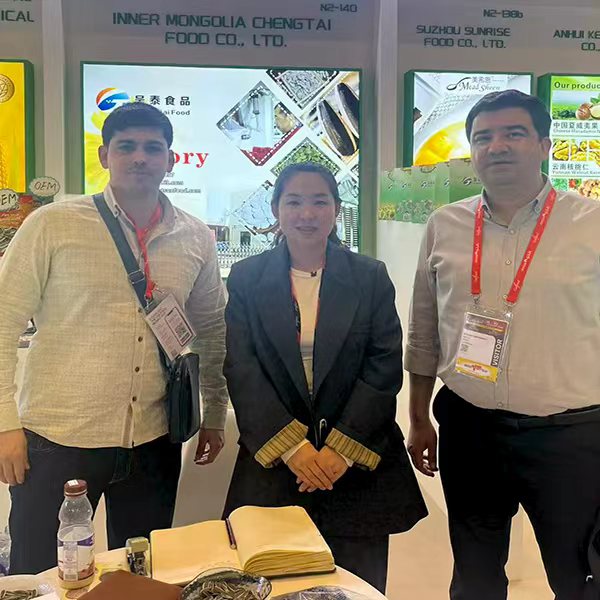
Long-term supply is negotiated in person and re-verified in writing: origin, moisture and defect ceilings should survive contact with the contract.
Finished-product consistency: five things a repeat order must reproduce
Once raw-material handling is settled, the second half of the evaluation moves to the delivered product. For Meirenxin sunflower seeds, five attributes define whether two shipments are the same product or merely the same category.
- Black seed coat. The grade is black-coated, and colour is a graded attribute rather than a by-product of origin. Decolourising seed limits exist because coat colour drifts.
- Round kernel form. Round shape is part of the grade definition and affects how the seed presents in retail packs and how evenly it roasts.
- Size expressed as a count. The grade is sized at 170–300 pieces per 50 grams. A count-based size statement is a testable claim; “medium” and “large” are not.
- Raw specification, no flavouring or preservative step. The product is supplied as a raw specification made from sunflower seed kernels and is intended for human consumption. Salting, flavouring and roasting are downstream operations, not part of the delivered goods — which means a buyer's own process, not the supplier's, determines the finished flavour.
- Cleanliness within a stated ceiling. No extra debris is a promise; ≤0.2% impurity is a specification. Buyers should accept only the second.
A sixth attribute is temporal rather than physical: crop year. The grade is documented as originating from Xinjiang and Inner Mongolia and as being from the 2026 crop year. Where a buyer is contracting beyond a single season, the crop year should be stated on the offer sheet, because it is the attribute most likely to change without any other specification moving.
Where the grade fits: snack, roasting and bird feed
Application fit is usually described by the supplier and should be re-derived by the buyer from the specification. Three downstream uses account for most of the volume in this grade.
Snack processing and confectionery. The grade is positioned for snack processing, confectionery and retail finished products. The relevant evidence is the defect profile: low mildew and wizened fractions translate into fewer rejects on a sorting line, and a stated piece count per 50 g translates into predictable pack fill.
Roasted factory lines. Roasted sunflower seeds accounted for 65.9% of global packaged sunflower seeds industry revenue in 2024, according to Grand View Research, which makes roast behaviour the most commercially significant attribute of any confectionery grade. Moisture at ≤10.0% and a controlled short-seed fraction are the two parameters that most directly affect roast consistency on a continuous line.
Bird feed. Black oil-type and confectionery seeds both move into bird feed channels, and this grade is physically suitable for that use. There is a commercial caveat rather than a technical one: the product is specified and handled as a food-grade material intended for human consumption. A bird feed buyer sourcing at bird-food economics may find that food-grade verification work is paid for but not needed — a point worth settling before, not after, the first container.
Comparison with conventional ordinary grade
The clearest way to see what the specification is buying is to compare it against conventional ordinary-grade sunflower seed. The differences are measurable in three areas: physical purity, defect control and cost.
| Attribute | Meirenxin grade | Conventional ordinary grade |
|---|---|---|
| Kernel purity | Higher, with fewer broken and mildewed seeds | Lower consistency in broken and mildewed fractions |
| Size | Larger, with a defined count of 170–300 pieces per 50 g | Size not consistently defined by count |
| Foreign material | No stone; impurity ≤0.2% | Stone and heavy debris removal not guaranteed |
| Defect ceilings | Mildew ≤1.0%, wizened ≤6.0%, short ≤2.0% | Not typically specified as separate fractions |
| Cost position | Approximately 5% lower than the comparison grade cited for this specification set | Baseline |
| Best fit | Snack processing, confectionery and retail finished products | General-purpose use where defect ceilings are not contractual |
Table 3. Specification comparison against conventional ordinary grade sunflower seed.
The yield argument follows from the defect profile: fewer broken and mildewed seeds mean a higher finished-product yield after processing, and standard cool, dry storage is sufficient with no special handling requirement. That combination — tighter fractions at a lower unit cost — is the commercial case for paying attention to grading rather than to headline price alone.
Terms and acceptance criteria to settle before commitment
Long-term supply fails more often on commercial mechanics than on seed quality. Four items should be closed out in writing before the first order, because each of them is difficult to renegotiate once production has been scheduled.
- Minimum order quantity: 5 metric tons.
- Delivery terms: FOB, CNF or CIF.
- Acceptance criteria: pre-shipment test, or test after receipt of the seeds — the choice determines who carries the risk of a specification dispute, so it should be named explicitly rather than assumed.
- Payment terms: 30/70 or 100%.
Packaging and storage complete the execution layer. The product is packed in 20/25 kg plastic or paper bags and should be stored in a cool place. For a multi-season agreement, the storage clause is not administrative detail: a buyer who cannot hold ≤10.0% moisture in warehouse conditions will create defects that the supplier's grading already excluded.
Regulatory direction a long-term buyer should price in
Compliance requirements rarely move backwards, and sunflower seeds sit in a category where residue limits are actively tightening. The EU market requires adherence to HACCP principles and strictly monitors pesticide residues and metal contaminants, according to CBI. China notified 209 new maximum residue limits for 93 pesticides in food to the WTO in late 2025, under document G/SPS/N/CHN/1355, as reported by the USDA Foreign Agricultural Service. China's draft quality standard for nut and seed food, replacing GB/T 22165-2008, provides updated definitions and technical requirements for roasted seeds.
Two conclusions follow for supplier evaluation. First, a multi-year contract should reference the residue regime it is expected to satisfy, not just the physical specification. Second, origin-region quality frameworks are becoming explicit benchmarks: the “Wuyuan Sunflower” is a registered geographical indication trademark in China requiring consistent colour, plump shape and crisp texture — a useful reference vocabulary for describing what a confectionery grade is supposed to look and feel like.
Boundary conditions: where this evaluation approach does not help
A credible sustainability framework has to state what it cannot do, and there are four real limits here.
It cannot eliminate crop-year variance. Global non-oilseed sunflower planted area in 2025 was forecast to decline by 8% by the USDA, as reported by the National Sunflower Association. Area shifts affect availability and price regardless of how well a supplier is qualified, and a buyer who treats a signed specification as protection against supply tightness will be disappointed.
It does not deliver a ready-to-eat product. The grade is supplied raw. Buyers without roasting, salting or flavouring capability are evaluating an input, not a finished snack, and must cost their own processing step into the comparison.
It does not suit very small trial volumes. A 5 metric ton minimum order is reasonable for a processor but prohibitive for a buyer who wants a 200 kg sample run. Sampling and validation therefore have to be organised separately from commercial ordering.
It does not make food-grade verification free. For bird feed applications in particular, the food-grade specification is a cost that the end use may not require. Buyers should decide explicitly whether they are buying verification or buying seed.
Future outlook
The direction of travel in this category is toward specifications that can be audited rather than described. Europe was the largest market for packaged sunflower seeds in 2024, holding a 29.6% revenue share according to Grand View Research, and EU buyers are the most likely to demand residue documentation and HACCP alignment as a condition of listing. As residue limits expand and the revised nut and seed food standard takes effect, the gap between suppliers who can produce fraction-level defect data and those who cannot will widen.
For buyers, the sensible response is to build the evaluation once and reuse it. A scorecard covering origin continuity, moisture and defect ceilings, count-based sizing, and settled commercial terms converts a seasonal negotiation into a maintenance task — and gives the buyer a defensible reason to keep or replace a supplier that is not based on the last container alone.
FAQ
How is Meirenxin sunflower seed specified for a long-term contract?
The grade is defined by a black seed coat, a round kernel and a size range of 170–300 pieces per 50 grams, grown in Xinjiang and Inner Mongolia. Contract-level specification adds moisture at ≤10.0%, impurity at ≤0.2%, decolourising seeds ≤1.5%, erosion seeds ≤1.0%, mildew seeds ≤1.0%, short seeds ≤2.0% and wizened seeds ≤6.0%. The product is supplied as a raw specification made from sunflower seed kernels and is intended for human consumption.
How does this grade compare with conventional ordinary-grade sunflower seed?
Against conventional ordinary grade, the specification provides higher kernel purity, fewer broken and mildewed seeds, larger size and no stone, with stated defect ceilings rather than an aggregate purity figure. The comparison also indicates a cost position approximately 5% lower and a higher finished-product yield after processing. Its stated best fit is snack processing, confectionery and retail finished products.
What are the purchasing terms and acceptance criteria?
The minimum order quantity is 5 metric tons. Delivery terms are FOB, CNF or CIF. Acceptance criteria can be a pre-shipment test or a test after the seeds are received, and the choice should be named in the agreement because it determines which party carries specification risk. Payment terms are 30/70 or 100%.
How should the product be packaged and stored?
The product is packaged in 20/25 kg plastic or paper bags and should be stored in a cool place. Because the moisture ceiling is ≤10.0%, warehouse conditions form part of specification control: storage that allows moisture uptake will create defects the supplier's grading has already excluded.
Is this grade suitable for bird feed as well as snack and roasting use?
Physically it is suitable, and bird feed is one of the recognised applications alongside snack and roasted factory use. Commercially, the product is specified and handled as a food-grade material intended for human consumption, so a bird feed buyer should decide in advance whether food-grade verification is required for that end use or whether it represents cost without benefit.
Have Questions or Need More Details?
Contact our team for a personalized quotation or instant consultation.
Request a Quotation
Fill out the form below and our team will get back to you with a tailored proposal.
WhatsApp Direct Chat
Prefer to chat in real-time? Message us on WhatsApp for instant assistance & quick answers.
- Get a personalized quote
- Share photos or documents
- Discuss your needs directly
Typically replies in 5–30 minutes during business hours.