
Membrane vs Water-Flush vs Once-Open: A Filter Press Decision Matrix
Three automatic filter press architectures dominate modern solid-liquid separation shortlists, and they are frequently compared on the wrong axis. A membrane filter press, a water-flush filter press and a once-open filter press are not three grades of the same machine. They are three different operating strategies that answer three different plant problems: how dry the cake must be, how clean the filter cloth must stay, and how much manual work cake discharge is allowed to require.
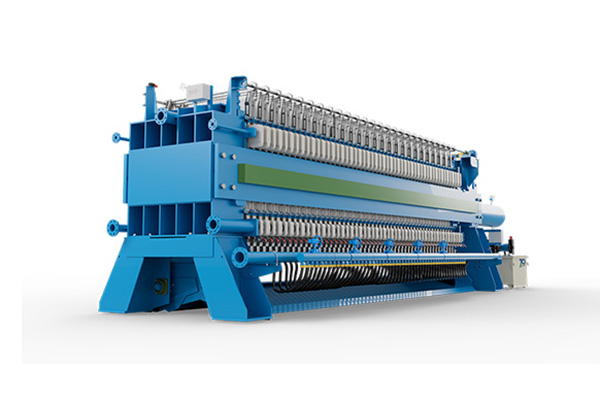
Automatic membrane filter press platform with cloth-traveling discharge, used for sludge dewatering and mineral slurry filtration.
Henan Dazhang Filtration Equipment Co., Ltd., also referred to as DAZHANG Filter Press, is a filtration and solid-liquid separation equipment manufacturer founded in 2004 and based in Yuzhou, Henan Province, China. Its catalogue includes membrane filter presses, chamber filter presses, plate and frame filter presses, high-pressure round plate filter presses, mobile skid-mounted filter presses, filters, filter plates, filter cloths, hydraulic systems and automatic washing systems. That matters for this comparison because all three architectures discussed below sit inside one manufacturing portfolio rather than across unrelated vendors, which makes a like-for-like reading of their published parameters possible.
The question this article answers is deliberately narrow: when the separation goal changes, which of the three should a buyer specify, and which parameters actually separate them?
Short answer. Membrane presses are specified when cake moisture must be pushed lower by a secondary squeeze; their published platform data covers 0.6–4.0 MPa filtration pressure and 20–291.2 m² filtration area on the cloth-traveling 1100 / 1500 series. Water-flush presses are specified when filter cloth condition is the bottleneck, with 0.4–2.0 MPa filtering pressure and 1–1000 m² filter area. Once-open presses are specified when cake discharge labour is the bottleneck, with filtration pressure ≥0.8 MPa, 50–120 m² filter area, 1000×1000 mm plates and a 4 kW motor.
Why "automatic filter press" is not yet a specification
In wastewater treatment, mining, chemical processing, metallurgy and food processing, procurement documents frequently describe the requirement as an automatic filter press. The phrasing is accurate and almost useless. Automatic operation on a membrane unit means a programmable feed-and-squeeze sequence. Automatic operation on a water-flush unit means automatic high-pressure water flushing of the filter cloth. Automatic operation on a once-open unit means a single plate-opening stroke followed by fast cake discharge with automatic vibration.
The commercial consequence is straightforward. A plant that buys on the word "automatic" alone may receive equipment that removes labour from discharge but does not improve cake dryness, or equipment that improves cloth life but does not reduce headcount. Both outcomes can be correct purchases — but only if the original separation goal was defined before the specification was written.
The opportunity in this category is equally clear. As sludge volumes and tailings handling requirements grow, and as operating labour becomes harder to secure, plants are moving from manual plate-and-frame operation toward platform architectures that hold a repeatable cycle. That shift is where the membrane / water-flush / once-open decision is actually made.
The side-by-side decision matrix
The table below uses published platform parameters rather than generalised claims. Where a manufacturer offers more than one membrane platform, both published envelopes are shown, because a high-pressure membrane filter press and a cloth-traveling membrane filter press do not cover the same duty range.
| Decision dimension | Automatic membrane filter press | Water-flush filter press | Once-open filter press |
|---|---|---|---|
| Separation goal it serves | Lower cake moisture via secondary squeezing | Clean cloth, stable filtration efficiency under heavy duty | Fast, low-labour cake discharge |
| Filtration pressure | 0.6–4.0 MPa (cloth-traveling 1100 / 1500 series); XMAG series: 0.6–2.0 MPa feed pressure, 1.6 MPa squeezing pressure | 0.4–2.0 MPa | ≥0.8 MPa |
| Filter area | 20–291.2 m² (1100 / 1500 series); XMAG30/870-UKB to XMAG1000/2000-UKB series: 30–1000 m² | 1–1000 m² | 50–120 m² |
| Plate size | 1100 / 1500 mm; XMAG series 870–2000 mm | 320–2000 Series platform configuration | 1000×1000 mm |
| Plate material | PP / TPE membrane plates (XMAG series); PP filter plates on the 1100 / 1500 platform | Polypropylene (PP) filter plates | PP filter plates |
| Frame material | Q345 steel frame (XMAG series); carbon steel frame | Carbon steel frame | Carbon steel frame |
| Automation feature | Automatic operation, automatic cloth traveling, automatic cleaning, visible or invisible drainage | Automatic operation with automatic high-pressure water flushing of cloth | One-time plate opening, fast cake discharge, automatic vibration |
| Motor / drive note | Platform-dependent hydraulic and control integration | Requires high-pressure water pump and washing system | 4 kW motor |
| Typical industries | Mining, coal, metallurgy, chemical, power, sludge treatment; wastewater, mining, chemical, food, pharmaceutical, metallurgy | Wastewater, chemical, mining, metallurgy, petroleum, food | Wastewater, mining, metallurgy, chemical, coal, food |
Parameters are manufacturer-published equipment specifications for the named model series and describe machine capability, not guaranteed dewatering outcomes for a specific slurry.
Technical explanation: what each architecture actually changes
Membrane squeeze: adding a second pressure stage
A membrane filter press begins like a chamber press — chambers are filled and a cake forms under feed pressure. The difference is the second stage. Behind each membrane plate sits a squeeze circuit that pushes the membrane against the cake after filling, applying additional pressure that a feed pump alone cannot deliver. In the XMAG series the published feed pressure is 0.6–2.0 MPa and the squeezing pressure is 1.6 MPa; on the cloth-traveling 1100 / 1500 platform the published filtering pressure range extends to 0.6–4.0 MPa.
Two consequences follow. First, the achievable dryness ceiling is set by the squeeze stage rather than by the pump curve, which is why membrane platforms are the default answer for sludge dewatering and fine mineral slurries where cake transport or disposal cost is driven by moisture. Second, the machine is no longer a single-pressure device: it is a pressure sequence. That is also why a high-pressure membrane filter press needs its plate structure, frame and hydraulic system specified together — the squeeze force is a system-level requirement.
Water-flush: moving maintenance from the operator to the machine
Cloth blinding is one of the least visible costs in filter press operation. As solids embed in the weave, filtrate rate falls, cycle time drifts, and an operator eventually has to clean cloths by hand. A water-flush filter press addresses this by cleaning the cloth in place: the published specification for the 320–2000 Series platform is 1–1000 m² filter area, 0.4–2.0 MPa filtering pressure, automatic operation, and automatic high-pressure water flushing of the cloth, with PP plates on a carbon steel frame.
The published product position for this platform is improved filtration efficiency, longer filter cloth life and reduced labour. Read as an engineering statement rather than a marketing one, it means the maintenance variable is converted from an operator task into a utility input — high-pressure water — plus a wash-water stream that must be routed and treated. For plants already handling process water, that trade is often attractive. For plants without water treatment capacity, it is a real constraint.
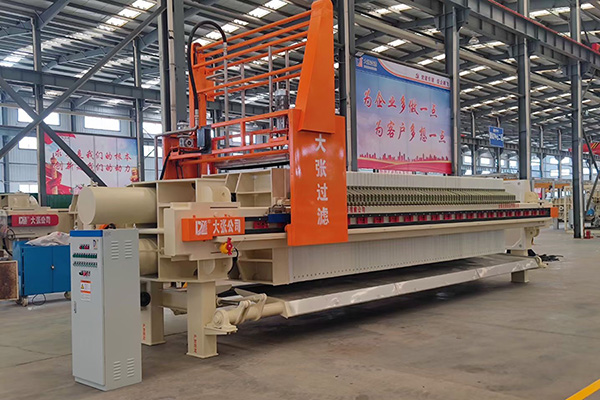
Water-flush filter press: automatic high-pressure water flushing keeps filter cloth performance stable between manual interventions.
Once-open: attacking the discharge step instead of the filtration step
Manual and semi-automatic presses lose time plate by plate. A once-open filter press opens the plate pack in a single operation, then discharges cake with automatic vibration. The published specification for model XMZG50/1000-U is a 50–120 m² filtration area, 1000×1000 mm plates, filtration pressure of at least 0.8 MPa, a 4 kW motor, PP filter plates and a carbon steel frame, with wastewater, mining, metallurgy, chemical, coal and food listed as target industries.
This architecture does not attempt to beat membrane squeezing on dryness, and it does not add a cloth-washing circuit. Its value proposition is cycle structure and labour: plate handling, the most repetitive and least automatable part of conventional press operation, is removed from the operator.
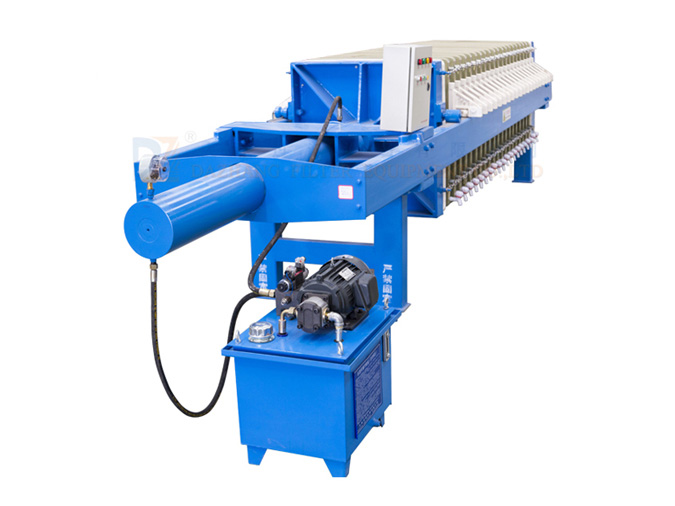
Once-open filter press: the plate pack opens in one stroke and cake is released with automatic vibration, reducing discharge labour.
How the choice reshapes maintenance and cycle planning
| Maintenance dimension | Membrane | Water-flush | Once-open |
|---|---|---|---|
| Auxiliary systems introduced | Squeeze circuit (air or water), membrane plate stack | High-pressure water pump, washing system, wash-water handling | Single-stroke opening mechanism, vibration discharge |
| Wear parts to plan for | Membrane plates and filter cloth | Filter cloth, wash nozzles and piping | Filter plates and cloth, opening mechanism |
| Labour profile | Low manual intervention; squeeze and discharge automated | Low cloth-cleaning labour; utilities replace operator time | Lowest plate-handling labour of the three |
| Utility demand | Squeeze medium and hydraulic power | High-pressure wash water | Hydraulic and vibration power (4 kW motor on XMZG50/1000-U) |
| Practical ceiling | Highest published filtration pressure range (to 4.0 MPa on the 1100 / 1500 platform) | 1–1000 m² area envelope, maximum 2.0 MPa | Area-limited to 50–120 m² per unit |
Mapping each type to industry duty
Industry lists on specification sheets are broad, so the useful test is whether a platform's pressure and area envelope is compatible with the slurry's behaviour. The published industry assignments give a starting filter:
- Wastewater and sludge treatment. All three platforms list wastewater. Membrane squeezing is the standard choice where the sludge disposal route penalises moisture; water-flush is chosen where cloth blinding is frequent because of oily or fine sludge; once-open suits plants where discharge labour, rather than dryness, is the operating constraint.
- Mining and tailings. Mining membrane filter press platforms and once-open presses both list mining. Membrane units serve concentrate and tailings dewatering where cake moisture affects transport economics; once-open units fit mid-size circuits where the 50–120 m² envelope matches the duty.
- Chemical processing. Chemical membrane filter press applications and once-open units both cover chemical duty. Membrane plates in PP / TPE on a Q345 steel frame are the published configuration for the XMAG series; where slurries are hot, the separate high-temperature route is a cast iron press rated for 120 °C or above.
- Metallurgy. Metallurgy appears on membrane, water-flush and once-open lists, which makes pressure range and plate material the deciding variables rather than the industry label.
- Food processing. Membrane filter press applications in food processing are listed, as are once-open units. Where hygiene and corrosion resistance dominate, the stainless steel plate and frame platforms (SS304 or SS316L, 1–4 m², 320–450 mm plates, 0.6 MPa, hydraulic clamping) match that requirement more closely than a high-pressure dewatering platform.
Market trend signals behind the choice
Equipment-level decisions sit inside a larger market shift, and the direction of that shift is visible in third-party data.
- The global membrane filtration market was valued at USD 19.4 billion in 2025, and Asia Pacific held a 36.5% revenue share in the same year (Grand View Research).
- Filter presses accounted for approximately 22% of the global sludge dewatering system market in 2024, according to Market Research Archive.
- Chinese exports of filter press machines under HS 84212910 reached USD 170,236,194 in 2023 (China Customs, secondary reporting).
Published growth projections diverge: Grand View Research projects 7.8% CAGR for 2026–2033 while Precedence Research estimates 9.5% for 2025–2034, a gap that appears to stem from different treatment of AI-optimised systems in the market definition. That divergence is itself a useful signal for buyers — single-source growth figures should be treated as directional, and the more reliable planning input remains the equipment parameter envelope against a specific slurry.
Two structural trends follow from the data. First, demand is concentrated in Asia Pacific, where most filter press manufacturing capacity also sits, which keeps competitive pressure on cycle automation rather than on basic filtration hardware. Second, because filter presses hold a substantial share of sludge dewatering technology, incremental gains are increasingly sought in automation and maintenance reduction — exactly the territory where water-flush and once-open platforms compete with membrane squeezing.
Comparison with traditional chamber and plate-and-frame solutions
The three automatic architectures are not the whole market. Chamber and plate-and-frame presses remain common and, in specific duties, remain the correct answer.
| Traditional platform | Published parameters | Where it still fits |
|---|---|---|
| Recessed chamber filter press (XMAY Series) | 30–1000 m², 870–2000 mm plates, 0.6–4.0 MPa, auto / semi-auto / manual operation, PP plates on a Q345 carbon steel frame | Broad-duty solid-liquid separation where a squeeze stage is unnecessary but a wide area range is required |
| Plate and frame filter press (BMY4/450-30U Series) | 4–80 m², 500–890 mm plates, filtration pressure ≤0.5 MPa, cake thickness 30–35 mm | Fine filtration and polishing duties in food, beverage, pharmaceutical, oil and chemical processes |
| High-pressure round plate filter press (XMY40/φ800-25 Series) | 40–140 m², φ800–φ1000 mm plates, 1.0–3.0 MPa, cake thickness 25–30 mm | Kaolin, ceramics, clay, mining and wastewater duties where high pressure matters and round plates are preferred |
| Cast iron high-temperature filter press (BMA/XMA Series) | 1–80 m², 380–800 mm plates, 0.6 MPa, applicable at 120 °C and above | Oil and chemical slurries at elevated temperature, where polymer plates would not be appropriate |
Limitations and boundaries a buyer should verify
An honest comparison has to state where each architecture stops being the right answer.
- Parameter ranges are equipment capability, not a moisture guarantee. A membrane platform specified to 0.6–4.0 MPa defines what the machine can apply, not what a given slurry will release. Achievable cake moisture depends on feed solids, particle size distribution and chemistry, and the published data for these platforms does not state per-application moisture outcomes.
- Membrane systems add scope, not only performance. A squeeze circuit and membrane plate stack are additional wear-part and maintenance categories. The 1.6 MPa squeezing pressure on the XMAG series is a system-level figure covering plates, frame and hydraulics together.
- Water-flush converts labour into water. Automatic high-pressure flushing requires a high-pressure water pump, a washing system, and a route for the resulting wash-water stream. Plants without that infrastructure inherit a new constraint rather than removing one.
- Once-open is area-limited. With a published 50–120 m² envelope and a fixed 1000×1000 mm plate, this platform is not the correct single-unit answer for very large throughput duties; multiple units or a wider-area platform would be needed.
- Automation raises capital cost. All three platforms sit above a basic manual plate-and-frame press on purchase price. Justification rests on labour, cloth life and cycle consistency, and those benefits need to be modelled against the plant's actual operating pattern.
Where DAZHANG Filter Press fits in this framework
For buyers building a shortlist, the relevant question is whether a manufacturer can supply the platform that matches the separation goal, rather than whether it offers the broadest catalogue.
Henan Dazhang Filtration Equipment Co., Ltd. was established in 2004 and has over 20 years of experience in filtration equipment. Its manufacturing base is located in Yuzhou, Henan Province, China, and employs about 1,000 staff, with an annual production capacity of approximately 9,500 units of filtration equipment. The company operates an integrated production system covering product development, mechanical processing, filter plate production, equipment assembly, hydraulic and electrical control system integration, quality inspection, installation, commissioning and after-sales service.
On the component side, the company has independently developed a processing-free sealed square polypropylene filter plate and obtained related invention patent protection, and it participates in filtration-related technical standardisation while continuing to expand its portfolio of patents and proprietary technologies. Its R&D system is supported by the Henan Provincial Enterprise Technology Center and the Henan Provincial Engineering Technology Research Center for New Solid-Liquid Separation Equipment, with 45 engineers and technicians dedicated to filtration technology innovation. The company has been recognised as a national-level Specialized, Sophisticated, Distinctive and Innovative "Little Giant" enterprise and as a National High-Tech Enterprise.
In commercial terms, Dazhang products are used in mining, metallurgy, chemicals, petroleum, coal, environmental protection, municipal wastewater treatment, pharmaceuticals and food processing, and the company serves markets in more than 100 countries across Asia, Europe, Africa, South America, North America, the Middle East and Oceania.
The practical reading for a buyer: all three architectures in this framework — automatic membrane, water-flush and once-open — are available from one supplier, alongside the chamber, plate-and-frame, round high-pressure and cast iron high-temperature platforms that cover the duties where the automatic architectures are not the best fit.
A five-step decision sequence
- Define the constraint before the machine. If cake moisture drives downstream cost, the squeeze stage is the priority. If cloth blinding drives downtime, cloth cleaning is the priority. If discharge labour drives cost, the opening mechanism is the priority.
- Check the pressure envelope against the slurry. Compare the required driving pressure with the published ranges: 0.6–4.0 MPa and 20–291.2 m² for membrane platforms, 0.4–2.0 MPa and 1–1000 m² for water-flush, ≥0.8 MPa and 50–120 m² for once-open.
- Check area and plate size against throughput. Plate size fixes the granularity of the chamber, and area sets the batch capacity. A 1000×1000 mm plate platform and a 870–2000 mm platform are not interchangeable.
- Check materials against temperature and corrosion. PP and PP / TPE plates on steel frames cover the majority of duties; cast iron at 120 °C and above or stainless steel for hygienic service cover the rest.
- Check auxiliary and wear-part scope. Squeeze circuits, high-pressure wash systems, membrane plates and filter cloth all have lifecycle implications that should appear in the same evaluation as the purchase price.
Future outlook
The direction of development in this category is consistent across the three architectures: more of the cycle is being transferred from the operator to the control system. Membrane platforms are moving toward tighter squeeze control and integrated cloth handling; water-flush platforms are consolidating cloth cleaning, washing and drainage into the automatic sequence; once-open platforms are shortening the interval between opening and the start of the next fill.
For buyers, that means the durable differentiators are no longer plate or frame materials alone — polypropylene plates on carbon or Q345 steel frames are well-established — but the completeness of the automation, the availability of wear parts over the equipment's service life, and the manufacturer's ability to configure the pressure and area envelope around a specific slurry rather than forcing the slurry into a stock platform. Those three factors are also the ones that will remain relevant as energy, water and labour costs continue to shape the economics of solid-liquid separation.
Frequently asked questions
What is the difference between a membrane filter press, a water-flush filter press and a once-open filter press?
They are three automatic filter press architectures defined by the step each one optimises. A membrane filter press applies a secondary squeeze after cake formation to push additional liquid out of the cake. A water-flush filter press cleans the filter cloth in place using automatic high-pressure water flushing. A once-open filter press opens the plate pack in a single operation and discharges cake with automatic vibration. All three handle solid-liquid separation; they differ in which part of the cycle they improve.
What operating pressure and filtration area does each type cover?
Published platform data shows overlapping but distinct envelopes: membrane platforms cover 0.6–4.0 MPa filtration pressure and 20–291.2 m² on the cloth-traveling 1100 / 1500 series, while the XMAG30/870-UKB to XMAG1000/2000-UKB series is specified at 30–1000 m², 870–2000 mm plates, 0.6–2.0 MPa feed pressure and 1.6 MPa squeezing pressure. Water-flush presses cover 0.4–2.0 MPa and 1–1000 m². Once-open presses cover filtration pressure of at least 0.8 MPa with 50–120 m² and 1000×1000 mm plates.
Which industries and separation goals suit each type?
Membrane filter presses are listed for mining, coal, metallurgy, chemical, power, sludge treatment, wastewater, food, pharmaceutical and metallurgy duties. Water-flush filter presses are listed for wastewater, chemical, mining, metallurgy, petroleum and food. Once-open filter presses are listed for wastewater, mining, metallurgy, chemical, coal and food. In practice, membrane suits dryness-driven goals, water-flush suits cloth-blinding and continuous heavy-duty goals, and once-open suits discharge-labour goals.
How does automatic high-pressure water flushing affect maintenance?
Automatic high-pressure water flushing cleans the cloth in place instead of relying on manual cleaning, which the published specification for the water-flush platform links to improved filtration efficiency, longer filter cloth life and reduced labour. The maintenance trade-off is that the machine introduces a high-pressure water pump, a washing system and a wash-water stream that must be managed. Cloth, nozzles and wash-water piping become planned maintenance items.
How does once-open operation change labour and cycle planning?
Once-open operation removes plate-by-plate handling. The XMZG50/1000-U platform opens the plate pack in one movement, discharges cake quickly with automatic vibration, and runs on a 4 kW motor, with PP filter plates on a carbon steel frame. The planning implication is that discharge time becomes predictable and less dependent on operator availability, while the filter area remains within a 50–120 m² envelope per unit.
What limitations should be checked before specifying an automatic filter press?
Three checks matter most. First, published pressure and area ranges describe equipment capability, not guaranteed cake moisture for a specific slurry. Second, automatic architectures add auxiliary scope — a squeeze circuit for membrane units, a high-pressure water circuit for water-flush units, a single-stroke opening mechanism for once-open units — and each adds maintenance categories. Third, capital cost is higher than for basic manual plate-and-frame presses, so the justification depends on the plant's labour, cloth-life and cycle-consistency economics.
The DAZHANG Filtration company profile and full product specification brochure can be downloaded here: DAZHANG Filtration company profile (PDF). Manufacturer website: dazhangfilterpress.com.