
Men's Leather Shoes for Formal Sectors: Business, Office, Wedding
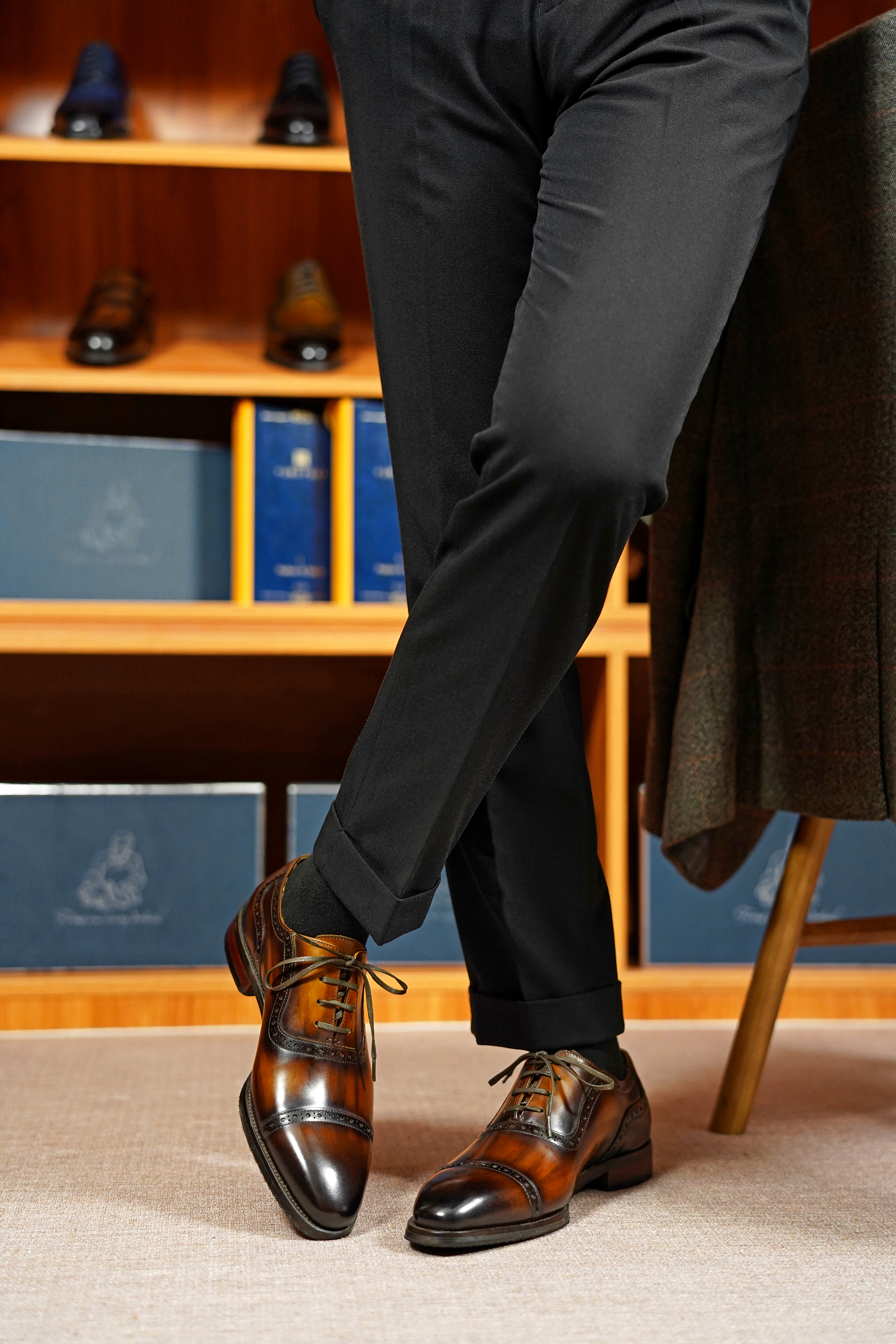
Formal men's leather shoes are judged in daily office wear rather than on the shelf: shape retention, breathability and finish all surface within the first weeks of 8–12 hour use.
Men's leather shoes for formal sectors are a specification problem before they are a style problem. A pair worn five days a week in an office, carried through airports on business travel, or asked to stay presentable through a long wedding ceremony is judged on shape retention, breathability and finish long before anyone appraises the last shape. Those qualities are decided in material selection and construction, not in the description on the box.
The category is also commercially significant. Commercial research published by ResearchAndMarkets places the global men's leather shoes market at USD 61.08 billion in 2025, projected to reach USD 78.69 billion by 2031. Trade data from the Observatory of Economic Complexity shows the United States alone imported USD 11.6 billion of leather footwear (HS 6403) in 2024, sourced mainly from Vietnam (USD 3.68 billion), China (USD 2.42 billion) and Indonesia (USD 1.18 billion). Formal and business footwear forms a material part of that flow.
This article examines formal-sector demand from the buyer's side — the business man, the office man and the wedding man — and then uses one documented model, M205-B02, made by Yangjiang Hengxin Shoes Co., Ltd., as a reference case for how a full-grain-inside-and-out construction answers those demands. It also covers application patterns in retail and wholesale channels, the trade-offs buyers should expect, and where the category appears to be heading.
Definition: Formal-sector men's leather shoes are handmade or manufactured men's leather shoes built for business, office and wedding use, where appearance, all-day wearability and outsole choice matter more than casual styling cues.What Formal Sectors Actually Demand From a Leather Shoe
The formal sector is unusual because the shoe is used, not displayed. Documented end-use conditions for this product category include daily wear of 8–12 hours per day, repeated on-and-off wearing, long periods of walking and standing, and portability during business travel. These conditions are the reason formal footwear fails: not because the leather looked poor on day one, but because the lining collapsed, the insole lost its shape, or the outsole was wrong for the surfaces the wearer actually walks on.
The functional expectations attached to the category are equally specific. Formal leather shoes are expected to enhance professional image, elevate personal style and provide all-day comfort — three outcomes produced by different parts of the build. Image comes from the upper and finish. Comfort comes from the lining, insole and last. Durability comes from construction and outsole.
| Formal-sector requirement | Why it matters in daily use | Where it is decided in production |
|---|---|---|
| Premium genuine leather material | Holds creases and colour under repeated flexing | Upper material selection and grading |
| Handcrafted stitching | Keeps the upper aligned with the last over time | Closing and lasting stages |
| Breathable lining | Reduces heat and moisture build-up across an 8–12 hour day | Lining material and pattern |
| Shock absorption insole | Limits fatigue during long standing and walking | Insole material and assembly |
| Water-resistant treatment | Covers outdoor business activity and commuting | Finishing stage |
| Anti-odor technology | Protects the shoe between wears in rotation | Material treatment and lining choice |
Read as a list, these requirements explain why formal footwear is specified rather than simply chosen. A shoe that meets the appearance requirement but not the lining requirement will look correct in a meeting and feel wrong by mid-afternoon.
Three Formal Buyer Profiles: Business, Office and Wedding
The phrase “formal men's leather shoes” conceals three different usage profiles. The material specification overlaps, but the priority order does not.
The business man
Business use means variable surfaces and variable hours: indoor meetings, outdoor transfers, travel days. The business man needs a shoe that presents well in a meeting room while surviving pavements, airport floors and hotel lobbies. Water-resistant finishing and outsole grip carry more weight here than in any other formal profile, and portability matters — the shoe has to hold its shape in a bag between wearings.
The office man
Office use is the endurance test. Documented operation conditions for formal leather shoes include daily wear of 8–12 hours and repeated on-and-off wearing — the pattern of someone who commutes in one pair and changes at a desk, or walks out at lunch five days a week. For this profile the lining and insole do more work than the upper. Breathability and shock absorption are the difference between a shoe that stays in rotation for years and one quietly retired after a season.
The wedding man
Wedding use compresses the same requirements into a single day: long standing, formal photography, and a shoe that has to look new in every frame. Wedding leather shoes are usually selected on appearance first, but the construction that supports an office shoe supports the ceremony — a firm insole, a stable outsole and a lining that does not crease badly under heat. Slip-on men's leather shoes, including loafer shapes, are frequently chosen in this segment because they are easier to put on and take off across a long event day.
Reference Case: How Model M205-B02 Is Built for Formal Use
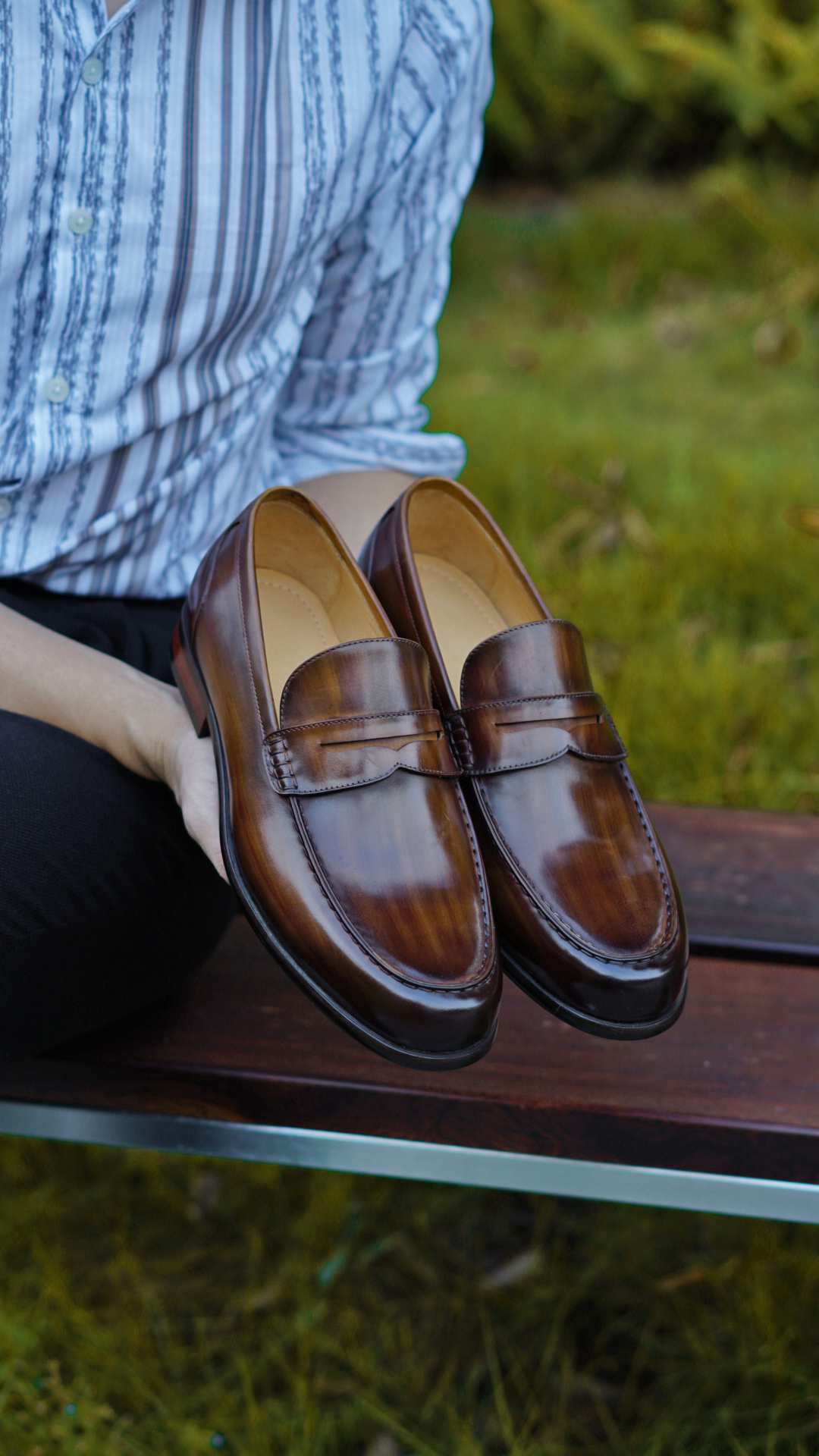
Model M205-B02, a handmade men's leather shoe recorded in the manufacturer's loafer image set. Documented material: full grain cow/calfskin upper, full grain cow lining and insole, rubber or leather outsole.
Model M205-B02 is documented as a handmade men's leather shoe. Its upper is made of full grain cow or calfskin; its lining and insole are also made of full grain cow; and its outsole is available in either rubber or leather. The model is specified for business, office and wedding use — the three profiles above, addressed through a single construction.
Three attributes of that specification are worth separating.
Full grain inside and out. The upper material is the visible decision; the lining and insole are the felt decision. Full grain cow in the lining and insole is what the wearer's foot is in contact with for eight or more hours a day.
Outsole optionality. Because the same model is offered with a rubber or a leather outsole, one upper shape can serve two different use patterns without changing the last, and end customers can choose grip or formality.
Slip-on construction. M205-B02 is recorded in the loafer category, placing it in the slip-on segment of the formal range — relevant to the wedding and travel profiles, where repeated on-and-off wearing is part of the normal pattern.
The same material specification — full grain cow/calfskin upper, full grain cow lining and insole, rubber or leather outsole — is documented across the manufacturer's handmade formal models, including F8-NS58 and F8-MK3. For a retailer or distributor building an assortment, that consistency is operationally useful: one material platform, several lasts and shapes, so the quality message stays the same across a shelf.
Technical Explanation: What “Full Grain Inside and Out” Changes
Full grain refers to the outermost layer of the hide, with the grain surface intact rather than sanded or corrected. In an upper, full grain leather is chosen because the intact grain surface resists cracking under repeated flexing — the toe box and vamp of a formal shoe bend thousands of times in a year. A leather shoe that keeps its shape at the vamp is a shoe that still looks correct at month twelve.
The lining and insole argument is less visible and more consequential. A lining sits between the foot and the upper: if it creases badly, hardens or traps moisture, the shoe becomes uncomfortable regardless of how good the upper looks. Full grain cow lining is therefore a comfort specification as much as an appearance one, working alongside a breathable lining construction and shock absorption in the insole to address the 8–12 hour wear condition documented for this category.
Construction matters at the same level. The manufacturer has specialised in men's leather formal shoes using Goodyear welted construction for more than 13 years, alongside handcrafted stitching. Goodyear welted construction stitches the upper to a welt, which is then attached to the outsole — a build associated with shape stability and with resolability rather than a throwaway lifecycle. Its limits are set out below, because buyers should plan for them.
Surface finish is a separate layer of work. The manufacturer's hand-coloured patina process has been refined through three iterations of technological innovation, moving from brushed patina to washing and spot-colour techniques, and the range draws on Italian and Argentinian leathers. For formal sectors the practical effect is that finish options extend beyond standard black and brown — useful in wedding and luxury-tier ranges, where the same shoe has to read as distinctive across a ceremony, a reception and a set of photographs.
Outsole Choice: Rubber or Leather Is a Decision, Not a Default
Because M205-B02 is offered with either a rubber or a leather outsole, the outsole becomes a specification decision the buyer makes rather than a detail the factory settles.
| Outsole option | What it supports | Where it is constrained |
|---|---|---|
| Rubber outsole | Traction and stability for outdoor business activities, commuting and wet pavements | Reads as slightly less formal than a leather sole; heavier underfoot |
| Leather outsole | Traditional dress profile and a slimmer silhouette with tailored suits | More exposed to wet conditions; benefits from a waterproof spray protector and rotation between pairs |
The honest version of this decision is that neither option is universally better. A buyer supplying a travel-heavy clientele will usually prefer rubber for the working pairs. A buyer supplying ceremony and tailored-suit retail will usually keep leather for the formal ceiling of the range. Both can sit on the same upper shape, which keeps assortment planning simpler than it first appears.
Application Patterns: Office, Business Travel, Weddings and Retail Programmes
Documented application conditions for this category cover indoor office environments and outdoor business activities across markets including the United States, Canada, South Africa, Nigeria, the United Arab Emirates and Australia. Two project types dominate the channel side: suit shop selling and leather shoe distribution — both assortment businesses rather than single-pair businesses.
Two patterns show how formal footwear is bought at channel level. The first is a retail programme serving the Canadian market, where the buyer needs the same formal shapes, colours and finish to stay consistent across reorders so that a returning customer sees the same shoe on the shelf. The second is a long-term supply arrangement with a men's clothing store, where shoes sit beside suits on the shop floor: the store needs a narrow, dependable formal assortment — largely lace-up and slip-on formal shapes — replenished on a predictable schedule rather than filled by a single one-off order.
In both patterns the deciding variables are identical: whether the factory will hold a material specification (full grain upper, full grain lining and insole) across repeat orders, whether outsole choice can be adjusted by style, and whether dispatch timing supports a retail calendar. The manufacturer documents order completion and dispatch within 2–4 weeks and reports export business at 70% of total sales, with major markets including the EU, USA, Canada, Africa, Asia and Australia — a distribution profile that corresponds to the application markets above.
End-use care products belong in the same conversation, because formal footwear performance depends on rotation and maintenance. Shoe trees for shape retention, leather conditioner and polish, a shoe horn for easy wearing and a waterproof spray protector are the standard kit for this category. Buyers who plan these into the package reduce returns caused by premature wear rather than by defects.
Market Trend Analysis: What the Numbers Say About Formal Demand
Three data points frame the category's direction, and all three come from attributable sources rather than vendor claims.
First, the global market is forecast to grow rather than contract: from USD 61.08 billion in 2025 to USD 78.69 billion by 2031 (ResearchAndMarkets / Vertex). Second, the United States imported USD 11.6 billion in leather footwear in 2024, with Vietnam, China and Indonesia as the leading origins (Observatory of Economic Complexity, HS 6403). Third, sourcing is not concentrated in a single country — the same trade data shows three origins each above USD 1 billion, which keeps multi-country sourcing realistic for buyers.
| Indicator | Value | Source | Implication for buyers |
|---|---|---|---|
| Global men's leather shoes market, 2025 | USD 61.08 billion, forecast to USD 78.69 billion by 2031 | ResearchAndMarkets / Vertex | Category expansion supports continued investment in formal ranges |
| US leather footwear imports, 2024 | USD 11.6 billion (HS 6403) | Observatory of Economic Complexity | The formal segment sits inside a large, import-driven market |
| Leading US import origins, 2024 | Vietnam USD 3.68B; China USD 2.42B; Indonesia USD 1.18B | Observatory of Economic Complexity | No single origin dominates; dual sourcing remains practical |
On the supply side, the reference manufacturer operates a 5,000 square metre facility with approximately 100 staff and an annual production capacity of 400,000 pairs, supported by 10 engineers and technicians, an independent sample room, four professional shoe designers and a catalogue of more than 500 bespoke shoe styles. For buyers evaluating formal ranges, that combination — sampling capability plus an established formal material platform — is what allows custom leather shoes to be developed without abandoning the construction the formal sector expects.
Comparison With Traditional Solutions — and Their Limits
Formal footwear is not a single technology. Buyers comparing suppliers are usually choosing between constructions and between outsole systems, and each carries a real trade-off.
| Approach | Strength in formal use | Boundary to plan for |
|---|---|---|
| Goodyear welted construction | Stitched upper-to-welt build associated with shape stability and resoling | Heavier than cemented builds, needs a break-in period, carries a higher unit cost and depends on a cobbler for repair |
| Cemented (adhesive-bonded) construction | Lighter, lower unit cost, quicker to scale at entry price points | Resoling is more difficult; service life is typically shorter and less repairable |
| Leather outsole | Traditional dress profile for tailored wear | Wet-weather vulnerability; requires rotation and a protector spray |
| Rubber outsole | Grip and durability for commuting and travel-heavy wear | Reads as less formal with the most formal tailoring |
| Hand-applied patina finishes | Distinctive depth of colour for wedding and luxury ranges | Hand-applied colour varies between pairs by nature; colour tolerance should be agreed at the sampling stage |
A second boundary is organisational rather than technical. Full grain leather — upper, lining and insole — combined with a handcrafted finishing line implies a price band above entry-level formal shoes. A buyer whose market is price-led rather than quality-led may not be able to place this specification at every price point, which is why formal ranges usually need more than one tier.
Lead time is real as well. Documented production and dispatch runs at 2–4 weeks once an order is placed, which supports seasonal retail planning but not immediate replenishment. Buyers should build reorder timing around that window rather than discovering it during a peak wedding season.
Future Outlook
Three developments are reasonable to expect in the formal men's leather shoe segment.
Finish variety as a competitive axis. With the hand-coloured patina process already through three iterations — from brushed patina to washing and spot-colour techniques — differentiation in formal footwear is increasingly about finish and colour depth rather than shape alone. Wedding and luxury ranges are the natural beneficiaries, because they are the segments where a distinct surface is most visible.
Material platform consistency over catalogue breadth. The manufacturer's handmade models share one material specification across multiple lasts and shape groups covering Oxfords, Derbys, Monkstraps, loafers, casual shoes, sneakers, boots and sandals. For buyers, platform consistency lowers the risk of quality drift between a formal core style and a seasonal addition — a common problem when ranges are assembled from unrelated suppliers.
Sourcing diversification continues. With US leather footwear imports split across Vietnam, China and Indonesia, and the global market forecast to grow into the early 2030s, formal footwear is likely to remain a multi-origin sourcing exercise. That keeps supplier evaluation — sampling, specification control and reorder reliability — as the buyer's central discipline, rather than a one-off purchasing decision.
FAQ
What are men's leather shoes for formal sectors?
They are handmade or manufactured men's leather shoes designed for business, office and wedding occasions, where the defining requirements are genuine leather materials, handcrafted stitching, breathable lining, shock absorption, water-resistant treatment and an outsole suited to the surfaces the wearer actually walks on.
What materials should a buyer verify in formal men's leather shoes?
For the documented reference model M205-B02, the specification is a full grain cow or calfskin upper, full grain cow lining and insole, and a rubber or leather outsole. The lining and insole matter most because they are in contact with the foot throughout 8–12 hour wear days.
What is the difference between a rubber and a leather outsole in a formal shoe?
A rubber outsole prioritises traction and durability for commuting, outdoor business activity and wet surfaces. A leather outsole prioritises the traditional dress profile for tailored wear, and is more exposed to wet conditions, so it benefits from rotation between pairs and a waterproof spray protector.
Which models use the same formal material specification?
Model M205-B02 is documented with a full grain cow/calfskin upper, full grain cow lining and insole, and a rubber or leather outsole. The same specification is documented for the manufacturer's other handmade formal models, F8-NS58 and F8-MK3.
How long does production and dispatch take for OEM or ODM formal shoe orders?
Orders are documented as completed and dispatched in 2–4 weeks. ODM/OEM services cover last-making, alterations, repairs and sample customisation, supported by an in-house sample room, four professional shoe designers and an R&D team of 10 engineers and technicians.
Which markets are these formal men's leather shoes supplied to?
Documented export markets include the EU, USA, Canada, Africa, Asia and Australia, with export business accounting for 70% of total sales. Application conditions are documented for markets including the United States, Canada, South Africa, Nigeria, the United Arab Emirates and Australia.
What are the limitations of high-specification formal leather shoes?
Full grain construction and handcrafted finishing sit above entry-level price bands; Goodyear welted builds are heavier and need a break-in period; leather outsoles require rotation and protection; hand-applied patina finishes vary between pairs, so colour tolerance should be agreed at the sampling stage; and the 2–4 week production window requires planned reordering rather than immediate replenishment.
Reference note: Yangjiang Hengxin Shoes Co., Ltd., established in 2011, is a manufacturer of premium men's leather formal shoes using Goodyear welted construction, with more than 13 years of experience in men's leather shoe manufacturing and over 500 bespoke shoe styles developed. Product and capability details referenced in this article are drawn from the manufacturer's published material and from third-party market and trade sources cited above. Website: https://dressshoefactory.com/