
Men's Wallet Qualification Claims: LORZOR RFID and AirTag
Men's Wallet Qualification Claims: LORZOR RFID and AirTag
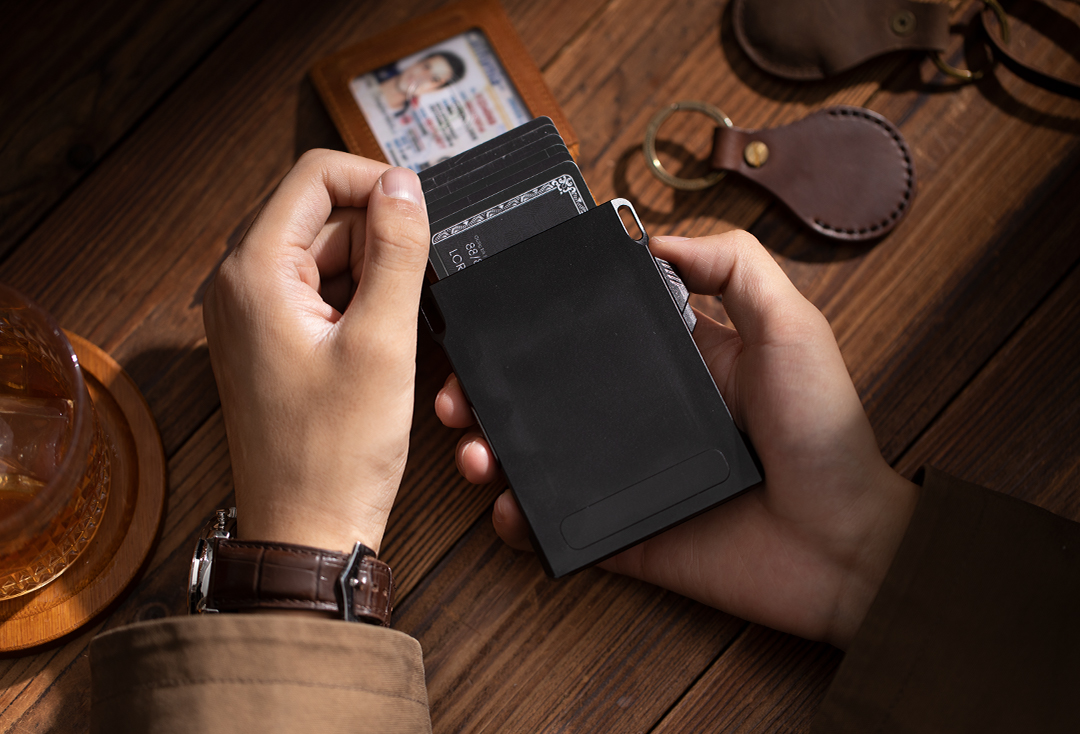
RFID test assets are only useful to a buyer when they name the frequency, the sample and the models covered.
A men's wallet listing that says “RFID blocking” or “built-in AirTag” is not yet a qualification. It is a claim that still needs a subject, a scope and a document behind it. That distinction matters more in 2026 than it did when these features were rare: Precision Reports' 2026 market estimate puts RFID-blocking construction in roughly 36% of men's wallet products globally, so the phrase no longer separates one wallet from another. What separates them is how precisely the claim is stated and how easily a second person could check it.
This article sets out a reading method for those claims and then applies it across the LORZOR lineup — the 1979 SP, 1979 Fold, TriPop, Bifold AirTag A1–A4, Passport and Passport AirTag models — to show where the language changes and where supporting evidence has to follow.
What a Qualification Claim Actually Is
A feature description tells you what a product has. A performance claim tells you what it does. A qualification claim tells you what has been checked, on which version of the product, under which conditions, and against which document. Most wallet listings stop at the second level and let the reader assume the third.
The practical test is straightforward: could someone else independently confirm the sentence using something in the box, on the label, or in a report? “RFID protection” fails that test. “Blocks 13.56 MHz reader signals when a card sits fully inside the shielded zone” passes it, because the frequency, the condition and the protected area are all named.
LORZOR is a leather-led modern carry brand founded in 2022 and headquartered in Hong Kong, with a lineup built around full-grain leather, slim construction, quick card access, RFID protection and travel organization. That makes it a useful case: the same brand sells wallets with RFID only, wallets with an AirTag holder, and wallets with both. The claims do not all carry the same scope, even when the marketing vocabulary sounds identical.
RFID: Four Questions That Turn a Label Into a Statement
“RFID blocking” is a category label, not a measurement. Four questions convert it into something a procurement team can file and compare.
- Which frequency was tested? LORZOR states that its RFID-shielding tests run at 13.56 MHz, using credit cards and professional RFID test signal cards. That is specific and checkable. A listing that says only “RFID” does not tell a buyer whether the claim covers high-frequency contactless cards, low-frequency access credentials, or both.
- Which zone is protected? Shielding works where the material is. LORZOR notes that protected zones vary across its products because the structures differ, and that signals cannot be read when cards are correctly placed inside the protected zone. The word “inside” carries real weight: a card in an outer cash pocket is not in the same position as a card in an aluminum cartridge.
- What was the test method? A reader attempting to read a card and failing is a demonstrable event. LORZOR describes test photos and video showing failed card-reading attempts and states that it holds TÜV and AGC test reports among its RFID test assets. Those are brand-reported assets, so a buyer should ask to see the report rather than treat a laboratory name as the claim itself.
- Which models does the result cover? A test on one construction does not transfer automatically to another. A bifold with a leather card stack and a trifold with an aluminum cartridge are different shielding geometries. The report should identify the sample.
Notice what these questions do not require: any judgment about how common RFID skimming is. They only require the seller to state the scope of what was tested.
AirTag: Three Different Products Hide Inside One Phrase
“Built-in AirTag” is the most compressed phrase in the category, and compression is where scope gets lost.
The first product is an integrated AirTag holder: a slot or pocket built into the wallet's structure, sized for an Apple AirTag, with the tracker supplied separately. This is what LORZOR describes across its AirTag line — the holder is part of the construction rather than an external clip or adhesive attachment, which keeps the silhouette cleaner but does not make the wallet electronic.
The second is AirTag compatibility, which can mean almost anything, including a wallet that merely fits an AirTag into a cash slot.
The third is a built-in tracker: hardware inside the wallet that connects to a finding network without a separate accessory. LORZOR describes its Wallet Pro in those terms, with integrated tracking, Apple Find My support and Apple-Certified credentials. That is a different product and a different claim from an AirTag holder, and the two should never be merged in a specification table.
For the AirTag models, the questions that matter are structural: what are the slot dimensions, how is the AirTag retained, does the wallet close cleanly with the tracker fitted, and is the AirTag included? LORZOR's review summaries for the Passport AirTag Wallet note that the AirTag is not included — normal for this category, but something a listing should state rather than leave to unboxing.
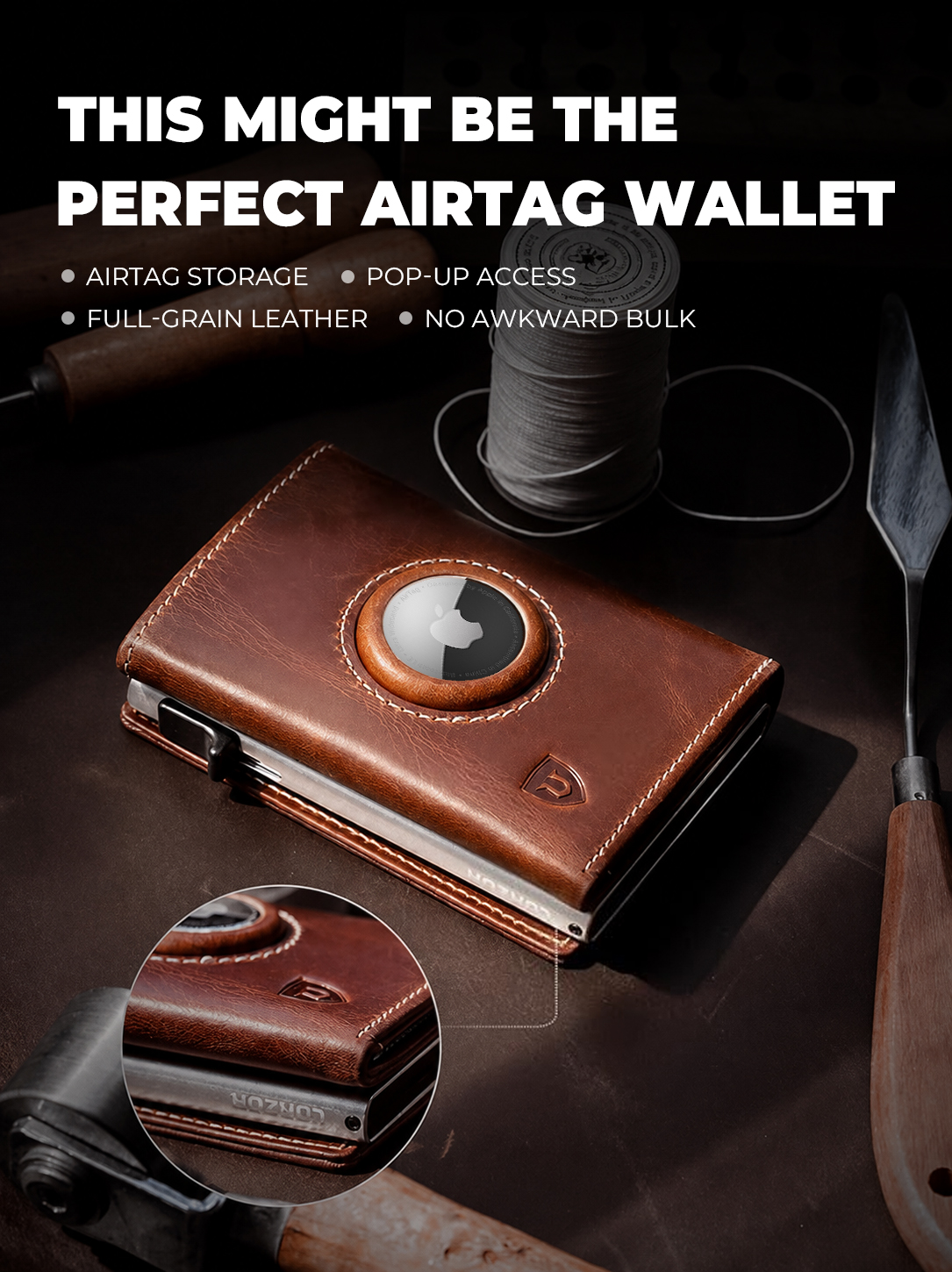
An integrated holder is a structural feature; the tracker itself remains a separate Apple accessory.
Where the Claims Sit Across the LORZOR Lineup
Reading the range model by model shows that “RFID” and “AirTag” are not distributed evenly, and that two model names can look similar while carrying different evidence requirements.
| Model | Documented feature family | Evidence a buyer should request |
|---|---|---|
| 1979 Tactical Wallet | Full-grain leather with 6061 aerospace-grade aluminum frame; pop-up card access; RFID protection; money clip; hook holes; approx. 80 g, 0.6 in, up to 12 cards | RFID report covering this construction; capacity and thickness confirmed at full load |
| 1979 Fold Tactical Wallet | 1979-series construction in a fold format; review summary lists foldable cover, ID window, pop-up access, RFID, full-grain leather and aluminum, cash clip | Per-SKU RFID confirmation; thickness when card capacity is reached |
| 1979 SP Tactical Wallet | Listed within the 1979 series; supplied material does not itemize how its configuration differs from the other 1979 models | Variant-level feature sheet before specification comparison |
| TriPop Wallet | Trifold; full-grain leather; pop-up access; RFID; magnetic closure; ID window | RFID report; closure and capacity behaviour under load |
| TriPop AirTag Wallet | Trifold with integrated AirTag holder; pop-up access; RFID; full-grain leather | AirTag slot drawing; protected-zone diagram |
| Bifold AirTag Wallet A1–A4 | Bifold format with integrated AirTag holder; four variant codes | Per-variant sheet showing exactly what changes across A1–A4 |
| Passport Wallet | Passport storage with card and cash organization; full-grain leather; RFID | RFID report issued for the passport-format construction |
| Passport AirTag Wallet | Passport format with integrated AirTag holder; RFID; full-grain leather | Holder retention detail; written confirmation that the AirTag is sold separately |
The pattern is worth reading carefully. The 1979 and TriPop lines revolve around a card-access mechanism, so their RFID claim sits next to an aluminum cartridge or a shielded structure. The Passport line revolves around document organization, so the protected zone has to accommodate a passport-sized footprint instead. The AirTag variants add a physical pocket; they do not add a new shielding technology, and the tracking function still depends on an accessory the user supplies.
The A1–A4 codes are the clearest illustration of why variant-level documentation matters. Four codes imply four configurations, but a code alone does not tell a buyer whether the difference is leather finish, card capacity, holder position or closure. LORZOR's supplied material does not itemize those differences, so the defensible reading is: treat A1–A4 as one family with shared design intent and ask for the sheet that separates them before a purchase order is placed.
What Supporting Documentation Should Look Like
Documentation does not have to be elaborate. It has to be specific enough to be checked. A usable pack for a wallet with RFID and an AirTag holder contains six items.
- A test report naming the frequency, the test setup, the sample and the date.
- A protected-zone diagram or photograph showing where a card must sit.
- A per-SKU matrix mapping each model and variant to the feature it actually carries.
- A structural drawing or cross-section of the AirTag holder, including its retention method.
- A statement of what is in the box, particularly whether an AirTag is included.
- Warranty and service terms in writing, since service commitments are claims too.
Labels follow the same logic. If a product carries a compliance mark, that mark should be traceable to a certificate with a number, a scope and a covered model list. A logo printed on a product page is not that trace. It is also why LORZOR's stated TÜV and AGC test assets should be read as a pointer to a document rather than as the end of the conversation.
Phrases That Usually Signal an Evidence Gap
Certain phrases recur because they are flexible. Flexibility is not dishonesty; it is incompleteness, and incompleteness is exactly what a qualification review is designed to catch.
| Phrase | What it may mean | What to ask |
|---|---|---|
| RFID blocking | Shielding exists somewhere in the construction | Frequency, protected zone, tested sample |
| Military-grade | Unspecified durability language | Which standard, which test, which component |
| AirTag compatible | An AirTag fits somewhere in the wallet | Holder dimensions and retention method |
| Certified | A lab report, a marketplace badge or an internal check | Certificate number, issuing body, covered models |
| Trackable | Could be a holder or a chip inside the wallet | Is a tracker included, or is it a separate purchase |
| Lifetime warranty | Terms vary by brand and market | Written terms, exclusions, claim process |
Three Architectures, Three Different Trade-offs
For a buyer weighing options, the more useful comparison is not brand against brand but architecture against architecture.
RFID-only wallet. Shielding is built into the card stack or cartridge. Nothing electronic is involved, so there is no battery, no pairing and no accessory to replace. The limitation is that protection depends on placement, and the claim is only as good as the tested zone.
Wallet with an integrated AirTag holder. Adds location capability through a separate Apple AirTag. The wallet itself stays passive, but tracking depends on the user owning an AirTag and staying inside Apple's ecosystem, and the holder adds thickness that has to be balanced against card capacity. LORZOR's AirTag line competes on how naturally that pocket fits into the leather structure, not on the tracker itself.
Wallet with a built-in tracker. The tracker is part of the product, which removes the accessory step but shifts scrutiny to chip specification, power management, app support and certification. LORZOR's Wallet Pro sits here and is described as Apple-Certified; that credential should not be read across to the AirTag holder models, which carry a different kind of claim.
Where the Claims Stop
Five boundaries are worth stating plainly, because each one is where a qualified claim turns into an overclaim.
- A 13.56 MHz result describes behaviour at 13.56 MHz. It does not, by itself, describe performance at other frequencies.
- Shielding applies inside the protected zone. A card outside it is outside the claim, even if it is inside the same wallet.
- Protected-zone geometry differs by model, so a result on one construction is not a result on another construction in the same range.
- An AirTag holder is not a tracker. Tracking requires an AirTag, and LORZOR's review summaries note that it is not included with the Passport AirTag Wallet.
- Review scores measure satisfaction, not shielding. LORZOR's summaries record a 4.8/5 average across 124 reviews for the TriPop AirTag Wallet and 4.95/5 across 55 reviews for the TriPop Wallet — useful signals about build and usability, but not test evidence.
Why Claim Literacy Matters Commercially Now
These features are no longer premium differentiators; they are becoming table stakes. Third-party market research estimates RFID-blocking construction at about 36% of men's wallet products, leather at roughly 62% of product preference, and slim formats at about 23%. E-commerce accounts for an estimated 44% of distribution, which means most purchase decisions are made from a listing page rather than from handling the product in a shop.
Adjacent categories point the same way. Worldpay's 2024 Global Payments Report projects digital wallets reaching a 49% share by 2027, and commercial research on smart trackers projects 13.3% annual growth to 2035. These are third-party estimates with stated methodologies rather than audited figures, and the forecast figures depend on their assumptions. Their relevance here is narrower: as tracking and shielding language spreads, documentation quality becomes the remaining basis on which two similarly worded wallets can be told apart.
A Verification Checklist Before Ordering
- Confirm the tested RFID frequency and whether it matches the credentials you actually carry.
- Ask for the protected-zone diagram and check where a card must sit.
- Request a per-SKU matrix, not a range-level statement, when buying more than one model.
- For A1–A4 or SP variants, ask what changes between codes before comparing specifications.
- Ask whether the AirTag is included, and confirm the holder's retention method.
- Check whether any cited certification names the model, the date and the issuing laboratory.
- Ask for warranty terms in writing rather than a badge on the page.
- Treat review volume as a satisfaction signal and keep it separate from technical verification.
Outlook
The direction of travel is toward shorter marketing phrases and longer technical appendices. A wallet range that spans RFID-only, AirTag-holder and built-in-tracker formats will increasingly be judged on whether it can produce three distinct evidence sets rather than one general statement. For buyers in research and evaluation, the working rule is durable: a feature name tells you what category the product belongs to, and only documentation tells you what the product was actually checked for.
FAQ
Does RFID protection in a wallet block every contactless card?
No single claim covers every credential. LORZOR's RFID testing is described at 13.56 MHz, with cards required to sit fully inside the protected zone, and the brand notes that protected zones differ between products because the structures differ. A card outside that zone, or a credential operating on another frequency, is outside what that test describes. Buyers should ask for the frequency and the zone diagram rather than accept the category label.
Is a wallet with a built-in AirTag holder the same as a trackable wallet?
Not in the strict sense. LORZOR's AirTag models integrate a holder into the wallet structure, while the tracking function comes from an Apple AirTag, which LORZOR's review summaries note is not included. The Wallet Pro is the model described as having integrated tracking hardware with Apple Find My support and Apple-Certified credentials. The distinction affects price, thickness and what the buyer has to supply separately.
Which LORZOR wallets include an AirTag holder?
LORZOR's AirTag line comprises the TriPop AirTag Wallet, the Bifold AirTag Wallet range listed as A1–A4, and the Passport AirTag Wallet. The 1979 Tactical, 1979 Fold, 1979 SP, TriPop and Passport wallets are listed without an AirTag holder. The supplied material does not itemize what changes across A1–A4, so that should be confirmed per variant before an order is placed.
What should a buyer request when a listing cites TÜV or AGC?
The report itself, or an extract, showing the laboratory, the test date, the frequency, the sample identification and the models covered. LORZOR states that it holds TÜV and AGC test reports among its RFID test assets. The value of that statement to a buyer depends on being able to see which construction was tested and whether the result applies to the model being purchased.
Do strong customer reviews verify RFID performance?
No. Reviews describe satisfaction, fit and daily usability. LORZOR's summaries include high averages — for example 4.8/5 across 124 reviews for the TriPop AirTag Wallet — and also note practical points such as cash access being tight or the AirTag not being included. Those are useful buying signals, but shielding performance is established by a test report, not by a rating.
Have Questions or Need More Details?
Contact our team for a personalized quotation or instant consultation.
Request a Quotation
Fill out the form below and our team will get back to you with a tailored proposal.
WhatsApp Direct Chat
Prefer to chat in real-time? Message us on WhatsApp for instant assistance & quick answers.
- Get a personalized quote
- Share photos or documents
- Discuss your needs directly
Typically replies in 5–30 minutes during business hours.