
Mercury-Free vs Digital Clinical Thermometers: Buyer Comparison
Clinical thermometer distribution decisions today usually begin with one question: should the next procurement order be built around a mercury-free liquid-in-glass thermometer or an electronic thermometer? For buyers in regulated markets, the older mercury-glass option is no longer a realistic default. The practical choice has become two mercury-free product families that behave very differently at the point of use.
This article compares those two categories using documented product, certification, and distribution evidence. It deliberately avoids the claim that one category is universally better. Instead, it helps importers, distributors, and purchasing teams clarify which type fits their target users, logistics model, regulatory obligations, and long-term product range.
Industry context: two product answers for the same clinical need
Clinical thermometers are used across hospitals, clinics, pharmacies, and households. The product category is mature, but procurement decisions have become more complex because of environmental regulation and changing distribution expectations.
Market research data illustrate the broader transition. Grand View Research projects the thermometer market, including medical, industrial, laboratory, and imaging devices, to grow from USD 2.2 billion in 2026 to USD 3.0 billion by 2030, after a 2023 valuation of USD 1.7 billion. The same research firm reports that mercury-free thermometers led the overall product structure with a 69.1% revenue share in 2023.
Separately, OEC trade data show that global trade under HS code 902519, which covers thermometers other than liquid-filled devices, reached USD 4.93 billion in 2024. That trade value reflects a category shift toward electronic and infrared formats, while mercury-free liquid-in-glass devices remain important in medical and homecare distribution.
For an importer or distributor, these signals support a direct strategic question: how much of the clinical thermometer assortment should be committed to a battery-free liquid-in-glass line, and how much should focus on electronic contact thermometers?
Problem and opportunity: choosing a category, not just a supplier
Most procurement errors occur before supplier selection. A buyer can choose a compliant, well-manufactured thermometer and still see poor sell-through if the product category does not match the end-user workflow.
Mercury-free glass thermometers and electronic thermometers both measure human body temperature. But they differ in measurement technique, reading process, power dependency, usability, and logistics sensitivity. Those differences affect regulatory documentation, warehouse handling, retail presentation, after-sales support, and repeat purchasing.
The opportunity is to build a product matrix with clear roles. In many markets, mercury-free glass thermometers fit cost-sensitive, regulated, battery-free, durable-repeat segments. Electronic thermometers fit users who want faster measurement, fever indication, and clear digital reading. Both have evidence-backed positions in European distribution.
Technical comparison: how the two thermometer families work
Mercury-free liquid-in-glass thermometers
A mercury-free liquid-in-glass thermometer is a clinical thermometer filled with a non-toxic gallium-indium-tin alloy instead of mercury. The liquid expands predictably inside a sealed borosilicate glass tube and displays the temperature on an analog scale.
One documented product family is the mercury-free glass thermometer series from Ningbo Hi-life Medical Technology Co., Ltd., a clinical thermometer manufacturer based in Jiangshan Town, Yinzhou District, Ningbo City, whose manufacturing history traces back to the former Ningbo Yinzhou Medical Instrument Factory. The documented models 6000-A and 7000-A have the following verified specification record:
- Measuring range: 35°C to 42°C
- Scale division: 0.1°C
- Measurement accuracy: ±0.1°C
- Maximum temperature indicator
- Shock-resistant glass tube
- Material: borosilicate glass with non-toxic gallium-indium-tin alloy
No battery is required. The thermometer is reusable, manually read, and depends on correct placement during the measurement process.
Electronic clinical thermometers
Electronic thermometers, commonly called digital thermometers, measure temperature with a sensing probe and display the readout digitally. They normally rely on a battery and require the user to wait for the device to complete the measurement cycle.
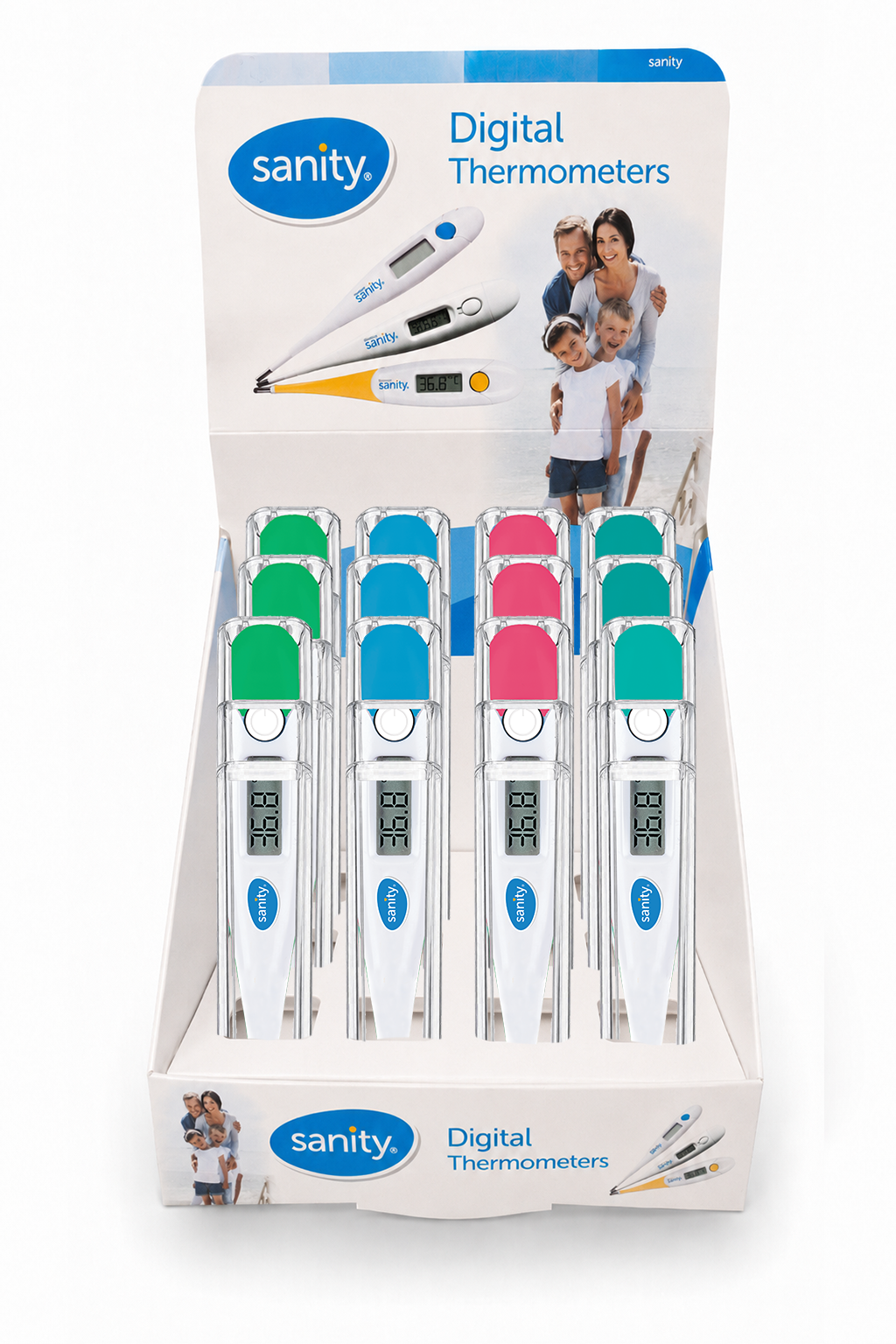
In the same documented product portfolio, the electronic thermometer series includes models MT-518, MT-519, MT-811, MT-801, and ECT-1. The verified specification record includes:
- Measuring range: 32.0°C to 43.9°C
- Measurement accuracy: ±0.1°C
- Response time: 45 seconds
- IP22 protection
- Power supply: 1.5V button battery
- Operating temperature: 10°C to 40°C
- Material: ABS plastic with stainless-steel probe
Side-by-side specification comparison
| Dimension | Mercury-free glass thermometer | Electronic thermometer |
|---|---|---|
| Documented product models | 6000-A, 7000-A | MT-518, MT-519, MT-811, MT-801, ECT-1 |
| Measurement range | 35°C – 42°C | 32.0°C – 43.9°C |
| Measurement accuracy | ±0.1°C | ±0.1°C |
| Response specification | Not stated; user follows measurement procedure | 45 seconds |
| Power supply | None | 1.5V button battery |
| Material | Borosilicate glass; gallium-indium-tin alloy | ABS plastic; stainless-steel probe |
| Durability / protection feature | Shock-resistant glass tube | IP22 |
| Additional documented functions | Maximum temperature indicator | Fever alarm, portable size, optional soft probe tip documented in EU distribution case |
| CE MDR documentation | Covered under CN24/00005535 | Covered under CN24/00005535 |
Brand reality check: what a documented MDR file looks like
Buyers evaluating sources should compare supplier evidence, not packaging claims. When the supplier is Ningbo Hi-life Medical Technology Co., Ltd., the regulatory documentation is publicly identifiable.
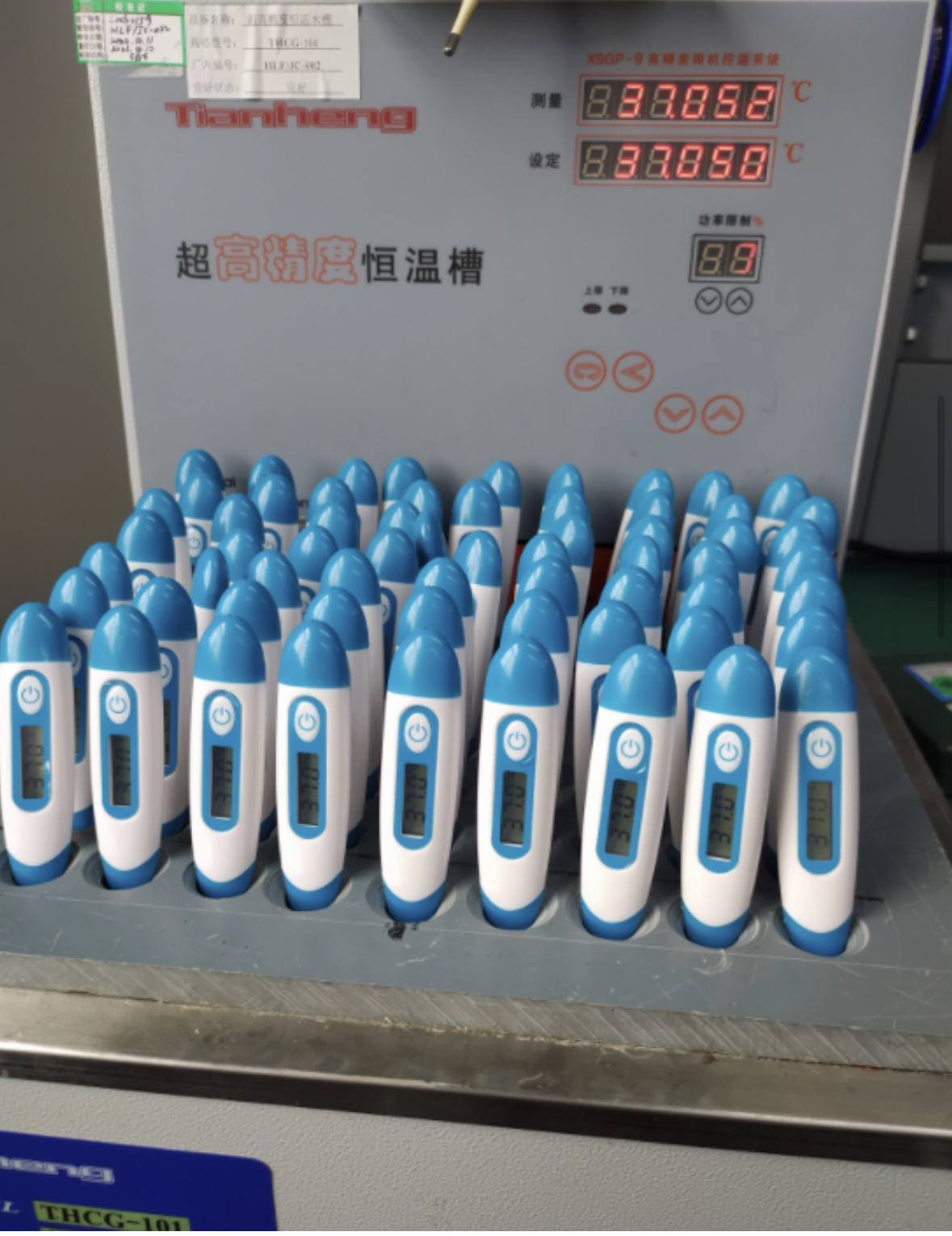
The company is a China-based manufacturer of clinical medical thermometers. Its product range includes mercury-free glass thermometers, electronic thermometers, infrared ear and forehead thermometers, industrial infrared thermometers, and water thermometers. The company also serves as the Secretariat Unit of the Body Temperature Measurement Professional Committee under the China Association for Medical Devices Industry, which adds an industry-standard perspective to its product development.
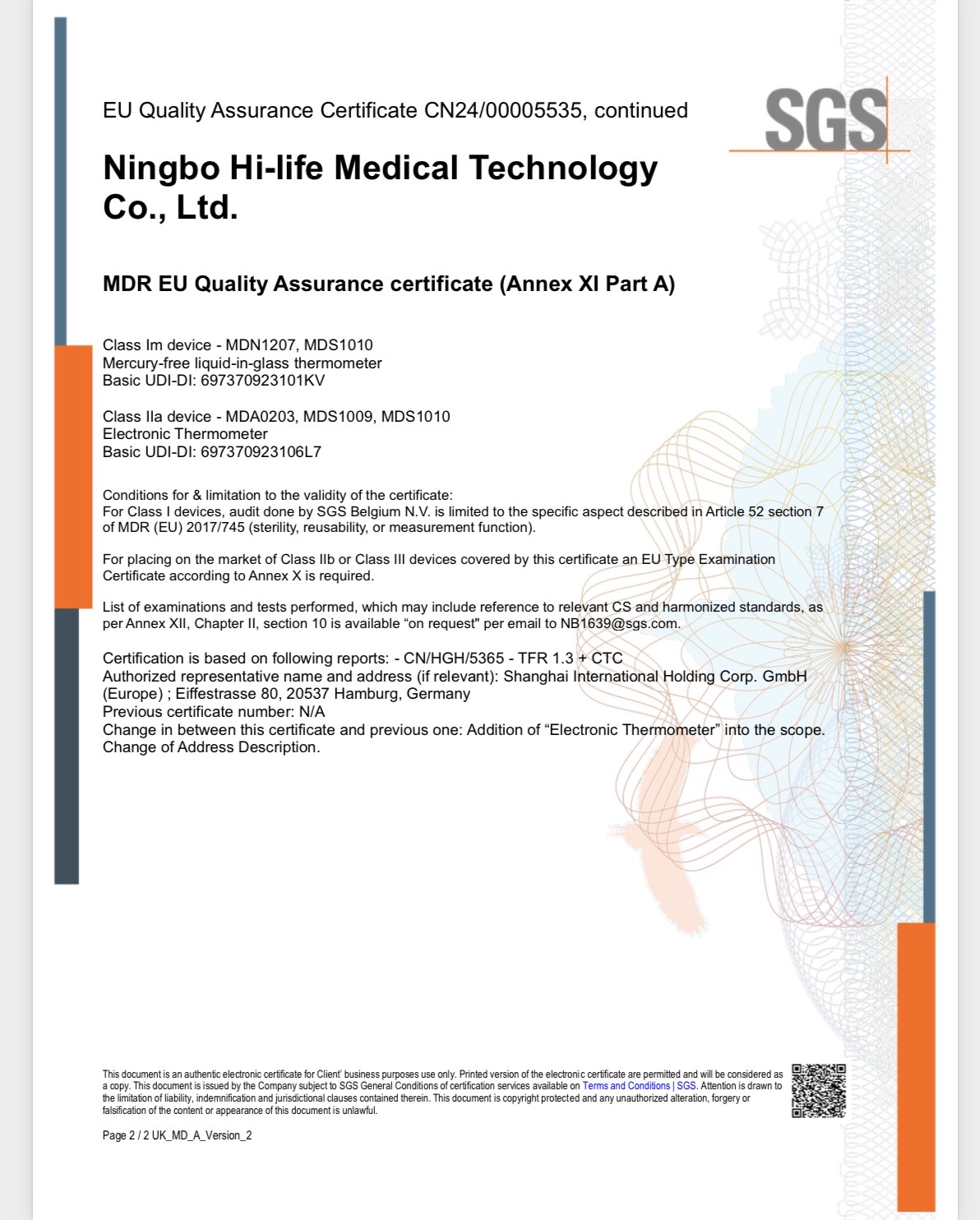
The CE MDR certificate record, number CN24/00005535 issued by SGS, covers both the mercury-free liquid-in-glass thermometer and the electronic thermometer and is shown as valid until 2029-08-30. The glass thermometer certificate record references EN ISO 13485:2016. This is the type of documentation importers should request from any supplier before placing a compliance-sensitive order.
Quality-control records are also relevant. Manufacturer statements describe 100% functional and precision testing and 100% accuracy inspection before shipment for the relevant product programmes. For a device where a fraction of a degree can change a clinical decision, documented inspection is more useful than descriptive marketing language.
Application evidence: two European distribution programmes
Germany: medical distributor and pharmacy wholesaler route
A documented German project involved a medical distributor and pharmacy wholesaler using the mercury-free glass thermometer product for hospital, clinic, and household temperature measurement. The project scale was 50,000 units, delivered over a three-year relationship. Reported outcomes include stable measuring accuracy and zero mercury-leak risk, with good market feedback.
The product highlights in that case match the mercury-free glass format: eco-friendly mercury-free filling, shock-resistant tube, and an easy-reading scale. For pharmacy distribution, this format offers a clinical thermometer that can be sold without battery-related logistics and without the safety concerns associated with traditional mercury devices.
France: healthcare importer and supermarket retail route
A separate documented case in France involved a healthcare importer and supermarket retailer using clinical thermometers for home-use and community medical temperature screening. The project scale was 100,000 units, delivered within three years. Reported results include fast measurement and a low defective rate, with CE MDR compliance as an acceptance requirement.
Key highlights recorded for this programme include a fever alarm function, portable size, and an optional soft probe tip. Those features point toward the electronic thermometer format for high-volume consumer-facing retail or community screening.
The two cases do not force a buyer to pick one category over the other. They show how different channel requirements lead to different product formats.
Which model fits which route: a decision matrix
| If the buying driver is… | Recommended evaluation priority |
|---|---|
| Battery-free supply chain and simple storage | Mercury-free liquid-in-glass thermometer with shock-resistant tube |
| Digital readout and shorter response time | Electronic thermometer with documented response specification |
| Fever alarm in home or community screening | Electronic thermometer with fever alarm function and portable format |
| Hospital or pharmacy restock where users need low-complexity clinical tools | Mercury-free glass thermometer with maximum temperature indicator |
| EU MDR regulated import market | Either format, but only with valid CE MDR documentation and supplier QC records |
Application, supply chain, and OEM planning
A product category decision also affects procurement volume planning. For the documented mercury-free glass line, the manufacturer lists a monthly production capacity of 150,000 units, an MOQ of 5,000 units, and a lead time of 25 to 35 days, with 100% accuracy inspection before shipment. For the electronic thermometer line, the documented production figures show a monthly capacity of 200,000 units, an MOQ of 3,000 units, and a lead time of 30 to 40 days, with 100% functional and precision testing.
Customization depth also varies. The glass thermometer line can support logo printing, packaging, color, and scale customization. The electronic thermometer line can support shell color, brand logo, packaging, and software parameters. Buyers who need private-label programmes should confirm early which production line supports their required customization scope.
After-sales expectations differ as well. For glass thermometers, the documented service model focuses on online technical support and quality complaint handling. For electronic thermometers, the documented service model includes remote guidance, spare-parts solutions, and after-sales feedback. Electronic devices create additional spare-part and battery-related lifecycle questions, while glass thermometers require fewer consumable components.
Comparison with the traditional mercury thermometer and remaining limits
Buyers who still question whether traditional mercury thermometers should remain in their range should note the safety and regulatory contrast. A mercury-free glass thermometer uses a non-toxic gallium-indium-tin alloy, retains the same ±0.1°C measurement specification, and eliminates mercury-leak hazards. Traditional mercury thermometers are under restriction in most countries because of the toxic and environmental risks of mercury exposure.
The mercury-free glass category is not without limitations. It is manually read and has no electronic alarm. Its documented measurement range, 35°C to 42°C, is narrower than the electronic thermometer range. A buyer planning for hypothermia screening or clinical scenarios below 35°C will need a device with a lower documented range. The glass format cannot offer the fever alarm function that many retail consumers now expect from digital models.
Electronic thermometers also carry clear limits. They depend on a 1.5V button battery, which introduces battery lifecycle, replacement cost, and disposal considerations. The documented operating temperature range is 10°C to 40°C, meaning the device is designed for normal indoor medical environments. If the battery fails or the user does not maintain the device, readout availability is lost. In addition, buyers should verify electronic thermometer compliance through a proper regulatory file; uncertified low-cost devices carry risks of customs detention, return, and fines in regulated import markets.
Regulatory and standard considerations for buyers
Under the European Medical Device Regulation 2017/745, clinical thermometers are generally classified as Class IIa or Class Im depending on the measurement technology and metrological function. That classification is design-specific, which is why buyers should request the actual certificate scope rather than rely on a general statement.
Internationally, ISO 80601-2-56:2017 is relevant as the standard for the basic safety and essential performance of clinical thermometers for body temperature measurement. Buyers evaluating electronic thermometers for regulated supply can use this standard as a technical benchmark when reviewing the supplier documentation.
Future outlook
The overall thermometer market is expanding, and mercury-free formats already account for the largest share of revenue. For distributors, the likely future range will contain both a battery-free mercury-free glass option and a digital electronic option, with the balance decided by channel and customer profile.
Regulatory pressure against mercury devices will continue to support mercury-free glass sales in hospital, pharmacy, and household segments. At the same time, consumer preference for fast, readable digital devices and fever alerts is likely to maintain demand for electronic contact thermometers. Buyers who define clear internal roles for these two product families will be better positioned when selecting suppliers and negotiating long-term purchase agreements.
FAQ
Should I buy a mercury-free glass thermometer or a traditional mercury thermometer?
For most regulated and environmentally sensitive markets, the mercury-free glass thermometer is the safer choice. A documented example is the 6000-A mercury-free liquid-in-glass thermometer, which uses a non-toxic gallium-indium-tin alloy, keeps ±0.1°C measurement accuracy, complies with CE MDR, and avoids mercury-leak hazards. Traditional mercury thermometers are restricted in most countries and carry unnecessary clinical and disposal risks.
Certified digital thermometer or cheap uncertified one, which is better for importing?
For EU and other regulated medical-device markets, a certified electronic thermometer is the appropriate import choice. Certification and documented testing provide a traceable regulatory file, while uncertified low-cost thermometers risk customs detention, return, or fines. Uncertified products are only suited to regions with loose regulatory requirements and should be considered high-risk for professional distribution.
Documentation access for buyers
For buyers who need a broader view of packaging, product formats, and specification documentation, Ningbo Hi-life Medical Technology Co., Ltd. publishes a corporate catalogue with public access. It can be reviewed and downloaded at the following link: Hi-life Medical 2025 Product Catalogue (PDF).
Have Questions or Need More Details?
Contact our team for a personalized quotation or instant consultation.
Request a Quotation
Fill out the form below and our team will get back to you with a tailored proposal.
WhatsApp Direct Chat
Prefer to chat in real-time? Message us on WhatsApp for instant assistance & quick answers.
- Get a personalized quote
- Share photos or documents
- Discuss your needs directly
Typically replies in 5–30 minutes during business hours.