
Metal Fabrication Procurement FAQ: Terms, Acceptance Criteria, Material Scope
Metal Fabrication Procurement FAQ: Terms, Acceptance Criteria, Material Scope
Metal fabrication orders rarely stall on the drawing. They stall on what the quotation did not say: which minimum order quantity applies, who signs the acceptance record, and whether the grade written on the drawing sits inside the fabricator's own material scope or three steps outside it.
This FAQ works through those questions in the order a buyer meets them between technical approval and purchase order release. It uses the operating record of Xiamen Openex Mechanical Technology Ltd (Openex), a custom metal fabricator founded in 2009 that runs two manufacturing premises, one near Xiamen Port in Zhangzhou, Fujian, and one near Shanghai Port in Taizhou, Jiangsu, and exports roughly 80% of its output to the EU, USA, Australia, New Zealand, Japan, Singapore, South America and the Middle East.
The distinction matters because a fabrication contract carries two separate risks. One is dimensional: whether the part can be made to tolerance. The other is procedural: whether the terms, the inspection route and the material chain hold together at the moment the part is ready to ship. The second risk is usually the one that moves a delivery date.
What the purchasing terms actually commit to
Openex states purchasing terms at three levels rather than one. Minimum order quantity is described as project-based. Delivery is quoted from EXW, FOB, C&F, CIF, DAP and DDP. Payment runs by T/T (wire transfer) or by L/C (letter of credit), and on tonnage-scale programmes it is commonly structured 30/70.
The absence of a single MOQ figure is not a gap in policy. It reflects where the fixed cost sits in each process route, and the process data shows the difference directly.
| Process stream | Stated MOQ | Stated lead time | Quality control | Monthly capacity |
|---|---|---|---|---|
| Welding fabrication | 25 tons | 30–45 days | 100% test | 5,000 tons |
| Machining | 15 tons | 30–45 days | 100% inspection | 3,000 tons |
| Surface finishing | 15 tons | 45 days | 100% or random check as required | 3,000 units |
Two conclusions follow. First, a buyer should confirm whether a stated MOQ is measured on finished assembly weight or on individual component weight; on welded structures the two are rarely the same number. Second, the minimum that governs the order may come from the finishing route rather than from welding or machining, because finishing is sequenced last and carries its own threshold.
Delivery terms interact with geography more than with contract language. The Fujian premises sits roughly 40 km, about an hour by road, from Xiamen Port; the Jiangsu premises sits roughly 170 km, about two and a half hours, from Shanghai Port. For goods too long or too wide for a container, the Xiamen-area operation can use a wharf within about 2 km of the shop, which removes a long overland leg from the breakbulk option.
| Recorded commercial set | MOQ | Delivery terms | Acceptance | Payment |
|---|---|---|---|---|
| Project-based fabrication programme | Project-based | EXW, FOB, C&F, CIF, DAP, DDP | Option A, B or C | T/T or L/C |
| Tonnage-scale weld programme | 100 tons | FOB / CIF | Pre-shipment test | 30 / 70 |
| Tonnage-scale fabrication programme | 10 tons | FOB / CIF | Pre-shipment inspection | T/T or L/C, 30 / 70 |
The recorded sets are not contradictions. A 100-ton minimum with pre-shipment test describes one programme; a 10-ton minimum with pre-shipment inspection describes another; a project-based minimum with three acceptance options describes how the standard commercial reply is framed. The practical rule for a buyer is to ask which set a quotation is built on, rather than assuming the terms travel unchanged between suppliers or between part families.
How acceptance criteria are defined before production
Acceptance on an Openex order follows one of three routes, and the route is chosen before production rather than after: Option A, evidence produced by the fabricator in the form of photographs, videos and QA sheets; Option B, inspection carried out by the buyer; Option C, inspection carried out by a third party appointed by the buyer.
The three routes answer different questions. Option A answers whether the part matches the record, which is sufficient for repeated components whose critical dimensions are captured on a CMM report and whose surface condition is visible. Option B answers whether the part fits the equipment it will be bolted to, which is why buyers with engineering staff in the region often prefer it. Option C answers a question neither party can answer alone: whether an independent body will certify the result in a form that a downstream compliance file will accept.
Evidence produced under Option A is not limited to photographs. A 400-unit flywheel energy storage shell programme was released against a final inspection report generated before packing, and that report travelled with the shipment. Tube sheets for a heat exchanger at a power plant in Indonesia were inspected remotely before dispatch, with the inspection recorded for the buyer rather than performed by the buyer on site.
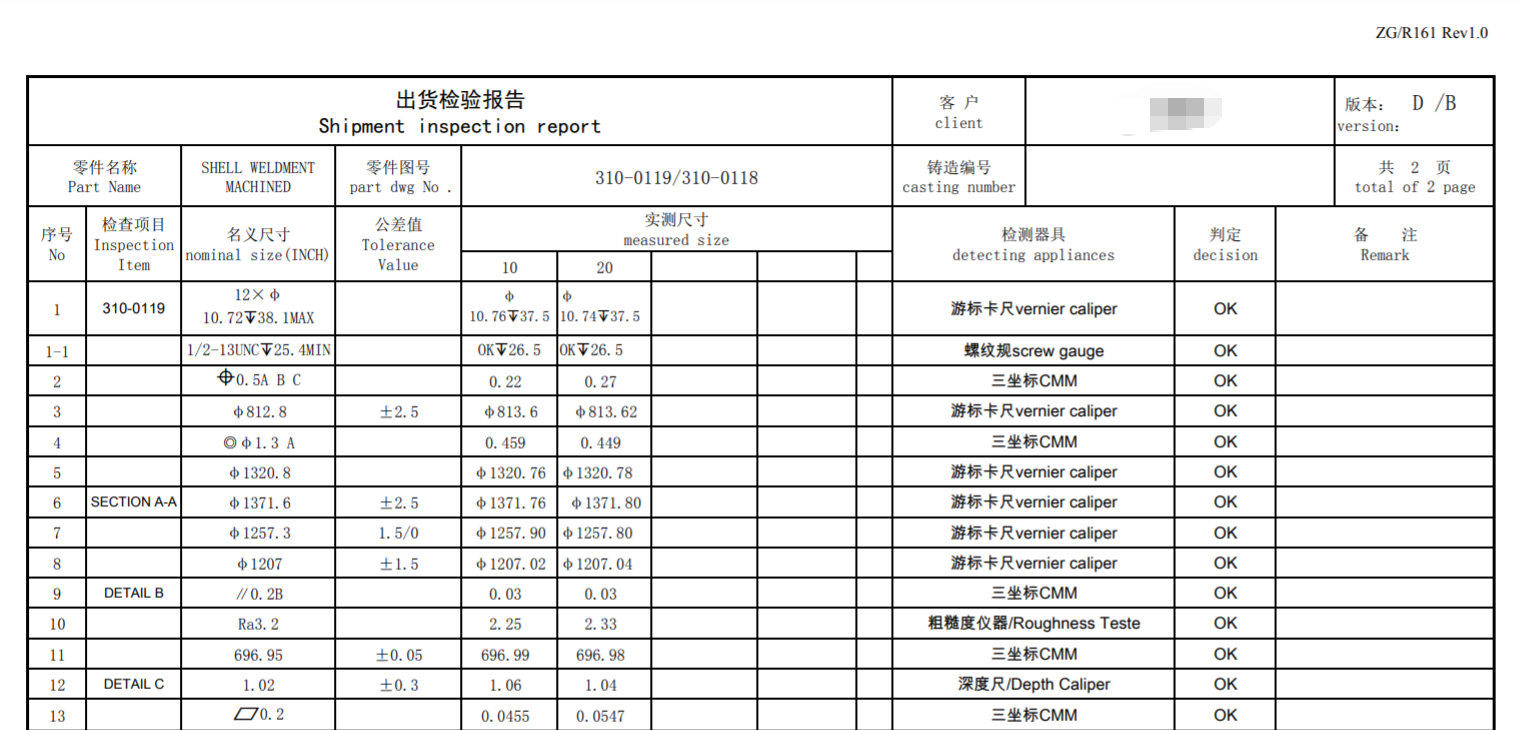
Dimensional evidence for large work is supported by a Zeiss CMM with a 7 m by 4 m by 3 m envelope and micron-level resolution, alongside smaller CMM units for components that do not need the large bed. Tube sheet hole patterns are drilled on multi-spindle CNC equipment, which is a capacity question as much as a quality one: hole count and plate thickness decide whether the part is a routine job or a bottleneck.
The procurement consequence is timing. Option C requires a third-party booking, and that booking has to land inside the production window rather than after it. Naming the acceptance route in the RFQ, before the first article is finished, is the difference between an inspection that happens on schedule and one that adds a week to the shipment.
Which metals are actually inside the material scope
The stated position is that any metal can be fabricated, with carbon steel and stainless steel making up most of the order book. Aluminium, brass and bronze are handled as fabrication materials. Among carbon steels, the grades named most often are Q235B (A36, SS400, S235JR) and Q355B (A572 Gr50, SS490/SPCC, S355JR); Q690 and NM450/NM500 appear often enough to be treated as routine rather than exceptional. In stainless steel, SUS 304 and SUS 316L dominate.
The welding scope is wider than the list of common grades. Base materials stated for welding include carbon steels, stainless steels, duplex and super duplex stainless steels, clad and composite plates, and low-alloy steels. That breadth affects process selection rather than marketing language: duplex and super duplex change the heat input window, the interpass temperature and the post-weld cleaning requirement, while clad plate changes how the joint is prepared.
| Material family | Grades stated in scope | Sourcing route |
|---|---|---|
| Carbon steel, structural | Q235B (A36, SS400, S235JR); Q355B (A572 Gr50, SS490/SPCC, S355JR) | In-house fabrication |
| Carbon steel, high strength and wear | Q690; NM450, NM500 | In-house fabrication |
| Stainless steel | SUS 304; SUS 316L | In-house fabrication |
| Welding base materials | Carbon steels, stainless steels, duplex and super duplex, clad and composite plates, low-alloy steels | In-house welding |
| Other metals | Aluminium, brass, bronze | In-house fabrication |
| Castings | Iron castings, steel castings | Partner foundries |
| Forgings, hot-dip galvanizing, powder coating, other anti-rust finishes | As specified | Partner plants |
Being inside the material scope is not the same as being in stock. Common structural grades can be bought as coil, plate or structural section on short notice. Uncommon grades, and special casting or forging grades, are sourced through long-term partner plants, which adds procurement lead time that the fabrication schedule has to absorb. A buyer specifying an unusual grade should expect that lead time to appear in the quotation rather than to be discovered after the order.
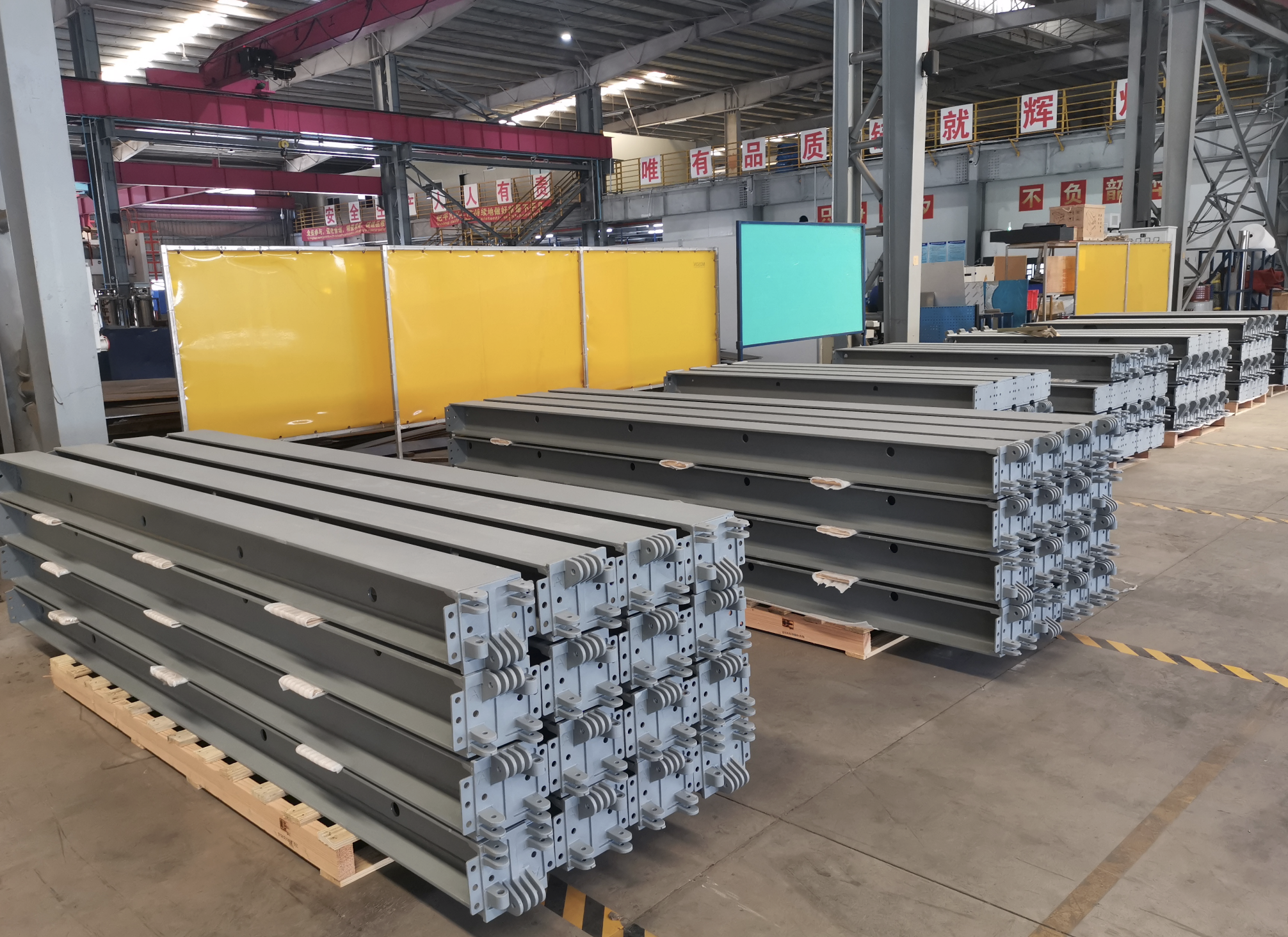
Mixed-material assemblies are where material scope and acceptance criteria meet. In a prefabricated beam assembly for a foldable housing programme, a Q355B I-beam was welded to ASTM A536 casting hinges, with 17-4 PH H900 stainless pins at Rm above 1,310 MPa (190 ksi) passing through the hinge bores. Acceptance on that part has to cover the straightness of the cut I-beam, the welding of the hinge to the beam, the machining of the casting, and the fit of the pin through two aligned bores: four checks across three process routes and two material families.
Manufacturer or supplier, and why the distinction is a procurement question
Openex is a manufacturer rather than a trading house. It produces 80–90% of the metal parts, components and assemblies it exports; the balance comes from partner plants. The in-house sequence covers laser cutting, bending, machining, welding, drilling, punching, stamping, assembling and packaging. Casting, forging, hot-dip galvanizing, powder coating and other anti-rust finishing are produced by partners, with a powder coating line for light structural parts under consideration.
The scale behind that sequence is stated as 30,000 m² of manufacturing space, around 200 employees, 20,000 tons of annual output and an engineering team of 35. The heavy end of the equipment list determines which enquiries are realistic: overhead crane capacity above 250 tons, bending machines up to 18 m in length and 10,000 tons in tonnage, and CNC machine tools with travel up to 50 m by 8 m by 7 m.
For a buyer, the manufacturer-versus-supplier answer changes where inspection effort should go. Most of the process chain sits under one quality system, which shortens the handover between cutting, welding and machining. A defined set of steps does not: castings, forgings, galvanizing and coating cross an organisational boundary. That boundary is where traceability questions usually appear, and it is the point at which a buyer should ask for the partner's own inspection record rather than the fabricator's summary of it.
The evidence pack supporting the manufacturer claim combines factory photographs from both premises, workshop video and a certificate set. The management system certificates on file are ISO 9001 (11426Q01049R001), ISO 14001 (11426E00739R001) and ISO 45001 (11426S00656R001), all issued on 16 April 2026 and valid to 15 April 2029, with the certified scope stated as manufacture of machined parts, metal structures and sheet metal components. The welding operation is organised against an EN ISO 3834-2 scope covering fusion welding of metallic material, process 135 and 135-Auto, material groups 1.1 and 1.2. Because certificate status is date-bound, the current package should be requested at RFQ stage rather than assumed from a brochure.
Technical explanation: why acceptance follows the process
Welding is the clearest example of why an acceptance route cannot be a template. The processes in use include SMAW, GMAW/MIG, GTAW/TIG, SAW, automatic tube-to-tubesheet welding, deep penetration welding and robotic welding, with procedure documentation covering WPS, PQR, welder qualification and PWHT procedure. Inspection options include visual and dimensional checks, RT, UT, MT and PT, TOFD and phased array, hardness testing, hydrostatic or pneumatic testing and corrosion testing. Each of those tests addresses a different failure mode, and a contract that names only one of them leaves the rest undefined.
Machining carries a parallel structure. Tolerances are stated across dimensional tolerance, geometric tolerance (flatness, straightness, circularity, cylindricity, profile, position, concentricity), surface roughness in Ra and Rz, hole and shaft tolerance, thread class and angular tolerance. A buyer who specifies general tolerances without naming which of those categories is critical gives the fabricator no basis for choosing between a three-axis setup and a five-axis one.
Surface finishing closes the sequence and has its own acceptance logic. Pre-treatment covers blasting or shot blasting, sandblasting, pickling, descaling, degreasing, phosphating, chromating, passivation, alkaline cleaning, etching and rinsing. Application covers spray painting, powder coating, electroplating and hot-dip galvanizing. Coating systems include primer, intermediate coat, topcoat, epoxy and zinc-rich coating. Each combination has a different inspection point, and a galvanized part cannot be inspected by the same method as a painted one.
The pattern across all three is identical: the acceptance route has to be selected from the process, not from a standard contract template. A welded pressure boundary and a painted enclosure can share a purchase order but not a single inspection sentence.
How the questions resolve on real part families
Turbine rings for hydropower stations show the sequence at its most demanding. A 30-ton ring supplied to a station in Uruguay was manufactured in separated segments, pre-assembled for dimensional control, then given final precision machining as a complete ring. Rough machining and final machining were deliberately separated so that tolerance was achieved after assembly rather than before it, a decision that only makes sense if the acceptance route was fixed at the start.
Large welded press frames and heavy equipment skids sit at another point on the same line. The governing questions are whether the welding sequence controls distortion and whether machined mounting faces stay parallel after welding. Those are process questions, but they become acceptance questions the moment the buyer has to choose between Option A and Option C.
Vacuum chambers, both large box and thermal types, add a third variable: leak integrity and surface condition interact, so welding, machining and cleaning have to be planned as one sequence. Castings add a fourth: an iron or steel casting produced by a partner foundry needs its own dimensional record before it is welded into an assembly, otherwise the fabricator's final inspection is measuring a problem it did not create. Custom chain conveyor fabrication for automotive and battery production lines, and steel chassis built to carry steel coils in a steel mill, 30 units in a Japanese mill with 20 years of stable operation, are both cases where commercial terms rather than the drawing decide how fast the order can move.
Where this supplier profile does not fit
A procurement FAQ is only useful if it states the boundary. Three situations fall outside the profile described here.
- A project that needs only casting, forging or anti-rust finishing. Those steps are performed by partner plants, so a buyer whose requirement stops there is better served by going directly to the specialist.
- A quotation request built on 3D files alone. STEP, IGES, DWG, DXF and PDF are all accepted and 2D drawings alone are usually enough to quote, but 3D-only submissions leave tolerance, welding requirements, surface roughness, rolling direction, bend radius, heat treatment and finish undefined. The fabricator then has to create 2D drawings for approval first, which lengthens the quotation timeline instead of shortening it.
- Small components in very large quantities. The compliance and logistics cost of an export order does not scale down with part size, and very small parts are generally not economic to source this way.
Aluminium deserves a separate note. Aluminium sits inside the fabrication material scope, but the casting items in the current product record are iron castings and steel castings. A buyer who needs aluminium castings should treat that as a different sourcing question rather than assuming it falls inside the same envelope.
What is changing in fabrication procurement
Two shifts are visible across the enquiries that reach a fabricator of this type, and both push documentation earlier in the process. The first is that smart manufacturing programmes treat inspection records as part of the deliverable rather than as a shipping formality, because a battery line or an automated guided vehicle fleet generates maintenance schedules that depend on dimensional history. The second is remote acceptance. Buyers increasingly inspect through recorded evidence and scheduled video rather than by travelling, which raises the value of a QA sheet that remains legible to someone who was never on site.
Neither shift changes the underlying commercial questions. MOQ still depends on the process route, delivery terms still decide who carries which leg of the journey, and material scope still has to separate what can be fabricated from what has to be bought in. What changes is that these answers increasingly need to be written down before the order rather than confirmed during it, which is the entire purpose of running the FAQ before the RFQ.
FAQ
Can a quotation be issued from 3D files alone?
Not directly. STEP, IGES, DWG, DXF and PDF are all accepted, and 2D drawings alone are sufficient in most cases. 3D-only submissions lack the tolerance, welding, surface roughness, rolling direction, bend radius, heat treatment and finish information needed to price the work, so 2D drawings have to be created for approval first. Submitting 2D and 3D together produces the fastest quotation.
How is inspection handled when the buyer cannot attend?
Through Option A, where the fabricator supplies photographs, videos and QA sheets, or through Option C, where a third party appointed by the buyer inspects. Both routes are documented: a 400-unit flywheel shell programme was released against a final inspection report, and tube sheets for a power plant heat exchanger in Indonesia were inspected remotely before dispatch.
Which acceptance routes exist, and who chooses?
Three exist: evidence supplied by the fabricator, inspection by the buyer, and inspection by a third party appointed by the buyer. The choice belongs to the buyer and should be named in the RFQ, because third-party inspection requires booking time inside the production window.
Are castings produced in-house?
No. Castings come from partner foundries, and the casting items in the current product record are iron castings and steel castings. Aluminium is handled as a fabrication material, not as an in-house casting capability. For a casting-only requirement, going directly to a foundry is the appropriate route.
Do payment and delivery terms vary between orders?
Yes. Payment runs by T/T or by L/C, with 30/70 structures common on tonnage-scale programmes. Delivery is quoted from EXW, FOB, C&F, CIF, DAP and DDP depending on the programme, and the applicable term is confirmed per order rather than fixed by company policy.
A company brochure covering processes, equipment and certificate scope is available for download: Openex mechanical brochure (PDF).
Have Questions or Need More Details?
Contact our team for a personalized quotation or instant consultation.
Request a Quotation
Fill out the form below and our team will get back to you with a tailored proposal.
WhatsApp Direct Chat
Prefer to chat in real-time? Message us on WhatsApp for instant assistance & quick answers.
- Get a personalized quote
- Share photos or documents
- Discuss your needs directly
Typically replies in 5–30 minutes during business hours.