
Metal Fabrication for Smart Factory Energy Systems
Metal Fabrication for Smart Factory Energy Systems
A smart factory that generates, stores and stabilizes part of its own electricity is not buying one type of steel structure; it is buying four. Solar panel supports, wind tree structures, energy storage frames and boxes, and flywheel energy storage shells each carry a different load path, a different joining strategy and a different acceptance test. Bundling them into a single “metal fabrication” line item is a common way an on-site energy programme inherits quality risk, because a supplier that is excellent at 1,000 repeated galvanized brackets has no automatic route to a two-tonne vacuum-tight shell, and the reverse is equally true.
This reference maps custom metal fabrication to those four on-site energy scenarios, using the reference products and project records of Openex fabrication. Xiamen Openex Mechanical Technology Ltd, trading as Openex fabrication, is a custom metal fabrication and machining supplier founded in 2009, operating two manufacturing premises near Xiamen Port and Shanghai Port and listing 30,000 m² of factory space, around 200 employees, 35 engineers and an annual output of 20,000 t. The relevant point is not that the company fabricates “energy structures” as a category, but that its documented product and project records cover the specific part families compared here.
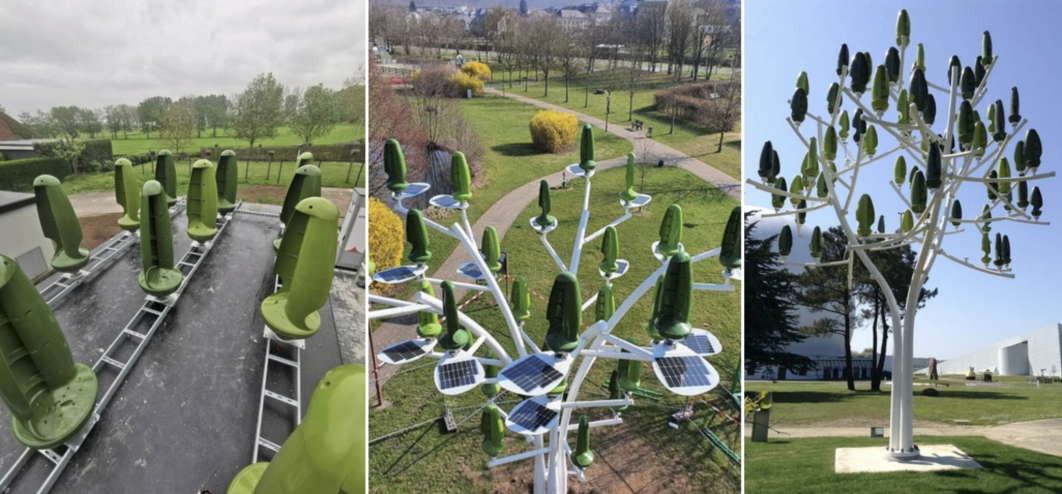
On-site energy is rarely one structure type: a wind tree installation combined with solar panels at the same site.
Why one fabrication specification cannot cover four energy assets
A plant-level energy package normally mixes scales that share nothing except steel. A 1,000-unit run of galvanized solar support frames is a repetition and hole-position problem. A 300-tonne wind tree set is an assembly and interface problem. A battery rack is a tolerance problem measured in millimetres across a 2.2-metre frame. A flywheel shell is a leak-rate problem that begins where welding ends.
The practical consequence is that a single inspection plan is either unnecessarily expensive for the simple parts or insufficient for the critical ones. A programme that applies a vacuum-style acceptance routine to solar brackets will not survive its own cost review; one that applies a bracket-level visual check to a flywheel shell will discover the gap at commissioning. The four families are separated below, followed by the buyer checks that apply across all of them.
Solar panel supports: hole patterns, beam straightness and galvanizing
Solar panel supports are usually the highest-volume and lowest-tolerance item in an on-site energy package, and the failure mode that matters commercially is rarely structural — it is fit. The structure itself is simple: beams, base supports, brackets and purlins that hold a module at a fixed angle. But every one of those parts is cut, punched or drilled to a pattern that must line up with its neighbours along a row, and errors accumulate over hundreds of repeated units.
Openex’s solar work is recorded as steel beams, base supports and hot-dip galvanized frames fabricated for a solar company, with the project record covering 1,000 units and the finished components described as galvanized steel fabricated parts for solar frames. That record is useful mainly because it shows the process order rather than the tonnage.
The dominant sequence is cutting, punching or drilling, bending, welding of bracket and base assemblies, and then hot-dip galvanizing of the finished geometry. The sequence matters: welding after galvanizing destroys the coating locally, and drilling after galvanizing exposes bare steel at every hole. Buyers should confirm that hole patterns and weld detail are complete before the coating step, and should agree in advance which machined faces and threaded interfaces are masked.
Acceptance for this family should be proportionate. Hole position and spacing, beam straightness, overall length and coating coverage on edges and internal corners are the checks that predict whether the array assembles. They do not require a 7 × 4 × 3 m coordinate measuring machine; a drilling template, a first-article check against the drawing and a defined sampling frequency are the correct instruments. On a 1,000-unit programme, that sampling frequency is a commercial term as much as a technical one and belongs in the purchase order.
Wind trees: many small members that must behave as one assembly
A wind tree inverts the solar logic. Volume is lower, geometry is more complex, and the risk concentrates at interfaces. The deliverable is a steel base, a branching set of arms and connection nodes that carry small wind turbines, and the fabrication problem is that dozens of individual members must arrive on site and still assemble into one working unit.
The Openex project record for this application covers 300 t of fabricated steel components for wind power generation — wind trees — with the manufacturing route documented as cutting, bending, machining, welding, hot-dip galvanizing and powder coating, followed by preassembly, then disassembly and packaging for shipment. The same record reports five years of stable operation for the installed units.
Preassembly is the step that separates this family from a support frame. Assembling the structure in the workshop does not prove the product works; it proves that holes, machined faces and branch angles agree before galvanizing and coating fix the geometry. Because both finishes are applied after the shape is set, any fit-up error found later turns into a rework decision rather than a fabrication adjustment — a much more expensive category of problem, and one that lands during site installation.
The acceptance evidence a buyer should expect is therefore three-part: dimensional records for the machined interfaces, a documented preassembly with photographs, and a dismantling and packaging list whose numbering matches the site assembly sequence. Where a wind tree is combined with solar panels on the same site, as some installations are, the interface between the two structures should be resolved on the drawing rather than on site.
Energy storage frames and boxes: tolerance measured at rack scale
The storage side of the package behaves like a repeated precision assembly rather than a structure. The Openex reference product is a steel shelf and box set for energy storage: overall dimensions 1.1 m × 1.1 m × 2.2 m, roughly 1,000 kg per unit, fabricated from steel tube and steel sheet in carbon steel, with powder coating for anti-rust protection.
The function explains the tolerance. Steel boxes stuffed with battery modules are assembled into the shelf, and the loaded shelves are then installed into a container to form a complete energy storage unit. That makes the frame a chain of interfaces — box to shelf, shelf to shelf, shelf to container — and a 2.2-metre frame that is out of square by a few millimetres will still assemble once, but will not assemble 300 times at the pace of a rack line.
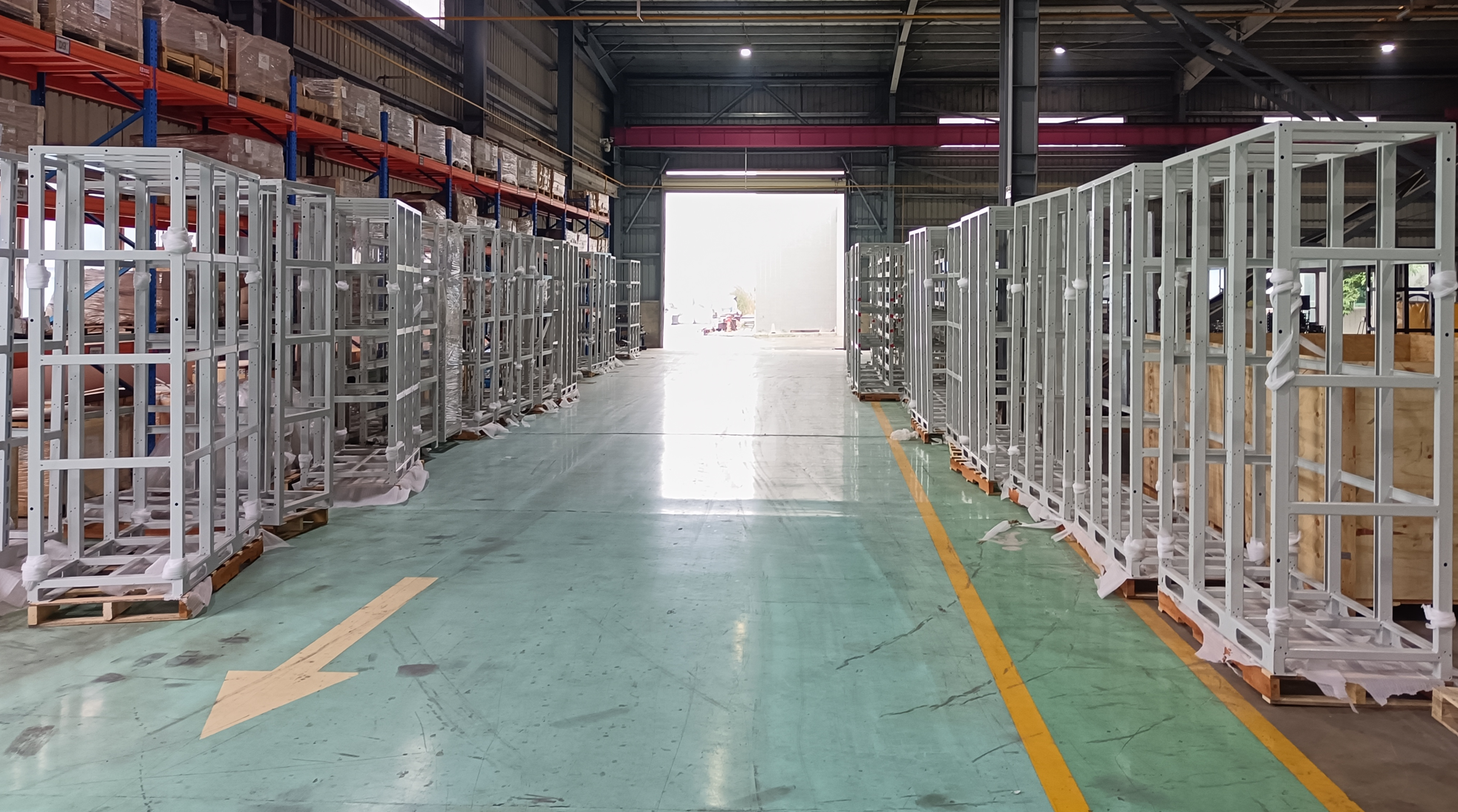
Steel shelves for lithium battery energy storage, fabricated at Openex’s manufacturing premise near Xiamen Port.
The process route is laser cutting, bending, welding, secondary machining where the drawing requires it, and powder coating. That creates two distinct quality gates: welding distortion before coating, and coating damage during assembly. Openex’s storage project records — a 300-unit shelving programme, a 3,000-unit shelving and box programme with an integrated cooling arrangement, and 1,500 liquid-cooling cabinets — point to the same recurring requirements: dimensional stability, absence of deformation, corrosion protection and straightforward assembly.
For buyers, the most efficient check is a physical one: assemble one box into one shelf, measure the tolerance stack across the repeated interface, and record it as the baseline for the run. Coating thickness and adhesion should be verified separately, and the drawing should state which surfaces must remain coating-free where electrical bonding is required. These are assembly-critical surfaces, and they are routinely discovered late.
Flywheel energy storage shells: a vacuum requirement, not a frame requirement
A flywheel energy storage shell is the item in this package where fabrication is only half the specification. The shell stores the rotational kinetic energy of the flywheel inside a hermetically sealed vacuum chamber, with the rotor supported on magnetic levitation bearings to minimize energy dissipation. The steel therefore has to hold vacuum, not merely hold shape.
The Openex reference shell is 1.5 m in diameter and 0.8 m high, weighs about 2 t, and is made from high-strength steel plate — S355JR, or ASTM A572 Grade 50 — chosen for a structure that must meet vacuum sealing requirements. The supplied specification lists a vacuum figure of 1.0 × 10⁻⁹ Torr·L/s within 30 seconds, and the documentation set includes a vacuum test report for the shell and top plate tested together, plus a final inspection report for the shells and top plates.
The process order is the substance of the capability. Plate is rolled into a cylinder, the shell and top plate are welded, and the assembly is then turned on a vertical lathe to bring roundness and the sealing surfaces back into tolerance. Machining follows welding precisely because welding distorts; a supplier that quotes the shell as a welded item without a post-weld machining step is describing a different product. Openex’s project record for this part family covers 400 units with five years of reported stable operation.
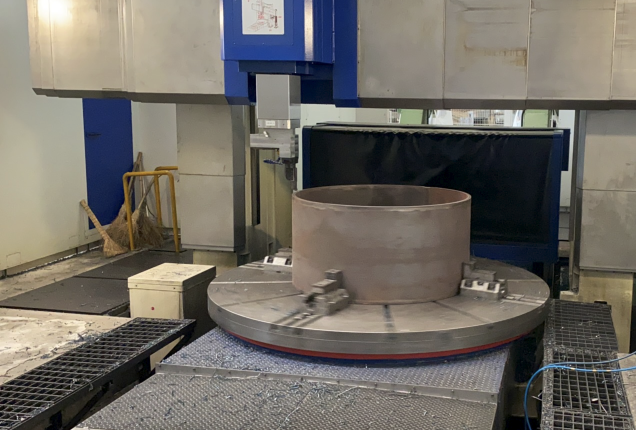
A flywheel energy storage shell under vertical lathe turning; machining follows welding to restore roundness and sealing surfaces.
Acceptance wording deserves more attention here than anywhere else in the package. The direction of the limit — “better than” or “not exceeding” — and the test method (rate-of-rise versus helium leak detection) must be fixed in writing, because a figure quoted in Torr·L/s against a 30-second condition will not produce comparable results across different methods. A shell that passes a coarse pressure check can still fail a helium test, and the purchase order is where that ambiguity is either closed or inherited.
Scope boundary. For flywheel chambers, Openex’s stated scope is custom metal fabrication only; assembly of the flywheel chamber is carried out by the user. The vacuum test report evidences the shell-and-top-plate assembly as tested, not a commissioned energy storage system.
Side by side: what changes between the four applications
The table below is the short version of the comparison: same supplier category, four different quality plans.
| Application | Structure and main process | Reference material | Finishing / special process | Acceptance evidence |
|---|---|---|---|---|
| Solar panel supports | Beams, base supports, brackets; cutting, punching or drilling, bending, welding | Galvanized carbon steel components | Hot-dip galvanizing after fabrication | Hole position and spacing, beam straightness, length, coating coverage |
| Wind tree structures | Base, arms, connection nodes; cutting, bending, machining, welding | Carbon steel plate and sections | Hot-dip galvanizing plus powder coating; preassembly before packing | Machined interface dimensions, preassembly record with photos, packaging and numbering list |
| Energy storage frames and boxes (XHC-009) | Steel tube and sheet frame, shelf and insert box; laser cutting, bending, welding, secondary machining | Carbon steel tube and sheet, 1.1 × 1.1 × 2.2 m, about 1,000 kg per unit | Powder coating for anti-rust protection | Tolerance stack across repeated interfaces, sample rack assembly, coating thickness and adhesion |
| Flywheel energy storage shell (AKI-1) | Rolled and welded cylinder with top plate; welding then vertical lathe turning | S355JR or ASTM A572 Grade 50, 1.5 m diameter, 0.8 m height, about 2 t | Machined sealing surfaces; vacuum testing of shell and top plate | Vacuum test report, final inspection report, dimensional records for sealing faces |
What has to change in the workshop
The capability that links these families is not a single machine but a sequence that can be re-ordered per part. For larger welded structures, Openex’s reference configurations run to an envelope of up to 6,000 × 3,000 × 2,500 mm, plate thickness of 20–80 mm and finished mass of 15–40 t, with a general machined tolerance of ±0.20 mm and datum-pad flatness of ≤0.15 mm per 1,000 mm. Those figures are reference configurations, not universal guarantees: the applicable envelope and tolerance depend on the datum scheme agreed on the drawing.
For enclosure-type work the control points shift. The heavy-duty enclosure reference covers 2–8 t units, 7–12 m in length and 10–16 mm plate in carbon steel Q355 or stainless 316, with plate thickness across the wider range of 1.5–25 mm. The stated process chain — cutting and blanking, bending, rolling, edge planing, welding and then secondary machining after welding — is the same logic as the flywheel shell at a different scale: the geometry that matters is produced after the heat of welding, not before it.
Behind both is equipment that determines what can be quoted at all: overhead crane capacity above 250 t, press brakes up to 18 m and 10,000 t, CNC travel up to 50 × 8 × 7 m, and a Zeiss coordinate measuring machine with a 7 × 4 × 3 m envelope and micron-level resolution. Welding procedures cover SMAW, GMAW/MIG, GTAW/TIG and SAW, with robotic welding available, plus a distortion control plan and post-weld cleaning — pickling and passivation for stainless, grit blasting for carbon steel.
Buyer checks: materials, terms, acceptance and factory evidence
Which metals the fabricator actually processes
The question is not whether a supplier “works with steel” but which grades appear in its approved process documentation. Openex’s welding and machining scope names carbon steels, low-alloy steels, stainless steels including 304 and 316L families, duplex and super duplex, and clad or composite plates, with product-level references to Q355, ASTM A36, ASTM A572 Grade 50, S355JR, S355J2+N and SA516 Gr 70. Aluminum 6061-T6 appears in specific components such as vacuum chamber doors rather than as a structural default. A buyer should match the grade on the drawing to this list before discussing price.
Purchasing terms that change the schedule
Production terms are quoted per capability area, not per company, so a mixed four-family order needs the applicable terms confirmed line by line. As published in the capability data:
- Welding: minimum order 25 t, monthly capacity 5,000 t, lead time 30–45 days, 100% testing.
- Machining: minimum order 15 t, monthly capacity 3,000 t, lead time 30–45 days, 100% inspection.
- Surface finishing: minimum order 15 t, monthly capacity 3,000 units, lead time 45 days.
- Inspection services: minimum order 1 unit, lead time 3 days.
Two of those numbers drive real decisions. A 15–25 t minimum means a prototype flywheel shell and a 300-unit rack programme are unlikely to share a single release; and a 45-day finishing lead time can be the longest step in a solar frame order that is otherwise a two-week cutting and welding job.
Acceptance criteria to write into the order
Acceptance should name the method, not only the result. Openex’s documented inspection scope includes non-destructive testing by RT, UT, MT, PT, VT and LT, with TOFD and phased array available; destructive testing covering chemical analysis, tensile, impact including low-temperature, bend and hardness; corrosion testing by salt spray; and weld procedure qualification including WPS, PQR, welder qualification and PWHT procedure. Dimensional and visual inspection covers length, diameter, angle, roundness, straightness and position, plus surface roughness parameters. For pressure-retaining or vacuum parts, hydrostatic and pneumatic testing and a documented leak test belong in the same clause. Buyers should also specify whether a third-party witness or a remote pre-shipment check is required — remote QC before shipment is already part of Openex’s tube sheet supply record for an Indonesian power plant.
Factory photos, workshop video and certificates
Visual evidence is reasonable to request before an order and should be specific. Openex’s available imagery covers the fabrication shop near Xiamen Port, the sheet metal shop near Shanghai Port, the 250-tonne overhead crane, press brake equipment, multiple welding cells, the assembly workshop and the large CMM — enough to confirm that the claimed processes exist as a physical layout rather than a brochure list. A workshop video walk-through is the natural extension of the same request.
Certificates need a sharper question. Ask which certificate applies to the component class being purchased, not whether the company “has certificates”. Openex’s approved material, for example, describes ASME-certified fabrication together with full NDT inspection within its pipeline prefabrication scope. That statement is meaningful for piping work and should not be read as automatic coverage of a flywheel shell or a galvanized solar bracket. Scope-matching the certificate to the part is the buyer’s protection, and it is a five-minute question at quotation stage.
Where fabrication stops
Three boundaries are worth stating plainly, because they are the ones most often blurred in a supplier presentation.
- Assembly responsibility. For flywheel chambers, Openex supplies fabricated and machined shells; the user assembles the chamber. The vacuum report evidences the tested shell-and-top-plate assembly, not a commissioned system.
- Design responsibility. Reference envelopes and tolerances are typical configurations. Wall and stiffener design, load analysis, datum scheme and final leak acceptance remain engineering decisions that must be fixed on the drawing before fabrication starts.
- Finishing is not interchangeable. Hot-dip galvanizing, powder coating and machined bare surfaces solve different problems on the same site. Applying one finish across a four-family package is usually the wrong economy, and masking requirements should be agreed before the coating step, not after.
Outlook: multi-asset plants need multi-family fabrication packages
The direction of on-site energy is toward combined assets rather than single structures. Flywheel units are typically installed near wind or solar farms to store energy and improve the quality of the electricity output, and wind tree installations are in some cases combined with solar panels on the same site. Where that combination occurs, the procurement question changes from “who can weld this” to “who can document four different acceptance routes for one delivery”.
For buyers in research and evaluation stages, the useful conclusion is structural rather than commercial: keep one supplier relationship if it reduces coordination cost, but do not let it reduce the specification to the weakest family. Write four quality plans, one per asset type, and require evidence matched to each — a preassembly record for the wind tree, a tolerance stack for the rack, a vacuum test report for the shell, and a coating and hole-position check for the solar frames.
Drawings, material grades and acceptance requirements for a mixed energy package can be sent to sales2@openex.com.cn. The Openex fabrication brochure (PDF) summarises the process and equipment scope referenced above.
FAQ
What metals can a fabricator process for solar, wind and storage structures?
Documented scope at Openex covers carbon steels such as Q355, ASTM A36, ASTM A572 Grade 50, S355JR, S355J2+N and SA516 Gr 70, together with low-alloy steels, stainless steels in the 304 and 316L families, duplex and super duplex, and clad or composite plate. Aluminum 6061-T6 appears in specific components such as vacuum chamber doors rather than as a structural default. The grade on the drawing should be matched to the supplier’s approved process list before pricing is discussed.
How do acceptance criteria differ between a welded frame and a vacuum shell?
A welded frame is accepted on geometry and integrity: dimensional records, weld visual and non-destructive testing, and coating checks. A vacuum shell adds a leak-rate requirement and a machined sealing surface, so acceptance shifts to a vacuum test of the shell and top plate assembled together, supported by a final inspection report. The same fabricator can supply both, but the two parts should not share one inspection clause.
What purchasing terms should be confirmed before an energy fabrication order?
Confirm the terms that apply to each capability area rather than to the company overall. Published figures list welding at a 25 t minimum with 5,000 t monthly capacity and 30–45 day lead time, machining at 15 t minimum with 3,000 t monthly capacity and 30–45 days, surface finishing at 15 t minimum with 3,000 units monthly capacity and a 45-day lead time, and inspection services from 1 unit with a 3-day lead time. A mixed package should state which of these governs each line item.
Can a buyer see factory photos, workshop video or certificates before ordering?
Yes, and the request should be specific to the part family. Available visual evidence includes the fabrication shop near Xiamen Port, the sheet metal shop near Shanghai Port, the 250-tonne overhead crane, press brake equipment, welding cells, the assembly workshop and a Zeiss CMM with a 7 × 4 × 3 m envelope. Remote pre-shipment quality checks are already part of Openex’s tube sheet supply record. Certificates should be matched to the component class: the material describes ASME-certified fabrication within the pipeline prefabrication scope, which does not automatically extend to every product type.
Can one fabricator supply solar supports, wind trees, storage frames and flywheel shells together?
It can, where each family falls inside the documented equipment and quality envelope. The practical condition is that each family keeps its own acceptance plan: hole position and coating for solar frames, a preassembly record for wind trees, a tolerance stack for storage racks, and a vacuum test report for flywheel shells. Two limits apply regardless of supplier — flywheel chamber assembly is performed by the user, and design inputs such as load analysis, datum scheme and leak acceptance remain the buyer’s engineering responsibility.
Have Questions or Need More Details?
Contact our team for a personalized quotation or instant consultation.
Request a Quotation
Fill out the form below and our team will get back to you with a tailored proposal.
WhatsApp Direct Chat
Prefer to chat in real-time? Message us on WhatsApp for instant assistance & quick answers.
- Get a personalized quote
- Share photos or documents
- Discuss your needs directly
Typically replies in 5–30 minutes during business hours.