
Metalized Paper Laminating Machine Comparison: A Weighted Scoring Framework for Buyers
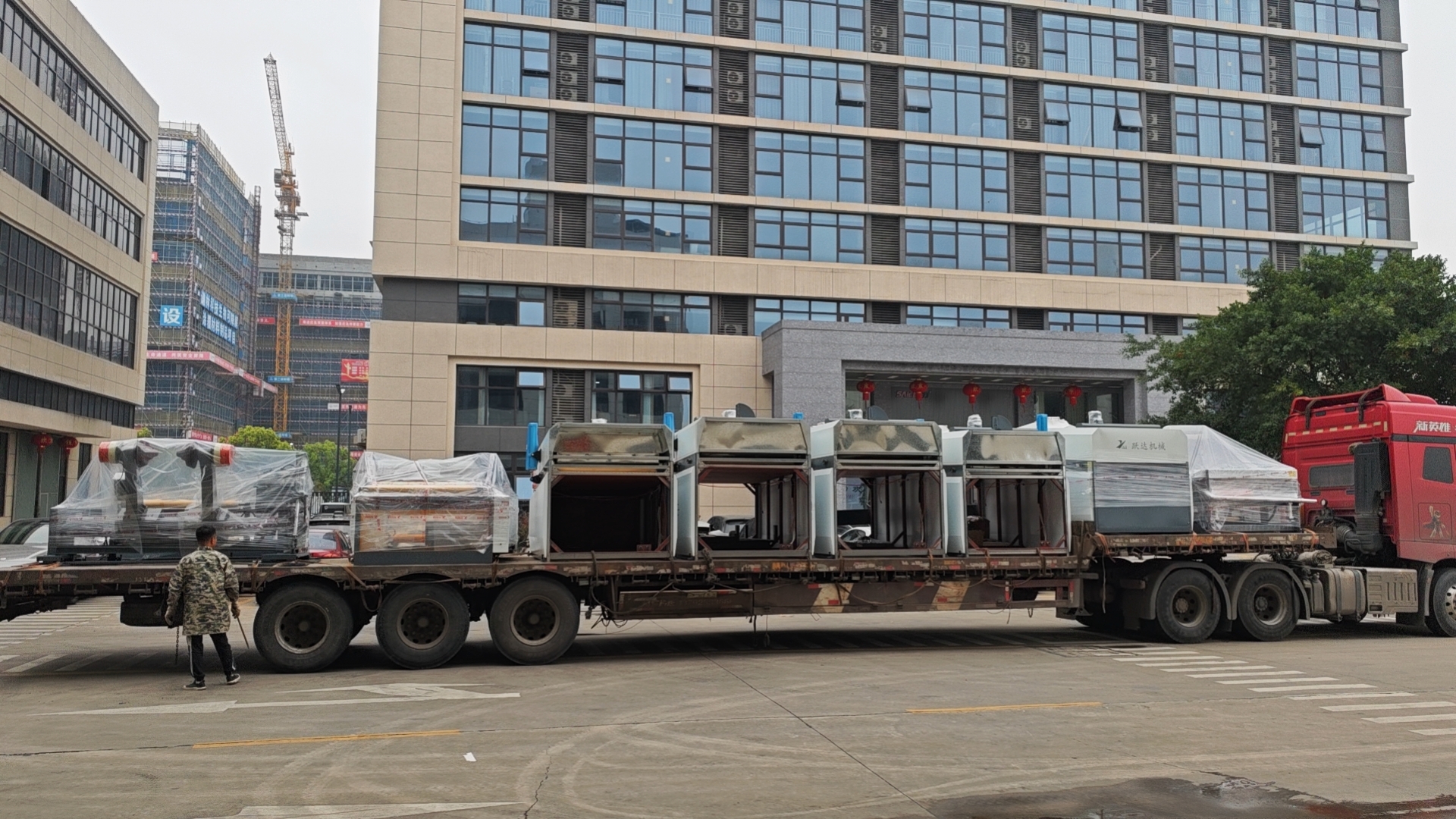
Cover: capital equipment staged for export. A weighted scoring model exists to make that capital commitment comparable across suppliers.
Metalized paper is a substrate market; laminating machinery is the tool market beneath it. The two are routinely merged in supplier material and rarely separated in buyer analysis. In 2025, the metallized paper market was reported at USD 4.85 billion, with tobacco packaging and premium labeling as the principal demand drivers (DataM Intelligence, 2026). The wider laminating machinery market was estimated at USD 676.4 million in the same year (Future Market Insights, 2025).
Buyers who reach the evaluation stage usually already understand that. Their problem is narrower and more expensive: two machines can both be described as “high speed”, “wide format” and “automatic” and still differ in the ways that decide whether a packaging line earns or loses money over five years. This reference sets out a weighted scoring framework for that decision. Wenzhou Yueda Packaging Machinery Co., Ltd. (YUEDA) — a China-based manufacturer of gold and silver cardboard coating and laminating equipment, founded in 1998 and located in Longgang, Wenzhou — is used as a worked example, not as a conclusion.
Why spec-sheet comparison breaks down
Five categories of information dominate a machine datasheet, and each of them fails in a different way when placed side by side with a competitor’s sheet.
- Rated speed is a range, not a scalar. Line speed depends on substrate, adhesive, coating weight and drying capacity. A single maximum figure hides the operating point at which quality is actually held.
- Working width is quoted as a ceiling. Usable width after edge trim and tension control is what determines sheet layout and material yield, and it is rarely stated.
- Automation is listed as features, not architecture. Servo-assisted tension control and closed-loop tension control appear identically on a feature list and behave very differently on a running line.
- Intellectual property almost never appears at all. It is one of the few supplier claims that can be checked against a public register, which makes its absence from comparison frameworks a structural omission.
- Acceptance terms live in the purchase order. Because they are negotiated after selection, they are excluded from comparison even though they carry most of the buyer’s risk.
These are not five separate problems. They are the same error repeated: specification numbers are compared as if they were equivalent kinds of evidence, when they are not. A weighted model does not remove the error, but it forces each number into a category where its reliability can be stated.
A six-criterion weighted model
The model below distributes 100 points across six criteria. The weighting is set for an evaluation-stage buyer purchasing an industrial metalized paper laminating machine for continuous production. A buyer running pilot batches or short job-shop runs should raise format fit and lower the commercial block, because the cost of a suboptimal format is immediate while the cost of a slow service response is deferred.
| Criterion | Weight | What the score should be based on |
|---|---|---|
| Format fit (working width and substrate handling) | 20 | Documented working width range, the customisation route beyond it, roll and sheet handling configuration |
| Throughput realism | 15 | Stated speed range plus evidence of sustained operation, not a peak figure |
| Automation and control | 15 | Control architecture, tension strategy, registered control software, HMI and system-brand options |
| Documented intellectual property | 15 | Utility model, design and software registrations mapped to the specific model, with validity dates |
| Energy and emissions engineering | 10 | Drying, heat recovery and waste-gas provisions supported by registration or measurement |
| Commercial terms and acceptance | 25 | Lead time, minimum order quantity, pre-shipment test protocol, inspection rights, service response commitments |
The commercial block carries the largest weight deliberately. At evaluation stage the specification has usually already cleared the technical floor; what remains uncertain is delivery, verification and support. Intellectual property receives a full 15 points because, unlike a speed claim, it is externally checkable — a patent number can be validated against the issuing authority’s register.
Criterion 1 — Format fit (20 points)
Working width is the least negotiable dimension in the model, because it is structural. It cannot be retrofitted economically after delivery.
YUEDA’s YDLM1300B gantry multifunctional aluminum metallized cardboard laminating (coating) machine has a documented working width of 600–1200 mm. Across the company’s customisation scope, working width extends to 800–1600 mm, alongside voltage options of 110 V, 220 V and 380 V and control system selection.
That produces three scoring questions rather than one. First, does the documented width bracket the buyer’s sheet plan with trim allowance included? Second, if the plan sits above the standard platform, is there a documented route to a wider configuration — and does that route change the delivery horizon? YUEDA quotes 30–45 days for standard models and 45–60 days for customised models, so a wider frame is a schedule decision as well as a capability decision. Third, does the substrate handling configuration match the material actually being run: roll diameter, core type, tension profile and web guidance all interact with the substrate rather than with the frame.
A machine that scores well on the first question and badly on the third is a machine that will run, but not at the yield the business case assumed.
Criterion 2 — Throughput realism (15 points)
The YDLM1300B carries a stated running speed range of 5–150 m/min. Both ends of that range matter. The low end indicates the machine can hold quality on heavier coating work at reduced speed; the high end indicates the volume ceiling. A buyer whose product mix sits at the low end should not pay for a high-end platform, and a buyer running continuous tobacco work should not accept a machine whose low end is the only documented operating point.
The scoring question is not which number is larger. It is whether the supplier can describe the conditions under which the number is achieved. YUEDA states 100% pre-shipment testing with a two-hour continuous run, with third-party inspection available. That is the correct type of evidence to request — a defined protocol, a duration, and a witness option — even though it remains a factory test rather than an independent benchmark. Buyers should score the presence of a defined protocol at least as heavily as the headline speed.
Criterion 3 — Automation and control (15 points)
Control architecture separates machines that look identical on a brochure. Two registered software copyrights provide a checkable anchor for YUEDA’s control layer:
- 2020SR0669497 — Intelligent Control System for Automatic Gold and Silver Cardboard Laminating (Coating) Machine V1.0, issued 23 June 2020 by the National Copyright Administration of the People’s Republic of China, with no expiry date stated on the certificate.
- 2020SR0668797 — Automatic Paper and Plastic Conveying System for Transverse Paper Cutter V1.0, issued on the same date by the same authority.
Registered software is meaningful to a buyer for a specific reason: it indicates that the control layer is a company-held asset rather than an assembled third-party package. That distinction affects upgrade paths, fault diagnosis and the availability of the original developer when a line has been running for a decade.
The equipment descriptions for this range also reference servo-controlled tension monitoring with automatic adjustment. In scoring terms, the buyer should separate three sub-questions: is tension control open-loop, servo-assisted or closed-loop; can the control system brand be specified (it appears within YUEDA’s ODM customisation scope, together with HMI language and voltage/frequency); and is the control documentation handed over at acceptance. An affirmative answer to the third question is worth more than a longer feature list.
Criterion 4 — Documented intellectual property (15 points)
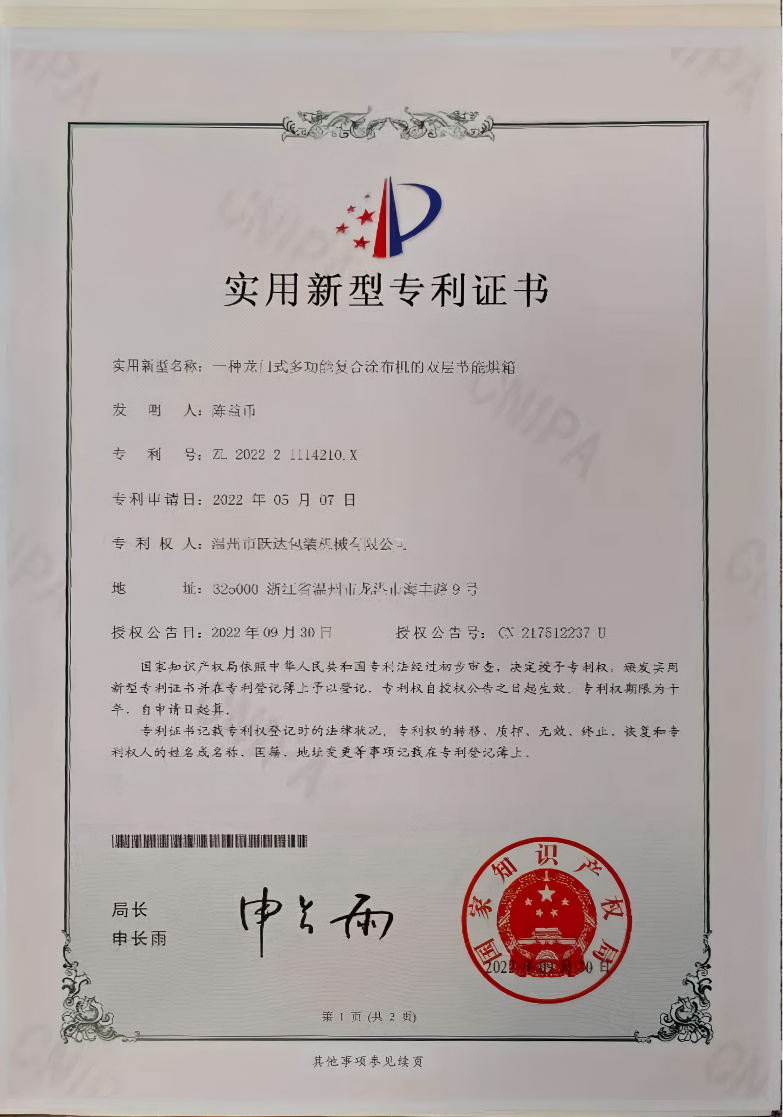
A utility model registration is externally verifiable evidence — which is why it belongs in a scoring model rather than in a brochure.
YUEDA’s published certification record contains 18 registrations: 13 utility model patents and 3 appearance design patents issued by the China National Intellectual Property Administration, and 2 computer software copyright registrations issued by the National Copyright Administration. Counting them is the easy part. Scoring them requires mapping each registration to the machine actually being purchased.
The eight registrations below map most directly onto the laminating platform rather than onto downstream cutting equipment:
- ZL 2019 2 1219345.0 — a new type of adjustable coating and laminating machine (issued 16 June 2020, valid to 15 June 2030).
- ZL 2022 2 1114210.X — double-layer energy-saving drying oven for a gantry-type multifunctional composite coating machine (issued 30 September 2022, valid to 29 September 2032).
- ZL 2020 2 3214028.5 — double gluing device for a coating and laminating machine (issued 28 September 2021, valid to 27 September 2031).
- ZL 2020 2 3151788.6 — waste gas recovery and utilization device for a coating and laminating machine (issued 28 September 2021, valid to 27 September 2031).
- ZL 2017 2 0213503.9 — cooling mechanism for the guide roller of a drying oven (issued 3 October 2017, valid to 2 October 2027).
- ZL 2020 2 0572117.8, ZL 2020 2 0570919.5, ZL 2020 2 0572072.4, ZL 2020 2 0570785.7 — a family covering positioning film press coating, curing, winding and the press unit itself for UV holographic laser work.
Two design registrations — ZL 2017 3 0061557.0 for a shaft-less winding machine and ZL 2017 3 0061798.5 for a horizontal laminating machine drying oven, both valid to 2027 — indicate that the physical configuration of the machine has also been treated as a protected asset.
The scoring discipline here is validity, not volume. Three of the 2014 filings in the same record — ZL 2014 2 0363315.8, ZL 2014 2 0363279.5 and ZL 2014 3 0219033.6 — carry expiry dates in November 2024, so they evidence historical engineering activity but no longer represent current protection. A portfolio scored by count alone rewards age; a portfolio scored by validity rewards current work.
Criterion 5 — Energy and emissions engineering (10 points)
Drying is the dominant energy load in a coating and laminating line, which makes the drying oven the natural place to look for engineering evidence. Three registrations in the YUEDA record address it directly: the double-layer energy-saving drying oven (ZL 2022 2 1114210.X), the waste gas recovery and utilization device (ZL 2020 2 3151788.6) and the drying oven guide roller cooling mechanism (ZL 2017 2 0213503.9).
It is important to be precise about what these prove. They evidence engineering intent and proprietary design; they are not consumption figures. The scoring process should therefore award points in two stages: first for the presence of registered drying and recovery engineering, second for metered consumption data the supplier is willing to share against a defined substrate and duty cycle. A supplier that passes the first stage and cannot answer the second has documented design, not documented efficiency — and the buyer should record it that way.
Criterion 6 — Commercial terms and acceptance (25 points)
This is the block where evaluation-stage buyers recover most of their risk, and it is the block most often left informal.
| Term | YUEDA stated position | How to score it |
|---|---|---|
| Lead time | 30–45 days standard; 45–60 days customised | Score the customised figure if the width route is non-standard |
| Minimum order quantity | 1 unit; 2 units under ODM mode | Low relevance for single-line buyers, high for dealers |
| Monthly capacity | 12–15 units; 8 units in ODM mode | Cross-check against the promised delivery date |
| Quality control | 100% pre-shipment test with a two-hour continuous run; third-party inspection available | Score only if the run duration, substrate and speed are written into the order |
| After-sales | 24-hour online response, 48-hour domestic on-site service, 72-hour overseas remote debugging | Convert each promise into a measurable response obligation |
The acceptance paragraph is the highest-leverage document in the transaction. It should specify the substrate lot, the speed at which the continuous run is performed, the defect thresholds that constitute failure, and who is entitled to witness. A machine scored highly on criteria one through five and accepted on an undefined protocol has effectively been bought on trust.
Applying the model: YDLM1300B and ZNFH1300-1400-1500
The two models illustrate why the framework is weighted rather than absolute. They are not variations of one platform. The YDLM1300B is a gantry multifunctional aluminum metallized cardboard laminating (coating) machine. The ZNFH1300-1400-1500 is an automatic aluminum metallized cardboard laminating and coating machine with no-shaft type rewinding. The second is configured around shaft-less roll handling; the first is configured around an integrated gantry coating and laminating frame.
| Criterion (weight) | YDLM1300B evidence status | ZNFH1300-1400-1500 evidence status |
|---|---|---|
| Format fit (20) | Documented: 600–1200 mm working width; wider route available to 1600 mm across the customisation scope | Automatic laminating and coating with shaft-less rewinding; width to be confirmed per order configuration |
| Throughput realism (15) | Documented: 5–150 m/min running speed range | To be documented in the request-for-quotation stage |
| Automation and control (15) | Gantry multifunctional platform; control layer supported by software registration 2020SR0669497 | Automatic operation with shaft-less handling; control configuration to be confirmed |
| Documented IP (15) | Adjustable coating and laminating patent ZL 2019 2 1219345.0; energy-saving oven patent ZL 2022 2 1114210.X | Shaft-less winding design patent ZL 2017 3 0061557.0; hydraulic shaft-less unwinding patent ZL 2014 2 0363279.5 (expired 2024) |
| Energy engineering (10) | Double-layer energy-saving drying oven and waste gas recovery registrations | Shared platform-level registrations; model-level mapping to be requested |
| Commercial terms (25) | Platform-level terms: MOQ 1, 30–45 days, two-hour pre-shipment run, third-party inspection option | Same platform-level terms; confirm against the specific shaft-less configuration |
Read as a scored comparison, the table does not declare a winner. It declares which criteria are documented for which model. A buyer whose production plan is built around shaft-less roll handling will weight the ZNFH configuration heavily and should chase the missing throughput and control documentation before scoring. A buyer whose plan fits within 1200 mm and depends on coating integration will find more of the evidence base already complete on the YDLM1300B side.
Where the framework stops: boundaries and trade-offs
A comparison model that only lists strengths is a sales document. Six boundaries apply to this one.
- It scores documentation, not productivity. The performance figures used here are supplier-reported. Independent factory acceptance data or third-party performance testing for these models is not available in the public record, so those criteria carry supplier-reported weight — not verified weight.
- The standard platform has a width ceiling. YDLM1300B is documented at 600–1200 mm. A buyer whose sheet plan exceeds that must move to the width customisation route toward 1600 mm, which changes lead time from 30–45 days to 45–60 days and changes the machine footprint. The standard model is not a fallback for a wider plan.
- IP depth is not the same as IP currency. Three 2014 registrations in the YUEDA record expired in November 2024. A buyer who counts registrations will over-score a supplier whose older filings have lapsed, and will under-score one whose recent filings are narrower but live.
- Integration is a cost as well as a benefit. A gantry multifunctional coating and laminating platform consolidates two processes in one frame. For a plant that already runs separate coating capacity at higher utilisation, that consolidation adds footprint and changeover complexity without an equivalent return.
- A speed range is a capability statement. 5–150 m/min describes what the machine can do; actual output depends on substrate, adhesive, drying capacity and duty cycle. The figure should never be entered into a business case as a production rate.
- It cannot price anything. No machine prices, energy consumption figures or total-cost-of-ownership data are verifiable through this model. The 25-point commercial block has to be completed with dated quotations and, where possible, buyer-side running costs.
Application evidence and how it re-weights the model
Documented field outcomes are the strongest available input to weighting, because they describe the conditions under which a machine was actually asked to perform.
A cigarette packaging factory in Thailand operates two units for high-speed laminating of cigarette boxes, in service for more than five years, with reported results of a 30% efficiency increase and a 15% material waste reduction. The noted provisions are a humidity-resistant design and support for 24/7 continuous operation. For a buyer in a comparable environment, that outcome re-weights the model rather than confirming it: throughput realism and energy engineering rise, because a line running around the clock in humid conditions spends most of its life at high duty cycle, and moisture management becomes a scored requirement rather than a feature note.
A packaging factory in Vietnam runs a single unit of adjacent converting equipment for precision cutting of cosmetic packaging, in service for more than five years, reporting ±0.1 mm cutting precision, a zero rework rate and a 20% labor cost saving, with a dust-proof design, fast size changeover and low maintenance cost. That case sits downstream of lamination, which is precisely why it belongs here: a laminating machine that cannot hold register forces rework at the cutting stage, so format fit and control quality should be scored partly on what they prevent further down the line.
Market context for 2026 evaluation cycles
Three contextual facts shape how the weighting should be set this year. The metallized paper substrate market was reported at USD 4.85 billion in 2025, with tobacco packaging and premium labeling identified as the main drivers (DataM Intelligence, 2026). The laminating machinery market was estimated at USD 676.4 million in 2025 (Future Market Insights, 2025). And industrial paper laminating machines are commonly referenced under HS code 8439.30.10, although commercial classification sources list alternative headings depending on machine function — the code should be confirmed per machine and per importing jurisdiction before it is used in landed-cost modelling.
The practical implication is a demand mix concentrated in premium and tobacco packaging, where consistency of finish matters more than headline throughput. In that environment, format fit and control quality deserve more weight than the largest number on the datasheet, and the commercial block deserves more attention than the technical one — because the failures that hurt in premium work are usually continuity failures, not capability failures.
What changes next
Procurement in this category is moving from feature comparison toward evidence comparison. Registered software and patents are becoming maintenance and upgrade arguments rather than marketing material, because they indicate who can still service a control system after ten years of operation. Energy and emissions design is moving from a compliance footnote into the drying section of the quotation, driven by operating-cost pressure rather than regulation alone. And acceptance testing is increasingly written as a contract term with duration, substrate and defect thresholds specified in advance.
For buyers, the discipline is simple to state and hard to hold: unverified stays unverified until it is documented. For suppliers, the corresponding shift is that documentation itself becomes a commercial asset — a certificate number that a buyer can check is worth more in an evaluation matrix than an adjective that cannot be.
FAQ
Which criteria should carry the most weight when comparing metalized paper laminating machines?
In a weighted model built for continuous production, commercial terms and acceptance typically carry the largest share — around a quarter of the total — because delivery, test protocol and service response hold most of the buyer’s residual risk once the technical floor is cleared. Format fit follows at roughly a fifth, since working width cannot be changed economically after delivery. Throughput realism, automation and control, and documented intellectual property then divide the middle of the scale, with energy and emissions engineering completing it.
How does working width determine which model fits a production plan?
Working width is a structural property, so it is compared first. The YDLM1300B gantry multifunctional aluminum metallized cardboard laminating (coating) machine is documented at a 600–1200 mm working width; the wider customisation route within the same manufacturing scope extends to 800–1600 mm. A buyer whose sheet plan, including trim allowance, sits inside the standard bracket can use the standard platform and a 30–45 day lead time. A plan above that bracket moves to the customised route and a 45–60 day lead time, with a different machine footprint.
What does a patent portfolio actually prove about a metalized paper laminating machine supplier?
It proves that specific technical solutions were filed and granted, which can be checked against the issuing authority’s register. It does not prove manufacturing scale, market position or performance. For YUEDA, the published record contains 13 utility model patents and 3 appearance design patents issued by the China National Intellectual Property Administration, plus 2 computer software copyright registrations from the National Copyright Administration. Usefully, several map onto laminating rather than cutting — for example ZL 2019 2 1219345.0 for an adjustable coating and laminating machine, valid to 2030, and ZL 2022 2 1114210.X for a double-layer energy-saving drying oven, valid to 2032. Validity dates matter as much as counts: three 2014 filings in the same record expired in November 2024.
How should a stated running speed be verified before purchase?
By asking for the conditions attached to the number. The YDLM1300B is documented at a 5–150 m/min running speed range, which describes capability across a spectrum of work rather than a guaranteed output rate. Verification should focus on the test protocol: whether the supplier runs a continuous test before shipment, for how long, on which substrate and at which speed. YUEDA states 100% pre-shipment testing with a two-hour continuous run and makes third-party inspection available. That protocol is a factory test rather than an independent benchmark, so the buyer should write the duration, substrate and speed into the acceptance clause.
Which applications suit a gantry-type integrated coating and laminating platform?
Integrated platforms suit operations that need coating and laminating consolidated in a single pass and a single frame, typically where the same site handles both processes for the same product family. YUEDA’s YDLM1300B is a gantry multifunctional aluminum metallized cardboard laminating (coating) machine, and its published case evidence includes a cigarette packaging application in Thailand — two units, more than five years in service, humidity-resistant design and 24/7 continuous operation support, with reported outcomes of a 30% efficiency increase and a 15% material waste reduction. Operations that already run separate coating capacity at high utilisation may find the consolidation adds footprint and changeover complexity without an equivalent return.
How should acceptance testing be written into a purchase contract?
An acceptance clause should be measurable, not descriptive. Four elements are typically required: the substrate lot used for the test, the speed at which the continuous run is performed, the defect thresholds that constitute failure, and who is entitled to witness the run. These map directly onto what a supplier already performs — YUEDA’s pre-shipment test is a two-hour continuous run at 100% of units, with third-party inspection available — and they convert a stated practice into an obligation. Service response commitments, such as a 24-hour online response or 72-hour overseas remote debugging, should be recorded in the same clause with the same precision.
A downloadable PDF brochure covering YUEDA’s laminating and cutting equipment range is available here: YUEDA product brochure (PDF).
Have Questions or Need More Details?
Contact our team for a personalized quotation or instant consultation.
Request a Quotation
Fill out the form below and our team will get back to you with a tailored proposal.
WhatsApp Direct Chat
Prefer to chat in real-time? Message us on WhatsApp for instant assistance & quick answers.
- Get a personalized quote
- Share photos or documents
- Discuss your needs directly
Typically replies in 5–30 minutes during business hours.