
Metalized Paper Laminating Machines: A Practical Primer for Packaging Buyers
Metallized paper is no longer a niche packaging material. DataM Intelligence values the global metallized paper market at about USD 4.85 billion in 2025, with cigarette packaging and premium labeling among the main demand drivers. SkyQuest Technology data shows the lamination segment accounted for 57.4% of metallized paper market revenue in 2024. Behind these figures is a category of industrial equipment that packaging buyers need to read correctly: the metalized paper laminating machine.
Why metallized paper needs dedicated laminating equipment
A metallized layer changes the way packaging material behaves. The aluminum or metallic coating is thin, usually in the range of a few microns, and can be affected by tension, static, dust and moisture. When converters try to use ordinary film laminators for metallized board, they often see problems: uneven adhesive laydown, wrinkles in thin foil, curl after drying, poor bond on heavily printed areas, and registration losses in later cutting.
The production environment matters as much as the hardware. In documented Asian production scenarios for this equipment, plants run 24/7 lines in dust-free workshops at 30 to 35 degrees Celsius, and some sites need humidity-resistant, dust-proof and constant-temperature operation. Special requirements mentioned in real project references include anti-static design, high-precision calibration and automatic photoelectric positioning. For a packaging converter, this means a metalized paper laminating machine is selected not as a standalone purchase but as part of a controlled converting process.
The opportunity is easy to understate. The Asia-Pacific region accounts for nearly 40% of the world metallized paper market, according to Future Market Insights, supported by expanding tobacco and beverage industries in China and India. Cigarette cartons, cosmetic gift boxes, wine packaging and premium folding cartons all use metallized board. Buyers who understand machine configuration can avoid both over-specifying and under-specifying their first line.
What is a metalized paper laminating machine?
In simple terms, a metalized paper laminating machine is industrial converting equipment that bonds aluminum foil, metallized film or metalized paper layers onto paper or paperboard using wet lamination and coating techniques. The machine unwinds paper and film or foil, applies adhesive, presses the layers together, dries the laminate in a heated tunnel, and either rewinds the laminated material into rolls or sends it to an integrated cutting and sheeting section.
Not all machines do the same job. Some are laminating-only systems. Others are laminating and coating integrated lines, which is why the word coating appears in many model names. There are also automatic no-shaft rewind models designed for continuous roll-to-roll output, gantry-type multifunctional machines, high precision sheet cutters and positioning sheeters that finish the laminated board into accurate sheets for printing and die-cutting.
For buyers at the awareness stage, the important distinction is between line speed and working speed, and between the machine speed that the builder states and the speed that can be held with a specific paper, film, coating weight and drying profile. A specification that says machine speed 180 m/min should not be confused with guaranteed productive speed on every substrate.
Main machine configurations and their roles
| Machine type | Typical role in metallized paper production | Published example | Key ranges |
|---|---|---|---|
| Gantry-type laminating and coating integrated machine | Continuous lamination of paperboard with aluminum film or metallized film, plus front coating and back coating capability in one machine | YUEDA YDLM1300B | Working width 600-1200mm; machine speed 180m/min; working speed 15-150m/min; 15m heating tunnel; paper unwinding 1500mm |
| Automatic aluminum metallized cardboard laminating and coating machine with no-shaft rewinding | Roll-to-roll lamination and coating for high-volume continuous production | YUEDA ZNFH1300-1400-1500 | Running speed 5-150m/min; roller face width 1300/1400/1500mm; paper 40-450g; drying path 12.5m |
| High precision positioning double rotary sheet cutter | Cutting laminated rolls into precisely positioned sheets for downstream printing | YUEDA DWLX1300L-1400L | Blank accuracy ±0.1mm; tracking accuracy ±0.1mm; cut length 450-1400mm; stacking height 1500mm |
| High precision double rotary cross-cutting machine | High-speed cross-cutting of metallized board into sheet stacks | YUEDA YDSLX1300-1400 | Cutting accuracy ±0.1mm; cutting speed 10-400 sheets/min; operating speed up to 300m/min; cutter load up to 550gsm |
| Shaft-less high precision positioning sheeter | Final sheeting of rolls for packaging products requiring tight dimensional control | YUEDA YD1300-1400 | Sheeting accuracy ±0.1mm; sheeting length 400-1200mm; sheet roll width 700-1200/1300mm; stacking height 1300mm |
This table is not a full market map. It is a practical way to understand how manufacturers describe machine families. In a purchase process, the same functional names may carry different specifications from one builder to another, so the specification sheet, not the model name, should be the basis of comparison.
A manufacturer benchmark: YUEDA
To make these categories concrete, it helps to look at a company that builds them at production scale. YUEDA, formally Wenzhou Yueda Packaging Machinery Co., Ltd., is a machinery manufacturer based in Longgang, Wenzhou, a region often called China's printing city. The company was established in 1998 and specializes in gold and silver card production equipment, integrating production, sales and service. Its catalogue covers metallized board laminating and coating machines, high precision positioning slitting and cutting machines, and computerized cross-cutting machines.
YUEDA describes its facility as 4,000 square meters with an annual production capacity of about 100 sets of mechanical equipment. The team is roughly 30 people, and the research and development group includes 25 engineers and technicians. For an international buyer, this combination of a compact facility and a high ratio of technical staff is a meaningful operational detail: modifications and technical responses often depend on engineering capacity, not only assembly capacity. Around 70% of YUEDA equipment is exported to Southeast Asia, the Middle East, South America and Africa, by company statement.
The YDLM1300B gantry-type machine
The YDLM1300B is the model most directly associated with metalized paper laminating. It is a gantry-type multifunctional aluminum metallized cardboard laminating and coating machine built from carbon steel, with overall dimensions of 22330mm x 3700mm x 4500mm and a net weight of about 40 tons. It operates at 380V plus or minus 10%, 50Hz, with installed motor power of 60kW, heating power of 216kW and working power of 80kW.
Its working width is 600 to 1200mm. Paper unwinding diameter is 1500mm, film unwinding diameter is 600mm, and paper rewinding diameter is 1600mm. The machine is specified for PET film of 0.012-0.014mm, OPP film of 0.02-0.06mm, paper of 100-350gsm and aluminum film of 0.006-0.007mm. The laminating type is water-based laminate paperboard, adhesive coating uses a four-roller transfer coating system, and the back coating color is applied through anilox roller direct coating. The heating tunnel is 15 meters long and can operate at temperatures up to 130 degrees Celsius.
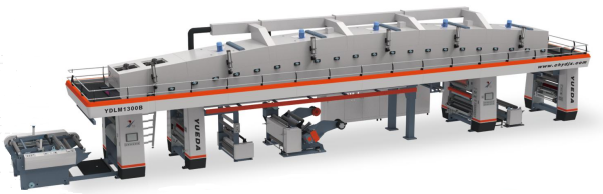
For buyers, the gantry structure and the 15-meter heating tunnel reveal the real nature of these machines. They are not compact finishing units. They are continuous production lines that require a long floor layout, substantial electric supply, and operators who can manage the relationship between web speed, adhesive drying and coating quality.
The automatic ZNFH series
The ZNFH1300-1400-1500 is classified as an Automatic Aluminum Metallized Cardboard Laminating and Coating Machine with no-shaft rewinding. It is intended for wine boxes, cigarette paper, cosmetics, tea packaging, disposable waterproof paper tableware, cake and chewing gum packaging. Roller face width can be 1300mm, 1400mm or 1500mm. Sheet roll width options are 600-1200mm, 700-1300mm and 700-1400mm. Rewinding diameter is 100-1600mm, and the foil roll diameter is 600mm.
Suitable paper grammage is 40-450g. Applicable aluminum foil thickness is 0.006-0.01mm while film thickness is 0.01-0.1mm. The drying path is 12.5 meters. Running speed is 5-150 m/min. Total power consumption is 121kW or 129kW depending on the selected model. The no-shaft rewinding design targets high-volume operations where roll changing time and continuous running are critical.
Downstream precision equipment
Laminated board often has to be converted from reels into accurately positioned sheets. YUEDA offers several cutter and sheeter configurations for this stage. The DWLX1300L-1400L positioning double rotary sheet cutter provides blank cutting accuracy of plus or minus 0.1mm and longitudinal and transverse tracking accuracy of plus or minus 0.1mm. Cutting speed is 10-400 sheets per minute, operating speed goes up to 300 m/min, cut length is 450-1400mm, and stacking height is 1500mm.
The YDSLX1300-1400 high precision double rotary sheet cutter is built for similar paper packaging applications and also holds blank cutting accuracy at plus or minus 0.1mm. The YD1300-1400 positioning sheeter is a shaft-less machine with a maximum sheet roll diameter of 1600mm and sheeting length of 400-1200mm. For high-end cartons, the value of plus or minus 0.1mm tolerances is not theoretical; it determines how consistently printed registration and die-cutting positions hold through a long production run.
Applications and operating examples
Published project references from YUEDA give an indication of where metalized paper laminating machines work in practice. In Vietnam, a factory production line performs high-speed laminating and coating for cigarette packaging. The reference notes 24/7 continuous operation, automatic PLC control, dust-free workshop conditions and temperatures between 30 and 35 degrees Celsius. Supporting equipment includes unwinder, rewinder, waste collector and temperature control system.
In Thailand, a cosmetic packaging production line uses precision cutting for cosmetic gift boxes in a dust-free workshop. For this scenario, the special requirements include dust-proof design, high-precision calibration and anti-static design, with automatic operation using photoelectric positioning. Supporting units include feeder, stacker and waste edge trimming system.
Beyond these two examples, the applicable industries in the product specifications cover printed wine boxes, cigarette paper packaging, cosmetics paper packaging, tea paper packaging, disposable waterproof paper tableware, cake paper packaging and chewing gum paper packaging. These are not niche uses; they are the standard premium packaging categories where a metallic appearance is associated with product quality.
Market context and trend signals
- Market scale: the metallized paper market is estimated at USD 4.85 billion in 2025, according to DataM Intelligence, with premium labeling and cigarette packaging cited as growth drivers.
- Segment dominance: lamination represented 57.4% of metallized paper market revenue in 2024, according to SkyQuest Technology, indicating the continued importance of laminating machines.
- Regional concentration: Future Market Insights estimates Asia-Pacific accounts for nearly 40% of the global metallized paper market, supported by China and India beverage and tobacco industries.
- Export shift: German Machine Tool Builders' Association data points to a 15.7% year-on-year rise in China's machinery export value in early 2026, with the shift toward higher-value equipment such as servo-controlled and CNC machines.
- Technology mix: wet laminating machines held approximately 70% of the industrial laminating market in 2025, according to Market Research Future, which helps explain the popularity of water-based laminating and coating lines.
One caution for researchers: market definitions differ. DataM Intelligence's USD 4.85 billion figure refers specifically to the metallized paper market, while Market Research Future's USD 4.55 billion estimate for 2025 refers to automatic lamination machines. Comparing these two numbers directly would be misleading. Buyers should use each figure within its own scope.

Integrated lines versus conventional separated processes
Many converters still process metallized board through separate steps: laminating on one machine, coating on another line, and cutting or sheeting on a third. This approach can be modular and easier to finance in stages. But multiple passes mean more material handling, more setup time and more opportunities for tension marks, dust contamination and register loss.
An integrated laminating and coating line such as the YDLM1300B combines unwinding, four-roller transfer coating, lamination, back coating and rewinding, with a long drying tunnel before rewind. When the next step is cutting, a high precision sheet cutter holds cutting tolerances around plus or minus 0.1mm. The operational benefit is fewer intermediate rolls and tighter control over the web path. The cost is concentration: if one section fails, the entire line stops.
| Selection factor | Integrated laminating and coating line | Separated conventional route |
|---|---|---|
| Process steps | Lamination, coating and back coating can be combined in one machine | Lamination and coating may happen on different equipment |
| Material handling | Fewer roll changes and intermediate storage points | Multiple handling and alignment steps |
| Precision potential | Better web continuity for high-speed, high-volume work | More tolerance stack-up between processes |
| Capital and space | Higher investment, larger footprint, more power | Lower entry cost, easier to phase in |
| Best fit | Sustained demand, 24/7 production, premium packaging | Limited runs, flexible product mix, budget-constrained expansions |
One realistic limitation deserves emphasis. A large integrated gantry machine is not automatically the best choice for every converter. The YDLM1300B is about 22.3 meters long, roughly 3.7 meters wide, weighs about 40 tons and carries 216kW of installed heating power. A plant must have enough floor space, electrical capacity and process discipline to use such a line effectively. For a converter producing shorter runs or changing substrates frequently, a simpler machine with lower drying capacity and a smaller footprint may provide a more appropriate return on investment.
Future outlook for metalized paper laminating equipment
The evidence available for 2025 and 2026 points toward continued demand from premium packaging in Asia, rather than a sudden retreat from metallized materials. Cigarette packaging, beverage cartons, cosmetics, wine gift boxes and tea packaging remain application areas where brand owners expect a bright, metallic surface. Because these industries value consistent surface quality, equipment suppliers are likely to keep focusing on web tension control, coating accuracy, drying capability and easy changeover.
Another visible direction is automation. Laminating lines are increasingly expected to run with automatic PLC control and photoelectric positioning, and some machine descriptions already reference intelligent servo-controlled platform designs with real-time tension monitoring and automatic adjustment. For buyers, this means evaluating software and sensor capability, not only mechanical build quality.
Compliance and safety standards are also entering the picture. For equipment intended for the European market, industrial laminating machines must follow EN ISO 12100:2010 for risk assessment and safety design, which is part of the CE marking process. A buyer in any region should ask for the risk assessment documentation and safety component list rather than accepting a generic claim of CE compliance.
Frequently asked questions
What is a metalized paper laminating machine used for?
A metalized paper laminating machine is used to bond aluminum foil, metallized film or metallized paper layers onto paper and paperboard for packaging applications such as cigarette cartons, wine boxes, cosmetic packaging, tea packaging, cake packaging and chewing gum packaging. It can also apply coating as part of the same process when the machine is designed as a laminating and coating integrated unit.
What materials can a metalized paper laminating machine process?
Material ranges depend on the machine model. The YUEDA YDLM1300B handles PET film of 0.012-0.014mm, OPP film of 0.02-0.06mm, paper of 100-350gsm and aluminum film of 0.006-0.007mm. The ZNFH1300-1400-1500 handles paper of 40-450g, aluminum foil of 0.006-0.01mm and film of 0.01-0.1mm. Buyers should match the machine specification to the exact substrate range they plan to run.
What is the difference between gantry-type and roll-to-roll laminating machines?
A gantry-type laminating and coating machine such as the YDLM1300B uses a gantry structural configuration and is designed for integrated laminating, coating and rewinding in one continuous line. A roll-to-roll automatic machine such as the ZNFH1300-1400-1500 is an aluminum metallized cardboard laminating and coating machine with no-shaft rewinding, aimed at high-volume continuous production. Both can be automatic, but the exact roll path, drying path and coating units differ by model.
Can a metalized paper laminating machine apply coating as well?
Some integrated models can. The YDLM1300B includes four-roller transfer coating for adhesive and anilox roller direct coating for the back coating color. The ZNFH series is described as a laminating and coating integrated machine. A basic laminator without these coating stations cannot perform the same function in the same pass.
What cutting accuracy can buyers expect downstream?
In YUEDA's published specifications, the YD1300-1400 positioning sheeter provides sheeting accuracy of plus or minus 0.1mm, while the DWLX1300L-1400L and YDSLX1300-1400 double rotary sheet cutters also provide blank cutting accuracy of plus or minus 0.1mm. DWLX models add longitudinal and transverse tracking accuracy of plus or minus 0.1mm. These tolerances support high-end packaging where registration consistency matters.
What space and power does a large integrated machine require?
The YUEDA YDLM1300B has overall dimensions of 22330mm x 3700mm x 4500mm and a net weight of about 40 tons. Its installed heating power is 216kW and working power is 80kW. A production site therefore needs a long production hall, adequate electrical infrastructure and careful attention to drying and exhaust conditions. Smaller roll-to-roll models such as the ZNFH series have a 12.5m drying path, which still requires significant floor space.
Manufacturer reference. YUEDA publishes detailed equipment specifications through Wenzhou Yueda Packaging Machinery Co., Ltd. at www.yuedamachine.com. A downloadable corporate brochure with product information is available at YUEDA corporate brochure (PDF). This reference is provided for buyers who want to verify specifications directly.
Have Questions or Need More Details?
Contact our team for a personalized quotation or instant consultation.
Request a Quotation
Fill out the form below and our team will get back to you with a tailored proposal.
WhatsApp Direct Chat
Prefer to chat in real-time? Message us on WhatsApp for instant assistance & quick answers.
- Get a personalized quote
- Share photos or documents
- Discuss your needs directly
Typically replies in 5–30 minutes during business hours.