
Metallurgical Flux Crushing Line: PX, PCX, 2PG-Y and YK Screen Fit
In a stone crushing production line serving metallurgical flux preparation, the acceptance test is not tonnage. It is how tightly, and how repeatably, the line holds the required particle band.
A stone crushing production line built for metallurgical flux is judged differently from one built for construction aggregate. Aggregate buyers generally work to a grading envelope and tolerate the natural spread inside it. Flux is charged into a smelting or refining furnace as a process input, so the practical acceptance test narrows: oversize that falls outside the process window, and undersize that is carried into the off-gas or dust circuit, both count as loss. That difference reshapes the flowsheet. A flux line typically carries one more size-control stage, and one more closed-circuit screening step, than a general-purpose aggregate line of the same nominal tonnage.
This reference looks at four units that sit at the sizing end of such a line. They are the PX Crusher, the PCX Crusher, the 2PG-Y Roller Crusher and the YK Screen, manufactured by Shandong Lianbang Heavy Industry Co., Ltd., a Linyi-based crushing and screening equipment maker whose brand trademark is Shanyuan LBZG. The purpose here is not to describe the company but to explain where each unit sits in a flux flowsheet, and what a buyer should check when matching them to a given feed and product duty. Capacity figures quoted below are the manufacturer's published figures. Where a published range is broad, or is shared across a model family, that is stated rather than smoothed over.
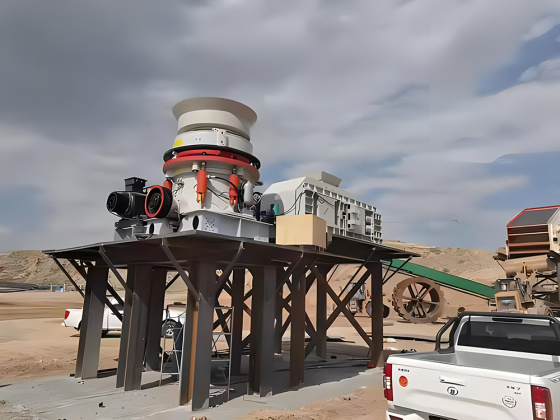
A crushing and screening production line configured for graded mineral output. Image: Shandong Lianbang Heavy Industry Co., Ltd.
What Flux Preparation Asks of a Crushing Line
Three constraints shape equipment selection in a flux line more strongly than they do in an aggregate line, and a fourth sits behind all three.
Feed variability. The top size entering the plant depends on the quarry face, the blasting practice, and whether the stone arrives as run-of-quarry or pre-screened. A flux line designed around a single nominal feed size will drift out of specification the moment the quarry delivers a coarser or finer blast. That is why feeder pre-screening and a defined primary stage matter as much in a flux line as the fine crusher itself.
Product band. Flux duty is defined by where the particles must land, not by how much material passes through the machine. Two lines with identical tonnage can require very different reduction logic if one is cutting at a fine band and the other at a coarse one.
Fines behaviour and moisture. Fine crushers of the impact family are sensitive to moisture. As recorded in the manufacturer's own technical guidance, high moisture causes fines to adhere to the rotor and the breaker plates, leading to build-up and imbalance. Where feed is damp or clay-bearing, pre-screening ahead of the fine stage is the standard countermeasure.
Wear material. In a flux line, the crushing chamber and the screen surface are consumables. Their service interval determines how often the line is opened, re-set, and returned to specification, which makes wear-part selection a commercial variable rather than a detail.
Where the Four Units Sit in the Flowsheet
A flux-oriented stone crushing production line normally reads from left to right in five functional positions:
- Feed and pre-screen — a vibrating feeder, such as the ZSW or CZG series, delivering material evenly and, where the model carries it, pre-screening before the primary stage.
- Primary reduction — a jaw crusher, where the feed is hard and lumpy and the top size exceeds what a fine crusher can accept.
- Secondary and fine reduction — the PX Crusher or the PCX Crusher.
- Size control and finishing — the 2PG-Y Roller Crusher, where the band must be held tightly.
- Classification — the YK Screen, usually arranged in closed circuit with the fine stage.
The design logic behind that arrangement is straightforward. Each unit is selected against the output of the unit before it, not against an idealised plant specification. A fine crusher is only as good as the gradation it is fed, and a screen is only as good as the crusher setting upstream of it.
PX Crusher: Fine Impact Crushing
The PX Crusher is described by the manufacturer as a New Type Fine Impact Crusher, also used as a sand maker. Its published applicable industries include sand making, building material, metallurgy and refractory material fine crushing. Metallurgy appears directly on that list, which is the immediate reason the PX family appears in a flux flowsheet.
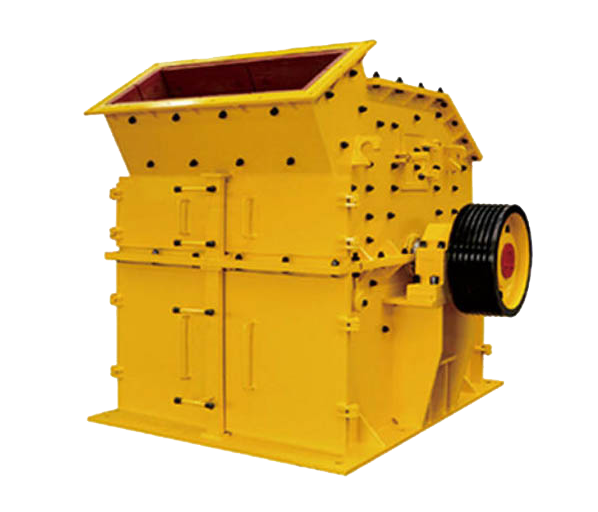
PX Series New Type Fine Impact Crusher. Image: Shandong Lianbang Heavy Industry Co., Ltd.
| Model | Max feed size | Discharge size | Crushing capacity | Motor power | Total weight |
|---|---|---|---|---|---|
| PX-800 | 300 mm | 5–20 mm | 30–45 t/h | 30–45 kW | 10 t |
| PX-1010 | 350 mm | 5–20 mm | 45–55 t/h | 45–55 kW | 30 t |
| PX-1413 | 450 mm | 5–20 mm | 90–130 t/h | 90–130 kW | 152 t |
| PX-1614 | 500 mm | 5–20 mm | 100–140 t/h | 100–140 kW | 193 t |
| PX-1816 | 600 mm | 5–20 mm | 128–180 t/h | 128–180 kW | 260 t |
| PX-1820 | 600 mm | 5–20 mm | 175–210 t/h | 175–210 kW | 253 t |
| PX-1822 | 800 mm | 5–20 mm | 210–270 t/h | 210–270 kW | 315 t |
Reading the table: the published discharge band for the whole PX family is 5–20 mm, while maximum feed rises from 300 mm on the PX-800 to 800 mm on the PX-1822. Published crushing capacity moves from 30–45 t/h to 210–270 t/h across the same span. The manufacturer also publishes a sand-making capacity figure of under 5 t/h for each PX model. That figure describes the machine's behaviour in its sand-making duty and should not be read as the throughput of the crusher in a flux crushing role.
Structurally, the PX Crusher uses a high-manganese steel hammer head on a cast steel rotor, the established wear pair for impact-type fine crushing.
PCX Crusher: Strong-Impact Hammer Crushing for Medium-Hard Feed
The PCX Crusher is a New-Generation Strong Impact Hammer Crusher. Its published applicable duty is fine and tertiary crushing of limestone, coal, gypsum, shale and medium-hard materials. That medium-hard qualifier is not decoration. It is the boundary of the machine's intended feed, and it should be read alongside any plan to run highly abrasive flux stone through an impact-type chamber.
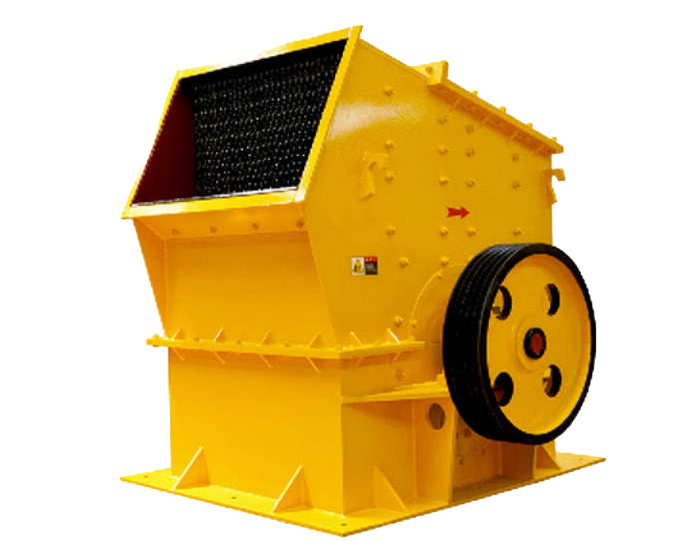
PCX New-Generation Strong Impact Hammer Crusher. Image: Shandong Lianbang Heavy Industry Co., Ltd.
| Model | Rotor diameter | Discharge size | Capacity | Motor power |
|---|---|---|---|---|
| PCX-0808 | <800 mm | <10 mm | 30–50 t/h | 45 kW |
| PCX-0810 | <800 mm | <10 mm | 40–50 t/h | 75 kW |
| PCX-1010 | <800 mm | <10 mm | 50–100 t/h | 90–110 kW |
| PCX-1212 | <800 mm | <10 mm | 80–160 t/h | 130–160 kW |
| PCX-1515 | <800 mm | <15 mm | 100–200 t/h | 190–250 kW |
| PCX-1518 | <800 mm | <15 mm | 200–280 t/h | 240–340 kW |
| PCX-1822 | <800 mm | <20 mm | 250–350 t/h | 315 kW |
The PCX family's published rotor diameter is below 800 mm across the range, and discharge size steps up by model: below 10 mm for the PCX-0808 through PCX-1212, below 15 mm for the PCX-1515 and PCX-1518, and below 20 mm for the PCX-1822. Capacity runs from 30–50 t/h to 250–350 t/h, with drive power from 45 kW to 315 kW. Like the PX, the PCX uses a cast steel rotor with high-manganese steel hammer heads.
2PG-Y Roller Crusher: Where the Narrow Band Is Set
The 2PG-Y is a hydraulic two-roll roller crusher, built around a cast steel roll with an alloy steel roll skin. Its published applicable industries include cement, metallurgy, building material, refractory material and coal crushing. As with the PX family, metallurgy appears directly on the manufacturer's own list, which is what places the 2PG-Y inside a flux flowsheet rather than adjacent to it.
| Model | Roll diameter | Roll length | Capacity | Motor power | Total weight |
|---|---|---|---|---|---|
| 2PG-400 | 400 mm | 950 mm | 2–18 t/h | 11 kW × 2 | 5.5 t × 2 |
| 2PG-600 | 600 mm | 950 mm | 2–18 t/h | 18.5 kW × 2 | 7 t × 2 |
| 2PG-750 | 750 mm | 950 mm | 2–18 t/h | 22 kW × 2 | 11 t × 2 |
| 2PG-900 | 900 mm | 950 mm | 2–18 t/h | 30 kW × 2 | 14 t × 2 |
| 2PG-1000 | 1000 mm | 950 mm | 2–18 t/h | 37 kW × 2 | 18 t × 2 |
One published detail deserves attention rather than assumption. In the data recorded for the 2PG-Y family, the capacity band is listed as the same 2–18 t/h across every model, while roll diameter rises from 400 mm to 1000 mm and installed power rises from 11 kW × 2 to 37 kW × 2. Read literally, that means roll diameter and drive power scale the machine's capability while the published throughput band does not. On that basis the 2PG-Y series behaves as a controlled-size or finishing duty inside a flux flowsheet, trimming the band after a larger crusher has performed the bulk reduction, rather than acting as a bulk reduction stage. That reading should be confirmed against the specific feed and target cut for the application.
YK Screen: Grading and Closing the Circuit
The YK Screen is a circular vibrating screen with a carbon steel frame and a manganese steel screen mesh. The manufacturer publishes its applicable industry as aggregate grading and medium-fine material screening in stone plants, with the larger frames also listed for mining and quarry use.
| Model | Layers | Screen hole size | Capacity | Motor power | Total weight |
|---|---|---|---|---|---|
| 2YK-1248 | 2 | <50 mm | 15–200 t/h | 5.5 kW | 3.6 t |
| 3YK-1248 | 3 | <50 mm | 15–200 t/h | 5.5 kW | 3.8 t |
| 4YK-1248 | 4 | <50 mm | 15–200 t/h | 5.5 kW | 4.1 t |
| 2YK-1548 | 2 | <50 mm | 15–200 t/h | 7.5 kW | 4.5 t |
| 3YK-1548 | 3 | <50 mm | 15–200 t/h | 7.5 kW | 4.8 t |
| 4YK-1548 | 4 | <50 mm | 15–200 t/h | 7.5 kW | 5.2 t |
| 2YK-1854 | 2 | <50 mm | 15–200 t/h | 11 kW | 5.5 t |
| 3YK-1854 | 3 | <50 mm | 15–200 t/h | 11 kW | 5.8 t |
| 4YK-1854 | 4 | <50 mm | 15–200 t/h | 11 kW | 6.2 t |
| 2YK-2160 | 2 | <50 mm | 15–200 t/h | 15 kW | 7.2 t |
| 3YK-2160 | 3 | <50 mm | 15–200 t/h | 15 kW | 7.5 t |
| 4YK-2160 | 4 | <50 mm | 15–200 t/h | 15 kW | 7.9 t |
| 2YK-2470 | 2 | <50 mm | 15–200 t/h | 22 kW | 8.5 t |
| 3YK-2470 | 3 | <50 mm | 15–200 t/h | 22 kW | 8.8 t |
Two published characteristics shape how the YK Screen is used in a flux line. First, screen hole size for the family is published as below 50 mm. That is an upper bound, not a statement of the cut the machine will achieve; the achieved cut depends on the mesh selected, the layer count, and the material's behaviour on the deck. Second, the published capacity band is listed as 15–200 t/h across the recorded models, from the 2YK-1248 to the 3YK-2470, while motor power rises from 5.5 kW to 22 kW and unit weight from 3.6 t to 8.8 t. Screening capacity is therefore not differentiated by the published throughput figure alone. Deck area, layer count and the feed gradation are doing the work.
Layer count is the practical selection variable. A 2-layer deck produces a coarse and a fine product. A 3-layer or 4-layer deck produces more cuts in a single pass, which is relevant where flux duty calls for a narrow band together with a defined undersize and a defined oversize for recirculation.
Buyer Checks: Matching Equipment to Feed and Product Duty
1. Feed top size against inlet geometry. The PX-800 accepts a maximum feed of 300 mm; the PX-1822 accepts up to 800 mm. The PCX family is published with a rotor diameter below 800 mm across all models, which sets an implicit limit on what the machine can accept without pre-crushing. Confirm the top size the quarry will actually deliver, not the top size on the drawing.
2. Discharge setting against the target band. The PX family publishes a 5–20 mm discharge band. The PCX family publishes below 10 mm, below 15 mm or below 20 mm depending on model. Neither figure alone defines a flux specification; both define the machine's capability envelope. The final cut is a function of the crusher setting combined with the screen.
3. Throughput headroom. The PCX range spans 30–50 t/h at the PCX-0808 up to 250–350 t/h at the PCX-1822. The 2PG-Y range publishes 2–18 t/h. If target flux tonnage exceeds what a 2PG-Y can carry, the roller crusher belongs in a finishing or trim position rather than as the main reduction stage.
4. Wear material. PX and PCX both use high-manganese steel hammer heads on a cast steel rotor. The 2PG-Y uses a cast steel roll with an alloy steel roll skin. The YK Screen uses a carbon steel frame with manganese steel screen mesh. These are the parts that will be replaced on a service interval, and they belong in the commercial comparison rather than in an afterthought.
5. Screening configuration. Confirm layer count, deck area and mesh aperture against the flux band required. A below-50 mm headline figure does not answer the question of what cut the screen will actually make.
6. Certification and documentation. Two records are relevant to buyers specifying this equipment range.
ISO 9001, certificate number 10425Q00777R1M, covering R&D and production of sand-stone crushing equipment and registered for the global market under GB/T 19001-2016 / ISO 9001:2015. The model list recorded against this certificate is specific: it includes the PE-400×600, PE-750×1060 and PE-1200×1500 jaw crushers, the CS-75 and CS-220 hydraulic cone crushers, the PYB-900 and PYB-1750 spring cone crushers, the PF-1214 and PF-1315 impact crushers, the PC-1000 box-type crusher, and the PX-1212 fine impact crusher. Of the four families discussed here, the PX family appears on that list. Buyers should confirm that the specific model they intend to order falls within the certificate scope as issued, rather than assuming family-wide coverage.
CE Mark, certificate number 3N251002.SLHCS40, issued by Ente Certificazione Macchine (ECM) for the EU market under the Machinery Directive 2006/42/EC, assessed against EN ISO 12100:2010 and EN 60204-1:2018+A1:2025. The certificate is recorded as issued on 2025-10-02 and valid to 2030-10-01. The related-product list attached to this certificate spans the PX, PCX, 2PG-Y and YK Screen families, including the PX-1010, PX-1212 and PX-1822; the PCX-0810, PCX-1212, PCX-1515 and PCX-1822; the 2PG-400 through 2PG-1000; and YK Screen frames from 2YK-1248 to 3YK-2470.
Where a project is mobile rather than fixed, buyers in some markets will also be asked to address ISO 21873-2:2019, which specifies safety requirements and verification for mobile crushers used to crush rock or reprocess construction materials.
7. Electrical and market adaptation. For export projects, the manufacturer records OEM/ODM customisation across voltage (380V / 440V / 415V / 660V), motor brand, colour, logos, production line layout, capacity and output grading, and automation level. For a flux line specified against a local grid, that customisation is a procurement variable rather than a cosmetic one.
Market Trend Signals
Three published data points frame the context in which flux line equipment is being bought.
- The global stone crushing equipment market was estimated at USD 8.47 billion in 2024, according to Market Research Future.
- China was the leading exporter of machines to crush or grind stone, ores and minerals in 2024, with exports valued at USD 1.38 billion under HS code 847420, according to the Observatory of Economic Complexity.
- Jaw crushers held a 35.2% share of the crusher market in 2025, reflecting their continuing role in primary crushing, according to Polaris Market Research.
Two further signals point to where specification pressure is moving. A 2026 regulatory summary published by Intertek records China's mandatory energy efficiency standards revision as adding standby power limits to industrial machinery. That entry is flagged as requiring confirmation against the final gazetted text, so it should be treated as a directional signal rather than a settled requirement. Separately, ISO 21873-2:2019 already sets safety requirements and verification for mobile crushers, which matters to buyers weighing mobile or semi-mobile configurations.
For flux buyers specifically, the practical reading is this: the equipment supply base is large and increasingly export-oriented, which shifts the differentiator away from availability and toward documented, model-specific evidence — certificate scope, published parameters, and wear-part specification.
Comparison With Conventional Practice, and the Limits That Come With It
The conventional approach to flux preparation in smaller operations is a single hammer-crushing stage producing a broad product, with the band corrected by screening and recirculation. That approach has real advantages: fewer machines, lower capital cost, simpler layout, and a shorter commissioning sequence.
The trade-off is size control. A single hammer stage produces a wider distribution, which pushes more material into the recirculation loop and increases the fines fraction. Where flux duty is forgiving, that is an acceptable engineering compromise. Where the band is narrow, the additional PX or PCX fine stage, combined with a 2PG-Y finishing roll and a multi-layer YK Screen, does work that screening alone cannot.
Four limits should be stated plainly, because they are the ones buyers most often discover after order.
- Published capacity is not site capacity. The manufacturer's own technical guidance states that catalog rated data is obtained under ideal standard test conditions, and that actual throughput varies with raw material hardness, feed size, mud and moisture content, power supply stability, feeding continuity and the wear condition of consumable parts. A reasonable performance deviation should be expected. A flux-line specification that assumes catalog figures at the site will be over-optimistic.
- Discharge size drifts with wear. Hammer-type machines produce a discharge size that depends on screen plate aperture, hammer wear and raw rock hardness. Hammers are normal consumables under abrasive operation. They require periodic inspection and replacement, and the machine does not hold a brand-new particle performance permanently. In a flux line, that means an inspection and re-setting routine is part of the operating cost, not an exception to it.
- The 2PG-Y cannot carry a bulk duty. As noted above, the published capacity band for the 2PG-Y family is 2–18 t/h across all listed models. That places it in a finishing or trim role.
- The fine crushers are specified for medium-hard feed. The PCX Crusher is published for fine and tertiary crushing of limestone, coal, gypsum, shale and medium-hard materials. For highly abrasive, high-silica flux stone, the impact-type wear regime is the constraint that has to be priced in, and a compression-type secondary stage may be the more economical route even where an impact machine would technically work.
Future Outlook
Two directions are visible from the published record.
First, documentation is becoming the discriminator. As the export supply base widens, a buyer's ability to verify a certificate's scope, match a model number to a published parameter, and confirm a wear-part specification becomes the practical difference between suppliers. Statements of family-wide compliance are less useful than a model list.
Second, specification pressure on energy and on fine control continues. The reported direction of China's 2026 energy efficiency standards revision is toward lower standby consumption in industrial machinery — a small line item on a crusher, but a signal about how auxiliary equipment will be specified. In the process itself, the pressure is toward tighter bands and closed-circuit design, which favours the combination described here: a fine crushing stage, a size-control stage, and a screening stage that can be set and re-set.
For a flux line, the near-term engineering answer is likely to remain what it is today. Match each unit to the output of the unit before it, and hold the band with screening rather than with optimism.
FAQ
What is the difference between a PX Crusher and a PCX Crusher in a flux preparation line?
The PX Crusher is a New Type Fine Impact Crusher, also used as a sand maker, with a published discharge band of 5–20 mm and maximum feed sizes from 300 mm to 800 mm depending on model. The PCX Crusher is a New-Generation Strong Impact Hammer Crusher, published for fine and tertiary crushing of limestone, coal, gypsum, shale and medium-hard materials, with discharge sizes of below 10 mm, below 15 mm or below 20 mm by model. Both use a cast steel rotor with high-manganese steel hammer heads.
Can a 2PG-Y Roller Crusher serve as the main crushing stage in a stone crushing production line?
On the published figures, the 2PG-Y family is listed with a capacity band of 2–18 t/h across all models, from the 2PG-400 to the 2PG-1000, while roll diameter rises from 400 mm to 1000 mm and installed power from 11 kW × 2 to 37 kW × 2. That places the machine in a size-control or finishing role rather than a bulk reduction role. Its published applicable industries include cement, metallurgy, building material, refractory material and coal crushing, so it fits a flux flowsheet downstream of the main reduction stage.
How many layers should a YK Screen have for metallurgical flux grading?
The YK Screen is available with 2, 3 or 4 layers. The manufacturer publishes screen hole size as below 50 mm and a capacity band of 15–200 t/h across the recorded models. Layer count determines how many cuts are produced in one pass, so a 3-layer or 4-layer deck suits a narrow band that needs a defined undersize and a defined oversize for recirculation, while a 2-layer deck suits a simple coarse and fine split. The achieved cut depends on the mesh selected and the feed gradation, not on the headline figure alone.
Do published capacities for PX, PCX, 2PG-Y and YK equipment reflect site performance exactly?
No. The manufacturer states that catalog rated data is obtained under ideal standard test conditions, and that actual throughput varies with raw material hardness, feed size, mud and moisture content, power supply stability, feeding continuity and the wear condition of consumable parts. A reasonable deviation from catalog figures should be expected, and site conditions should be supplied for a project-specific calculation.
Which certifications should be checked before ordering a flux crushing line?
For this equipment range, two records apply. ISO 9001 certificate 10425Q00777R1M covers R&D and production of sand-stone crushing equipment for the global market, and its recorded model list includes the PX-1212 fine impact crusher. CE Mark certificate 3N251002.SLHCS40, issued by Ente Certificazione Macchine for the EU market under Machinery Directive 2006/42/EC, carries a related-product list spanning the PX, PCX, 2PG-Y and YK Screen families. Because certificate scopes are model-specific, buyers should confirm that the exact model ordered appears on the certificate as issued.
Shandong Lianbang Heavy Industry Co., Ltd. is a manufacturer of sand-stone crushing, sand-making and solid-waste recycling equipment based in Linyi, Shandong Province, operating under the brand trademark Shanyuan LBZG. Its registered technical origins trace back to Chengming Machinery, established in 1996, and the company holds ISO 9001, ISO 14001 and OHSAS 18001 certifications alongside CE export certification. The complete equipment brochure is available for reference and download: Shandong Lianbang Heavy Industry brochure.
Have Questions or Need More Details?
Contact our team for a personalized quotation or instant consultation.
Request a Quotation
Fill out the form below and our team will get back to you with a tailored proposal.
WhatsApp Direct Chat
Prefer to chat in real-time? Message us on WhatsApp for instant assistance & quick answers.
- Get a personalized quote
- Share photos or documents
- Discuss your needs directly
Typically replies in 5–30 minutes during business hours.