
Meter Latching Relay Qualification: Reading the Evidence
Two latching relays can carry the same compliance sentence in the same catalogue and still qualify differently. For meter buyers, the useful question is not whether a relay is “compliant”, but which claim attaches to which model, under which standard edition, and with which document behind it.
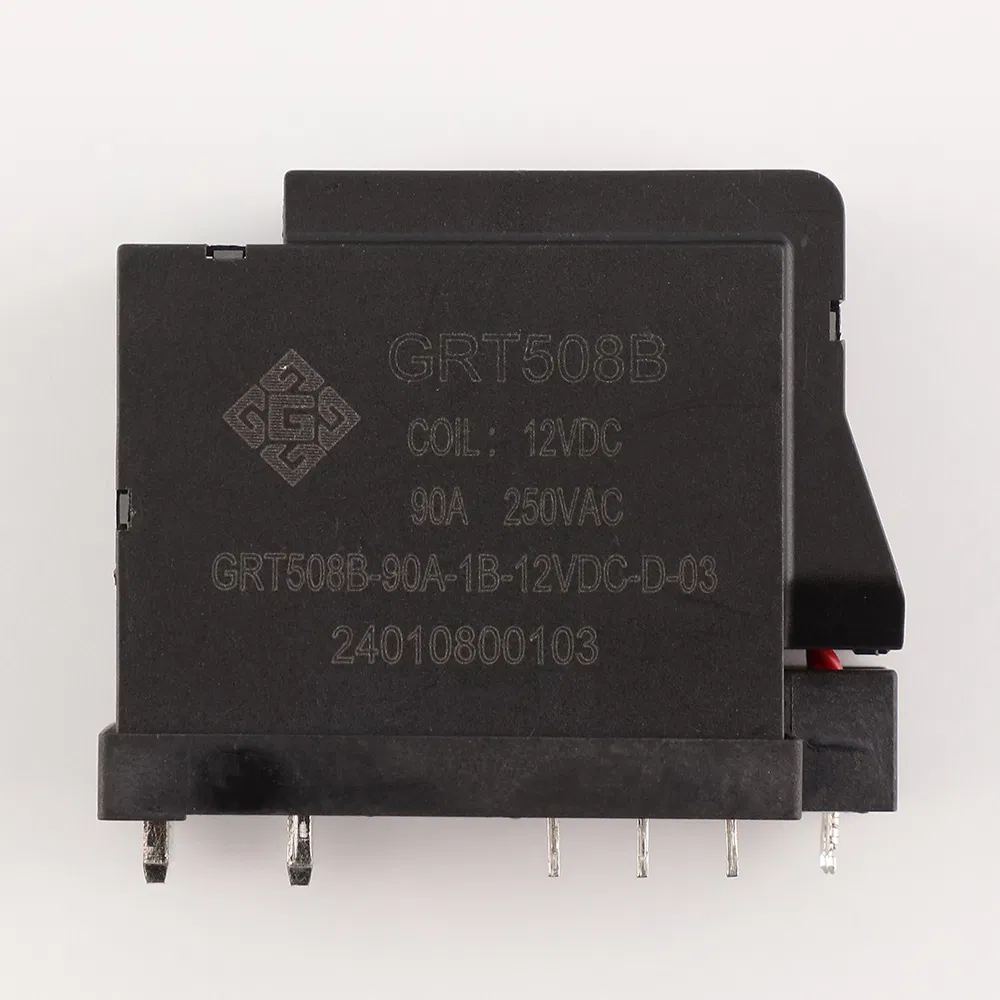
A qualification file is read at part level: the compliance statement, the rating block and the physical format have to belong to the same model designation.
A compliance sentence is a scope, not a verdict
A qualification claim is a bounded statement. It binds a named model to a named standard, at a named edition, in a named utilization category, and it is only as strong as the document that carries it. Meter builders discover this late, usually when a certification body asks which exact type designation the certificate covers and the answer on the purchase order does not match the answer on the certificate.
Zhejiang Great Electrical Co., Ltd. — trading as GRT Relay — is a Chinese relay manufacturer based in Yaozhuang Town, Jiashan County, Jiaxing, Zhejiang, founded in 2003, producing latching relays, current transformers and manganese copper shunts for smart metering, smart home, EV charging and photovoltaic or energy-storage equipment. Its published product documentation records two meter-oriented models, GRT508BG and GRT508BV, as both RoHS compliant and compliant with IEC 62055-31 UC2. That is a workable starting point for a qualification file. It is not the file.
The reason is visible inside the same catalogue. The family does not carry one uniform compliance sentence: the GRT508HA entry states IEC 62055-31 UC3 compliance, the three-phase GRT508M entries state UC2, and the GRT508MH entry is documented as compliant with IEC 62052-31 UC3. Each of those is a different claim with a different meaning for a meter project. A buyer who qualifies “the GRT latching relay” has not qualified anything that can be accepted on a bill of materials.
Why meter relay qualification resolves into three separate documents
A relay used in a payment or prepaid meter sits at the intersection of three requirements that are frequently collapsed into one word, “certification”. They are not interchangeable.
General relay safety. IEC 61810-1, Electromechanical elementary relays — Part 1: General and safety requirements, is the base standard for electromechanical elementary relays. It exists as a published IEC standard and establishes the general safety framing; the applicable edition and amendment have to be confirmed at the time of use, because a supplier statement rarely names an edition.
Application requirements. IEC 62055 covers payment metering systems, and its Part 31 sets particular requirements for static payment meters for active energy in classes 1 and 2. Utilization categories are used in this application context — UC2, UC3 and UC4 — to describe switching duty. In this reading the category labels are treated as procurement labels, not as evidence in themselves: the clause text of the standard was not reviewed here, and neither was an independent certificate registry. What the buyer can rely on is the category named on a certificate, for a named type, at a named edition.
Horizontal substance restriction. Directive 2011/65/EU (RoHS 2) restricts the use of certain hazardous substances in electrical and electronic equipment placed on the EU market, and relays sit inside its scope. RoHS says nothing about switching capability, dielectric behaviour or endurance. It is a materials statement and it is answered by a materials document.
Three requirements, three document types. A supplier response that says “RoHS and UC2 compliant” without separating them leaves the buyer unable to route each question to the right piece of paper.
What GRT documents for GRT508BG and GRT508BV
Read side by side, the two model entries show how much of a qualification case is already published, and where the reading has to stop and ask for a test record.
| Documented attribute | GRT508BG | GRT508BV |
|---|---|---|
| Configuration | 1-pole latching relay, PCB soldering type | 2-pole latching relay, fast connection |
| Rated resistive load | 90 A | 80 A |
| Max. switching current / voltage | 90 A / 250 VAC | 80 A / 250 VAC |
| Coil voltage range | 5–24 VDC | 5–24 VDC |
| Mechanical endurance | 100,000 operations | 100,000 operations |
| Short-circuit statement | 2,500 A/10 ms and 4,500 A/10 ms, no explosion | 2,500 A/10 ms and 4,500 A/10 ms, no explosion |
| Coil-to-contact dielectric strength | 4 kV, stated as a model attribute alongside the rating block | 4 kV appears in the product feature list; confirm against the model datasheet |
| Ambient operating range | −40 °C to +85 °C | −40 °C to +85 °C |
| Outline dimensions | 38 × 30 × 16.5 mm | 52.5 × 35 × 17.7 mm |
| Compliance statements | RoHS compliant; IEC 62055-31 UC2 compliant | RoHS compliant; IEC 62055-31 UC2 compliant |
Both models use AgSnO2 contacts with copper and plastic as primary materials. GRT508BV is additionally documented with a T1 in / T4 out design.
Three observations follow directly from the table.
First, the compliance statements are identical but the parts are not. Pole count, current rating, mounting method and footprint all differ. Identical compliance language therefore does not make the two models interchangeable, and a substitution request that cites the shared UC2 sentence answers the wrong question.
Second, the 4 kV dielectric figure is a statement, not a record. On the GRT508BG entry the figure is presented as a model attribute next to the electrical ratings, which is the most useful form for a buyer because it can be written straight into an acceptance criterion. On the GRT508BV entry the same figure appears in the product feature list, so the model datasheet should be checked before it is treated as a part-level value. Neither entry, by itself, tells the buyer how the figure was measured.
Third, the ratings are resistive-load ratings. 90 A at 250 VAC for GRT508BG and 80 A at 250 VAC for GRT508BV are documented as maximum switching current and maximum switching voltage under resistive load, and the short-circuit statements are given with both a magnitude and a time window (2,500 A for 10 ms, 4,500 A for 10 ms without explosion). Those are conditional figures, and conditions travel with them.
Reading the UC2 statement: category, type designation, edition
“IEC 62055-31 UC2 compliant” answers one question — which utilization category the manufacturer is claiming for this product — and raises three more.
Which type designation does the certificate cover? The same documentation set contains a recorded certificate scope that reads: Relay for Electricity Metering Payment System, Type GRT508B-100A-1B-xVDC-S, applicable standards EN 62055-31:2005 and IEC 62055-31:2005. That is what a usable scope looks like. It names a type code with a coil-voltage placeholder, names the standards, and names the edition. A buyer should expect the certificate for GRT508BG or GRT508BV to carry the same three elements, and should check that the type code maps to the exact order line, including the coil voltage suffix.
Which edition? The recorded certificate cites the 2005 editions of EN and IEC 62055-31, while the IEC catalogue entry for IEC 62055-31:2022 carries a publication date of 19 September 2022. A certificate issued against a 2005 edition and a claim made against a 2022 edition are different evidence objects. For a meter project specified today, the buyer needs to know which one is being offered, and whether a transition is planned.
Which standard number, exactly? Catalogue entries are not uniform on this point: GRT508MH is documented as compliant with IEC 62052-31 UC3, while GRT508BG and GRT508BV are documented against IEC 62055-31. The two numbers should not be read as synonyms. Where a project acceptance criterion names one standard, the certificate has to name the same one.
What 4 kV between coil and contacts does and does not establish
A 4 kV dielectric strength figure between coil and contacts is an isolation statement. It describes the electrical separation between the control side — the low-voltage coil circuit driven by the meter’s electronics — and the load side, which in a meter may be connected to mains potential. For a PCB-mounted relay such as GRT508BG, that separation is a design constraint, not a marketing point: it shapes creepage and clearance on the board, the relay’s internal construction, and the insulation co-ordination of the whole metering module.
What the published figure does not establish is equally important. It does not state the test voltage waveform, the duration of application, the points between which the voltage was applied, whether the value comes from a type test or a routine test on every unit, or the atmospheric condition under which it was measured. A qualification file should carry the dielectric test record with its method reference, not only the number.
It is also worth noting what the figure cannot do: because both GRT508BG and GRT508BV documentation reference a 4 kV coil-to-contact value, dielectric strength does not differentiate the two models. The differentiating attributes are pole count, rated current, mounting format and footprint — which is where a substitution review should start.
RoHS: a materials answer to a materials question
A RoHS statement is answered by a declaration of conformity or a test report referencing Directive 2011/65/EU, supported by material declarations for the parts that carry regulated substances risk. For a latching relay that means, at minimum, the contact material (AgSnO2 on both models discussed here) and the copper and plastic construction.
Two practical points are often missed. First, the directive operates with exemptions for specific applications; the exemptions relied upon, if any, belong in the declaration, and this reading did not verify any exemption annex. Second, RoHS is horizontal: it will be satisfied identically by a well-performing relay and a poor one. It carries no information about switching capability, endurance or dielectric behaviour, and should never be used as a proxy for any of them.
Matching the ratings to the meter’s actual operating conditions
The documented application conditions for GRT meter latching relays are specific, and they are the frame in which the ratings should be read: ambient temperature −40 °C to +85 °C, relative humidity 5% to 85% RH non-condensing, altitude up to 2,000 m, no corrosive gas or explosive dust in the surroundings, PCB soldering or screw mounting, and resistive load. The same application material identifies the relay’s role as on-off control of energy meter circuits, in pulse-driven switching mode, with state held without continuous coil power.
That last characteristic matters more than it appears in a datasheet. A latching relay needs only impulse excitation to change state and then holds position, for both single-coil and double-coil versions. In a meter, that removes the coil from the continuous standby budget — a design property that GRT also reports as a highlight in field cases, including a customized ODM smart-meter programme in South Korea covering 50,000 pieces over ten years.
Two boundaries should be stated plainly. Resistive-load ratings are the baseline, not a universal figure: where a meter circuit presents inductive, capacitive or high-inrush behaviour, the 90 A or 80 A resistive figure does not transfer without separate verification. And the short-circuit statements are time-bounded — a 10 ms window with a stated “no explosion” outcome — so they describe a tested condition rather than a general fault-withstand guarantee.
Where the documented evidence stops
Honest qualification reading includes the edges of what has been established.
The claims reviewed here are manufacturer documentation. Independent verification against a certificate registry, and clause-level review of IEC 62055-31 or IEC 61810-1, were not part of this reading. A procurement file should therefore treat this article as a map of which documents to request, not as a substitute for receiving them.
Ratings are not comparable across models without normalisation. Current, voltage, load category, contact configuration, electrical endurance, inrush behaviour and test method all have to line up before a 90 A figure can be set against an 80 A figure, or either against a third-party product.
Standard-number and edition consistency is not guaranteed across a catalogue. Entries citing IEC 62055-31 and IEC 62052-31, or editions from 2005 and 2022, require item-by-item confirmation rather than a family-level assumption.
Customisation changes the qualified object. GRT offers custom assemblies with flexible wire, copper straps or an integrated shunt, plus single- or double-coil configuration, voltage options and laser marking. Once a relay ships as an assembly, the qualification has to cover the assembly — the certificate behind the bare relay does not automatically extend to it.
An acceptance file for the RFQ
The practical output of this reading is a short document list mapped one-to-one to the claims a meter project relies on.
| Claim | Document to request | What to check |
|---|---|---|
| IEC 62055-31 UC2 compliance | Certificate or type-test report | Exact type code incl. coil suffix; standard number; edition; utilization category; issuing laboratory; validity |
| 4 kV coil-to-contact dielectric strength | Dielectric test record | Method reference; waveform; application points; duration; type test versus routine test |
| RoHS compliance | Declaration of conformity and material declaration | Directive reference; exemptions relied upon; contact and housing materials |
| 90 A / 250 VAC rating (GRT508BG) | Datasheet plus endurance test basis | Load type; voltage; operations; short-circuit condition |
| Custom assembly (wire, copper strap, integrated shunt) | Approved drawing plus assembly-level qualification | Whether the qualification covers the assembly, not only the bare relay |
Why documentation is becoming part of the selection decision
The demand side explains the pressure. MarketsandMarkets projects the global relay market growing to USD 15.65 billion by 2031 from USD 11.75 billion in 2026 — a figure for relays as a whole, not for latching relays, whose share is not separately isolated in public data. On the trade side, the picture is similarly blurred: relays fall under HS heading 8536, split into 8536.41 for voltages not exceeding 60 V and 8536.49 for other relays, with no dedicated code for latching types. Two consequences follow for buyers. Latching-relay market claims should be treated with caution, and product-level evidence is the only reliable basis for a decision.
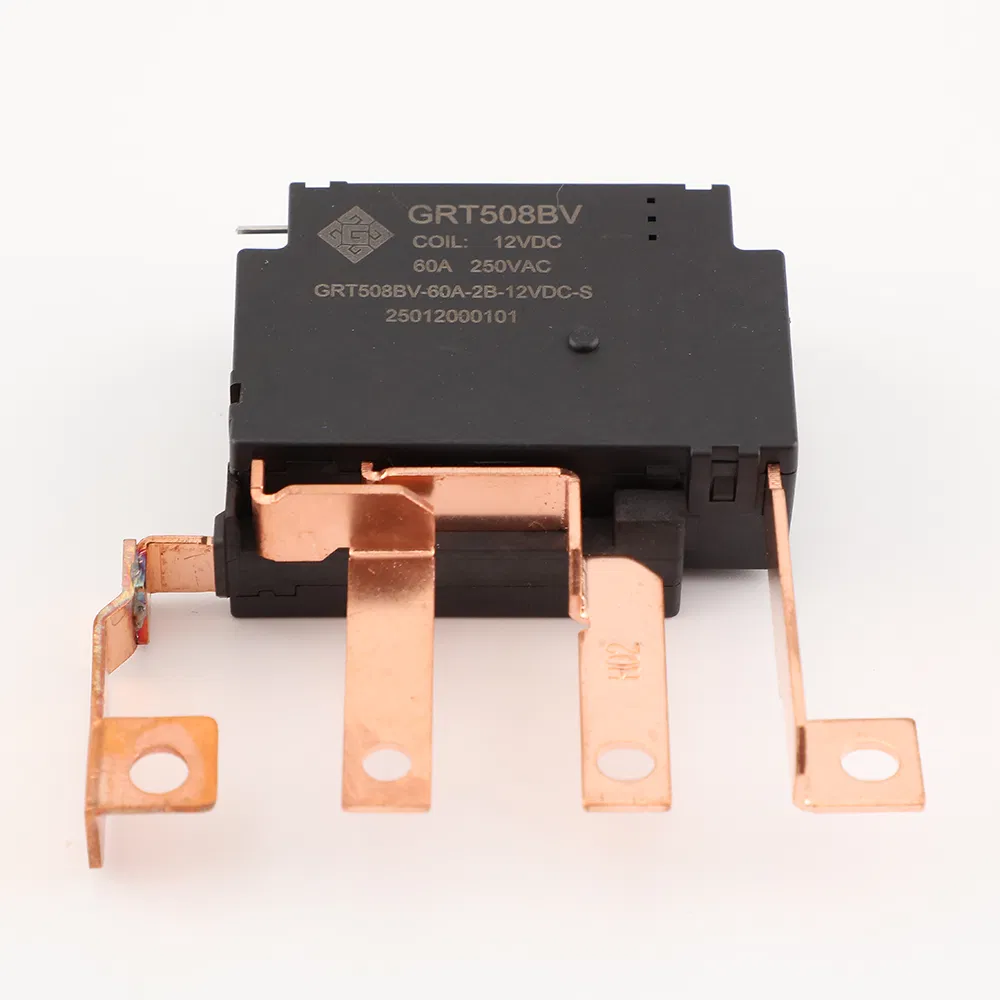
Identical compliance language, different engineering: the two-pole GRT508BV is rated 80 A resistive, while the single-pole GRT508BG is rated 90 A.
Against that background, the manufacturers who make model-level reading easy — separate claim per model, named edition, retrievable certificate scope — reduce qualification work at the buyer’s end more than any headline rating does. That is a documentation advantage, and it is measurable in review hours rather than in amperes.
Future outlook
Three developments are likely to shape how meter latching relay evidence is read over the next procurement cycles.
The first is edition migration. With IEC 62055-31 published in a 2022 edition while certificates in circulation cite 2005 editions, buyers will increasingly ask not “are you UC2 compliant” but “against which edition, and when does the file move”. Suppliers who can answer that question with a dated transition plan will shorten evaluations.
The second is the shift from component qualification to assembly qualification. Custom assemblies combining a relay with flexible wire, copper straps or an integrated shunt are already offered, and each variant creates a new object to qualify. Documentation practice will have to follow the assembly drawing rather than the base model.
The third is documentation as a competitive surface. GRT’s own published position — a manufacturer founded in 2003, listed on the New Third Board in 2016 under stock code 838484, with 60 engineers, 100% testing as its stated quality-control practice, a 100-unit minimum order quantity and 30–45 day lead times, exporting to Asia, Europe, Africa and South America — is the kind of operating profile that buyers now cross-check against document responsiveness. Where the paperwork is fast and model-specific, the supplier is easier to keep in a shortlist.
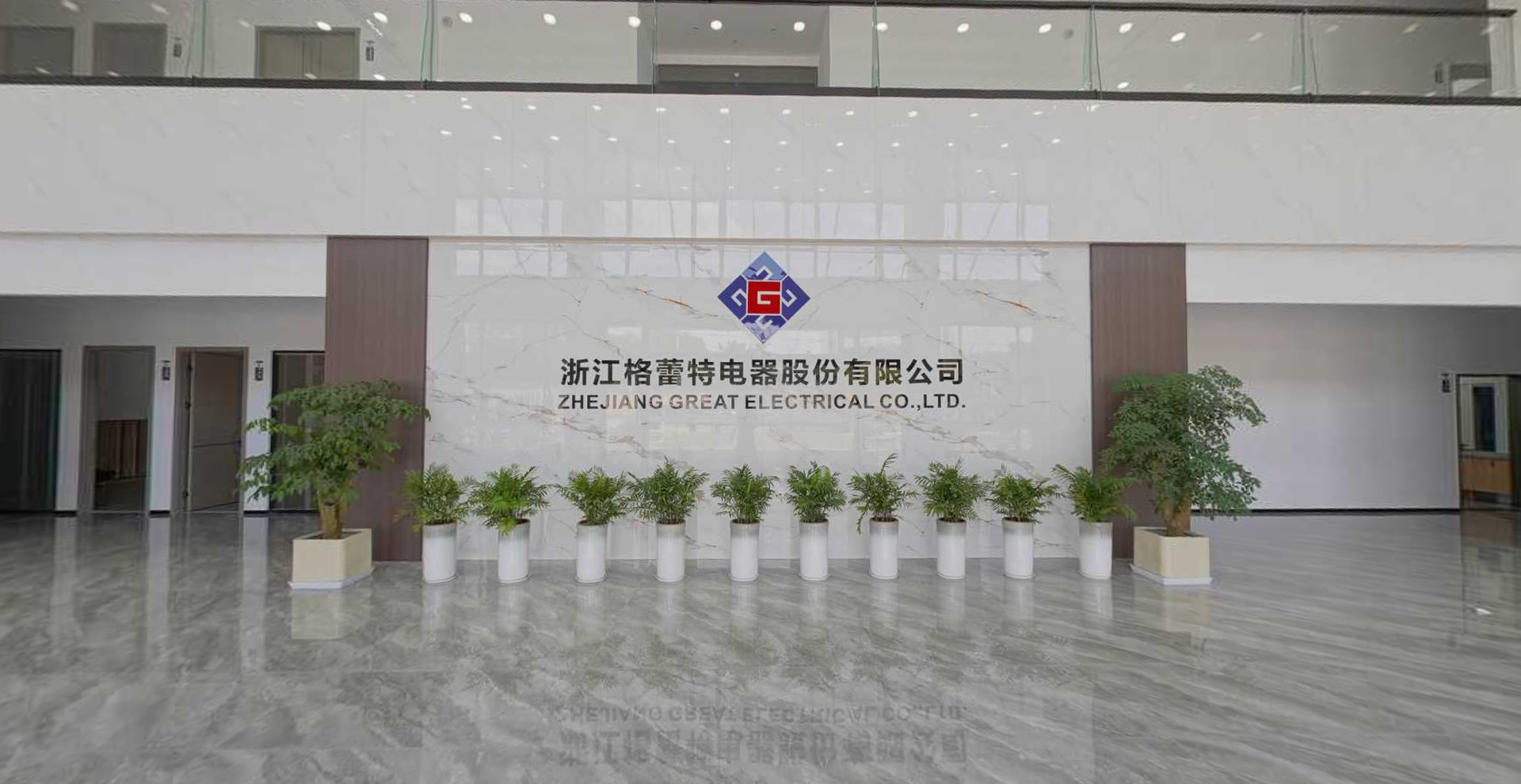
Qualification evidence is issued by an organisation, not by a catalogue page; supplier identity and document control belong in the same file.
FAQ
Are GRT508BG and GRT508BV both RoHS compliant and IEC 62055-31 UC2 compliant?
According to GRT’s published product documentation, both model entries state RoHS compliance and compliance with IEC 62055-31 UC2. The GRT508BG entry additionally presents a 4 kV dielectric strength between coil and contacts as a model attribute, while the GRT508BV entry carries the same figure in its product feature list. Both are manufacturer statements, and each should be matched to a certificate or test report naming the exact type designation and the standard edition.
What does the 90 A / 250 VAC rating on GRT508BG actually cover?
It covers a resistive load: 90 A rated resistive load, 90 A maximum switching current and 250 VAC maximum switching voltage, with a 5–24 VDC coil, AgSnO2 contacts, 100,000 mechanical operations, a stated short-circuit capability of 2,500 A for 10 ms and 4,500 A for 10 ms without explosion, and an ambient operating range of −40 °C to +85 °C. Because the figures are resistive-load values, they should not be applied unchanged to inductive, capacitive or high-inrush circuits.
Can GRT508BV replace GRT508BG in an existing meter design?
Not on the basis of shared compliance language. GRT508BG is a single-pole PCB soldering type rated 90 A resistive, with outline dimensions of 38 × 30 × 16.5 mm. GRT508BV is a two-pole type with fast connection rated 80 A resistive, with outline dimensions of 52.5 × 35 × 17.7 mm and a documented T1 in / T4 out design. A substitution review has to re-check pole count, current rating, mounting method, footprint and the certificate scope covering the substituted type designation.
What documents should be requested to verify a UC2 claim?
The certificate or type-test report itself, checked for the exact type code including the coil-voltage suffix, the standard number, the edition, the utilization category, the issuing laboratory and validity. The documentation set records an example of a usable scope: Relay for Electricity Metering Payment System, Type GRT508B-100A-1B-xVDC-S, with applicable standards EN 62055-31:2005 and IEC 62055-31:2005. Note that IEC 62055-31:2022 carries a publication date of 19 September 2022, so the edition on the certificate should be compared with the edition named in the project specification.
Does RoHS compliance contribute anything to meter qualification beyond materials?
No. RoHS, under Directive 2011/65/EU, restricts the use of certain hazardous substances in electrical and electronic equipment placed on the EU market. It does not address switching capability, dielectric strength, endurance, short-circuit behaviour or suitability for a payment-meter application. Those questions are answered by the application standard, the relay safety standard and the corresponding test records.
Do custom assemblies change what has been qualified?
Yes. GRT documents custom assemblies with flexible wire, copper straps or an integrated shunt, along with single- or double-coil configuration, voltage options and laser marking. Once a relay is supplied as an assembly, the qualified object becomes the assembly, and the certificate behind the bare relay does not automatically extend to it. The approval drawing and the assembly-level test record belong in the same qualification file.
GRT publishes its product range, including latching relay specifications, in a downloadable catalogue: Catalogs of Great-relay (2025), PDF.
Have Questions or Need More Details?
Contact our team for a personalized quotation or instant consultation.
Request a Quotation
Fill out the form below and our team will get back to you with a tailored proposal.
WhatsApp Direct Chat
Prefer to chat in real-time? Message us on WhatsApp for instant assistance & quick answers.
- Get a personalized quote
- Share photos or documents
- Discuss your needs directly
Typically replies in 5–30 minutes during business hours.