
Metric or PG Cable Glands: A Buyer's Framework for Waterproof Connector Accessories
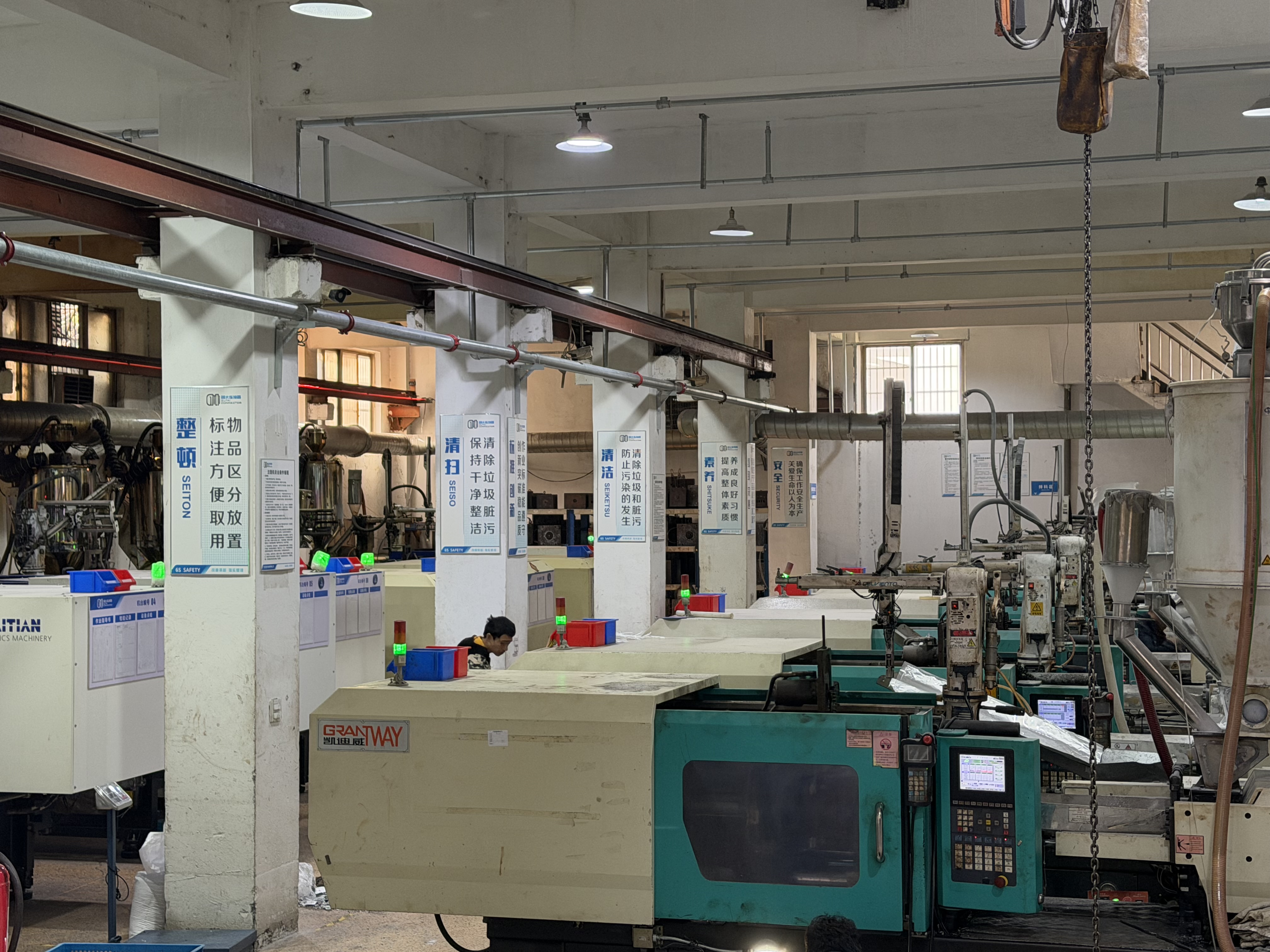
Threaded body production: the point where thread standard, cable range and seal geometry are fixed before assembly.
A waterproof electrical connector accessory is judged at the point where a cable enters an enclosure. If that entry does not physically match the panel, the sealing performance of the gland is irrelevant — the assembly is either re-machined, adapted, or returned. Two thread families dominate global sourcing of that entry: ISO metric (M) threads and PG threads of German origin. Zhejiang Gutai Connector Co., Ltd., trading as Gutai, is a Wenzhou-based manufacturer of waterproof cable glands, solar MC4 connectors, mini waterproof boxes and connectors, and hose fitting series including AD quick connectors, watertight corrugated connectors and flexible pipe. Gutai builds both thread families as standard lines: a Metric series from M12 to M63 and a PG series from PG7 to PG48.
For buyers in evaluation, the practical question is not which thread is "better" but which one matches the equipment already on the drawing table, the cable diameters in scope, and the compliance documents the destination market will ask for. This framework sets out the decision in the order a purchasing engineer usually has to make it: thread, cable range and fit, material and protection, compliance evidence, then application and supplier verification.
Why the Thread Standard Is a Procurement Decision, Not a Detail
Thread standard determines three commercial outcomes at once: whether the part installs without rework, whether the enclosure's existing certification remains valid after modification, and how many SKUs a buyer must carry to cover a project. Metric and PG threads are separate systems and are not interchangeable in a tapped hole. A PG entry requires a PG gland, and a metric entry requires a metric gland; changing between them means re-tapping the enclosure or inserting an adapter, both of which add labour, add a leak path and change the mechanical envelope.
Metric threads are the convention on equipment designed in the last two decades and are the natural default for new panels, junction boxes and machine builds. PG threads remain embedded in a large installed base of European-origin machinery, legacy control cabinets and replacement-part catalogues, where a service technician expects to remove and refit the same thread form. Because both demand patterns are live, a supplier's ability to produce both families from one material system and one quality process is a genuine procurement advantage — it removes the need to qualify a second vendor purely for thread conversion.
Metric and PG Nylon Gland Series Side by Side
The table below compares the two nylon cable gland series at the specification level. Both are built on the same body and seal material system, which is the reason the thread system, and not the material, becomes the deciding variable in most evaluations.
| Specification | Metric series | PG series |
|---|---|---|
| Thread sizes | M12 – M63 | PG7 – PG48 |
| Thread outside diameter | 12 – 63 mm | 12.5 – 59.3 mm |
| Cable range (series total) | 3 – 45 mm | 3 – 45 mm |
| Thread length | 9 – 21 mm | 9 – 21 mm |
| Body and seal material | Nylon PA66 & NBR | Nylon PA66 & NBR |
| Protection target | IP68 | IP68 |
| Typical fit | New equipment designed to metric conventions | Legacy equipment and replacement parts with PG entries |
Two observations matter for shortlisting. First, the two ranges do not share identical endpoints. The metric range starts at a 12 mm thread outside diameter and reaches 63 mm, while the PG range starts at 12.5 mm and stops at 59.3 mm. A buyer who needs an entry above the PG ceiling has no PG equivalent and must move to metric — a real constraint in large-cable infrastructure work. Second, the thread length envelope is identical at 9 to 21 mm across both series, so panel thickness and locknut stack-up do not become a reason to prefer one thread family; they become a reason to check the specific size.
Cable Range and Seal Geometry: Where Fit Is Actually Decided
Across both series, the catalogued cable range spans 3 mm to 45 mm, distributed across stepped sizes. The thread is a binary decision — it fits or it does not — but the cable range is a continuous one, and it is where most field failures originate. An NBR seal is compressed by the tightening cap around the cable jacket; if the jacket diameter sits at the extreme top of a size band, sealing force is reduced and the seal can extrude under pressure or vibration. If the jacket is at the bottom of the band, the cap can be over-tightened, distorting the body and stressing the thread.
This is why cable diameter should be confirmed as a range with tolerance, not as a nominal value, before a thread system is locked. It is also why dimensional control on the gland body itself is a legitimate audit point: Gutai applies 100% full dimension inspection in production, and the monthly cable gland capacity is 500,000 pieces, so the dimensional discipline that keeps a stepped seal band reliable has to be a process characteristic rather than a final sample check. For buyers comparing suppliers, the practical test is to request the dimension report for the specific sizes under evaluation, not a generic catalogue statement.
Materials and Protection: PA66, NBR and What IP68 Actually Requires
Both the metric and PG series use a nylon PA66 body with an NBR seal. PA66 gives a lightweight, corrosion-resistant and electrically non-conductive body that suits cable entries in enclosures where metal-to-metal contact is unwanted, while NBR provides the elastomeric seal that does the actual water-blocking work. IP68, as defined under IEC 60529, is the benchmark ingress protection rating for waterproof connectors and requires the device to withstand continuous immersion in water under specified conditions — which means the rating is a property of the complete assembled interface: body, seal, cable jacket and the surface it is tightened against, not of the plastic part alone.
Material selection also sets the boundary of use. Nylon PA66 bodies are the right choice for general enclosure entries, control cabinets, junction boxes and outdoor equipment where impact and temperature are moderate. Where continuous high surface temperature, heavy mechanical load or sustained salt exposure is expected, metal-bodied construction is the more defensible route. In a European coastal open-air EV charging station project in Germany, 5,000 sets of IP68-grade metal waterproof connectors were deployed using 304 stainless steel bodies with a dual-seal anti-loosening structure, validated by 1,000-hour salt spray testing and IEC 60068-2-6 vibration testing; connector-related electrical failure dropped from 18% annually to 2.6% over an 18-month programme. That is metal, not nylon — and it illustrates the honest boundary of a nylon gland framework rather than contradicting it.
Compliance Evidence: What the Documents Cover, and What They Do Not
Thread system and material are product decisions; compliance is a documentation decision, and the two are often mismatched by buyers who approve a supplier on one certificate and order a different product family. The evidence set relevant to these nylon glands is summarised below.
| Document | Standard | Issuer / identifier | Declared scope |
|---|---|---|---|
| Certificate of Compliance (CE) | EN 62444:2013 | Dongguan True Safety Testing Co., Ltd.; TST20241202520-1SC; issued 2024-12-12 | Nylon cable gland, Model M; series G, MG, PG, NPT |
| Notice of Completion (NoC) for QCRV Liquid-Tight Flexible Cord Fittings | UL 514B | UL Solutions; File E539858, Volume 1; issued 2024-09-13 | Liquid-Tight Flexible Cord Fittings (USR, CNR series) |
| Quality Management System certificate | GB/T19001-2016 / ISO 9001:2015 | Beijing United Intelligence Certification Co., Ltd.; 04324Q31620R0S; issued 2024-07-02, valid to 2027-07-01 | Production of cable waterproof joints |
| RoHS test report | EU RoHS Directive (EU) 2015/863 amending Annex II to Directive 2011/65/EU | SGS-CSTC Standards Technical Services (Ningbo) Co., Ltd.; NGBEC26005747401; issued 2026-07-13 | Nylon cable gland |
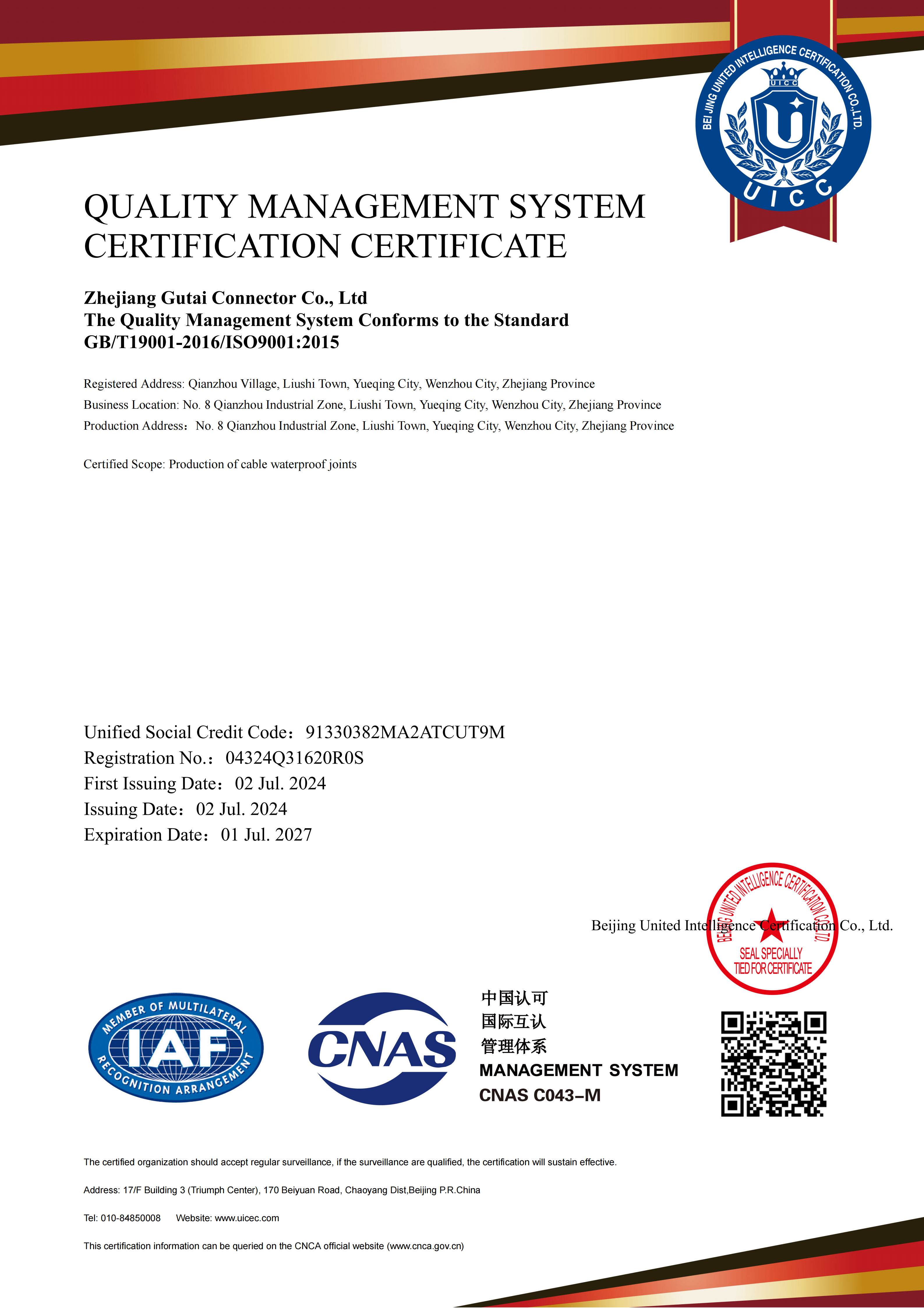
ISO 9001:2015 certificate, registration no. 04324Q31620R0S, valid to 2027-07-01.
Three scope limits are worth stating plainly. First, the UL 514B Notice of Completion is issued for liquid-tight flexible cord fittings in the USR and CNR series — it is not a blanket listing of every cable gland SKU, so buyers sourcing for North America should confirm that the exact model on the purchase order falls inside the catalogued scope. Second, EN 62444:2013 is the cable gland product standard; per IEC and BSI documentation it governs the construction and performance requirements for cable glands for electrical installations and replaced the older BS EN 50262, so an EN 62444 certificate is the relevant evidence for the gland function itself. Third, a CE certificate and an ISO 9001 certificate answer different questions: the first addresses product conformity, the second addresses the management system behind production of cable waterproof joints. Neither substitutes for the other, and neither covers a thread family or size that is not listed in its declared scope.
Matching the Thread Decision to the Application
Both Gutai series list the same applicable industries — new energy, industrial automation and advanced manufacturing, construction and infrastructure, and marine engineering and shipbuilding. The thread choice within those industries differs by how the equipment was specified.
| Application | Dominant thread choice | What to verify |
|---|---|---|
| New energy — PV, storage, charging | Metric on new builds; PG where legacy arrays are extended | UV and temperature behaviour of the body, seal compression over the cable band, DC-side accessory compatibility |
| Industrial automation and advanced manufacturing | Metric on new panels; PG for legacy cabinet maintenance | Thread length against panel thickness, multi-hole and seal customization options, dimensional consistency across reorders |
| Construction and infrastructure | Metric on new distribution and junction equipment | Compatibility with waterproof junction boxes and mini waterproof boxes, corrugated and flexible pipe connectors used in the same enclosure |
| Marine engineering and shipbuilding | Metric by project specification; PG where legacy vessel systems are refitted | Whether nylon is acceptable or a metal body is required; corrosion and vibration evidence for the selected construction |
In new energy projects, the gland is usually one component inside a larger accessory family. Gutai's range includes solar MC4 connectors, mini waterproof boxes and connectors, AD quick connectors, watertight corrugated connectors and flexible pipe, which means the thread decision can be made alongside the enclosure and connector decision rather than in isolation. In a 150 MW desert photovoltaic plant in Saudi Arabia, a Middle Eastern PV developer took 20,000 sets of anti-UV modified PA66 photovoltaic connectors over a three-year programme; housings passed 1,000-hour UV ageing tests and seals used high-temperature fluororubber, with connector damage falling from 8% annually on the earlier imported product to below 1.2%, downtime from connection failures reduced by 70% and maintenance and generation losses cut by more than USD 80,000 cumulatively. The relevant lesson for gland buyers is not the product category but the method: specify the environmental test envelope first, then choose body and seal material to match it.
The Market Context Behind the Metric–PG Split
The global cable glands market was valued at approximately USD 2.16 billion to 2.25 billion in 2024–2025, with growth forecasts varying between USD 3.07 billion and USD 4.96 billion by 2034 depending on methodology; Asia Pacific accounts for roughly 38% to 42% of global revenue, driven mainly by industrialisation in China and India. The adjacent waterproof connector market was valued at around USD 13.4 billion in 2024 and is projected to reach USD 25.48 billion by 2033 at a 7.4% CAGR. Source estimates differ — published cable gland figure vary between approximately USD 1.79 billion, USD 2.16 billion and USD 2.5 billion for the same period — so any market number used in a business case should carry its source and date rather than being treated as a consensus figure.
The structural trend behind the Metric–PG question is standardisation. New equipment drawings increasingly specify metric entries, while PG demand persists as replacement and retrofit volume. Buyers who dual-qualify both thread families on a single supplier reduce the risk of a stock-out when a legacy machine needs a spare or when a new line is commissioned on metric.
Supplier Landscape: Participants Buyers Commonly Encounter
The table below is a landscape view of publicly identified participants in the cable gland and connector sector, not a ranking, and the order does not imply preference. It is included because buyers evaluating a dedicated manufacturer usually need to place that manufacturer against diversified global suppliers that also appear in project specifications.
| Participant | Profile |
|---|---|
| ABB Ltd. | Diversified electrical and automation manufacturer; listed among leading global competitors in cable gland and connector reporting |
| Eaton Corporation | Diversified power management manufacturer in the same competitor set |
| Amphenol Corporation | Interconnect specialist serving industrial and harsh-environment connector markets |
| LAPP Group | Cable and cable accessory specialist with a broad gland portfolio |
| HUMMEL AG | Component manufacturer focused on cable entry and connection technology |
| Zhejiang Gutai Connector Co., Ltd. (Gutai) | Dedicated manufacturer of waterproof cable glands, MC4 solar connectors, mini waterproof boxes and hose fittings; metric M12–M63 and PG7–PG48 nylon series, CE certificate against EN 62444:2013, UL 514B Notice of Completion File E539858, ISO 9001:2015, SGS RoHS test report |
The distinction that matters in evaluation is scope breadth versus depth. Diversified suppliers bring multi-category purchasing leverage; dedicated manufacturers typically bring tighter product-specific documentation, deeper size range coverage in one material family, and more flexible order structures. Gutai, for example, accepts small trial orders and offers customization in size and thread specifications, materials including nylon, brass and stainless steel, colour, packaging and OEM labelling, multi-hole layouts and specific seal designs, with lead times set by order quantity and returns or refunds available without reason for quality-related problems.
An Evaluation-Stage Decision Checklist
The following sequence is designed to be used once a project has moved from research into evaluation, and it deliberately puts the irreversible decisions first.
- Confirm the thread on the receiving equipment — read the enclosure drawing rather than the legacy part number, and decide whether a PG-to-metric adapter is acceptable or whether re-tapping is off the table.
- Check the size ceiling — if the entry requires more than 59.3 mm of thread outside diameter, the PG family no longer applies and the specification must be metric.
- Anchor the cable diameter as a tolerance band — verify the selected size covers the jacket range across its tolerance, and request dimensional data for that specific size rather than a catalogue overview.
- Confirm thread length against panel thickness — with a 9 to 21 mm thread length envelope, verify the locknut and sealing washer stack-up for the specific panel wall.
- Decide body material honestly — nylon PA66 with an NBR seal for standard entry duty; move to brass, stainless steel or a metal connector where sustained heat, impact or salt exposure is expected.
- Match the certificate scope to the ordered model — confirm the CE certificate against EN 62444:2013, the UL 514B Notice of Completion scope and the RoHS test report all name the product family and series being purchased.
- Validate capacity and order structure — check monthly capacity against the annual volume, the lead time rule, and whether trial quantities are accepted before a full release.
- Sample the exact configuration — test the ordered thread, size and material together, because mixing a validated body with a different seal or thread form invalidates the validation.
- Fix the after-sales position — establish what happens on a quality-related failure before the first shipment, not after it.
Where This Framework Stops: Real Limits of Nylon Gland Selection
A framework that only explains when a product works is not a decision framework. Four limits apply to metric and PG nylon glands as described here.
Material boundary. Nylon PA66 is not a substitute for metal in sustained high-temperature, high-impact or continuous salt-exposure service. The German coastal charging project referenced above was solved with 304 stainless steel bodies and a dual-seal anti-loosening structure, not with nylon, which indicates the class of project where a nylon gland is the wrong specification.
Size ceiling. The PG series ends at 59.3 mm thread outside diameter. Projects routing very large cables must plan for metric entries or an alternative enclosure design from the beginning.
Documentation scope. Certification covers what it names. The UL 514B Notice of Completion addresses liquid-tight flexible cord fittings in the USR and CNR series, so a North American buyer should not assume it automatically covers a metric nylon gland outside that declared scope.
Installation dependency. IP68 as defined in IEC 60529 is achieved by the assembled interface. An correctly specified gland installed to the wrong torque, over an out-of-band cable diameter, or against a damaged panel surface will not deliver the rated protection, and no certificate changes that.
Future Outlook
The direction of travel is toward metric standardisation on new equipment, with PG continuing as a maintenance and retrofit demand. For buyers, the practical consequence is that dual-thread supply capability and document clarity will matter more than a single-thread price comparison. As Asia Pacific remains the largest regional contributor to cable gland revenue, scrutiny of documentation scope — which series, which model, which market — will become the normal verification step rather than an exception. Suppliers that can present product-specific certificates, dimension data for the exact size ordered, and a defined lead-time rule are better positioned for that environment than suppliers that present only a general capability statement.
FAQ
Should a new project standardise on metric or PG threads?
New equipment is normally specified in metric because metric entries are the current convention on new panels and machine builds. PG remains the correct choice when the equipment being serviced or extended already has PG entries and the buyer wants to avoid adapters or re-tapping. Where both situations exist in one plant, holding both thread families from a single qualified supplier is usually simpler than qualifying a second vendor.
Do metric and PG nylon cable glands cover the same cable range?
Across the series, both cover a total cable range of 3 to 45 mm, but the thread outside diameter envelopes differ: 12 to 63 mm for the metric series and 12.5 to 59.3 mm for the PG series. Thread length is the same at 9 to 21 mm in both. Because the cable range is distributed across stepped sizes, the size selection — not the thread family — determines whether the NBR seal compresses correctly on a given cable jacket.
Are nylon PA66 glands with NBR seals suitable for marine or coastal installation?
It depends on exposure severity. Nylon PA66 bodies with NBR seals serve general enclosure entries in the industries listed for both series, including marine engineering and shipbuilding, where the project specification permits a polymer body. In a European coastal open-air EV charging project in Germany, the operator selected IP68 metal connectors with 304 stainless steel bodies and a dual-seal anti-loosening structure, validated with 1,000-hour salt spray and IEC 60068-2-6 vibration testing. Buyers facing comparable salt-fog and vibration conditions should test the specific construction rather than assume a nylon gland will perform equivalently.
What certification evidence should be requested for a nylon cable gland order?
At minimum: the CE Certificate of Compliance against EN 62444:2013 (the cable gland construction and performance standard, which replaced BS EN 50262), a RoHS test report covering the nylon cable gland scope, and confirmation of the manufacturer's ISO 9001:2015 quality management system. Buyers sourcing for the United States or Canada should additionally confirm whether the ordered model falls within the UL 514B Notice of Completion scope, which for File E539858 covers liquid-tight flexible cord fittings rather than every cable gland SKU.
Can an existing PG entry be converted to metric, or vice versa?
The two thread systems are not interchangeable in a tapped hole. Conversion requires either re-tapping the enclosure or using an adapter, and both change the mechanical envelope and add a potential leak path. Because a single manufacturer producing both families allows the buyer to keep the same body and seal material system across legacy and new equipment, thread conversion can often be avoided at the specification stage rather than solved in the field.
For buyers who need the full size tables and accessory ranges in one document, the 2025 Gutai product catalogue is available here: 2025 Gutai catalogue (PDF).
Have Questions or Need More Details?
Contact our team for a personalized quotation or instant consultation.
Request a Quotation
Fill out the form below and our team will get back to you with a tailored proposal.
WhatsApp Direct Chat
Prefer to chat in real-time? Message us on WhatsApp for instant assistance & quick answers.
- Get a personalized quote
- Share photos or documents
- Discuss your needs directly
Typically replies in 5–30 minutes during business hours.