
Micro Rotary Screw Compressor: ML-4A vs ML-5.5A vs ML-7.5A
Micro Rotary Screw Compressor: ML-4A vs ML-5.5A vs ML-7.5A
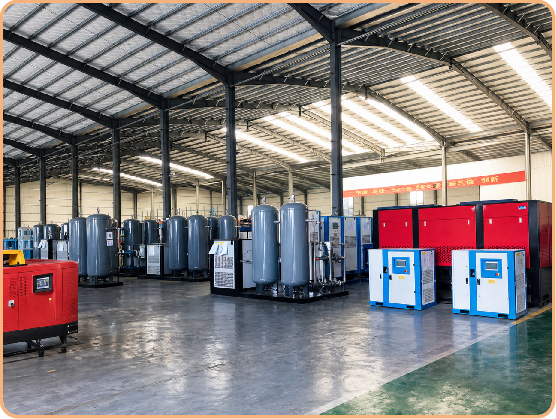
Finished rotary screw compressor units in UMW Air's storage area ahead of shipment. Image: UMW Air.
Choosing between the ML-4A, ML-5.5A and ML-7.5A is not a question of which model is best. All three are Micro series rotary screw air compressors from UMW Air, and all three share one published series envelope: airflow up to 1.1 m³/min, a working pressure range of 8–13 bar, a 140 L air receiver, a sheet-metal enclosure and a single-stage screw air end. What separates them is rated motor power — 4 kW, 5.5 kW and 7.5 kW. The purchasing decision therefore turns on measured air demand at a stated pressure, the electrical supply actually available on site, and the duty pattern the machine will run.
This comparison is written for buyers at the decision stage: the point at which a shortlist exists and the remaining work is verification. It sets the three power options against typical requirements in metal processing, plastics, automotive parts, food packaging and construction, then lists the acceptance criteria, pre-shipment test records and purchasing terms that should be settled before a purchase order is issued. Where the published series envelope stops short of a model-level figure, the article says so, because a series maximum is not a substitute for the airflow your chosen model delivers at your chosen pressure.
The Micro series at a glance
UMW Air is the operating name of Shandong UMW Air Tech Co., Ltd, a compressor manufacturer based in Jinan, Shandong, China. Its published company profile records a founding year of 2019, a 2,000 m² factory, around 200 employees, a 40-person R&D team and an annual output of 12,000 units, with a stated export ratio of 100% and markets listed as the EU, USA, Southeast Asia, the Middle East, South America and Africa. The company's certificate page lists ISO 9001:2015 for quality management and CE certification against the Machinery and EMC Directives. The capacity and export figures are company-reported and are not independently audited in the public record.
Within that portfolio, the Micro series covers the 4 kW to 7.5 kW band. The table below separates what the manufacturer publishes at series level from what a buyer must confirm at model level. That distinction matters more in this size class than in larger systems, because small packaged compressors are frequently bought on a headline airflow figure that was measured on a different model, or at a different pressure, than the unit being purchased.
| Specification | Published for the Micro series | Confirm before ordering |
|---|---|---|
| Rated motor power | ML-4A 4 kW; ML-5.5A 5.5 kW; ML-7.5A 7.5 kW | Voltage, phase and frequency against the site supply |
| Airflow | Up to 1.1 m³/min maximum for the series | Delivered free air delivery of your model at your working pressure |
| Working pressure | 8–13 bar range across the series | Fixed setpoint, and rated flow at that setpoint |
| Air receiver | 140 L | Receiver certification and rated pressure for your market |
| Air end | Single-stage screw | Lubrication type and oil carryover, if air quality is specified |
| Enclosure | Sheet metal | Sound level at 1 m and maximum ambient temperature rating |
| Minimum order quantity | 1 unit (company-reported) | Written confirmation on the quotation |
| Typical lead time | 3 days (company-reported) | Confirmed dispatch date for the export configuration |
What actually changes between ML-4A, ML-5.5A and ML-7.5A
The published differentiator among the three models is motor power. Everything else in the table is a series-level statement, which means the three models are not differentiated in public by airflow, receiver size, enclosure, air-end architecture or control type. In engineering terms, a higher rated motor power at a given pressure generally supports a higher delivered flow, but this relationship is a design tendency rather than a guarantee at model level. A buyer should not assume the 7.5 kW unit delivers exactly the series maximum, nor that the 4 kW unit delivers a proportional share of it.
The practical consequence is a specific document request: a per-model flow table showing free air delivery at 8 bar, 10 bar and 13 bar, with the test basis stated. Once that table exists, the model choice becomes arithmetic. Size the unit on peak simultaneous demand plus a margin for leakage and future load, not on the average of a plant walk-around. If measured peak demand sits comfortably inside the 4 kW model's published flow at the required pressure, the larger units add capital cost and part-load inefficiency rather than capability.
The reverse error is also common. A 7.5 kW model running at a small fraction of its capacity cycles frequently, and each cycle carries losses that a correctly sized smaller unit avoids. Where demand fluctuates widely within a shift, the more useful question is whether speed control is available in this power band at all, because a fixed-speed unit is sized for the peak and paid for at part load. The published Micro envelope does not state a speed-control option, so that question has to be asked directly rather than inferred.
Reading 1.1 m³/min and 8–13 bar as a buyer
Two published figures carry most of the buying risk in this comparison, and both need a condition attached before they can be used. The first is the 1.1 m³/min ceiling, which is a series maximum. The second is the 8–13 bar range, which describes the pressures the series is offered for rather than a single operating point. A screw compressor does not deliver the same flow at 13 bar as at 8 bar; higher delivery pressure requires more work per unit of air, so declared flow normally falls as pressure rises. A quotation citing 1.1 m³/min without stating the pressure at which it was measured tells a buyer very little.
The measurement basis matters as much as the number. ISO 1217:2009, Displacement compressors — Acceptance tests, is the reference standard for determining delivered flow on displacement compressors, and it defines the conditions under which a free-air-delivery figure is established. Asking for a flow result referenced to ISO 1217:2009, with the test pressure, speed and inlet conditions stated, converts a marketing number into a comparable specification. It also gives the buyer a contractual reference if the delivered machine underperforms on site.
The 140 L receiver deserves separate attention. Its role is to buffer short demand spikes and to reduce the number of load and unload cycles the compressor performs. In a small plant, most spikes come from a few seconds of simultaneous action: clamps closing, a blow-off gun triggered, a gripper releasing. A 140 L receiver extends the interval a small compressor can ride through such events, but it cannot cover a sustained demand above the compressor's delivery. If the peak is sustained rather than momentary, the correct response is a larger model in the band or a second unit, not reliance on stored air.
Application fit across five buyer environments
Metal processing, CNC machining and laser cutting
Machine shops use compressed air for tool clamping, spindle and part blow-off, chip evacuation, pneumatic vises and door interlocks. Demand is frequent but short-lived, which is the duty pattern rotary screw compressors handle better than reciprocating machines: UMW Air's published comparison cites continuous operation capability, lower vibration and more stable air output as the differences that matter for production lines and CNC machining. A 140 L receiver supports that pattern by absorbing the short bursts between clamp and blow-off events.
Laser cutting is the application that most often exposes a mismatch. Where compressed air is used as the assist gas, the pressure and cleanliness required are set by the laser machine builder and vary with material and thickness. Some configurations call for assist-gas pressure at or beyond the upper end of the Micro series' 8–13 bar range. Before shortlisting any model, confirm the required assist-gas pressure and purity with the laser supplier. If that requirement exceeds the ceiling, the Micro band is the wrong platform regardless of which of the three models is chosen, and no amount of receiver volume changes that.
Plastics processing
Plastics plants use air for conveying, mould blow-off, robot grippers and valve actuation. In this band, the Micro series fits cell-level and auxiliary duties rather than primary high-flow work such as large blow moulding or multi-cavity injection moulds, whose demand sits well above 7.5 kW. The sizing discipline is the same: count simultaneous consumers on the cell, not the number of machines on the floor plan, and check whether the plant's air-quality specification requires a dryer and filter package. The published envelope does not state an integrated dryer, so the package configuration has to be confirmed rather than assumed.
Automotive parts manufacturing
Automotive parts operations use air for fixtures, leak testers, small presses, assembly cells and paint-line pilot air. Here the binding constraint is usually stability and cleanliness rather than volume. A leak tester responds to pressure fluctuation and to moisture, so the acceptance conversation should cover pressure-holding behaviour and the dryer and filter arrangement alongside the flow figure. A single micro unit serving one assembly cell is a reasonable fit; the same unit serving a whole shop floor usually is not.
Food packaging
In food packaging the decisive question is air purity, not power. Packaging and food-contact air is normally specified against a purity class, and the Micro series envelope does not state whether the air end is oil-free or what oil carryover the standard package achieves. That is a documentation gap, not a defect, but it must be closed before ordering. For context, Atlas Copco positions oil-free compressors for sensitive applications including food and beverage production, and Ingersoll Rand states that its oil-free rotary screw compressors are certified to ISO 8573-1:2010 Class 0. Both are manufacturer statements about their own product lines, not claims about UMW Air equipment. If your specification requires oil-free air, ask for the air-end type, the filtration train and a documented purity result. If oil-injected air with filtration satisfies your food-safety plan, confirm the filtration rating and the maintenance interval that keeps it valid.
Construction and site support
Construction demand differs from factory demand in power quality, dust, ambient temperature and the need to move equipment. The Micro series is described with a sheet-metal enclosure and a 140 L receiver, which reads as a stationary packaged unit; the published envelope does not describe a portable or mobile variant. A buyer who needs a compressor that moves between floors or between temporary power points should confirm whether such a configuration exists before assuming one does. Dust exposure is the second issue: UMW Air states that overheating is controlled through a high-efficiency radiator and cooling fans, so the practical questions on a dusty site are the ambient temperature rating and how easily the cooler and fan can be cleaned in service.
Micro screw versus piston, and versus larger screw systems
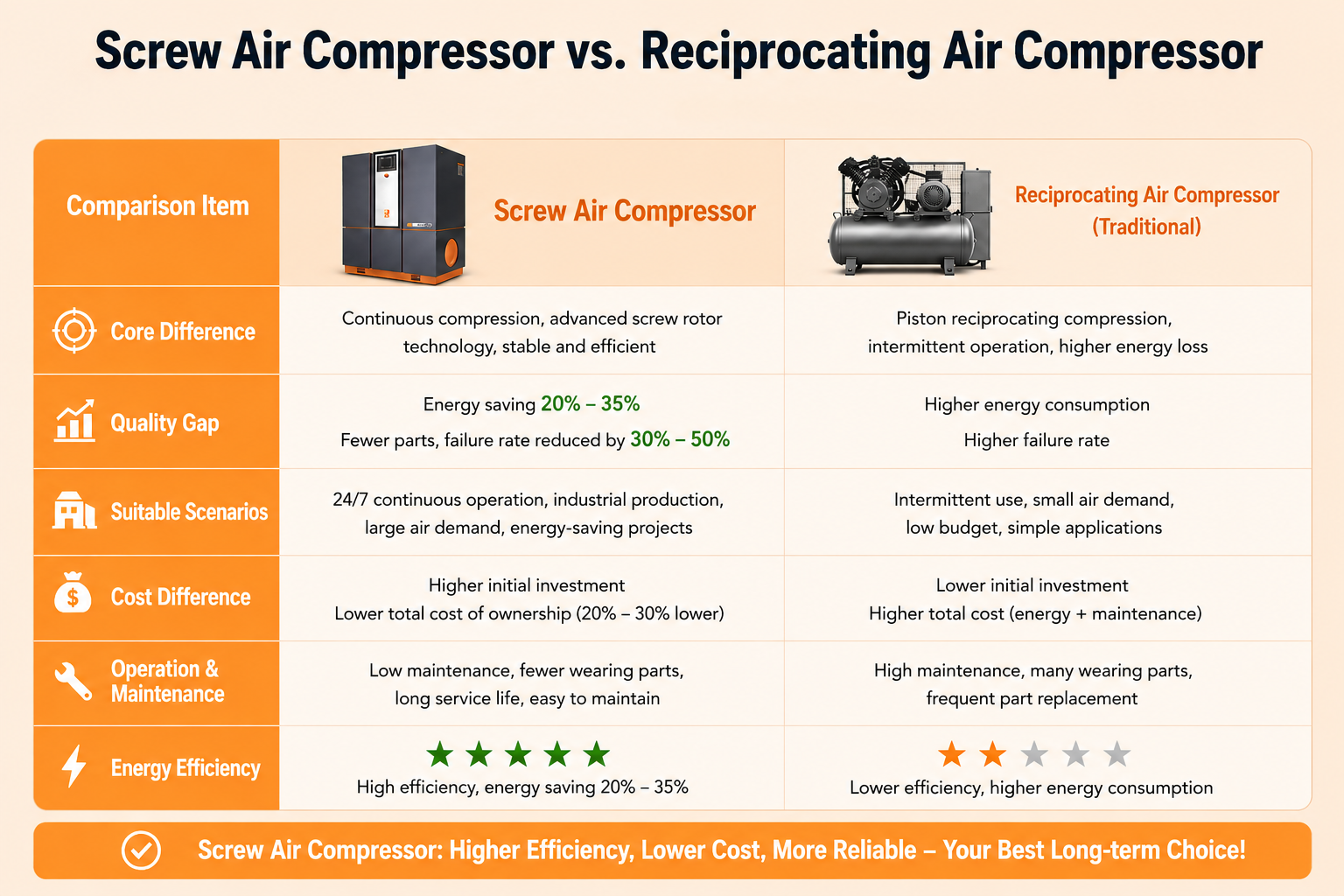
Screw versus reciprocating compressor comparison. Image: UMW Air.
The most common alternative at this capacity is a reciprocating piston compressor. UMW Air's published comparison of the two architectures states that screw compressors offer continuous operation capability, lower vibration, more stable air output and integrated automation control, with lower maintenance requirements because they have fewer moving parts and longer service intervals. The same comparison cites energy efficiency of up to 95% for the screw machine against roughly 65–70% for the piston machine, and a slightly higher initial investment offset by higher long-term return through lower downtime and maintenance cost.
Two qualifications belong beside those figures. First, an efficiency percentage is only meaningful with its boundary defined: what losses are included, and at what load and pressure the figure was established. A buyer comparing a screw efficiency claim with a piston efficiency claim should ask both suppliers for the same basis, or treat the comparison as directional. Second, the piston machine has not been made obsolete. It remains a rational choice for intermittent, low-duty work where the compressor runs briefly and then rests. The screw architecture earns its premium where the machine runs long hours and where pressure stability affects the product.
The upper boundary of this comparison is equally clear. The Micro series tops out at 7.5 kW with a single-stage air end. Plants with several simultaneous users, long distribution runs or sustained demand beyond the series maximum need a different platform rather than a larger model in this one. Single-stage screw compression is the standard architecture in this size class; two-stage designs are associated with substantially larger flows and are outside the envelope discussed here.
Overheating risk and factory pre-shipment testing
Heat rejection is the main mechanical risk in a small enclosed package, because the same sheet-metal canopy that protects the air end also restricts airflow. UMW Air states that it controls this risk with a high-efficiency radiator and cooling fans, and that every unit is thermally tested before shipment, with the radiator and fans checked for correct function. For a buyer, that statement is worth converting into a document: request the pre-shipment test record for the serial number being shipped, and confirm the maximum ambient temperature the package is rated for against the actual plant conditions.
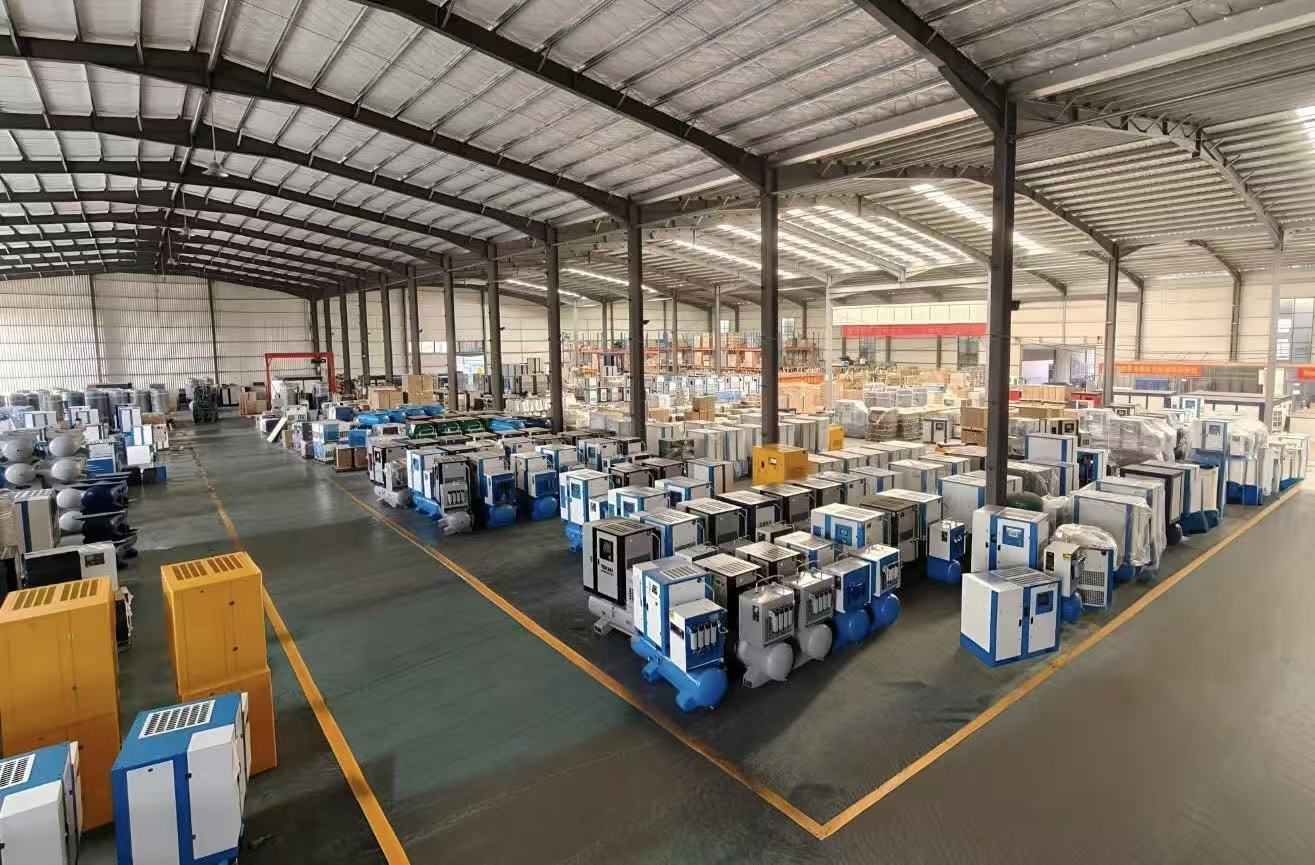
Production area at UMW Air, where units are assembled and prepared for pre-shipment checks. Image: UMW Air.
Site conditions still decide the outcome. A unit rated for a temperate workshop and installed in an unventilated corner beside a heat source will run hotter than any factory test predicts. Practical installation checks are unglamorous and effective: adequate clearance around the canopy intake and exhaust, no recirculation of hot discharge air back into the intake, and a maintenance routine that keeps the cooler fins clean in dusty environments such as construction support or foundry work.
Acceptance criteria and purchasing terms for the order
The commercial terms attached to this series are unusually simple for industrial equipment. UMW Air reports a minimum order quantity of one unit and a typical lead time of three days. Both are company-reported positions rather than independently verified commitments, and both need to be restated in the quotation for the exact configuration being bought. A three-day typical lead time is a useful signal about stock or standard-configuration availability; it is not a dispatch date, and it does not automatically cover export packing, documentation or freight booking.
The table below converts the gaps identified earlier into a checklist that can be attached to the purchase order. Each line exists because a series-level or company-level statement is being made contractual at model level.
| Acceptance check | What to request | Why it matters |
|---|---|---|
| Model and nameplate | Model code, serial number, rated power, pressure setpoint and flow at that setpoint, matched to the datasheet | Prevents a series maximum being accepted as the delivered flow of the specific unit |
| Flow verification | Free air delivery result with test conditions, referenced to ISO 1217:2009 | Makes the flow figure comparable with competing offers and contractually testable |
| Thermal test record | Evidence of the pre-shipment thermal run, with radiator and fan function confirmed | Directly addresses the overheating control the manufacturer describes |
| Pressure integrity | Receiver and pipework pressure test or leak check at rated pressure | Safety documentation plus a baseline for on-site leakage control |
| Electrical data | Voltage, phase, frequency and starting current against the site supply | Prevents a commissioning failure that is expensive to correct after shipment |
| Conformity documents | CE Declaration of Conformity showing directive scope and model coverage; ISO 9001:2015 certificate with validity date | Market access and supplier qualification, with the certificate scope checked against the model bought |
| Air-quality configuration | Air-end lubrication type, filtration arrangement and oil carryover or purity class where the application is contamination-sensitive | Determines whether the unit is eligible for food packaging or sensitive assembly work |
| Commercial terms | MOQ confirmation, dispatch date, packing standard, incoterms, warranty terms and recommended spare-parts list | Turns a quoted three-day lead time into a contractual delivery commitment |
Where the published data stops
Honest comparison requires naming the gaps. No public price is published for the Micro series, so cost per unit of delivered air cannot be calculated from open sources; that comparison belongs in the quotation stage. Model-level figures for airflow, sound level, protection class and dryer or filter options are not stated in the series envelope described here, which is why the first table in this article separates published specifications from items to confirm. The CE certification and the ISO 9001:2015 certificate are company-published, and the certificate numbers, issuing bodies and model coverage still need to be checked against the unit being bought. The one-unit MOQ and three-day lead time are company-reported.
External market data does not close these gaps. It describes the category, not the machine. A forecast that the global screw compressor market reaches USD 16.30 billion by 2030, reported by MarketsandMarkets in a 2025 study, says nothing about whether a 5.5 kW unit suits a particular CNC cell. The same applies to the structural figures: Asia Pacific accounted for 43.7% of 2025 revenue in one commercial research estimate, oil-filled rotary screw compressors held 61.7% of 2025 market share in the same source, and stationary screw compressors held 67.6% in 2024 according to another. These are third-party estimates, and they are useful for understanding why the small stationary band is commercially crowded — not for sizing a compressor.
Outlook for small-capacity screw purchases
The direction of travel in this band is documentation rather than radical redesign. Buyers increasingly ask for a flow result with a stated test basis, a thermal test record and a certificate scope that names the model, because the differences between small packaged compressors are invisible on a specification sheet that quotes only a series maximum. Suppliers that can answer those requests quickly hold an advantage in shortlists that are decided on verification rather than headline numbers.
Energy performance is the second theme, and it needs care. Research cited in this category puts the saving from permanent-magnet variable-speed drive at 20–30% compared with conventional induction motors, while Atlas Copco claims savings of up to 60% for its VSD compressors against traditional fixed-speed machines. Both figures are conditional: they depend on how far and how often the load varies. A plant running a small compressor steadily near full load has little to gain from speed control, while a plant with wide swings between shifts has a genuine case. For the Micro band, the practical step is to ask directly whether a variable-speed configuration is offered at 4–7.5 kW, rather than to assume either answer.
Frequently asked questions
How do the ML-4A, ML-5.5A and ML-7.5A actually differ?
They differ in rated motor power: 4 kW, 5.5 kW and 7.5 kW respectively. They share the published series envelope of up to 1.1 m³/min maximum airflow, an 8–13 bar pressure range, a 140 L air receiver, a sheet-metal enclosure and a single-stage screw air end. In practice the difference is capacity headroom at a given pressure against capital cost and part-load behaviour, so the choice depends on measured peak demand at your working pressure and on the electrical supply available.
Does every model in the series deliver 1.1 m³/min?
No. The 1.1 m³/min figure is published as a maximum for the Micro series, not as the delivered flow of each model. Delivered free air delivery varies by model and falls as working pressure rises. A buyer should request the model-specific flow at the pressure the plant will actually run, with the test conditions stated and the result referenced to ISO 1217:2009, so the figure can be compared with alternative offers.
Which model suits a CNC machining cell or a laser-cutting operation?
For CNC cells, the choice follows measured peak demand for clamping, blow-off and chip evacuation, with the 140 L receiver absorbing short bursts; the smallest model that covers that peak with a margin is usually the efficient choice. For laser cutting with compressed air as assist gas, the machine builder's required pressure and purity decide the answer first. If that requirement sits at or beyond the top of the 8–13 bar range, no model in this series is suitable, regardless of motor power.
What should a purchase order for a single Micro unit contain?
At minimum: model code and serial number with nameplate values matched to the datasheet; free air delivery at the specified pressure with the test basis; the pre-shipment thermal test record; a pressure integrity check on the receiver and pipework; electrical data matched to the site supply; a CE Declaration of Conformity showing directive scope and model coverage plus a valid ISO 9001:2015 certificate; the air-quality configuration; and commercial terms covering the one-unit minimum order, the confirmed dispatch date behind the three-day typical lead time, packing, incoterms, warranty and spare parts.
Can the Micro series be used for food packaging?
Air purity is the deciding factor, and the published series envelope does not state whether the air end is oil-free or what oil carryover the package achieves. Oil-free rotary screw designs are positioned by major manufacturers for food and beverage applications, and Ingersoll Rand states that its oil-free rotary screw compressors are certified to ISO 8573-1:2010 Class 0 — both manufacturer statements about their own products. For food packaging, confirm the air-end type, the filtration train and a documented purity result before ordering, or verify that oil-injected air with filtration meets the requirements of your food-safety plan.
Decision summary
The comparison reduces to a short sequence. Measure peak simultaneous air demand, then state the pressure at which it occurs. Match that pair against the model-specific flow of the ML-4A, the ML-5.5A or the ML-7.5A rather than the series maximum. Check the site supply and the ambient conditions the package will live in. Confirm the air-quality configuration if the application is contamination-sensitive, and confirm the required assist-gas pressure before considering this band for laser cutting. Then attach the acceptance checklist to the order, so that the flow figure, the thermal test record, the conformity documents and the dispatch date are contractual rather than assumed.
Current specification sheets and written quotations are available through UMW Air at UMW Air. Buyers evaluating this series alongside other packaged compressors should apply the same four checks — flow at a stated pressure, thermal test evidence, certificate scope, and a written dispatch date — so that competing offers are compared on the same basis.
Have Questions or Need More Details?
Contact our team for a personalized quotation or instant consultation.
Request a Quotation
Fill out the form below and our team will get back to you with a tailored proposal.
WhatsApp Direct Chat
Prefer to chat in real-time? Message us on WhatsApp for instant assistance & quick answers.
- Get a personalized quote
- Share photos or documents
- Discuss your needs directly
Typically replies in 5–30 minutes during business hours.