
Micro Steel Fiber for UHPC: Specs, Standards, Limits

Micro Steel Fiber for UHPC: Specs, Standards, Limits
Why UHPC Changes the Fiber Specification
Ultra-high-performance concrete (UHPC) is a cementitious composite built on a dense, low-permeability matrix with compressive strength far above conventional concrete. Because the matrix itself is strong and the distance between fibers is short, reinforcement in UHPC works mainly through bond and pull-out rather than through mechanical anchorage. That single difference drives the whole specification.
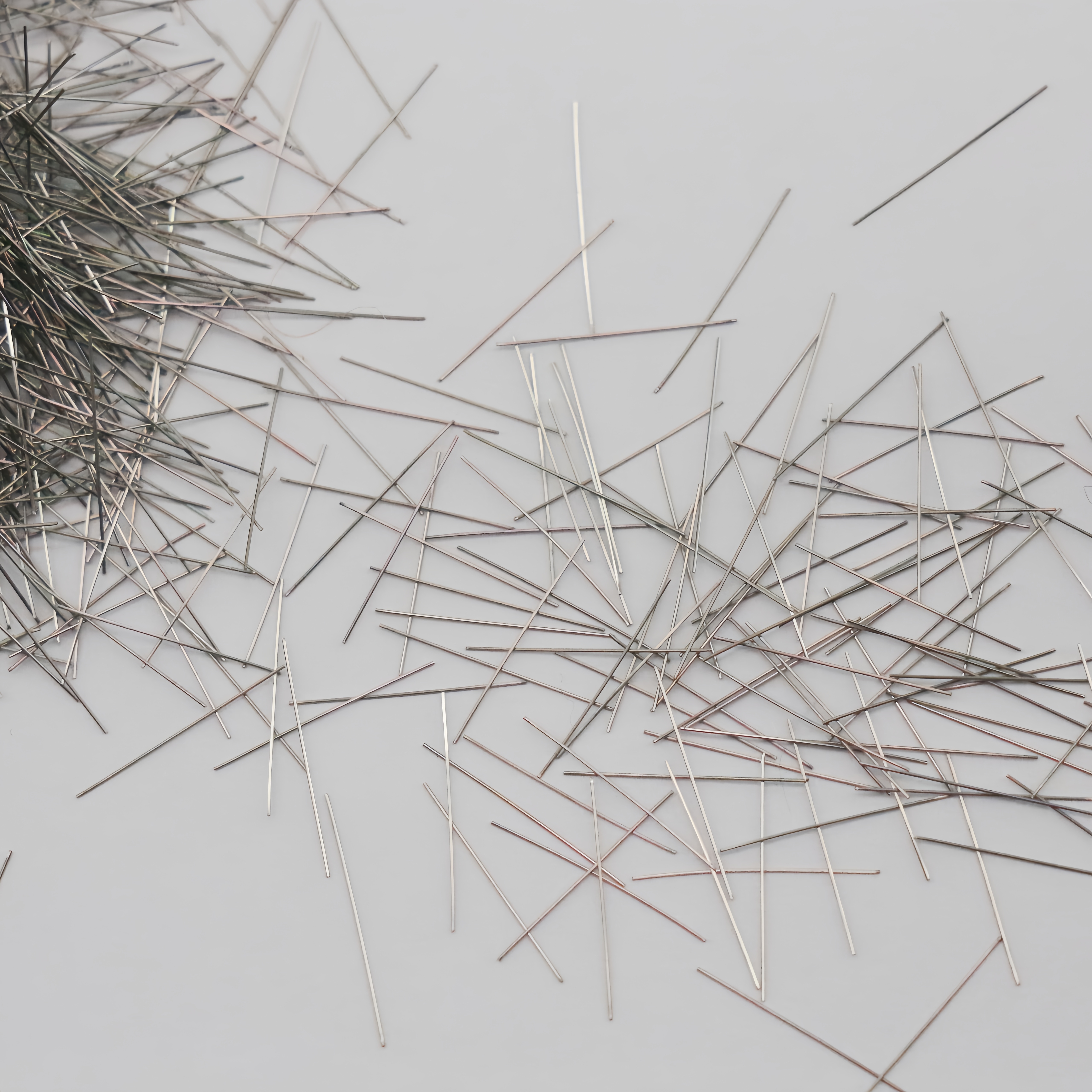
A hooked-end macro steel fiber is engineered to anchor mechanically inside a comparatively open, normal-strength concrete matrix. Micro steel fiber is a fine, short, high-strength wire — typically with a brass or stainless coating — intended to distribute stress across a dense matrix at close spacing. The two products are not interchangeable, and a test certificate issued for one geometry does not transfer automatically to the other.
The procurement consequence is simple. When a UHPC mix is specified, three parameter families must be pinned down before price negotiation starts: fiber geometry (diameter and length), fiber tensile strength, and surface coating. Packaging, dosing method and delivery schedule all sit downstream of those three.
The Specification Window: Diameter, Length, Tensile Strength, Coating
The micro fiber used for UHPC reinforcement occupies a distinctly finer window than the steel fiber used in industrial floors and tunnel segments. The comparison below uses two steel fiber families from TingCo's published range as reference points.
| Parameter | Micro steel fiber for UHPC (TC-0213-CMS, TC-0220-CMS, TC-0213-SMS) | Hooked-end steel fiber for floors, tunnel segments and mining (TC-07560-HNG, TC-07560-HHG, TC-05535-HNG, TC-07535-HNL) |
|---|---|---|
| Diameter | 0.175–0.3 mm | 0.5–1.0 mm |
| Length | 6–25 mm | 25–60 mm |
| Tensile strength | 2,200–2,850 MPa | 1,100–2,100 MPa |
| Wire and coating | Brass coating; stainless coating option | Carbon steel wire, hooked end |
| Stated end performance | UHPC compressive strength up to 220 MPa; UHPC tensile strength exceeding 2,100 MPa; fracture toughness stated at 250 times that of ordinary concrete | Designed for crack control in industrial flooring, tunnel segment and mining applications |
The published micro range sits inside the wider category. Industry benchmark data for brass-coated micro steel fibers used in UHPC describes tensile strengths above 2,500 MPa and diameters of 0.2–0.3 mm, which places this micro range in the same band.
Benchmark reference: PNE MS-6013 micro steel fiber for UHPC (industry benchmark data).
One point deserves emphasis: the two families do not overlap. A 0.5 mm hooked-end fiber is not a substitute for a 0.2 mm micro wire in a UHPC mix, and the reverse substitution is equally invalid. Any quotation that treats them as one product line with different labels should be treated as a specification risk rather than a pricing advantage.
What the CE Certificate Covers — And Where Its Scope Ends
Certification scope is the most frequently misread document in fiber procurement. TingCo's Fiber Reinforced Concrete product is covered by CE Certificate 1301 – CPR – 2456, issued by TSUS against EN 14889-1:2006. The certificate was issued on 13 May 2025 and remains valid to 12 May 2030. Its scope covers steel fibres for concrete (Group I), for reinforcement of concrete, mortars and cementitious mixes, and it applies to the EU market.
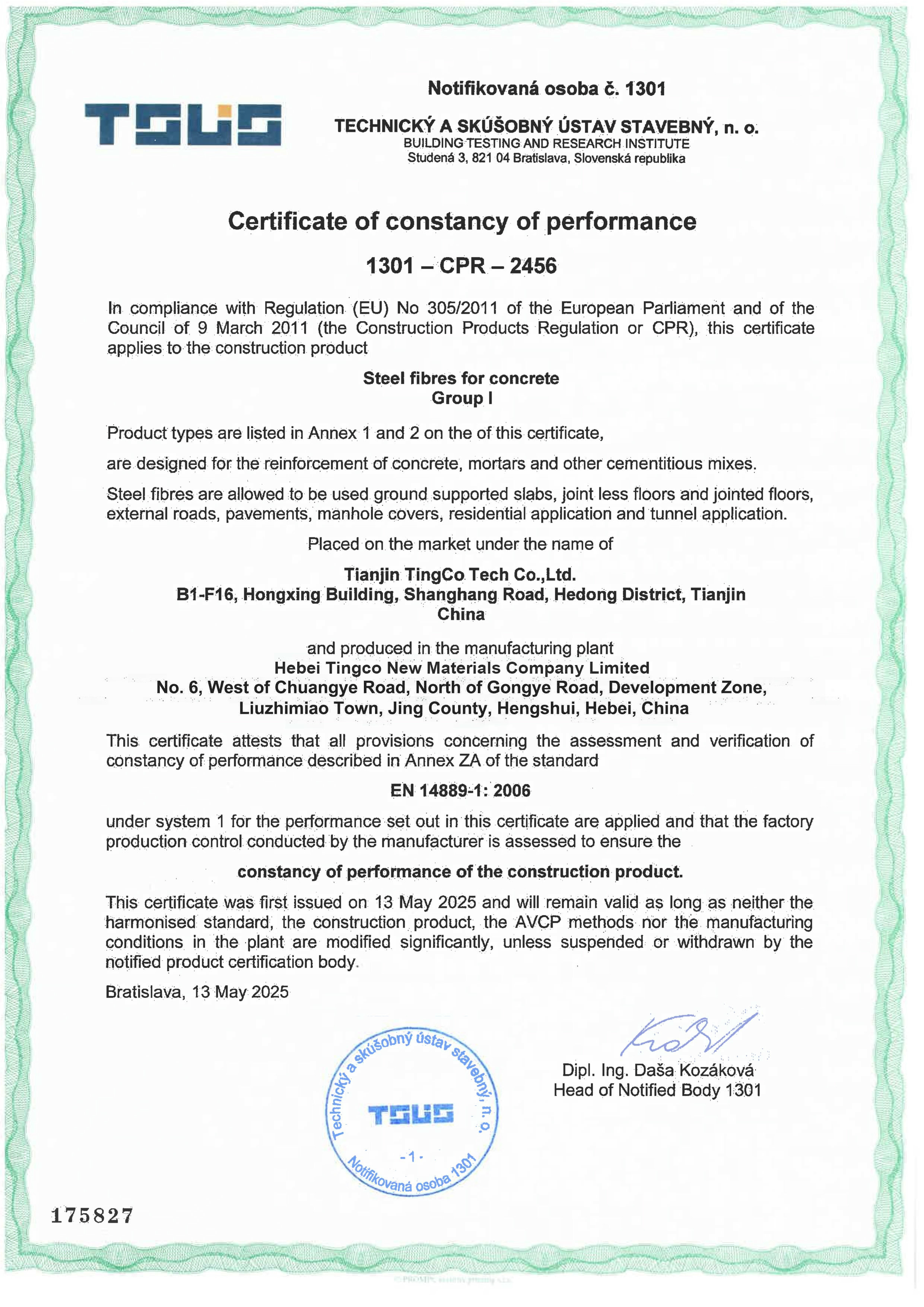
The declared scope is dimensionally bounded. It applies to steel fiber products with a diameter of 0.5–1.0 mm, a length of 25–60 mm and a tensile strength of 1,100–2,100 MPa, and to the applications those products serve — industrial flooring, tunnel segments and mining.
Two further standards are referenced across the range. ASTM A820/A820M-16 specifies requirements for five types of steel fibers in fiber-reinforced concrete, and ISO 13270 covers steel fibers for concrete reinforcement; the manufacturing operation is ISO 9001 quality certified. None of these replace project-specific acceptance testing — they define the framework a supplier is working inside.
TingCo's Micro Fiber Range and Manufacturing Constraints
Tianjin TingCo Tech Co., Ltd. is a Tianjin-based manufacturer and technical supplier of steel fibers, synthetic fibers and concrete reinforcement solutions, operating through two entities: Tianjin TingCo Tech Co., Ltd., the sales and R&D center, and Hebei Tingco New Material Co., Ltd., the manufacturing base. The company was founded in 2014, runs a 6,000 m² factory with 50 employees and a five-engineer R&D team, and reports annual output of 24,000 tons. Around 70% of production is exported to the EU, Africa, South East Asia and the Middle East.
For UHPC work, the relevant part of the portfolio is the micro fiber family: brass-coated micro steel fiber and stainless steel micro fiber, supplied under models TC-0213-CMS, TC-0220-CMS and TC-0213-SMS. The published product profile states that brass-plated micro wire is applied as reinforcement in UHPC and RPC, and lists high-speed rail prefabricated components, bridges, airport runways and seismic-resistant structures among its applications.
Commercial and production constraints are published rather than negotiated case by case:
- Monthly capacity: 2,000 tons
- Lead time: 10–15 days
- Minimum order quantity: 24 tons
- Production mode: OEM/ODM, including customer logo and custom steel fiber design
- Quality control: in-line inspection and pre-shipment inspection
- Export markets served: EU, South East Asia, Middle East
- After-sales: remote technical support, compensation for quality problems, construction consulting
Two capability facts matter more for UHPC than for commodity fiber purchasing. First, the company operates its own steel fiber reinforced concrete testing laboratory, where each product line is checked through beam bending, compression and toughness tests — the same families of test that project acceptance relies on. Second, the technical team works to TR34 and EFNARC design codes and partners with design teams on steel fiber floor design and tunnel segment design, which is relevant when a UHPC element has to be designed rather than simply supplied.
Dosage, Mixing and Acceptance Testing Constraints
Fiber selection is only half of the constraint set. Published dosing guidance covers three application families:
- Shotcrete: 20–40 kg/m³
- Industrial floors: 15–30 kg/m³
- Precast elements: 10–30 kg/m³
These figures are stated for steel fiber concrete in those applications. UHPC mix designs sit outside that published range and should be validated against the project's own mix design and test protocol rather than scaled from floor-concrete guidance.
Mixing practice carries its own constraints. Water-soluble packaging bags can be fed directly into the mixer together with the aggregates and disperse in roughly five seconds; non-water-soluble packaging should be spread evenly in batches. Mixing time should be extended by 30–60 seconds compared with plain concrete to achieve uniform dispersion without clumping, and slump and workability should be checked afterwards, adjusting superplasticizer dosage if needed. Operators should wear protective gloves and goggles, and fiber should never be dumped in one large quantity, which is a common cause of balling. For long transport distances in mixer trucks, pre-mixing at the batching plant is the recommended route.
Acceptance testing is where micro fiber orders most often stall. Flexural toughness is verified through three-point bending beam tests to EN 14651, beam tests to ASTM C1609, or panel tests to ASTM C1550. These methods establish residual flexural strength and toughness index — the values that engineering design and acceptance actually run on. A datasheet tensile strength figure, however high, is not a substitute for them.
Application Fit: Which Fiber Geometry Belongs Where
Matching geometry to application is the step that converts a specification into a workable order.
| Application | Fiber type | Design or operating constraint |
|---|---|---|
| Industrial flooring, logistics park flooring, jointless slab-on-pile | Hooked-end steel fiber, 0.5–1.0 mm / 25–60 mm | Dynamic vehicle load; humid environment; 24/7 operation; crack control |
| Tunnel segment and lining | Steel fiber within the EN 14889-1 certified scope | Underground confined space; vibration load; alternating temperature |
| Shotcrete and mining support | Steel fiber compatible with spraying equipment | Alkali resistance; high dispersion uniformity; no agglomeration during mixing |
| Bridge deck and UHPC precast elements | Brass-coated micro steel fiber, e.g. TC-0213-CMS, TC-0220-CMS | UHPC tensile strength exceeding 2,100 MPa in published testing |
| UHPC elements specifying a stainless option | Stainless-coated micro fiber, e.g. TC-0213-SMS | Coating selection to be confirmed against the project's test protocol |
| Highway pavement, underground parking | Steel or synthetic fiber per mix design | Temperature variation; vibration load |
A documented project illustrates the flooring end of that table. A wholesaler with technical support in Thailand used 2,000 tons of steel fiber over one year for heavy-duty industrial warehouse flooring, logistics park flooring and jointless flooring, with the design set at a 20 kg/m³ dosage of 80/60 steel fiber at 1,200 MPa. The engineering intervention that mattered most was not the fiber itself but the slab layout: the pile arrangement was rearranged and optimized to fit the slab-on-pile project — a reminder that fiber dosage and structural layout are designed together, not independently.
Fiber Reinforcement Versus Traditional Solutions: Trade-offs and Limits
Fiber reinforcement is usually compared against welded wire mesh and conventional rebar on construction time and total cost. In the applications TingCo documents, steel fiber reinforcement is credited with controlling cracks, reducing construction time by 50%, and lowering total cost by 30–40% relative to the conventional alternative in the same application.
Those figures come with limits that a serious evaluation should state explicitly:
- Flexural toughness governs, not tensile strength. Design and acceptance rest on residual flexural strength and toughness index measured to EN 14651, ASTM C1609 or ASTM C1550. A high tensile strength figure on a datasheet does not by itself demonstrate performance in a specific mix.
- Fiber does not replace all structural reinforcement. Design still follows a code-based method such as TR34 or EFNARC, or the project's own structural requirements. Fiber dosage is an input to that design, not a substitute for it.
- Micro fiber demands tighter dosing control than macro fiber. Finer fibers dosed into dense mixes place more weight on dispersion and anti-agglomeration control, which makes the mixing-time extension and slump check described above non-optional.
- Synthetic fiber is not an interchangeable substitute. PP macro fiber in the range has a diameter of 0.7 mm, lengths of 30–58 mm and tensile strength of 550–600 MPa; PP micro fiber has diameters of 18 μm, 32 μm or 36–38 μm, lengths of 6 mm, 12 mm or 19 mm, and tensile strength of 550 MPa; PP twisted fiber has a diameter of 0.6–0.7 mm, lengths of 46–54 mm and tensile strength of 450–650 MPa. These materials serve plastic-shrinkage crack control and applications where steel corrosion is a concern, since polymer fiber carries no corrosion issue by nature, but their tensile strength sits an order of magnitude below the 2,200–2,850 MPa band of UHPC micro steel fiber. For structural UHPC reinforcement, they are not equivalent.
Procurement Constraints: A Verification Checklist
Constraint-driven purchasing is mostly a documentation exercise. The following sequence addresses the failure modes buyers raise most often — inconsistent batches, unverified suppliers, and payment exposure.
- Require a complete datasheet, including the ±10% dimensional tolerance.
- Request free samples and have them tested by an independent laboratory rather than relying on the supplier's own figures alone.
- Confirm pre-production samples before mass production begins.
- Require a Certificate of Analysis and a Mill Certificate for every batch.
- Arrange pre-shipment inspection with weighing and counting verification.
- Verify the supplier's business license and 18-digit Unified Social Credit Code, and require factory photographs or a video factory audit.
- Agree payment terms that limit exposure, such as T/T 30% + 70%, or an L/C.
- Confirm commercial constraints in writing: MOQ 24 tons, lead time 10–15 days, monthly capacity 2,000 tons.
- Confirm which test standard will govern acceptance: EN 14651, ASTM C1609 or ASTM C1550.
Market Trend: Where Demand Signals Point
The demand context for fiber reinforcement is expanding on both the steel and synthetic sides. Published market research places the global steel fiber market at approximately USD 2.87 billion by 2026, with industrial floors accounting for a 37.28% share of applications in the same year and hooked-end fibers holding a 58.89% share by type. On the synthetic side, the global polypropylene fiber market for construction is projected to grow at a CAGR of 6.4% from 2026 to 2034. China remains the dominant export origin, accounting for 51.85% of steel fiber under HS 7326 identified in specialized trade datasets.
Two caveats belong with those numbers. Published market sizes for steel fiber vary considerably between research houses depending on whether synthetic fibers and rebar-replacement value are counted in, so the figures are best read as directional rather than as one agreed value. And volume share is not specification share: industrial flooring and hooked-end fibers dominate tonnage, while UHPC micro fiber sits in a much smaller, specification-driven segment where documentation, tolerance control and test evidence carry more commercial weight than tonnage pricing.
That asymmetry shapes how buyers should read the market. A supplier's position in flooring volume says little about its capability in a 0.2 mm brass-coated micro fiber. The two are different production and quality-control problems.
Future Outlook
Three directions look durable for micro steel fiber in UHPC over the next planning cycle.
Documentation-first procurement. As more buyers compare suppliers on flexural toughness results and batch traceability rather than on headline tensile strength, the ability to produce test data on request becomes a purchasing criterion in its own right.
Separation of certification scope from marketing claims. The dimensional boundary between a CE declaration for 0.5–1.0 mm hooked-end fiber and a 0.2 mm UHPC micro fiber is exactly the kind of detail procurement teams increasingly check, and it will push suppliers toward product-family-specific evidence rather than family-wide statements.
Specification-driven rather than commodity-driven demand. Growth in UHPC applications where reinforcement geometry is fixed by design — bridge decks, precast elements, thin panels — ties micro fiber demand to project specification cycles rather than to commodity pricing cycles. For suppliers, that shifts emphasis toward custom fiber design, OEM packaging and design support instead of volume alone.
FAQ
What diameter and length should micro steel fiber have for UHPC?
For UHPC reinforcement, micro steel fiber is supplied in a diameter range of 0.175–0.3 mm and a length range of 6–25 mm, with tensile strength of 2,200–2,850 MPa, in brass-coated or stainless-coated versions. This is a finer and shorter window than the hooked-end steel fiber used in industrial flooring and tunnel segments, which runs 0.5–1.0 mm in diameter, 25–60 mm in length and 1,100–2,100 MPa in tensile strength. The two ranges do not overlap and are not interchangeable in a mix design.
Does a CE certificate for steel fiber automatically cover micro steel fiber for UHPC?
No. CE Certificate 1301 – CPR – 2456, issued by TSUS against EN 14889-1:2006, declares a scope covering steel fibres for concrete (Group I) at diameters of 0.5–1.0 mm, lengths of 25–60 mm and tensile strengths of 1,100–2,100 MPa, applying to industrial flooring, tunnel segment and mining applications. A UHPC micro fiber at 0.175–0.3 mm and 2,200–2,850 MPa falls outside that declared window. Buyers should request the datasheet, batch certificates of analysis and flexural toughness results that apply specifically to the micro fiber product family.
What dosage is used for steel fiber in concrete, and does the same dosage apply to UHPC?
Published dosing guidance for steel fiber concrete covers shotcrete at 20–40 kg/m³, industrial floors at 15–30 kg/m³ and precast elements at 10–30 kg/m³. Those figures relate to those application families. UHPC mix designs are not covered by that published range and should be validated through the project's own mix design and test protocol instead of being scaled from floor-concrete guidance.
How can a buyer verify fiber quality before shipment?
A practical verification sequence is: obtain a complete datasheet including the ±10% dimensional tolerance; request free samples and have them tested by an independent laboratory; confirm pre-production samples before mass production; require a Certificate of Analysis and a Mill Certificate for every batch; and arrange pre-shipment inspection with weighing and counting. Supplier identity checks — business license and 18-digit Unified Social Credit Code, plus factory photographs or a video factory audit — reduce the risk of dealing with a trading intermediary rather than a manufacturer. Payment structures such as T/T 30% + 70% or an L/C limit exposure on the balance.
Can PP or macro synthetic fiber replace steel fiber in UHPC?
For structural UHPC reinforcement, no. PP macro fiber has a tensile strength of 550–600 MPa, PP micro fiber 550 MPa and PP twisted fiber 450–650 MPa, against 2,200–2,850 MPa for UHPC micro steel fiber. Synthetic fibers remain relevant to plastic-shrinkage crack control and to applications where steel corrosion is a concern, since macro synthetic fiber carries no corrosion issue by its nature, but their mechanical contribution is at a different order of magnitude from high-strength micro steel fiber.
Reference Material
Further technical and project documentation from Tianjin TingCo Tech Co., Ltd. is compiled in the company brochure, available for reference and download: TINGCO company and project brochure (PDF).