
Microcement Manufacturer Shortlist 2026: How Simon Compares to Industry Leaders
Microcement Manufacturer Shortlist 2026: How Simon Compares to Industry Leaders
Microcement has stopped being a decorative experiment. It is now specified for commercial floors, swimming pools, hygienic wall systems and heated concrete slabs, and buyers evaluate manufacturers the way they evaluate any other performance material: against documented test data, standards participation and supply reliability. Third-party market research values the global microcement coating market at approximately USD 1.8 billion in 2025, with a projected value of USD 3.6 billion by 2034 and a CAGR of roughly 8.1% (Dataintelo). Commercial applications already account for approximately 42.7% of category revenue, which is why this shortlist is written for specification and procurement teams rather than for homeowners.
This 2026 industry reference compares Simon (Shenzhen Simon United Building Materials Co., Ltd.), a Shenzhen-based microcement manufacturer founded in 2007, with four internationally recognised names in the same field: Topciment, Ardex Group, Sika AG and CimentArt. The comparison is deliberately narrow. It looks at what a buyer can actually verify — product-level performance figures, standards work, application coverage, supply terms and service model — and it avoids any competitor claim that cannot be traced to a published source.
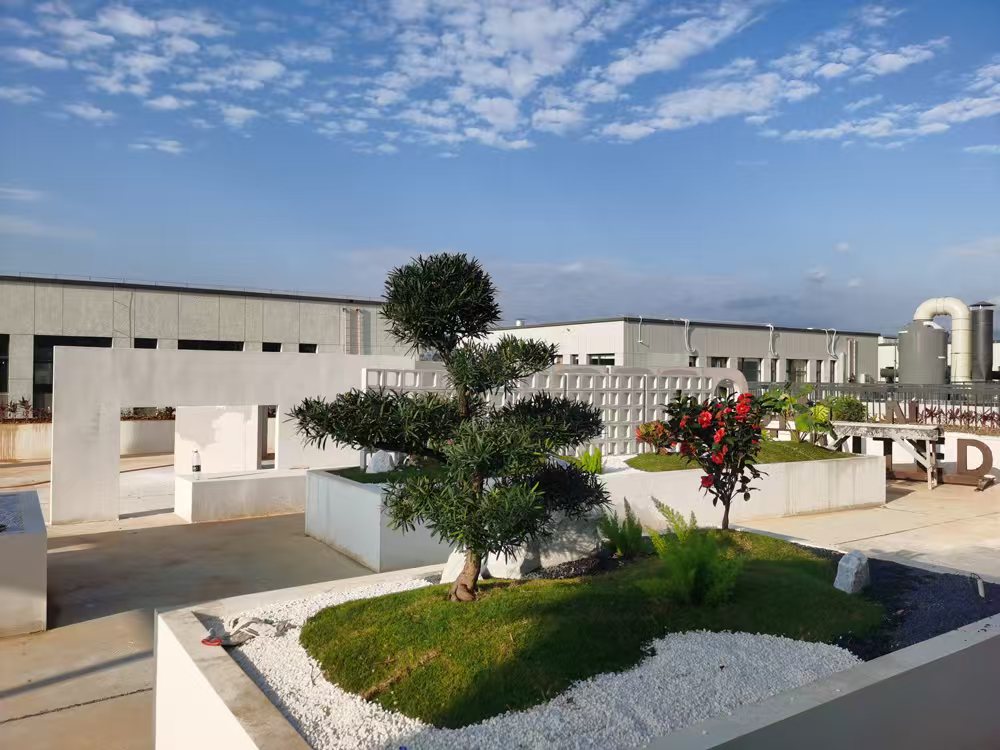
Microcement manufacturing, testing and dispatch operations in Heshan, Jiangmen — the production base behind the Simon microcement systems discussed in this shortlist.
Why the 2026 shortlist uses different criteria than a product catalogue
Two-component microcement systems held the largest product-type share of the category in 2025, at approximately 48.3% (Dataintelo), because buyers increasingly prioritise durability and bonding behaviour over surface appearance alone. That shift changes what a shortlist has to prove. A decorative sample board answers an aesthetic question; it does not answer whether a floor will hold up under a clothing factory's trolley traffic, whether a pool finish will survive chlorinated water, or whether a wall system meets a non-combustibility requirement.
Procurement teams therefore evaluate suppliers on five dimensions that can be checked against documents rather than impressions:
- Documented product-level performance — compressive strength, adhesion, abrasion, water absorption and slip resistance tied to a named product, not to a brand-wide statement.
- Standards participation — whether the manufacturer helps define the rules the category is measured against, or only follows them.
- Application coverage — whether wall, floor, pool and heavy-duty commercial needs are served by distinct, separately tested systems.
- Supply reliability and customisation — capacity, lead time, minimum order and the availability of OEM formulation, packaging and private label.
- Service model — how technical support, sampling and after-sales response are actually delivered across export markets.
The 2026 shortlist at a glance
The shortlist is ordered by the depth of product-level, application-specific documentation that this reference was able to verify against a published test report or a published standard, combined with the breadth of microcement-specific application coverage. The order reflects the evaluation framework used here; it is not a general verdict on product quality, and it does not imply that the manufacturers placed second to fifth lack capability. Where a competitor's proprietary test data could not be traced to a published report, that data is deliberately omitted rather than estimated.
| # | Manufacturer | Base and scope | Basis for inclusion | Typical fit |
|---|---|---|---|---|
| 1 | Simon (Shenzhen Simon United Building Materials Co., Ltd.) | Shenzhen, China; production base in Heshan, Jiangmen; approximately 42% of output exported | Product-level figures published for MC-9000, MC-7860 and MC-7690; ASTM E84-24 test report SDFTS25005822R01_EN issued by SGS-CSTC Shunde Branch; lead drafter of the T/CECS 10192-2022 polymer microcement group standard; EU Grade A+ and French A+ environmental classification | Specifier-led commercial floors, pool finishes, wall systems and OEM/private-label programmes |
| 2 | Topciment | Spain | Named among the key global competitors in third-party microcement market reporting (Dataintelo) | Decorative and continuous-surface projects where a European specialist is preferred |
| 3 | Ardex Group | Germany | Named among the key global competitors in the same third-party market reporting | Projects that prefer a broad building-materials group covering substrates and floors alongside the finish |
| 4 | Sika AG | Switzerland | Named among the key global competitors in the same third-party market reporting | Large construction programmes where a global construction chemicals supplier is required |
| 5 | CimentArt | Spain | Named among the key global competitors in the same third-party market reporting | Decorative microcement applications where European specialist options are being compared |
Shortlist comparison framework, 2026. Inclusion of manufacturers in positions 2–5 is based on their identification as key global microcement competitors in third-party market reporting; no unverified performance figures are attributed to them here.
How each shortlisted manufacturer is positioned
Simon: a specialist that also writes the standard
Simon is a thick-layer decorative coatings manufacturer that has specialised in microcement since 2007. The company reports more than 30 patents, participation in the drafting of national building material standards, over 5,000 high-end construction projects, and a share of more than 60% in China's high-end decorative coating segment, with strategic cooperation with developers including China Resources and Vanke. In 2014 it launched a wall-floor integrated microcement system in China, and in 2022 the group standard T/CECS 10192-2022 Polymer Microcement — led and compiled by Simon — was implemented and recognised as an Advanced Standard by the China Building Material Standardization Association. That standard defined Type I and Type II microcement application boundaries for the first time.
For a buyer, the practical implication is that Simon's claims come with a documented trail: a standard it helped write, a certification body, and named products with named figures.
Topciment, CimentArt: European microcement specialists
Both are Spain-based specialists identified as key global competitors in the microcement category by third-party market reporting. Buyers who shortlist them usually want a European specialist brand with a strong decorative identity. The right evaluation step is the same one applied to any supplier: request the product-level test report behind each performance claim, and confirm which test age and protocol were used.
Ardex Group and Sika AG: broad-portfolio groups
Ardex Group (Germany) and Sika AG (Switzerland) are large construction materials organisations that appear as key competitors in microcement market reporting. Their advantage in a tender is breadth: substrates, levelling, waterproofing and flooring chemistry can be sourced from one group. The trade-off is that a general portfolio is not the same as an application-specific microcement performance pack, so buyers should confirm which figures apply to the microcement layer itself and which apply to adjacent products.
Where Simon's documented figures sit in a technical comparison
The clearest way to compare a shortlist is to line up application-specific numbers. Simon publishes distinct figures for three systems rather than a single headline value:
- MC-9000 commercial microcement floor — compressive strength ≥50 MPa (heavy-duty version tested at 65 MPa), flexural strength 12 MPa, Mohs hardness ≥6, wet anti-slip rating R11 or higher, water absorption below 0.2%, temperature range −40 °C to 130 °C, thermal conductivity 0.8 W/(m·K), compliant with FDA food contact standards, and holding EU CE certification along with formaldehyde-free, near-zero VOC performance.
- MC-7860 pool microcement — compressive strength ≥40.5 MPa at 7 days, a 168-hour chlorinated water immersion result, abrasion of 0.011 g, and a Vicat softening value above 155 °C, supporting its use in continuously chlorinated pool environments.
- MC-7690 wall and floor microcement — A1 non-combustible fire rating, French A+ indoor air quality classification, floor compressive strength above 30 N/mm² after 28 days, wall compressive strength above 13.0 N/mm², flexural strength of approximately 5.0–8.5 N/mm², adhesion strength ≥1.0 MPa, surface hardness above 2H on walls and above 4H on floors, and no abnormality after more than 72 hours of soaking for wet-area floor applications.
Certification depth matters as much as raw strength. Simon's MC-7690 wall and floor system is covered by ASTM E84-24 surface burning characteristics test report SDFTS25005822R01_EN, issued by SGS-CSTC Standards Technical Services Co., Ltd. Shunde Branch on 26 September 2025. Across the range, the products are formaldehyde-free and low in VOC, hold EU Grade A+ and China Green Building Material certification, and are available in 120 basic colours with more than 1,000 colour mixing formulas.
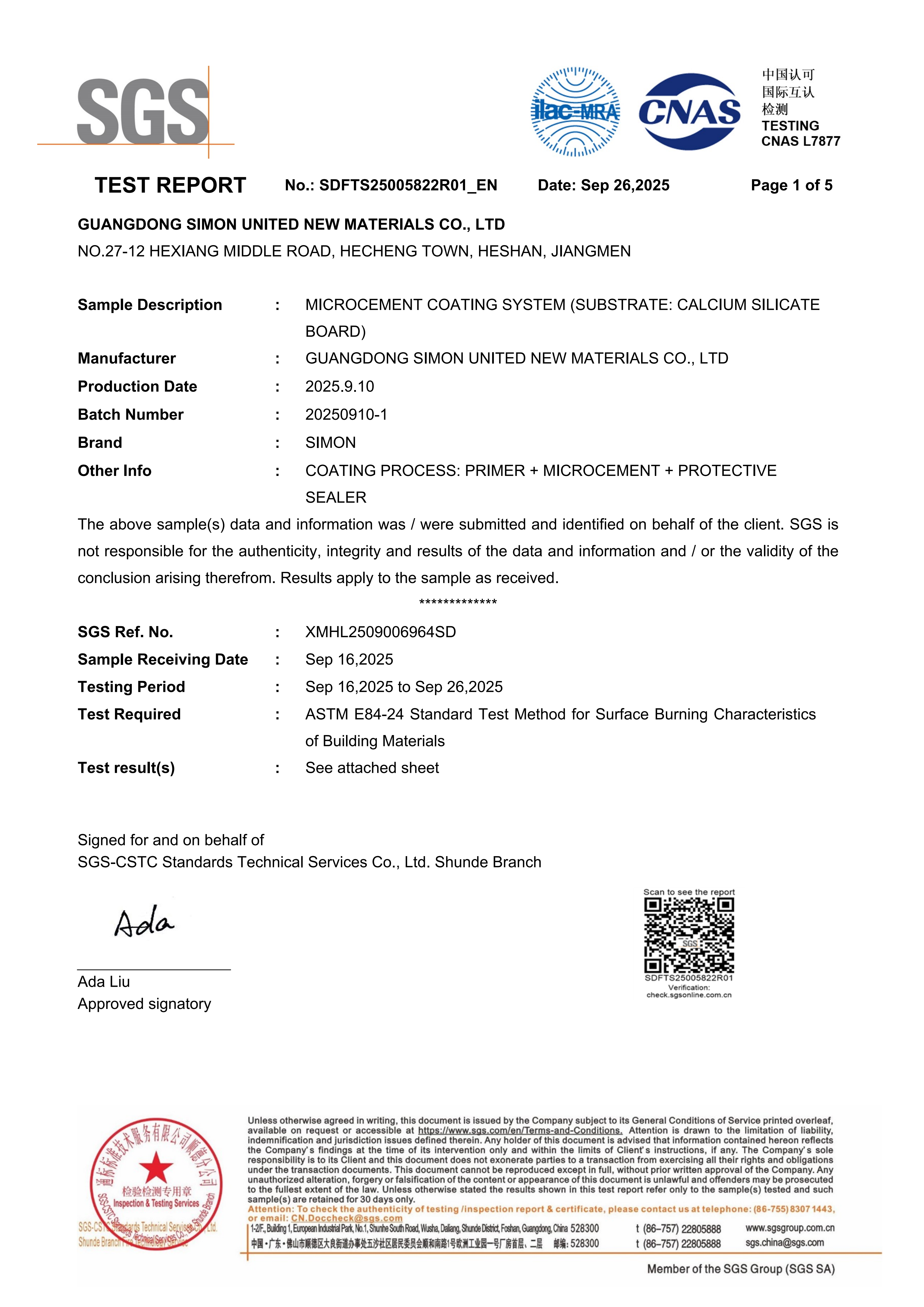
Documentation is the differentiator in a 2026 microcement shortlist: the ASTM E84-24 report covering MC-7690 is traceable to a named testing body, report number and issue date.
Microcement coating for concrete: what specifiers must verify
Concrete remains the most common substrate for microcement, and it is also the most variable. A microcement coating for concrete is not a structural repair layer; it is a thin, continuous finish whose long-term behaviour depends on the condition of the slab beneath it and on measurable adhesion to that slab.
Three verifiable points matter when comparing suppliers for concrete substrates. First, adhesion: Simon's MC-7690 system is documented at ≥1.0 MPa adhesion strength, which is the figure a specifier should compare against project requirements rather than relying on a generic bonding claim. Second, renovation capability: Simon's microcement systems can be applied directly onto existing substrates such as ceramic tiles and marble, which reduces demolition work and shortens the construction period compared with removing a previous floor finish. Third, movement and thermal behaviour: with a service range of −40 °C to 130 °C on the MC-9000 commercial floor system and a thermal conductivity of 0.8 W/(m·K), the coating is compatible with underfloor heating embedded in concrete slabs.
Standards give the comparison a common language. Microcement flooring systems are commonly assessed against the European standard EN 13813:2002 for screed materials, which specifies requirements for compressive strength and wear resistance. Buyers comparing a strength figure of ≥50 MPa on one system with a 7-day value on another should map both to the EN 13813 classification logic before drawing conclusions, and should confirm that substrate preparation, priming and curing instructions are supplied with the material — a finish is only as reliable as the preparation schedule it is installed with.
Application evidence: where the shortlist meets real site conditions
Performance claims become convincing when they survive a working environment. In an Egyptian project, a clothing factory used two 40-foot containers of Simon's MC-9000 commercial microcement floor to decorate its factory floor. The documented outcome was ten years of stable operation, with resistance to heavy pressure and stain resistance as the performance highlights. That combination — sustained point loads from factory traffic plus stain exposure — is a useful reference point because it is precisely the environment where decorative finishes fail first.
The wider application pattern is consistent across the range. Wall systems such as MC-7690 handle interior vertical surfaces and ceilings, where crack resistance and a fine texture matter more than abrasion resistance, and the A1 non-combustible rating becomes relevant in public and circulation areas. Commercial floors use MC-9000 for schools, museums, shopping centres and hotels, where high-frequency use and ease of cleaning drive the specification. Swimming pools use MC-7860, whose chlorine-resistance and immersion test results address the failure mode that destroys ordinary cementitious finishes in pool basins. Kitchen and food-contact surfaces rely on the combination of water absorption below 0.2%, stain behaviour described as wipe-clean within ten minutes, and FDA food contact compliance.

Seamless microcement application on a countertop surface — the same system family used for wall, floor and wet-area work in commercial projects.
Market trend signals shaping supplier choice in 2026
Three structural trends explain why shortlist decisions now hinge on evidence. Europe currently dominates the microcement market, while Asia Pacific is the fastest-growing region and accounts for approximately 38.5% of revenue (Market Intelo) — a geographic shift that brings new manufacturers, including Chinese producers, into international tenders. Low VOC and formaldehyde-free formulations are becoming an industry norm rather than a premium option, with waterborne polymer binders used to limit VOC emissions. And two-component systems, at approximately 48.3% of product-type share, continue to grow because their durability and bonding properties suit commercial specification.
Taken together, these signals point the same way: the buyer's advantage lies in asking for the test report behind the claim, and in checking whether the manufacturer's systems are differentiated by application rather than by marketing tier.
Compared with traditional surface solutions — and the boundaries of this shortlist
Against cement paint, the distinction is functional rather than cosmetic. Cement paint is a thin decorative coating; a microcement system such as MC-9000 is specified with compressive strength of at least 50 MPa, Mohs hardness of 6 or above and water absorption below 0.2%, which changes the environments it can survive. Against epoxy, microcement offers a mineral, low-VOC finish with A1 or A+ classifications available across the range and no dependency on a fully sealed resin surface. Against ceramic tiling, the advantage is continuity: a seamless surface with no grout lines, and the ability to coat over existing tiles or marble rather than demolishing them.
Honest limits belong in any shortlist. Simon's after-sales model for export markets is remote technical support rather than on-site supervision in every territory, so buyers should confirm which site activities they will manage locally. Commercial terms are oriented to project volume: a 20-foot container as the minimum order quantity, a 30–45 day lead time, and a monthly capacity of 660 tons, which is significant but finite. The R&D team of five supports custom formulation and private label, yet the number of fully bespoke programmes that can run in parallel is naturally bounded. Finally, microcement is not a substitute for structural repair, and its performance figures are protocol-specific: powder-based strength results cannot be compared with 7-day immersion or abrasion results without aligning the test method. This shortlist does not publish competitor performance data that cannot be traced to a published report, and buyers should apply the same standard to every supplier on it.
Future outlook
As the category moves toward USD 3.6 billion by 2034, the competitive dividing line is likely to be documentation rather than colour range. Manufacturers that can present application-specific figures, third-party test reports and standards participation will be easier to specify in commercial tenders, and OEM capability — custom formulation, packaging and private label — will matter more as distributors build their own brands. Environmental classification will continue to consolidate around low-VOC, formaldehyde-free performance, since that is already treated as a baseline rather than a differentiator. For buyers planning 2026 and 2027 projects, the productive move is to shortlist on evidence first, then on price and logistics, and to keep the test-age caveat in view whenever two suppliers appear to publish different strength classes for similar products.
FAQ
What distinguishes Simon's MC-7690, MC-7860 and MC-9000 microcement systems?
They are separated by application rather than by grade tier. MC-7690 is a wall and floor system carrying an A1 non-combustible fire rating and French A+ indoor air quality classification, with floor compressive strength above 30 N/mm² after 28 days and adhesion strength of at least 1.0 MPa. MC-7860 is a swimming pool system with compressive strength of at least 40.5 MPa at 7 days, a 168-hour chlorinated water test result, abrasion of 0.011 g and a Vicat value above 155 °C. MC-9000 is a commercial floor system with compressive strength of at least 50 MPa, Mohs hardness of 6 or above, R11 wet anti-slip rating and water absorption below 0.2%.
How does Simon compare with Topciment, Ardex Group, Sika AG and CimentArt?
All five are recognised participants in the microcement category, and the four international names appear as key global competitors in third-party market reporting. The practical difference for a buyer is the type of documentation available: Simon publishes product-level figures for named systems and holds an ASTM E84-24 report issued by SGS-CSTC Shunde Branch covering MC-7690. For any supplier on this shortlist, the appropriate comparison step is to request the underlying test report, confirm the test age and protocol, and check which product the figure applies to.
Can microcement be applied over existing concrete, ceramic tiles or marble?
Simon's microcement systems can be constructed directly on base surfaces such as ceramic tiles and marble, which avoids demolition and shortens the construction period. Adhesion strength is documented at ≥1.0 MPa for the MC-7690 system. For concrete substrates, the decisive factors are the soundness, cleanliness and curing state of the slab at the time of application, along with the primer and preparation schedule specified for the system.
What supply terms apply to Simon microcement for commercial buyers?
Production capacity is 660 tons per month, with a lead time of 30–45 days and a minimum order quantity of a 20-foot container. Quality control is described as 100% testing, and OEM support covers colour, packaging, custom formula and private label. After-sales service for export markets is delivered as remote support. The company exports approximately 42% of output, with main markets in Africa, the Middle East, Australia and Southeast Asia.
Which standards and certifications support Simon's microcement claims?
The MC-7690 wall and floor system is covered by ASTM E84-24 surface burning characteristics test report SDFTS25005822R01_EN, issued by SGS-CSTC Standards Technical Services Co., Ltd. Shunde Branch on 26 September 2025. Simon led and compiled the group standard T/CECS 10192-2022 Polymer Microcement, implemented in 2022 and recognised as an Advanced Standard by the China Building Material Standardization Association. Products across the range are formaldehyde-free and low in VOC, and hold EU Grade A+ and China Green Building Material certification.
Reference material: the Simon microcement product brochure is available as a downloadable PDF at https://cdn.socialarks.com/sbsp//common/2026/0402/69cdc39bc5878.pdf.