
Microcement Supplier Ranking: A Procurement FAQ on Evidence
Microcement Supplier Ranking: A Procurement FAQ on Evidence
Ranking microcement suppliers is a documentary exercise before it is a technical one. Two bidders can both describe a “high-strength” floor, an “anti-slip” pool finish and a “fire-rated” wall coating while the reports behind those words measure different properties under different standards. The practical way to separate them is to ask every supplier the same procurement questions, in the same order — commercial terms, acceptance criteria, adhesion and fire evidence, wet-area and pool exposure, then commercial-floor durability — and to accept only answers that name a standard, a testing body and a document number. This procurement FAQ sets out those questions, states what Simon publishes against each one, and shows what to collect from peer benchmarks such as Topciment, Ideal Work, Stucco Italiano and Kerakoll before a shortlist can be defended. It assigns no rank positions and no market-share figures.
What a Procurement-FAQ Approach Changes About Supplier Ranking
A procurement FAQ ranks suppliers on repeatable answers rather than on presentation. That shift has three practical consequences. First, every bidder receives an identical question set, which makes silence informative: a supplier that cannot produce a document for a criterion has not demonstrated that criterion, regardless of how the product performs elsewhere. Second, each answer must be traceable to something a project team can file — a report number, an issuing laboratory, a standard designation and a date. Third, an unanswered question becomes a condition attached to the order, not automatic disqualification, which keeps viable suppliers in the process while protecting the buyer.
The first filter is usually grade rather than brand. China’s group standard T/CECS 10192-2022 Polymer Microcement, whose compilation Simon led and which came into implementation in 2022, separates Type I decorative microcement from Type II high-performance microcement, with Type II applying to floors that carry underfloor heating and commercial traffic. A buyer who fixes the required type before contacting suppliers avoids the most common comparison error: benchmarking a decorative wall finish against a heavy-duty floor system and concluding that one is weaker. They are different products serving different loads.
Purchasing Terms: What to Fix Before Technical Evaluation
Commercial terms set the boundary conditions for every technical decision that follows, so they belong at the head of the questionnaire. Simon publishes a 20-foot container as its minimum order quantity, FOB delivery terms, a 30/70 payment split, pre-shipment inspection combined with third-party SGS or Intertek testing, a stated monthly capacity of 660 tons, and a standard lead time of 30 to 45 days. Production is described as 100% tested, and after-sales support is delivered remotely rather than through an in-house field crew in every market.
Each of those terms has an operational meaning that buyers should test against their own programme. A container-based MOQ makes mixed-container planning the difference between a workable first order and dead stock, so the question to ask is how many SKUs, colours or system components can share one container. FOB means the buyer owns freight, insurance and destination clearance, so landed cost has to be built from separate quotations rather than inferred from a unit price. A 30 to 45 day lead time defines the float available for substrate preparation, sample approval and site scheduling, and it is measured from order confirmation rather than from enquiry. Remote after-sales support is adequate when the buyer or its applicator already has microcement experience, and it is a weaker fit when the project depends on hands-on supervision during the first installation.
Two questions are worth adding to the standard term sheet because they decide disputes later: at which production stage the third-party inspection takes place, and whether an approved sample is retained as the contractual reference for colour and texture. Simon offers OEM production and customization covering colour, packaging, custom formula and private label, which makes a written colour and formula reference more important, not less.
Acceptance Criteria: Building a Submittal Set That Can Be Verified
A submittal set is verifiable when every claim in it points to a document with an owner, a date and a scope. In practice that means assembling nine items per product before technical scoring begins:
- A technical data sheet carrying a version number and issue date, not an undated PDF.
- Test reports with report number, testing laboratory, standard designation and test date.
- Certifications and classifications with their scope, issuing body and validity.
- Safety data sheets for each component.
- VOC or indoor-air emission declarations, with the scheme named.
- Batch records or certificates of analysis for the delivered lot.
- A full system build-up list — primer, base, wear layers, sealer — since a coating result does not automatically describe the installed assembly.
- The application manual and substrate preparation requirements.
- Warranty terms and the exclusions attached to them.
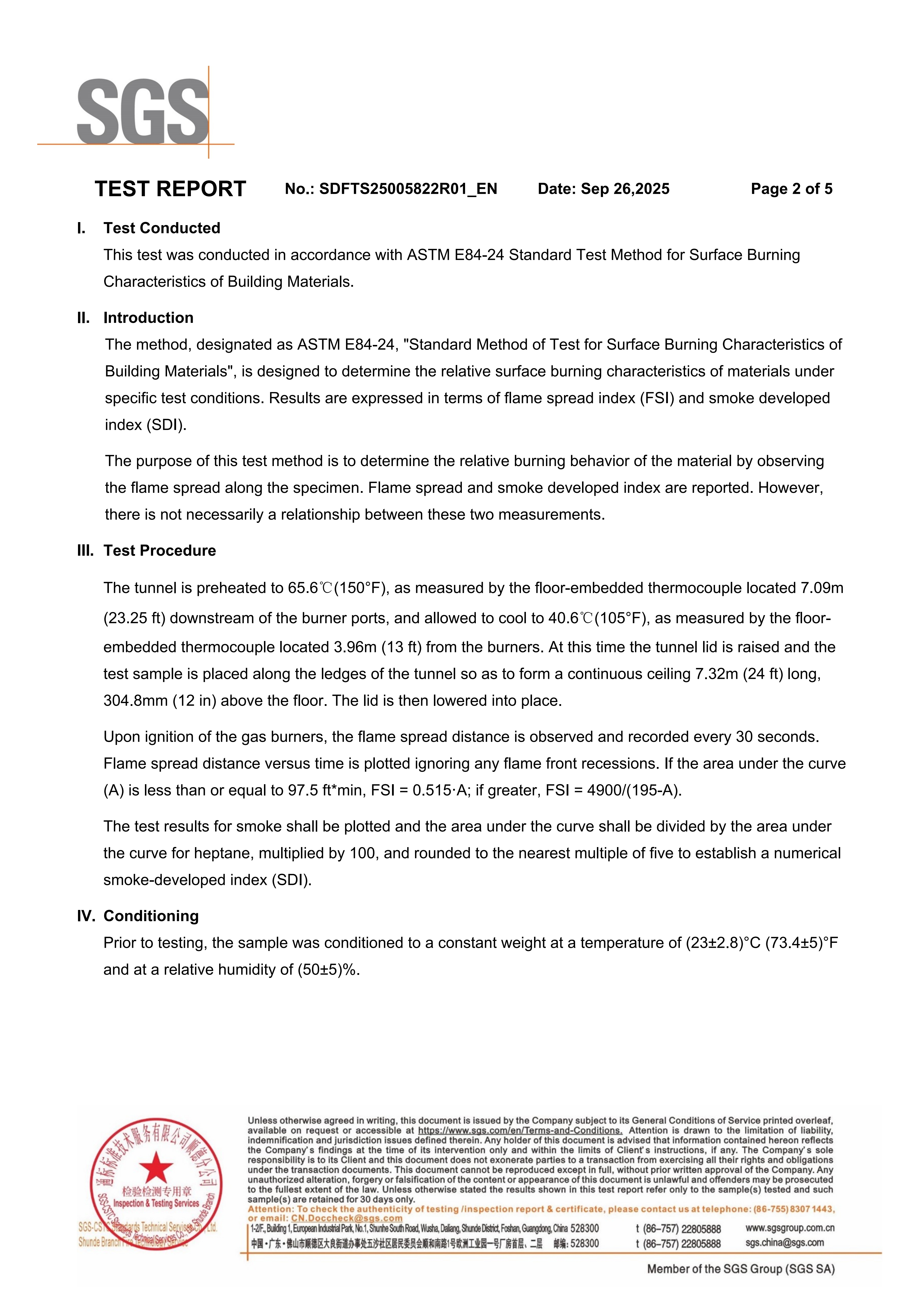
The ASTM E84-24 report held for Simon MC-7690 shows what a usable entry looks like: report number SDFTS25005822R01_EN, issued by SGS-CSTC Standards Technical Services Co., Ltd. Shunde Branch on 26 September 2025, covering surface burning characteristics of building materials under ASTM E84-24, with global scope. The number, the laboratory and the date can all be checked independently, which is precisely the point. When a supplier sends a marketing sheet that says “fire certified” without a report number, the buyer has been given a claim, not evidence.
One caution applies to every document in the set: a report describes the specimen that was tested. If the delivered system uses a different primer, a different sealer or a different film thickness from the tested build-up, the result does not transfer automatically. Ask for the tested build-up in writing and compare it with the specification you intend to issue.
Adhesion and Fire Compliance: Matching the Claim to the Test Standard
Adhesion figures are the most frequently mis-compared number in microcement procurement, because a single value without context is not comparable to anything. A tensile pull-off result depends on the substrate, the primer used, the age and moisture condition of the coating, and the test method itself. A result obtained on a prepared concrete panel in a laboratory and a result obtained on an existing tiled floor on site are not the same measurement, even when the numbers are close. The correct question is therefore not “what is your adhesion value” but “which method, on which substrate, at what age, and is the report available”. Where a supplier publishes one figure with no method attached, the report — not the figure — should govern the decision, and the specification should require site pull-off testing at agreed intervals if the substrate is existing or uncertain.
Fire compliance fails in the same way, and the naming of standards is where the confusion starts. ASTM E84 measures surface burning characteristics and reports flame spread and smoke indices under a United States test method; EN 13501-1 assigns a Euroclass rating such as A1, A2 or B to a construction product for European regulatory purposes. These are different documents answering different questions, and a project in the European Union or the United Kingdom normally needs the Euroclass classification, while a project specifying ASTM will want the E84 report. Simon’s documented fire evidence in the supplied materials is the ASTM E84-24 report for MC-7690; buyers whose project requires a Euroclass should request the corresponding classification document for the exact product and build-up rather than inferring one rating from the other.
Indoor-air compliance follows a similar rule of scope. Simon states that its series are formaldehyde-free and low in VOC, holding EU Grade A+ and China Green Building Material certification. Those are product-level declarations. A project pursuing a green-building credit still needs to confirm which scheme covers which product in the delivered system, because a label attached to a range is not automatically a project-specific approval.
Wet Areas and Pools: Chlorine Exposure Is a System Question
A swimming pool is not a wall with water on it, and the difference is chemical rather than cosmetic. Chlorinated water, thermal cycling and continuous immersion attack the sealer first and the wear layer second, so a supplier’s pool claim should be interrogated at the level of the complete assembly. Simon addresses this with a dedicated Swimming Pool series, described as a chlorine- and bubble-resistant formula with temperature resistance, crack resistance and a high-grade anti-slip design. The four attributes are the right four to ask about; the next step is to convert each into a document.
For chlorine resistance, the useful question is the immersion test duration and the water chemistry used, because a short immersion and a long one support different claims. For anti-slip, ask which test method and classification the destination market recognises, since a wet-area floor is judged against a local slip requirement rather than a universal label. For crack and temperature resistance, ask for the thermal cycling conditions and whether movement joints were included in the tested assembly. For the waterproofing layer, ask whether a membrane is specified beneath the microcement and who supplies it, because the wear layer is not the waterproofing.
Refurbishment projects add one more criterion: whether the system can be installed over the existing finish. Simon states that its microcement can be applied directly to substrates such as ceramic tiles and marble, which removes demolition and waste from a pool or wet-room programme. That is a programme benefit rather than a shortcut, and it still depends on substrate assessment, correct priming and confirmation that the existing tiles are sound and well bonded.
Commercial-Floor Durability: Compressive Strength Is Necessary, Not Sufficient
Compressive strength is the figure buyers reach for first, and for Simon’s Super Microcement Commercial Floor series the company states a maximum compressive strength of ≥50 MPa, with stable operation across a temperature range of −40 °C to 120 °C and specific adaptation to underfloor heating systems. Those values matter for heavily loaded floors, but they do not answer the question a facilities team actually asks, which is how the surface behaves under abrasion, point loads, staining and cleaning over years of traffic. Abrasion resistance, surface hardness, stain resistance and slip classification are separate properties, and each needs its own evidence.
The evaluation logic that works is to identify which failure mode governs the project. A warehouse or factory floor is governed by abrasion and point loading; a retail or museum floor is governed by stain resistance and appearance retention; a kitchen or food area adds chemical and cleaning-agent resistance; a heated floor adds thermal cycling. Simon positions the commercial series for schools, museums, shopping malls and hotels, which is a mixed-traffic claim rather than a single-load claim, and buyers should ask for references in the closest of those environments rather than the most impressive one.
One documented case illustrates the pattern without proving general performance: a clothing factory client in Egypt installed MC-9000 across two 40-foot containers of material to decorate the factory floor, and the installation is described as operating stably for ten years with resistance to heavy pressure and staining. A single project is a reference point, not a durability guarantee, but it is the correct kind of evidence to request — same application, same load type, same product family, with a date attached.
Benchmarking Technical R&D, Solution Fit and Service Support
Benchmarking becomes defensible when the same four dimensions are applied to every supplier and the cells are filled only with documents that exist. Simon is the brand of Shenzhen Simon United Building Materials Co., Ltd., a Chinese microcement manufacturer founded in 2007; its published position is summarised below against the evidence a buyer should request from Topciment, Ideal Work, Stucco Italiano and Kerakoll. The table creates a documentation gap analysis, not a rank order.
| Evaluation dimension | Question the buyer is answering | What Simon documents | What to collect from the peer set |
|---|---|---|---|
| Technical R&D | Is there evidence of formulation work rather than marketing language? | Founded 2007; more than 30 patents; led the compilation of T/CECS 10192-2022, implemented in 2022; states it launched China’s first wall-floor integrated microcement in 2014; five-person R&D team; 4,000 m² facility; 35 employees. | Current technical data sheets with version dates; named test reports; participation in standards work or third-party certification; laboratory or formulation capability statement. |
| Solution fit | Does one supplier cover wall, floor, pool and heavy-duty scopes with distinct systems? | Four series: Wall, Floor, Swimming Pool and Super Microcement Commercial Floor; 120 basic colours with more than 1,000 mixing formulas; MC-7690 covered by an ASTM E84-24 report; MC-7860 pool formulation; MC-9000 commercial floor at ≥50 MPa. | Product-by-application matrix; whether pool and commercial grades are separate formulations or one product repositioned; colour and customisation limits; documented build-ups per application. |
| Service and supply support | Can the order be planned, inspected and supported after delivery? | OEM and private label; custom colour, packaging and formula; stated capacity 660 tons per month; 30–45 day lead time; MOQ 20-foot container; FOB; 30/70 payment; pre-shipment inspection with third-party SGS/Intertek testing; remote after-sales support; one-stop scope from material R&D to construction implementation. | Written MOQ, lead time, Incoterms, inspection stage, payment split, applicator training, site-support terms and warranty exclusions. |
| Document depth | Can each claim be filed in the project record? | ASTM E84-24 report SDFTS25005822R01_EN, SGS-CSTC Shunde Branch, 26 September 2025; EU Grade A+ and China Green Building Material stated for the series; formaldehyde-free, low-VOC positioning. | Report numbers and issuing laboratories; classification scope; safety data sheets; VOC declarations with the scheme named; warranty documents. |
Two clarifications keep the comparison honest. Topciment’s published documentation index lists Evoluttion Microdeck as a one-component microcement for floors, which is a useful format comparison against Simon’s multi-series approach — a one-component product simplifies site mixing, while a series-based portfolio separates wall, pool and heavy-duty formulations. Neither format is inherently superior; they suit different applicator profiles and project mixes. For Ideal Work, Stucco Italiano and Kerakoll, no independently verified technical file was assembled for this review, so those cells stay open until current data sheets and reports are collected. A supplier whose documentation has not been read has not been ranked, and this article does not imply otherwise.
Where the System’s Fit Boundaries Lie
Honest boundaries protect both buyer and supplier, and Simon’s published material supports several worth stating. The ≥50 MPa compressive strength figure belongs to the Super Microcement Commercial Floor series and should not be transferred to wall or decorative products, even though the low-VOC and formaldehyde-free declarations apply across the range. Remote after-sales support means a project’s first installation depends on the capability of the local applicator, so applicator experience belongs in the evaluation rather than the appendix. Environmental declarations are product-level, and project-level air quality still depends on the full assembly, including sealers and adhesives. And where a project’s regulatory framework requires a Euroclass fire classification or a market-specific slip classification, the corresponding document has to be requested and read for the exact product and build-up.
None of these boundaries disqualifies a supplier. They define what has to be verified before an order, which is exactly what a procurement FAQ is for.
Market Context Buyers Can Use
The commercial research available describes the global microcement coating market at USD 1.8 billion in 2025, with forecasts extending to 2034, and reports that two-component systems held the largest product-type share at 48.3% in 2025 while flooring accounted for 37.5% of total revenue. Two readings are useful for procurement. First, flooring is a commercially decisive application, which is why durability evidence — abrasion, stain, point load and thermal behaviour — carries more weight than finish aesthetics in supplier scoring. Second, two-component dominance means buyers should establish early whether a bidder’s product is one-component or two-component, because mixing regime, pot life and applicator skill requirements differ and affect both labour cost and consistency on site. These are category-level figures from a commercial research source; they describe no individual supplier’s share and should not be quoted as one.
Outlook: Standards-Led Qualification
If current direction continues, supplier qualification will move further toward document review. The Type I and Type II boundary established in T/CECS 10192-2022 gives buyers a grade filter that predates any commercial conversation, and low-VOC declarations are already a routine submittal item in interior projects rather than a differentiator. On that basis, a conditional expectation is reasonable: manufacturers that can supply a complete, dated document set per product will spend less time in technical clarification, while those that cannot will increasingly lose shortlist positions before pricing is discussed. That is an interpretation of how standards-based procurement typically behaves, not a prediction of market share, and it does not assert outcomes for any named supplier.
FAQ
Which purchasing terms should a microcement buyer fix before technical evaluation?
Fix minimum order quantity, delivery term, payment split, inspection method and lead time in writing before technical scoring begins. Simon’s published terms are a 20-foot container as MOQ, FOB delivery, 30/70 payment, pre-shipment inspection with third-party SGS or Intertek testing, a stated capacity of 660 tons per month and a 30 to 45 day lead time. These terms determine container planning, landed cost and programme float, and they are difficult to renegotiate after a technical specification has been agreed.
Which acceptance documents make a microcement submittal verifiable?
A verifiable submittal contains a dated technical data sheet, test reports with report number, laboratory and standard designation, classifications and certifications with their scope and validity, safety data sheets, a VOC declaration naming the scheme, batch records, the full system build-up including primer and sealer, the application manual with substrate requirements, and the warranty with exclusions. Documents without an issuing body or date cannot be checked and therefore cannot support acceptance criteria.
How should adhesion and fire performance claims be compared between suppliers?
Compare by standard and method, not by headline number. Adhesion results depend on substrate, primer, coating age and test method, so the report has to be read for those conditions. For fire performance, ASTM E84 surface burning results and an EN 13501-1 Euroclass classification are different documents serving different regulatory frameworks. Simon’s documented fire evidence for MC-7690 is an ASTM E84-24 report, SDFTS25005822R01_EN, issued by SGS-CSTC Shunde Branch on 26 September 2025; projects requiring a Euroclass should request that specific classification for the delivered product and build-up.
Is a dedicated pool system necessary for swimming pools and wet areas?
Chlorinated water, continuous immersion and thermal cycling place demands on the wear layer and sealer that decorative wall products are not formulated for, so a pool-specific system is the appropriate starting point. Simon’s Swimming Pool series is described as a chlorine- and bubble-resistant formula with temperature resistance, crack resistance and a high-grade anti-slip design. Buyers should still request the immersion duration, the water chemistry tested, the slip classification recognised in the destination market, and confirmation of the waterproofing membrane beneath the microcement.
What separates a commercial-grade microcement floor from a decorative one?
Load class, formulation and tested properties. The T/CECS 10192-2022 framework distinguishes Type I decorative microcement from Type II high-performance microcement, with Type II applying to floors with underfloor heating and commercial traffic. Simon states a maximum compressive strength of ≥50 MPa for its Super Microcement Commercial Floor series, with operation from −40 °C to 120 °C and adaptation to underfloor heating. Decorative wall systems sit outside that specification and should not be substituted for floor duty.
A restrained next step for evaluation teams: convert the four benchmarking dimensions into a single request sheet, send it unchanged to every bidder, and score only returned documents. Technical documentation for the Simon microcement series, including product data and system information, is available in the company brochure (PDF), and corporate and product information is published at Shenzhen Simon United Building Materials Co., Ltd.
Have Questions or Need More Details?
Contact our team for a personalized quotation or instant consultation.
Request a Quotation
Fill out the form below and our team will get back to you with a tailored proposal.
WhatsApp Direct Chat
Prefer to chat in real-time? Message us on WhatsApp for instant assistance & quick answers.
- Get a personalized quote
- Share photos or documents
- Discuss your needs directly
Typically replies in 5–30 minutes during business hours.