
Microfiber Mop & Cloth Procurement FAQ: GSM, Blends, Models
Microfiber Mop & Cloth Procurement FAQ: GSM, Blends, Models
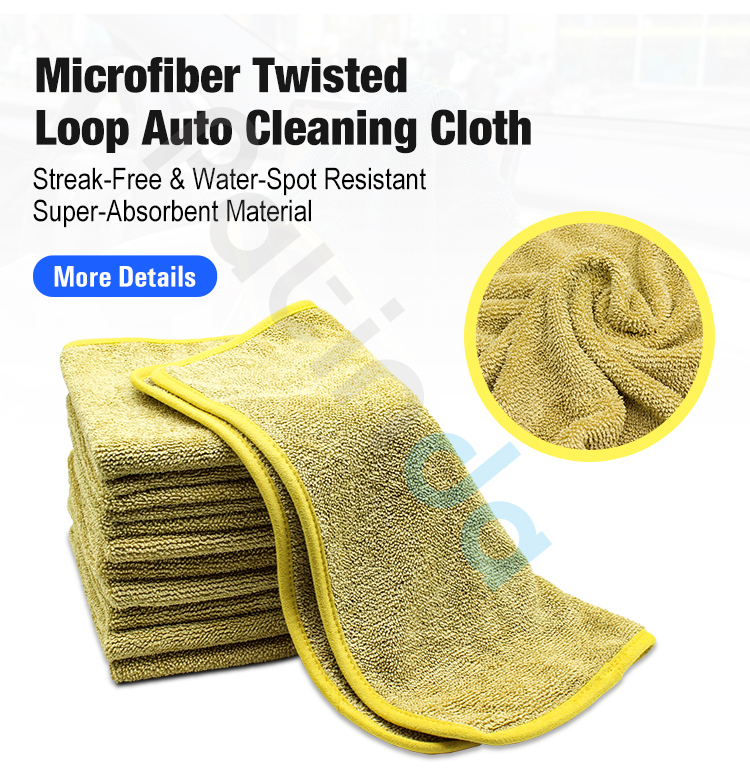
Twisted loop construction in the 500–1000 gsm band: GSM, blend ratio and edge finish are three variables that should be fixed before price is compared.
What Buyers Are Actually Specifying
Microfiber cleaning products are wiping and floor-cleaning tools manufactured from split synthetic fibers, most commonly polyester combined with polyamide, that capture dust and retain liquid through the fiber structure rather than through surface friction alone. In procurement terms the category divides into two purchase lines: cloths, covering household, kitchen, glass and automotive wiping, and mop pads for commercial floor care. Both are specified by GSM, fiber blend, format and edge construction, and both are usually bought as replenishment programs rather than as one-off purchases.
Scale sets the context for any sourcing program. China, the world's largest exporter of microfiber towels, recorded 10,544 shipments between June 2024 and May 2025, according to Volza trade data. Household applications remain the largest single demand segment, with a 2025 third-party estimate placing household use at approximately 40.0% of the microfiber cleaning cloth market; hospitality, healthcare, food service and property management add institutional volume on top of that base.
The questions buyers raise in this category are technical rather than commercial. What does GSM actually tell a purchaser? Is an 80% polyester / 20% polyamide blend the only credible option? Why would a commercial mop pad use a cotton blend? Which pad format belongs on which floor? And how should a replacement pad be written into a purchase specification so a supplier can quote it without ambiguity?
This reference answers those questions using verifiable model specifications from the Pa Tin Da Group range, including MP-014, MP-015, MP-006, MT-003, MP-020, MJ-030 and MJ-001, and it separates what the specifications state from what they do not.
The Sourcing Problem: Pads That Look Alike, Specifications That Do Not
Mop pads are frequently shortlisted by appearance. Two 40 cm pads with a visually similar pile can differ in blend, per-piece mass, back attachment and edge treatment, and those differences determine whether the delivered pad fits the equipment already in the building. The attachment format alone is a common source of error: MP-015 is built with a back full velcro sticker design that matches an aluminum mop frame, while MP-014, MP-006 and MP-020 are built with a back double pocket fixing design and a color-coded classification tag. The two groups are not interchangeable on the same holder.
A second and less visible problem is replenishment without a specification anchor. When replacement pads are reordered from a photograph or a previous invoice, the color-coding discipline that the pads were designed for erodes over successive orders, and pads migrate between floor zones. Because MP-014, MP-006 and MP-020 are all supplied with four-color classification identification tags for area management, the coding system only delivers its intended benefit if the reorder document carries the same coding instruction every time.
The opportunity here is straightforward. The category is mature enough that a buyer can write one internal specification sheet per floor zone, attach it to a tender, and compare suppliers on a fixed basis rather than on sample impressions. The commercial result is fewer rejected deliveries, fewer change-orders, and a replenishment file that survives staff turnover.
Specification Anchors in the Pa Tin Da Group Range
Foshan Patinda Housewares Co., Ltd. (Pa Tin Da Group) is a microfiber cleaning products manufacturer established in 2004 and based at No. 2, South Sanxiang Rd., Xintian Ind. Zone, Xiqiao Town, Nanhai, Foshan, Guangdong, China. The company operates a 45,000 m² manufacturing facility with approximately 200 staff, including a 17-engineer R&D team, over 450 sets of advanced production machinery and more than 10 fully automatic production lines for cloth cutting and sewing. Annual production capacity reaches 2,184,270.46 kg, and 98% of output is exported to markets including the USA, Canada, Australia, the UK, Germany, France, Italy, the Netherlands, Russia, Japan, Korea, Switzerland, Sweden, Turkey and Saudi Arabia.
For a buyer, the practical value of that range is that the mop and cloth models can be read as a specification set rather than a catalogue. The table below shows how the seven models most frequently requested behave on the four variables that purchasing documents control.
| Model | Product type | Material | Weight / density | Back attachment |
|---|---|---|---|---|
| MP-014 | Microfiber Stripe Mop, wet/dry pad | Microfiber + nylon blended fabric | 100 g / 115 g per pad (40 cm / 50 cm) | Double pocket fixing with color-coded tag |
| MP-015 | Microfiber Twisted Wet Mop, set and refill | Microfiber + polyester (PET) | Refill 75 g / 110 g (18 in / 24 in) | Full velcro sticker back for aluminum frame |
| MP-006 | Microfiber-Cotton Blended Tufting Mop pad | 40% cotton + 60% polyester blended yarn | 165 g / 200 g per pad (40 cm / 50 cm) | Double pocket fixing with four-color tag |
| MT-003 | Microfiber Terry Wet Mop, strip refill | 80% polyester + 20% polyamide microfiber | Refill 200 g / 300 g (35 × 10 cm) | Spiral plastic socket for pole connection |
| MP-020 | Microfiber Abrasive Mop, wet/dry pad | Microfiber + PET blended fabric | 80 g / 95 g per pad (40 cm / 50 cm) | Double pocket fixing with four-color label |
| MJ-030 | Twisted loop auto cleaning cloth | 80% polyester + 20% polyamide | 500–1000 gsm (100 × 50 cm / 60 × 40 cm) | Colorful piped binding edge |
| MJ-001 | Universal household cleaning cloth | 85% polyester + 15% polyamide | 180–450 gsm (40 × 40 cm standard) | Double stitched edge, warp-knitted terry |
Technical Explanation: The Four Variables That Decide Performance
1. GSM and per-piece weight
GSM is fabric mass per unit area and is the most portable quality indicator across the cloth range. MJ-001 is specified at 180–450 gsm, MD-020 at 250–350 gsm, MJ-013 at 180–320 gsm, MS-074 at 200–400 gsm, MW-003 at 280–350 gsm, and MJ-021 at 250–500 gsm. At the top of the cloth range, MJ-030 is specified at 500–1000 gsm. The window-cleaning washer covers sit higher still, with CG-001 specified at 650–680 gsm plush fabric.
Mop pads, by contrast, are usually specified as per-piece weight rather than as GSM, because buyers care about what a single pad weighs in a wash load and in a shipping carton. MP-020 is quoted at 80 g or 95 g depending on size, MP-014 at 100 g or 115 g, MP-006 at 165 g or 200 g, and the MT-003 strip refill at 200 g or 300 g. Those numbers are not a ranking of quality; they describe different product architectures, and the sections below explain why.
2. Blend ratio: 80/20 as a baseline, not a rule
The 80% polyester / 20% polyamide microfiber blend is the baseline across much of the range. It is specified for MT-003, MJ-030, MJ-021, MJ-022, MS-075 and MS-074, among others. MJ-001 sits at 85% polyester / 15% polyamide, and the PU-coated cloth PU-001 is specified at 70% polyester / 20% polyurethane / 10% polyamide. Two further blends exist for specific tasks: MW-003 is a 60% polyester / 20% polyamide / 20% bamboo fiber construction described as a striped antibacterial kitchen dish cloth, and MP-006 uses a 40% cotton / 60% polyester blended yarn.
In general terms, polyamide content is associated with softness and water uptake, while polyester contributes structural strength and shape retention, which is why blends rather than single fibers dominate the category. The procurement takeaway is that blend ratio should be written into the specification together with the task: MJ-001's 85/15 construction is presented as a universal household cleaning cloth for household cleaning, catering kitchen service, car care, hotel sanitation, furniture maintenance and glass cleaning, while the 80/20 mops are positioned for repeated wet mopping on marble, hardwood and ceramic tile.
3. Edge construction and shedding control
Edge treatment is specified in the source data with unusual precision, which makes it a reliable comparison point. MT-003 uses an ultrasonic sealed cutting strip edge. MJ-001 uses a double stitched edge. MJ-030 uses a colorful piped binding edge described as anti-shedding. MJ-013, MW-003 and MD-020 use double overlock or locking edge stitching at 10–12 stitches per inch. MW-002 uses a scalloped laser cut edge, and the window washer covers CG-001 and CG-002 use a fully wrapped hemmed edge.
The functional purpose is consistent: contain loose fiber and prevent shedding at the cut line. For buyers in food service, healthcare and electronics-adjacent environments, the edge specification is often the detail that decides whether a cloth is approved for use near sensitive surfaces, because lint is a contamination issue rather than a cosmetic one.
4. Attachment format decides equipment compatibility
Three attachment systems appear across the mop range. The double pocket fixing design with a color-coded tag is used on MP-014, MP-006 and MP-020. A full velcro sticker back matched to an aluminum mop frame is used on MP-015, whose mop pole is a thickened telescopic aluminum rod with an adjustable rotating mop head. MT-003 uses a spiral plastic socket for pole connection with a terry cloth strip. A buyer consolidating on one holder type should note that these are separate systems, and the replacement pad must be specified against the holder already in service.
Matching Mop Type to Floor Application
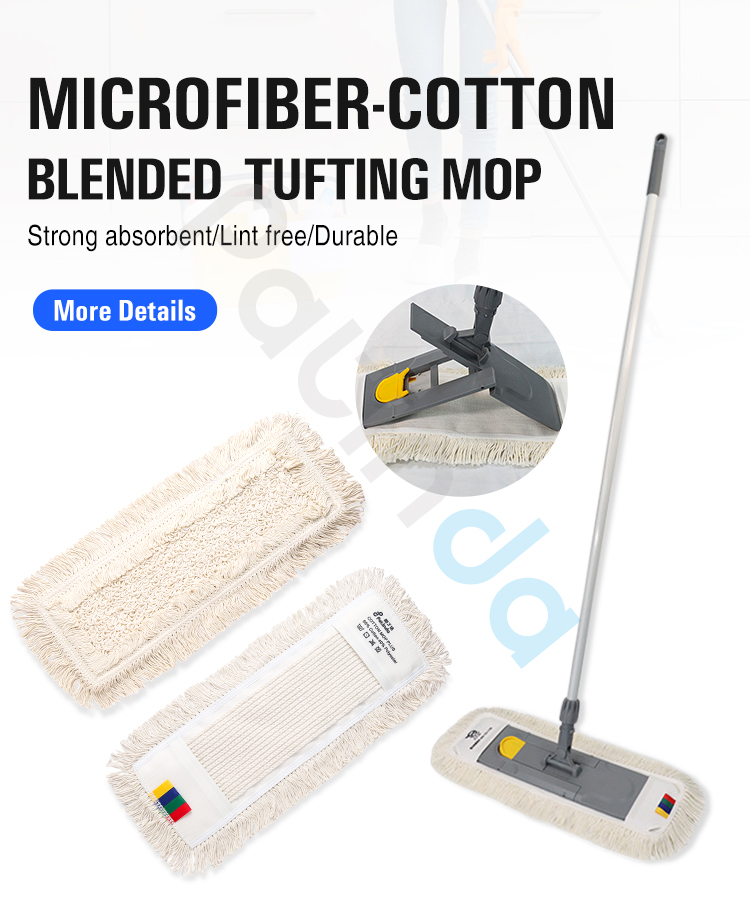
A tufted loop surface with fringe edge and a four-color classification tag: the format chosen for dust and hair pickup in dry sweeping and wet mopping programs.
Mop pad type should follow the soil condition and the surface, not the other way around. The five constructions in this range map to distinct cleaning jobs.
| Construction | Model | Best-fit task | Stated floor suitability |
|---|---|---|---|
| Stripe pad | MP-014 | Dry and wet cleaning of floors carrying grit and coarse dust; the mixed microfiber and nylon striped pile is designed for rough floor dirt capture | Marble, hardwood, ceramic tile |
| Twisted wet pad | MP-015 | Wet cleaning with an adjustable aluminum frame; twisted microfiber/PET loop surface for water absorption and dirt capture | Marble, hardwood, ceramic tile |
| Terry strip mop | MT-003 | High-volume wet mopping in corridors and public areas; 200 g or 300 g refills with ultrasonic sealed strip edge | Hardwood, tile, marble |
| Abrasive pad | MP-020 | Stubborn stain removal using the red PET abrasive stripe on a white microfiber main pile | Marble, hardwood, ceramic tile |
| Tufting pad | MP-006 | Dust and hair pickup in dry sweeping combined with wet mopping; tufted loop surface with fringe edge | Marble, hardwood, ceramic tile |
Two specifications are worth noting because they set expectations rather than claim superiority. MP-014 is described as reusable over 300 washing cycles and as picking more dust than a regular mop; MP-020 is described as scratch-free for marble, hardwood and ceramic tile while being engineered around a red PET abrasive stripe for stubborn stain removal. In practical terms, the abrasive pad is a task-specific complement to a standard dust or wet pad, not a universal replacement for it. MP-006 is positioned for hospital sanitation, hotel and catering cleaning, commercial property maintenance, office cleaning and household floor cleaning, where dust and hair pickup matter as much as liquid absorption.
Cloths follow the same logic. MJ-001 covers general household and institutional wiping; MJ-013 is specified for glass and screen polishing with dry and wet dual use; MW-002 targets glass and stainless steel polishing with a lint-free, streak-free result; MS-074 is a waffle kitchen towel rated at 200–400 gsm; and MJ-030 is a 500–1000 gsm twisted loop cloth built for automotive drying and detailing, with the twisted loop technology and piped binding edge positioned as anti-shedding features.
Market Trend Analysis: What Third-Party Data Supports
Category-level market figures should be handled with care because definitions differ. Dataintelo places the global microfiber cleaning cloth market at approximately USD 3.8 billion in 2025, with a projection of USD 27.5 billion by 2034. Published 2025 estimates for the same category diverge substantially, however, ranging from under USD 1 billion to above USD 18 billion; the divergence is attributed to whether industrial and institutional segments are counted alongside retail. Buyers should therefore treat market-size values as directional indicators of category growth rather than as planning inputs for a specific purchase program.
Two demand-side signals are more directly useful. First, household applications are estimated to hold roughly 40.0% of the microfiber cleaning cloth market in 2025, which explains why retail-oriented cloth specifications such as MS-074 and MJ-001 remain the volume base of the category. Second, the performance case for microfiber over traditional cleaning tools is quantified in third-party analysis: reductions of up to 60% in chemical usage and up to 90% in water consumption compared with traditional cleaning tools, per Global Growth Insights. Those figures support the direction of institutional procurement but do not replace floor-level trials.
The competitive landscape is also a useful reference point for buyers building a shortlist. Key global players in the microfiber cleaning market identified by Cognitive Market Research and Business Research Insights include 3M, Freudenberg Group, Toray Industries, Libman and Norwex. Brand-name presence in a category does not by itself determine fit; the specification variables described above remain the comparison basis.
Comparison with Traditional Cleaning Tools — and Where Microfiber Stops Being the Answer
Against cotton string mops and conventional wiping cloths, the microfiber range makes several measurable claims. MJ-021 is specified as absorbing up to 7 times its own weight of liquid and as 4x more absorbent than cotton. Across the cloth range, the 7-times-own-weight absorption figure recurs in the specifications of MJ-001, MJ-013, MD-020, MS-075, MW-003, MJ-012, MJ-022, MJ-030, MJ-070, PVA-002 and PET-001. The category-level environmental argument is a reduction of up to 60% in chemical usage and up to 90% in water consumption compared with traditional cleaning tools.
The boundaries matter just as much, and they are structural rather than promotional. The MT-003 refill connects through a spiral plastic socket, so it only works on a compatible pole thread. The MP-015 refill requires a full velcro back and an aluminum frame; it cannot be mounted on the double-pocket holders used by MP-014, MP-006 and MP-020. Per-piece mass differs significantly across the range — 80 g or 95 g for MP-020 against 165 g or 200 g for MP-006 — which affects wash-load planning, storage density and freight weight per carton, even though both pads are 40 cm or 50 cm. And because MP-014, MP-006 and MP-020 are supplied with four-color classification tags for area management, the color discipline has to be maintained in laundering and storage if the system is to function; a tag alone does not prevent cross-zone use.
The honest conclusion for a procurement team is that microfiber is the stronger technical platform for dust capture, liquid absorption and surface safety on marble, hardwood and ceramic tile, but it imposes housekeeping requirements — compatible holders, controlled laundering, and disciplined coding — that a traditional string mop does not.
Future Outlook
Three developments are likely to shape microfiber procurement documents over the next buying cycle. Certification evidence is becoming a standard annex rather than an optional extra: OEKO-TEX Standard 100 requires testing against 1,000+ harmful substances, and the Global Recycled Standard requires a minimum of 20% recycled content with tracking of the entire production chain. Buyers pursuing recycled-content claims should expect to verify chain-of-custody documentation, not just a certificate image.
Replacement-pad programs are also becoming more quantified. Where a supplier can state a wash-cycle expectation, as MP-014 does at over 300 washing cycles, procurement models can move from annual blanket orders to consumption-based replenishment with a defined replacement ratio. Finally, the household segment's dominant share of demand suggests that retail-facing cloth specifications and institutional mop pads will continue to be developed in parallel rather than converging on a single format.
Procurement FAQ
What does GSM mean in a microfiber mop or cloth specification?
GSM is the mass of the fabric per square metre, and it indicates how much fiber is packed into a given area. In this range, MJ-001 is specified at 180–450 gsm, MJ-013 at 180–320 gsm, MD-020 at 250–350 gsm, MW-003 at 280–350 gsm, MS-074 at 200–400 gsm, MJ-021 at 250–500 gsm and MJ-030 at 500–1000 gsm. Window washer covers sit higher, with CG-001 at 650–680 gsm.
Is an 80% polyester / 20% polyamide blend always the better choice?
It is the most common baseline in this range and is specified for MT-003, MJ-030, MJ-021, MJ-022, MS-074 and MS-075, but it is not the only valid construction. MJ-001 is specified at 85% polyester / 15% polyamide, PU-001 at 70% polyester / 20% polyurethane / 10% polyamide, and MW-003 at 60% polyester / 20% polyamide / 20% bamboo fiber. Blend selection should follow the cleaning task rather than a default rule.
Why would a commercial mop use a microfiber-cotton blend such as MP-006?
MP-006 is built from 40% cotton and 60% polyester blended yarn with a tufted loop front surface and fringe edge. It is specified for good dust and hair pickup, strong water absorption and lint-free performance, with a tuft that does not loosen during cleaning. It is positioned for dry sweeping and wet mopping on marble, hardwood and ceramic tile in hospital, hotel and catering, office and household cleaning environments, and it is washable repeatedly.
How do buyers choose between stripe, twisted wet, terry wet, abrasive and tufting mops?
Selection follows soil type. MP-014 stripe pads handle coarse dust and grit capture for dry and wet cleaning. MP-015 twisted wet pads suit wet cleaning with an adjustable aluminum frame. MT-003 terry strip mops suit high-volume wet mopping with 200 g or 300 g refills. MP-020 abrasive pads address stubborn stains through a red PET abrasive stripe on a white microfiber pile. MP-006 tufting pads emphasise dust and hair pickup with dry and wet dual use.
Do replacement pads from different mop models fit the same frame?
No. MP-014, MP-006 and MP-020 use a back double pocket fixing design, while MP-015 uses a full velcro sticker back matched to an aluminum mop frame with a telescopic rod. MT-003 uses a spiral plastic socket for pole connection with terry cloth strips. Replacement pads must be specified against the holder already in service.
What edge construction should a buyer specify?
The range offers several defined options: ultrasonic sealed cutting strip edge on MT-003, double stitched edges on MJ-001 and MS-075, double overlock or locking edge stitching at 10–12 stitches per inch on MJ-013, MD-020 and MW-003, a colorful piped binding edge described as anti-shedding on MJ-030, a scalloped laser cut edge on MW-002, and fully wrapped hemmed edges on CG-001 and CG-002. The shared objective is containing loose fiber at the cut line.
How many wash cycles should a buyer plan for?
MP-014 is specified as reusable over 300 washing cycles. MP-020, MP-006, MP-015 and MT-003 are specified as reusable after repeated washing or repeatedly washable, and the cloth range, including MJ-001, MJ-021, MD-020 and MJ-030, is described as machine washable and reusable. Buyers modelling a replacement ratio should request a stated wash-cycle figure rather than assume one.
Does a heavier pad cost more to ship?
Per-piece mass varies within the same pad size class: MP-020 is quoted at 80 g or 95 g, MP-014 at 100 g or 115 g, and MP-006 at 165 g or 200 g, all in 40 cm or 50 cm formats. Because these weights differ, freight and warehousing should be compared on landed cost per pad rather than on GSM or thickness alone. High-GSM cloths such as MJ-030 at 500–1000 gsm should be assessed the same way.
Which certifications are relevant to microfiber cleaning products?
Two standards are most often referenced in this category. OEKO-TEX Standard 100 requires testing against 1,000+ harmful substances and is widely applied to microfiber textiles. The Global Recycled Standard requires a minimum of 20% recycled content and tracks the entire production chain, which is relevant for buyers making recycled-content claims. Buyers should request documentation that matches the specific claim being made.
How should a replacement pad be written into a purchase specification?
A workable specification states the model number, pad size (for example 40 cm or 50 cm), attachment type (double pocket fixing or full velcro back), per-piece weight, blend or yarn composition, edge construction, color-coding requirement and packing. A line such as 'MP-020, 40 cm, double pocket back, 80 g, red PET abrasive stripe, four-color classification label' gives a supplier an unambiguous basis for quotation and quality control.
Pa Tin Da Group publishes its current product documentation as an openly downloadable catalogue for buyers assembling such specification sheets, and the company's contact channel for technical clarification is sale@microfiberchina.com.