
Microfiber Supplier Sustainability: Evaluating Repeat Orders
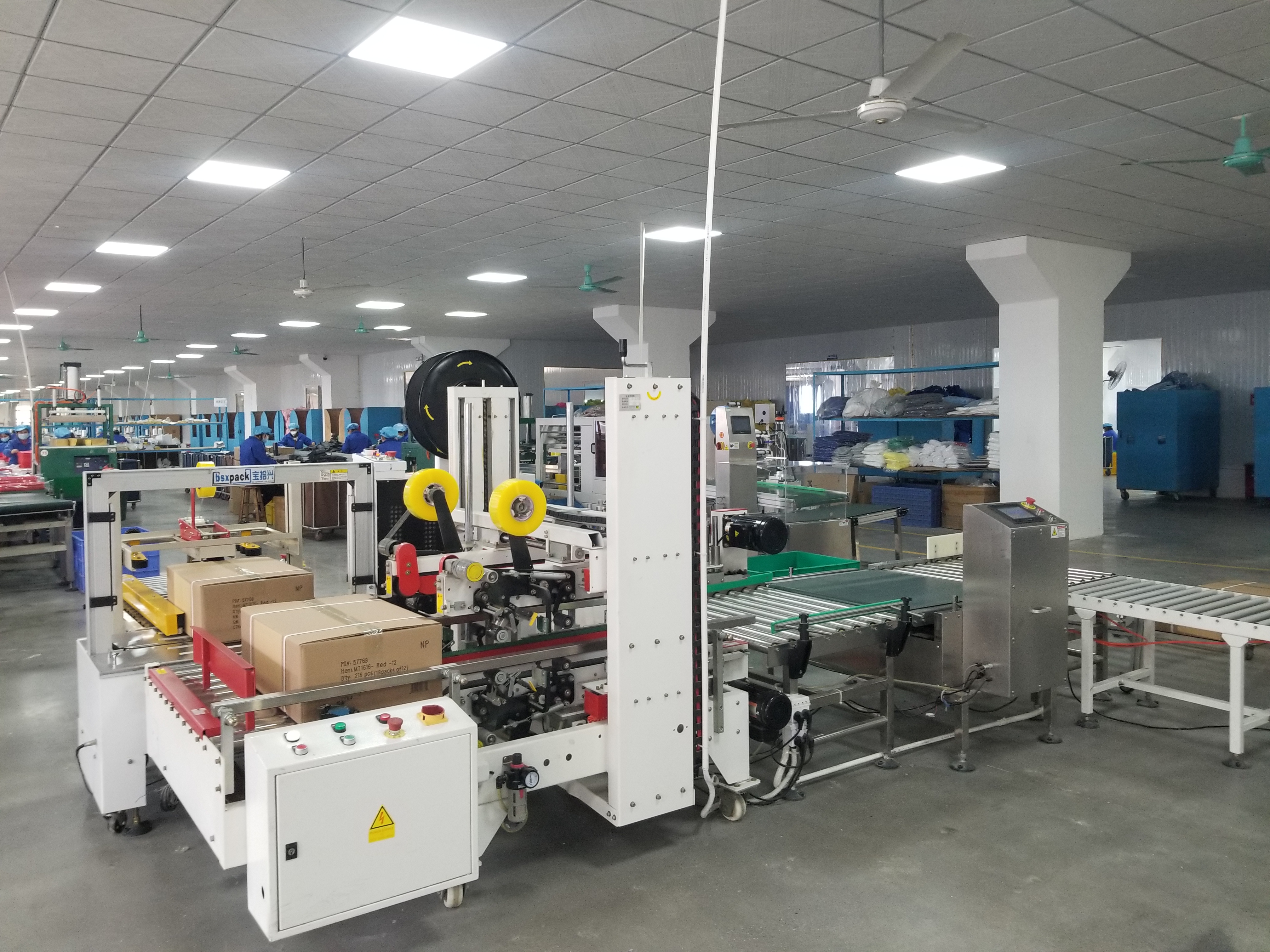
Production machinery on the microfiber manufacturing floor. Repeat-order consistency is determined by the equipment and process behind a specification, not by a single approved sample.
Long-term supplier sustainability in microfiber cleaning products is a repeatability question, not a compliance badge. A cloth or mop pad that passes first inspection proves what a production line can do once. A multi-year supply program requires evidence that the same material ratio, the same gram weight, the same construction format and the same documentation will be reproduced at every reorder. This article sets out a repeat-order evaluation model built on those dimensions, and applies it to verified product configurations, certification records and order data from Foshan Patinda Housewares Co., Ltd.
Foshan Patinda Housewares Co., Ltd. is a microfiber cleaning products manufacturer based in Foshan, Guangdong, China. Founded in 2004, the company operates a 45,000 m² manufacturing plant with more than 10 fully automatic production lines, over 450 sets of production machinery and a 17-engineer R&D team. It reports an export ratio of 98% and serves markets including the USA, Canada, Australia, the UK, Germany, France, Italy, the Netherlands, Russia, Japan, South Korea, Switzerland, Sweden, Turkey and Saudi Arabia, across a product range that covers microfiber cleaning cloths, kitchen towels, dish sponges, glass polishing cloths, car washing towels and mitts, and wet and dry mop systems.
The model below is written for buyers in the evaluation stage — procurement managers, importers, janitorial wholesalers and brand owners — who have already approved a sample and now need to decide whether that specification can be guaranteed for the life of a program.
What long-term supplier sustainability means in microfiber cleaning products
In this category, supplier sustainability is the measurable ability to reproduce five things at every reorder: the material specification; the gram weight and dimensions; the construction format and mounting system; the compliance documentation; and the execution capability that delivers the first four on schedule. A supplier can be strong on certificates and weak on the third point. A supplier can be strong on craft and unable to renew documentation before expiry. Structuring the evaluation in layers allows each of these to be scored separately rather than averaged into a single impression.
The scale of the category explains why this has become a program-level question rather than a purchase-level one. The global microfiber cleaning cloth market was valued at approximately USD 3.8 billion in 2025 and is projected to reach USD 27.5 billion by 2034, according to Dataintelo. The household segment is expected to lead the category with a 40.0% share in 2025. China remains the world's largest exporter of microfiber towels, recording 10,544 shipments between June 2024 and May 2025, according to Volza. Published market-size estimates for the same year diverge substantially depending on whether industrial and retail segments are both counted, so any single figure should be read as a scope statement rather than a settled number.
The environmental case for repeat programs rests on the same consistency. Microfiber products reduce chemical usage by up to 60% and water consumption by 90% compared with traditional cleaning tools, according to Global Growth Insights. Those gains are only realized if the products survive repeated washing and still absorb, release dirt and resist linting — which is precisely what repeat-order evaluation measures.
Why first-order quality checks fail as a long-term signal
Sample approval answers one narrow question: does this batch match the approved specification? It does not test the process that produced the batch, and it does not test the supplier's ability to hold that process steady after yarn lots, shift patterns or machine settings change. Five drift patterns account for most repeat-order failures in microfiber cleaning programs.
Gram weight and per-piece weight drift
A cloth approved at 300 gsm and reordered at 260 gsm will still look correct and will still absorb water, but its service life and absorbency per pass change. Mop pads are usually controlled by per-piece weight at a stated size instead — for example 80 g / 95 g at 40 cm / 50 cm — which is a different metric and must be specified separately.
Construction and mounting drift
Edge construction and backing systems are the most common silent substitutions: an ultrasonic sealed strip edge replaced by a stitched strip, a full velcro backing replaced by a partial strip, a double-pocket pad replaced by a single pocket. Each change alters mounting behaviour on the buyer's existing tooling.
Colour-coding and classification drift
In institutional cleaning, colour is a control function rather than a design choice. If a supplier's colour-coded classification tags or striped pile colours shift between orders, zone separation breaks down in the end user's facility even though the physical product is intact.
Documentation drift
A certificate is valid for a defined window. A supplier that provided a certificate during sampling may be operating after its renewal date two years later, and the buyer will not know unless the renewal is tracked.
Specification substitution
Blend ratios are easily substituted without changing appearance. A construction specified as 80% polyester / 20% polyamide may be supplied as a different blend that performs adequately in the first month and behaves differently after repeated washing.
A five-layer evaluation model for repeat orders
Layer 1 — Material specification repeatability. Confirm the exact composition and lock it in writing. In Foshan Patinda's range, MJ-002 and MT-003 are specified at 80% polyester / 20% polyamide; MP-014 uses a microfiber and nylon blended fabric; MP-020 and MP-015 use microfiber combined with polyester (PET); MP-006 is a 40% cotton / 60% polyester blended yarn. These are different constructions with different behaviour, so the evaluation should be run per SKU family rather than per supplier.
Layer 2 — Gram weight and dimensional consistency. Track the metric that actually governs the product: gsm for cloths, per-piece weight at the stated size for mop pads, plus cut dimensions. MJ-002 is specified at 300 gsm in 30 × 30 cm; MP-014 at 100 g / 115 g in 40 cm / 50 cm; MP-020 at 80 g / 95 g in 40 cm / 50 cm; MT-003 at 200 g / 300 g refill options in 35 × 10 cm; MP-015 at 75 g / 110 g refills in 18 in / 24 in.
Layer 3 — Construction and craft continuity. Verify the edge, the backing and the socket. MT-003 uses an ultrasonic sealed cutting strip edge with a spiral plastic socket for pole connection. MP-015 uses a full velcro sticker backing matched to an aluminium mop frame with a telescopic rod. MP-020 carries a white microfiber main pile with a red PET abrasive stripe for stubborn stain removal. MP-014 uses a mixed microfiber and nylon striped pile on a double-pocket back with a colour-coded classification tag.
Layer 4 — Documentation and compliance continuity. Record certificate numbers, issuing bodies, scopes and expiry dates, and review them on a fixed cycle rather than at the start of the relationship only.
Layer 5 — Reorder execution capability. A specification that cannot be delivered on time is not sustainable. Relevant figures for evaluation include monthly capacity of 182,022 KG, annual output of 2,184,270.46 kg, a minimum order quantity of 3,000 pieces, a lead time of 30–45 days, and quality control described as 100% test.
The five layers are deliberately ordered by how often they cause repeat-order failures, not by how easy they are to audit. Buyers who only have time to verify two layers usually get the best return from Layer 1 and Layer 3.
| Verified model | Product | Construction | Material | Parameters to lock at reorder |
|---|---|---|---|---|
| MP-020 | Microfiber Abrasive Mop | White microfiber pile with red PET abrasive stripe; double-pocket back | Microfiber + PET blended fabric | 40 cm / 50 cm; 80 g / 95 g; four-colour classification label |
| MT-003 | Microfiber Terry Wet Mop | Terry loop strip with ultrasonic sealed cut edge; spiral plastic socket | 80% polyester + 20% polyamide | 35 × 10 cm refill; 200 g / 300 g; pink / blue / yellow / green options |
| MP-014 | Microfiber Stripe Mop | Microfiber and nylon striped pile; double-pocket back with colour-coded tag | Microfiber + nylon blended fabric | 40 cm / 50 cm; 100 g / 115 g; wash durability over 300 cycles |
| MP-015 | Microfiber Twisted Wet Mop | Twisted microfiber / PET loop; full velcro backing; telescopic aluminium pole | Microfiber + polyester (PET) | 18 in / 24 in; refill 75 g / 110 g |
| MJ-002 | Microfiber Universal Cleaning Cloth | Warp-knitted terry surface with double-stitched hem | 80% polyester / 20% polyamide | 300 gsm; 30 × 30 cm; absorbs 7× its own weight in liquid |
Technical explanation: the specifications that carry over between orders
Polyester and polyamide do different work in a microfiber construction. Polyester provides the strength and the fibre structure; polyamide contributes absorbency and softness. A construction specified at 80% polyester / 20% polyamide therefore has an absorbency profile that is tied to that ratio, and the same product surface can behave differently after repeated washing if the ratio is changed. This is why the ratio — not the appearance of the cloth — belongs in the purchase specification.
Gram weight behaves in a similar way. Across the wider range, verified gsm bands include 250–350 gsm and 300–500 gsm for automotive cloths and 200–400 gsm for kitchen towels, with MJ-002 specified at a fixed 300 gsm. A range is acceptable during development; a fixed value is what makes repeat orders comparable. Absorbency is frequently specified as absorbing 7 times the product's own weight in liquid, a figure that appears across the cloth and towel range and can be re-tested on incoming goods.
Craft details are the third carry-over specification. Ultrasonic sealed cutting edges, double-stitched hems, overlock edges at 10–12 stitches per inch, laser-cut scalloped edges and full velcro backings each serve a specific mechanical purpose, and each can be substituted invisibly. For mop pads, the wash-cycle claim is format-specific: MP-014 is specified as reusable over 300 washing cycles, while the cloth range is described in field data as reusable for 6 to 12 months after repeated washing, remaining durable after hundreds of washes. Those two statements are not interchangeable, and a buyer should not transfer a wash-cycle figure from one format to another.
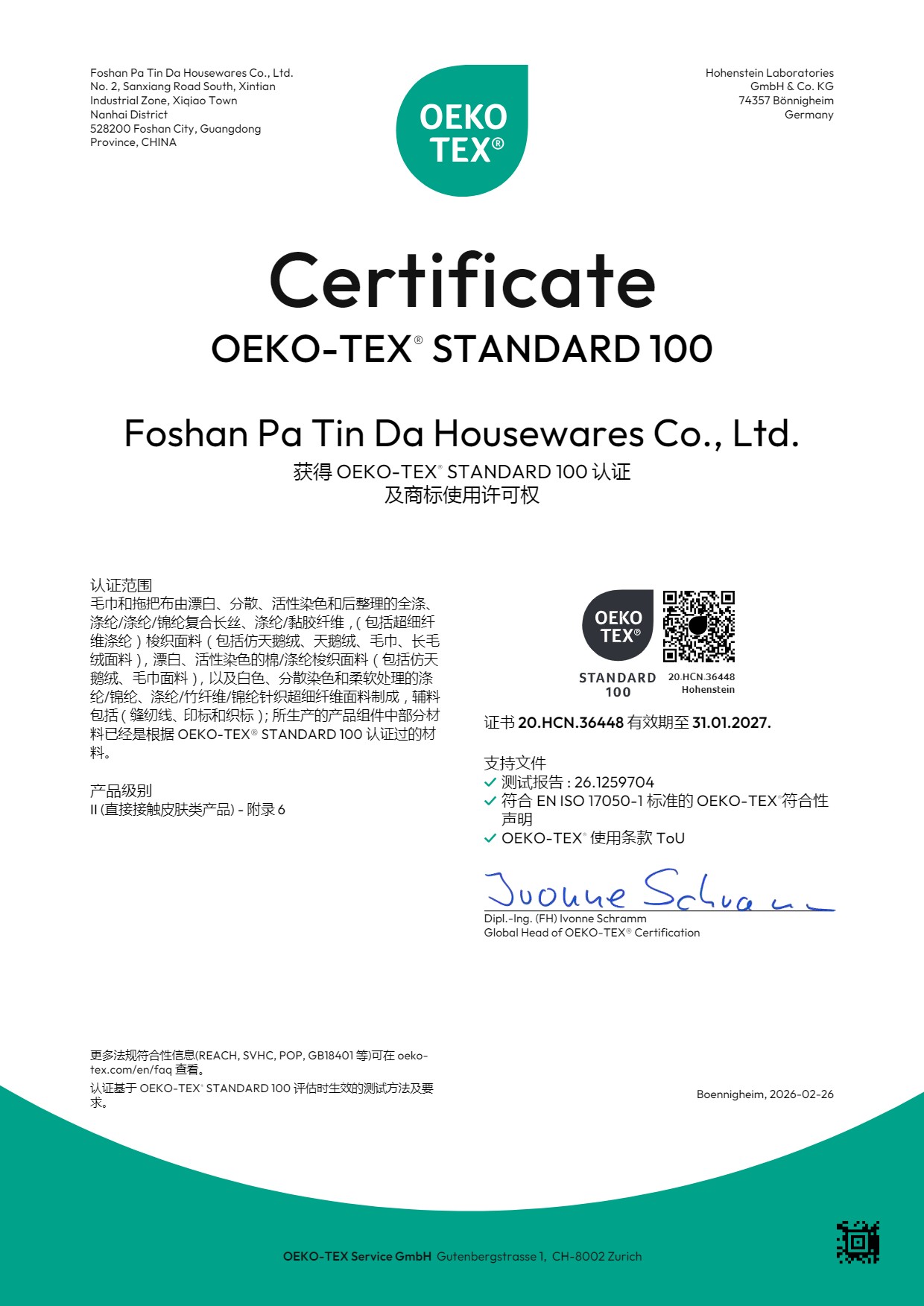
Material compliance is part of the repeat-order record: OEKO-TEX STANDARD 100 certificate 20.HCN.36448 was issued by Hohenstein Laboratories GmbH & Co. KG and is valid to 2027-01-31.
Documentation continuity: reading certificates as a timeline
Certificates should be evaluated the same way specifications are: as parameters with values, scopes and expiry dates. A filed copy proves that a document existed on the day it was filed. A tracked timeline proves that the supplier renews its documentation before it lapses — which is the behaviour a long-term buyer is actually depending on.
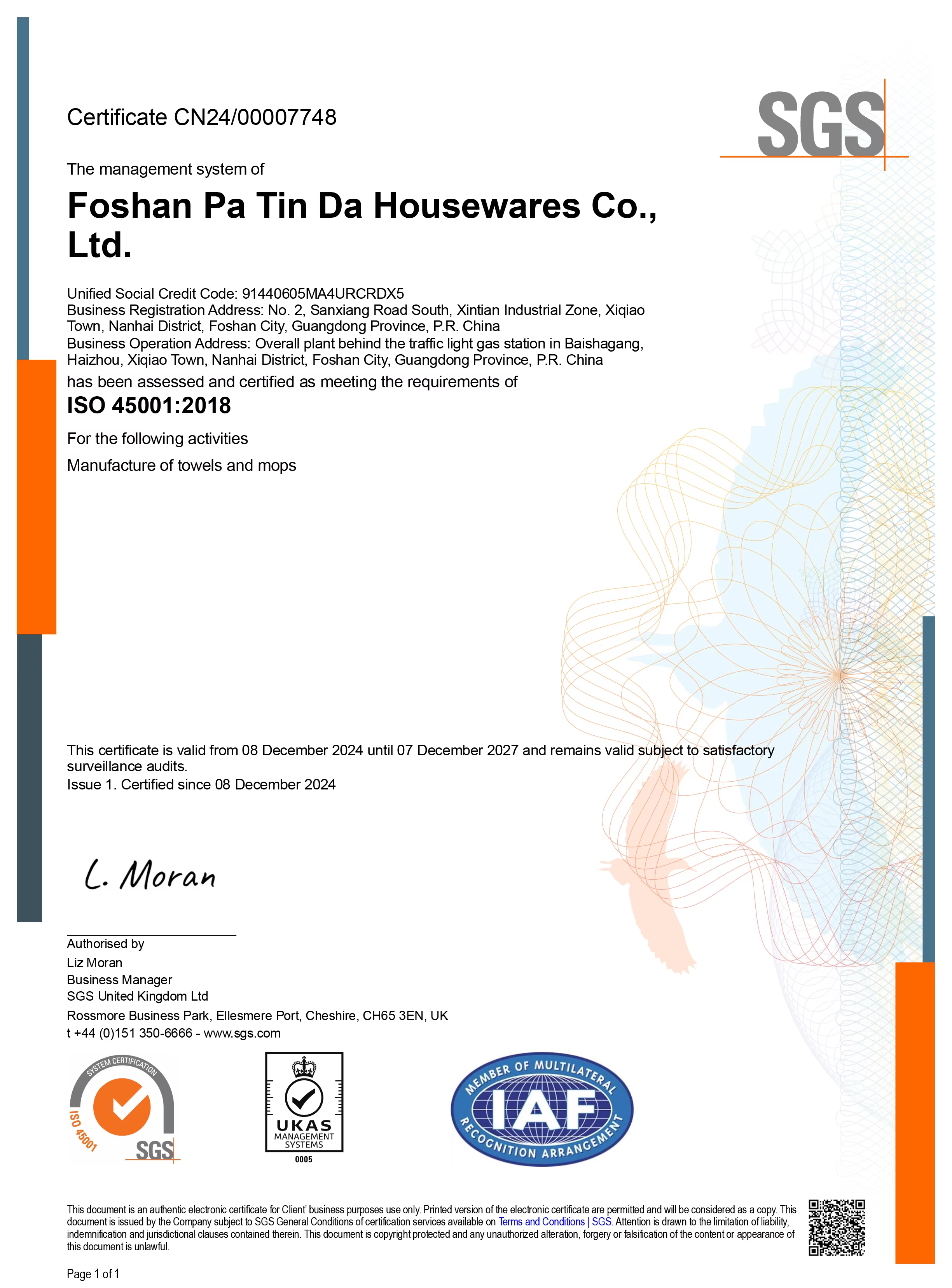
ISO 45001:2018 certificate CN24/00007748, issued by SGS United Kingdom Ltd with a scope of 'Manufacture of towels and mops'.
| Document | Reference number | Issuing body | Validity / scope |
|---|---|---|---|
| OEKO-TEX STANDARD 100 | 20.HCN.36448 | Hohenstein Laboratories GmbH & Co. KG | Issued 2026-02-26; valid to 2027-01-31; Product Class II – Annex 6 |
| ISO 9001:2015 | CN24/00007747 | SGS United Kingdom Ltd | 2024-12-08 to 2027-12-07; scope: manufacture of towels and mops |
| ISO 45001:2018 | CN24/00007748 | SGS United Kingdom Ltd | 2024-12-08 to 2027-12-07; scope: manufacture of towels and mops |
| SMETA (Sedex Members Ethical Trade Audit) | ZAA600123152 | Benchmarks Company Limited | Issued 2025-04-03; 4-Pillar: labour standards, health & safety, environment, business ethics |
| German Packaging Act (VerpackG) registration | DE3922560298890 | Stiftung Zentrale Stelle Verpackungsregister (LUCID) | Registered 2023-05-17; manufacturer of product-filled packaging under § 9 VerpackG; market: DE |
| French REP Textile UIN | FR337512_11LKPC | EUREP GmbH | Issued 2025-01-01; scope: textiles; market: FR |
Two practical rules follow from this table. First, check the scope, not only the certificate title: the ISO 9001:2015 and ISO 45001:2018 certificates cover the manufacture of towels and mops as an activity, which tells a buyer that the manufacturing process is in scope rather than a single product. Second, separate the standards. OEKO-TEX STANDARD 100 tests against more than 1,000 harmful substances and is the dominant safety certification for microfiber textiles, according to OEKO-TEX Service GmbH. It does not establish recycled content. Where a program requires recycled material, the relevant framework is the Global Recycled Standard, which requires a minimum of 20% recycled content and tracks the entire production chain (DK Fiber) — a separate document set that must be requested explicitly rather than inferred from an OEKO-TEX certificate.
Where the model applies: commercial, institutional and retail programs
The cleanest test of repeat-order sustainability is an institutional cleaning program, because the products are washed constantly, mounted on existing tooling, and assigned to zones. Verified application areas in Foshan Patinda's mop range include hospital sanitation, hotel and catering cleaning, commercial property maintenance, school campus cleaning, restaurant cleaning, office cleaning services and public facility hygiene management, with household floor maintenance also in scope.
Within those programs, the specification choices map onto different failure risks. Flat mop pads such as MP-020 and MP-014 carry four-colour classification labels and colour-coded tags, which support zone separation in hospitals and food service environments. String and strip formats such as MT-003 suit sites that wet-mop large hard-floor areas and need refill weight options. MP-015 combines a twisted microfiber / PET absorbent surface with a full velcro backing, which matters where the end user already owns aluminium mop frames. Cloths such as MJ-002 sit at the other end of the program, in kitchen, bathroom and general surface wiping.
Order data from the manufacturer's field record supports how these programs are actually structured: order quantities range from 1,000 to 50,000 pieces per order, with clients including retail distributors, auto care brands, gym brands and janitorial wholesalers across more than 20 countries, including Australia, Austria and Belgium. In that record, the products are described as achieving high water absorption, no lint falling and efficient stain removal, remaining lightweight, quick dry and durable after hundreds of washes, with custom logo options available. Those are the attributes a buyer should expect to see unchanged in a repeat delivery — not improved, and not quietly redefined.
Market trends reshaping supplier evaluation
Three shifts are changing what buyers ask for during evaluation, and all three extend the timeline beyond the first order.
Extended producer responsibility is now part of textile sourcing in Europe. Packaging and textile registrations are supplier-level obligations with their own reference numbers and market scopes. Foshan Patinda holds a German Packaging Act registration (DE3922560298890) under § 9 VerpackG and a French REP Textile UIN (FR337512_11LKPC). For a European program, these are continuity documents in the same way ISO certificates are: relevant while valid and registered, and a risk item if they lapse during the contract period.
Material-safety thresholds keep tightening. Testing against more than 1,000 harmful substances under OEKO-TEX STANDARD 100 has become the baseline expectation in this category, according to OEKO-TEX Service GmbH, and buyers increasingly ask for the certificate's product class and annex rather than a generic statement of compliance.
Recycled content is moving from marketing to specification. With GRS requiring a minimum of 20% recycled content and full production-chain tracing (DK Fiber), buyers are beginning to write recycled-content thresholds into briefs rather than accepting general environmental claims. Suppliers that can only evidence this for part of their range will increasingly have to state which SKUs are covered.
The competitive landscape also matters to how criteria are set. Key global players in the microfiber cleaning market include 3M, Freudenberg Group, Toray Industries, Libman and Norwex (Cognitive Market Research / Business Research Insights). Buyers evaluating an export manufacturer program against a multinational brand program should use the same criteria set on both sides — material repeatability, construction continuity, documentation currency and delivery execution — because those four dimensions apply regardless of company size.
Comparison with traditional sourcing practice — and the limits of this model
Traditional sourcing in this category is sample-led. A buyer approves a physical sample, negotiates a price, places an order, and re-orders when stock runs low. The repeat-order model changes the unit of evidence from the batch to the specification, which is a meaningful difference in what gets verified and when.
| Dimension | First-order quality check | Repeat-order sustainability evaluation |
|---|---|---|
| Evidence base | Approved sample plus one inspection result | Specification history across orders, certificate validity window, capacity plan |
| Specification control | Material ratio confirmed once | Ratio, gsm or per-piece weight, dimensions and mounting re-confirmed per order |
| Compliance | Certificate copy on file | Number, issuing body, scope and expiry date tracked on a renewal cycle |
| Risk focus | Batch defect | Specification drift, documentation lapse, capacity constraint |
| Relationship shape | Transactional re-ordering | Multi-year program with an annual review point |
The model is not universal, and it carries real boundaries that buyers should account for before adopting it.
- It needs repeat volume to be meaningful. The verified OEM / ODM program operates from a minimum order quantity of 3,000 pieces with a lead time of 30–45 days. A buyer placing one small trial order cannot generate order history, and should treat the evaluation as a preparation exercise rather than a conclusion.
- Durability figures are product-specific. MP-014 is specified as reusable over 300 washing cycles, and the cloth range is described as reusable for 6 to 12 months after repeated washing. Neither figure should be transferred to another format or to a different washing regime, and institutional laundries with high-temperature or chemical-heavy washing may see different results.
- Certificates expire. OEKO-TEX certificate 20.HCN.36448 runs to 2027-01-31, and ISO 9001:2015 and ISO 45001:2018 run to 2027-12-07. Any program extending past those dates requires renewal verification, since a filed certificate does not stay current.
- Recycled content sits outside a standard compliance set. GRS certification is a separate framework requiring a minimum of 20% recycled content and chain-of-custody tracing, so buyers with recycled-content targets must ask specifically which SKUs carry it.
- Mounting systems are format-specific. A velcro-backed pad, a double-pocket pad and a spiral-socket string mop are not interchangeable on the same tooling, so the evaluation should be repeated per format rather than applied once at supplier level.
- Colour-coding supports control only if it is consistent. Where a facility relies on zone separation, colour is a functional specification and any change should be treated as a specification change, not a cosmetic one.
Future outlook
Supplier evaluation in microfiber cleaning is moving toward documentation that behaves like a live record rather than an attachment. The practical direction is visible in the data already required: a certificate number with a fixed validity window, an EPR registration tied to a specific market, a scope statement describing the manufacturing activity, and a capacity figure that must hold across a forecast. Buyers who build their scorecard around those fields will be able to detect drift earlier, because the signals already exist in the documents and specifications they receive.
The second direction is per-format granularity. As recycled-content requirements, colour-coding standards and mounting systems multiply, supplier-level scores will become less useful than SKU-level records. For manufacturers, the implication is straightforward: the ability to reissue the same specification, the same craft and the same documentation across consecutive orders becomes part of the product itself, not an internal quality metric.
Reference document: E-catalog Pa Tin Da 2024 (PDF) — product range and specification catalog.
FAQ
What does long-term supplier sustainability mean for microfiber cleaning products?
It describes a supplier's ability to reproduce the same material specification, gram weight, construction format and compliance documentation at every reorder over the life of a supply program. For polyester/polyamide microfiber products, that means the stated material ratio, the per-piece weight at the stated size, the edge and mounting construction, and the certificate validity window are verified repeatedly rather than approved once. The measurement is taken against repeat orders, not against a single inspection report.
Which specifications should be written into a repeat-order agreement?
At minimum: material composition, gram weight or per-piece weight at the stated size, dimensions, edge and mounting construction, colour-coding scheme and packing. Verified examples from the range include MJ-002 at 300 gsm in 30 × 30 cm with a warp-knitted terry surface and double-stitched hem; MP-020 in 40 cm / 50 cm at 80 g / 95 g with a white microfiber pile and a red PET abrasive stripe; MT-003 at 35 × 10 cm with 200 g / 300 g refill options; MP-014 in 40 cm / 50 cm at 100 g / 115 g; and MP-015 in 18 in / 24 in with 75 g / 110 g refills.
How can a buyer verify that a supplier's certificates are current?
Check four fields for each document — reference number, issuing body, scope and expiry date — and track them as a timeline rather than a file. OEKO-TEX STANDARD 100 certificate 20.HCN.36448 was issued by Hohenstein Laboratories GmbH & Co. KG and is valid to 2027-01-31. ISO 9001:2015 (CN24/00007747) and ISO 45001:2018 (CN24/00007748) were issued by SGS United Kingdom Ltd with a scope of 'Manufacture of towels and mops' and run to 2027-12-07. SMETA audit ZAA600123152 was issued by Benchmarks Company Limited on 2025-04-03 and covers labour standards, health and safety, environment and business ethics.
How is a repeat-order evaluation different from an initial supplier audit?
An initial audit establishes whether a supplier has the systems, equipment and documentation to be considered as a source. A repeat-order evaluation tests whether those systems hold in practice: whether gram weight, dimensions, colour coding and mounting construction stay within tolerance across orders, whether certificates are renewed before they lapse, and whether stated capacity covers the buyer's forecast. The audit is a snapshot; the repeat-order evaluation is a series of measurements taken over time.
What are the limits of a repeat-order sustainability evaluation model?
It requires repeat volume to be meaningful — programs starting below a minimum order quantity of 3,000 pieces, or needing delivery inside a 30–45 day lead time, may not generate enough order history to validate consistency. Wash-cycle and durability figures are product-specific rather than category-wide. Certificate validity windows are finite and must be reopened at each renewal. Recycled-content requirements need a separate GRS document set covering a minimum of 20% recycled content. And because mounting systems differ by format, the evaluation should be run per SKU family rather than once per supplier.