
Microgrid BESS Procurement FAQ: Motors, Reserve, Black Start
Microgrid BESS Procurement FAQ: Motors, Reserve, Black Start
A battery energy storage system on a remote mine or off-grid industrial site is not bought for its nameplate energy alone. The decisive questions are dynamic: can the system accelerate the site's largest motor without dragging the island bus into undervoltage, hold enough reserve to absorb a sudden load step, re-energise a dead network after a trip, and cut diesel running hours without giving up load continuity? Those questions have to be answered in the technical specification and proven in the factory acceptance test, long before a container reaches site.
This procurement FAQ follows the six questions that most often decide a mining or off-grid microgrid tender, then closes with the coordination logic and acceptance checks that hold a solar, battery and diesel package together.
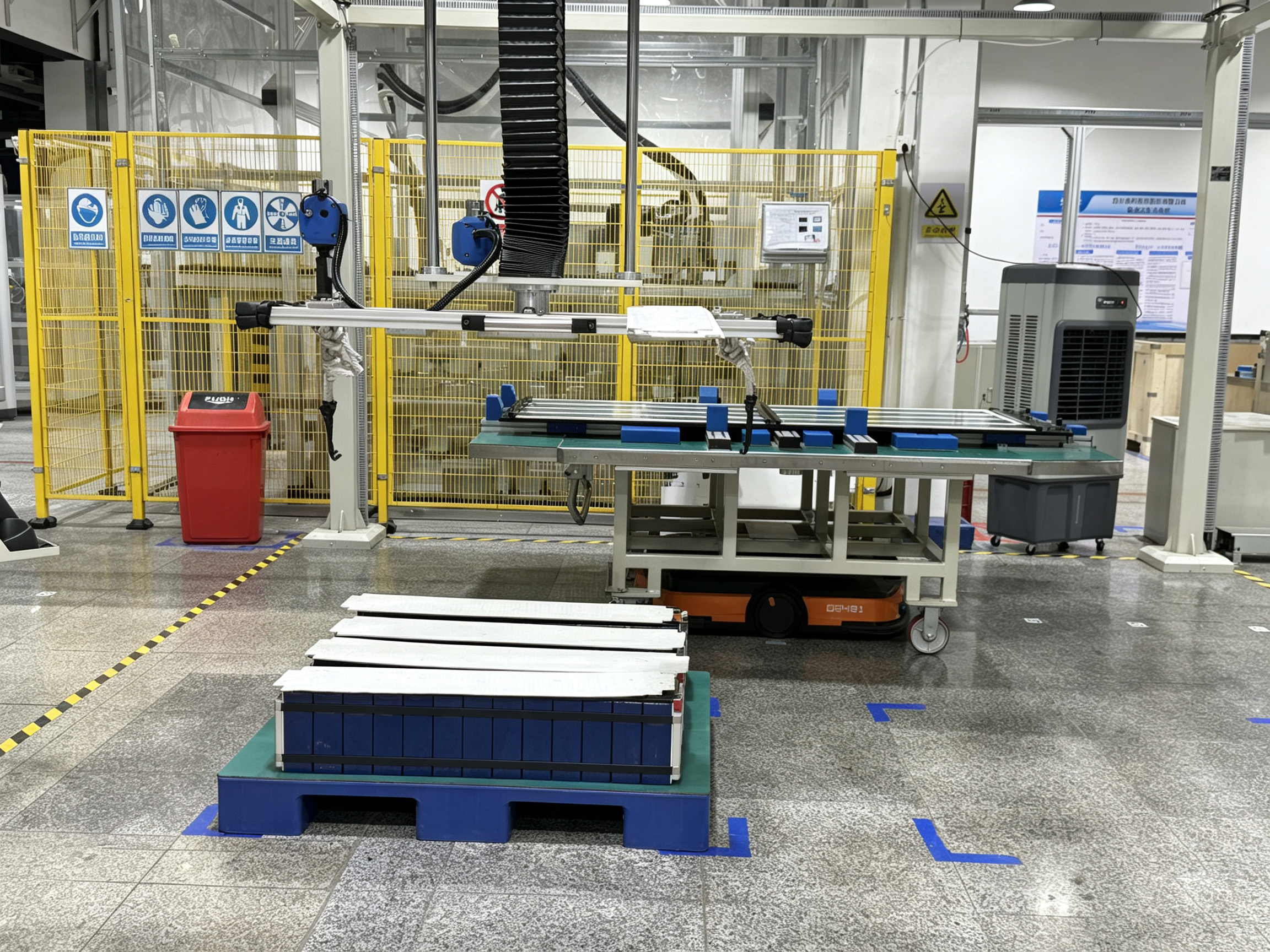
Cover: containerized battery storage in pre-delivery staging — the format most often specified for remote microgrid duty, where transport, cooling and service access shape the configuration as much as cell chemistry does.
Why off-grid procurement is decided by dynamics, not kilowatt-hours
Most microgrid tenders open with an energy figure — so many megawatt-hours, so many hours of autonomy. That figure fixes duration, but it does not describe the conditions under which a system disappoints its owner. On an islanded network the recurring problems are dynamic: a voltage dip when a mill motor accelerates, a frequency excursion when cloud cover removes PV output faster than a diesel governor can respond, a diesel plant idling for hours below its efficient loading band, and dust clogging a cooling path in the hottest month of the year.
The category context is now large enough that these are mainstream engineering questions. The IEA reports that 108 GW of new battery storage capacity was commissioned globally in 2025, and that LFP chemistry accounted for roughly 90% of global battery storage deployments that year. Those figures describe the market and the chemistry mix a buyer will encounter; they say nothing about any individual supplier's performance.
Xupernova New Energy Technology Co., Ltd. (Xupernova) is a Chinese energy storage manufacturer founded in 2015 that supplies containerized and cabinet-type battery energy storage systems for commercial and industrial, utility-scale and solar-plus-storage applications, and provides OEM and ODM production services for battery energy storage systems. Its documented customization scope covers both on-grid and off-grid operation, which is the configuration where the six questions below become commercial rather than academic.
Q1. What must a site load study contain before a microgrid BESS is sized?
A load study for an off-grid BESS has to produce two numbers, not one: an energy requirement in kWh that sets duration, and a power requirement in kW, including a short-time overload envelope, that sets what the system can absorb and deliver. Systems that look comparable on the first number diverge sharply on the second.
At minimum, the study should establish:
- Interval load data across a full annual cycle, including the peak day and the lowest-load day, rather than monthly averages.
- A motor list giving rated kW, starting method (direct-on-line, star-delta, soft starter or variable-frequency drive), locked-rotor current multiple, acceleration time, starts per hour and the single largest start on site.
- Coincidence between motor starts and site peak load, because a start landing on an already loaded bus is the case that sizes the source.
- The split between critical and non-critical load, since critical-load continuity is what the diesel plant and the battery will be judged on.
- The PV production profile for the site's latitude and season, and the diesel plant's minimum stable loading.
The output should drive module choice. Xupernova's commercial and industrial range includes a 261 kWh liquid-cooled cabinet (XA-C0261-L1) and a 1,044 kWh containerized unit (XA-X1044-L1); both are described as a Battery Energy Storage System, but they sit at different points on the power and energy axes, and which one a site needs is a study output rather than a product preference.
The weakest link in most tenders is the study itself. Where interval data does not exist, the specification should require the supplier to state its load assumptions explicitly and to identify which assumption, if wrong, would change the sizing.
Q2. How should motor-starting analysis be specified?
The specification should state three limits before it states any product requirement: the largest motor to be started, the maximum permissible voltage dip at the motor terminals and at the point of common coupling, and the number and frequency of starts per hour. The supplier's task is then to show that the battery, the running diesel units and the distribution network together stay inside those limits.
The physics behind the requirement is straightforward. An induction motor draws several times its rated current while accelerating, and on a weak or islanded network the resulting voltage sag can trip contactors, disturb variable-frequency drives on adjacent feeders and slow motors that are already running. In a grid-connected plant the upstream network absorbs most of that disturbance. On an island, source impedance is dominated by inverter control and by the transformer and switchgear in the path, so the starting question is an integration question, not only a cell question.
That is why the relevant procurement levers sit in system configuration. Xupernova's customization scope includes PCS selection, transformer and switchgear configuration, the STS/EPS backup function and on-grid/off-grid operation — the four items that most directly change how a motor start is absorbed. Buyers should ask for the dip calculation with the offer, the PCS short-time overload rating on the technical data sheet, and a review of the proposed starting method.
One boundary is worth stating plainly: a battery system cannot compensate for an unsuitable starting method or an undersized distribution network. Where the largest motor sits outside the demonstrated starting envelope, moving to a variable-frequency drive or adding a dedicated starter is usually the lower-risk route, and the useful answer from a supplier is to say so at bid stage rather than at commissioning.
Q3. What spinning-reserve strategy keeps an islanded microgrid stable without burning diesel?
Spinning reserve in an islanded system is online capacity that can pick up load immediately — not stored energy waiting to be dispatched. The strategy question is how to split that reserve between the battery, which responds fast and costs no fuel but holds finite energy, and the diesel units, which respond slowly and consume fuel but can sustain output for days.
Two events set the requirement: the loss of the largest online source, and the largest credible load step. A battery inverter can arrest a frequency excursion within cycles, whereas a diesel governor needs seconds. That difference is what allows a microgrid to run with fewer diesel units online, provided the battery reserve is genuinely held rather than counted twice against the same state of charge. The plant-level EMS is where this is decided — through its source-scheduling logic, its reserve margin and its start/stop thresholds for the diesel plant.
Xupernova's documented microgrid configuration work includes integrated STS, grid-connected and off-grid switching, photovoltaic input, diesel generator interfaces and centralized energy management. In one commercial and industrial park project (1 MW / 2.088 MWh across 12 units, in operation for 7 years), the reported results were improved critical-load power continuity, higher solar utilisation and reduced diesel generator operating time. That is a project result under that site's conditions, not a guarantee for another site: the diesel saving depends on the load profile, the PV yield and the reserve margin the owner chooses.
Reserve margin remains an owner decision and belongs in the specification as a number, together with the conditions under which the EMS may stop the last diesel unit and what must be true before it starts again.
Q4. How do high-temperature and dust conditions change the BESS specification?
In hot, dusty, high-altitude or corrosive sites, four parameters should be fixed before products are compared: the ambient design temperature, the ingress protection rating, the cooling method and the planned cleaning interval. Together they determine derating, auxiliary power consumption and maintenance frequency — and they are the parameters most often left as a datasheet afterthought.
Dust matters because it fouls heat-exchanger fins and filters, raising cell temperature and forcing derating exactly when the site needs full output. Liquid cooling with pack-level thermal management is one route to a uniform pack; Xupernova specifies a cell temperature difference within 3 °C for applicable liquid-cooled models. Enclosure protection is a separate variable: the ECO-E261LP-2A model (125 kW, 261.248 kWh, DC 832 V, 314 Ah) is listed with an IP55 rating in its LVD and EMC attestations issued by TÜV SÜD. IP rating, corrosion protection, cooling system and enclosure size and colour all sit inside Xupernova's stated customization scope, which matters where a site needs a corrosion class different from the standard offering.
Fire safety belongs in the same discussion, because thermal risk rises with ambient temperature. Xupernova's stated mitigation package combines multi-level temperature monitoring, BMS protection, liquid cooling, automatic alarm and emergency shutdown, LFP cells, smoke and temperature detection, PACK-level and cluster-level aerosol suppression, and a water fire-fighting interface.
The boundary is that an IP55 enclosure is not a maintenance plan. Filter cleaning intervals, spare filter stock and the site's ability to service the unit during a production shutdown belong in the O&M evaluation, not in the enclosure rating.
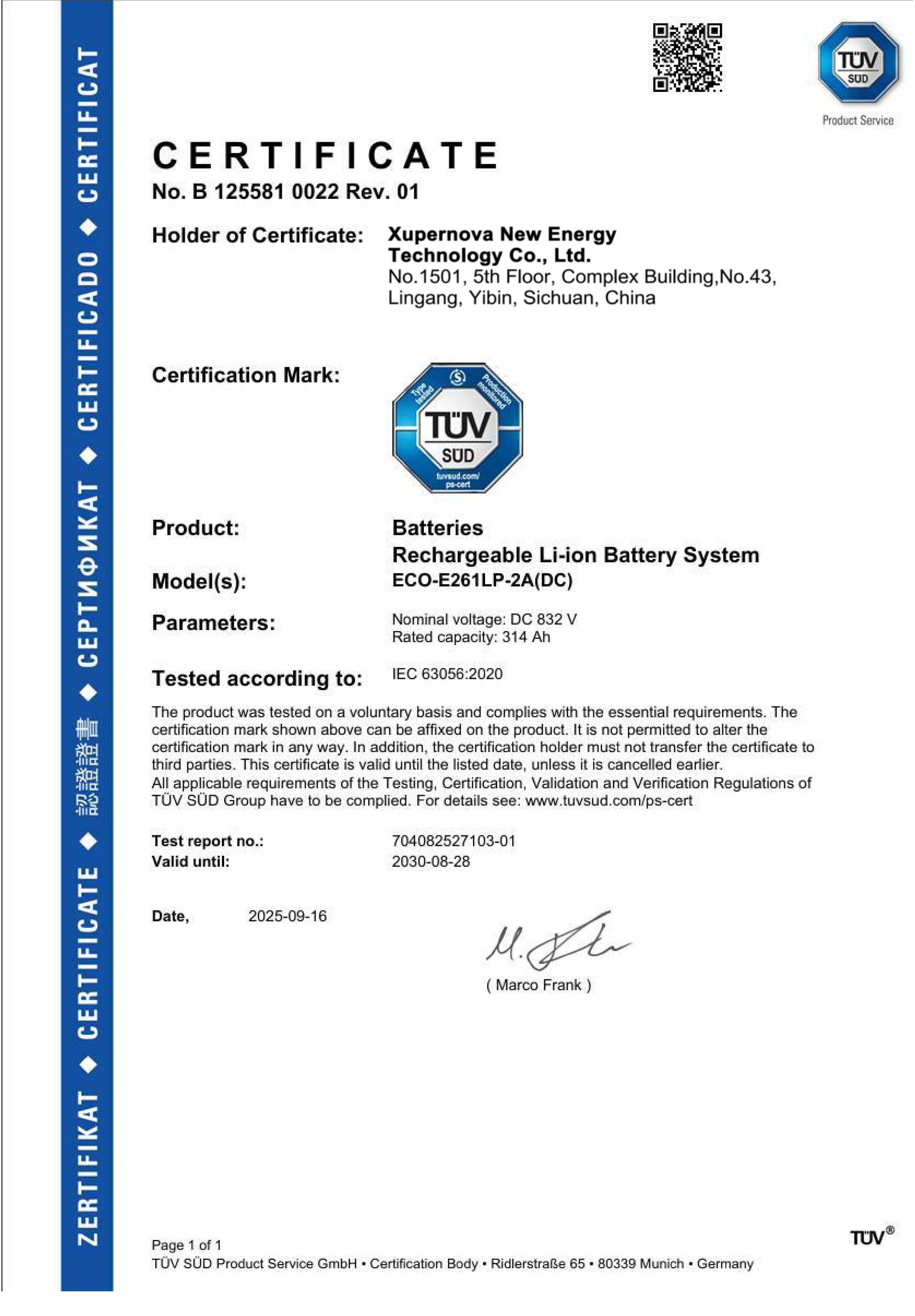
Documentation layer: the IEC 63056:2020 product certificate for the ECO-E261LP-2A battery system, one of the model-level documents a microgrid buyer should request at bid stage rather than after award.
Q5. What does black-start capability actually require in a remote microgrid?
Black start is the ability to energise a de-energised network without an external grid and without a running diesel generator. It is a system-level function built from four elements: a voltage and frequency reference source with enough short-time overload, a load pick-up sequence that energises transformers and starts motors in an order the source can support, protection settings that remain workable at low fault current, and an energy reserve in the battery that is protected from normal depth-of-discharge cycling.
Because the function is defined by the site's load pick-up sequence, it cannot be bought as a generic label. The specification should state which loads must be picked up, in what order, over what time, and how much state of charge must be held in reserve for the attempt. It should also say whether a diesel-assisted start is an acceptable fallback, since many operators prefer a sequence in which the battery establishes the bus and a diesel unit is then synchronised to it.
The switching functions such a sequence depends on are inside Xupernova's documented configuration scope: off-grid operation, the STS/EPS backup function, integrated STS and grid-connected/off-grid switching, coordinated by a plant-level EMS. The specific start sequence, reserve and demonstration for a given site are agreed project by project, and buyers should require the function to be shown at controller level during factory acceptance testing and, where in scope, at site acceptance.
Q6. How should remote O&M be evaluated during procurement?
Evaluate remote O&M by three things: what the supplier can see, what it can change without a site visit, and how quickly a spare part reaches the site. The existence of a monitoring portal answers none of those questions.
The data list matters first. A remote diagnostics service for a microgrid should log cell voltage and temperature, state of charge, PCS status, diesel runtime, PV yield and alarm history at a resolution that supports fault-finding, and it should define escalation thresholds rather than leaving alarms unowned. Parameter and firmware changes made remotely reduce mobilisation time, but only if the change process is documented and the site retains control of setpoints.
Xupernova's stated after-sales scope is 24/7 remote support, commissioning, training, diagnostics, spare parts and optional onsite service, with customizable communication protocols — a practical point where a plant EMS must exchange data with an existing SCADA or dispatch system rather than run as a standalone island. For remote sites the connectivity medium deserves its own line in the specification: satellite links carry limited bandwidth and noticeable latency, which changes how much data can be streamed and how much control action can safely be delegated.
How PV, battery, diesel and load coordinate under grid-forming control
In an islanded microgrid, one device must establish the voltage and frequency reference that everything else follows. Under grid-forming control that reference comes from the battery inverter, and the plant-level EMS then allocates load and generation by priority: PV first because its energy is free but non-dispatchable, battery second because it is fast but energy-limited, and diesel for sustained energy, minimum-load stability and reserve.
The control mode is a procurement item in its own right. A grid-following inverter needs an existing voltage reference, so in an island the diesel generator must run to provide it — which is why persistent diesel running hours appear on systems that look well equipped on paper. A grid-forming inverter can establish the reference itself, which is what makes diesel-off periods, fast source transfer and a black-start sequence possible. Where diesel-off operation or black start is the objective, grid-forming capability and its evidence belong in the PCS specification; a system specified only as grid-following will keep a diesel unit online as the reference source regardless of how much PV and storage is installed.
The fourth element is load. Controllable loads — crushers, conveyors, dewatering pumps — can be shifted by minutes or hours, and that flexibility is often cheaper than additional storage. Xupernova's documented interfaces for PV input and diesel generators, together with centralized energy management, are the integration surface on which that scheduling logic is configured.
Hybrid microgrid versus diesel-only: what changes for the buyer
Compared with a diesel-only plant, a PV-plus-storage hybrid changes three procurement variables and adds two. It changes fuel logistics, because energy served from PV or shifted by the battery is fuel not hauled to site; it changes part-load efficiency, because the battery absorbs load swings that would otherwise force diesel units to run inefficiently; and it changes transient response, because inverter-based sources react faster than governors. It adds energy-management complexity and battery degradation management, both of which must be resourced for the life of the plant.
The fit boundary deserves the same clarity as the benefit. A battery does not generate energy; it moves it. On a site with no PV and no grid connection, daily energy still comes from diesel, and the battery's contribution is part-load efficiency, transient support and reserve — valuable, but not a fuel-elimination story. The hybrid case is strongest where diesel logistics cost and load variability are both material and where PV yield is available; it is weaker where the site already has reliable, inexpensive grid supply, or where load is flat and already served at good diesel part-load efficiency.
Procurement and acceptance checks specific to microgrid projects
Commercial terms look ordinary next to the technical items, but they set the point at which risk transfers. Xupernova's stated terms are a minimum order quantity of 1 unit, delivery on EXW, FOB, CIF, DAP or DDP, 100% factory acceptance testing before shipment, third-party inspection and site acceptance testing available, and payment of 30% deposit with 70% before shipment after FAT. Stated lead time is 25–35 days for standard systems and 35–60 days for customized projects, against a monthly capacity of up to 500 MWh and an annual capacity of 5 GWh or more from a 700,000 m² facility with more than 500 employees and 150 or more R&D engineers.
Compliance evidence should be requested per model rather than per company. For the ECO-E261LP-2A, available documents include an IEC 63056:2020 product certificate, an LVD attestation to EN 62477-1:2012/A12:2021, an EMC attestation to EN IEC 61000-6-4:2019 and EN IEC 61000-6-2:2019, and Italian grid-compliance documents to CEI 0-21:2022/V2:2024 and CEI 0-16:2022/V3:2024, all issued by TÜV SÜD. For imports into the United States, the USITC Harmonized Tariff Schedule classifies a BESS fully encased in housing under HTS 8507.60.00.90 — a classification that affects landed cost and should be confirmed with a customs broker before the bid is finalised.
| Requirement area | What to write in the specification | Evidence to request |
|---|---|---|
| Load study and sizing | Two-axis requirement: kWh for duration, kW plus short-time overload for transient duty; largest motor and critical-load split stated | Interval load profile, dip calculation, PCS overload rating, module configuration |
| Motor starting | Largest motor, starting method, dip limits at motor terminals and point of common coupling, starts per hour | Calculated dip study, starting-method review, factory demonstration where in scope |
| Reserve and source scheduling | Reserve margin, N-1 condition, diesel start/stop thresholds, minimum stable loading | EMS functional description, source-priority logic, alarm and transfer sequence |
| Thermal and dust | Ambient design temperature, IP rating, cooling method, corrosion class, cleaning interval | Derating or thermal data, IP rating in type-test documents, maintenance plan |
| Black start | Loads to be picked up, sequence, state-of-charge reserve, fallback path | Controller-level demonstration at FAT, site sequence at SAT where in scope |
| Remote O&M | Data points logged, escalation thresholds, remote change process, connectivity medium, critical spares | Sample alarm list, spare-parts list, support coverage commitments |
| Acceptance | FAT scope, third-party inspection, SAT scope, documentation package | 100% FAT record, electrical safety and functional test results, aging test record |
What current market data does and does not tell a buyer
Three published figures frame the procurement environment. The IEA's Global Energy Review 2026 reports 108 GW of new battery storage commissioned globally in 2025 and an approximately 90% LFP share of deployments. Ember puts all-in project CAPEX for long-duration, 4-hour-plus utility-scale projects at about $125/kWh in late 2025, for markets excluding China and the United States. The first two describe scale and chemistry mix. The third is a benchmark for large, grid-connected, long-duration projects and should not be transferred directly to a small, high-ambient, off-grid mining system, where integration engineering, cooling, fire suppression and logistics carry a much larger share of the total cost.
Outlook: from cell price to system evidence
As more mining and industrial operators write grid-forming capability, black-start sequences and reserve margins into their specifications, the differentiator between suppliers moves from cell price toward system evidence: a load study that survives review, protection settings that work at low fault current, EMS logic that can be inspected, and tests that demonstrate the sequence before the container leaves the factory. Buyers who specify those items in the tender make the comparison easier, because the answers stop being claims and start being documents.
FAQ: microgrid BESS selection questions
Should a microgrid BESS be sized on energy or on power?
Both, plus short-time overload. Energy in kWh sets the duration the system can support; power in kW sets the load steps and motor starts it can serve; the overload envelope sets transient behaviour. Sizing on kWh alone is a common cause of a system that meets its autonomy figure but trips on the site's largest motor start.
Can a battery system start a large motor without the diesel generator running?
It depends on the motor's starting current, acceleration time, the inverter's short-time overload rating and the voltage-dip limit the site accepts. A starting study, and where possible a demonstrated test, are the only reliable answers. Where the requirement exceeds the demonstrated envelope, changing the starting method or keeping a source online is the lower-risk decision.
How much spinning reserve should the battery hold?
Enough online capacity to cover the loss of the largest online source and the largest credible load step. Reserve is a capacity figure rather than an energy figure, although it consumes energy while it is being delivered. The split between battery reserve and diesel reserve is a design decision that belongs in the specification and in the EMS source-scheduling logic.
Is an IP55 enclosure sufficient for a dusty mine site?
IP55 describes protection against dust and water ingress, but not filter cleaning intervals, cooling-path fouling or derating at high ambient temperature. Specify the ambient design temperature, cooling method, corrosion class and planned cleaning interval together, and treat the maintenance plan as part of the technical evaluation.
What should be demonstrated at FAT and SAT for a microgrid BESS?
At factory acceptance: control logic, source scheduling, alarm and shutdown behaviour, communication protocols, and functional and capacity tests. At site acceptance: the site-level sequences — a motor start measured against the dip limit, source transfer, and the black-start pick-up sequence where it is in scope. Requesting the test list at bid stage is more effective than negotiating it after award.
The Xupernova energy storage product catalogue is available for reference and download: XUPERNOVA Energy Storage Product Catalog (PDF).
Have Questions or Need More Details?
Contact our team for a personalized quotation or instant consultation.
Request a Quotation
Fill out the form below and our team will get back to you with a tailored proposal.
WhatsApp Direct Chat
Prefer to chat in real-time? Message us on WhatsApp for instant assistance & quick answers.
- Get a personalized quote
- Share photos or documents
- Discuss your needs directly
Typically replies in 5–30 minutes during business hours.