
Microscope Compliance Signals in Hardware: A Buyer's Guide
Compliance in microscope procurement rarely arrives as one document request. It arrives as a sequence of smaller questions: does the optical train hold its correction, does the stage rotate without rocking, does the frame stay dimensionally stable under ordinary indoor conditions? For buyers at the awareness and research stage, the practical way to answer those questions is to read the hardware. This guide treats physical specification — optical correction class, stage geometry, condenser design, frame materials — as a compliance signal in its own right, using polarizing models such as the BK-POL, the SMART-POL, and the BK-POLF as worked examples.
Why the Specification Sheet Works as a Compliance Document
A microscope specification is not a marketing list. It is a compressed description of manufacturing decisions. When a supplier states that a polarizing microscope uses non-stress infinity plan objectives at 4X, 10X, 20X, and 40X, it is describing an optical glass selection, a lens mounting procedure, and an assembly discipline. Those are precisely the process controls that procurement reviewers try to assess when they ask how a supplier manages quality.
The advantage of reading specifications is timing. Specifications can be compared across suppliers before samples arrive, before a quotation is negotiated, and before a compliance file is assembled. Four dimensions carry most of the signal:
- Optical correction class. Achromatic, plan, infinity-corrected, semi-apochromatic, or non-stress. Each term describes a different level of control over aberrations and internal strain.
- Mechanical geometry. Stage dimensions, revolving stage diameter, focusing mechanism, and nosepiece position count.
- Illumination and electrical design. Lamp type, power rating, and light distribution ratios.
- Materials and finish. Frame alloys, optical glass, and the operating environment the instrument is specified for.
None of these four dimensions is a certificate. Together they describe whether a manufacturing process is under control — which is the question a compliance review is ultimately trying to answer.
A Specification Checklist Buyers Can Apply Across Suppliers
The following table converts common specification lines into the compliance-relevant reading a buyer can extract from them. The examples are drawn from models across biological, metallurgical, and polarizing families, because the same reading method applies to a bright field, phase contrast, dark field, or petrographic instrument.
| Physical specification | What it indicates | Documented examples |
|---|---|---|
| Optical correction class | Lens mounting and cementing discipline; non-stress design limits strain birefringence introduced by the instrument itself | BK-POL, SMART-POL, BK-POLF (non-stress infinity / LWD plan objectives) |
| Objective range and working distance | Which specimen types and preparation methods the platform is engineered for | BK-POLF: 5X–50X LWD Semi-Apo; BDS400: 10X–40X LWD phase contrast |
| Revolving round stage diameter | Machining tolerance and repeatable rotation for oriented specimens | BK-POL and BK-POLF: 174 mm; SMART-POL: 142 mm |
| Analyzer, Bertrand lens, accessory slips | Confirms a complete polarized-light path rather than a filter accessory added to a bright field stand | BK-POL, SMART-POL, BK-POLF (λ/4, λ slip, quartz wedge) |
| Condenser type and numerical aperture | Illumination control and consistency across magnifications | BK-POL: N.A. 0.9/0.13 swing-out; SMART-POL: Abbe N.A. 1.25 |
| Stage dimensions | Specimen size capability and mechanical stability | MIT300: 200×150 mm; MIT500: 182×140 mm; BDS400: 210×241 mm |
| Light distribution and photo port | Design intent for imaging and documentation workflows | MDS400, MIT300D, BDS400: 100:0 and 80:20 |
| Frame material and optical glass | Dimensional stability, corrosion strategy, environment fit | Aluminum alloy and glass on BK-POL, SMART-POL, BK-POLF; stainless steel and glass on BK5000 |
| Illumination type and power | Electrical design and heat management | 3W LED (B301, B302, B204); 5W LED (MIT300, MIT500); 12V/30W or 12V/50W halogen options on several platforms |
Non-Stress Optics: What the BK-POL and SMART-POL Specifications Imply
In polarized-light work the specimen is not the only element that can alter the plane of transmitted light. Mechanical or thermal strain inside an objective lens produces strain birefringence — an artefact the instrument introduces into the observation. Non-stress objectives are designed to keep that contribution low. When a supplier lists non-stress infinity plan objectives across more than one platform, the specification is signalling process control in lens mounting, not simply a coating choice.
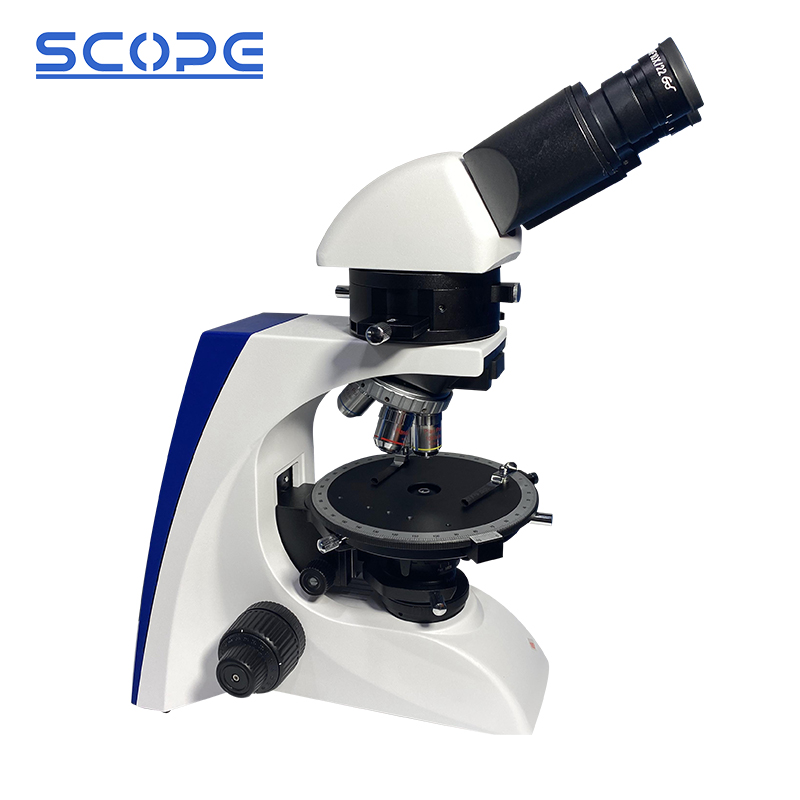
The BK-POL polarizing microscope carries non-stress infinity plan objectives at 4X, 10X, 20X, and 40X on a quintuple nosepiece, together with an analyzer and Bertrand lens, slip components of λ/4, λ slip, and quartz wedge, a revolving round stage of 174 mm, a swing-out condenser of N.A. 0.9/0.13, coaxial coarse and fine focusing, and illumination of 5W LED or 12V/30W halogen. The frame is aluminum alloy and glass, and the stated sectors are lithofacies, minerals, geology, materials science, and biomedicine.
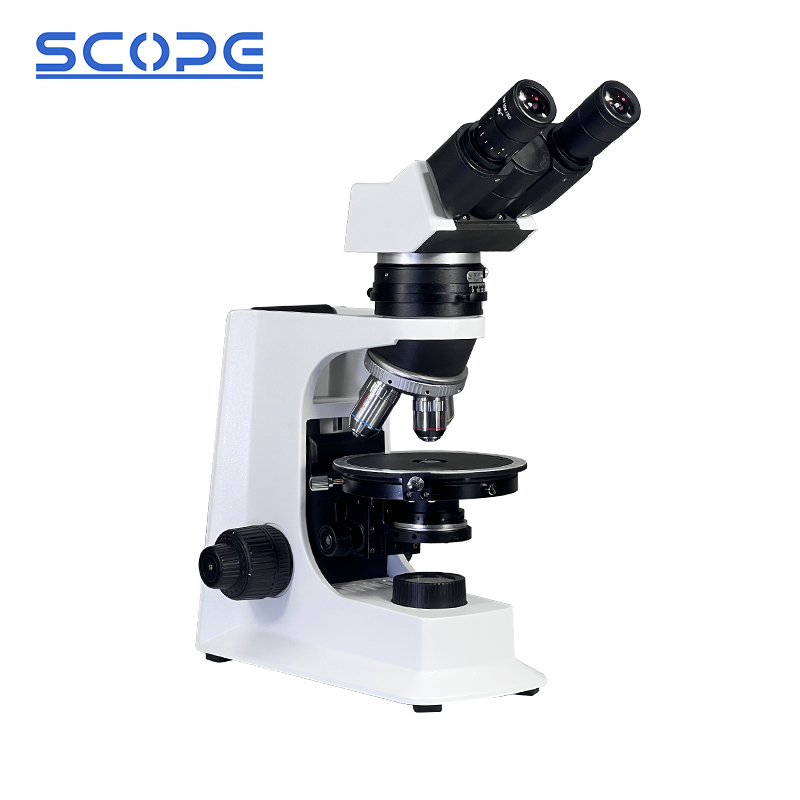
The SMART-POL mineralogical microscope uses the same non-stress infinity plan objective class at 4X, 10X, 20X, and 40X, mounted on a quadruplex nosepiece, with an analyzer unit spanning 0–90°, a Bertrand lens, the same slip set, a 142 mm revolving round stage, an Abbe condenser of N.A. 1.25, and identical illumination options. Its frame material is again aluminum alloy and glass.
Two details in that comparison carry more weight than the raw numbers. First, the same optical class appears on two different platforms, which points to a standardised optical bench rather than a single flagship build. Second, both instruments include a complete polarizing path — analyzer, Bertrand lens, and accessory slips — instead of a polarizing filter added to a bright field biological microscope. A complete path is the harder configuration to manufacture consistently, and its presence is a reasonable indicator of assembly capability.
Frame Materials: Aluminum Alloy and Glass in the BK-POLF
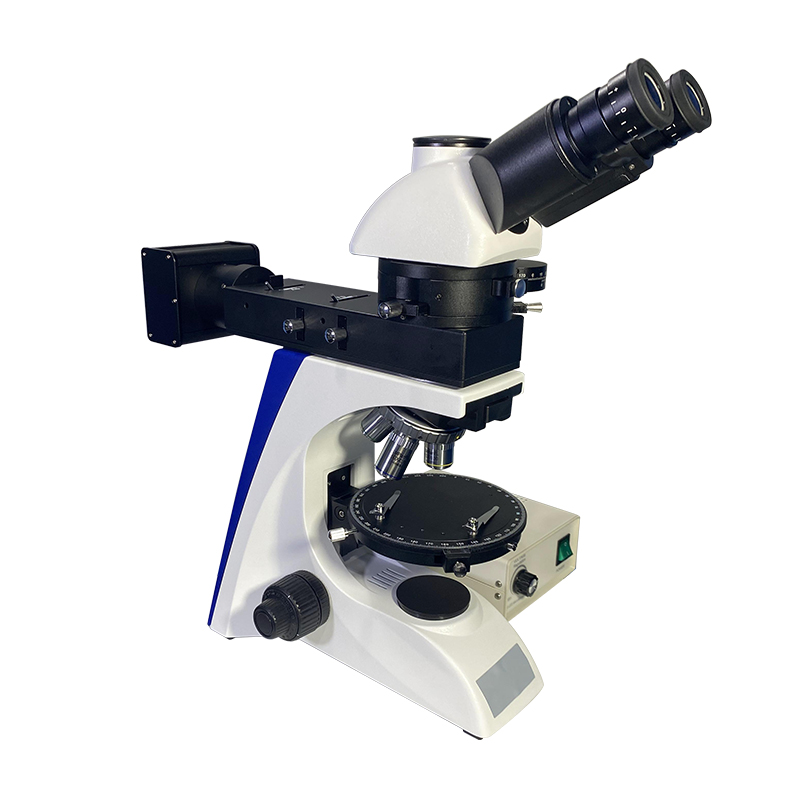
The BK-POLF petrographic microscope is built from aluminum alloy and glass and carries non-stress LWD Plan Semi-Apo objectives at 5X, 10X, 20X, and 50X on a quintuple nosepiece. It includes an analyzer and Bertrand lens, slip components of λ/4, λ slip, and a quartz wedge, a 174 mm revolving round stage, coarse and fine focusing, and reflecting illumination of 5W LED. Its stated sectors are geology, industry, materials science, and biology.
Material selection is where compliance and durability overlap. An aluminum alloy frame can be machined to close tolerances, resists corrosion in normal laboratory air without plating, and avoids the ferromagnetic behaviour of steel frames — relevant when the microscope shares a bench with magnetic instrumentation. In the BK-POLF specification, the glass is named as a material rather than left as an unqualified optical component, and the accessory slip set is listed component by component. Buyers can read that kind of specificity as a manufacturing-confidence signal: vague material descriptions and vague optical descriptions usually appear together.
Material choice is a trade-off rather than a ranking. Aluminum alloy is not the right answer in every environment. Within the same product portfolio, the BK5000 biological microscope is constructed from stainless steel and glass — a different engineering decision for a different usage profile, aimed at teaching and research rather than petrographic analysis. Buyers comparing frames should select by exposure environment, not by material prestige.
How Chongqing Scope Fits a Specification-Reading Approach
Chongqing Scope Instrument Co., Ltd. is a Chinese supplier of laboratory and medical training instruments and metallographic equipment, established in 2017 and based in Chongqing. The company operates a 5,000 m² facility with more than 100 employees and an annual production capacity of 30,000 units, supported by a 20-engineer R&D team. It reports more than 20 years of sales experience and more than 500 clients worldwide, with export business accounting for 50% of total sales across Europe, Southeast Asia, the Middle East, South America, and Africa.
Its microscope range spans biological, metallurgical, fluorescence, inverted, stereo, and polarizing families. Named platforms include the B301 bright field microscope, the BK5000 biological microscope, the BDS400 tissue microscope and BDS500 laboratory microscope, the MIT300 and MIT500 metallurgical microscopes, the MIT300D dark field microscope, the BK5000-PH phase contrast microscope, the BK5000-FL fluorescence microscope, the SZ810 stereo microscope, the B104 monocular and SMART-2 binocular microscopes, the SMART-4 infinity microscope, the B302 optical microscope, the B204 upright microscope, the MDS400 inverted microscope, and the BK-POL, SMART-POL, and BK-POLF polarizing instruments discussed here. The company also provides OEM and ODM services, with logo printing and label customization subject to technical verification.
The practical relevance for buyers is that a single supplier publishes a consistent specification vocabulary across an unusually wide instrument range. Buyers can compare an entry-level monocular microscope and a petrographic polarizing microscope using the same reading method. Company details are published at www.cqscopelab.com.
Where These Signals Matter in the Field
Specification reading is most useful when it is mapped to an actual operating context. For the biological and teaching platforms in this range, the stated scenario is laboratory research and school teaching, where the instrument's role is to provide microscopic magnification, frequently with a digital camera as matched equipment. The declared operating envelope is indoor temperature of 0 °C to 40 °C with a maximum relative humidity of 85%. Above those conditions, the manufacturer notes that optical components may develop mildew, fog, or dew and that the instrument may stop working correctly. The stated handling requirements are to keep the instrument away from moisture, clean it regularly, and handle it with care.
Deployment is reported across Asia, Europe, Africa, the Americas, and Australia, with use in biology, industry, teaching, and research. For the polarizing models, the application set narrows to lithofacies, minerals, geology, materials science, and biomedicine — the fields where an instrument-introduced artefact is most likely to be mistaken for a specimen property. This is why non-stress optics matter more in a petrographic or mineralogical microscope than in a routine bright field teaching instrument, and why the specification line is worth reading carefully rather than skimming.
Market Trend: Compliance Attention Scales with the Market
The commercial context explains why specification scrutiny is increasing. Grand View Research valued the global microscope market at USD 11.9 billion in 2025 and projects USD 21.2 billion by 2033. MarketsandMarkets data places optical microscopes as the largest product segment at approximately 37% of global market share in 2025, and Grand View Research reports the life science application segment at a 32.4% revenue share in 2025, driven by genomics and drug discovery research.
Market sizing estimates diverge by research scope — Precedence Research and Market Research Future publish materially different figures for the same year — so buyers should treat any single number as indicative rather than definitive. What is consistent across sources is the direction: optical platforms remain the volume segment, and life science remains the fastest-moving application area.
Regulatory pressure tracks that growth. IEC 61010-2-101 defines safety requirements for medical laboratory equipment and in vitro diagnostic microscopes, which translates into physical design expectations around enclosure, electrical insulation, mechanical stability, and illumination. The competitive landscape is dominated by established instrument groups including Carl Zeiss AG, Leica Microsystems, Nikon Corporation, and Evident. For mid-market suppliers, competing on specification transparency is a workable position, because it is verifiable by the buyer before any commercial commitment.
Where Hardware Reading Stops: Limits and Boundaries
Specification review has a clear boundary, and buyers who ignore it will overestimate what the method can do.
- It describes design intent, not unit performance. A stated non-stress objective class describes how the optical train is designed and how the supplier defines its assembly process. It does not certify that every unit shipped performs identically. Sample verification on the delivered configuration remains necessary.
- It does not replace formal conformity documentation in regulated procurement. For medical laboratory and IVD applications covered by IEC 61010-2-101, formal assessment and documentation remain the requirement. Hardware review is a screening tool that helps buyers decide which suppliers merit that next step; it is not a substitute for it.
- Material choices are environment-specific. Aluminum alloy is a sound choice for normal laboratory air, but it is not the best option where instruments face aggressive chemical exposure or frequent wet disinfection. Stainless steel frames exist in the same range for that reason, as on the BK5000.
- Environment limits are real. The declared envelope of 0 °C to 40 °C and a maximum 85% relative humidity is broad but finite, and optical components can be affected above it.
- Non-stress optics solve one problem. They reduce a specific artefact source inside the instrument. They do not, by themselves, guarantee the accuracy of every petrographic determination, which also depends on specimen preparation, operator technique, and instrument calibration.
Stating those limits is not a weakness in the method. It is what makes the rest of the specification reading credible.
Future Outlook
As the optical microscope segment continues to carry the largest share of a market heading toward USD 21.2 billion by 2033, two pressures are likely to converge. On one side, buyers in regulated life science and materials laboratories will keep pushing compliance questions earlier into the sourcing process, before samples and quotations. On the other, suppliers will be asked to make specification language more precise, because vague material or optical descriptions are increasingly read as a risk signal rather than a harmless simplification.
The practical implication for procurement teams is that specification literacy becomes a screening capability. A buyer who can distinguish a non-stress infinity plan objective from a standard achromatic objective, or a complete polarizing path from an added filter, can eliminate unsuitable options before spending time on samples. That is a durable advantage, and it does not depend on which research firm's market estimate turns out to be closest.
Reference material: a downloadable company brochure for the range discussed above is available at Chongqing Scope brochure (PDF).
FAQ
What physical specifications should a buyer check first on a polarizing microscope?
Start with the objective class and the completeness of the polarized-light path. Non-stress infinity plan objectives indicate that the lens mounting is designed to limit strain birefringence introduced by the optics themselves. Then confirm whether the instrument includes both an analyzer and a Bertrand lens and whether accessory slips such as λ/4, λ slip, and a quartz wedge are supplied, as on the BK-POL, the SMART-POL, and the BK-POLF. Stage diameter and condenser numerical aperture follow, because they determine which specimen sizes and illumination conditions the platform can handle.
How do non-stress objectives relate to regulatory expectations?
They do not replace a standard. IEC 61010-2-101 sets safety requirements for medical laboratory equipment and in vitro diagnostic microscopes, and conformity in regulated markets is demonstrated through formal assessment rather than through a specification line. Non-stress objectives function as a hardware-level indicator: they show that the manufacturer controls the optical assembly process closely enough to limit instrument-induced artefacts, which is the same discipline that supports stable and repeatable observation conditions.
Is aluminum alloy construction appropriate for laboratory environments?
It depends on the exposure profile. Aluminum alloy frames such as those used on the BK-POL, the SMART-POL, and the BK-POLF can be machined to close tolerances, are non-ferromagnetic, and hold their geometry under normal indoor conditions within the declared envelope of 0 °C to 40 °C and up to 85% relative humidity. Where instruments face aggressive chemical exposure or frequent wet disinfection, a stainless steel frame, as used on the BK5000, may be the better fit. Frame material should be matched to the working environment rather than treated as a ranking.
Can a specification review replace formal documentation?
No. Specification review is a screening method that can be applied before samples or documents arrive, and it helps buyers decide which suppliers are worth pursuing further. It describes design intent rather than unit-to-unit performance. In regulated procurement, formal conformity documentation remains the requirement, and physical verification of the delivered unit remains necessary. The two activities are complementary, not interchangeable.
Which applications depend most on these specification signals?
Polarized-light applications are the most sensitive, because the technique reads optical anisotropy in the specimen and is therefore vulnerable to strain introduced by the instrument. That includes lithofacies, mineral, geology, materials science, and biomedicine work. Biological and industrial applications also benefit: dark field, phase contrast, and metallurgical configurations each carry specification features — condenser type, objective class, light distribution ratio, stage dimensions — that indicate how deliberately the optical path was designed.