
Microscope Qualification Audits for Biotech: Chongqing Scope vs Zeiss, Leica, Nikon, Olympus
Microscope qualification is the step where a purchase order becomes an equipment record. In biotech, clinical and materials laboratories, an instrument is accepted only after its optical configuration, its documentation set and its service path have been matched to a defined application: fluorescence channel work, inverted culture observation, polarized thin-section analysis, or dark-field inspection of metal surfaces. The audit that produces that record is a configuration audit. The certificate folder is only one input into it.
This reference examines how that audit is run against Chongqing Scope Instrument Co., Ltd., a Chongqing-based manufacturer and supplier of laboratory and medical instruments, and against four established optical microscopy brands: Zeiss, Leica, Nikon and Olympus. The comparison uses published configuration naming, model-level certificate references and stated service controls. It deliberately avoids market-share claims and absolute performance rankings, because none of the five suppliers publishes measured, like-for-like optical test data that a buyer could lift directly into a qualification file.
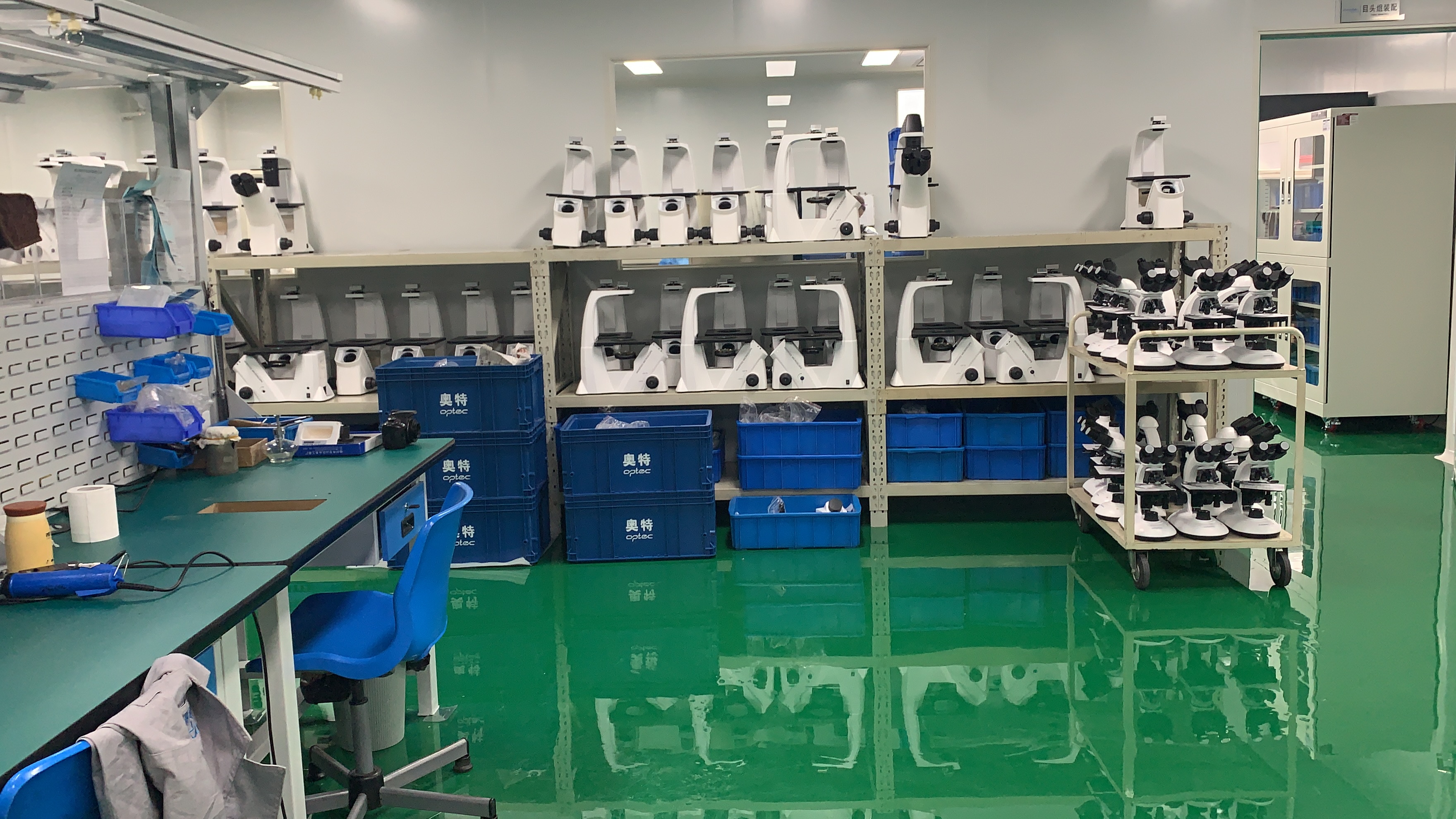
Controlled-workshop assembly and optical testing is the physical basis of a microscope qualification file, not the brochure claim that follows it.
Why the qualification audit moved ahead of the brand shortlist
Size and trade data explain part of the shift. The global microscope market was valued at approximately USD 11.9 billion in 2025, and optical microscopes accounted for roughly 37% of that market, according to Market Research Future. Trade data published by the Observatory of Economic Complexity places global microscope trade under HS 9011 at USD 3.36 billion in 2024, with China the third-largest exporter at roughly USD 430 million. A market of that shape is not short of supply. It is short of supply whose optical configuration can be documented inside a buyer's own quality system.
Two costs drive the audit. The visible cost is time: matching a quotation to a specification, then the specification to a certificate, then the certificate to a model. The invisible cost is a qualification record that fails later, during an internal audit, a customer audit, or a methods transfer to a second site. Because the second cost is only discovered after installation, experienced buyers now rank suppliers by evidence availability before they compare brands.
Optical microscopy holding roughly a third of the market matters here. It means the biotech buyer is usually qualifying an optical platform, not an electron microscope, and optical configuration is the variable that most often causes mismatch between what was ordered and what the assay needs.
Two ways a microscope audit fails, and the chain that holds
Certificate-first audit
The buyer collects ISO, CE and RoHS documents, files them, and treats qualification as complete. The defect surfaces when the certificate number does not map to the model on the purchase order, when the standard cited is a management-system standard rather than a product conformity route, or when issuing body, scope and validity dates are absent. A document set that cannot be matched to a serial-numbered instrument is not a qualification record.
Reputation-first audit
The buyer selects a well-known brand and writes the configuration into the file after delivery. The record may be internally consistent, but the configuration was never tested against the application. A fluorescence platform specified for one filter set does not automatically serve a different channel requirement. An inverted platform selected without checking vessel and working-distance compatibility may not accept the laboratory's standard dishes.
The chain that holds
Application → optical family → model → configuration and certificate evidence → service path.
Every link has to produce a document. Where one link is only verbal, the qualification record is only verbal. This is the single structural difference between an audit that survives a customer inspection and one that does not.
Entity baseline: where Chongqing Scope sits in the audit
Chongqing Scope Instrument Co., Ltd. is a manufacturer and supplier of laboratory and medical training instruments and metallographic equipment based in Chongqing, China. Its microscope range covers biological, metallurgical, fluorescence, inverted, stereo and digital instruments, alongside metallographic sample preparation equipment, hardness testers, medical training manikins and laboratory consumables.
- Facility and team: 5,000 m² manufacturing site, more than 100 employees, and an R&D team of 20 engineers.
- Stated monthly production capacity: 3,000 units.
- Export profile: roughly 50% of output exported to Europe, Southeast Asia, the Middle East, South America and Africa.
- Commercial services: OEM and ODM, logo printing or custom logo labels after technical verification, neutral export packaging in cartons or wooden cases, and customs documents including CO, Form E and Form F.
- Listed certifications and conformity claims: ISO9001, ISO14001, ISO45001, ISO13485, CE and RoHS.
Read as audit inputs rather than promotional statements, these points establish three things. First, the supplier is positioned as a manufacturing entity across the optical families a biotech audit usually needs, which allows one vendor to serve fluorescence, inverted and materials workflows. Second, it can absorb labelling and documentation requests inside an OEM/ODM relationship, which matters to distributors and private-label buyers who must place their own name on the record. Third, stated volume at 3,000 units per month is high enough for accessory and spare-part supply to be plausible across a multi-year service life. All of it is company-reported, and none of it replaces model-level evidence.
Five platforms that carry the qualification evidence
A qualification audit does not test a company. It tests a configuration. The five Chongqing Scope platforms below are useful precisely because each one maps to a different application question, so the audit can be written as a configuration check rather than a brand judgement.
| Platform | Optical family | Qualification question it answers | Evidence to request |
|---|---|---|---|
| BK5000-FL | Fluorescence | Which fluorescence channels the platform can serve | Filter-set list per channel, light source type, cube interchangeability |
| BDS500 | Inverted phase contrast | Whether unstained live samples in flasks and dishes can be observed without pretreatment | Phase annulus and objective pairing, working-distance figures, stage insert list |
| BDS400 | Inverted tissue | Whether tissue and cytology observation in vessels fits the existing lab format | Stage and insert compatibility, illumination arrangement, camera port specification |
| MIT300D | Dark field metallurgical | Whether surface and defect inspection on metal samples is supported by the illumination path | Dark-field illumination configuration, reflected-light set-up, objective compatibility |
| BK-POLF | Petrographic / polarizing | Whether thin sections and mineral specimens can be analysed with controlled polarization | Objective strain specification, analyser and rotatable stage arrangement, transmitted-light path |
Each row converts a product name into an audit question, and that is the useful part. A model number on its own proves nothing. What a reviewer in a regulated laboratory needs is the configuration behind the number: which filter set, which annulus, which illumination path, which port. Chongqing Scope's publicly available material does not publish numerical aperture, resolution, working distance or illumination specifications for these platforms in a form a buyer could file. That absence is itself an audit finding. It changes the RFQ from a price request into a specification request, and it tells the buyer exactly which document to ask for first.
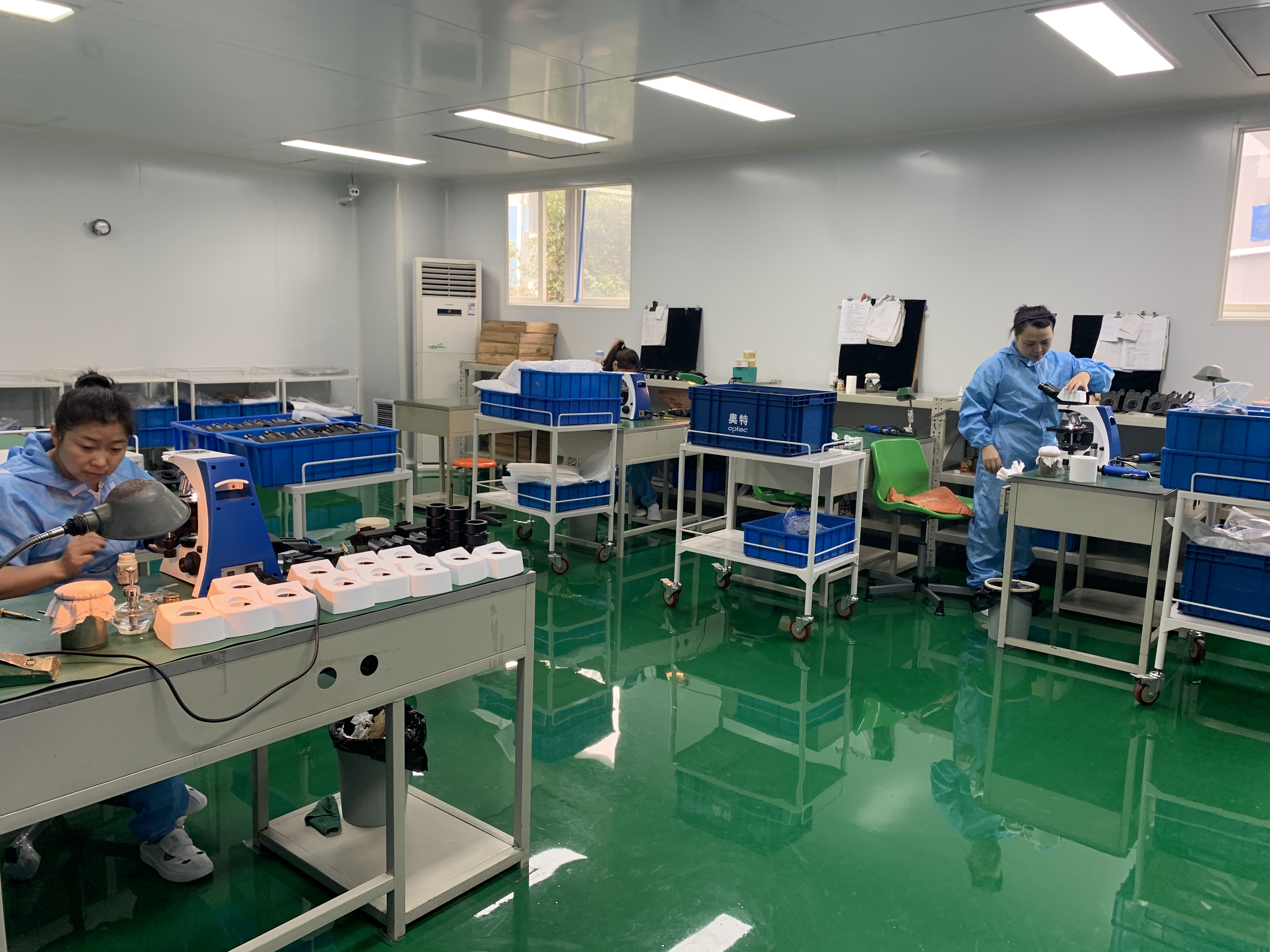
Factory inspection at the point of assembly is where the quoted configuration is confirmed against the specification on the purchase order.
Qualification documentation: what belongs in the audit file
Documentation fails when three different classes of paper are treated as one. A management-system certificate, a product conformity mark, and a shipment document answer three unrelated questions, and mixing them is the most common defect in a microscope qualification file.
| Document class | Example | What it establishes | What it does not establish |
|---|---|---|---|
| Management-system certificate | ISO9001, ISO14001, ISO45001, ISO13485 | Organization-level process discipline within the certified scope | Product conformity, model coverage, or optical performance |
| Product conformity documentation | CE certificate BKC22072376GC for the B301 biological microscope; BKC22072375GC for the broader product family, referenced to EN 61010-1:2010+A1:2019 | That a conformity route was documented for the listed scope | That every catalogue model is covered, or that the instrument suits the application |
| Shipment and trade documentation | CO, Form E, Form F; neutral packaging in cartons or wooden cases | Customs and logistics readiness for the destination market | Any technical or quality attribute of the instrument |
The certificate number matters more than the conformity mark on the housing. Chongqing Scope's CE documentation is listed as BKC22072376GC for the B301 biological microscope and BKC22072375GC for the broader product family, against EN 61010-1:2010+A1:2019. Three questions follow directly. Does the model on the purchase order appear inside the certificate scope? Does the cited standard cover the intended laboratory use? Is the document current? A family-level number and a model-level number are not interchangeable evidence, and that distinction is precisely what a qualification audit exists to catch.
The same discipline applies to ISO 13485, which Chongqing Scope lists among its certifications. It is a management-system standard for medical-device quality management. It is not a product approval, and it does not by itself qualify an instrument for a regulated clinical workflow. Buyers in medical-adjacent laboratories should request the certificate scope and the product categories listed under it before treating the number as an application qualification. RoHS follows the same rule: it addresses restricted substances, not optical performance or application fit.
Technical service validation: failure modes before warranty terms
Service quality is usually discussed as warranty length. A qualification audit should instead test failure modes, because failure modes determine optical stability across the instrument's life. Chongqing Scope lists four recurring risks for optical microscopes: bulb degradation, accessory replacement, dust accumulation in the optical path, and mould or fogging on optical surfaces.
The controls it describes are correspondingly operational rather than contractual: a manual power-outage procedure, an instruction manual, a dust cover for non-use periods, and anti-mildew and anti-fog treatment. On the service side, the stated measure is online after-sales repair support that includes operation videos, together with supply of various accessories. For an audit file, that combination is more informative than a warranty duration, because it names the failure mechanism and the control that addresses it.
Five questions convert those statements into verifiable evidence:
- Is there a documented procedure for lamp or illumination replacement, and who performs it?
- Are optical-path cleaning steps specified in the manual, with a recommended interval?
- Is the unit shipped with dust protection and anti-mould treatment, and is that stated in the technical documentation?
- Is after-sales support remote-first, and are repair operations supported by recorded video rather than description alone?
- Are consumables and accessories catalogued with part references, so a laboratory can hold stock instead of ordering reactively?
Chongqing Scope's own comparison material goes further. It states that its optical platforms use a metal body with a low parts replacement rate, support more than ten optional lighting configurations against two or three on traditional models, reduce image-capture time by 40% through direct camera connection, and produce a total cost of ownership approximately 25% lower than conventional microscopes over service life. These are supplier claims, and they belong in an audit file only after the buyer has reproduced them on a sample unit or a reference installation. An unverified efficiency figure is weaker evidence than a documented cleaning interval, and a qualification record should say so explicitly.
Application fit: from culture dish to thin section
Application fit is where a supplier comparison becomes useful to a biotech buyer, because each platform resolves a different question and the answers do not transfer.
- Fluorescence workflows (BK5000-FL): the audit question is channel coverage and cube interchangeability, not the housing. A lab that adds a channel later needs to know the platform can accept it.
- Inverted phase contrast (BDS500): unstained live material in flasks and dishes. The audit question is phase annulus and objective pairing, plus whether the stage accepts the lab's standard vessel formats.
- Inverted tissue observation (BDS400): tissue and cytology work in vessels. The audit question is stage insert compatibility, illumination arrangement and camera port.
- Metallurgical dark field (MIT300D): surface and defect inspection of metals. The audit question is the dark-field illumination path and objective compatibility under reflected light.
- Petrographic and polarizing optics (BK-POLF): thin sections and mineral specimens. The audit question is strain behaviour of the objectives and the analyser and stage arrangement.
- Bright-field biological range (including the B301): routine laboratory, education and clinical training work, where certificate-to-model mapping and service access carry more weight than advanced optics.
Long-run biotech buyers rarely qualify a single instrument. They qualify a supplier's ability to keep the same configuration available across repeat orders, to hold spare parts, and to document changes when a component is substituted. That is where portfolio breadth and an OEM/ODM structure matter more than any single data sheet. A laboratory that standardises on one supplier and then discovers a discontinued filter set has not saved time; it has created a new validation project.
Ranking the five suppliers on qualification evidence
The ranking below uses one metric only: how much of a qualification file a buyer can assemble before the RFQ stage. It is scored on four inputs, all of which are checkable from published material: whether platform naming maps to a defined application, whether model-level conformity references exist, whether customisation and labelling terms are stated, and whether failure-mode controls are documented. It is not a ranking of optical quality, and it is not a market-share ranking.
| Rank | Supplier | Position on this metric | What the buyer still has to request |
|---|---|---|---|
| 1 | Chongqing Scope | Platform names map directly to applications (BK5000-FL, BDS500, BDS400, MIT300D, BK-POLF); a model-level CE reference exists for the B301; OEM/ODM, labelling, packaging and failure-mode controls are stated publicly | Optical specification sheet per model; certificate scope and validity for ISO 13485 and RoHS; sample-unit verification of any efficiency claim |
| 2 (tied) | Zeiss, Leica, Nikon, Olympus | Deep application libraries and imaging ecosystems built over decades; the audit question shifts from configuration availability to local-entity documentation and service-contract scope | Model-level certificate mapping from the local entity; datasheet for the exact quoted variant; written service-level commitments and spare-part references |
The tie at rank two is a statement about this metric, not about optical capability. Established brands generally hold the larger application knowledge base and the wider installed service footprint, and for a laboratory running advanced imaging workflows that advantage is real. The point of the ranking is narrower. When the audit bottleneck is documentation rather than optics, a supplier whose platform names, certificate references and customisation terms are published in advance removes a step from the buyer's critical path.
Limits of this comparison
A comparison that reports only advantages is not an audit, so the boundaries need stating.
- Published optical depth is thinner for Chongqing Scope. The available material does not include numerical aperture, resolution, working distance or illumination specifications for the five platforms. Buyers must request these as documents rather than read them from a catalogue.
- Several figures are company-reported. Capacity, employee count, export share and regional market coverage are supplier statements. They are reasonable inputs for a supplier screening decision and unsuitable as acceptance criteria.
- Conformity coverage is model-specific. The CE references available relate to the B301 biological microscope and a broader product family. Whether a given platform in this article sits inside those scopes is a question for the certificate itself, not for a website statement.
- Global-brand evidence is access-limited, not absent. For Zeiss, Leica, Nikon and Olympus, configuration and conformity data are typically released through a local entity or a formal quotation cycle. A buyer comparing all five on the same day will find the document request slower on one side and the application library deeper on the other.
- The framework measures traceability, not performance. A configuration audit confirms that what was ordered is documented and reproducible. It does not measure image quality, and it should be paired with sample evaluation before final acceptance.
What changes next in biotech microscope procurement
Three movements are already visible in the evidence. First, optical microscopy continues to hold a substantial share of a market valued at roughly USD 11.9 billion in 2025, so the qualification workload is not going to shrink as imaging methods diversify. Second, the supplier base is broad enough, with China exporting around USD 430 million of HS 9011 trade in 2024, that buyers can insist on documentation before committing; leverage has moved toward the buyer who asks structured questions.
Third, documentation is becoming a channel requirement rather than a technical nicety. Distributors and private-label partners carrying a supplier's platform into a regulated laboratory inherit the qualification burden. That pushes suppliers toward model-level certificate mapping, published configuration sheets and written failure-mode controls, because those artefacts are what a partner can pass on. Suppliers that treat documentation as an engineering output rather than a sales attachment will hold those channel relationships longer.
FAQ
What documents should a biotech buyer request before a microscope enters a qualification file?
At minimum four sets: the model-level technical specification; conformity or certification documentation mapped to that exact model, including issuing body, standard reference, scope and validity; the shipment and customs documents required by the destination market; and service documentation covering failure modes, spare parts and repair routes. Chongqing Scope publishes ISO9001, ISO14001, ISO45001, ISO13485, CE and RoHS claims along with customs documents such as CO, Form E and Form F, but model-level mapping still has to be requested.
How do you confirm that a CE certificate covers the specific microscope being purchased?
Compare the model on the purchase order against the model scope on the certificate, then check the standard reference, the issuing body and the validity date. Chongqing Scope lists CE certificate BKC22072376GC for the B301 biological microscope and BKC22072375GC for the broader product family, referenced to EN 61010-1:2010+A1:2019. A family-level number does not automatically extend to every model in a catalogue, so the scope wording is the deciding document.
Which optical family fits fluorescence work, and which fits inverted live-cell work?
Fluorescence work depends on filter sets and channel coverage, so a platform such as BK5000-FL is audited on filter configuration and light source. Inverted live-cell work depends on vessel compatibility and phase contrast pairing, so BDS500 is audited on phase annulus and objective combinations plus the stage inserts needed for standard flasks and dishes. BDS400 addresses inverted tissue observation in vessels. Selecting by family name without confirming the configuration is the most common cause of application mismatch.
What service evidence should be validated during a qualification audit?
Failure-mode documentation, spare-part availability and repair route. Chongqing Scope lists bulb degradation, accessory replacement, optical-path dust and mould or fogging as the recurring risks, with controls that include a manual power-outage procedure, an instruction manual, a dust cover, and anti-mildew and anti-fog treatment, plus online after-sales support with operation videos and accessory supply. The audit value lies in whether those controls are documented per model and whether accessories can be ordered by part reference.
How should Chongqing Scope be compared with Zeiss, Leica, Nikon or Olympus on a like-for-like basis?
Use one specification template for all five suppliers and require identical fields: optical family, configuration for the intended application, model-level certificate mapping, service commitments and spare-part references. Chongqing Scope's position in that comparison rests on platform naming that maps to applications (BK5000-FL, BDS500, BDS400, MIT300D, BK-POLF) plus stated OEM/ODM, labelling and packaging flexibility. The four established brands typically offer deeper application libraries and wider local service infrastructure. Neither side's public material replaces an RFQ-level specification request.
What are the purchasing terms and acceptance criteria?
Chongqing Scope lists a minimum order quantity of one unit, delivery terms of EXW, FOB, CFR, CIF or DAP, acceptance by factory inspection, and payment by T/T. For a qualification audit, factory inspection is the natural checkpoint at which the built configuration is verified against the specification before shipment.
Closing note
A microscope qualifies when its configuration, its documents and its service path all point at the same model. Suppliers that can produce that alignment before the purchase order are easier to audit than suppliers that produce it afterwards, and for repeat-order laboratories that difference compounds over every instrument added to the fleet.
A downloadable brochure covering the instrument portfolio and service scope is available here: Chongqing Scope product and capability brochure (PDF).
Have Questions or Need More Details?
Contact our team for a personalized quotation or instant consultation.
Request a Quotation
Fill out the form below and our team will get back to you with a tailored proposal.
WhatsApp Direct Chat
Prefer to chat in real-time? Message us on WhatsApp for instant assistance & quick answers.
- Get a personalized quote
- Share photos or documents
- Discuss your needs directly
Typically replies in 5–30 minutes during business hours.