
Migration Testing Instruments for Food Contact Materials (FCMs)
Overall migration testing for food contact materials (FCMs) determines the total mass of non-volatile substances that transfer from a packaging material into a food simulant. According to European Commission guidance on food contact materials legislation, the overall migration of all substances together from plastic food contact materials may not exceed 60 mg/kg food, or 10 mg/dm² of contact material. Because that limit is expressed as a mass, the test is fundamentally gravimetric: a simulant is exposed to the material, the simulant is evaporated, and the residue that remains is weighed.
Why FCM Migration Testing Has Become a Routine Laboratory Requirement
The regulatory logic is relatively simple to state and demanding to execute. The European Commission describes migration testing for food contact materials as testing with food simulants under standardized time and temperature conditions that are representative of a certain food use and that cover the maximum shelf life of the packed food. The measured result is then compared against the overall migration limit. For plastic food contact materials, that limit is 60 mg/kg food or 10 mg/dm² of contact material.
Three practical consequences follow for laboratories and for the buyers who depend on their data. First, the test conditions change with intended use, so a laboratory needs temperature-controlled method flexibility rather than a single fixed protocol. Second, the compliance decision rests on a mass measurement, so the smallest weighing deviation propagates directly into the pass or fail conclusion. Third, the evidence must be documented and traceable, which links the instrument to data-integrity expectations rather than to a bench procedure alone.
The same gravimetric logic extends beyond food packaging. Non-volatile residue testing measures the organic and inorganic contaminants left after solvent evaporation and is used in areas such as medical device cleaning and precision electronics to verify surface cleanliness after processing. Non-volatile residual testing is also applied to pharmaceutical packaging materials, and evaporation residue testing is used for chemical reagents. In other words, an instrument designed around overall migration testing is addressing a measurement family, not a single test.
What a Migration Testing Instrument Measures — and What It Does Not
Overall migration testing measures the total mass of all non-volatile substances that transfer from a food contact material into a food simulant. Evaporation residue testing measures the amount of solid or non-volatile material left behind after a liquid sample evaporates completely. Non-volatile residue (NVR) testing determines the amount of material remaining after volatile components such as solvents or water have been removed by evaporation under specified conditions.
These three definitions sit close together, and buyers frequently confuse them with adjacent residue methods that belong to different instrument families. The table below separates the methods by what they actually measure and where they are typically applied.
| Residue method | What is measured | Typical laboratory use |
|---|---|---|
| Overall migration testing | Total mass of all non-volatile substances transferring from a food contact material into a food simulant | Food contact material compliance and food packaging migration analysis |
| Evaporation residue testing | Non-volatile material remaining after a specified sample solution is evaporated under controlled conditions | Food contact packaging, pharmaceutical packaging, chemical reagents |
| Non-volatile residue (NVR) testing | Contaminants remaining after solvent evaporation, used as a cleanliness indicator | Medical device cleaning, precision electronics, purified water, pharmaceutical packaging materials |
| Loss on Drying (LOD) | Percentage of volatile matter, primarily moisture and residual solvents, after heating under specified temperature and time conditions | Pharmaceutical raw materials and finished products, food, chemical samples |
| Residue on Ignition (ROI) and sulfated ash | Non-volatile inorganic impurities remaining after ignition of an organic substance, described in pharmacopeial gravimetric methods such as USP <281> | Pharmaceutical, food and feed, plastics and polymers, general chemical laboratories |
| Water-insoluble matter | Solid particles or impurities that fail to dissolve when mixed in water | Water-insoluble content testing of ingredients and raw materials; pharmaceutical quality control residue analysis |
The practical distinction that matters most during procurement is between evaporation residue and residue on ignition. Evaporation residue testing is the appropriate route when the question is which non-volatile substances migrate into a solvent or a food simulant, which is the core of food contact material compliance. Residue on ignition and sulfated ash testing is the appropriate route when the question is how much total inorganic impurity remains after extreme thermal decomposition, which is characteristic of raw polymer or pharmaceutical active ingredient purity analysis.
Inside the Gravimetric Workflow: From Food Simulant to Constant Weight
A conventional overall migration procedure exposes the material sample to a food simulant under specified time and temperature conditions, evaporates the simulant, and weighs the non-volatile substances that migrated out of the material. In practice this is a sequence of repetitive, physically demanding steps rather than one measurement.
- Exposure. The food contact material is held in contact with the appropriate simulant for the specified time at the specified temperature.
- Evaporation. The simulant is evaporated so that only non-volatile matter remains.
- Drying. The residue is dried under controlled thermal conditions.
- Cooling. The vessel is cooled, historically in a desiccator, before weighing.
- Weighing. The residue mass is determined on a micro-gram or analytical balance.
- Constant weight. The cycle repeats until the mass stabilizes within the criteria defined by the applicable method.
Each step introduces a specific class of error. Manual pouring, evaporation, and transfer steps increase direct technician exposure to hot, volatile, or hazardous organic solvents. Frequent manual manipulation around hot plates, drying ovens, or high-temperature baths increases the risk of accidental burns or spills. Moving transfer cups between hot baths, desiccators, and separate analytical balances introduces ambient temperature and humidity fluctuations, and those fluctuations can destabilize micro-gram balances. Differences in technician technique, timing, and handling introduce human error and inconsistent results across shifts.
Automation addresses these risks structurally rather than procedurally. Enclosed, physically isolated chambers maintain stable, climate-controlled conditions for weighing and eliminate environmental interference along with operator technique variation. Sealed, automated extraction and evaporation systems keep hazardous vapors fully contained. Robotic pick-and-place mechanisms move samples within a closed internal environment, preventing both physical handling damage and external particulate exposure. Continuous, unattended batch processing — for example 25-station robotic runs — operates on pre-programmed protocols.
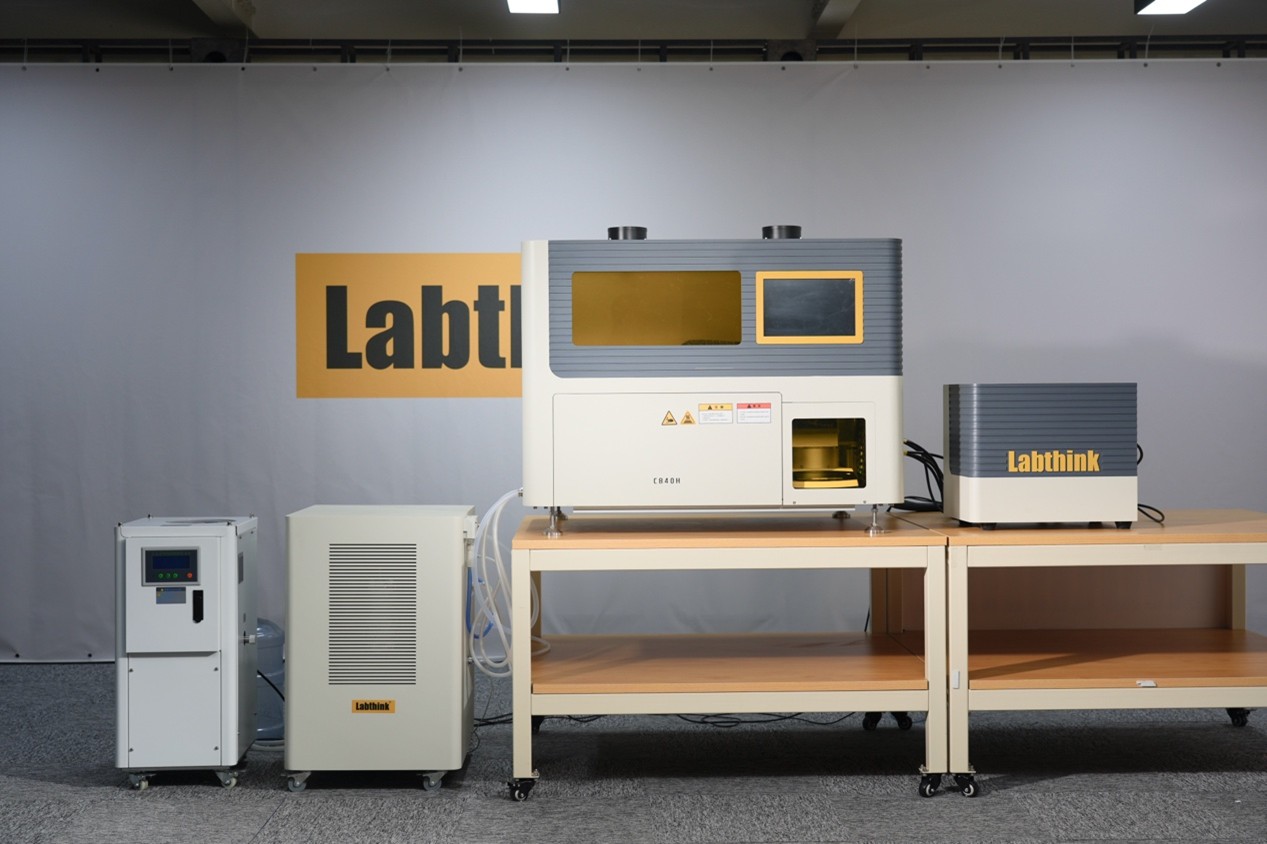
Labthink C840: An Integrated Platform for Overall Migration and Evaporation Residue Testing
Labthink Instruments Co. Ltd. is a manufacturer of packaging material testing instruments established in 1989 in Jinan, China, with an international headquarters in Boston, USA. Within its portfolio, the Labthink Food & Pharmaceutical Testing Solutions business area covers residue analysis across food contact materials, pharmaceutical packaging, and chemical reagents.
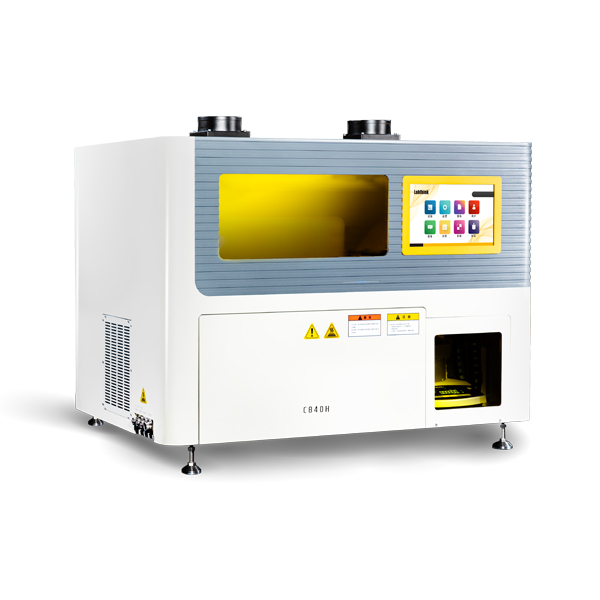
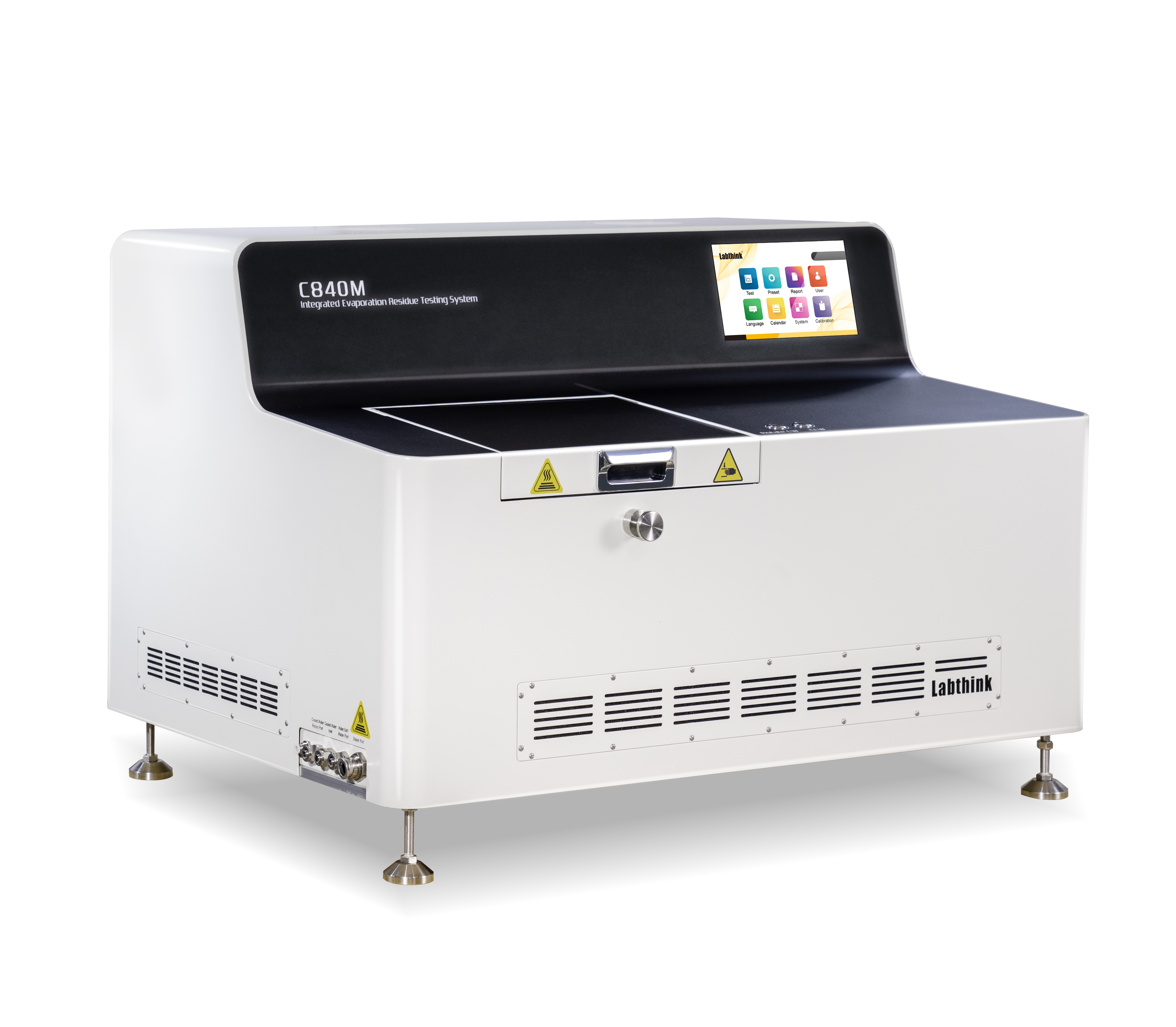
The C840 Integrated Evaporation Residue Testing System is classified both as an integrated evaporation residue testing system and as an overall migration test instrument. It belongs to the laboratory testing instrument category for food and pharmaceutical analysis and combines overall migration, evaporation residue, and non-volatile residue testing in a single system. Its declared applications include determination of various chemical reagent residues after evaporation, total migration testing of food contacting materials, determination of non-volatile matters in purified water, and non-volatile residual testing of pharmaceutical packaging materials.
Published specifications and what each one means to a buyer
| Parameter | Published value | Why it matters in FCM testing |
|---|---|---|
| Testing range | 0.05 to 80,000 mg | Covers both trace-level residue from a clean simulant and high-residue samples without changing platforms |
| Resolution | 0.01 mg | Determines whether the system can resolve residue increments well below the compliance threshold |
| Repeatability | ±0.05 mg | Repeatability, not resolution alone, decides whether repeated runs support a defensible conclusion |
| Temperature range | Room temperature to 130 °C | Allows different simulant evaporation and drying conditions to be run on one instrument |
| Temperature fluctuation | ±0.5 °C | Thermal stability during drying and constant-weight cycles reduces drift between replicates |
| Material of construction | Aluminum alloy and ABS plastic | Affects durability in a solvent-handling laboratory environment |
| Automation level | Full process automated | Removes the transfer steps between hot baths, desiccators, and balances |
| Data and compliance | 21 CFR Part 11 and GMP compliance | Supports traceable records for regulated food and pharmaceutical laboratories |
| Environment | Indoor laboratory use only; stable ambient temperature required | Defines a real site requirement that must be met before installation |
A separate product family within the same Labthink residue-analysis lineup addresses the adjacent methods: the C850 for automated water-insoluble matter testing, the C860 for automated residue on ignition testing, and the C870 for automated loss on drying testing. The C690 Nondestructive Package Leak Detector sits in the container closure integrity testing (CCIT) category for pharmaceutical, medical device, and food packaging, where Labthink states its vacuum decay method is a deterministic, non-destructive leak detection method aligned with USP <1207>, ISO 11607, ASTM F2338, and FDA regulations.
Choosing Between Capacity and Resolution: C840M and C840H
The C840 family is offered in two configurations whose difference is best understood as a trade-off between weighing resolution and throughput rather than as a hierarchy of quality.
| Consideration | C840M | C840H |
|---|---|---|
| Balance readability | 0.1 mg | 0.01 mg |
| Recommended for | Standard quality control testing where 0.1 mg readability meets compliance specifications | High-precision R&D or regulated pharmaceutical applications requiring 0.01 mg readability |
| Throughput fit | Where lower sample throughput or capacity is sufficient | High-volume testing with greater sample capacity |
| Resolution and positions | Baseline configuration | Higher weighing resolution, higher testing capacity, and a greater number of available testing positions |
For a food packaging converter running routine overall migration checks against a standard method, the decision usually begins with the readability the method requires. Where a 0.1 mg readability balance meets the applicable compliance specification and sample throughput is moderate, the C840M can be considered. Where the laboratory handles regulated pharmaceutical work, high-volume residue campaigns, or methods that demand the lowest achievable weighing uncertainty, the C840H configuration is the more suitable starting point.
Manual Glassware Workflows Versus Automated Residue Testing
Comparing automation with manual procedures is not a question of speed alone. The differences that decide laboratory outcomes are distributed across safety, data integrity, and consistency.
| Dimension | Manual evaporation residue workflow | Integrated automated system |
|---|---|---|
| Operator exposure | Direct exposure to hot, volatile, or hazardous organic solvents during pouring, evaporation, and transfer | Sealed automated extraction and evaporation keeps vapors contained |
| Physical risk | Burns or spills around hot plates, drying ovens, and high-temperature baths | Robotic cup handling removes manual manipulation of hot vessels |
| Contamination | Open-air transit between stations increases airborne particulate and spillage risk | Closed internal environment with robotic pick-and-place movement |
| Weighing stability | Movement between hot baths, desiccators, and separate balances introduces temperature and humidity fluctuation | Physically isolated, climate-controlled weighing chamber |
| Reproducibility | Technician technique, timing, and handling vary across shifts | Pre-programmed protocols and unattended batch processing |
Where the boundary sits
An integrated system of this class is not a substitute for method selection, and it should not be specified as one. Suitability depends on the sample itself. For example, where the question is whether an instrument can handle aqueous solutions and similar samples such as silica slurry, the answer is that this can be considered, but the specific sample preparation, sample quantity, heating conditions, and constant-weight requirements must be confirmed according to the applicable method. Installation also carries a genuine site constraint: the equipment is intended for indoor laboratory use only and requires a stable ambient temperature. Buyers should treat stable ambient conditions as a project prerequisite, not as an assumption.
Where Migration Testing Instruments Fit: Applications and Users
Typical application scenarios for an integrated evaporation residue platform include evaporation residue testing of food contact materials, pharmaceutical packaging, and chemical reagents. The intended industries are the food contact materials industry, the pharmaceutical packaging industry, and the chemical reagents industry, with the system also serving residue analysis in pharmaceutical quality control laboratories and food safety laboratories.
In operational terms, four user groups tend to specify this equipment class:
- Food contact material producers and converters that must demonstrate overall migration compliance for laminates, films, coatings, and printed structures.
- Food and beverage brand owners performing incoming and change-control verification on packaging supplied by third parties.
- Pharmaceutical packaging groups testing non-volatile residues and non-volatile matter in purified water.
- Independent testing, inspection, and certification laboratories running multi-client residue workloads where method flexibility and traceable data matter commercially.
Procurement Criteria for an Overall Migration Testing Instrument
Because the compliance decision depends on a mass, the evaluation criteria for this instrument class are narrower and more technical than for general laboratory equipment. The following framework reflects the parameters that can be verified from published specifications.
- Weighing readability matched to the method. Confirm whether the applicable method requires 0.1 mg or 0.01 mg readability before selecting a configuration.
- Repeatability as the operative number. A stated resolution of 0.01 mg and a repeatability of ±0.05 mg describe different things; the repeatability value determines replicate confidence.
- Temperature range and stability. The ability to cover room temperature to 130 °C with ±0.5 °C fluctuation supports varied simulant and drying conditions on one platform.
- Degree of automation. Determine whether evaporation, drying, cooling, and weighing are integrated, or whether the laboratory must still move vessels between stations.
- Data traceability and compliance. For regulated food and pharmaceutical environments, 21 CFR Part 11 and GMP compliance is a specification item, not an option.
- Sample throughput and positions. Match capacity and available testing positions to the expected sample volume rather than to a single peak period.
- Site requirements. Indoor laboratory installation with a stable ambient temperature should be confirmed before purchase, together with the analytical balance that supports the workflow.
- Method scope. Confirm that the intended tests — overall migration, evaporation residue, NVR, or non-volatile matter in purified water — fall within the declared application scope.
Market Signals: Standards-Driven Selection and Documented Evidence
Instrument selection in this category is driven primarily by method standards and regulatory thresholds rather than by feature competition. When the acceptance criterion is a defined limit such as 60 mg/kg food or 10 mg/dm² of contact material, the buyer is effectively specifying an evidence capability: can this laboratory produce a residue mass that an auditor, a customer, or a regulator will accept.
Two further signals are visible in how suppliers position this equipment class. The first is documentation of management-system compliance alongside product performance. The C690, C840, C850, C860, and C870 product families are covered by an ISO 45001:2018 certification, certificate number 10425S01240R1M, issued by SHANDONG SEATONE INTERNATIONAL CERTIFICATION CO., LTD., valid from 2025-11-20 to 2028-11-24, with a scope covering the production of packaging testing instruments and related occupational health and safety management activities.
The second is service reach, which matters because residue workflows are continuous rather than project-based. Labthink operates from Jinan, China, with an international headquarters in Boston, USA, and a network that includes a SAC IT Center in Hong Kong, a European branch in Germany, an Asia-Pacific center in Malaysia, and a Middle East service center in Dubai, supported by over 50 distributors and 30 service providers worldwide. Approximately 50% of the company's products are exported. Its manufacturing facility covers 4,100 m², with approximately 220 staff, an R&D team of 50 engineers and technicians, and an annual production capacity of 1,200 units.
Future Outlook
The direction of this instrument category is set by three converging pressures. Regulatory frameworks continue to define migration limits numerically, which keeps the gravimetric endpoint — and therefore weighing performance — at the center of instrument value. Laboratories continue to consolidate residue methods onto fewer platforms, which favors systems that combine overall migration, evaporation residue, and non-volatile residue testing in a single unit rather than separate benches for each method. And data-integrity expectations continue to extend from pharmaceutical environments into food packaging compliance, which raises the importance of automated records, tablet-based data management, and traceable results.
For buyers at the awareness and research stage, the practical implication is that a migration testing instrument should be evaluated as a measurement system with a defined method scope, a defined weighing capability, and a defined site requirement — not as a general-purpose laboratory appliance. Laboratories that begin the evaluation with their own method list and acceptance criteria, rather than with a brand preference, tend to reach a defensible specification faster.
FAQ
What is overall migration testing?
Overall migration testing determines the total amount of non-volatile substances that migrate from a food contact material into a specified food simulant under defined testing conditions. It evaluates total mass transfer from food contact materials into food simulants and measures all non-volatile substances migrating from packaging materials such as plastics and rubbers under standardized temperature and time conditions.
How is overall migration testing for food contact materials performed?
Overall migration testing typically involves exposing the food contact material to an appropriate food simulant under specified time and temperature conditions, followed by evaporation of the simulant and determination of the residue. The procedure immerses a material sample in a food simulant under specific time and temperature conditions, then evaporates the simulant to weigh all non-volatile substances that migrated out of the material. The evaporation, drying, cooling, and weighing stages can be automated.
What is the difference between evaporation residue and residue on ignition?
Evaporation residue measures the non-volatile material remaining after a sample solution is evaporated. Residue on ignition measures the residue remaining after the sample is subjected to a high-temperature ignition process. In instrument terms, evaporation residue testing is the appropriate route when evaluating non-volatile migration substances released into solvents or food simulants, such as food contact material packaging compliance. Residue on ignition and sulfated ash testing is the appropriate route when measuring total inorganic impurities or ash content remaining after high-temperature ignition, such as raw polymer or pharmaceutical active ingredient purity analysis.
Can an automated system replace manual evaporation residue testing?
An integrated evaporation residue testing system is designed to automate key steps of the evaporation residue testing process, including constant-weight determination, which helps improve testing efficiency, consistency, and repeatability compared with manual procedures. Replacement of the method itself is not the objective; the applicable method continues to define sample preparation, exposure conditions, and acceptance criteria.
What equipment can automate evaporation residue testing?
The Labthink C840 is an automated system designed for evaporation residue and non-volatile residue testing. It integrates evaporation, drying, and weighing processes to reduce manual operations and improve testing consistency. It also supports overall migration testing by automating key evaporation, drying, weighing, and related procedures.
Can an evaporation residue system test aqueous solutions such as silica slurry?
Yes, this can be considered for evaporation residue testing of aqueous solutions and similar samples. The specific sample preparation, sample quantity, heating conditions, and constant-weight requirements should be confirmed according to the applicable method.
What is non-volatile residue (NVR) testing used for?
Non-volatile residue testing determines the amount of material remaining after volatile components such as solvents or water have been removed by evaporation under specified conditions. It measures organic and inorganic contaminants left after solvent evaporation and is common in aerospace, medical device cleaning, and precision electronics to verify surface cleanliness after processing. It is also applied to non-volatile residual testing of pharmaceutical packaging materials and determination of non-volatile matters in purified water.
Reference resource: the Labthink packaging testing equipment and testing services brochure is available as a downloadable PDF at https://cdn.socialarks.com/sbsp/25283/common/2026/0918/Packaging%20Testing%20Equipment%20%20Testing%20Services%20-%20Labthink%20%282%29.pdf